 Скачать презентацию ALPHA ANTIHYDROGEN TRAPPED Paul D Bowe University of
053f807602a73a5af8aadfe695ede161.ppt
- Количество слайдов: 26



ALPHA ANTIHYDROGEN TRAPPED Paul D. Bowe University of Århus, Denmark ON BEHALF OF THE ALPHA COLLABORATION Detector Seminar, CERN, Geneva 25 th February 2011. 25 th. February 2011 CERN Detector Seminar P. D. Bowe
The ALPHA Collaboration University of Aarhus, Denmark University of British Columbia, Canada Auburn University, USA University of Liverpool, UK Federal University of Rio de Janeiro, Brazil 25 th. February 2011 Simon Fraser University, Canada NRCN - Nucl. Res. Center Negev, Israel University of California Berkeley, USA RIKEN, Japan TRIUMF, Canada University of Wales Swansea, UK CERN Detector Seminar University of Tokyo, Japan P. D. Bowe
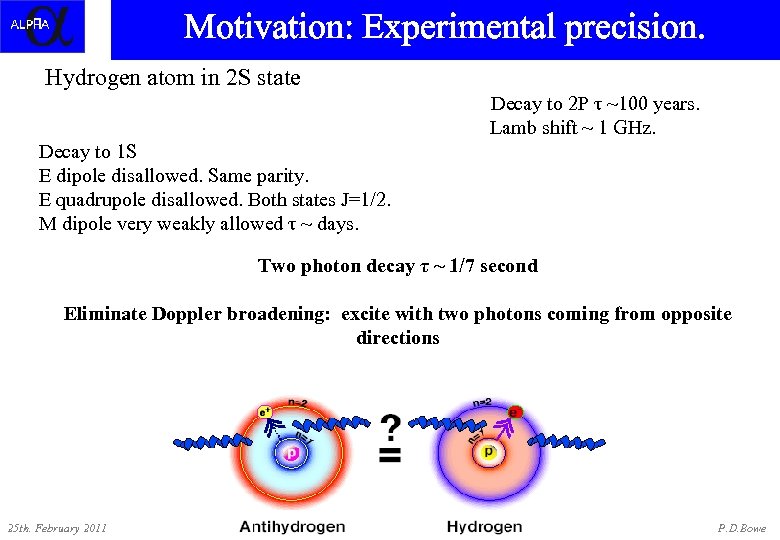
Motivation: Experimental precision. Hydrogen atom in 2 S state Decay to 2 P τ ~100 years. Lamb shift ~ 1 GHz. Decay to 1 S E dipole disallowed. Same parity. E quadrupole disallowed. Both states J=1/2. M dipole very weakly allowed τ ~ days. Two photon decay τ ~ 1/7 second Eliminate Doppler broadening: excite with two photons coming from opposite directions 25 th. February 2011 CERN Detector Seminar P. D. Bowe
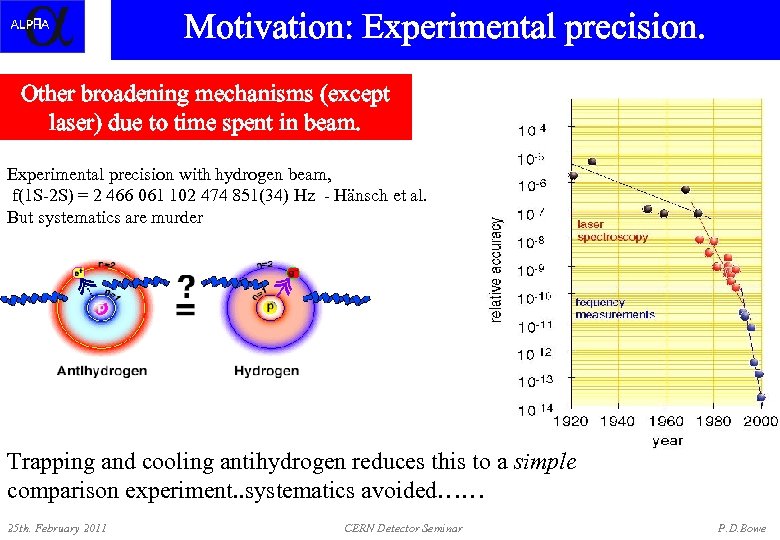
Motivation: Experimental precision. Other broadening mechanisms (except laser) due to time spent in beam. Experimental precision with hydrogen beam, f(1 S-2 S) = 2 466 061 102 474 851(34) Hz - Hänsch et al. But systematics are murder Trapping and cooling antihydrogen reduces this to a simple comparison experiment. . systematics avoided…… 25 th. February 2011 CERN Detector Seminar P. D. Bowe
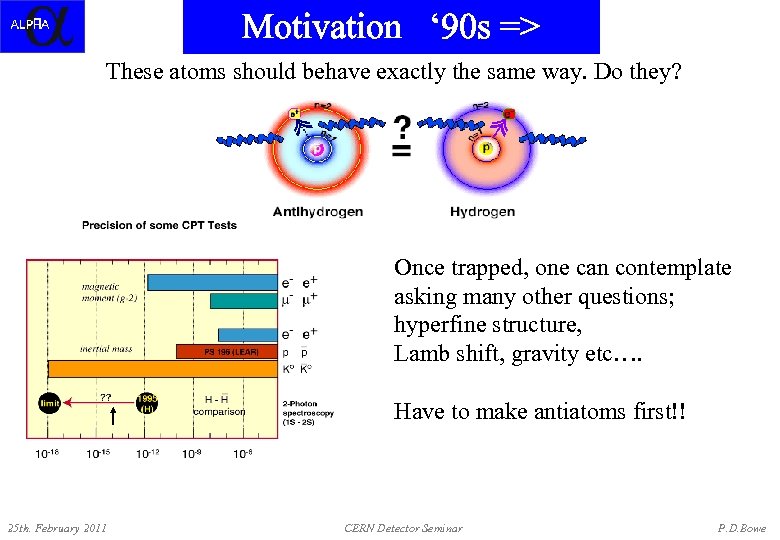
Motivation ‘ 90 s => CPT tests These atoms should behave exactly the same way. Do they? Once trapped, one can contemplate asking many other questions; hyperfine structure, Lamb shift, gravity etc…. Have to make antiatoms first!! 25 th. February 2011 CERN Detector Seminar P. D. Bowe
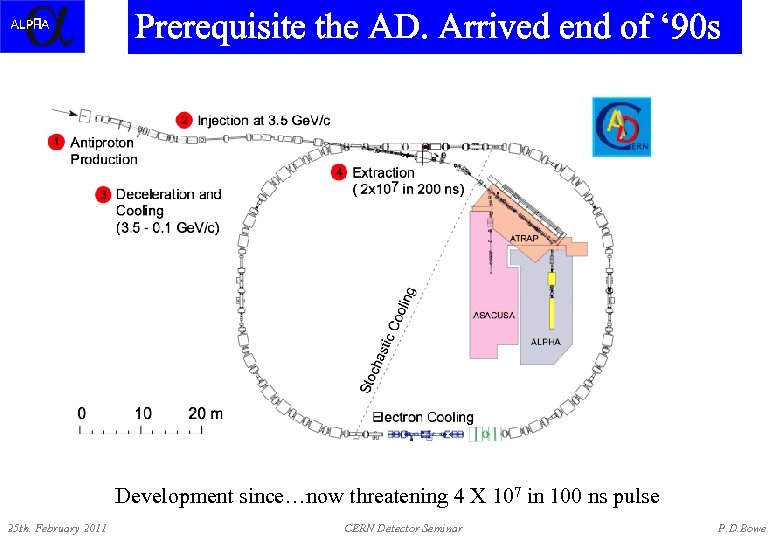
Prerequisite CPT tests the AD. Arrived end of ‘ 90 s Development since…now threatening 4 X 10⁷ in 100 ns pulse 25 th. February 2011 CERN Detector Seminar P. D. Bowe
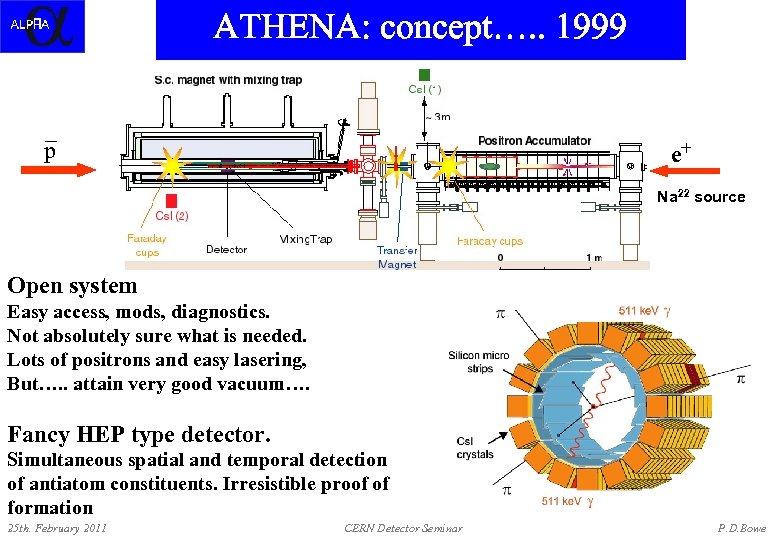
ATHENA: concept…. . 1999 _ p e+ Na 22 source Open system Easy access, mods, diagnostics. Not absolutely sure what is needed. Lots of positrons and easy lasering, But…. . attain very good vacuum…. Fancy HEP type detector. Simultaneous spatial and temporal detection of antiatom constituents. Irresistible proof of formation 25 th. February 2011 CERN Detector Seminar P. D. Bowe
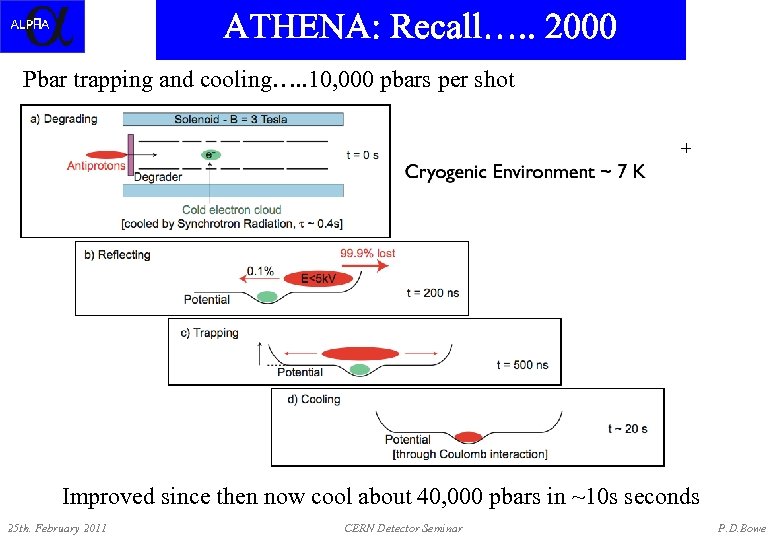
ATHENA: Recall…. . 2000 Pbar trapping and cooling…. . 10, 000 pbars per shot _ + Improved since then now cool about 40, 000 pbars in ~10 s seconds 25 th. February 2011 CERN Detector Seminar P. D. Bowe
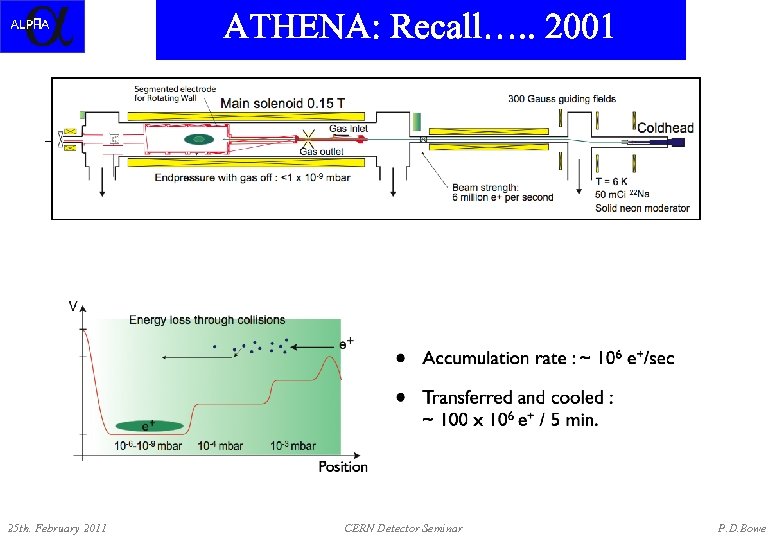
ATHENA: Recall…. . 2001 _ 25 th. February 2011 + CERN Detector Seminar P. D. Bowe
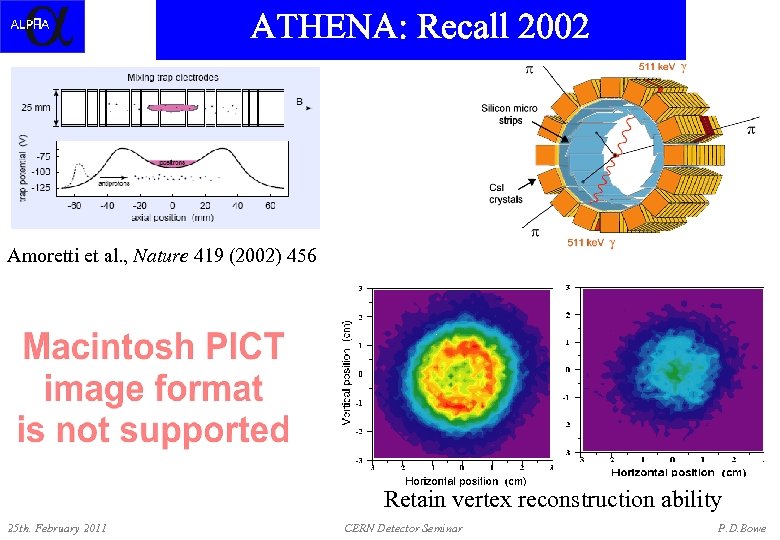
ATHENA: Recall 2002 Amoretti et al. , Nature 419 (2002) 456 Retain vertex reconstruction ability 25 th. February 2011 CERN Detector Seminar P. D. Bowe
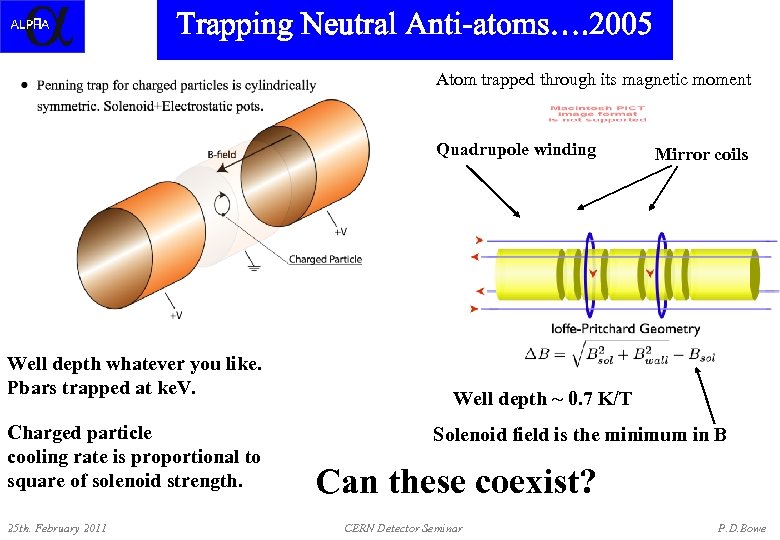
Trapping Neutral Anti-atoms? Trapping. Neutral Anti-atoms…. 2005 Atom trapped through its magnetic moment Quadrupole winding Well depth whatever you like. Pbars trapped at ke. V. Charged particle cooling rate is proportional to square of solenoid strength. 25 th. February 2011 Mirror coils Well depth ~ 0. 7 K/T Solenoid field is the minimum in B Can these coexist? CERN Detector Seminar P. D. Bowe
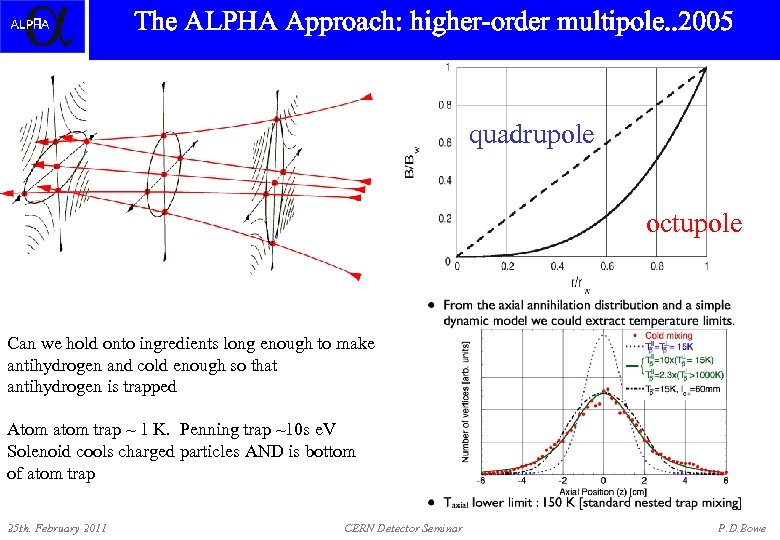
The ALPHA Approach: higher-order multipole. . 2005 quadrupole octupole Can we hold onto ingredients long enough to make antihydrogen and cold enough so that antihydrogen is trapped Atom atom trap ~ 1 K. Penning trap ~10 s e. V Solenoid cools charged particles AND is bottom of atom trap 25 th. February 2011 CERN Detector Seminar P. D. Bowe
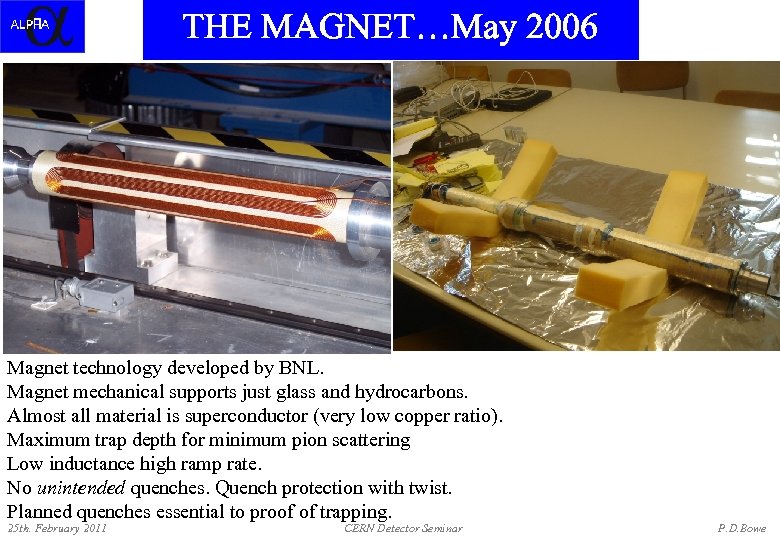
THE MAGNET…May 2006 Trap Magnet Prototype Magnet technology developed by BNL. Magnet mechanical supports just glass and hydrocarbons. Almost all material is superconductor (very low copper ratio). Maximum trap depth for minimum pion scattering Low inductance high ramp rate. No unintended quenches. Quench protection with twist. Planned quenches essential to proof of trapping. 25 th. February 2011 CERN Detector Seminar P. D. Bowe
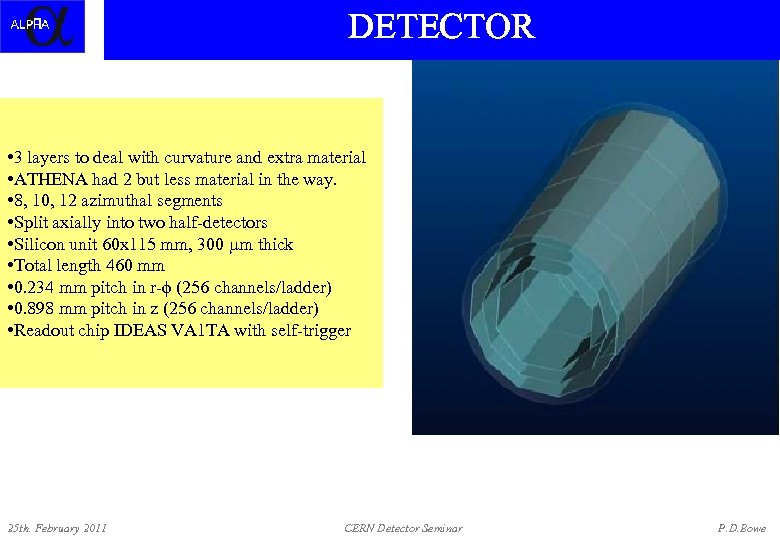
DETECTOR Detector Conceptual Drawing • 3 layers to deal with curvature and extra material • ATHENA had 2 but less material in the way. • 8, 10, 12 azimuthal segments • Split axially into two half-detectors • Silicon unit 60 x 115 mm, 300 m thick • Total length 460 mm • 0. 234 mm pitch in r- (256 channels/ladder) • 0. 898 mm pitch in z (256 channels/ladder) • Readout chip IDEAS VA 1 TA with self-trigger 25 th. February 2011 CERN Detector Seminar P. D. Bowe
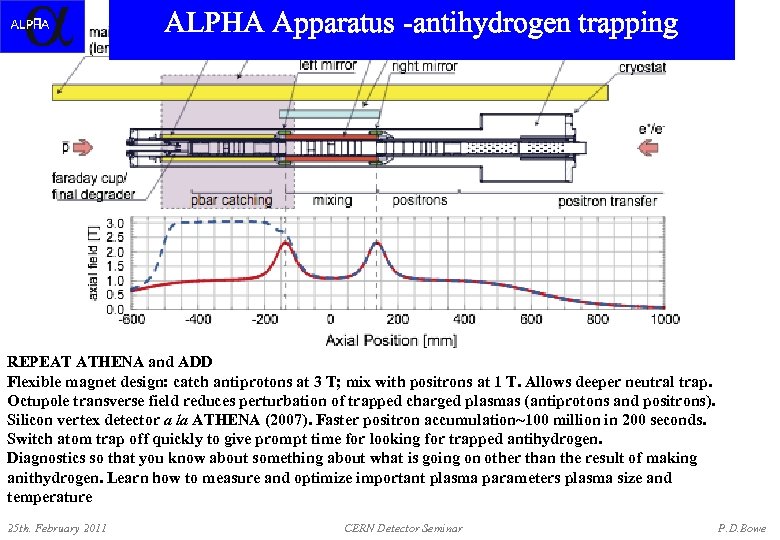
ALPHA Apparatus -antihydrogen trapping REPEAT ATHENA and ADD Flexible magnet design: catch antiprotons at 3 T; mix with positrons at 1 T. Allows deeper neutral trap. Octupole transverse field reduces perturbation of trapped charged plasmas (antiprotons and positrons). Silicon vertex detector a la ATHENA (2007). Faster positron accumulation~100 million in 200 seconds. Switch atom trap off quickly to give prompt time for looking for trapped antihydrogen. Diagnostics so that you know about something about what is going on other than the result of making anithydrogen. Learn how to measure and optimize important plasma parameters plasma size and temperature 25 th. February 2011 CERN Detector Seminar P. D. Bowe
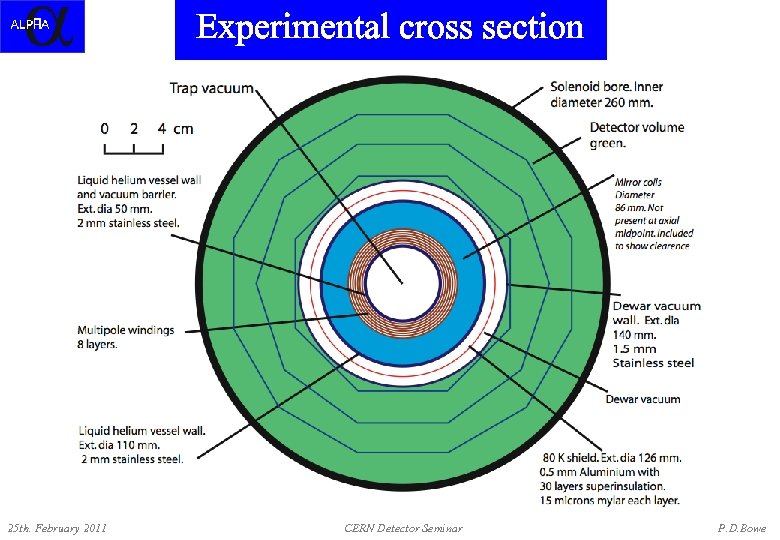
Experimental cross section Apparatus Cross Section 25 th. February 2011 CERN Detector Seminar P. D. Bowe
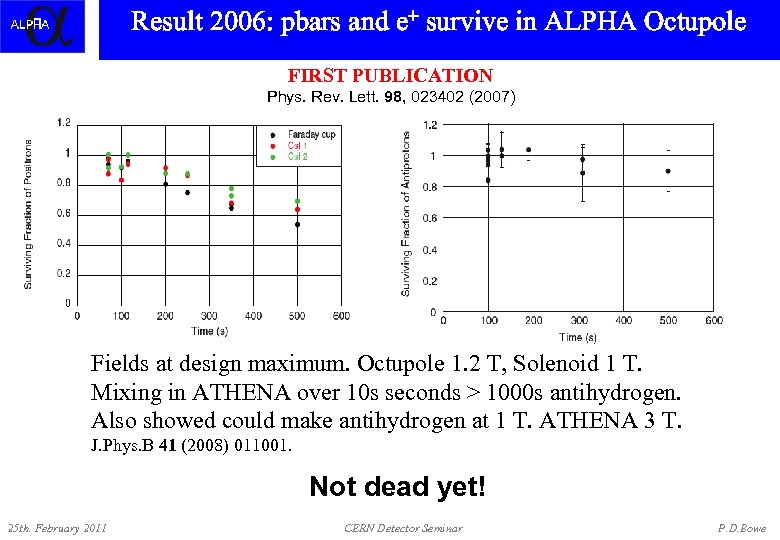
Result 2006: pbars ALPHA Octupole and e+ survive in ALPHA Positrons in FIRST PUBLICATION Phys. Rev. Lett. 98, 023402 (2007) Fields at design maximum. Octupole 1. 2 T, Solenoid 1 T. Mixing in ATHENA over 10 s seconds > 1000 s antihydrogen. Also showed could make antihydrogen at 1 T. ATHENA 3 T. J. Phys. B 41 (2008) 011001. Not dead yet! 25 th. February 2011 CERN Detector Seminar P. D. Bowe
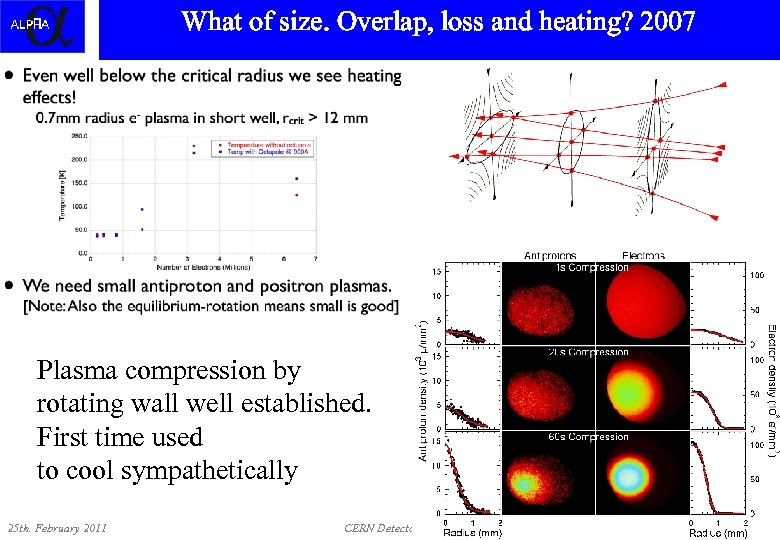
What of size. ALPHA and heating? Positrons in. Overlap, loss. Octupole 2007 Plasma compression by rotating wall well established. First time used to cool sympathetically 25 th. February 2011 CERN Detector Seminar P. D. Bowe
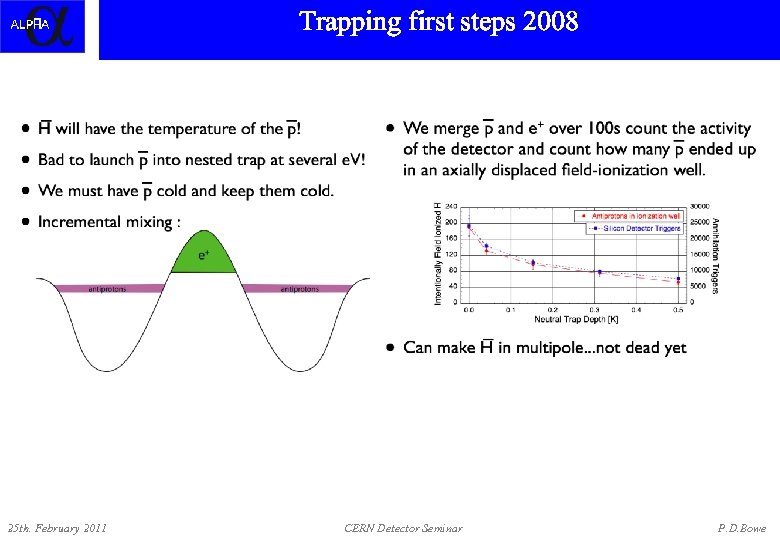
Positrons Trapping first steps 2008 in ALPHA Octupole 25 th. February 2011 CERN Detector Seminar P. D. Bowe
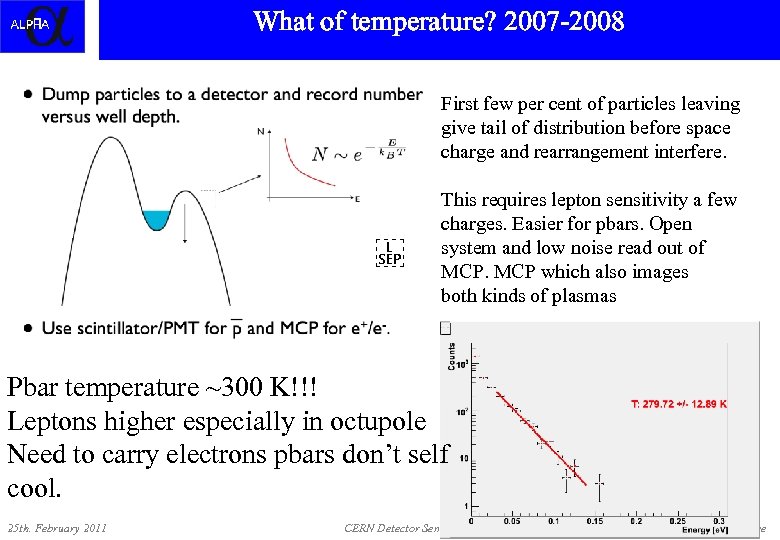
What of temperature? 2007 -2008 Positrons in ALPHA Octupole First few per cent of particles leaving give tail of distribution before space charge and rearrangement interfere. This requires lepton sensitivity a few charges. Easier for pbars. Open system and low noise read out of MCP which also images both kinds of plasmas Pbar temperature ~300 K!!! Leptons higher especially in octupole Need to carry electrons pbars don’t self cool. 25 th. February 2011 CERN Detector Seminar P. D. Bowe
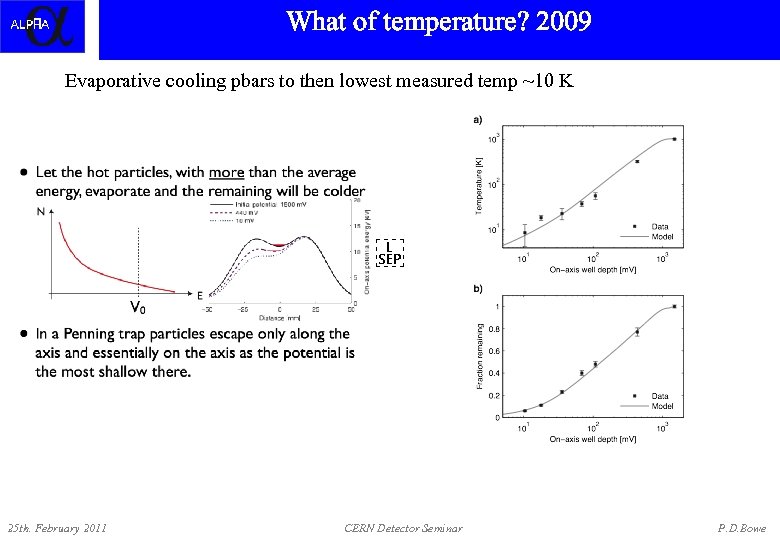
What of temperature? 2009 Positrons in ALPHA Octupole Evaporative cooling pbars to then lowest measured temp ~10 K 25 th. February 2011 CERN Detector Seminar P. D. Bowe
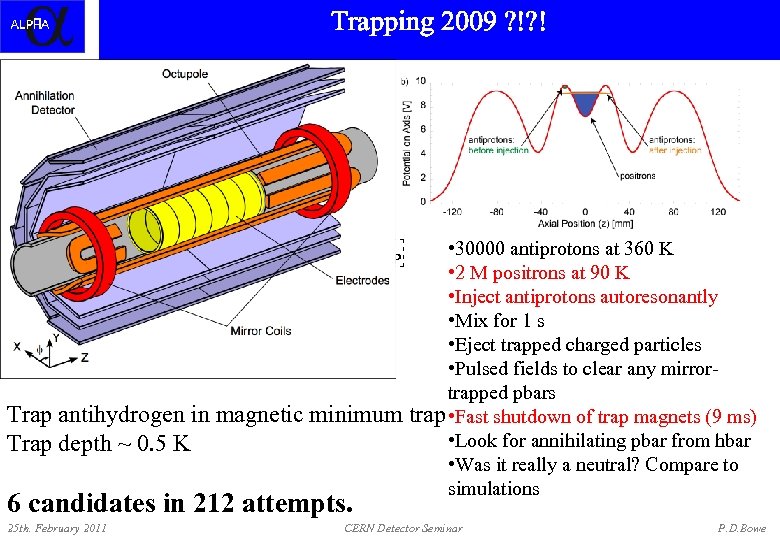
Positrons in. Trapping 2009 ? !? ! ALPHA Octupole • 30000 antiprotons at 360 K • 2 M positrons at 90 K • Inject antiprotons autoresonantly • Mix for 1 s • Eject trapped charged particles • Pulsed fields to clear any mirrortrapped pbars Trap antihydrogen in magnetic minimum trap • Fast shutdown of trap magnets (9 ms) • Look for annihilating pbar from hbar Trap depth ~ 0. 5 K • Was it really a neutral? Compare to simulations 6 candidates in 212 attempts. 25 th. February 2011 CERN Detector Seminar P. D. Bowe
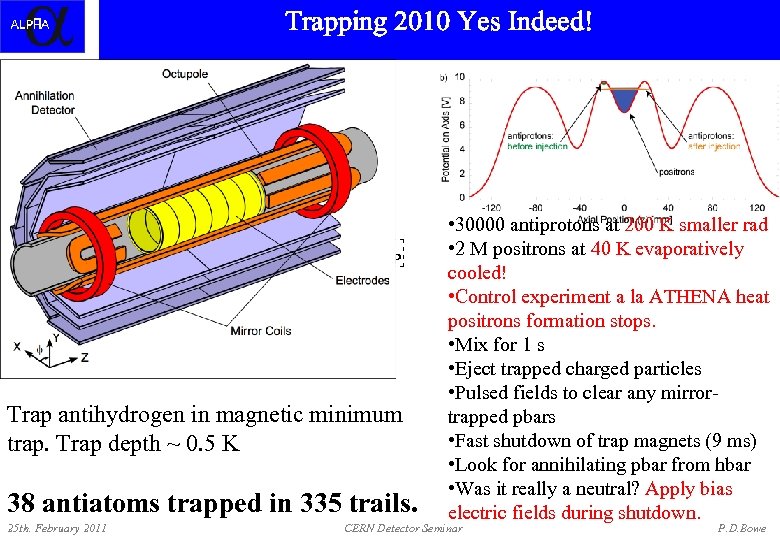
Trapping 2010 Yes Indeed! Positrons in ALPHA Octupole Trap antihydrogen in magnetic minimum trap. Trap depth ~ 0. 5 K 38 antiatoms trapped in 335 trails. 25 th. February 2011 • 30000 antiprotons at 200 K smaller rad • 2 M positrons at 40 K evaporatively cooled! • Control experiment a la ATHENA heat positrons formation stops. • Mix for 1 s • Eject trapped charged particles • Pulsed fields to clear any mirrortrapped pbars • Fast shutdown of trap magnets (9 ms) • Look for annihilating pbar from hbar • Was it really a neutral? Apply bias electric fields during shutdown. CERN Detector Seminar P. D. Bowe
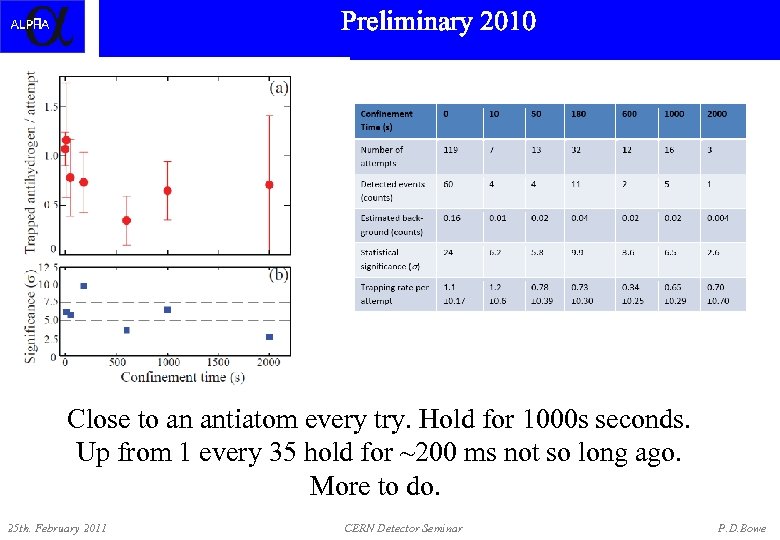
Positrons in Preliminary Octupole ALPHA 2010 Close to an antiatom every try. Hold for 1000 s seconds. Up from 1 every 35 hold for ~200 ms not so long ago. More to do. 25 th. February 2011 CERN Detector Seminar P. D. Bowe
Plenty ALPHA and beyond. Positrons into do in 2011 Octupole Thank you for your interest! 25 th. February 2011 CERN Detector Seminar P. D. Bowe
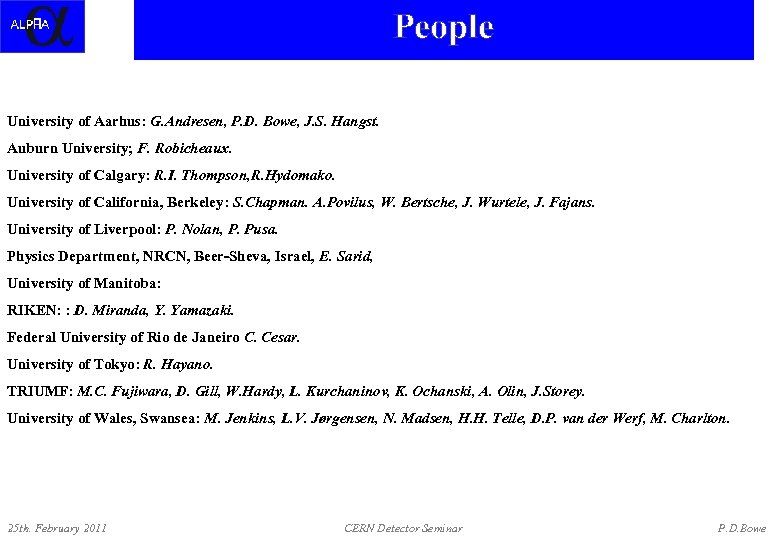
People University of Aarhus: G. Andresen, P. D. Bowe, J. S. Hangst. Auburn University; F. Robicheaux. University of Calgary: R. I. Thompson, R. Hydomako. University of California, Berkeley: S. Chapman. A. Povilus, W. Bertsche, J. Wurtele, J. Fajans. University of Liverpool: P. Nolan, P. Pusa. Physics Department, NRCN, Beer-Sheva, Israel, E. Sarid, University of Manitoba: RIKEN: : D. Miranda, Y. Yamazaki. Federal University of Rio de Janeiro C. Cesar. University of Tokyo: R. Hayano. TRIUMF: M. C. Fujiwara, D. Gill, W. Hardy, L. Kurchaninov, K. Ochanski, A. Olin, J. Storey. University of Wales, Swansea: M. Jenkins, L. V. Jørgensen, N. Madsen, H. H. Telle, D. P. van der Werf, M. Charlton. 25 th. February 2011 CERN Detector Seminar P. D. Bowe
Скачать презентацию ALPHA ANTIHYDROGEN TRAPPED Paul D Bowe University of
053f807602a73a5af8aadfe695ede161.ppt