


 Скачать презентацию Almaty state humanitarian teacher s training college 2 Using
Teaching English through the songs.pptx
- Количество слайдов: 28
 Almaty state humanitarian teacher’s training college 2 Using songs in teaching in primary English school Uzeeva Nuriya Group: FL-47 Almaty 2012
 Aim: To illustrate advantages of using songs in process of teaching English in primary school.
 The objectives: q 1) to examine teaching resources on this issue; q 2) to explore the literature on a variety of technologies; q 3) to examine the peculiarities of song material for teaching English language in primary school; q 4) to introduce a collection of song material for English classes in primary school; q 5) to reveal the results of practice in teaching English through the songs.
 q"Music is one of the most effective means to influence the feelings and emotions of students, which is a “strong psychological stimulus” (V. Levy)
 q. In the humanization of education in the Republic of Kazakhstan, where the identity of the growing person is in the centre of all educational and developing activities, the search for effective ways of learning a foreign language attracts attention of many scientists, trainers and teachers.
 “Instead of the teacher of concrete subject the teacher of a new formation should come, the teacher who knows modern pedagogical technologies and means of informatization of education” notioned in the Conception of development of education in RK
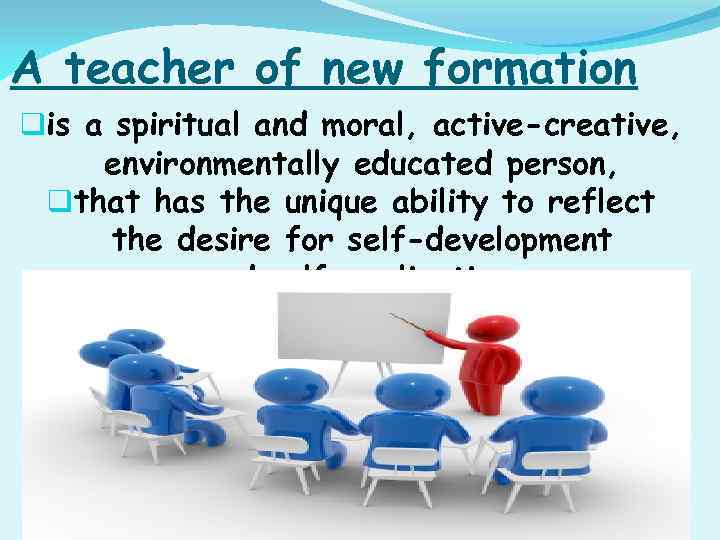 A teacher of new formation qis a spiritual and moral, active-creative, environmentally educated person, qthat has the unique ability to reflect the desire for self-development and self-realization.
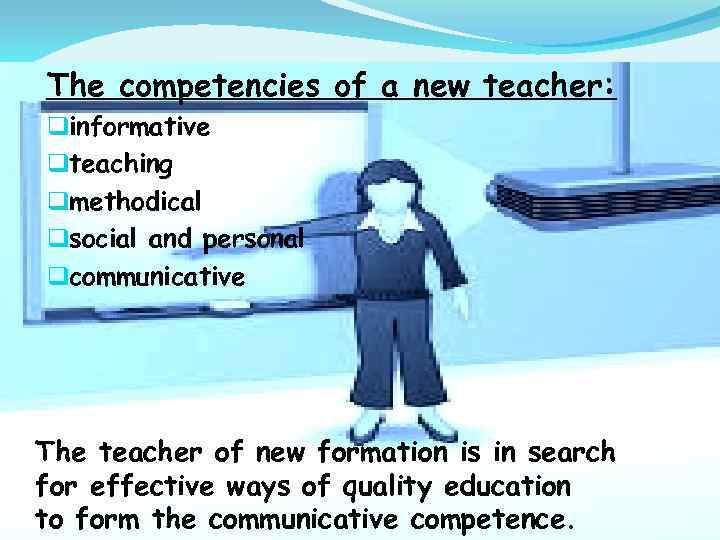 The competencies of a new teacher: qinformative qteaching qmethodical qsocial and personal qcommunicative The teacher of new formation is in search for effective ways of quality education to form the communicative competence.
 q. One of such efficient ways of communication technology – is using songs in teaching English in a primary school.
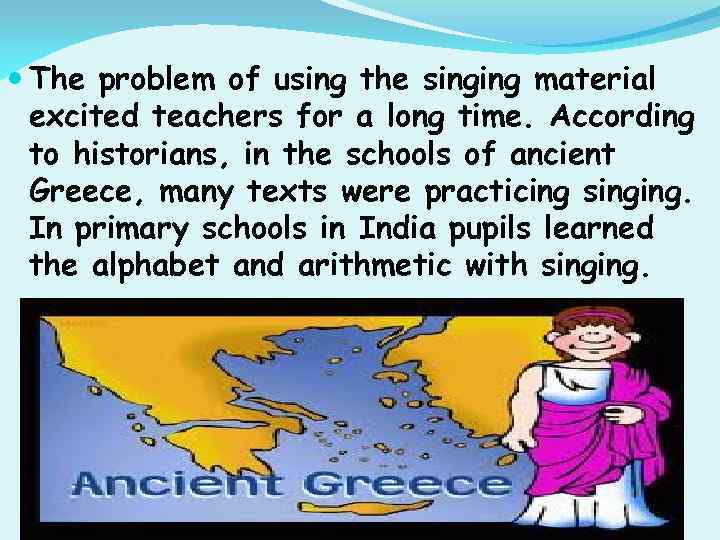 The problem of using the singing material excited teachers for a long time. According to historians, in the schools of ancient Greece, many texts were practicing singing. In primary schools in India pupils learned the alphabet and arithmetic with singing.
 The reasons of teaching English through Songs: 1) Most children love singing 2) Singing helps raise children’s self-confidence 3) Children are relaxed when singing 4) Music makes it easier to remember language 5) Songs are ideal for learning stress, rhythm, intonation, or sound patterns
 The use of song material at the lessons of English has a number of advantages: q - The songs are better absorbed and activate grammar. q - The songs contribute to the improvement of foreign language pronunciation skills. q - Songs promote aesthetic education, team building, a more complete disclosure of the creative abilities of each. q - Songs and other musical works stimulate monologue and dialogue speech.
 Music is element of each human society. It shows many aspects of its culture the relationship to the past and the ancestors, the faith, the fun and the anxieties of its people, the hopes and the view of the future. Music has immanent powers, for example it gives people energy or music can change people’s mood. So teachers use the song at the lesson of English learning in primary school.
 Working on a song can be divided into several areas: Ø Ø Ø -grammar; -phonetic; -vocabulary; -regional studies; -kind of relaxation;
 The criteria for song selection: qsong should motivate and give pleasure; qentry should correspond to the age of students; qsong should match the level of preparedness of the group; qsong should have the right rhythm; qsong should not be long; qperformer of the song should have a clear pronunciation; q. If possible, the song should be perfect for organizing and training exercises.
 There are some methods to use the songs of teaching English at primary school: 1. 2. 3. 4. 5. 6. 7. Songs by lines. Tell them story. Singing cards. Mixed words. Missing words. Choose the title. Two variants.
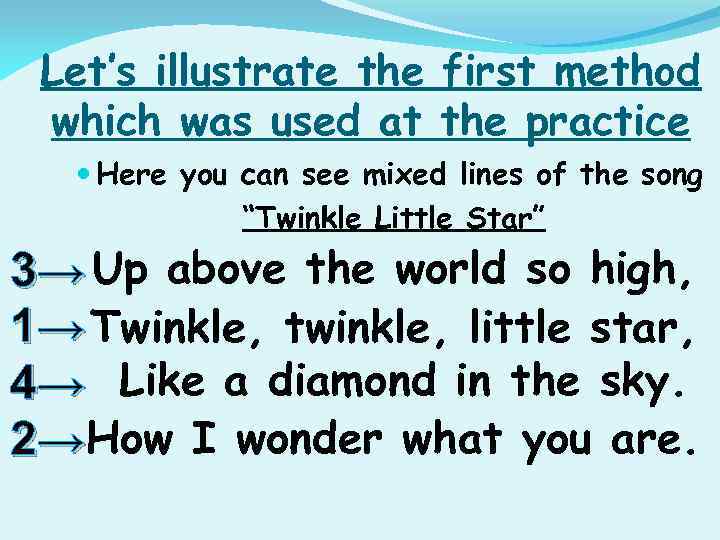 Let’s illustrate the first method which was used at the practice Here you can see mixed lines of the song “Twinkle Little Star” 3→ Up above the world so high, 1→ Twinkle, twinkle, little star, 4→ Like a diamond in the sky. 2→How I wonder what you are.
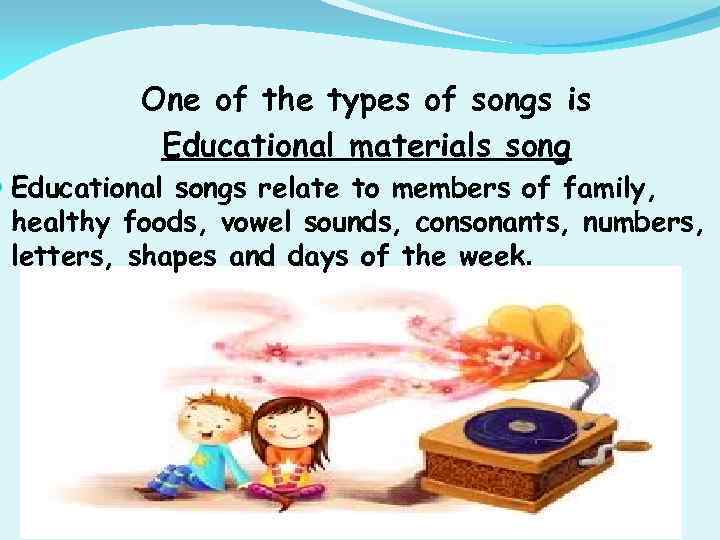 One of the types of songs is Educational materials song Educational songs relate to members of family, healthy foods, vowel sounds, consonants, numbers, letters, shapes and days of the week.
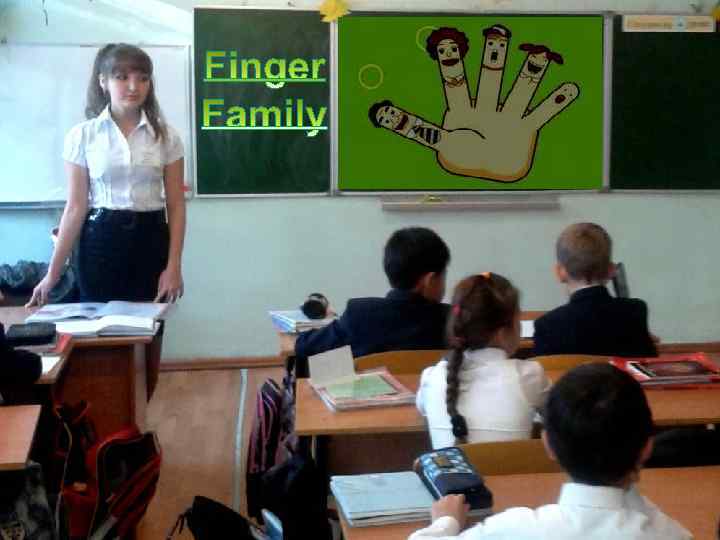
 The educational song: “Finger Family” Objectives: q. To form the ability to comprehend the meaning of the words. q. To form the ability to guess the words in a context. q. To form the ability to say family members.
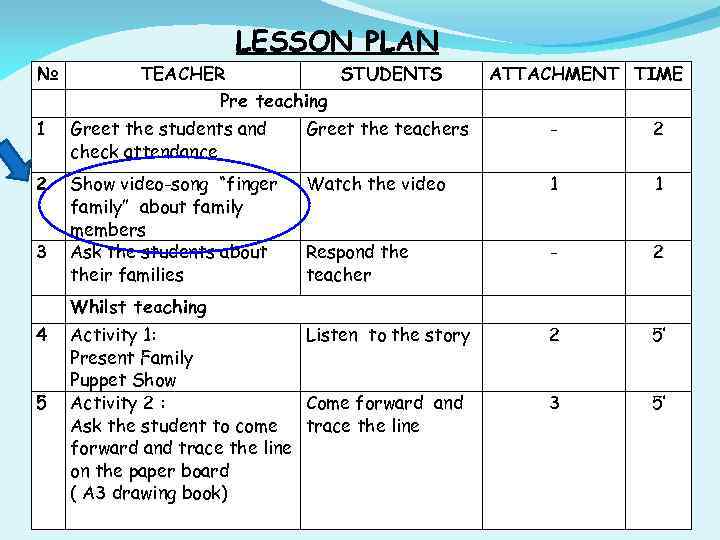 LESSON PLAN № TEACHER STUDENTS ATTACHMENT TIME Pre teaching 1 Greet the students and check attendance Greet the teachers - 2 2 Show video-song “finger family” about family members Ask the students about their families Watch the video 1 1 Respond the teacher - 2 2 5’ 3 Whilst teaching 4 5 Activity 1: Listen to the story Present Family Puppet Show Activity 2 : Come forward and Ask the student to come trace the line forward and trace the line on the paper board ( A 3 drawing book)
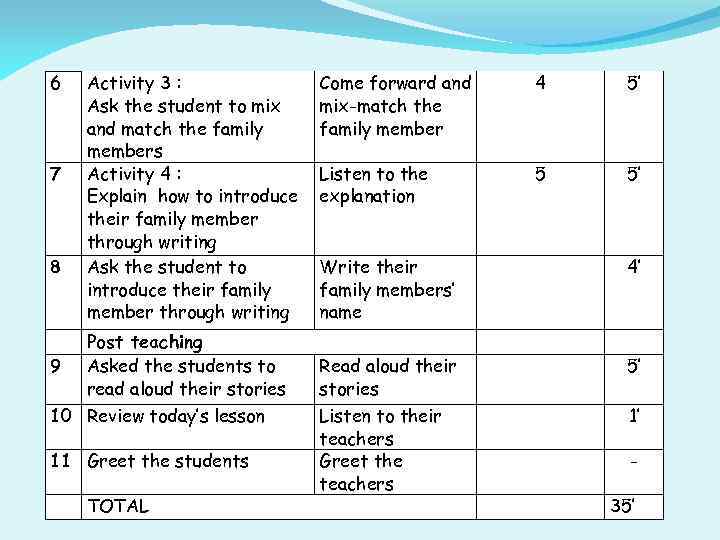 6 7 8 9 Activity 3 : Ask the student to mix and match the family members Activity 4 : Explain how to introduce their family member through writing Ask the student to introduce their family member through writing Post teaching Asked the students to read aloud their stories 10 Review today’s lesson 11 Greet the students TOTAL Come forward and mix-match the family member 4 5’ Listen to the explanation 5 5’ Write their family members’ name 4’ Read aloud their stories 5’ Listen to their teachers Greet the teachers 1’ 35’
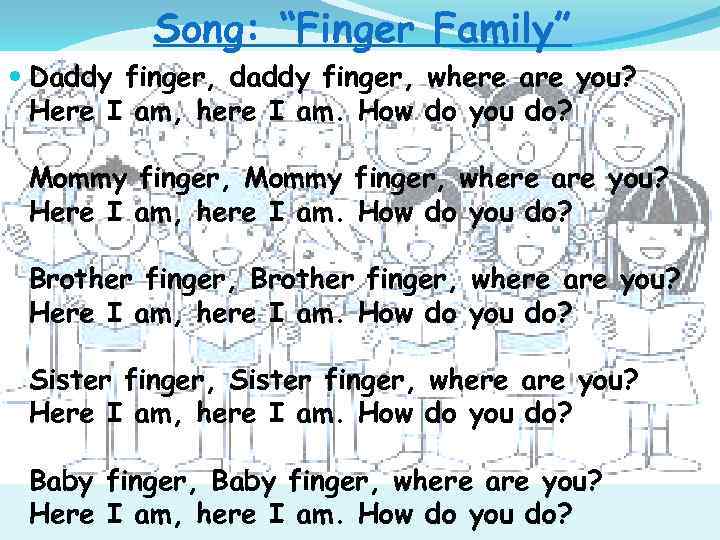 Song: “Finger Family” Daddy finger, daddy finger, where are you? Here I am, here I am. How do you do? Mommy finger, where are you? Here I am, here I am. How do you do? Brother finger, where are you? Here I am, here I am. How do you do? Sister finger, where are you? Here I am, here I am. How do you do? Baby finger, where are you? Here I am, here I am. How do you do?
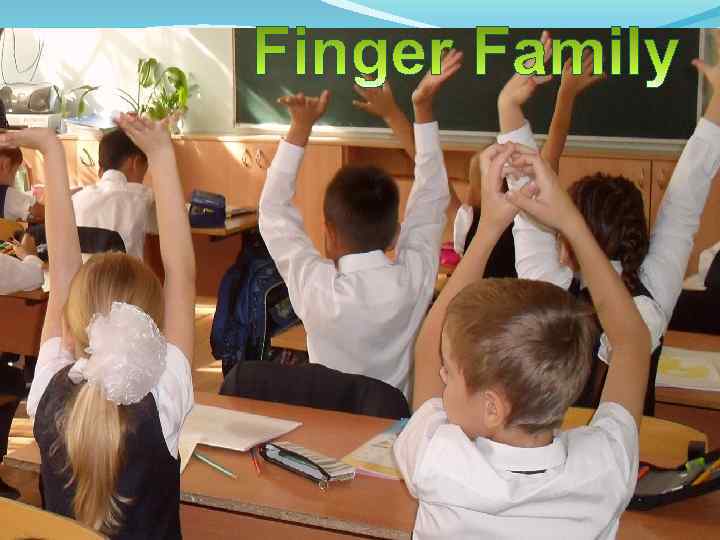
 After singing we see that the song “Finger Family” Is an excellent way for children to: qlearn to listen carefully – with a real purpose qlearn and memorise words and phrases qdevelop familiarity with the sounds, rhythms and stress of English language.
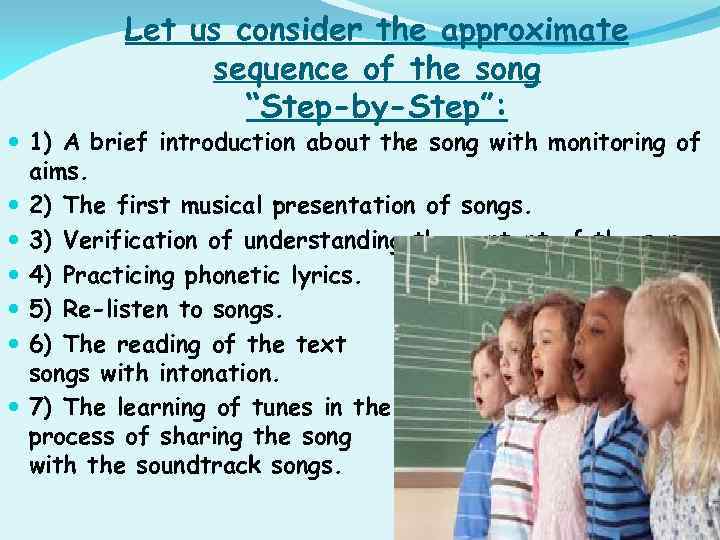 Let us consider the approximate sequence of the song “Step-by-Step”: 1) A brief introduction about the song with monitoring of aims. 2) The first musical presentation of songs. 3) Verification of understanding the content of the song. 4) Practicing phonetic lyrics. 5) Re-listen to songs. 6) The reading of the text songs with intonation. 7) The learning of tunes in the process of sharing the song with the soundtrack songs.
 To all, the teacher should always approach their work creatively, should be very interested in what he does, because the whole learning process depends primarily on the teacher. We can get better results of studying English in primary school using the songs in the process of teaching, because children study with great pleasure and interest the progress of the lesson that uses the song!
 Thank You for attention!