 Скачать презентацию ALMA MATER STUDIORUM UNIVERSITY of BOLOGNA School
f47375dfed98ecff0662f9df4541d970.ppt
- Количество слайдов: 32



ALMA MATER STUDIORUM – UNIVERSITY of BOLOGNA School of Economics, Management and Statistics in Forlì IP course “SUSTAINABLE REFURBISHMENT, RETROFIT, ENERGY MANAGEMENT IN HOUSING” SMEs and Networking in Project Management for Building Refurbishment and new Technologies for Energy Saving VGTU – 12. 04. 2013 Laura Tampieri - laura. tampieri@unibo. it
Agenda ØNetworking ØProject Management for Building Refurbishment ØNew Technologies for Energy Saving
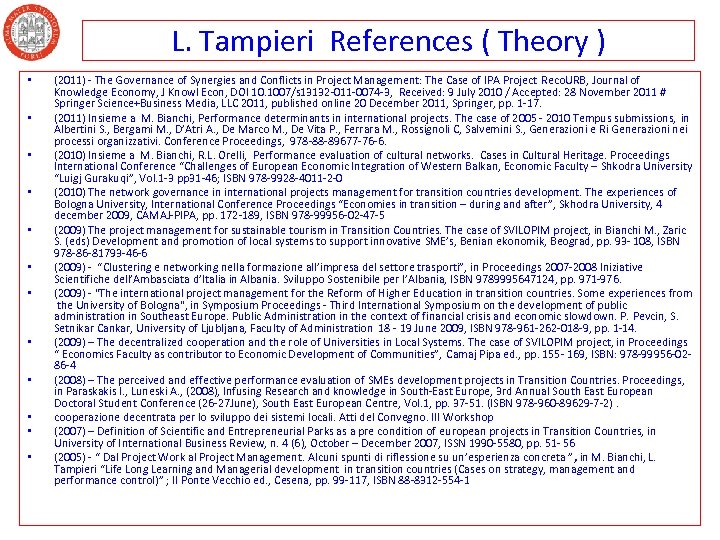
L. Tampieri References ( Theory ) • • • (2011) - The Governance of Synergies and Conflicts in Project Management: The Case of IPA Project Reco. URB, Journal of Knowledge Economy, J Knowl Econ, DOI 10. 1007/s 13132 -011 -0074 -3, Received: 9 July 2010 / Accepted: 28 November 2011 # Springer Science+Business Media, LLC 2011, published online 20 December 2011, Springer, pp. 1 -17. (2011) Insieme a M. Bianchi, Performance determinants in international projects. The case of 2005 - 2010 Tempus submissions, in Albertini S. , Bergami M. , D’Atri A. , De Marco M. , De Vita P. , Ferrara M. , Rossignoli C, Salvemini S. , Generazioni e Ri Generazioni nei processi organizzativi. Conference Proceedings, 978 -88 -89677 -76 -6. (2010) Insieme a M. Bianchi, R. L. Orelli, Performance evaluation of cultural networks. Cases in Cultural Heritage. Proceedings International Conference “Challenges of European Economic Integration of Western Balkan, Economic Faculty – Shkodra University “Luigj Gurakuqi”, Vol. 1 -3 pp 31 -46; ISBN 978 -9928 -4011 -2 -0 (2010) The network governance in international projects management for transition countries development. The experiences of Bologna University, International Conference Proceedings “Economies in transition – during and after”, Skhodra University, 4 december 2009, CAMAJ-PIPA, pp. 172 -189, ISBN 978 -99956 -02 -47 -5 (2009) The project management for sustainable tourism in Transition Countries. The case of SVILOPIM project, in Bianchi M. , Zaric S. (eds) Development and promotion of local systems to support innovative SME’s, Benian ekonomik, Beograd, pp. 93 - 108, ISBN 978 -86 -81793 -46 -6 (2009) - “Clustering e networking nella formazione all’impresa del settore trasporti”, in Proceedings 2007 -2008 Iniziative Scientifiche dell’Ambasciata d’Italia in Albania. Sviluppo Sostenibile per l’Albania, ISBN 9789995647124, pp. 971 -976. (2009) - "The international project management for the Reform of Higher Education in transition countries. Some experiences from the University of Bologna", in Symposium Proceedings - Third International Symposium on the development of public administration in Southeast Europe. Public Administration in the context of financial crisis and economic slowdown. P. Pevcin, S. Setnikar Cankar, University of Ljubljana, Faculty of Administration 18 - 19 June 2009, ISBN 978 -961 -262 -018 -9, pp. 1 -14. (2009) – The decentralized cooperation and the role of Universities in Local Systems. The case of SVILOPIM project, in Proceedings “ Economics Faculty as contributor to Economic Development of Communities”, Camaj Pipa ed. , pp. 155 - 169, ISBN: 978 -99956 -0286 -4 (2008) – The perceived and effective performance evaluation of SMEs development projects in Transition Countries. Proceedings, in Paraskakis I. , Luneski A. , (2008), Infusing Research and knowledge in South-East Europe, 3 rd Annual South East European Doctoral Student Conference (26 -27 June), South East European Centre, Vol. 1, pp. 37 -51. (ISBN 978 -960 -89629 -7 -2). cooperazione decentrata per lo sviluppo dei sistemi locali. Atti del Convegno. III Workshop (2007) – Definition of Scientific and Entrepreneurial Parks as a pre condition of european projects in Transition Countries, in University of International Business Review, n. 4 (6), October – December 2007, ISSN 1990 -5580, pp. 51 - 56 (2005) - “ Dal Project Work al Project Management. Alcuni spunti di riflessione su un’esperienza concreta ”, in M. Bianchi, L. Tampieri “Life Long Learning and Managerial development in transition countries (Cases on strategy, management and performance control)” ; Il Ponte Vecchio ed. , Cesena, pp. 99 -117, ISBN 88 -8312 -554 -1
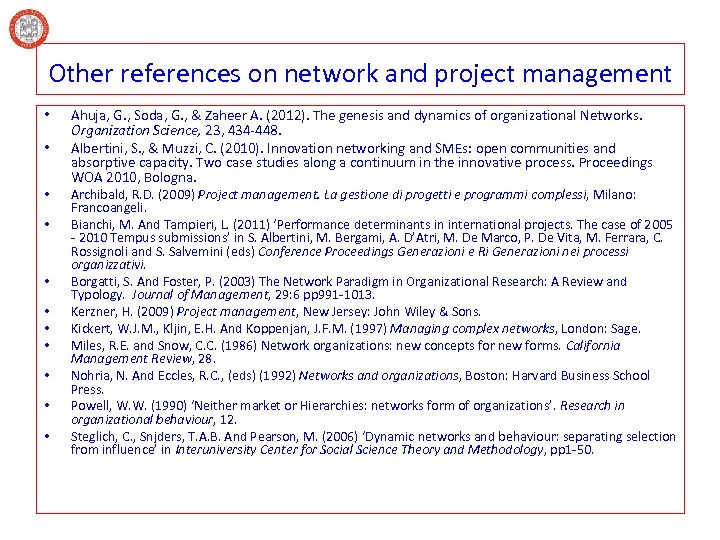
Other references on network and project management • • • Ahuja, G. , Soda, G. , & Zaheer A. (2012). The genesis and dynamics of organizational Networks. Organization Science, 23, 434 -448. Albertini, S. , & Muzzi, C. (2010). Innovation networking and SMEs: open communities and absorptive capacity. Two case studies along a continuum in the innovative process. Proceedings WOA 2010, Bologna. Archibald, R. D. (2009) Project management. La gestione di progetti e programmi complessi, Milano: Francoangeli. Bianchi, M. And Tampieri, L. (2011) ‘Performance determinants in international projects. The case of 2005 - 2010 Tempus submissions’ in S. Albertini, M. Bergami, A. D’Atri, M. De Marco, P. De Vita, M. Ferrara, C. Rossignoli and S. Salvemini (eds) Conference Proceedings Generazioni e Ri Generazioni nei processi organizzativi. Borgatti, S. And Foster, P. (2003) The Network Paradigm in Organizational Research: A Review and Typology. Journal of Management, 29: 6 pp 991 -1013. Kerzner, H. (2009) Project management, New Jersey: John Wiley & Sons. Kickert, W. J. M. , Kljin, E. H. And Koppenjan, J. F. M. (1997) Managing complex networks, London: Sage. Miles, R. E. and Snow, C. C. (1986) Network organizations: new concepts for new forms. California Management Review, 28. Nohria, N. And Eccles, R. C. , (eds) (1992) Networks and organizations, Boston: Harvard Business School Press. Powell, W. W. (1990) ‘Neither market or Hierarchies: networks form of organizations’. Research in organizational behaviour, 12. Steglich, C. , Snjders, T. A. B. And Pearson, M. (2006) ‘Dynamic networks and behaviour: separating selection from influence’ in Interuniversity Center for Social Science Theory and Methodology, pp 1 -50.
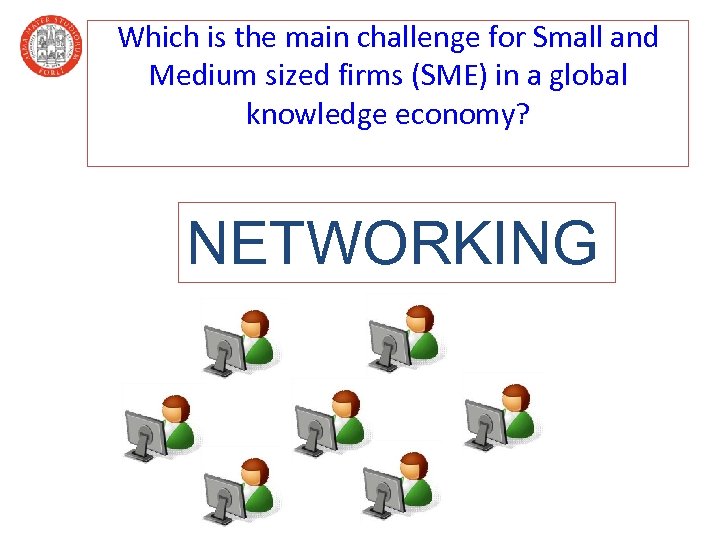
Which is the main challenge for Small and Medium sized firms (SME) in a global knowledge economy? NETWORKING
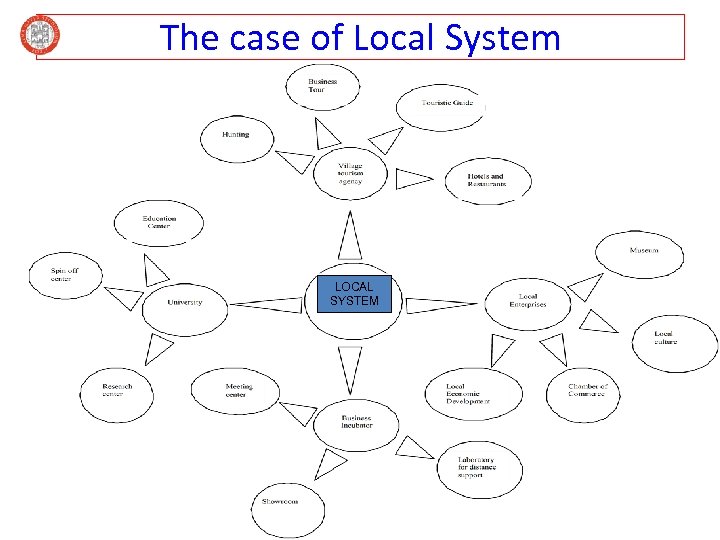
The case of Local System LOCAL SYSTEM
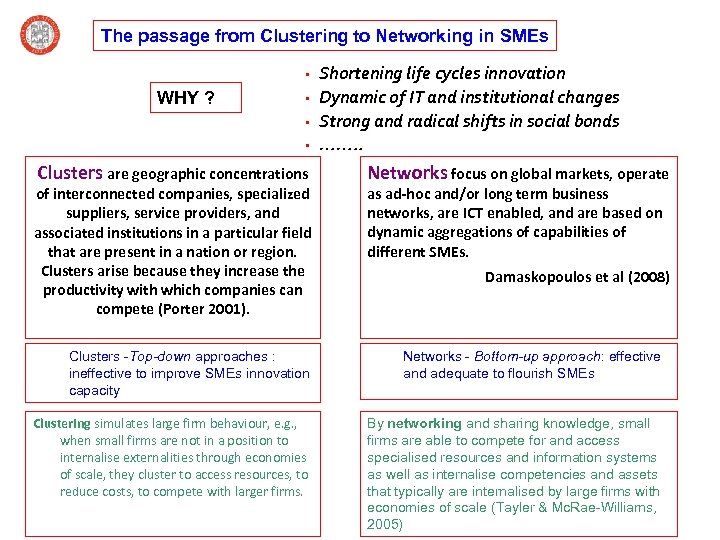
The passage from Clustering to Networking in SMEs • WHY ? • • • Clusters are geographic concentrations of interconnected companies, specialized suppliers, service providers, and associated institutions in a particular field that are present in a nation or region. Clusters arise because they increase the productivity with which companies can compete (Porter 2001). Shortening life cycles innovation Dynamic of IT and institutional changes Strong and radical shifts in social bonds ……. . Networks focus on global markets, operate as ad-hoc and/or long term business networks, are ICT enabled, and are based on dynamic aggregations of capabilities of different SMEs. Damaskopoulos et al (2008) Clusters -Top-down approaches : ineffective to improve SMEs innovation capacity Networks - Bottom-up approach: effective and adequate to flourish SMEs Clustering simulates large firm behaviour, e. g. , when small firms are not in a position to internalise externalities through economies of scale, they cluster to access resources, to reduce costs, to compete with larger firms. By networking and sharing knowledge, small firms are able to compete for and access specialised resources and information systems as well as internalise competencies and assets that typically are internalised by large firms with economies of scale (Tayler & Mc. Rae-Williams, 2005)
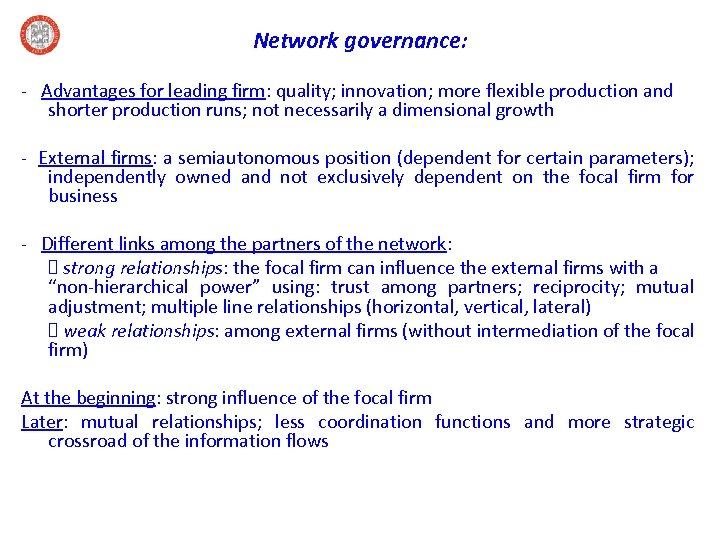
Network governance: - Advantages for leading firm: quality; innovation; more flexible production and shorter production runs; not necessarily a dimensional growth - External firms: a semiautonomous position (dependent for certain parameters); independently owned and not exclusively dependent on the focal firm for business - Different links among the partners of the network: strong relationships: the focal firm can influence the external firms with a “non-hierarchical power” using: trust among partners; reciprocity; mutual adjustment; multiple line relationships (horizontal, vertical, lateral) weak relationships: among external firms (without intermediation of the focal firm) At the beginning: strong influence of the focal firm Later: mutual relationships; less coordination functions and more strategic crossroad of the information flows
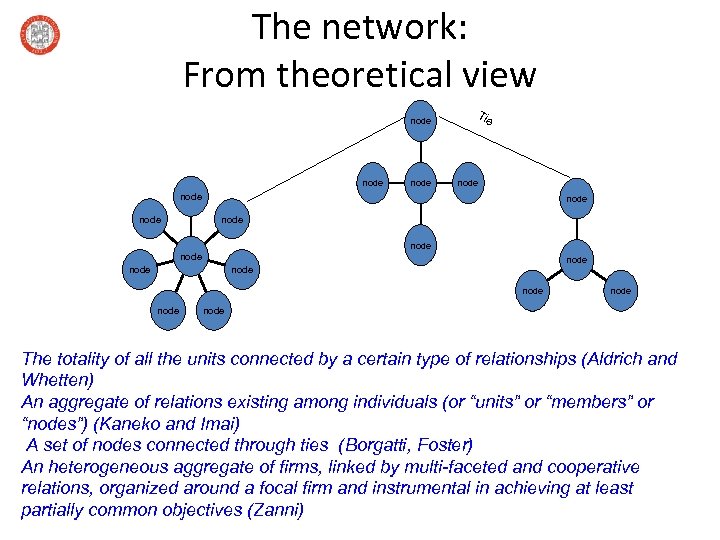
The network: From theoretical view node Tie node node node node The totality of all the units connected by a certain type of relationships (Aldrich and Whetten) An aggregate of relations existing among individuals (or “units” or “members” or “nodes”) (Kaneko and Imai) A set of nodes connected through ties (Borgatti, Foster) An heterogeneous aggregate of firms, linked by multi-faceted and cooperative relations, organized around a focal firm and instrumental in achieving at least partially common objectives (Zanni)
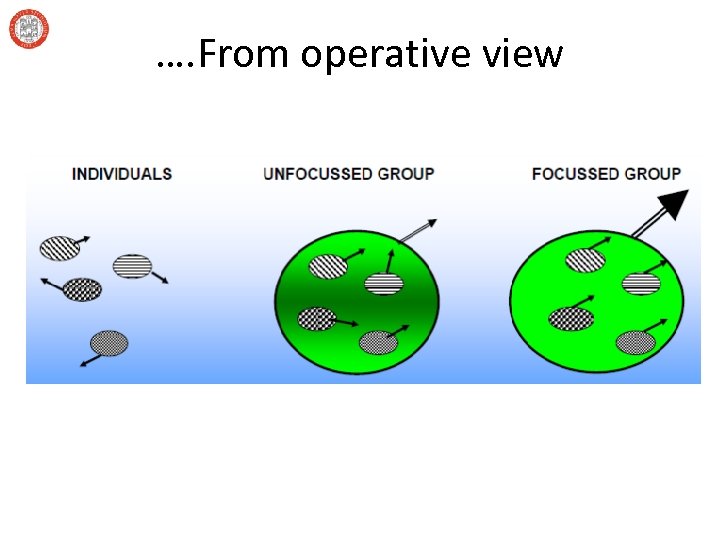
…. From operative view
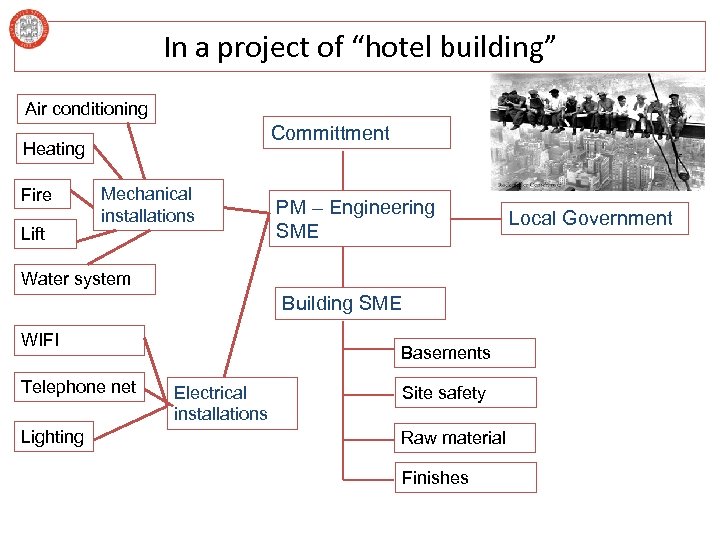
In a project of “hotel building” Air conditioning Committment Heating Fire Lift Mechanical installations PM – Engineering SME Water system Building SME WIFI Telephone net Lighting Basements Electrical installations Site safety Raw material Finishes Local Government
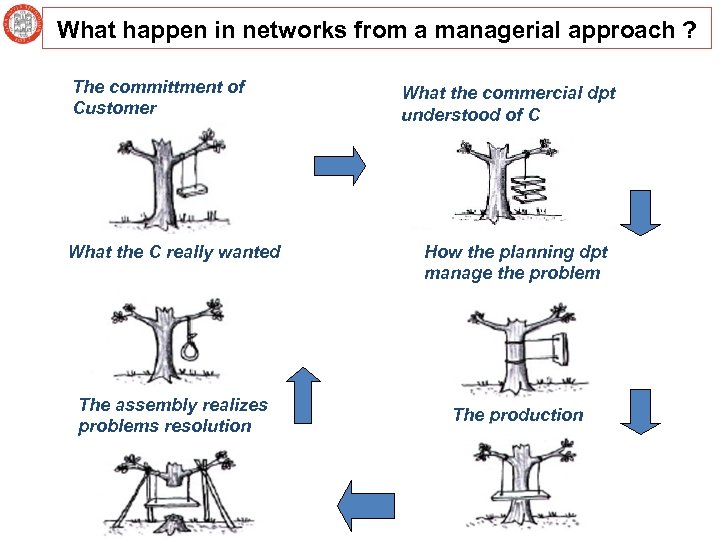
What happen in networks from a managerial approach ? The committment of Customer What the C really wanted The assembly realizes problems resolution What the commercial dpt understood of C How the planning dpt manage the problem The production
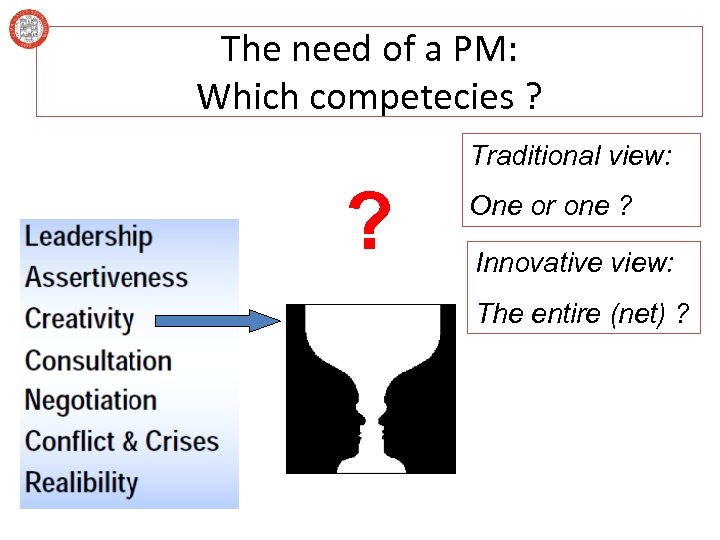
The need of a PM: Which competecies ? Traditional view: ? One or one ? Innovative view: The entire (net) ?
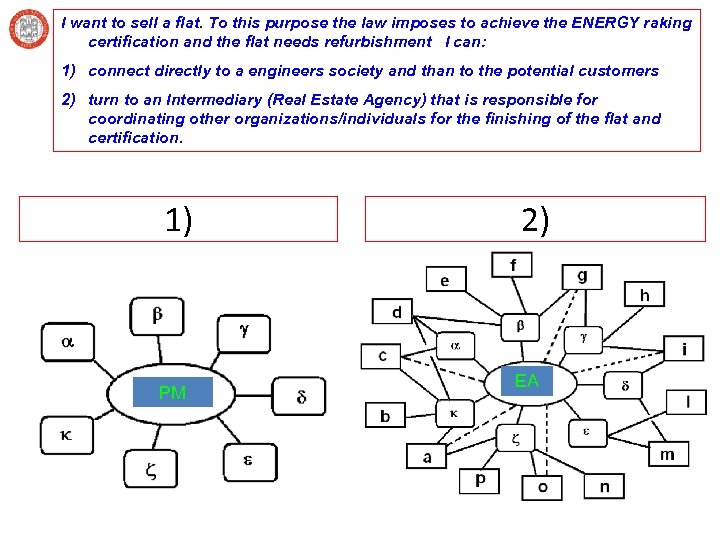
I want to sell a flat. To this purpose the law imposes to achieve the ENERGY raking certification and the flat needs refurbishment I can: 1) connect directly to a engineers society and than to the potential customers 2) turn to an Intermediary (Real Estate Agency) that is responsible for coordinating other organizations/individuals for the finishing of the flat and certification. 1) PM 2) EA
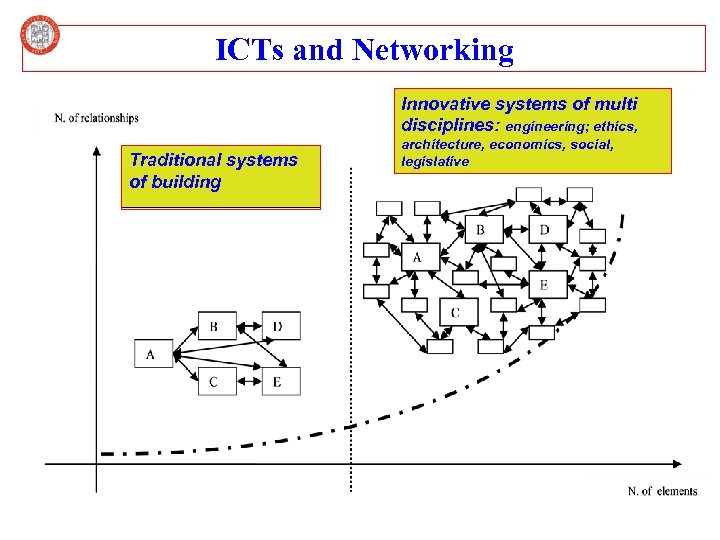
ICTs and Networking Innovative systems of multi disciplines: engineering; ethics, Traditional systems of building architecture, economics, social, legislative
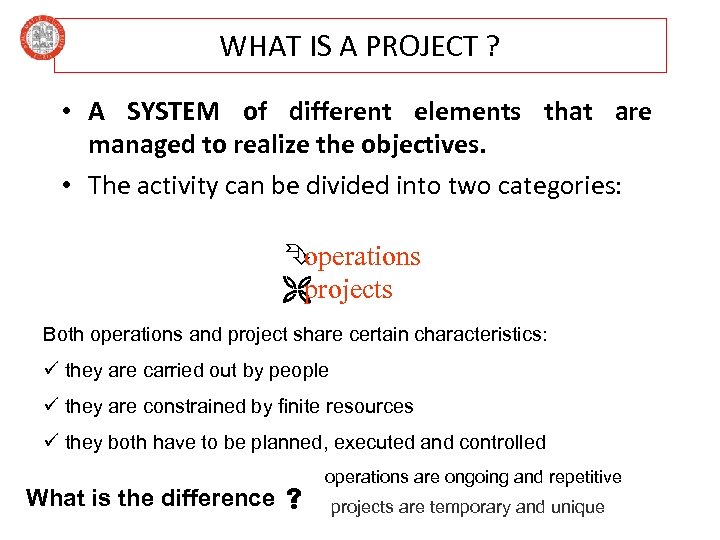
WHAT IS A PROJECT ? • A SYSTEM of different elements that are managed to realize the objectives. • The activity can be divided into two categories: Ê operations Ë projects Both operations and project share certain characteristics: ü they are carried out by people ü they are constrained by finite resources ü they both have to be planned, executed and controlled What is the difference operations are ongoing and repetitive projects are temporary and unique
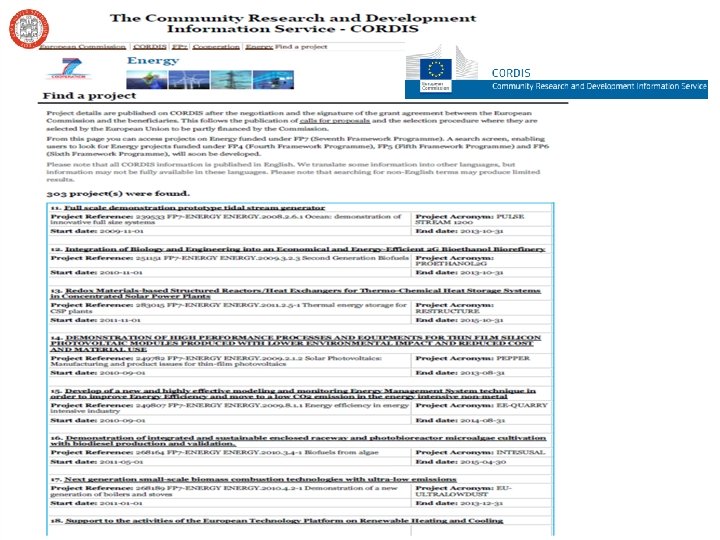
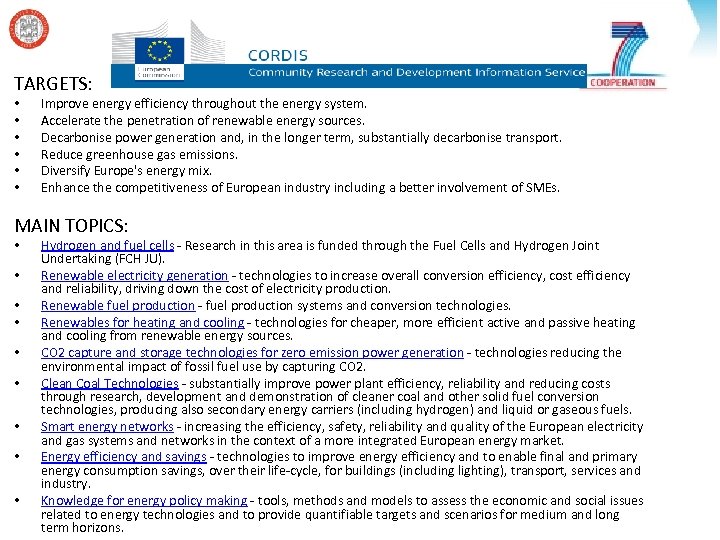
TARGETS: • • • Improve energy efficiency throughout the energy system. Accelerate the penetration of renewable energy sources. Decarbonise power generation and, in the longer term, substantially decarbonise transport. Reduce greenhouse gas emissions. Diversify Europe's energy mix. Enhance the competitiveness of European industry including a better involvement of SMEs. MAIN TOPICS: • • • Hydrogen and fuel cells - Research in this area is funded through the Fuel Cells and Hydrogen Joint Undertaking (FCH JU). Renewable electricity generation - technologies to increase overall conversion efficiency, cost efficiency and reliability, driving down the cost of electricity production. Renewable fuel production - fuel production systems and conversion technologies. Renewables for heating and cooling - technologies for cheaper, more efficient active and passive heating and cooling from renewable energy sources. CO 2 capture and storage technologies for zero emission power generation - technologies reducing the environmental impact of fossil fuel use by capturing CO 2. Clean Coal Technologies - substantially improve power plant efficiency, reliability and reducing costs through research, development and demonstration of cleaner coal and other solid fuel conversion technologies, producing also secondary energy carriers (including hydrogen) and liquid or gaseous fuels. Smart energy networks - increasing the efficiency, safety, reliability and quality of the European electricity and gas systems and networks in the context of a more integrated European energy market. Energy efficiency and savings - technologies to improve energy efficiency and to enable final and primary energy consumption savings, over their life-cycle, for buildings (including lighting), transport, services and industry. Knowledge for energy policy making - tools, methods and models to assess the economic and social issues related to energy technologies and to provide quantifiable targets and scenarios for medium and long term horizons.
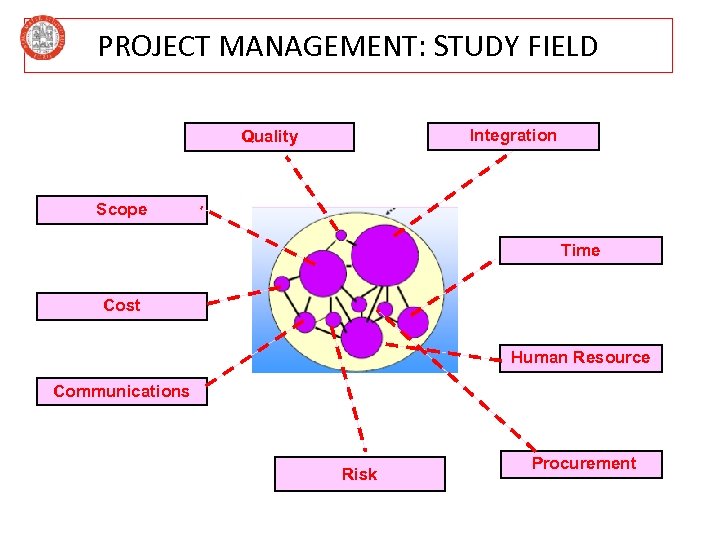
PROJECT MANAGEMENT: STUDY FIELD Integration Quality Scope Time Cost Human Resource Communications Risk Procurement
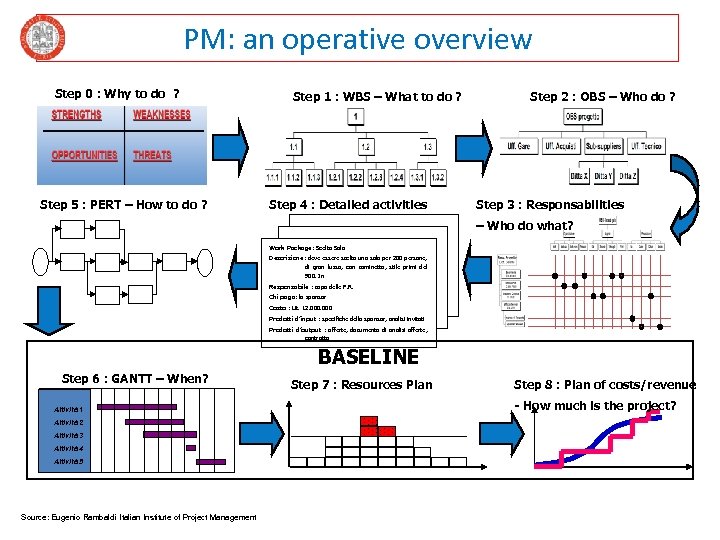
PM: an operative overview Step 0 : Why to do ? Step 5 : PERT – How to do ? Step 1 : WBS – What to do ? Step 4 : Detailed activities Step 2 : OBS – Who do ? Step 3 : Responsabilities – Who do what? Work Package: Scelta Sala Descrizione: deve essere scelta una sala per 200 persone, di gran lusso, con caminetto, stile primi del 900. In Responsabile : capo delle P. R. Chi paga: lo sponsor Costo : Lit. 12. 000 Prodotti d’input : specifiche dello sponsor, analisi invitati Prodotti d’output : offerte, documento di analisi offerte, contratto BASELINE Step 6 : GANTT – When? Attività 1 Attività 2 Attività 3 Attività 4 Attività 5 Source: Eugenio Rambaldi Italian Institute of Project Management Step 7 : Resources Plan Step 8 : Plan of costs/revenue - How much is the project?
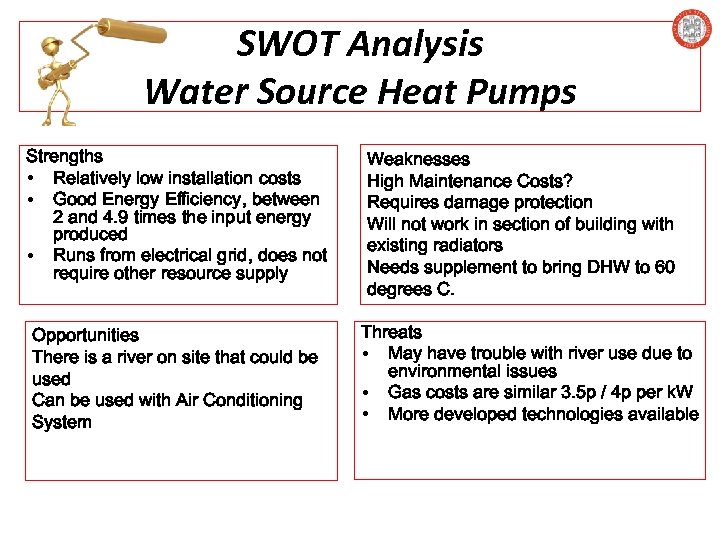
SWOT Analysis Water Source Heat Pumps Strengths • Relatively low installation costs • Good Energy Efficiency, between 2 and 4. 9 times the input energy produced • Runs from electrical grid, does not require other resource supply Opportunities There is a river on site that could be used Can be used with Air Conditioning System Weaknesses High Maintenance Costs? Requires damage protection Will not work in section of building with existing radiators Needs supplement to bring DHW to 60 degrees C. Threats • May have trouble with river use due to environmental issues • Gas costs are similar 3. 5 p / 4 p per k. W • More developed technologies available
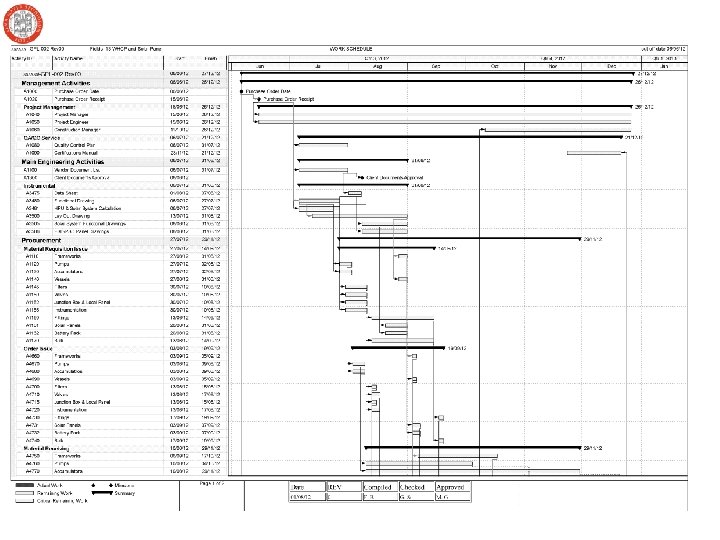

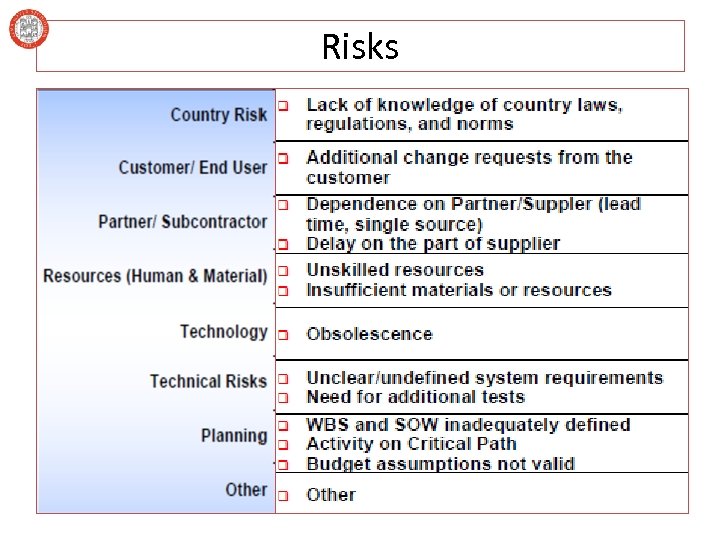
Risks
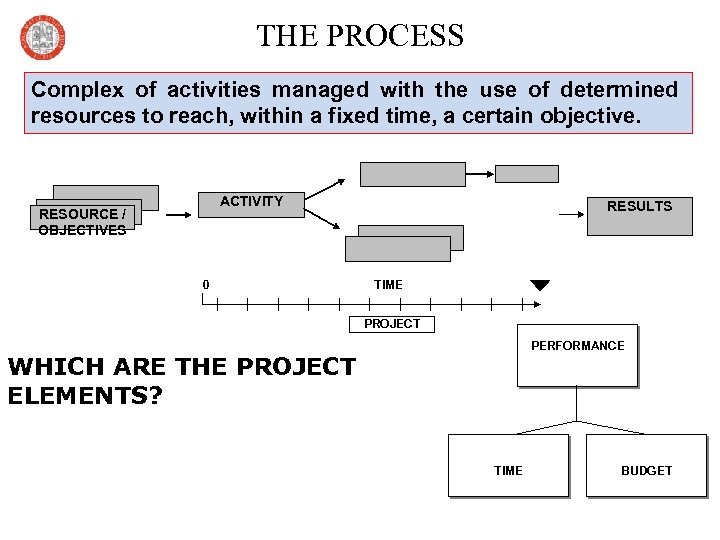
THE PROCESS Complex of activities managed with the use of determined resources to reach, within a fixed time, a certain objective. ACTIVITY RESOURCE / OBJECTIVES 0 RESULTS TIME PROJECT PERFORMANCE WHICH ARE THE PROJECT ELEMENTS? TIME BUDGET
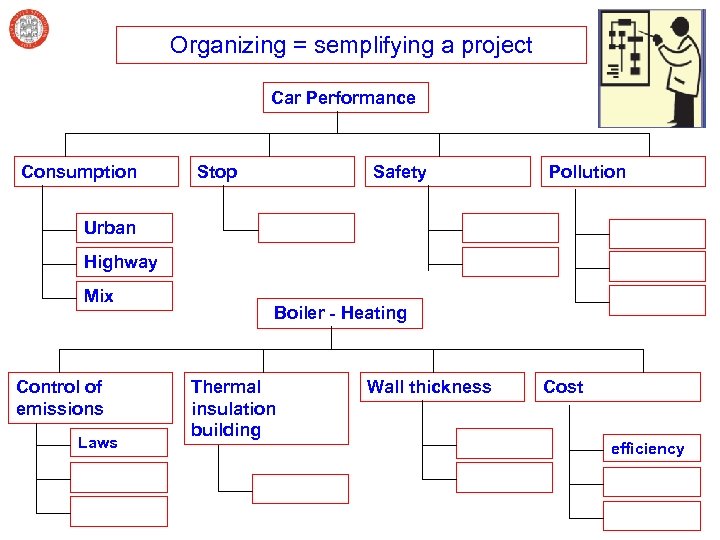
Organizing = semplifying a project Car Performance Consumption Stop Safety Pollution Urban Highway Mix Control of emissions Laws Boiler - Heating Thermal insulation building Wall thickness Cost efficiency
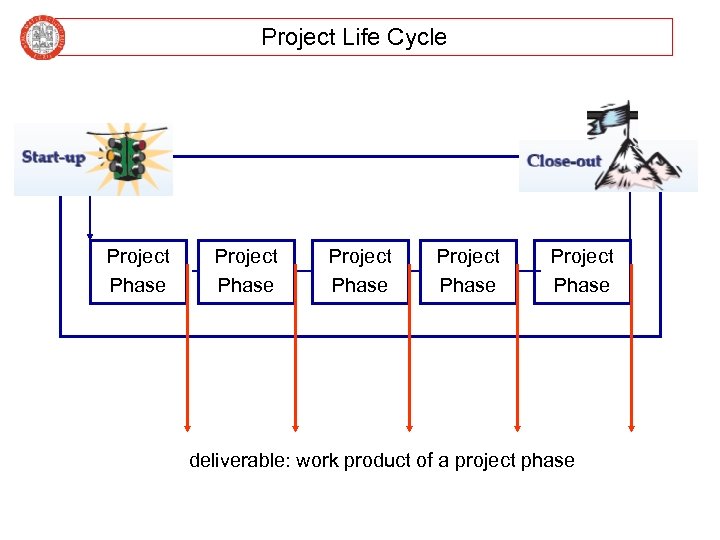
Project Life Cycle Initiation Project Phase Conclusion Project Phase deliverable: work product of a project phase
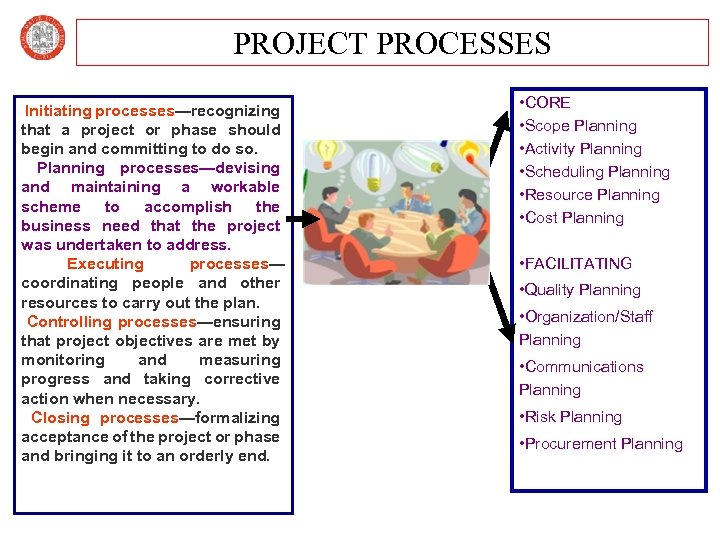
PROJECT PROCESSES Initiating processes—recognizing that a project or phase should begin and committing to do so. Planning processes—devising and maintaining a workable scheme to accomplish the business need that the project was undertaken to address. Executing processes— coordinating people and other resources to carry out the plan. Controlling processes—ensuring that project objectives are met by monitoring and measuring progress and taking corrective action when necessary. Closing processes—formalizing acceptance of the project or phase and bringing it to an orderly end. • CORE • Scope Planning • Activity Planning • Scheduling Planning • Resource Planning • Cost Planning • FACILITATING • Quality Planning • Organization/Staff Planning • Communications Planning • Risk Planning • Procurement Planning
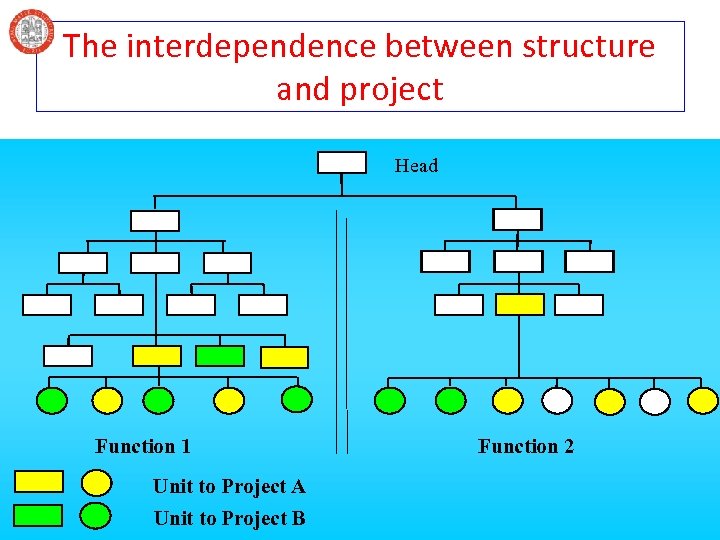
The interdependence between structure and project Head Function 1 Unit to Project A Unit to Project B Function 2
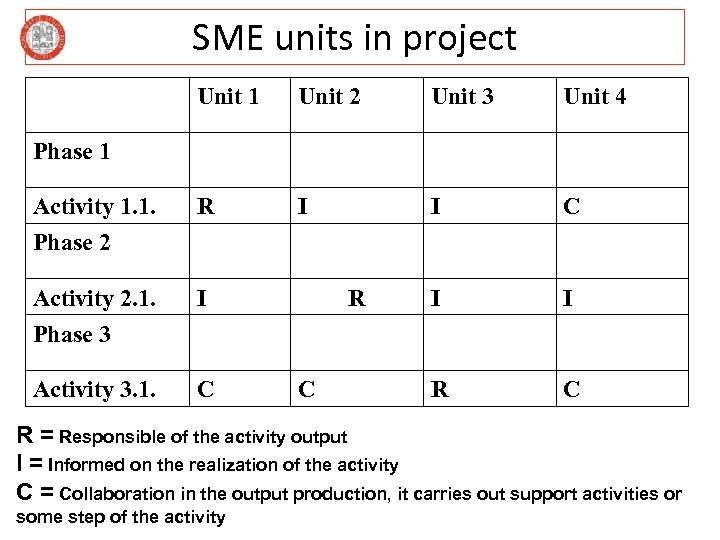
SME units in project Unit 1 Unit 2 Unit 3 Unit 4 Activity 1. 1. Phase 2 R I I C Activity 2. 1. Phase 3 I I I Activity 3. 1. C R C Phase 1 R C R = Responsible of the activity output I = Informed on the realization of the activity C = Collaboration in the output production, it carries out support activities or some step of the activity
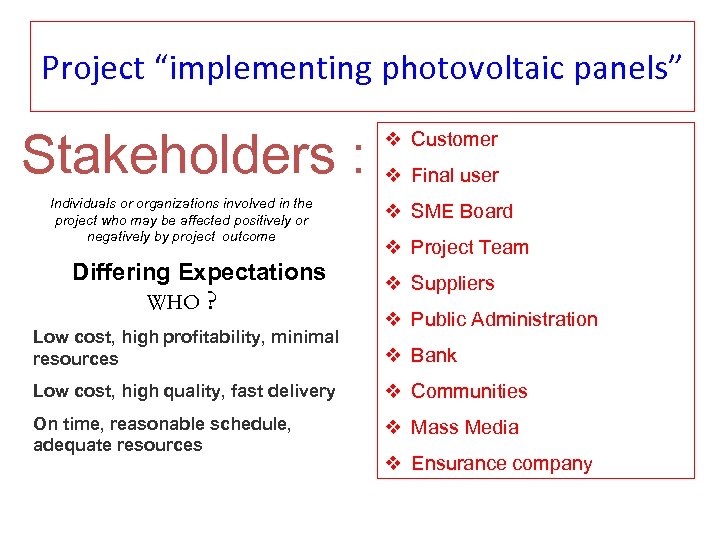
Project “implementing photovoltaic panels” Stakeholders : Individuals or organizations involved in the project who may be affected positively or negatively by project outcome Differing Expectations WHO ? Low cost, high profitability, minimal resources v Customer v Final user v SME Board v Project Team v Suppliers v Public Administration v Bank Low cost, high quality, fast delivery v Communities On time, reasonable schedule, adequate resources v Mass Media v Ensurance company
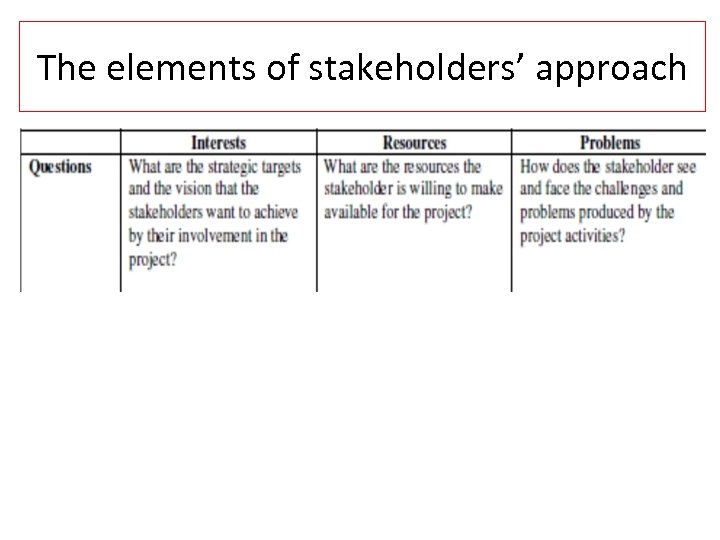
The elements of stakeholders’ approach
Скачать презентацию ALMA MATER STUDIORUM UNIVERSITY of BOLOGNA School
f47375dfed98ecff0662f9df4541d970.ppt