 Скачать презентацию Alliance for Health Reform Briefing What s in There
9710401f03426eb2d8bdc7364b11b6f3.ppt
- Количество слайдов: 4



Alliance for Health Reform Briefing: What’s in There? An Ask-the-Experts Overview of the Health Reform Law April 16, 2010 Dean A. Rosen, Partner dean@mvc-dc. com
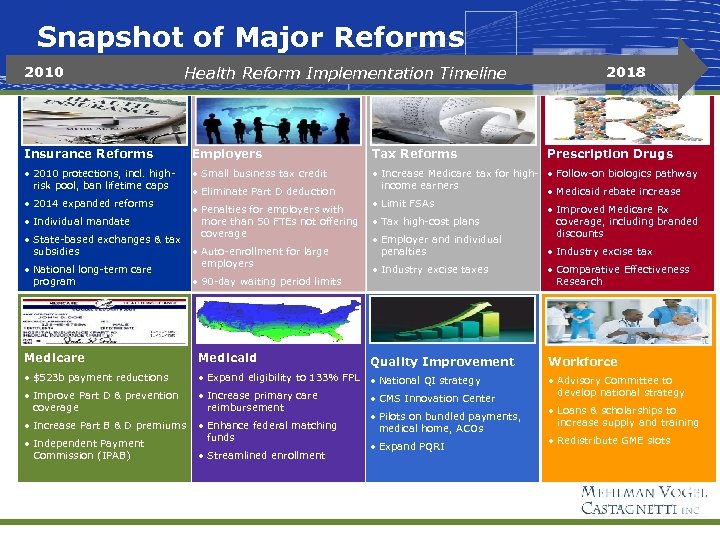
Snapshot of Major Reforms 2010 Health Reform Implementation Timeline 2018 Insurance Reforms Employers Tax Reforms • 2010 protections, incl. highrisk pool, ban lifetime caps • Small business tax credit • Increase Medicare tax for high- • income earners • • Limit FSAs • • Tax high-cost plans • 2014 expanded reforms • Individual mandate • State-based exchanges & tax subsidies • National long-term care program • Eliminate Part D deduction • Penalties for employers with more than 50 FTEs not offering coverage • Auto-enrollment for large employers • 90 -day waiting period limits • Employer and individual penalties Improved Medicare Rx coverage, including branded discounts • Industry excise tax Quality Improvement Workforce • $523 b payment reductions • Expand eligibility to 133% FPL • • Increase primary care • reimbursement • • Enhance federal matching funds • • Streamlined enrollment • Independent Payment Commission (IPAB) Medicaid rebate increase • Comparative Effectiveness Research Medicaid • Increase Part B & D premiums Follow-on biologics pathway • Industry excise taxes Medicare • Improve Part D & prevention coverage Prescription Drugs National QI strategy CMS Innovation Center Pilots on bundled payments, medical home, ACOs Expand PQRI • Advisory Committee to develop national strategy • Loans & scholarships to increase supply and training • Redistribute GME slots
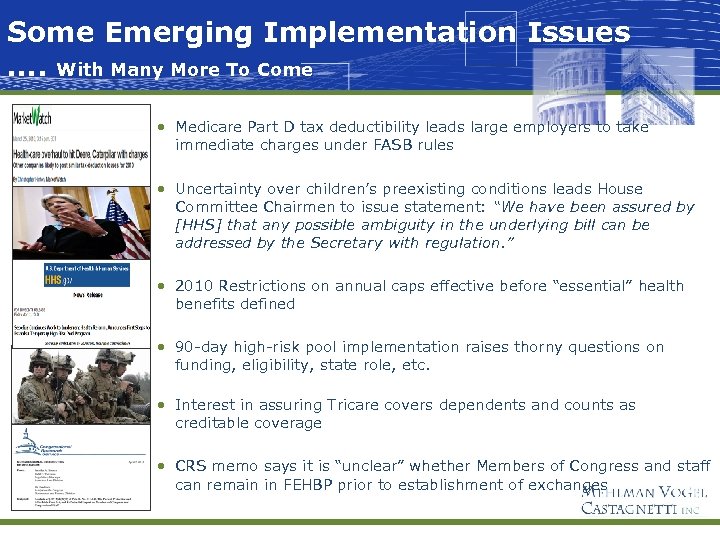
Some Emerging Implementation Issues …. With Many More To Come • Medicare Part D tax deductibility leads large employers to take immediate charges under FASB rules • Uncertainty over children’s preexisting conditions leads House Committee Chairmen to issue statement: “We have been assured by [HHS] that any possible ambiguity in the underlying bill can be addressed by the Secretary with regulation. ” • 2010 Restrictions on annual caps effective before “essential” health benefits defined • 90 -day high-risk pool implementation raises thorny questions on funding, eligibility, state role, etc. • Interest in assuring Tricare covers dependents and counts as creditable coverage • CRS memo says it is “unclear” whether Members of Congress and staff can remain in FEHBP prior to establishment of exchanges
Key Takeaways • Patient Protection and Affordable Health Care Act is wide-ranging, making major changes to entitlement programs, launching new public health initiatives, imposing new taxes and reforming private insurance markets in all 50 states • Implementation will be spread out over several years • In key areas, regulators have broad discretion in interpreting the new law • Several federal agencies will have a major role, including the Department of Health and Human Services, the Department of Labor, and the Department of Treasury • Effective implementation will require close cooperation between the federal government and states on Medicaid expansions, exchange operation, insurance reforms and other areas • The impact of recommendations of several boards and commissions, yet to be appointed, is highly uncertain • Congressional responsibility divided among a number of Committees
Скачать презентацию Alliance for Health Reform Briefing What s in There
9710401f03426eb2d8bdc7364b11b6f3.ppt