Скачать презентацию Allergen In-house Training Dr Lyn Davies Agri Quality
337267cfe846d5a376cec39b25d63989.ppt
- Количество слайдов: 21
 Allergen In-house Training Dr Lyn Davies, Agri. Quality
 Overview • • Why train your team? Allergen training basics How to identify effective training resources How do you get buy-in from your team?
 Awareness is not enough Mindset and attitude are crucial
 Why train your team? • • Protect your customers Protect your brand Everyone has a part to play Mistakes are costly Recalls still happen!
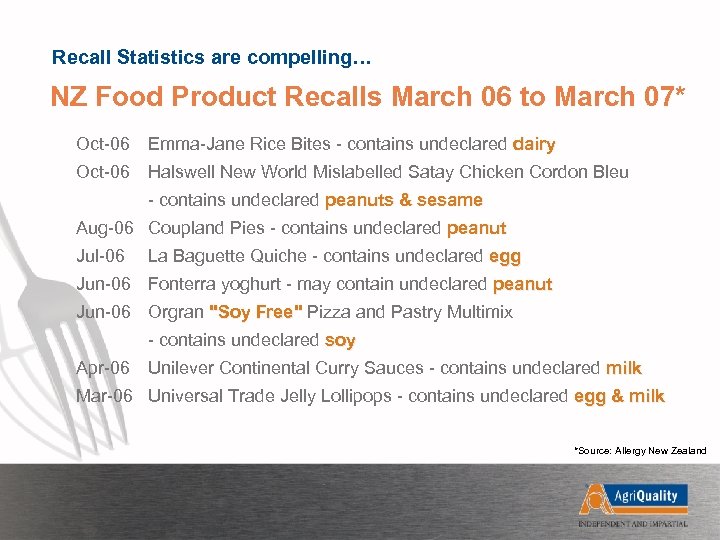 Recall Statistics are compelling… NZ Food Product Recalls March 06 to March 07* Oct-06 Emma-Jane Rice Bites - contains undeclared dairy Oct-06 Halswell New World Mislabelled Satay Chicken Cordon Bleu - contains undeclared peanuts & sesame Aug-06 Coupland Pies - contains undeclared peanut Jul-06 La Baguette Quiche - contains undeclared egg Jun-06 Fonterra yoghurt - may contain undeclared peanut Jun-06 Orgran "Soy Free" Pizza and Pastry Multimix - contains undeclared soy Apr-06 Unilever Continental Curry Sauces - contains undeclared milk Mar-06 Universal Trade Jelly Lollipops - contains undeclared egg & milk *Source: Allergy New Zealand
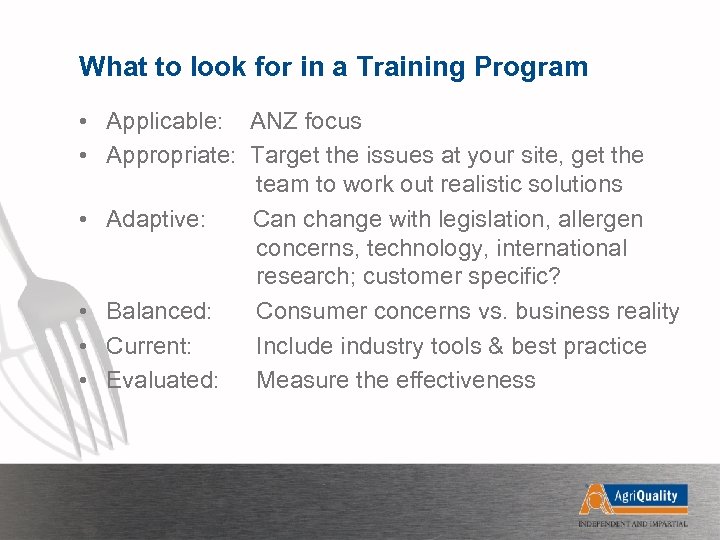 What to look for in a Training Program • Applicable: ANZ focus • Appropriate: Target the issues at your site, get the team to work out realistic solutions • Adaptive: Can change with legislation, allergen concerns, technology, international research; customer specific? • Balanced: Consumer concerns vs. business reality • Current: Include industry tools & best practice • Evaluated: Measure the effectiveness
 Identifying good training resources • • Find out what’s already there Seek feedback from other’s who have used it Will it meet your needs? What do you get out of it? - Certificate of achievement - On-going support - Updates available
 What’s already out there? • Allergen Bureau Presentation - www. allergenbureau. net/resources/training-materials/ - AB Members/suppliers training, at-cost
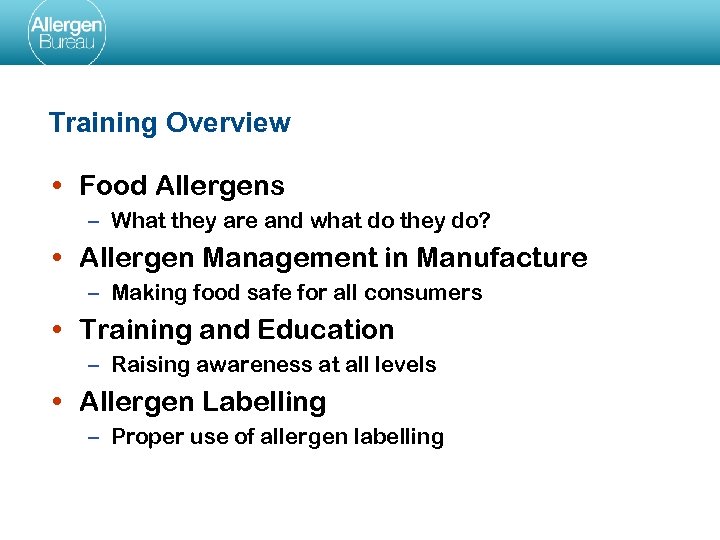 Training Overview • Food Allergens – What they are and what do they do? • Allergen Management in Manufacture – Making food safe for all consumers • Training and Education – Raising awareness at all levels • Allergen Labelling – Proper use of allergen labelling
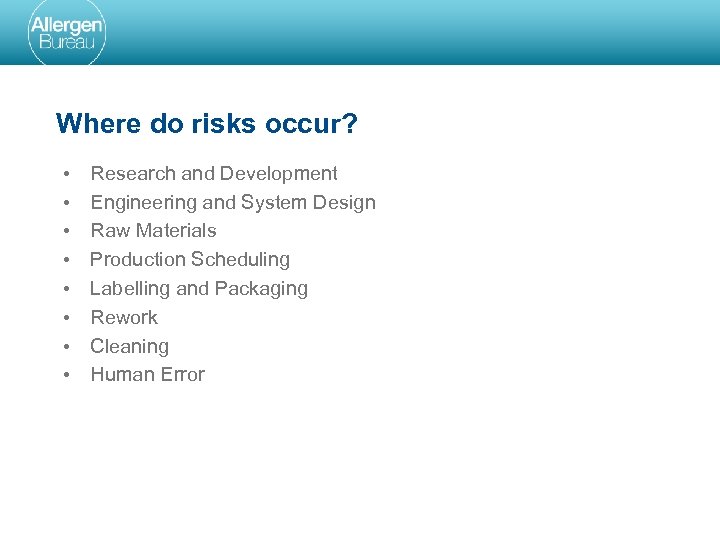 Where do risks occur? • • Research and Development Engineering and System Design Raw Materials Production Scheduling Labelling and Packaging Rework Cleaning Human Error
 What’s already out there? • Allergen Bureau Presentation - www. allergenbureau. net/resources/training-materials/ - AB Members/suppliers training, at-cost • • Food Safety/HACCP training Agri. Quality Allergen Awareness Training Company in-house/supplier training programs DVD or Video materials
 What is in development? • The Allergen Bureau is seeking funding for the development of Unit Standard based training modules. • These would be delivered on behalf of the Allergen Bureau by Industry Training Organisations (ITOs) • Courses aim to be developed in 2007
 Where are the Gaps? How do we address them? • Large companies - have greater resources but more communication challenges & they still get it wrong • SMEs - 45% SMEs surveyed had no allergen training* • Suppliers - 76% SMEs learn about allergens requiring labelling from their suppliers* *Results from Allergen Bureau SME Survey 2006)
 Getting buy-in from your team • Sell it to your executive - Recall statistics Cost: Benefit calculations Be the training champion Get your team behind you
 Know what the barriers are – tackle them head on! • Time: to find resources, to do the training, to implement learnings etc • Motivation: training = boring? ! • Cost: resources, travel, production down-time • Fear: assessment component, identifying poor practices, staff taking control • Complacency: “We’ve never had a problem” (yet)
 Tackling the barriers • Identify resources that work for your company - Use real-life examples & case-studies Workshop problems and find solutions Use stories from the team or allergy groups Include incentives (prizes!) Pilot your ideas Use mixed media Plan and dedicate the time
 How do you do it? Small groups • Training most effective where those trained have ownership of the issues and contribute to implementation of control processes • Representatives from all areas of the company • Workshop scenarios: - Change of ingredients - Customer complaint - Label game
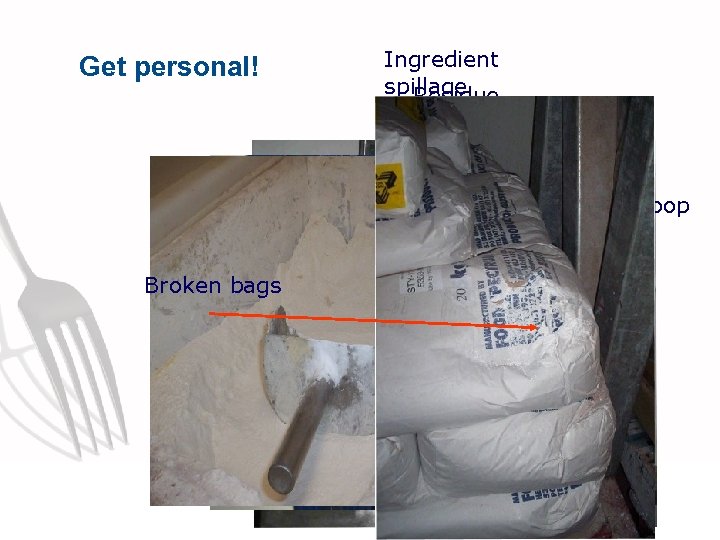 Get personal! Ingredient spillage Residue Dirty scoop Broken bags
 Summary • Allergen training is essential for everyone in your organisation, from company executives to the production floor, marketing, R&D, CIC etc • Training records are as valuable as the training itself • There are several options currently available • We are aiming to standardise training resources