 Скачать презентацию All About Loans Continuing Education With Patricia Lavigne
4f2ac5197fcdd854f99de1bb66c70386.ppt
- Количество слайдов: 65



All About Loans Continuing Education With Patricia Lavigne Mortgage Loan Officer (212)210 -9969 / Cell (845)234 -5472 1
From June 2009 2
From June 2009 3
From June 2009 4
From June 2009 5
From June 2009 6
From June 2009 7
From June 2009
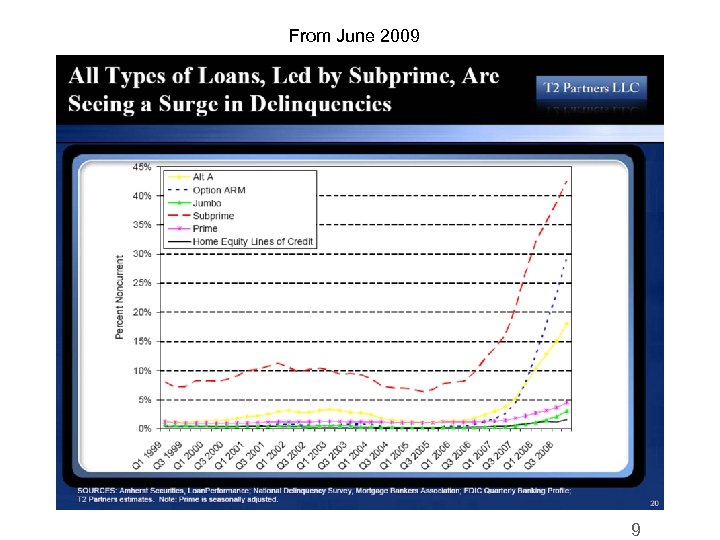
From June 2009 9
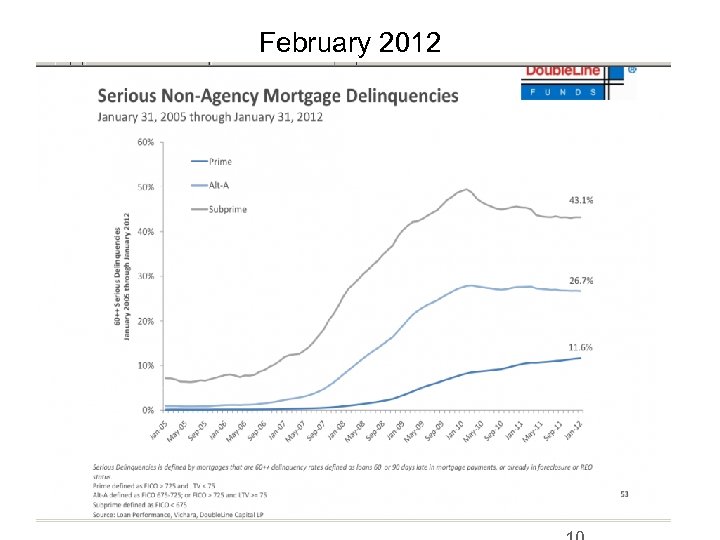
February 2012
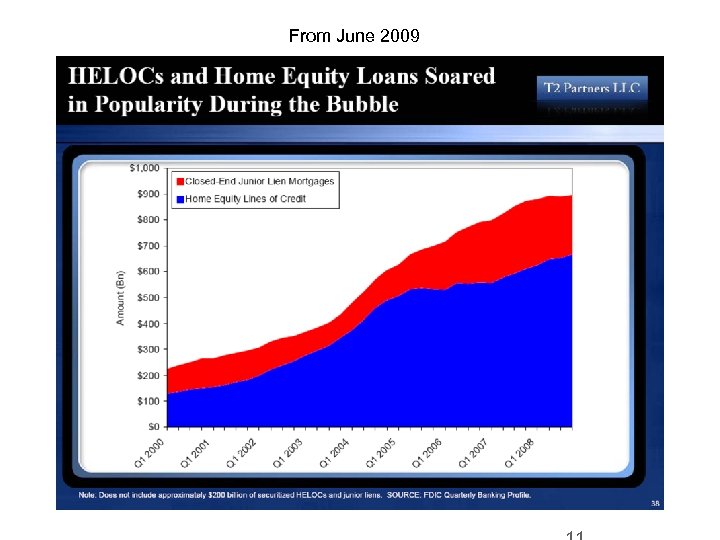
From June 2009
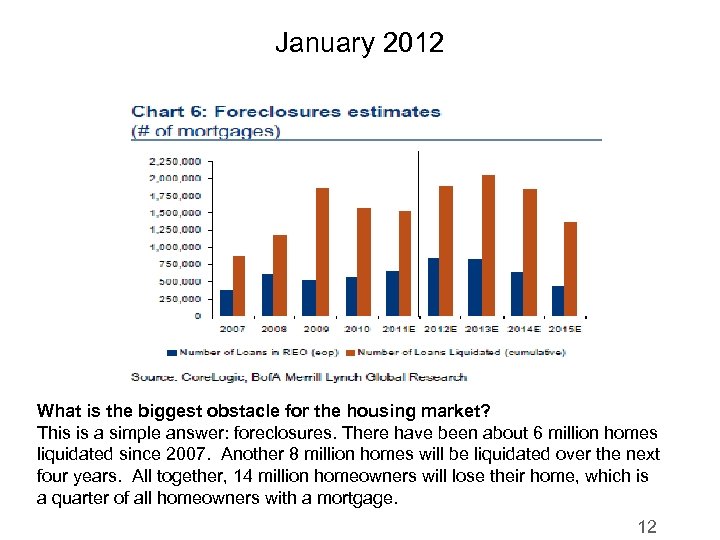
January 2012 What is the biggest obstacle for the housing market? This is a simple answer: foreclosures. There have been about 6 million homes liquidated since 2007. Another 8 million homes will be liquidated over the next four years. All together, 14 million homeowners will lose their home, which is a quarter of all homeowners with a mortgage. 12
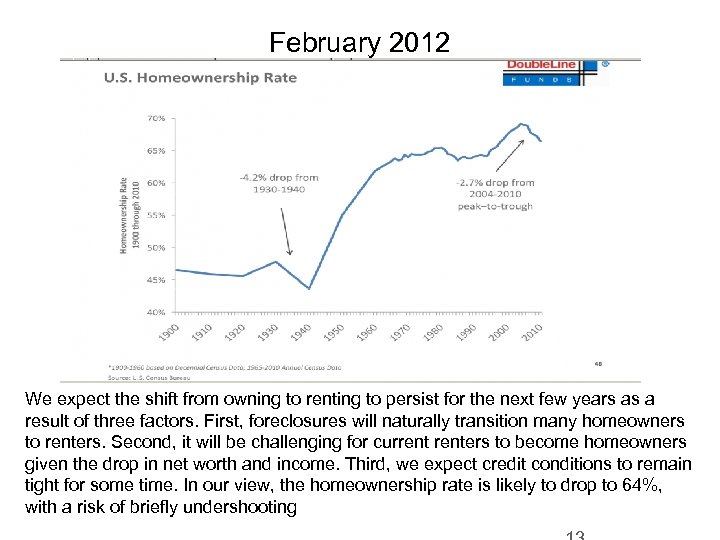
February 2012 We expect the shift from owning to renting to persist for the next few years as a result of three factors. First, foreclosures will naturally transition many homeowners to renters. Second, it will be challenging for currenters to become homeowners given the drop in net worth and income. Third, we expect credit conditions to remain tight for some time. In our view, the homeownership rate is likely to drop to 64%, with a risk of briefly undershooting
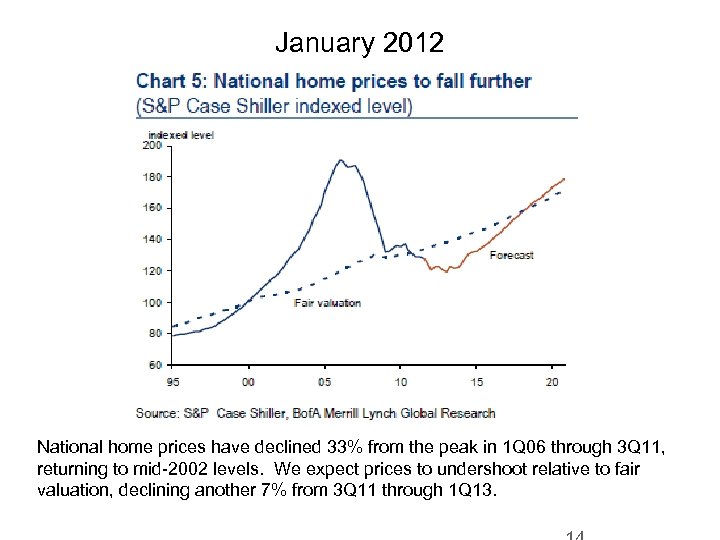
January 2012 National home prices have declined 33% from the peak in 1 Q 06 through 3 Q 11, returning to mid-2002 levels. We expect prices to undershoot relative to fair valuation, declining another 7% from 3 Q 11 through 1 Q 13.
February 2012
From August 2010
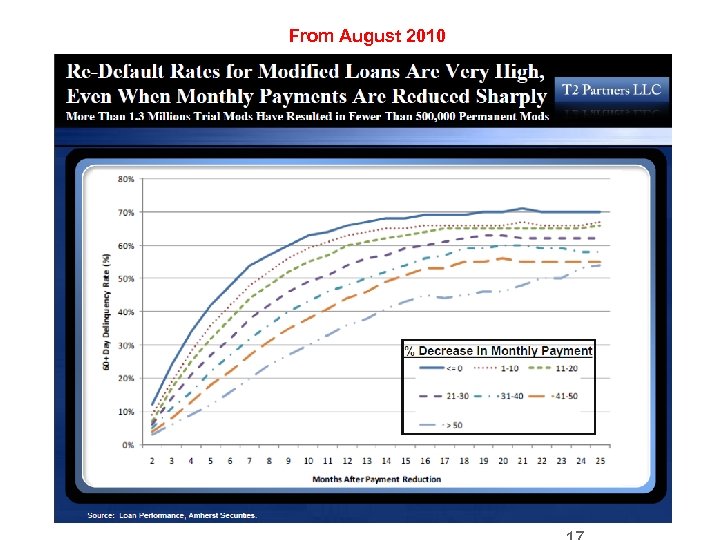
From August 2010
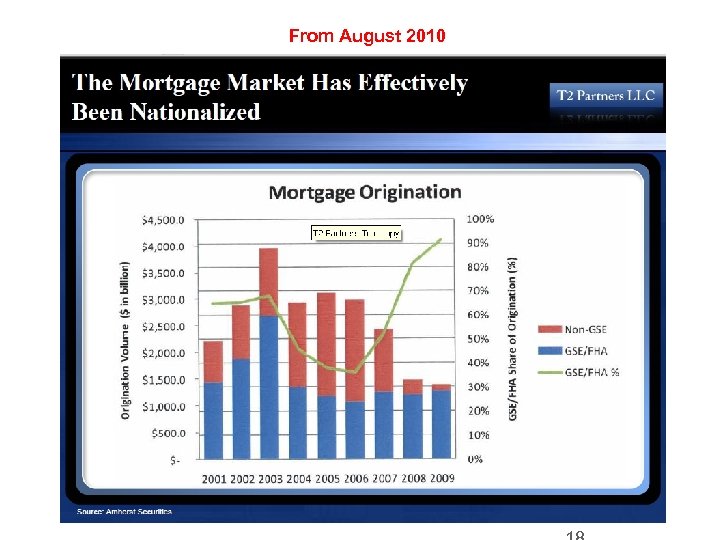
From August 2010
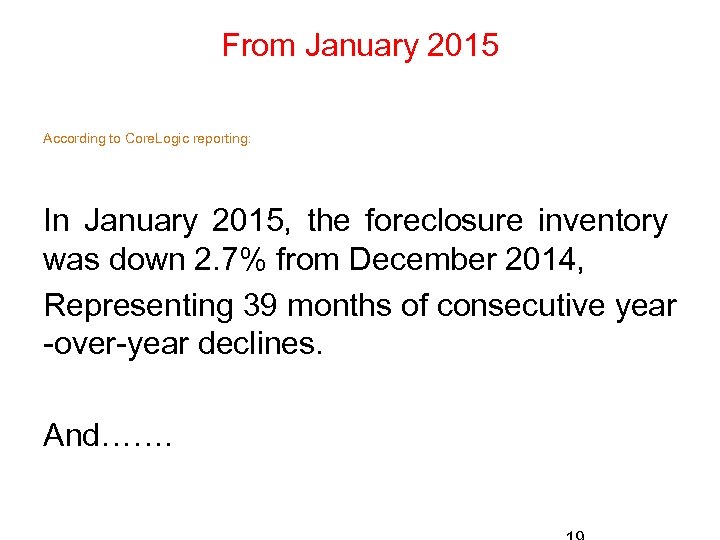
From January 2015 According to Core. Logic reporting: In January 2015, the foreclosure inventory was down 2. 7% from December 2014, Representing 39 months of consecutive year -over-year declines. And…….
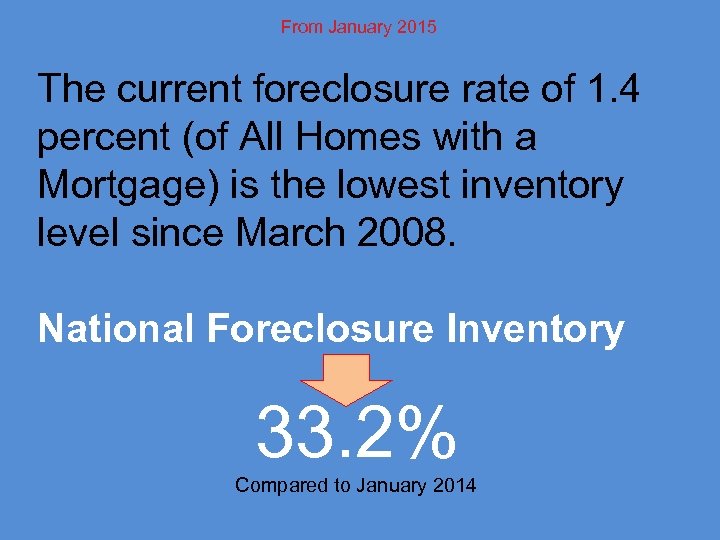
From January 2015 The current foreclosure rate of 1. 4 percent (of All Homes with a Mortgage) is the lowest inventory level since March 2008. National Foreclosure Inventory 33. 2% Compared to January 2014
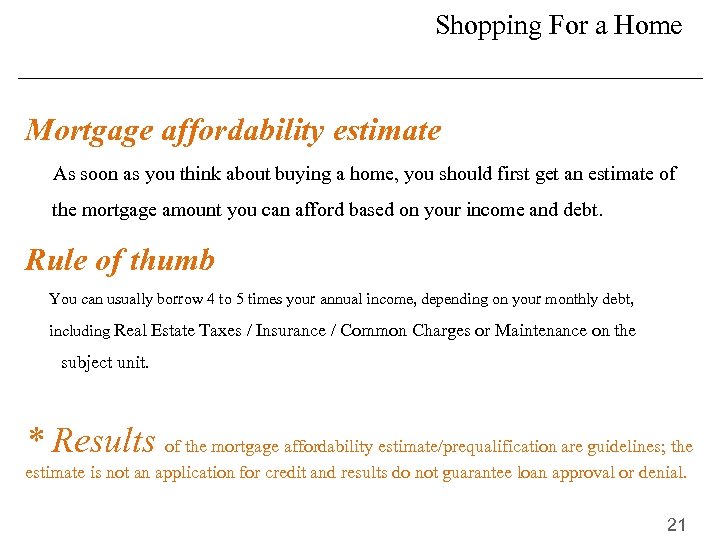
Shopping For a Home Mortgage affordability estimate As soon as you think about buying a home, you should first get an estimate of the mortgage amount you can afford based on your income and debt. Rule of thumb You can usually borrow 4 to 5 times your annual income, depending on your monthly debt, including Real Estate Taxes / Insurance / Common Charges or Maintenance on the subject unit. * Results of the mortgage affordability estimate/prequalification are guidelines; the estimate is not an application for credit and results do not guarantee loan approval or denial. 21
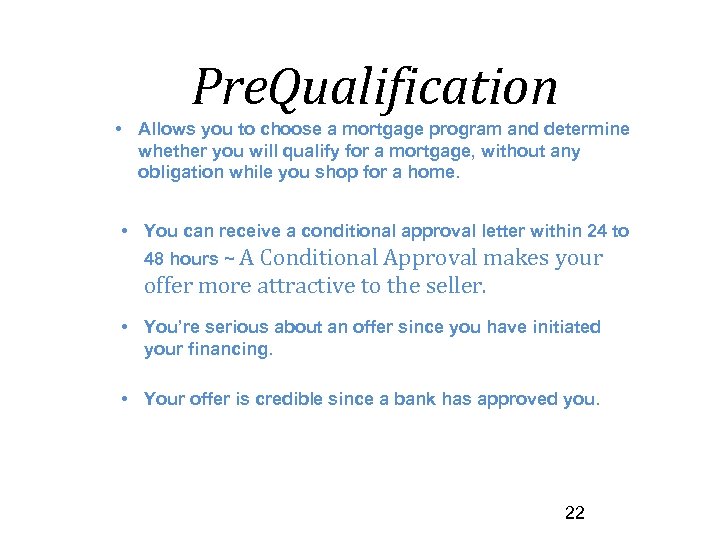
Pre. Qualification • Allows you to choose a mortgage program and determine whether you will qualify for a mortgage, without any obligation while you shop for a home. • You can receive a conditional approval letter within 24 to 48 hours ~ A Conditional Approval makes your offer more attractive to the seller. • You’re serious about an offer since you have initiated your financing. • Your offer is credible since a bank has approved you. 22
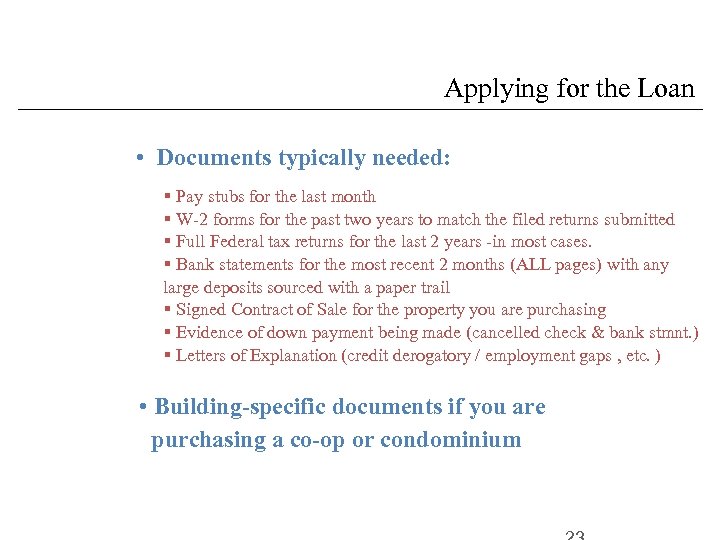
Applying for the Loan • Documents typically needed: § Pay stubs for the last month § W-2 forms for the past two years to match the filed returns submitted § Full Federal tax returns for the last 2 years -in most cases. § Bank statements for the most recent 2 months (ALL pages) with any large deposits sourced with a paper trail § Signed Contract of Sale for the property you are purchasing § Evidence of down payment being made (cancelled check & bank stmnt. ) § Letters of Explanation (credit derogatory / employment gaps , etc. ) • Building-specific documents if you are purchasing a co-op or condominium
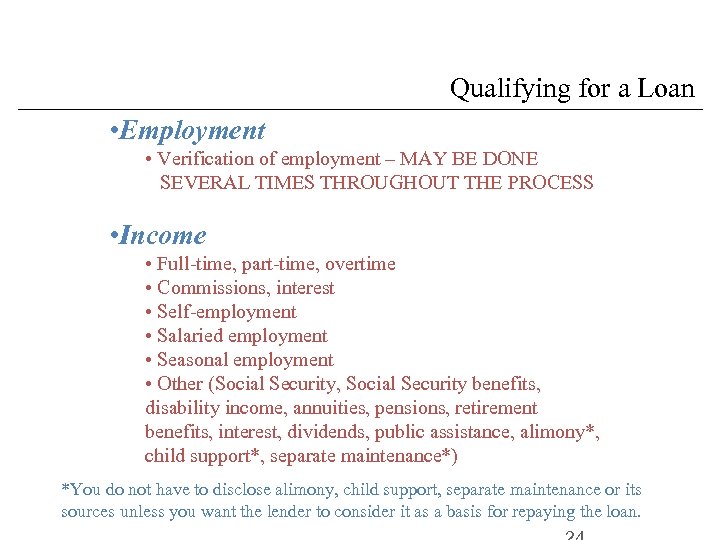
Qualifying for a Loan • Employment • Verification of employment – MAY BE DONE SEVERAL TIMES THROUGHOUT THE PROCESS • Income • Full-time, part-time, overtime • Commissions, interest • Self-employment • Salaried employment • Seasonal employment • Other (Social Security, Social Security benefits, disability income, annuities, pensions, retirement benefits, interest, dividends, public assistance, alimony*, child support*, separate maintenance*) *You do not have to disclose alimony, child support, separate maintenance or its sources unless you want the lender to consider it as a basis for repaying the loan.
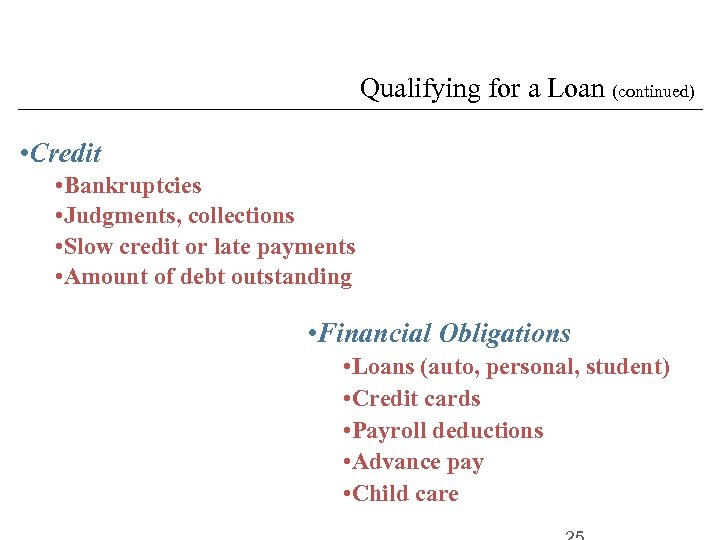
Qualifying for a Loan (continued) • Credit • Bankruptcies • Judgments, collections • Slow credit or late payments • Amount of debt outstanding • Financial Obligations • Loans (auto, personal, student) • Credit cards • Payroll deductions • Advance pay • Child care
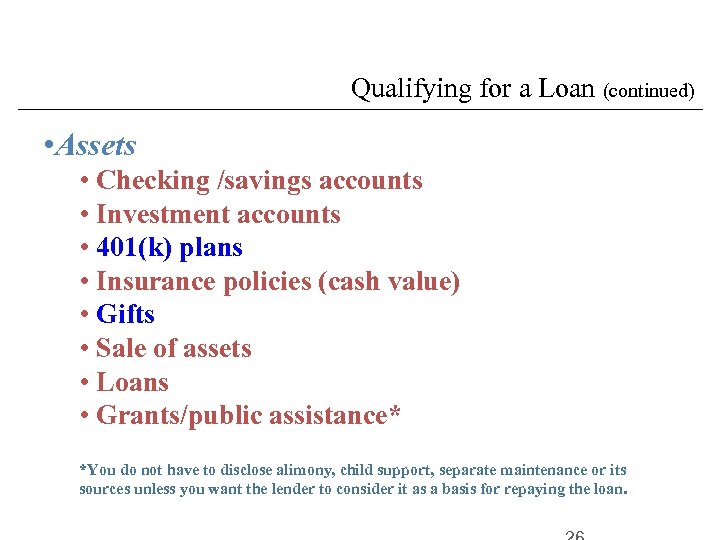
Qualifying for a Loan (continued) • Assets • Checking /savings accounts • Investment accounts • 401(k) plans • Insurance policies (cash value) • Gifts • Sale of assets • Loans • Grants/public assistance* *You do not have to disclose alimony, child support, separate maintenance or its sources unless you want the lender to consider it as a basis for repaying the loan.
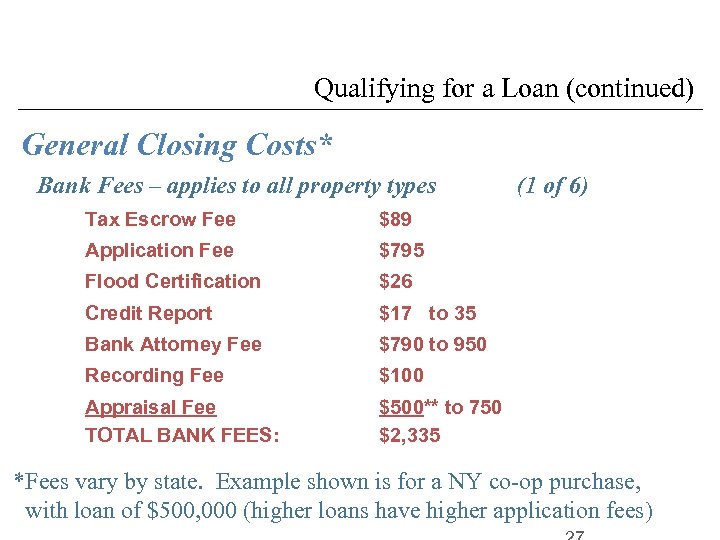
Qualifying for a Loan (continued) General Closing Costs* Bank Fees – applies to all property types Tax Escrow Fee $89 Application Fee $795 Flood Certification $26 Credit Report $17 to 35 Bank Attorney Fee $790 to 950 Recording Fee $100 Appraisal Fee TOTAL BANK FEES: (1 of 6) $500** to 750 $2, 335 *Fees vary by state. Example shown is for a NY co-op purchase, with loan of $500, 000 (higher loans have higher application fees)
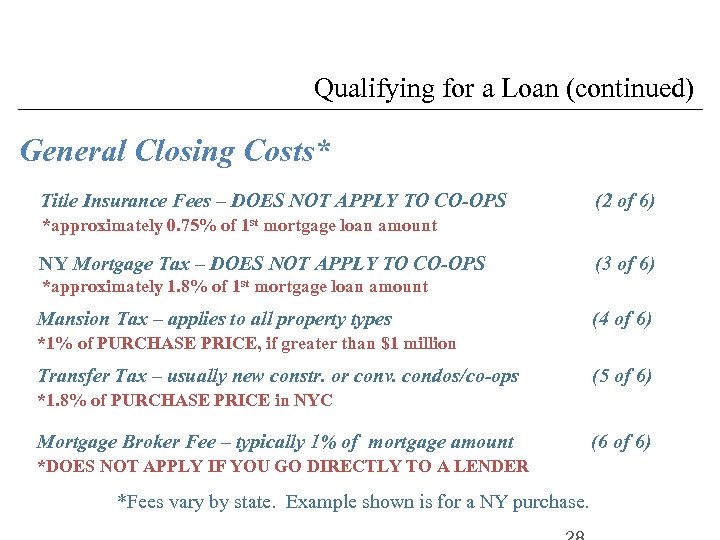
Qualifying for a Loan (continued) General Closing Costs* Title Insurance Fees – DOES NOT APPLY TO CO-OPS (2 of 6) *approximately 0. 75% of 1 st mortgage loan amount NY Mortgage Tax – DOES NOT APPLY TO CO-OPS (3 of 6) *approximately 1. 8% of 1 st mortgage loan amount Mansion Tax – applies to all property types (4 of 6) *1% of PURCHASE PRICE, if greater than $1 million Transfer Tax – usually new constr. or conv. condos/co-ops (5 of 6) *1. 8% of PURCHASE PRICE in NYC Mortgage Broker Fee – typically 1% of mortgage amount *DOES NOT APPLY IF YOU GO DIRECTLY TO A LENDER *Fees vary by state. Example shown is for a NY purchase. (6 of 6)
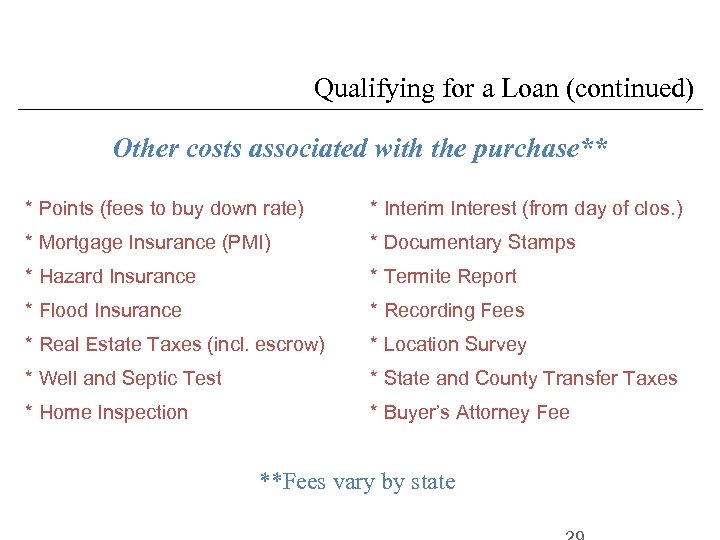
Qualifying for a Loan (continued) Other costs associated with the purchase** * Points (fees to buy down rate) * Interim Interest (from day of clos. ) * Mortgage Insurance (PMI) * Documentary Stamps * Hazard Insurance * Termite Report * Flood Insurance * Recording Fees * Real Estate Taxes (incl. escrow) * Location Survey * Well and Septic Test * State and County Transfer Taxes * Home Inspection * Buyer’s Attorney Fee **Fees vary by state
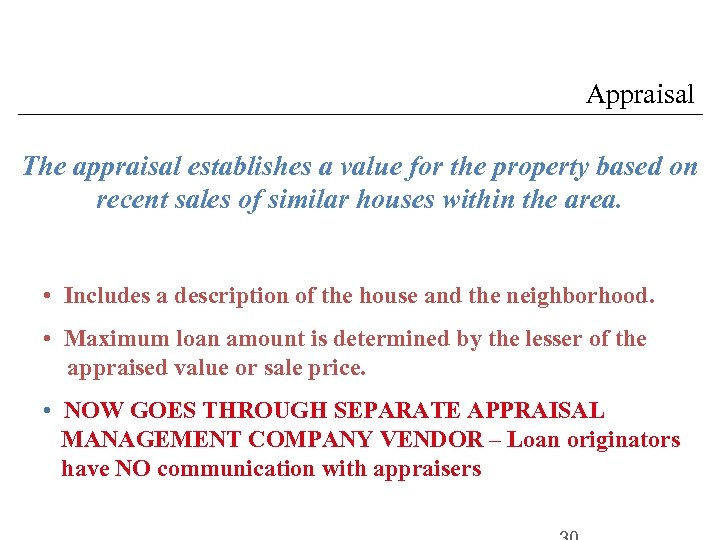
Appraisal The appraisal establishes a value for the property based on recent sales of similar houses within the area. • Includes a description of the house and the neighborhood. • Maximum loan amount is determined by the lesser of the appraised value or sale price. • NOW GOES THROUGH SEPARATE APPRAISAL MANAGEMENT COMPANY VENDOR – Loan originators have NO communication with appraisers
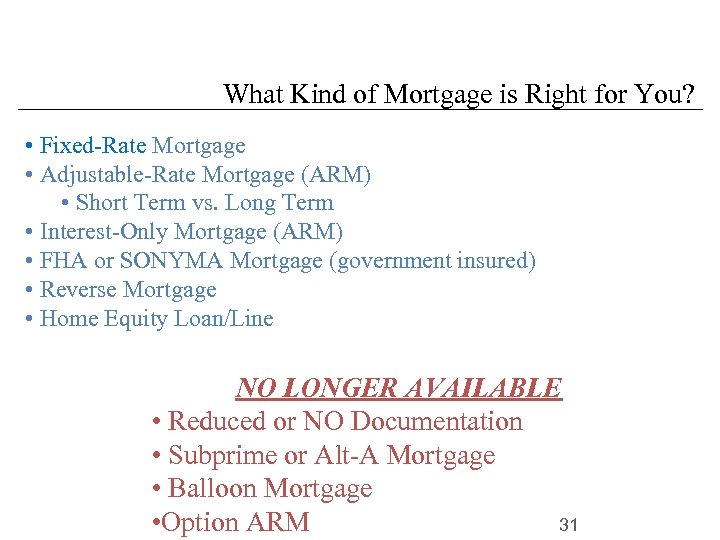
What Kind of Mortgage is Right for You? • Fixed-Rate Mortgage • Adjustable-Rate Mortgage (ARM) • Short Term vs. Long Term • Interest-Only Mortgage (ARM) • FHA or SONYMA Mortgage (government insured) • Reverse Mortgage • Home Equity Loan/Line NO LONGER AVAILABLE • Reduced or NO Documentation • Subprime or Alt-A Mortgage • Balloon Mortgage • Option ARM 31
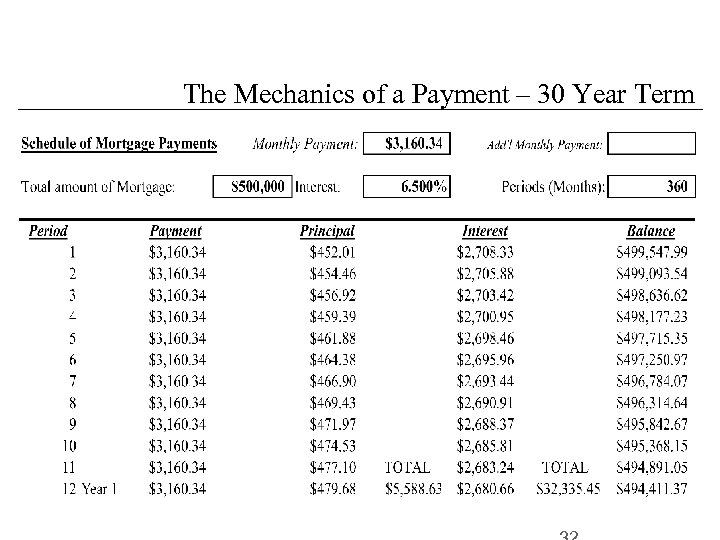
The Mechanics of a Payment – 30 Year Term
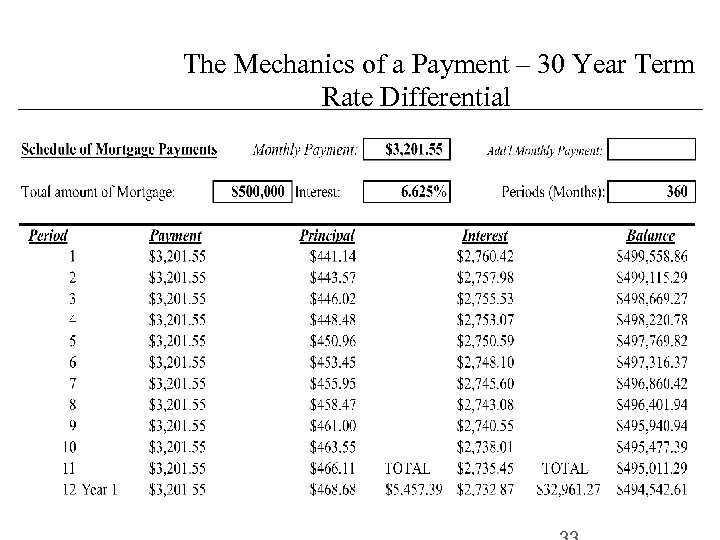
The Mechanics of a Payment – 30 Year Term Rate Differential
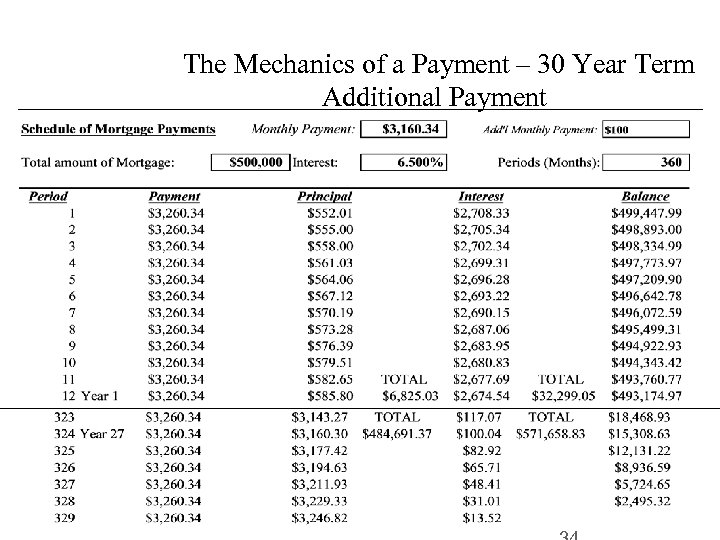
The Mechanics of a Payment – 30 Year Term Additional Payment
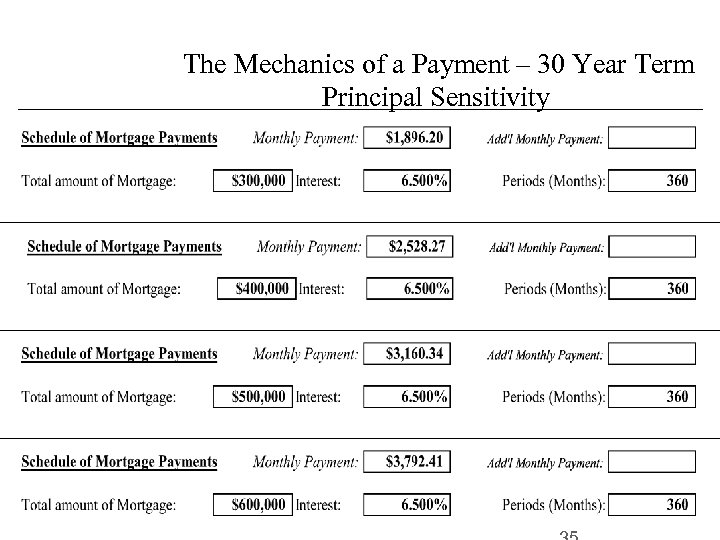
The Mechanics of a Payment – 30 Year Term Principal Sensitivity
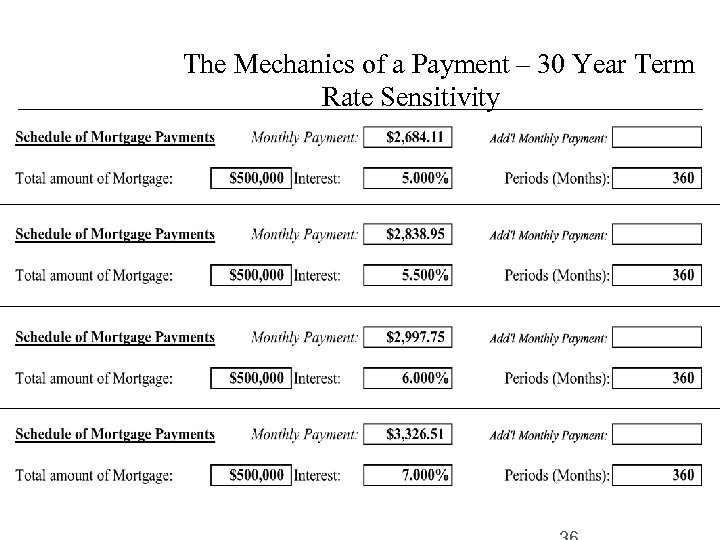
The Mechanics of a Payment – 30 Year Term Rate Sensitivity
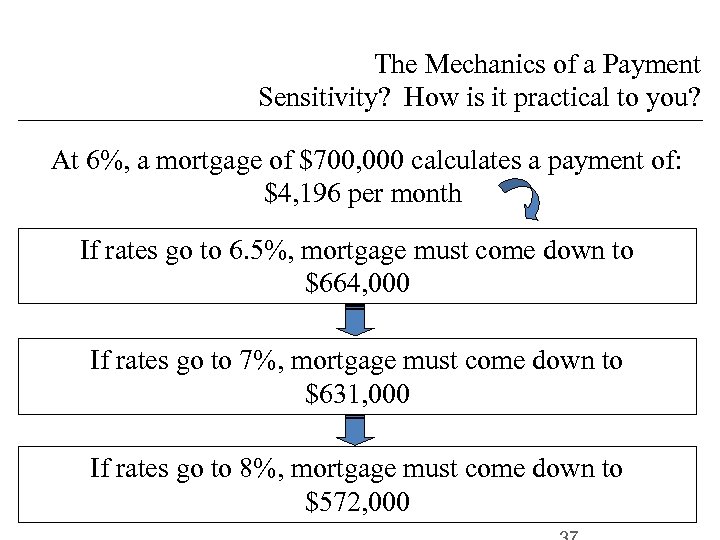
The Mechanics of a Payment Sensitivity? How is it practical to you? At 6%, a mortgage of $700, 000 calculates a payment of: $4, 196 per month If rates go to 6. 5%, mortgage must come down to $664, 000 If rates go to 7%, mortgage must come down to $631, 000 If rates go to 8%, mortgage must come down to $572, 000
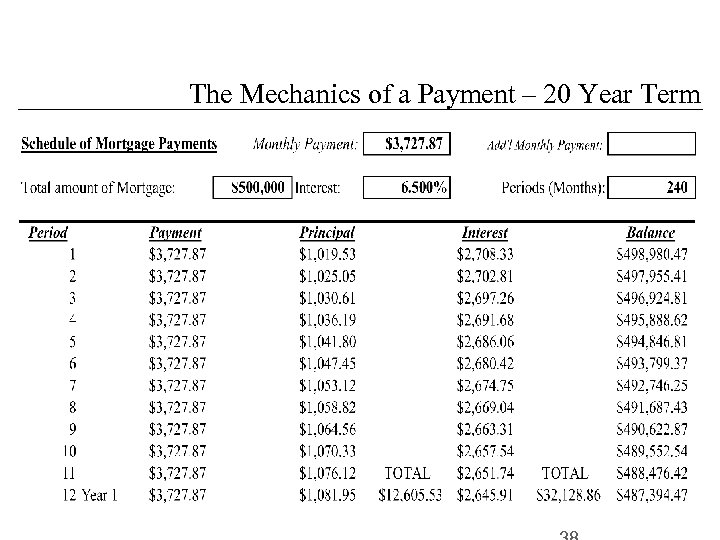
The Mechanics of a Payment – 20 Year Term
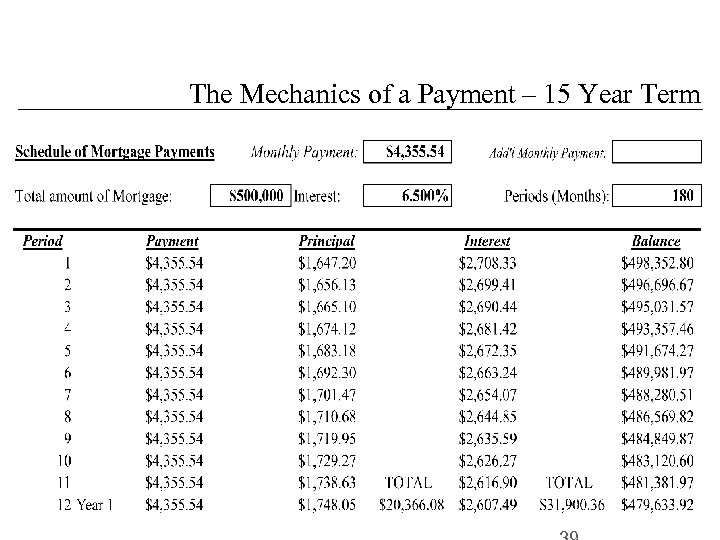
The Mechanics of a Payment – 15 Year Term
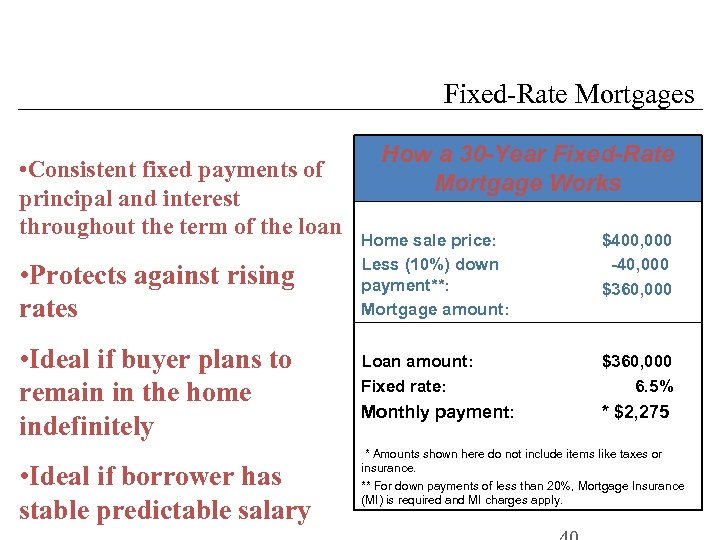
Fixed-Rate Mortgages • Consistent fixed payments of principal and interest throughout the term of the loan • Protects against rising rates • Ideal if buyer plans to remain in the home indefinitely • Ideal if borrower has stable predictable salary How a 30 -Year Fixed-Rate Mortgage Works Home sale price: Less (10%) down payment**: Mortgage amount: $400, 000 -40, 000 $360, 000 Loan amount: Fixed rate: $360, 000 6. 5% Monthly payment: * $2, 275 * Amounts shown here do not include items like taxes or insurance. ** For down payments of less than 20%, Mortgage Insurance (MI) is required and MI charges apply.
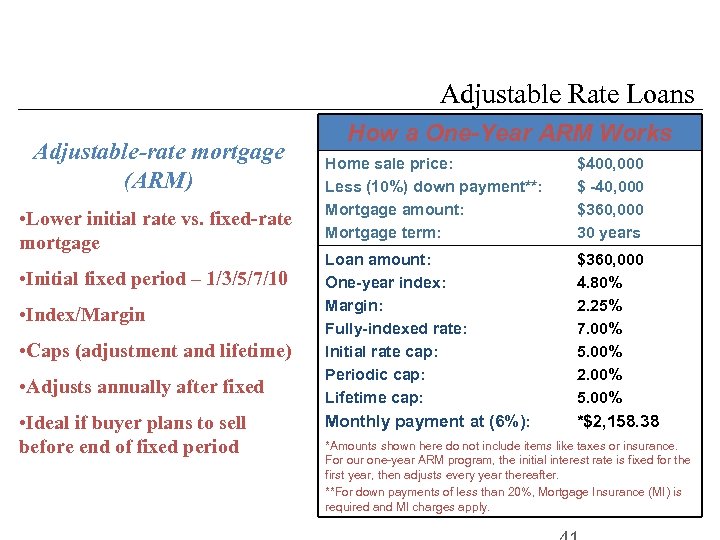
Adjustable Rate Loans Adjustable-rate mortgage (ARM) • Lower initial rate vs. fixed-rate mortgage • Initial fixed period – 1/3/5/7/10 • Index/Margin • Caps (adjustment and lifetime) • Adjusts annually after fixed • Ideal if buyer plans to sell before end of fixed period How a One-Year ARM Works Home sale price: Less (10%) down payment**: Mortgage amount: Mortgage term: $400, 000 $ -40, 000 $360, 000 30 years Loan amount: One-year index: Margin: Fully-indexed rate: Initial rate cap: Periodic cap: Lifetime cap: $360, 000 4. 80% 2. 25% 7. 00% 5. 00% 2. 00% 5. 00% Monthly payment at (6%): *$2, 158. 38 *Amounts shown here do not include items like taxes or insurance. For our one-year ARM program, the initial interest rate is fixed for the first year, then adjusts every year thereafter. **For down payments of less than 20%, Mortgage Insurance (MI) is required and MI charges apply.
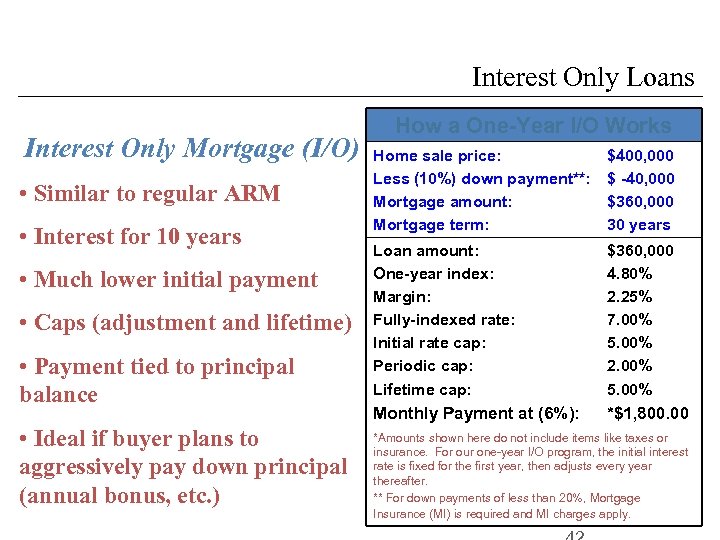
Interest Only Loans Interest Only Mortgage (I/O) • Similar to regular ARM • Interest for 10 years • Much lower initial payment • Caps (adjustment and lifetime) • Payment tied to principal balance • Ideal if buyer plans to aggressively pay down principal (annual bonus, etc. ) How a One-Year I/O Works Home sale price: Less (10%) down payment**: Mortgage amount: Mortgage term: $400, 000 $ -40, 000 $360, 000 30 years Loan amount: One-year index: Margin: Fully-indexed rate: Initial rate cap: Periodic cap: Lifetime cap: $360, 000 4. 80% 2. 25% 7. 00% 5. 00% 2. 00% 5. 00% Monthly Payment at (6%): *$1, 800. 00 *Amounts shown here do not include items like taxes or insurance. For our one-year I/O program, the initial interest rate is fixed for the first year, then adjusts every year thereafter. ** For down payments of less than 20%, Mortgage Insurance (MI) is required and MI charges apply.
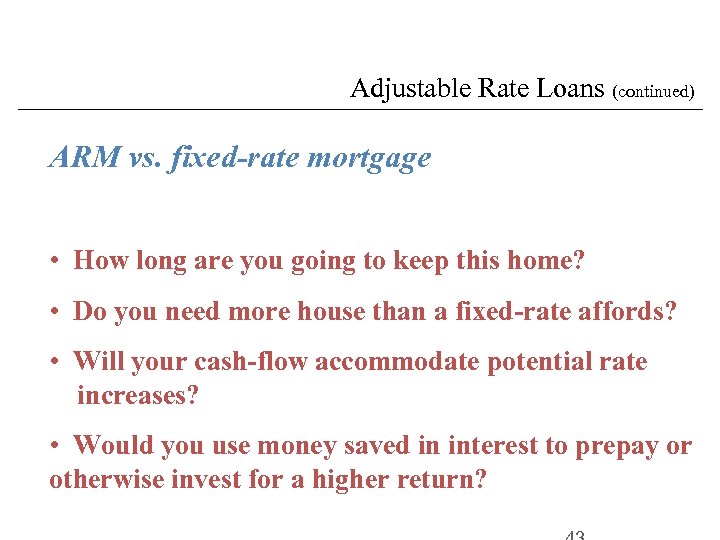
Adjustable Rate Loans (continued) ARM vs. fixed-rate mortgage • How long are you going to keep this home? • Do you need more house than a fixed-rate affords? • Will your cash-flow accommodate potential rate increases? • Would you use money saved in interest to prepay or otherwise invest for a higher return?
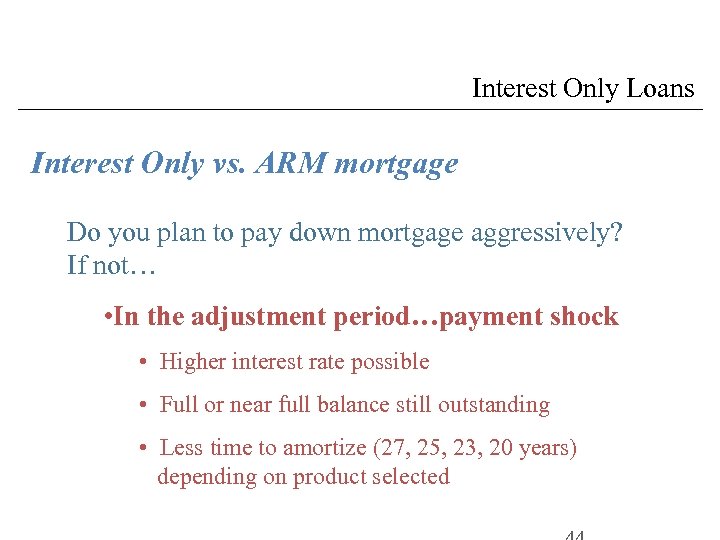
Interest Only Loans Interest Only vs. ARM mortgage Do you plan to pay down mortgage aggressively? If not… • In the adjustment period…payment shock • Higher interest rate possible • Full or near full balance still outstanding • Less time to amortize (27, 25, 23, 20 years) depending on product selected
Creative Financing Alternatives to traditional mortgages… • Home equity programs that permit a simultaneous first mortgage and second mortgage closing • Temporary buy-downs (up-front fee or premium used to buy down the interest rate for a temporary time period)
Creative Financing Continued Using a creative underwriting style • Asset Dissipation – This is when an asset such as a mutual fund / stock/ savings / checking / vested amount in retirement account is averaged and considered income. The method can be used for employed or retired borrowers.
Condominiums - Where’s the Risk Condominium living means participation in an association where the residents must rely on each other and their Board members to keep the property and its financials in good standing. HOAs which are run poorly: § Run the budget in the red § Levy large assessments for unnecessary work § Apply for improper insurance coverage (in an effort to cut costs) leading to additional cost for the association members § Allow too many investors to purchase units in one building § Have Board members who are unwilling to address building needs in an effort to reduce costs § Have relaxed policies for delinquent dues
Condominiums - Where’s the Risk HOAs frequently must raise their dues or assess additional one-time fees in order properly run the association. Some of the causes of rising dues are: § Need to increase reserves for future protection § Rising cost of repairs § Rising cost of insurance § Unexpected damages needing repairs § Updating to property § Supplementing large influx of delinquent dues § Original developer “low balled” the dues to make the property more attractive Once these dues are raised other problems can arise: § Homeowners unable to make new payments and forced to sell § Property is not as attractive to prospective buyers § Association tempted to not make future necessary repairs to avoid another assessment
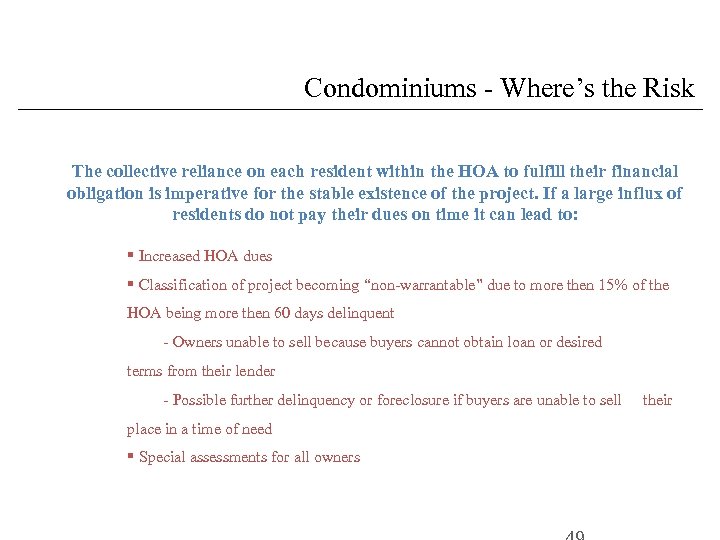
Condominiums - Where’s the Risk The collective reliance on each resident within the HOA to fulfill their financial obligation is imperative for the stable existence of the project. If a large influx of residents do not pay their dues on time it can lead to: § Increased HOA dues § Classification of project becoming “non-warrantable” due to more then 15% of the HOA being more then 60 days delinquent - Owners unable to sell because buyers cannot obtain loan or desired terms from their lender - Possible further delinquency or foreclosure if buyers are unable to sell place in a time of need § Special assessments for all owners their
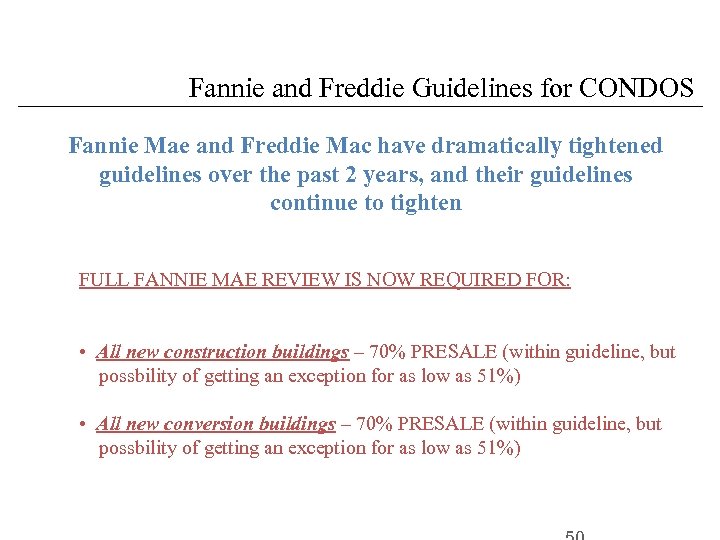
Fannie and Freddie Guidelines for CONDOS Fannie Mae and Freddie Mac have dramatically tightened guidelines over the past 2 years, and their guidelines continue to tighten FULL FANNIE MAE REVIEW IS NOW REQUIRED FOR: • All new construction buildings – 70% PRESALE (within guideline, but possbility of getting an exception for as low as 51%) • All new conversion buildings – 70% PRESALE (within guideline, but possbility of getting an exception for as low as 51%)
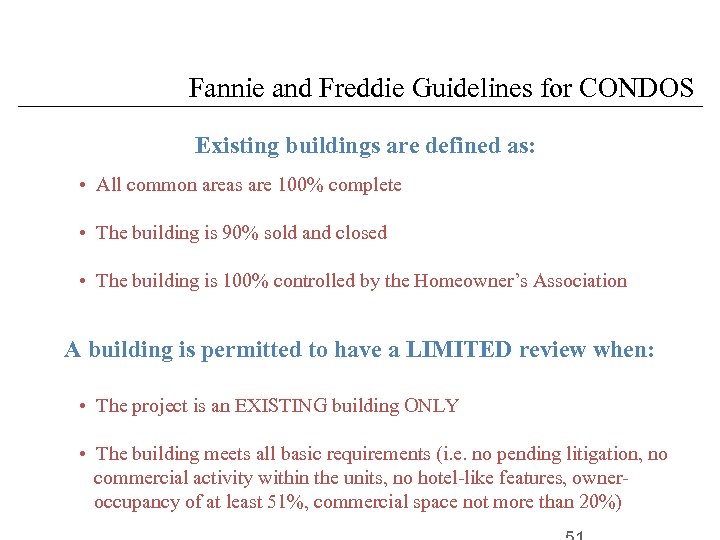
Fannie and Freddie Guidelines for CONDOS Existing buildings are defined as: • All common areas are 100% complete • The building is 90% sold and closed • The building is 100% controlled by the Homeowner’s Association A building is permitted to have a LIMITED review when: • The project is an EXISTING building ONLY • The building meets all basic requirements (i. e. no pending litigation, no commercial activity within the units, no hotel-like features, owneroccupancy of at least 51%, commercial space not more than 20%)
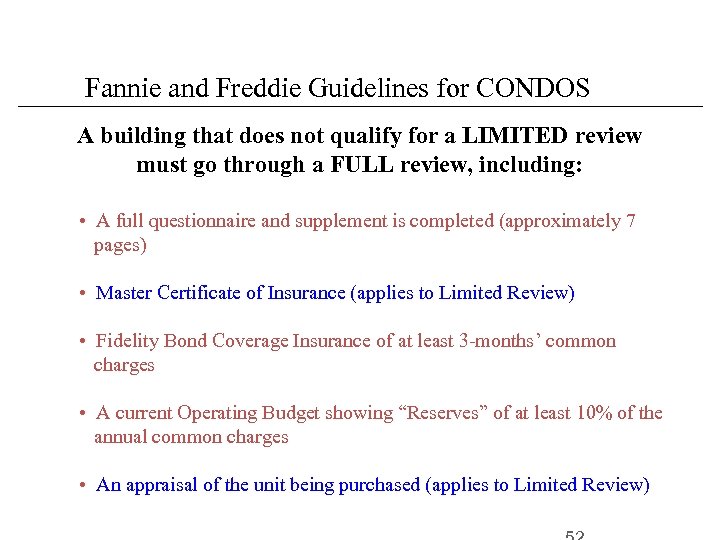
Fannie and Freddie Guidelines for CONDOS A building that does not qualify for a LIMITED review must go through a FULL review, including: • A full questionnaire and supplement is completed (approximately 7 pages) • Master Certificate of Insurance (applies to Limited Review) • Fidelity Bond Coverage Insurance of at least 3 -months’ common charges • A current Operating Budget showing “Reserves” of at least 10% of the annual common charges • An appraisal of the unit being purchased (applies to Limited Review)
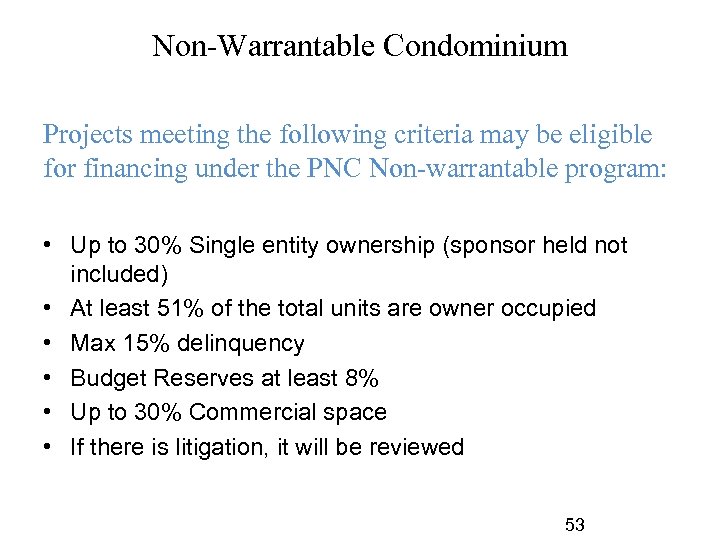
Non-Warrantable Condominium Projects meeting the following criteria may be eligible for financing under the PNC Non-warrantable program: • Up to 30% Single entity ownership (sponsor held not included) • At least 51% of the total units are owner occupied • Max 15% delinquency • Budget Reserves at least 8% • Up to 30% Commercial space • If there is litigation, it will be reviewed 53
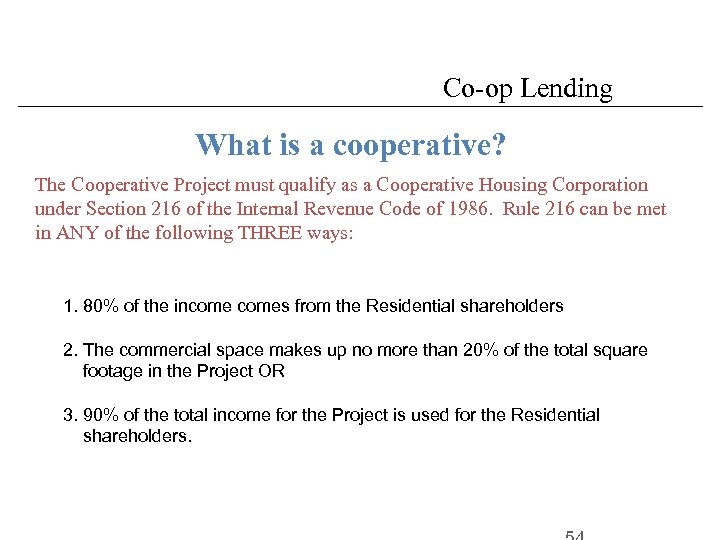
Co-op Lending What is a cooperative? The Cooperative Project must qualify as a Cooperative Housing Corporation under Section 216 of the Internal Revenue Code of 1986. Rule 216 can be met in ANY of the following THREE ways: 1. 80% of the incomes from the Residential shareholders 2. The commercial space makes up no more than 20% of the total square footage in the Project OR 3. 90% of the total income for the Project is used for the Residential shareholders.
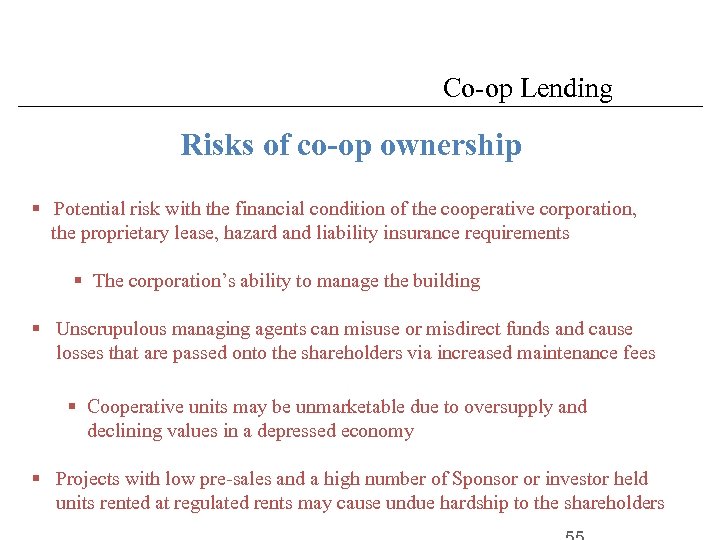
Co-op Lending Risks of co-op ownership § Potential risk with the financial condition of the cooperative corporation, the proprietary lease, hazard and liability insurance requirements § The corporation’s ability to manage the building § Unscrupulous managing agents can misuse or misdirect funds and cause losses that are passed onto the shareholders via increased maintenance fees § Cooperative units may be unmarketable due to oversupply and declining values in a depressed economy § Projects with low pre-sales and a high number of Sponsor or investor held units rented at regulated rents may cause undue hardship to the shareholders
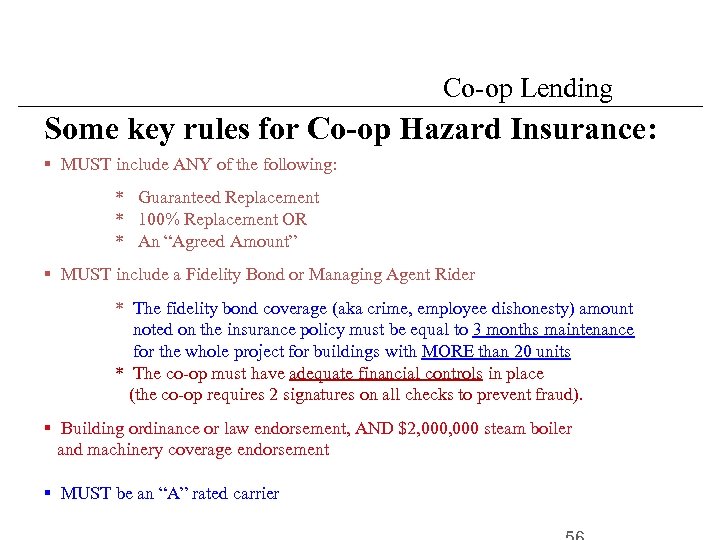
Co-op Lending Some key rules for Co-op Hazard Insurance: § MUST include ANY of the following: * Guaranteed Replacement * 100% Replacement OR * An “Agreed Amount” § MUST include a Fidelity Bond or Managing Agent Rider * The fidelity bond coverage (aka crime, employee dishonesty) amount noted on the insurance policy must be equal to 3 months maintenance for the whole project for buildings with MORE than 20 units * The co-op must have adequate financial controls in place (the co-op requires 2 signatures on all checks to prevent fraud). § Building ordinance or law endorsement, AND $2, 000 steam boiler and machinery coverage endorsement § MUST be an “A” rated carrier
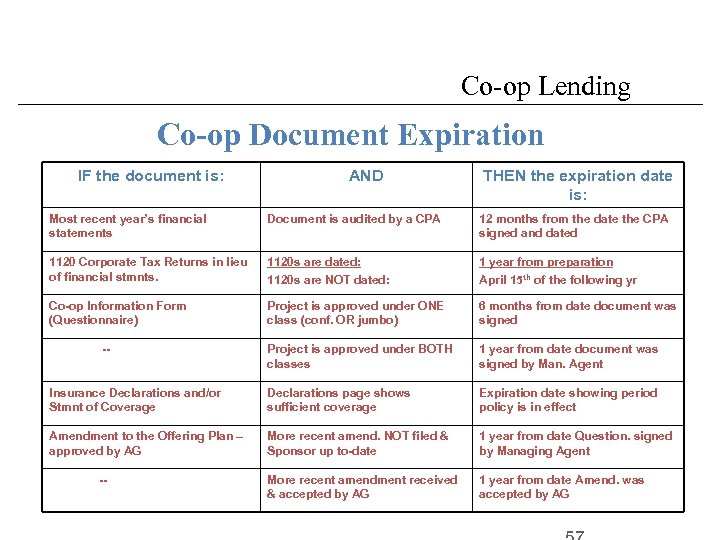
Co-op Lending Co-op Document Expiration IF the document is: AND THEN the expiration date is: Most recent year’s financial statements Document is audited by a CPA 12 months from the date the CPA signed and dated 1120 Corporate Tax Returns in lieu of financial stmnts. 1120 s are dated: 1120 s are NOT dated: 1 year from preparation April 15 th of the following yr Co-op Information Form (Questionnaire) Project is approved under ONE class (conf. OR jumbo) 6 months from date document was signed Project is approved under BOTH classes 1 year from date document was signed by Man. Agent Insurance Declarations and/or Stmnt of Coverage Declarations page shows sufficient coverage Expiration date showing period policy is in effect Amendment to the Offering Plan – approved by AG More recent amend. NOT filed & Sponsor up to-date 1 year from date Question. signed by Managing Agent More recent amendment received & accepted by AG 1 year from date Amend. was accepted by AG -- --
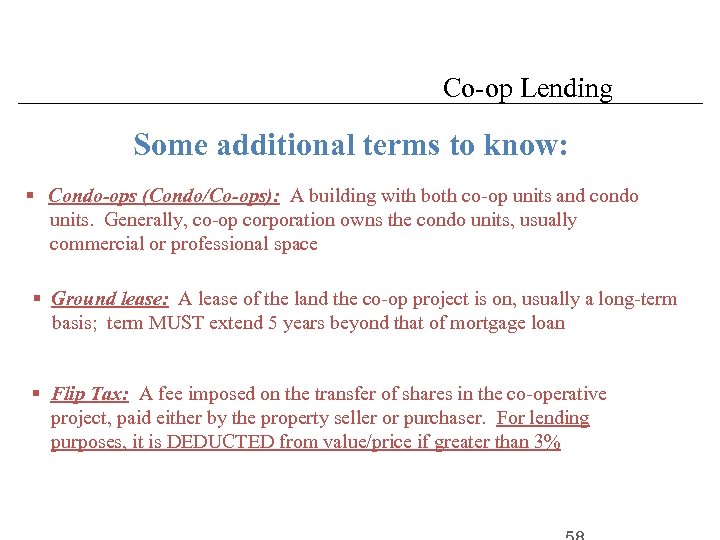
Co-op Lending Some additional terms to know: § Condo-ops (Condo/Co-ops): A building with both co-op units and condo units. Generally, co-op corporation owns the condo units, usually commercial or professional space § Ground lease: A lease of the land the co-op project is on, usually a long-term basis; term MUST extend 5 years beyond that of mortgage loan § Flip Tax: A fee imposed on the transfer of shares in the co-operative project, paid either by the property seller or purchaser. For lending purposes, it is DEDUCTED from value/price if greater than 3%
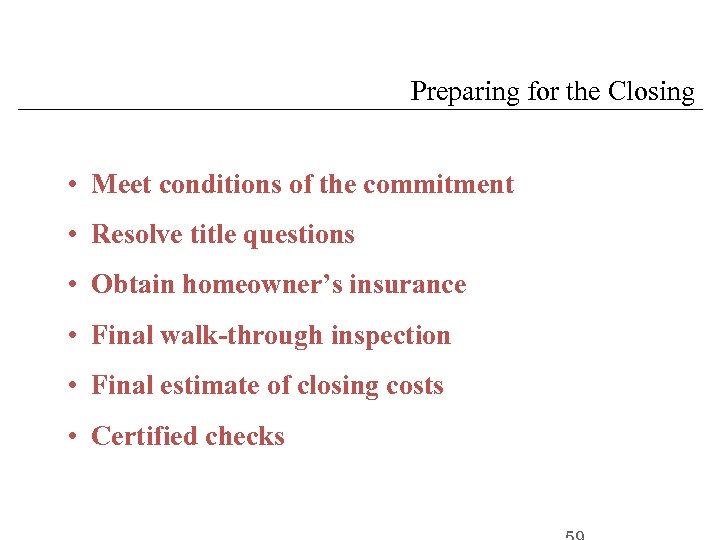
Preparing for the Closing • Meet conditions of the commitment • Resolve title questions • Obtain homeowner’s insurance • Final walk-through inspection • Final estimate of closing costs • Certified checks
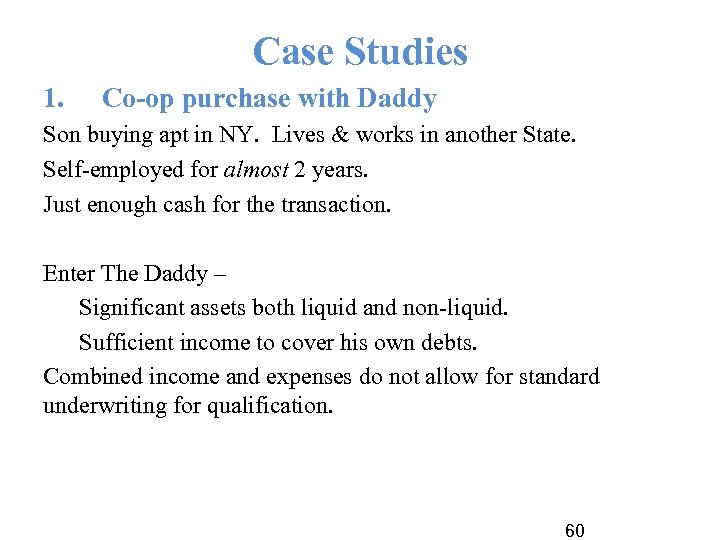
Case Studies 1. Co-op purchase with Daddy Son buying apt in NY. Lives & works in another State. Self-employed for almost 2 years. Just enough cash for the transaction. Enter The Daddy – Significant assets both liquid and non-liquid. Sufficient income to cover his own debts. Combined income and expenses do not allow for standard underwriting for qualification. 60
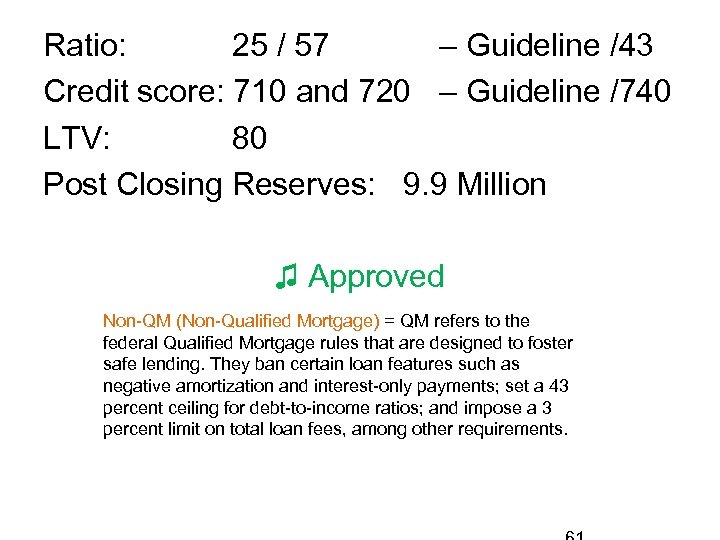
Ratio: 25 / 57 – Guideline /43 Credit score: 710 and 720 – Guideline /740 LTV: 80 Post Closing Reserves: 9. 9 Million ♫ Approved Non-QM (Non-Qualified Mortgage) = QM refers to the federal Qualified Mortgage rules that are designed to foster safe lending. They ban certain loan features such as negative amortization and interest-only payments; set a 43 percent ceiling for debt-to-income ratios; and impose a 3 percent limit on total loan fees, among other requirements.
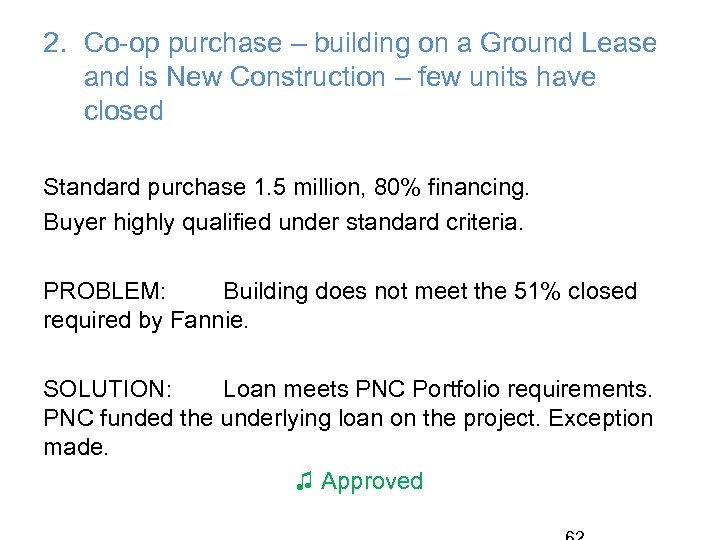
2. Co-op purchase – building on a Ground Lease and is New Construction – few units have closed Standard purchase 1. 5 million, 80% financing. Buyer highly qualified under standard criteria. PROBLEM: Building does not meet the 51% closed required by Fannie. SOLUTION: Loan meets PNC Portfolio requirements. PNC funded the underlying loan on the project. Exception made. ♫ Approved

Common Things That Can Derail a File 1. 2. 3. 4. 5. 6. Information missing from the Application Pay stubs that are not consecutive or do not show required info Bonus received for 1 year only Credit Issues Bank statement shows other persons as account holder/Trust Deposit paper trails missing or incomplete/ unknown source of deposit / cash 7. Income verified does not match income provided: Tax returns, P&L’s or Balance sheets, or K-1’s missing 8. Borrower’s Visa is Expired 9. Customer refuses to transfer reserve funds to US account 10. Low Appraised value 11. Borrower received a new auto or other loan prior to anticipated closing 12. Building is not approvable

Current Projects in our Area 50 UN 10 Madison Square West The Greenwich Lane The Azure 50 West 250 West 64

Thank you Please call me Each and Every time your Buyer or Owner has questions related to home finance. ~ Patricia Lavigne 212 -210 -9969 845 -234 -5472
Скачать презентацию All About Loans Continuing Education With Patricia Lavigne
4f2ac5197fcdd854f99de1bb66c70386.ppt