


 Скачать презентацию ALICE Commissioning Successes S L Smith and of
184a1382641fb68410ccbca8cd53d081.ppt
- Количество слайдов: 38
 ALICE Commissioning Successes S. L. Smith, and of course the rest of the ALICE team!
 Contents • • ALICE introduction Photoinjector commissioning Superconducting module status Commissioning EO and synchronisation Science beyond energy recovery Programme Summary 2
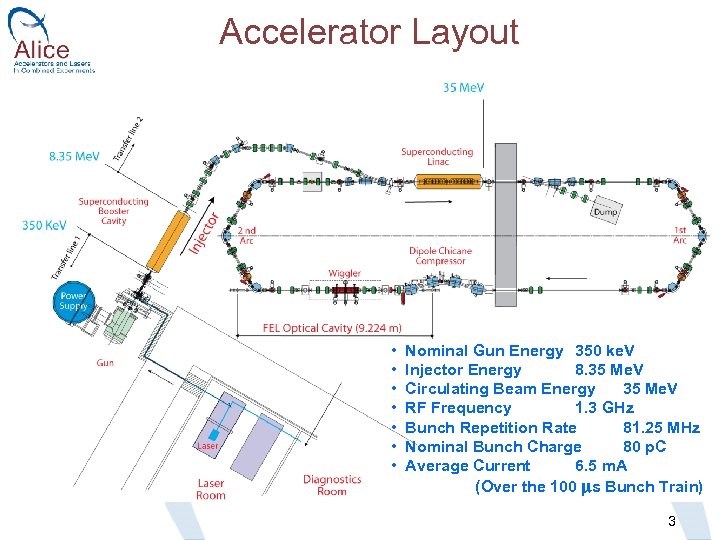 Accelerator Layout • • Nominal Gun Energy 350 ke. V Injector Energy 8. 35 Me. V Circulating Beam Energy 35 Me. V RF Frequency 1. 3 GHz Bunch Repetition Rate 81. 25 MHz Nominal Bunch Charge 80 p. C Average Current 6. 5 m. A (Over the 100 ms Bunch Train) 3
 Photoinjector
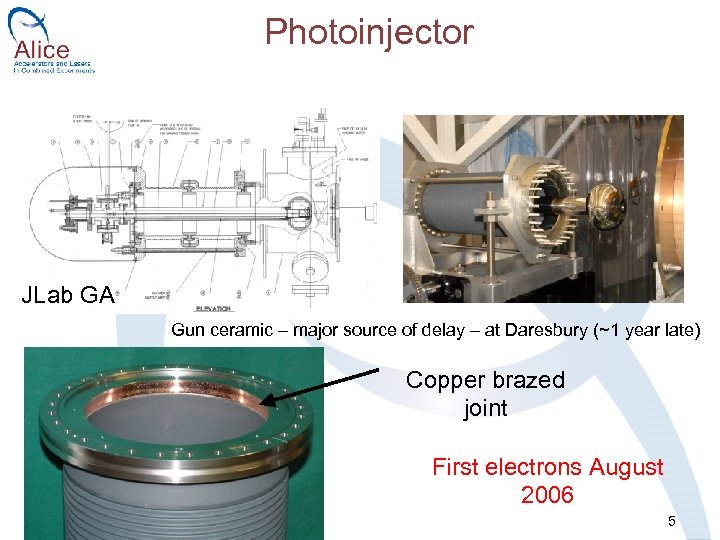 Photoinjector JLab GA Gun ceramic – major source of delay – at Daresbury (~1 year late) Copper brazed joint First electrons August 2006 5
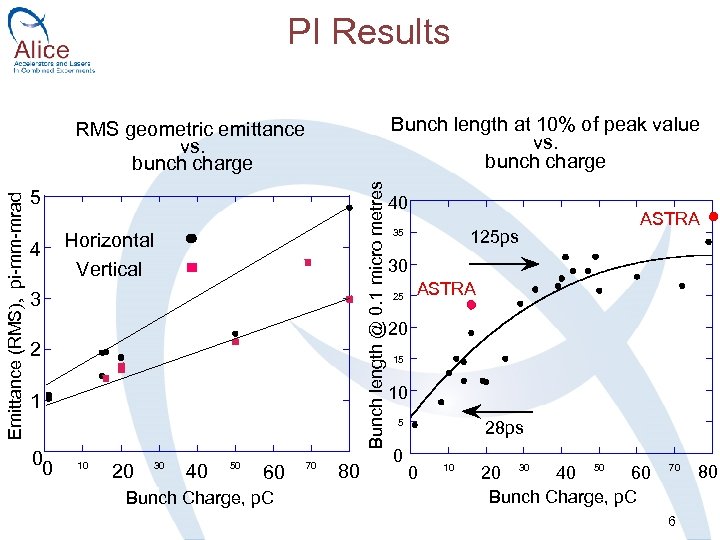 PI Results Bunch length at 10% of peak value vs. bunch charge Bunch length @ 0. 1 micro metres 5 Horizontal Vertical 4 3 2 1 0 0 Emittance (RMS), pi-mm-mrad RMS geometric emittance vs. bunch charge 10 20 30 40 50 60 Bunch Charge, p. C 70 80 40 125 ps 35 ASTRA 30 25 ASTRA 20 15 10 5 0 28 ps 0 10 20 30 40 50 60 Bunch Charge, p. C 70 6 80
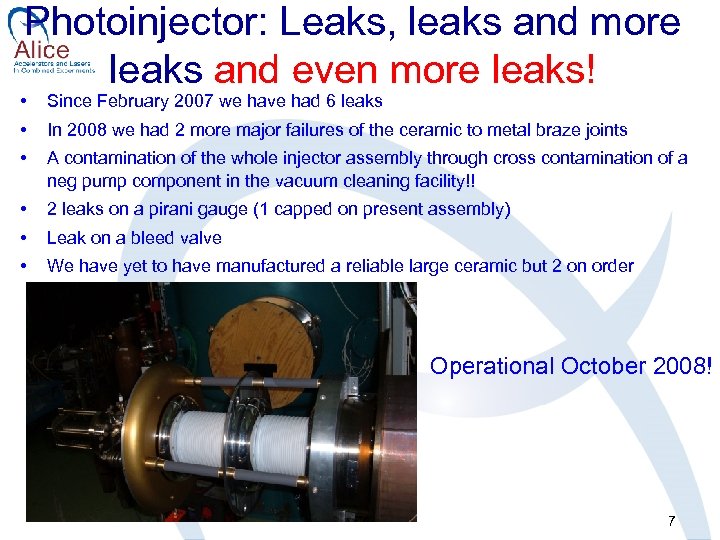 Photoinjector: Leaks, leaks and more leaks and even more leaks! • Since February 2007 we have had 6 leaks • In 2008 we had 2 more major failures of the ceramic to metal braze joints • A contamination of the whole injector assembly through cross contamination of a neg pump component in the vacuum cleaning facility!! • 2 leaks on a pirani gauge (1 capped on present assembly) • Leak on a bleed valve • We have yet to have manufactured a reliable large ceramic but 2 on order Operational October 2008! 7
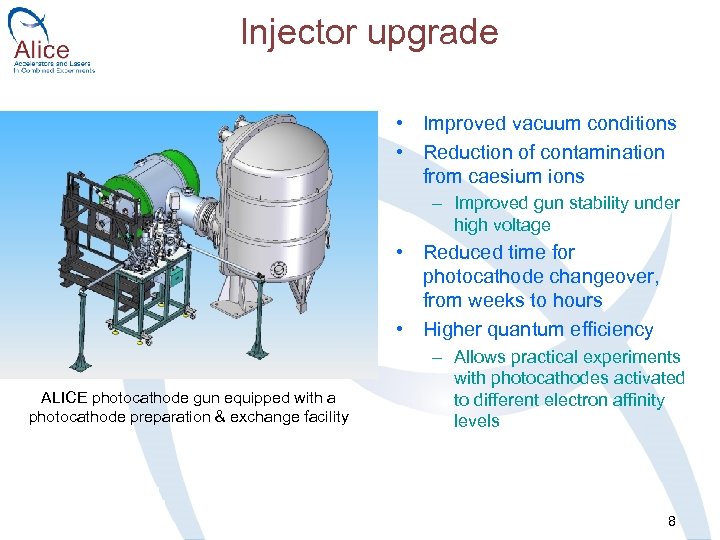 Injector upgrade • Improved vacuum conditions • Reduction of contamination from caesium ions – Improved gun stability under high voltage • Reduced time for photocathode changeover, from weeks to hours • Higher quantum efficiency ALICE photocathode gun equipped with a photocathode preparation & exchange facility – Allows practical experiments with photocathodes activated to different electron affinity levels 8
 Cryogenics and Superconducting RF Superconducting modules
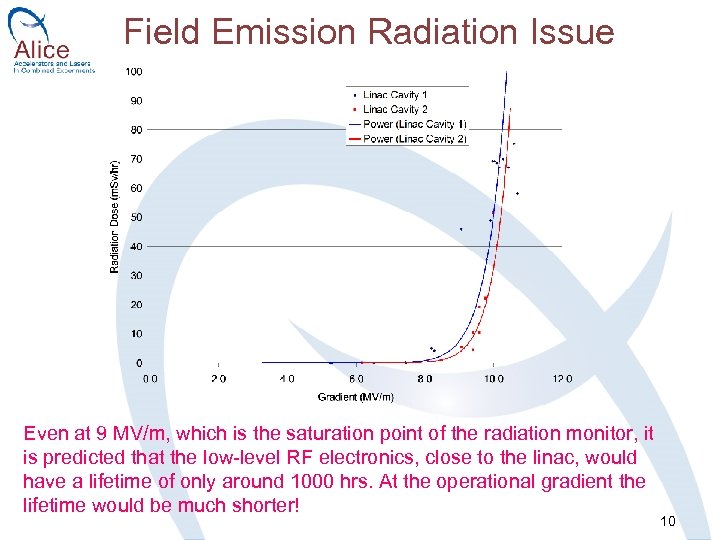 Field Emission Radiation Issue Even at 9 MV/m, which is the saturation point of the radiation monitor, it is predicted that the low-level RF electronics, close to the linac, would have a lifetime of only around 1000 hrs. At the operational gradient the lifetime would be much shorter! 10
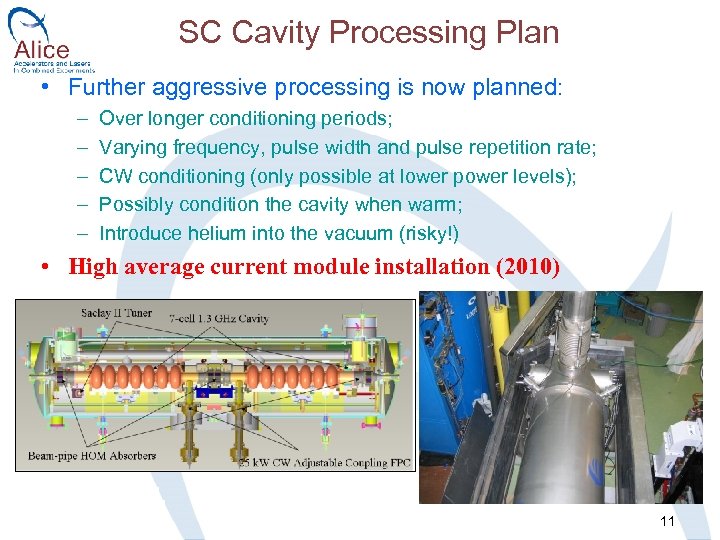 SC Cavity Processing Plan • Further aggressive processing is now planned: – – – Over longer conditioning periods; Varying frequency, pulse width and pulse repetition rate; CW conditioning (only possible at lower power levels); Possibly condition the cavity when warm; Introduce helium into the vacuum (risky!) • High average current module installation (2010) 11
 Commissioning ALICE
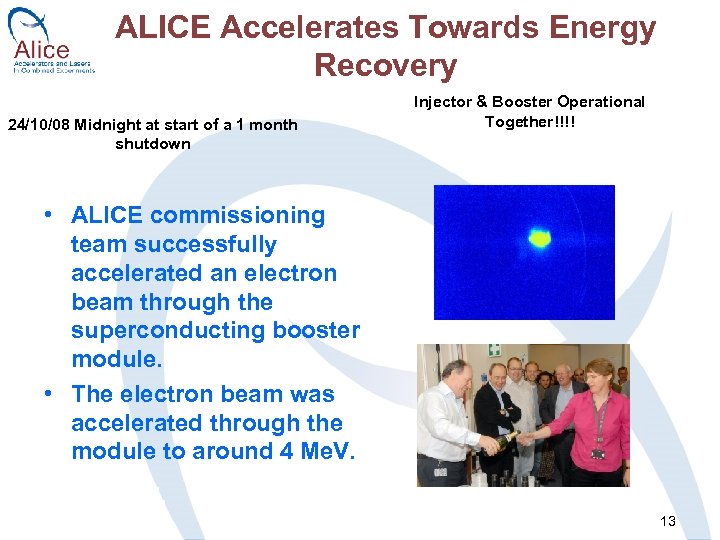 ALICE Accelerates Towards Energy Recovery 24/10/08 Midnight at start of a 1 month shutdown Injector & Booster Operational Together!!!! • ALICE commissioning team successfully accelerated an electron beam through the superconducting booster module. • The electron beam was accelerated through the module to around 4 Me. V. 13
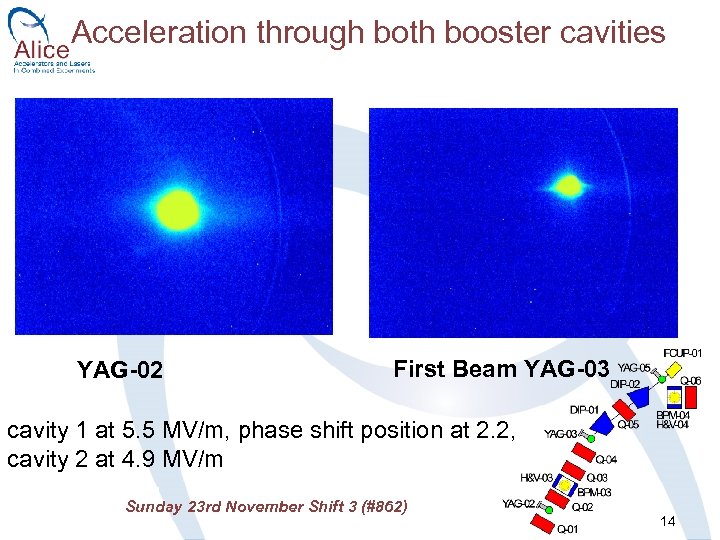 Acceleration through both booster cavities YAG-02 First Beam YAG-03 cavity 1 at 5. 5 MV/m, phase shift position at 2. 2, cavity 2 at 4. 9 MV/m Sunday 23 rd November Shift 3 (#862) 14
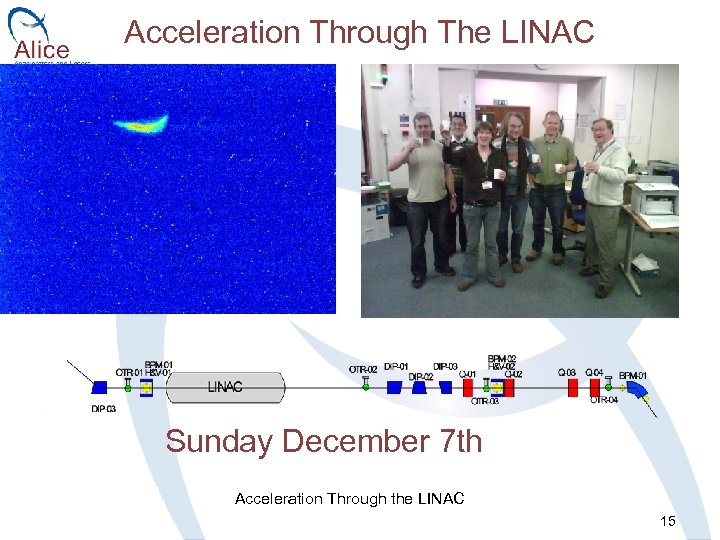 Acceleration Through The LINAC Sunday December 7 th Acceleration Through the LINAC 15
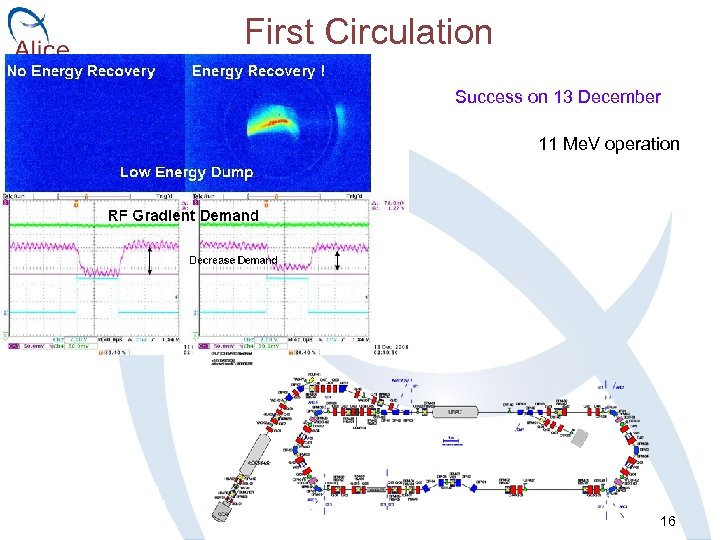 First Circulation Success on 13 December 11 Me. V operation 16
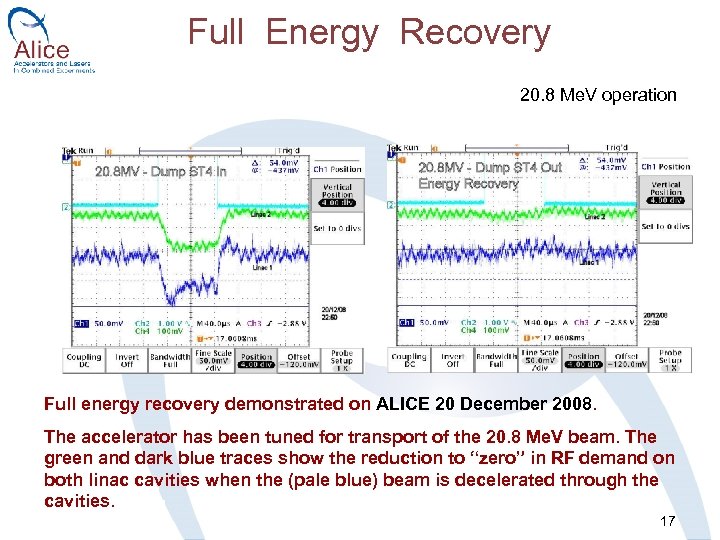 Full Energy Recovery 20. 8 Me. V operation Full energy recovery demonstrated on ALICE 20 December 2008. The accelerator has been tuned for transport of the 20. 8 Me. V beam. The green and dark blue traces show the reduction to “zero” in RF demand on both linac cavities when the (pale blue) beam is decelerated through the cavities. 17
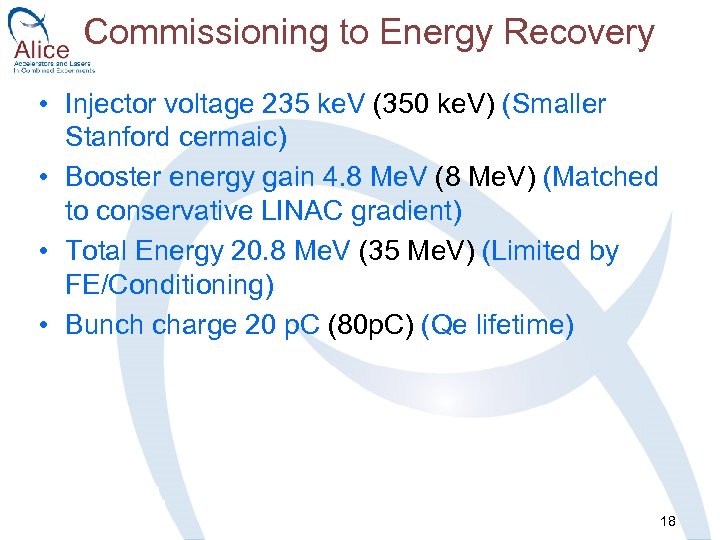 Commissioning to Energy Recovery • Injector voltage 235 ke. V (350 ke. V) (Smaller Stanford cermaic) • Booster energy gain 4. 8 Me. V (8 Me. V) (Matched to conservative LINAC gradient) • Total Energy 20. 8 Me. V (35 Me. V) (Limited by FE/Conditioning) • Bunch charge 20 p. C (80 p. C) (Qe lifetime) 18
 Commissioning ALICE • First energy recovery (Dec 2009) – Without FEL, installation planned Summer 2009 • Fine tuning – injector tuning for minimal emittance – optimisation of energy recovery at nominal beam parameters – beam diagnostics • Short pulse commissioning stage – longitudinal dynamics, electro-optical diagnostic studies • Energy recovery with FEL (Summer 2009) – first light ! – recovery of a disrupted beam 19
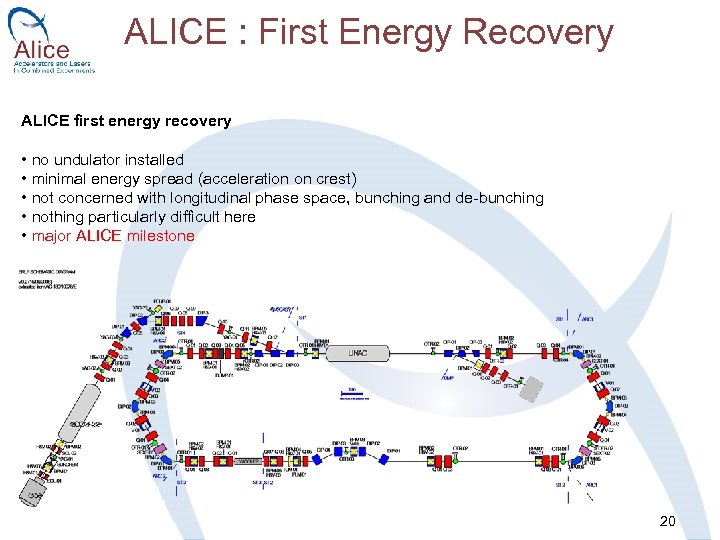 ALICE : First Energy Recovery ALICE first energy recovery • no undulator installed • minimal energy spread (acceleration on crest) • not concerned with longitudinal phase space, bunching and de-bunching • nothing particularly difficult here • major ALICE milestone 20
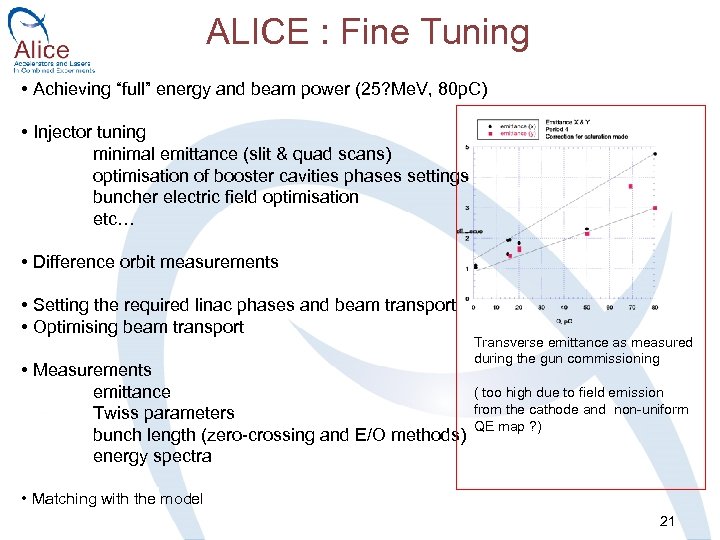 ALICE : Fine Tuning • Achieving “full” energy and beam power (25? Me. V, 80 p. C) • Injector tuning minimal emittance (slit & quad scans) optimisation of booster cavities phases settings buncher electric field optimisation etc… • Difference orbit measurements • Setting the required linac phases and beam transport • Optimising beam transport • Measurements emittance Twiss parameters bunch length (zero-crossing and E/O methods) energy spectra Transverse emittance as measured during the gun commissioning ( too high due to field emission from the cathode and non-uniform QE map ? ) • Matching with the model 21
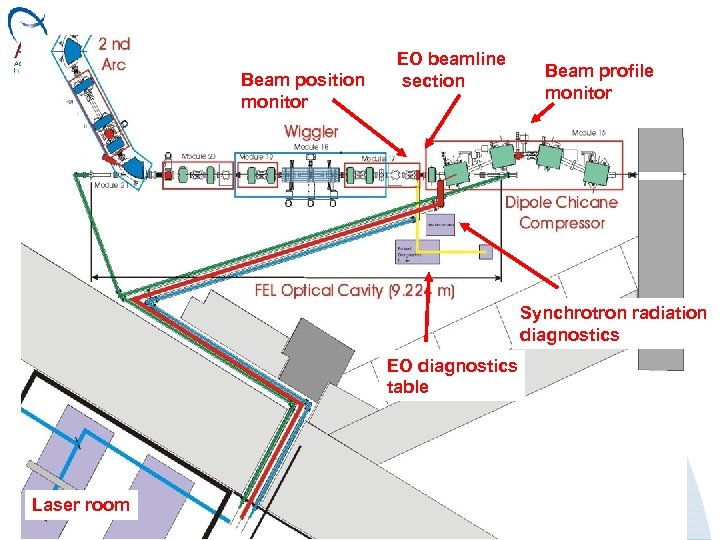
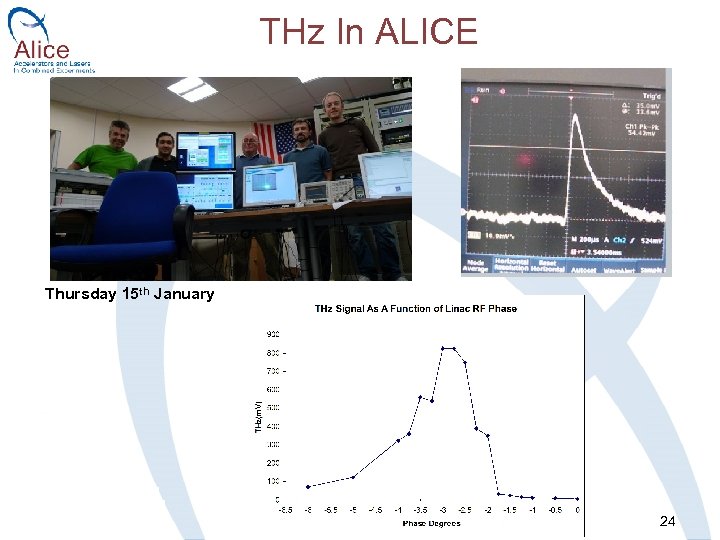
 ALICE : Short Pulse Commissioning • Initially, no FEL still not installed yet … • Longitudinal dynamics Linac phases tuning R 56 tuning in ARC 1 & ARC 2 sextupole tuning longitudinal bunch compression setup min bunch length • Phase transfer measurements using either BPMs or E/O • THz measurements • E/O bunch length measurements 22
 Beam position monitor EO beamline section Beam profile monitor Synchrotron radiation diagnostics EO diagnostics table Laser room 23
 THz In ALICE Thursday 15 th January 24
 EO Diagnostics and Synchronisation
 Electro-optic sampling of Coulomb field probe laser co-propagates with bunch (with transverse offset) Coulomb field of relativistic bunch probe laser encoding of bunch information into laser thanks to S. Jamison decoding of information from laser pulse 26
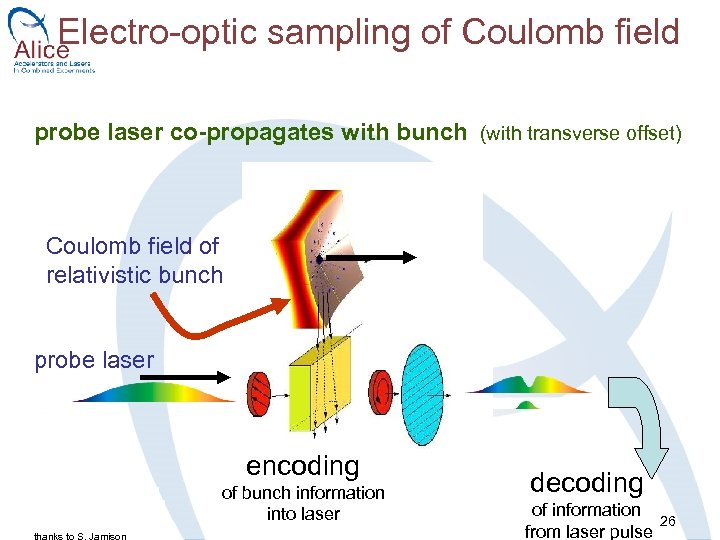
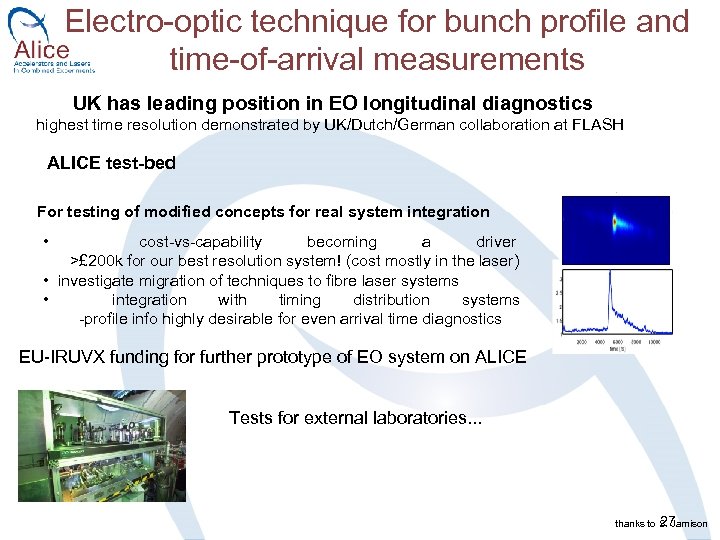 Electro-optic technique for bunch profile and time-of-arrival measurements UK has leading position in EO longitudinal diagnostics highest time resolution demonstrated by UK/Dutch/German collaboration at FLASH ALICE test-bed For testing of modified concepts for real system integration • cost-vs-capability becoming a driver >£ 200 k for our best resolution system! (cost mostly in the laser) • investigate migration of techniques to fibre laser systems • integration with timing distribution systems -profile info highly desirable for even arrival time diagnostics EU-IRUVX funding for further prototype of EO system on ALICE Tests for external laboratories. . . 27 thanks to S. Jamison
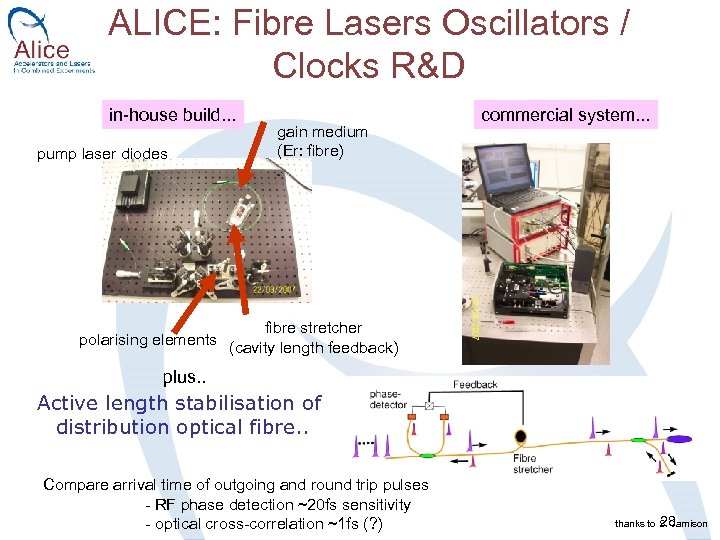 ALICE: Fibre Lasers Oscillators / Clocks R&D in-house build. . . pump laser diodes gain medium (Er: fibre) commercial system. . . fibre stretcher polarising elements (cavity length feedback) plus. . Active length stabilisation of distribution optical fibre. . Compare arrival time of outgoing and round trip pulses - RF phase detection ~20 fs sensitivity - optical cross-correlation ~1 fs (? ) 28 thanks to S. Jamison
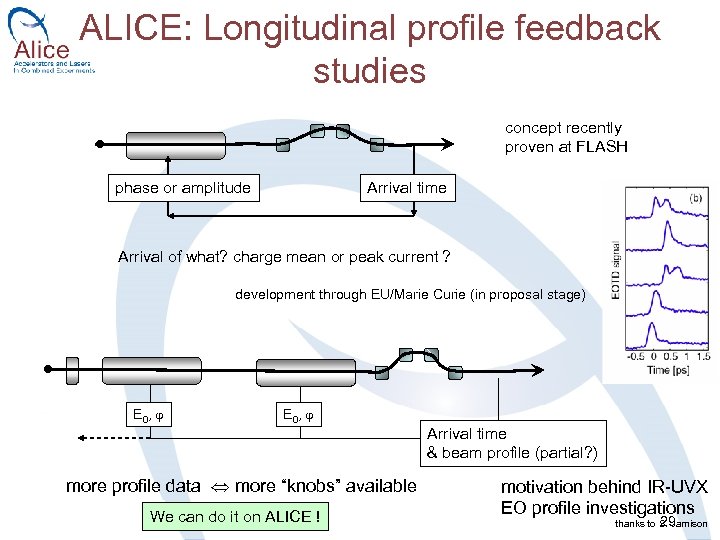 ALICE: Longitudinal profile feedback studies concept recently proven at FLASH phase or amplitude Arrival time Arrival of what? charge mean or peak current ? development through EU/Marie Curie (in proposal stage) E 0, j Arrival time & beam profile (partial? ) more profile data more “knobs” available We can do it on ALICE ! motivation behind IR-UVX EO profile investigations 29 thanks to S. Jamison
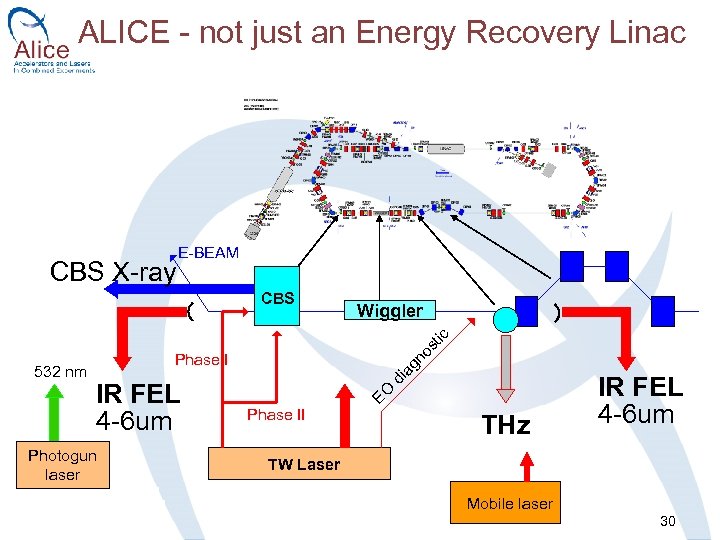 ALICE - not just an Energy Recovery Linac CBS X-ray E-BEAM Photogun laser di a IR FEL 4 -6 um gn o Phase I EO 532 nm Wiggler st ic CBS Phase II THz IR FEL 4 -6 um TW Laser Mobile laser 30
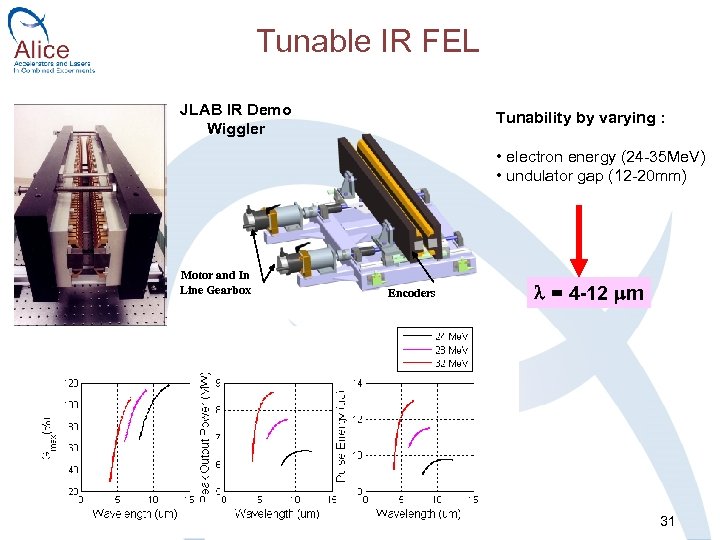 Tunable IR FEL JLAB IR Demo Wiggler Tunability by varying : • electron energy (24 -35 Me. V) • undulator gap (12 -20 mm) Motor and In Line Gearbox Encoders l = 4 -12 mm 31
 Future Plans
 Science Beyond Energy Recovery • • EMMA – the first NS FFAG Accelerator physics research – – – – • • Photoinjector upgrade, load lock system and diagnostics line High average current accelerator module Photocathode research and testing (using the upgraded gun) Linac Transfer Matrix Investigation Beam Tomography @ High Bunch Charges and Low Energy Laser slicing Micro-bunching? Laser Wakefield Acceleration (LWFA) on ALICE CBS X-ray source IR and THz research programme Tissue Culture Laboratory @ ALICE Exciting pump – probe research programme with all ALICE light sources: – – – TW laser (10 TW, 100 / 35 fs, 10 Hz) IR FEL (~4 mm, ~15 MW peak, ~1 ps, ~10 m. J) fs tunable laser THz radiation (broadband) CBS X-ray source (15 -30 ke. V, 107 – 108 photons/pulse, <1 ps) 33
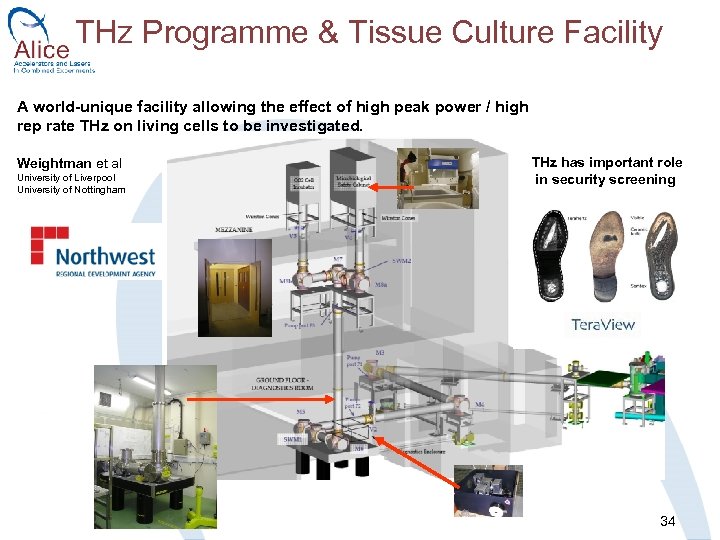 THz Programme & Tissue Culture Facility A world-unique facility allowing the effect of high peak power / high rep rate THz on living cells to be investigated. Weightman et al University of Liverpool University of Nottingham THz has important role in security screening 34
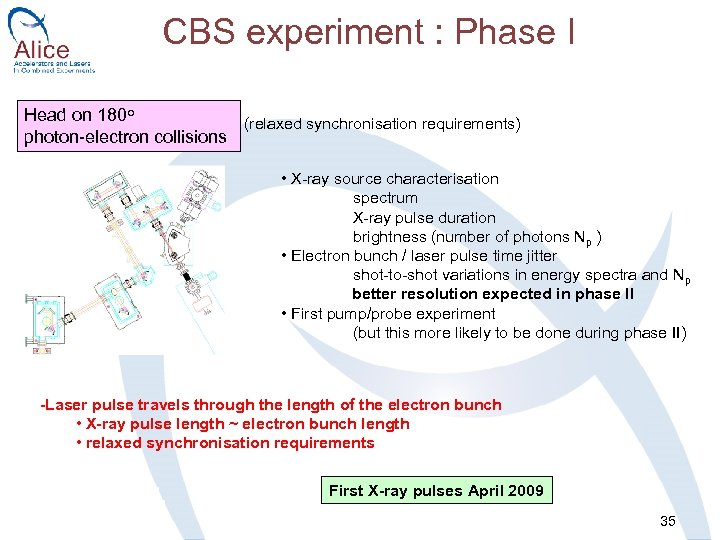 CBS experiment : Phase I Head on 180 o (relaxed synchronisation requirements) photon-electron collisions • X-ray source characterisation spectrum X-ray pulse duration brightness (number of photons Np ) • Electron bunch / laser pulse time jitter shot-to-shot variations in energy spectra and Np better resolution expected in phase II • First pump/probe experiment (but this more likely to be done during phase II) -Laser pulse travels through the length of the electron bunch • X-ray pulse length ~ electron bunch length • relaxed synchronisation requirements First X-ray pulses April 2009 35
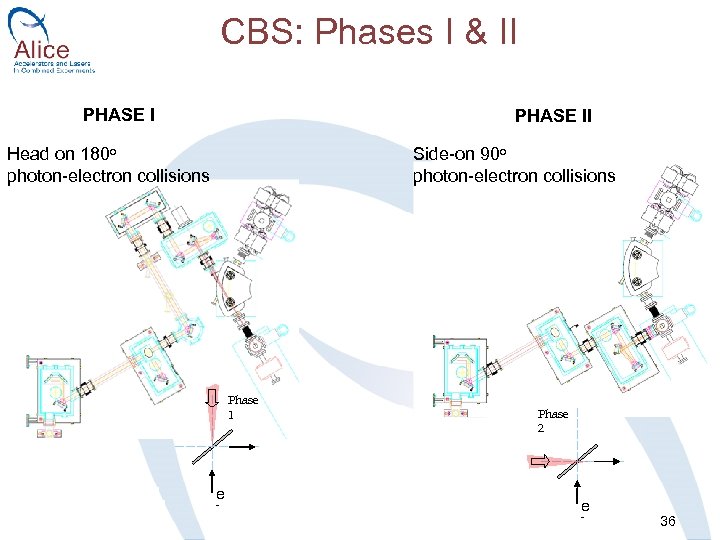 CBS: Phases I & II PHASE II Head on 180 o photon-electron collisions Side-on 90 o photon-electron collisions Phase 1 e - Phase 2 e - 36
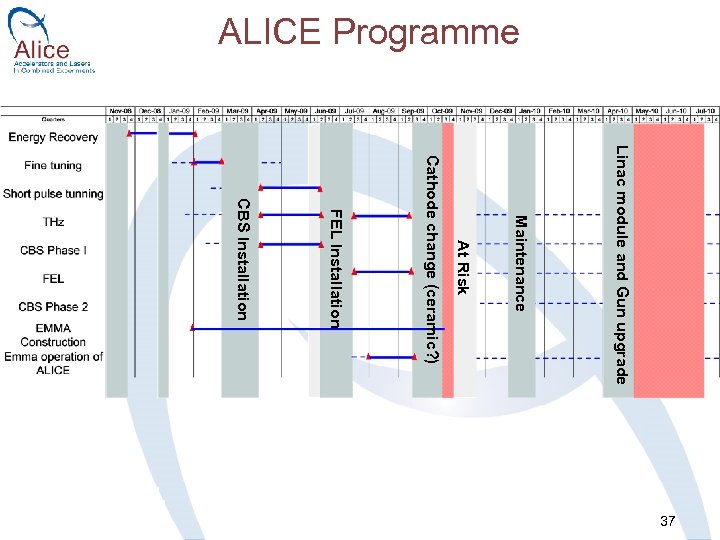 ALICE Programme Linac module and Gun upgrade Maintenance At Risk Cathode change (ceramic? ) FEL Installation CBS Installation 37
 Summary • Accelerator commissioning has now reached a critical stage • ALICE has provided the UK with an opportunity to develop generic technologies and skills important to delivery of advance accelerator driven facilities – Photoinjector, SC RF, cryogenics etc. • ALICE will provide a unique R&D facility in Europe, dedicated to accelerator science & technology development – Offering a unique combination of accelerator, laser and freeelectron laser sources – Enabling essential studies of beam combination techniques – Providing a suite of photon sources for scientific exploitation Many thanks to all contributors to this presentation 38