


 Скачать презентацию Algorithms and Data Structures Lecture XV Simonas Šaltenis
0addd6d826fa074a39a288fe74d42596.ppt
- Количество слайдов: 47
 Algorithms and Data Structures Lecture XV Simonas Šaltenis Nykredit Center for Database Research Aalborg University simas@cs. auc. dk November 7, 2002 1
 This Lecture n Tractable and intractable alg. Problems n n What is a ”reasonable” running time? NP problems, examples NP-complete problems and polynomial reducability What have we learned? November 7, 2002 2
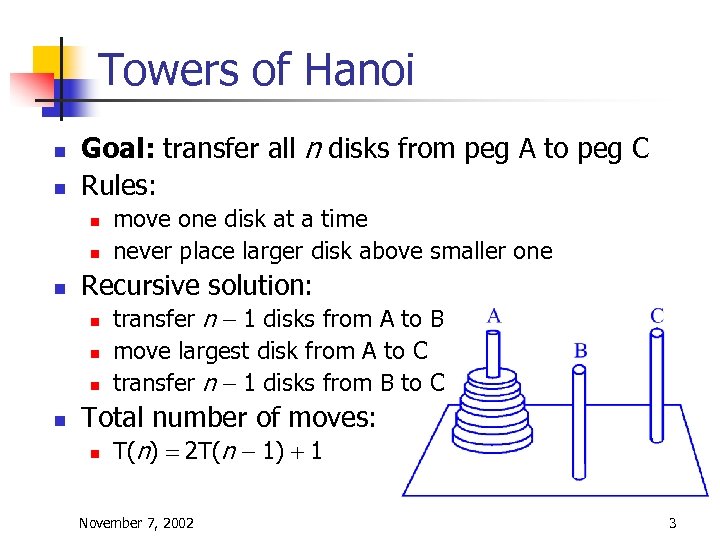 Towers of Hanoi n n Goal: transfer all n disks from peg A to peg C Rules: n n n Recursive solution: n n move one disk at a time never place larger disk above smaller one transfer n - 1 disks from A to B move largest disk from A to C transfer n - 1 disks from B to C Total number of moves: n T(n) = 2 T(n - 1) + 1 November 7, 2002 3
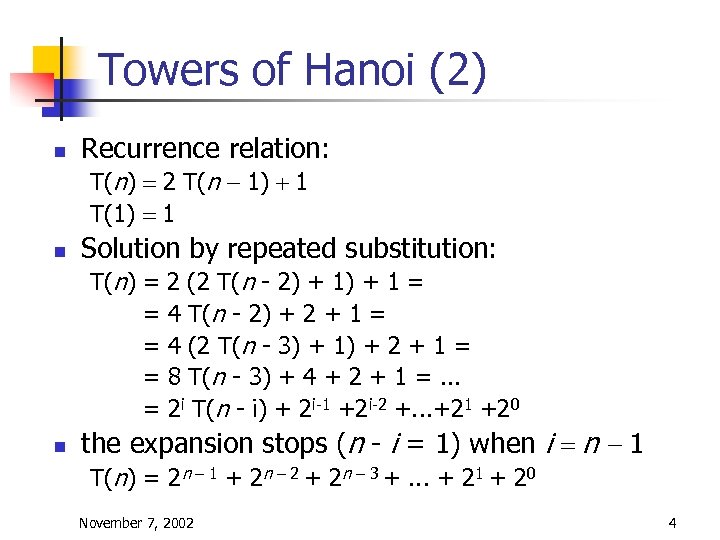 Towers of Hanoi (2) n Recurrence relation: T(n) = 2 T(n - 1) + 1 T(1) = 1 n Solution by repeated substitution: T(n) = 2 (2 T(n - 2) + 1 = = 4 T(n - 2) + 2 + 1 = = 4 (2 T(n - 3) + 1) + 2 + 1 = = 8 T(n - 3) + 4 + 2 + 1 =. . . = 2 i T(n - i) + 2 i-1 +2 i-2 +. . . +21 +20 n the expansion stops (n - i = 1) when i = n - 1 T(n) = 2 n – 1 + 2 n – 2 + 2 n – 3 +. . . + 21 + 20 November 7, 2002 4
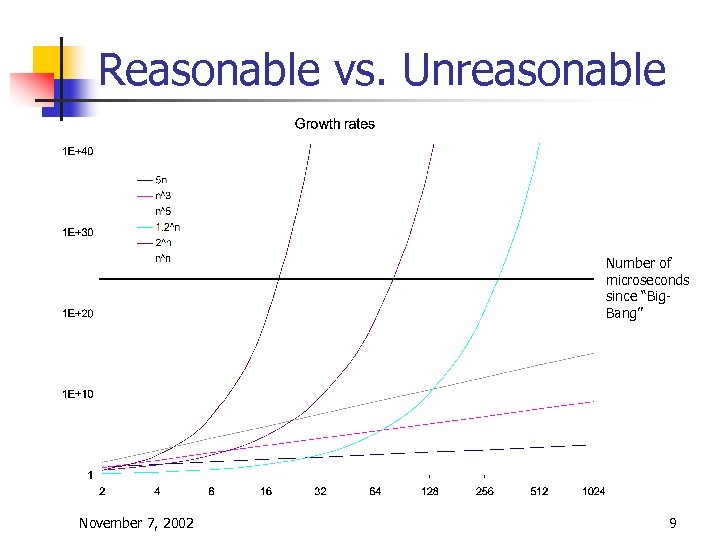
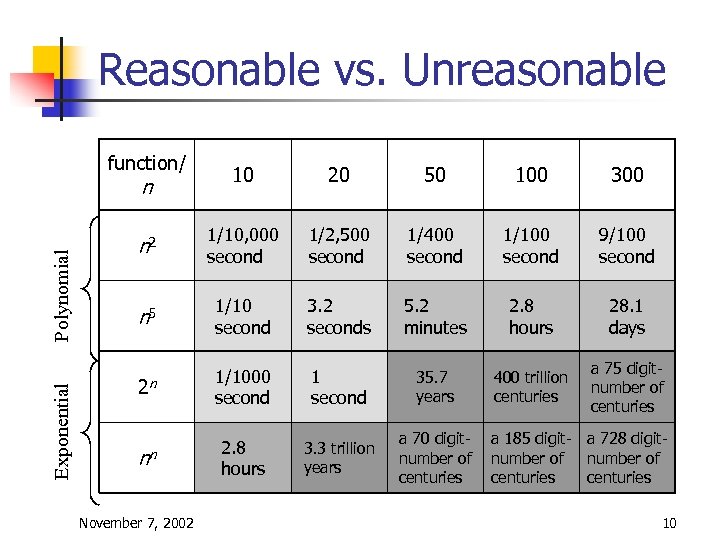
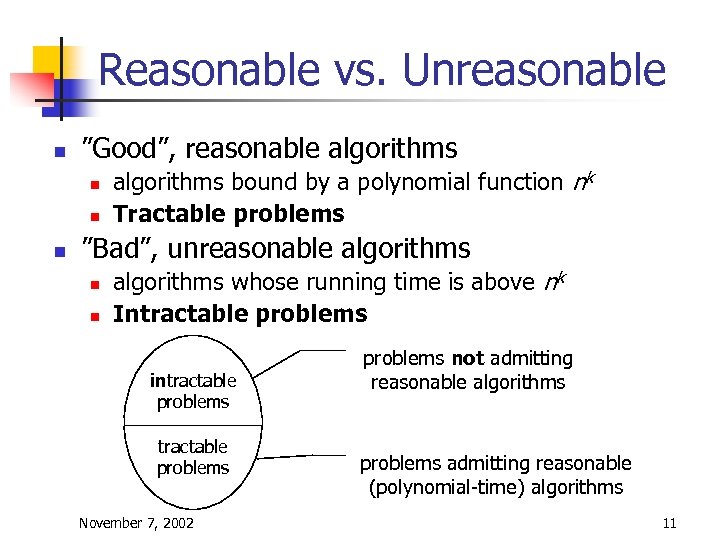
 Towers of Hanoi (3) n This is a geometric series, so that we have T(n) = 2 n - 1 = O(2 n) n n The running time of this algorithm is exponential (kn) rather than polynomial (nk) Good or bad news? n n n the Induist priests were confronted with a tower problem of 64 rings. . . assuming one could move 1 million rings per second, it would take half a million years to complete the process. . . One move per second = 585 billion years! November 7, 2002 5
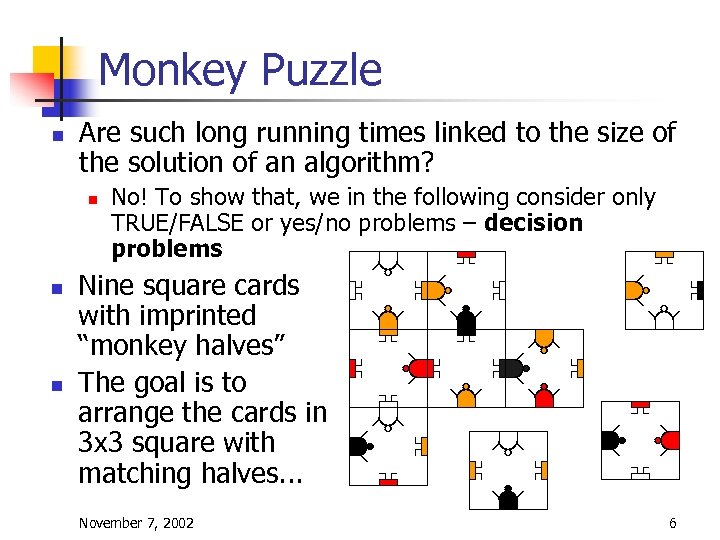 Monkey Puzzle n Are such long running times linked to the size of the solution of an algorithm? n n n No! To show that, we in the following consider only TRUE/FALSE or yes/no problems – decision problems Nine square cards with imprinted “monkey halves” The goal is to arrange the cards in 3 x 3 square with matching halves. . . November 7, 2002 6
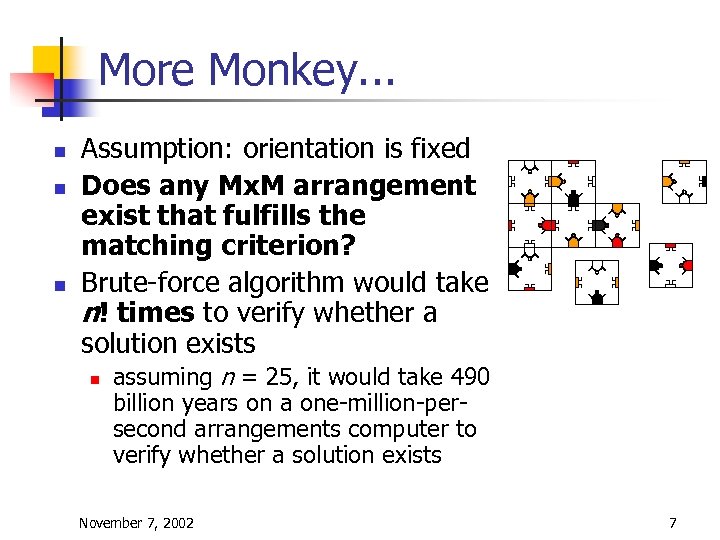 More Monkey. . . n n n Assumption: orientation is fixed Does any Mx. M arrangement exist that fulfills the matching criterion? Brute-force algorithm would take n! times to verify whether a solution exists n assuming n = 25, it would take 490 billion years on a one-million-persecond arrangements computer to verify whether a solution exists November 7, 2002 7
 Monkey (3) n Improving the algorithm n n discarding partial arrangements etc. A smart algorithm would still take a couple of thousand years in the worst case Is there an easier way to find solutions? MAYBE! But nobody has found them, yet! (room for smart students. . . ) November 7, 2002 8
 Reasonable vs. Unreasonable Number of microseconds since “Big. Bang” November 7, 2002 9
 Reasonable vs. Unreasonable function/ 10 20 50 100 300 n 2 1/10, 000 second 1/2, 500 second 1/400 second 1/100 second 9/100 second n 5 1/10 second 3. 2 seconds 5. 2 minutes 2. 8 hours 28. 1 days 2 n 1/1000 second 1 second 35. 7 years 400 trillion centuries a 75 digitnumber of centuries nn 2. 8 hours 3. 3 trillion years a 70 digitnumber of centuries Exponential Polynomial n November 7, 2002 a 185 digit- a 728 digitnumber of centuries 10
 Reasonable vs. Unreasonable n ”Good”, reasonable algorithms n n n algorithms bound by a polynomial function nk Tractable problems ”Bad”, unreasonable algorithms n n algorithms whose running time is above nk Intractable problems intractable problems November 7, 2002 problems not admitting reasonable algorithms problems admitting reasonable (polynomial-time) algorithms 11
 So What! n Computers become faster every day n n insignificant (a constant) compared to exp. running time Maybe the Monkey puzzle is just one specific problem, we could simply ignore n n n the monkey puzzle falls into a category of problems called NPC (NP complete) problems (~1000 problems) all admit unreasonable solutions not known to admit reasonable ones… November 7, 2002 12
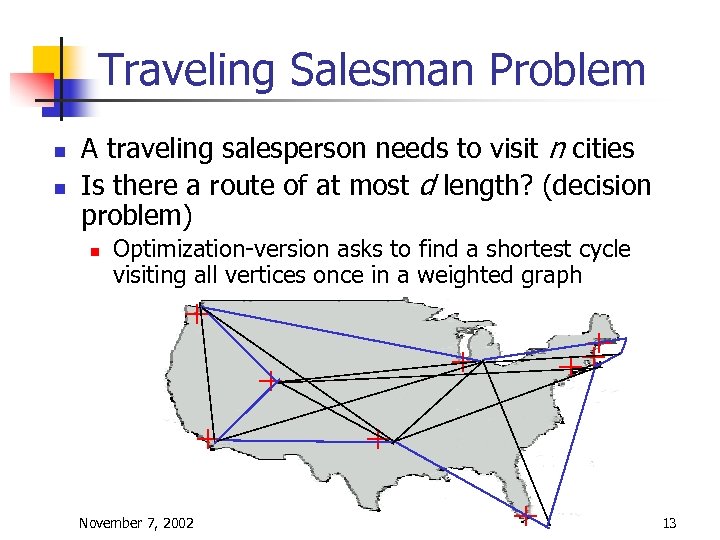 Traveling Salesman Problem n n A traveling salesperson needs to visit n cities Is there a route of at most d length? (decision problem) n Optimization-version asks to find a shortest cycle visiting all vertices once in a weighted graph November 7, 2002 13
 TSP Algorithms n n Naive solutions take n! time in worst-case, where n is the number of edges of the graph No polynomial-time algorithms are known n n TSP is an NP-complete problem Longest Path problem between A and B in a weighted grapah is also NP-complete n Remember the running time for the shortest path problem November 7, 2002 14
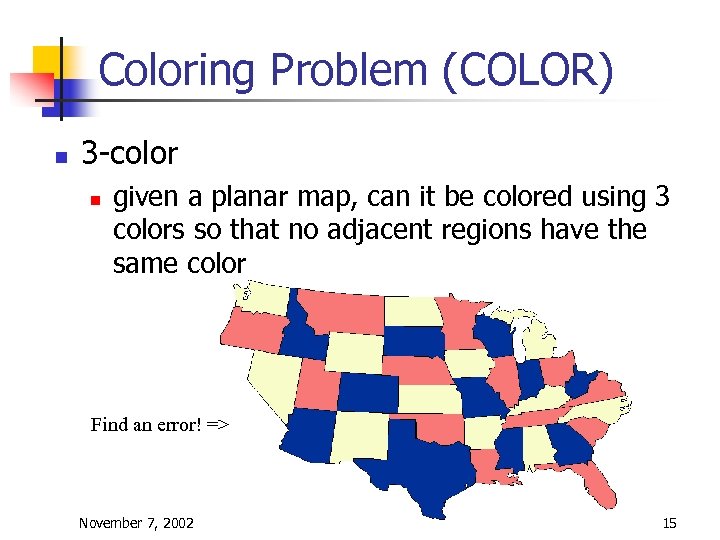 Coloring Problem (COLOR) n 3 -color n given a planar map, can it be colored using 3 colors so that no adjacent regions have the same color Find an error! => November 7, 2002 15
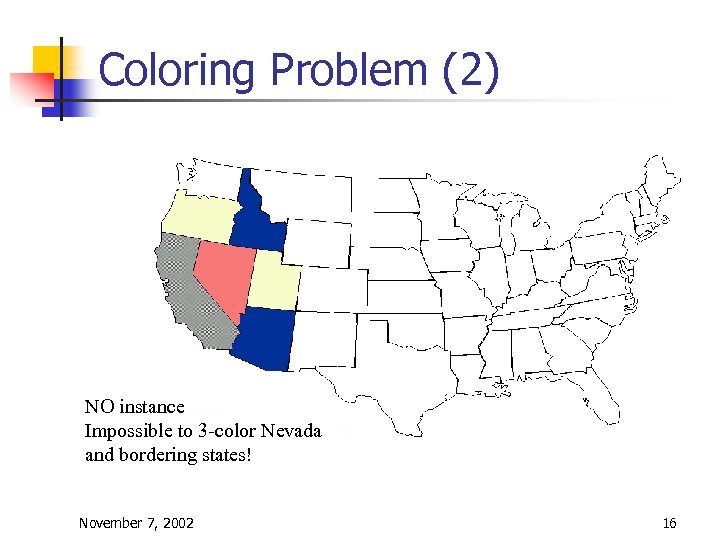 Coloring Problem (2) NO instance Impossible to 3 -color Nevada and bordering states! November 7, 2002 16
 Coloring Problem (3) n n n Any map can be 4 -colored Maps that contain no points that are the junctions of an odd number of states can be 2 -colored No polynomial algorithms are known to determine whether a map can be 3 colored – it’s an NP-complete problem November 7, 2002 17
 Determining Truth (SAT) n n Determine the truth or falsity of logical sentences in a simple logical formalism called propositional calculus Using the logical connectives (&-and, Ú-or, ~-not, ®-implies) we compose expressions such as the following ~(E ® F) & (F Ú (D ® ~E)) n The algorithmic problem calls for determining the satisfiability of such sentences n e. g. , E = true, D and F = false November 7, 2002 18
 Determining Truth (SAT) n n Exponential time algorithm on n = the number of distinct elementary assertions (O(2 n)) Best known solution, problem is in NPcomplete class! November 7, 2002 19
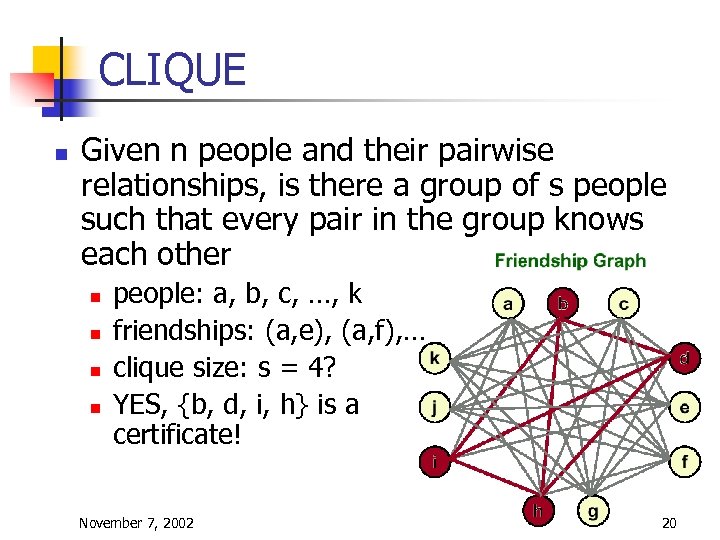 CLIQUE n Given n people and their pairwise relationships, is there a group of s people such that every pair in the group knows each other n n people: a, b, c, …, k friendships: (a, e), (a, f), … clique size: s = 4? YES, {b, d, i, h} is a certificate! November 7, 2002 20
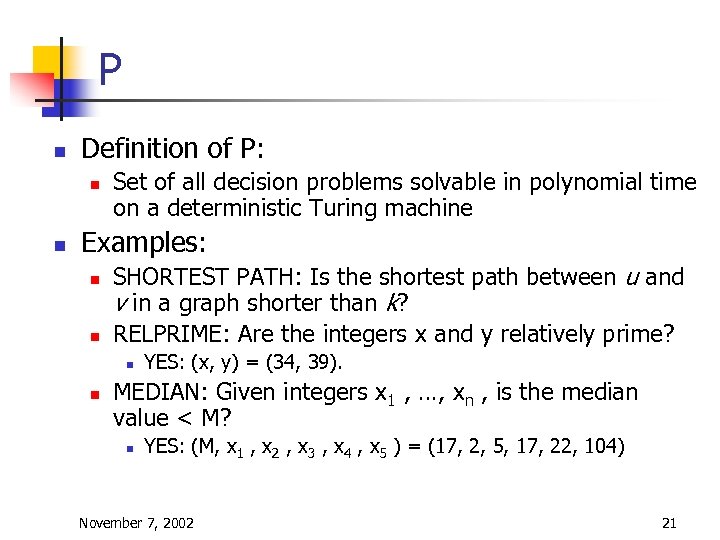 P n Definition of P: n n Set of all decision problems solvable in polynomial time on a deterministic Turing machine Examples: n n SHORTEST PATH: Is the shortest path between u and v in a graph shorter than k? RELPRIME: Are the integers x and y relatively prime? n n YES: (x, y) = (34, 39). MEDIAN: Given integers x 1 , …, xn , is the median value < M? n YES: (M, x 1 , x 2 , x 3 , x 4 , x 5 ) = (17, 2, 5, 17, 22, 104) November 7, 2002 21
 P (2) n P is the set of all decision problems solvable in polynomial time on REAL computers. November 7, 2002 22
 Short Certificates n n To find a solution for an NPC problem, we seem to be required to try out exponential amounts of partial solutions Failing in extending a partial solution requires backtracking However, once we found a solution, convincing someone of it is easy, if we keep a proof, i. e. , a certificate The problem is finding an answer (exponential), but not verifying a potential solution (polynomial) November 7, 2002 23
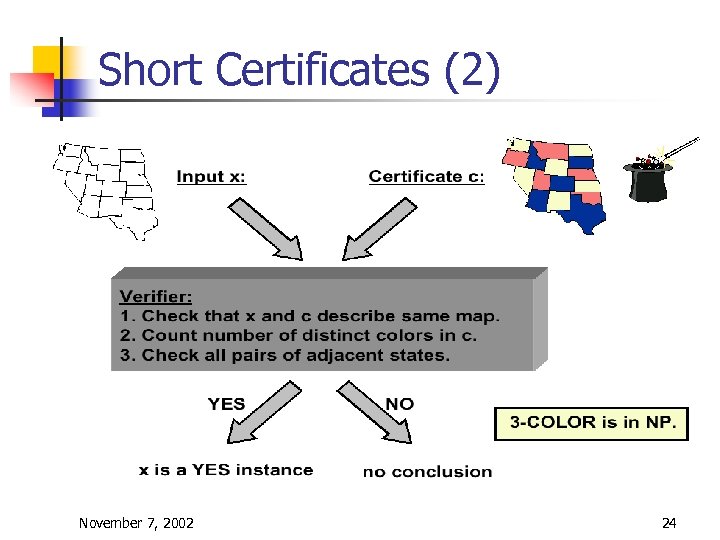 Short Certificates (2) November 7, 2002 24
 On Magic Coins and Oracles n Assume we use a magic coin in the backtracking algorithm n n n whenever it is possible to extend a partial solutions in ”two” ways, we perform a coin toss (two monkey cards, next truth assignment, etc. ) the outcome of this ”act” determines further actions – we use magical insight, supernatural powers! Such algorithms are termed ”nondeterministic” n they guess which option is better, rather than employing some deterministic procedure to go through the alternatives November 7, 2002 25
 NP n Definition of NP: n n n Set of all decision problems solvable in polynomial time on a NONDETERMINISTIC Turing machine Definition important because it links many fundamental problems Useful alternative definition n Set of all decision problems with efficient verification algorithms n n efficient = polynomial number of steps on deterministic TM Verifier: algorithm for decision problem with extra input November 7, 2002 26
 NP (2) n n NP = set of decision problems with efficient verification algorithms Why doesn’t this imply that all problems in NP can be solved efficiently? n BIG PROBLEM: need to know certificate ahead of time n n real computers can simulate by guessing all possible certificates and verifying naïve simulation takes exponential time unless you get "lucky" November 7, 2002 27
 NP-Completeness n Informal definition of NP-hard: n n A problem with the property that if it can be solved efficiently, then it can be used as a subroutine to solve any other problem in NP efficiently NP-complete problems are NP problems that are NP-hard n ”Hardest computational problems” in NP November 7, 2002 28
 NP-Completeness (2) n n n Each NPC problem’s faith is tightly coupled to all the others (complete set of problems) Finding a polynomial time algorithm for one NPC problem would automatically yield a polynomial time algorithm for all NP problems Proving that one NP-complete problem has an exponential lower bound woud automatically proove that all other NPcomplete problems have exponential lower bounds November 7, 2002 29
 NP-Completeness (3) n How can we prove such a statement? n Polynomial time reduction! n n given two problems it is an algorithm running in polynomial time that reduces one problem to the other such that n n given input X to the first and asking for a yes/no answer we transform X into input Y to the second problem such that its answer matches the answer of the first problem November 7, 2002 30
 Reduction Example n Reduction is a general technique for showing that one problem is harder (easier) than another n n For problems A and B, we can often show: if A can be solved efficiently, then so can B In this case, we say B reduces to A (B is "easier" than A, or, B cannot be ”worse” than A) November 7, 2002 31
 Redcution Example (2) n SAT reduces to CLIQUE n n n Given any input to SAT, we create a corresponding input to CLIQUE that will help us solve the original SAT problem Specifically, for a SAT formula with K clauses, we construct a CLIQUE input that has a clique of size K if and only if the original Boolean formula is satisfiable If we had an efficient algorithm for CLIQUE, we could apply our transformation, solve the associated CLIQUE problem, and obtain the yes/no answer for the original SAT problem November 7, 2002 32
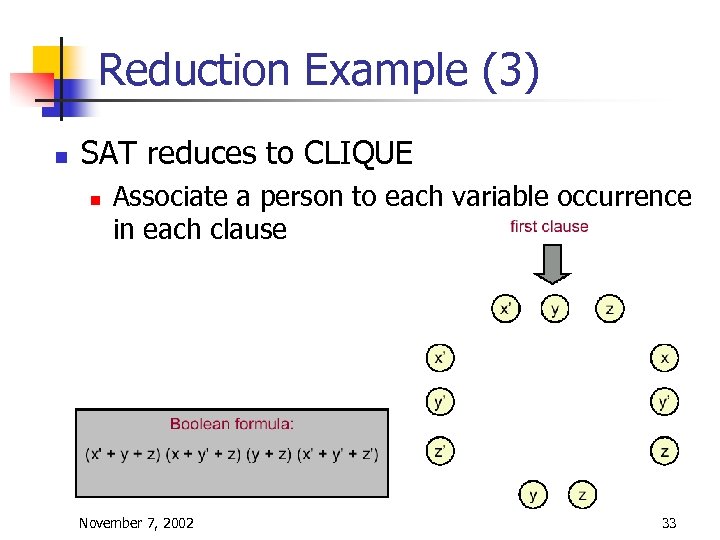 Reduction Example (3) n SAT reduces to CLIQUE n Associate a person to each variable occurrence in each clause November 7, 2002 33
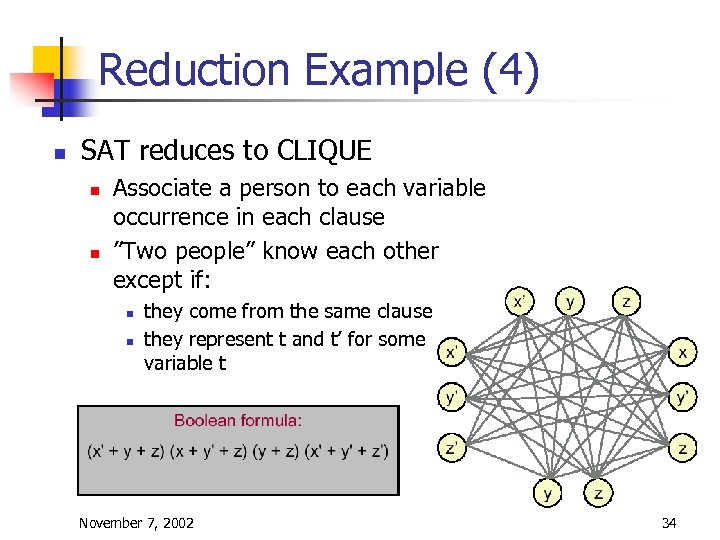 Reduction Example (4) n SAT reduces to CLIQUE n n Associate a person to each variable occurrence in each clause ”Two people” know each other except if: n n they come from the same clause they represent t and t’ for some variable t November 7, 2002 34
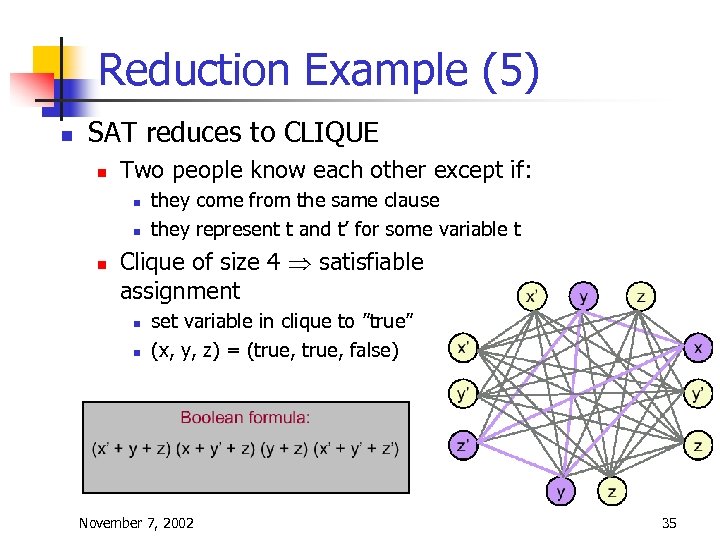 Reduction Example (5) n SAT reduces to CLIQUE n Two people know each other except if: n n n they come from the same clause they represent t and t’ for some variable t Clique of size 4 Þ satisfiable assignment n n set variable in clique to ”true” (x, y, z) = (true, false) November 7, 2002 35
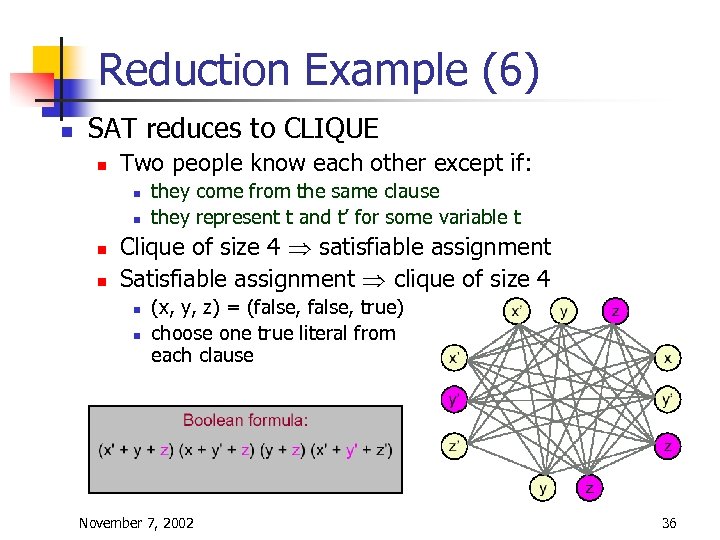 Reduction Example (6) n SAT reduces to CLIQUE n Two people know each other except if: n n they come from the same clause they represent t and t’ for some variable t Clique of size 4 Þ satisfiable assignment Satisfiable assignment Þ clique of size 4 n n (x, y, z) = (false, true) choose one true literal from each clause November 7, 2002 36
 CLIQUE is NP-complete n n n n CLIQUE is in NP SAT is in NP-complete SAT reduces to CLIQUE Hundreds of problems can be shown to be NP-complete that way… November 7, 2002 37
 The Start… n n The World’s first NP-complete problem SAT is NP-complete. (Cook-Levin, 1960’s) November 7, 2002 38
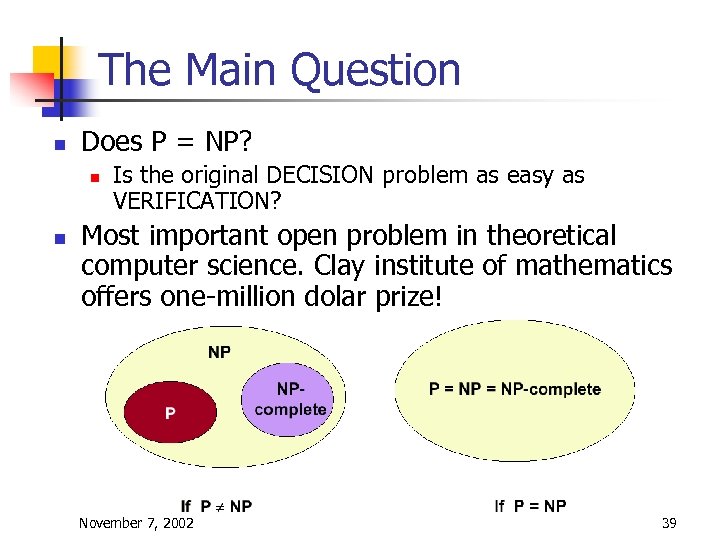 The Main Question n Does P = NP? n n Is the original DECISION problem as easy as VERIFICATION? Most important open problem in theoretical computer science. Clay institute of mathematics offers one-million dolar prize! November 7, 2002 39
 The Main Question (2) n If P=NP, then: n n Efficient algorithms for 3 - COLOR, TSP, and factoring. Cryptography is impossible on conventional machines Modern banking system will collapse If no, then: n Can’t hope to write efficient algorithm for TSP n n see NP- completeness But maybe efficient algorithm still exists for testing the primality of a number – i. e. , there are some problems that are NP, but not NP-complete November 7, 2002 40
 The Main Question (3) n Probably no, since: n n n Thousands of researchers have spent four decades in search of polynomial algorithms for many fundamental NP-complete problems without success Consensus opinion: P ¹ NP But maybe yes, since: n No success in proving P ¹ NP either November 7, 2002 41
 Dealing with NP-Completeness n Hope that a worst case doesn’t occur n Complexity theory deals with worst case behavior. The instance(s) you want to solve may be "easy" n n n Change the problem n n Develop a heuristic, and hope it produces a good solution. Design an approximation algorithm: algorithm that is guaranteed to find a high- quality solution in polynomial time n n TSP where all points are on a line or circle 13, 509 US city TSP problem solved (Cook et. al. , 1998) active area of research, but not always possible Keep trying to prove P = NP. November 7, 2002 42
 The Big Picture n n Summarizing: it is not known whether NP problems are tractable or intractable But, there exist provably intractable problems n n Even worse – there exist problems with running times unimaginably worse than exponential! More bad news: there are provably noncomputable (undecidable) problems n There are no (and there will not ever be!!!) algorithms to solve these problems November 7, 2002 43
 The Course n Toolbox of algorithmic techniques n n n Divide and Conquer (Merge sort, Quicksort, Binary search, Closest pair) Dynamic programming (Matrix chain multiplication, Longest Common Subsequence) Greedy algorithms (Prim’s, Kruskal’s, Dijkstra’s) Sweeping in computational geometry Analysis of algorithms: n n n Correctness of algorithm Asymptotic notations Recurrences November 7, 2002 44
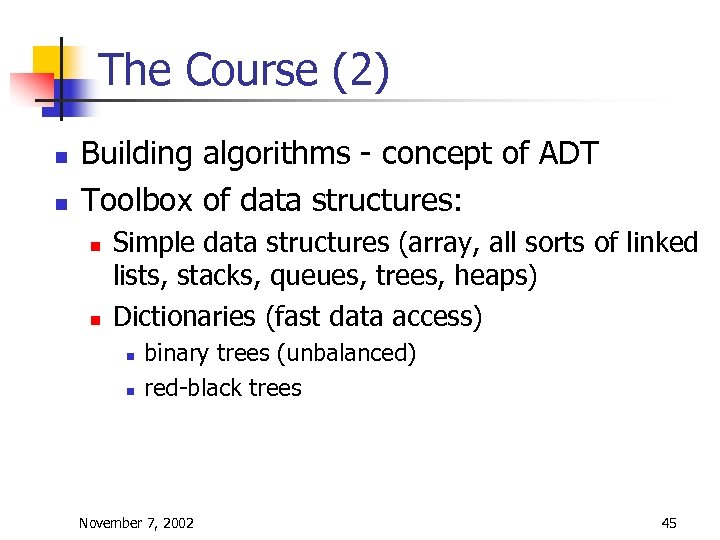 The Course (2) n n Building algorithms - concept of ADT Toolbox of data structures: n n Simple data structures (array, all sorts of linked lists, stacks, queues, trees, heaps) Dictionaries (fast data access) n n binary trees (unbalanced) red-black trees November 7, 2002 45
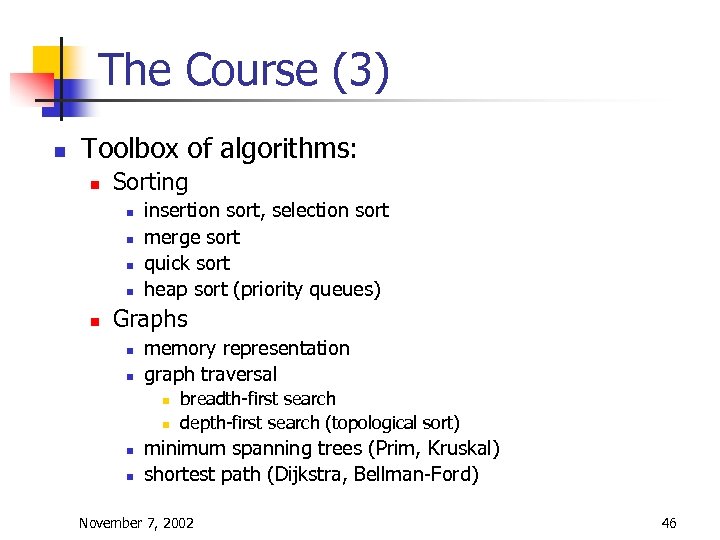 The Course (3) n Toolbox of algorithms: n Sorting n n n insertion sort, selection sort merge sort quick sort heap sort (priority queues) Graphs n n memory representation graph traversal n n breadth-first search depth-first search (topological sort) minimum spanning trees (Prim, Kruskal) shortest path (Dijkstra, Bellman-Ford) November 7, 2002 46
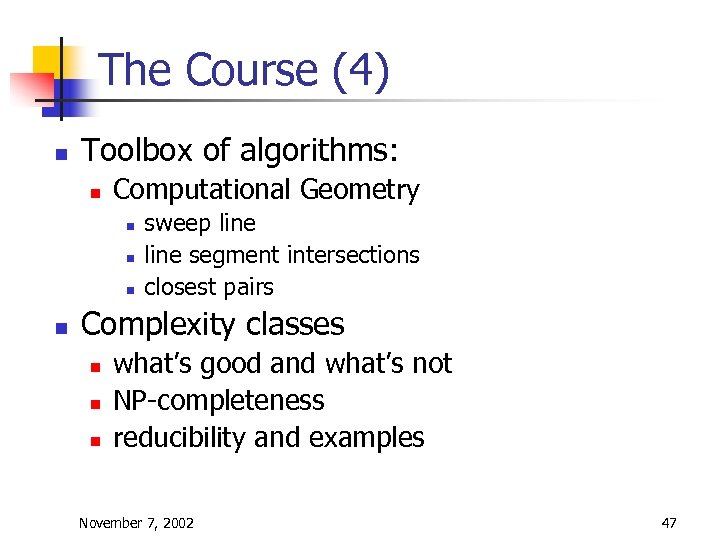 The Course (4) n Toolbox of algorithms: n Computational Geometry n n sweep line segment intersections closest pairs Complexity classes n n n what’s good and what’s not NP-completeness reducibility and examples November 7, 2002 47