


 Скачать презентацию Algorithmic Trading as a Science Haksun Li haksun
8acfc739c84b61b6eec6848f5a5045d0.ppt
- Количество слайдов: 57
 Algorithmic Trading as a Science Haksun Li haksun. li@numericalmethod. com www. numericalmethod. com
 Speaker Profile Haksun Li, Numerical Method Inc. Quantitative Trader Quantitative Analyst Ph. D, Computer Science, University of Michigan Ann Arbor M. S. , Financial Mathematics, University of Chicago B. S. , Mathematics, University of Chicago
 Definition Quantitative trading is the systematic execution of trading orders decided by quantitative market models. It is an arms race to build more comprehensive and accurate prediction models (mathematics) more reliable and faster execution platforms (computer science)
 Scientific Trading Models Scientific trading models are supported by logical arguments. can list out assumptions can quantify models from assumptions can deduce properties from models can test properties can do iterative improvements
 Superstition Many “quantitative” models are just superstitions supported by fallacies and wishful-thinking.
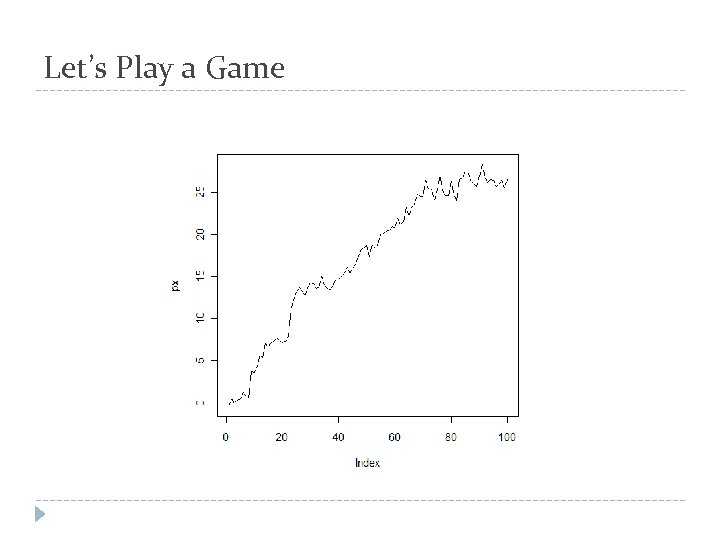 Let’s Play a Game
 Impostor Quant. Trader Decide that this is a bull market by drawing a line by (spurious) linear regression Conclude that the slope is positive the t-stat is significant Long Take profit at 2 upper sigmas Stop-loss at 2 lower sigmas
 Reality r = rnorm(100) px = cumsum(r) plot(px, type='l')
 Mistakes Data snooping Inappropriate use of mathematics assumptions of linear regression Ad-hoc take profit and stop-loss linearity homoscedasticity independence normality why 2? How do you know when the model is invalidated?
 Fake Quantitative Models Assumptions cannot be quantified No model validation against the current regime Cannot explain winning and losing trades Cannot be analyzed (systematically)
 Extensions of a Wrong Model Some traders elaborate on this idea by using a moving calibration window (e. g. , Bands) using various sorts of moving averages (e. g. , MA, WMA, EWMA)
 A Scientific Approach Start with a market insight (hypothesis) Translate English into mathematics hopefully without peeking at the data write down the idea in math formulae In-sample calibration; out-sample backtesting Understand why the models work or fail in terms of model parameters e. g. , unstable parameters, small p-values
 MANY Mathematical Tools Available Markov model co-integration stationarity hypothesis testing bootstrapping signal processing, e. g. , Kalman filter returns distribution after news/shocks time series modeling The list goes on and on……
 A Sample Trading Idea When the price trends up, we buy. When the price trends down, we sell.
 What is a Trend?
 An Upward Trend More positive returns than negative ones. Positive returns are persistent.
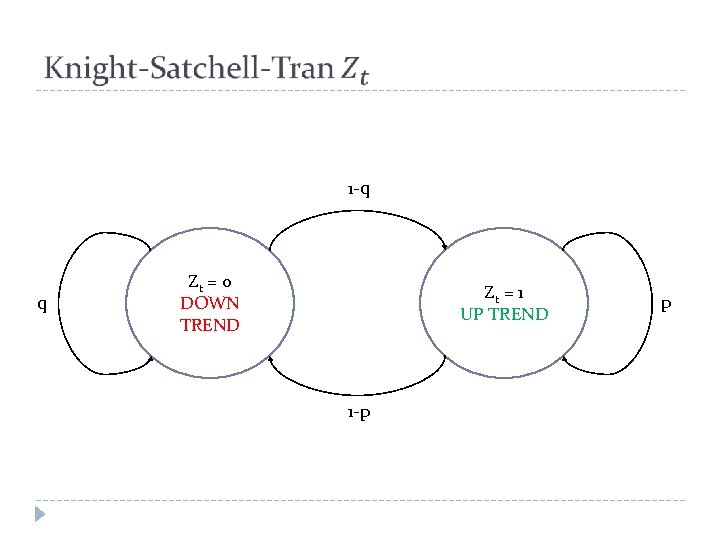 1 -q q Zt = 0 DOWN TREND Zt = 1 UP TREND 1 -p p
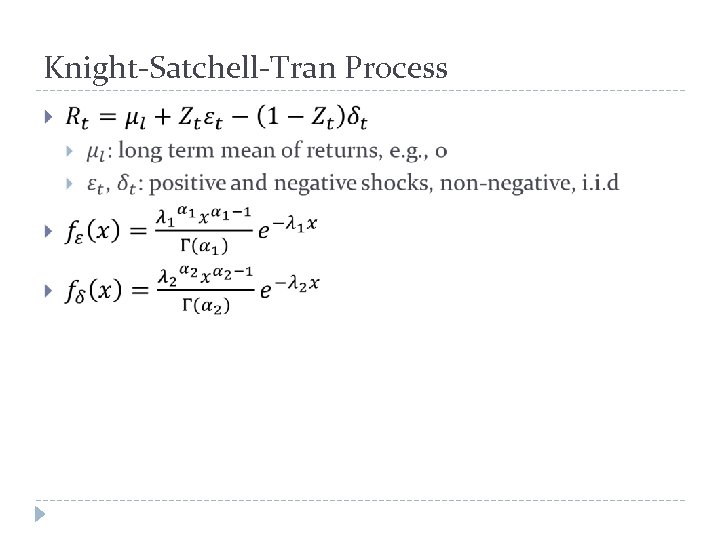 Knight-Satchell-Tran Process
 How Signal Do We Use? Let’s try Moving Average Crossover.
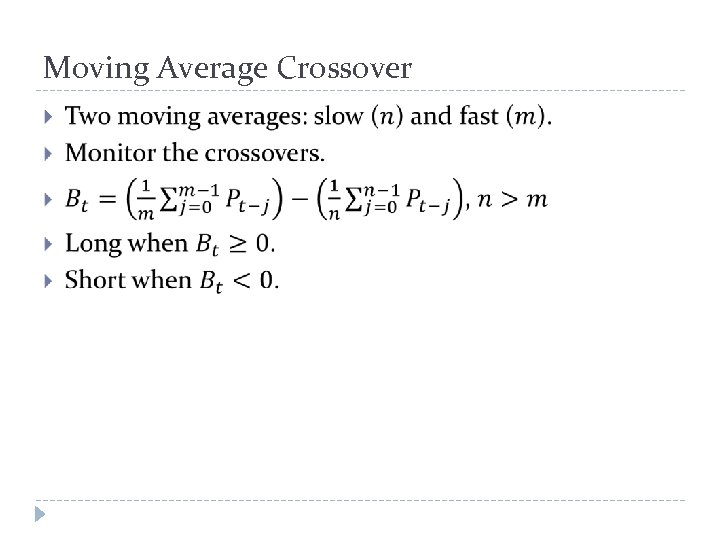 Moving Average Crossover
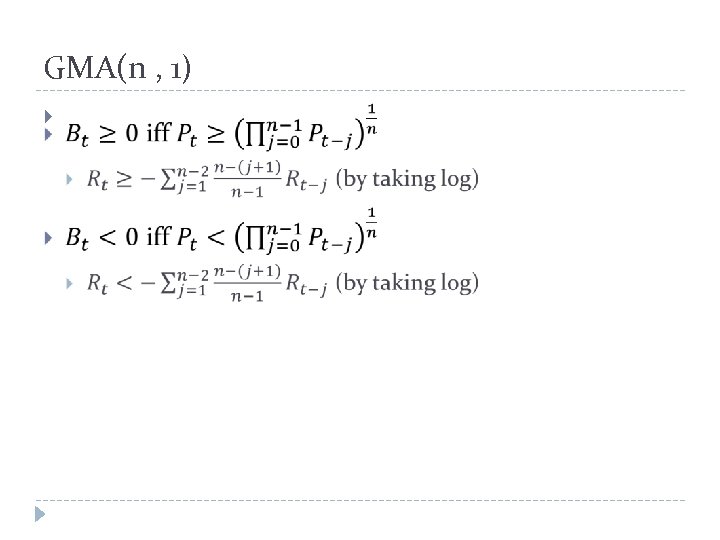 GMA(n , 1)
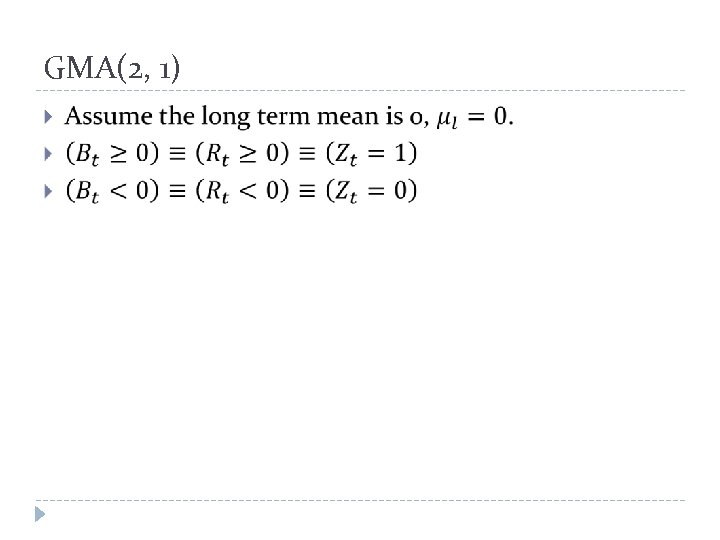 GMA(2, 1)
 Naïve MA Trading Rule Buy when the asset return in the present period is positive. Sell when the asset return in the present period is negative.
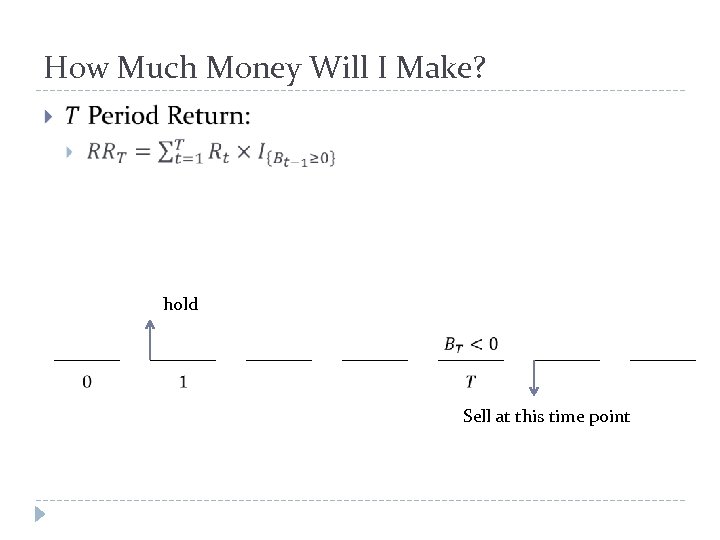 How Much Money Will I Make? hold Sell at this time point
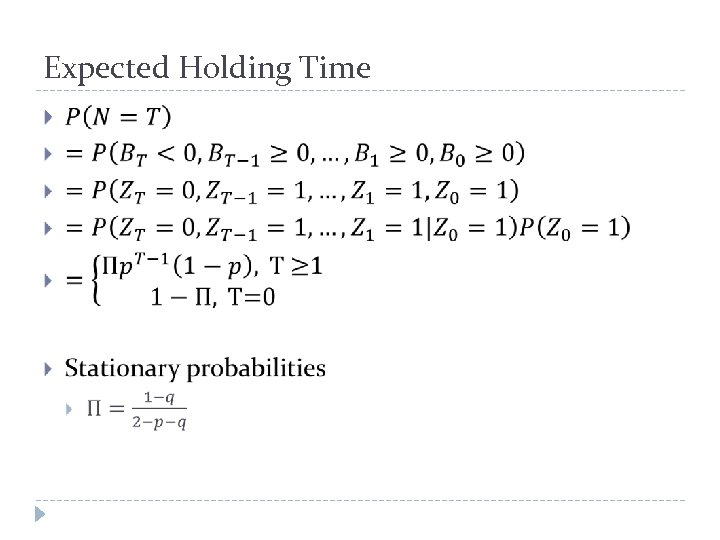 Expected Holding Time
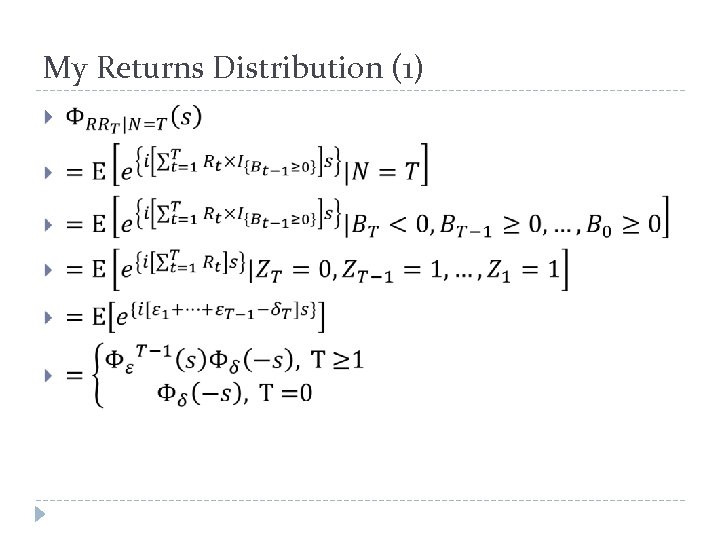 My Returns Distribution (1)
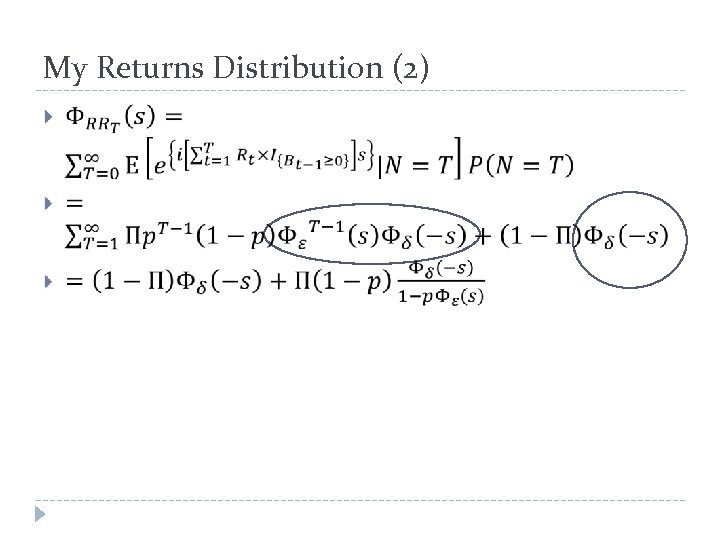 My Returns Distribution (2)
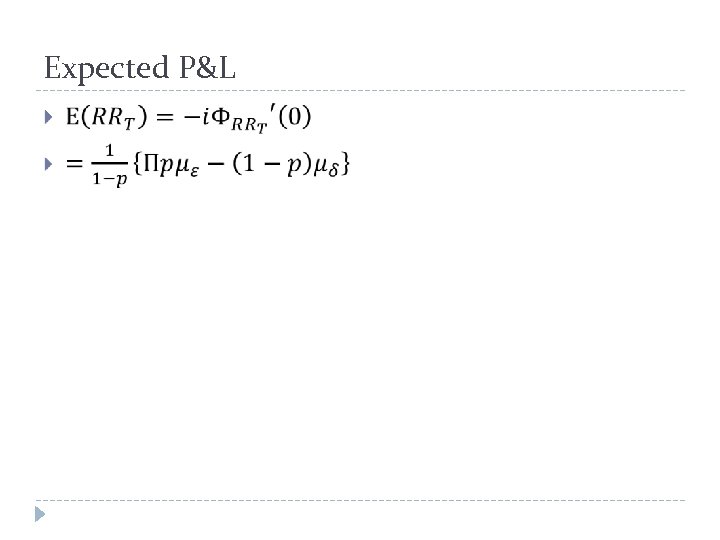 Expected P&L
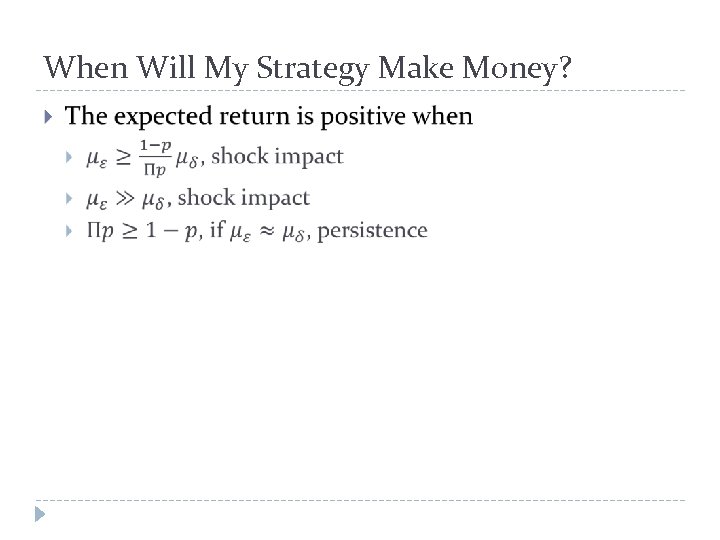 When Will My Strategy Make Money?
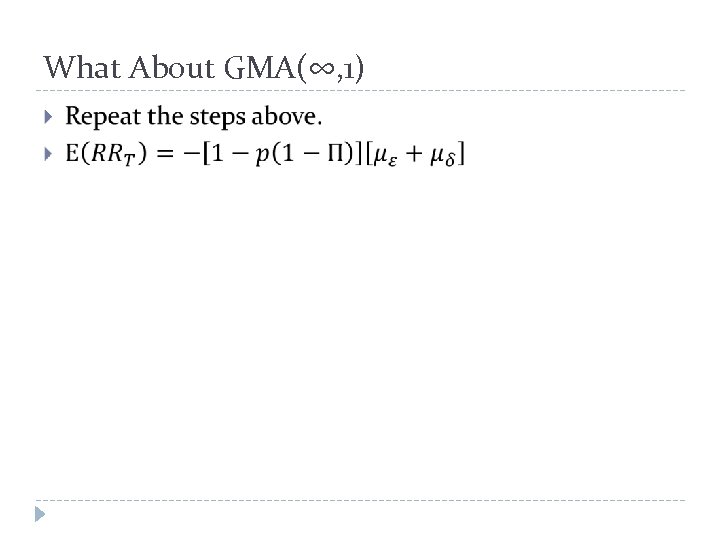 What About GMA(∞, 1)
 When Will GMA(∞, 1) Make Money?
 Model Benefits (1) It makes “predictions” about which regime we are now in. We quantify how useful the model is by the parameter sensitivity the duration we stay in each regime the state differentiation power
 Model Benefits (2) We can explain winning and losing trades. Is it because of calibration? Is it because of state prediction? We can deduce the model properties. Are 2 states sufficient? prediction variance? We can justify take-profit and stop-loss based on trader utility function.
 Backtesting simulates a strategy (model) using historical or fake (controlled) data. It gives an idea of how a strategy would work in the past. It gives an objective way to measure strategy performance. It generates data and statistics that allow further analysis, investigation and refinement. It does not tell whether it will work in the future. e. g. , winning and losing trades, returns distribution It helps choose take-profit and stop-loss.
 Some Performance Statistics p&l mean, stdev, corr Sharpe ratio confidence intervals max drawdown breakeven ratio biggest winner/loser breakeven bid/ask slippage
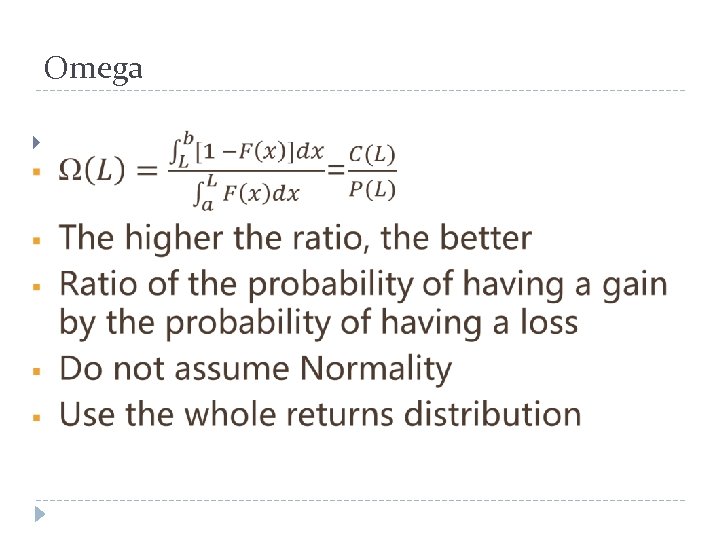 Omega
Omega
 Performance on MSCI Singapore
 Bootstrapping We observe only one history. What if the world had evolve different? Simulate “similar” histories to get confidence interval. White's reality check (White, H. 2000).
 Fake Data
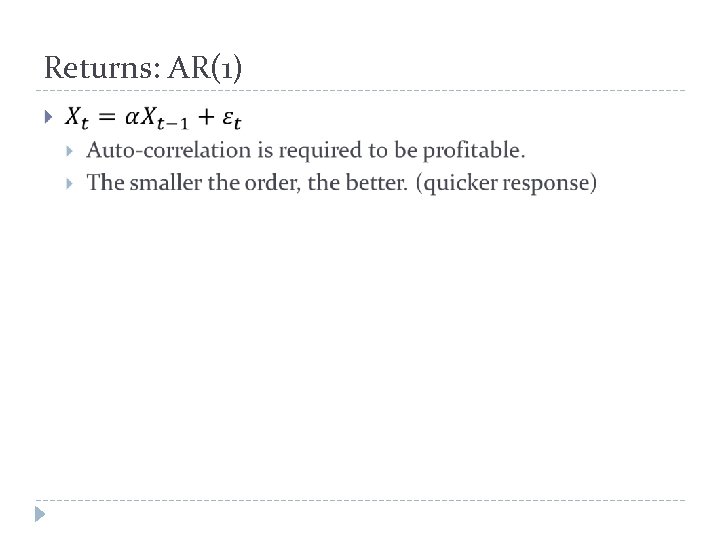 Returns: AR(1)
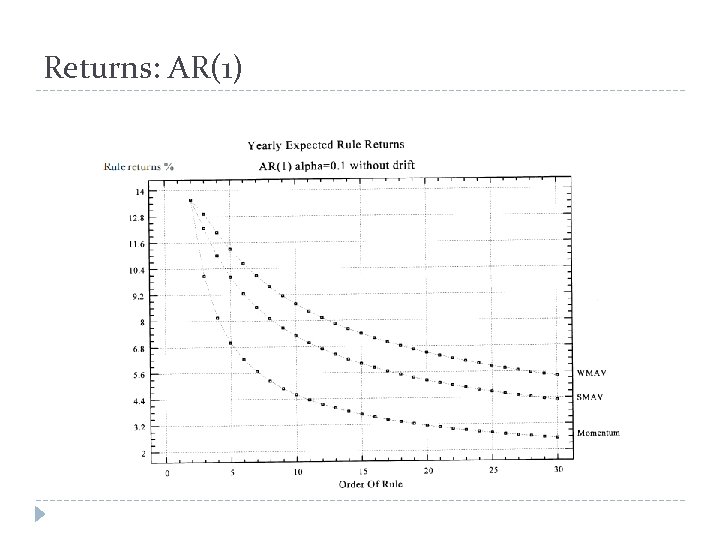 Returns: AR(1)
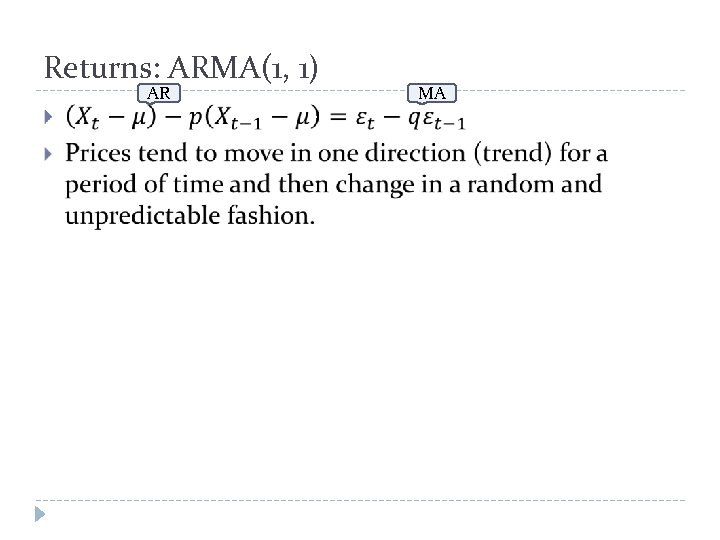 Returns: ARMA(1, 1) AR MA
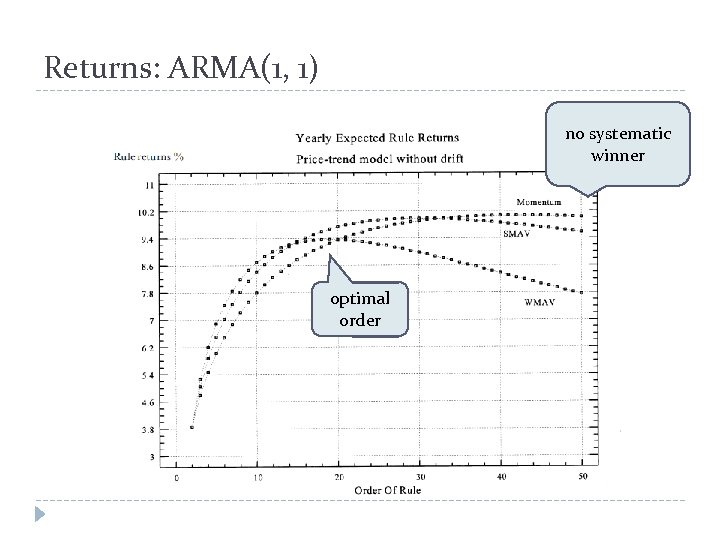 Returns: ARMA(1, 1) no systematic winner optimal order
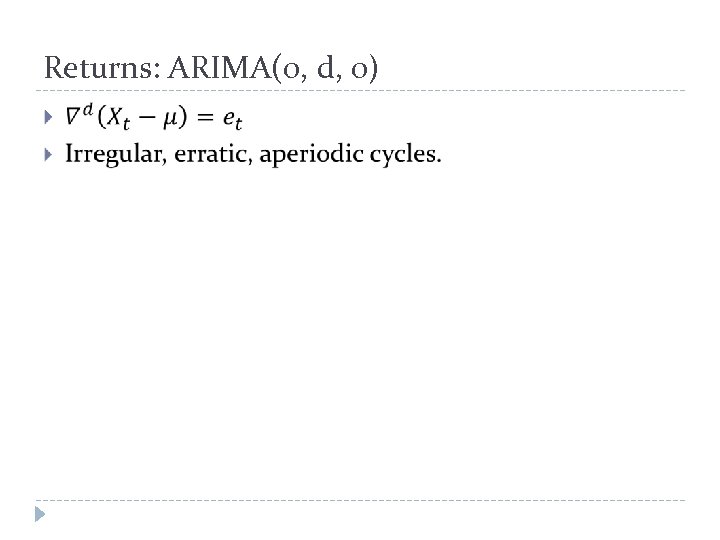 Returns: ARIMA(0, d, 0)
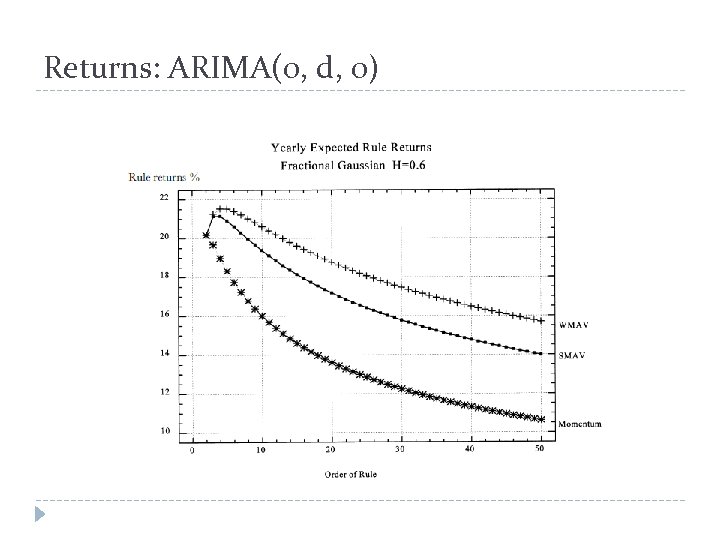 Returns: ARIMA(0, d, 0)
 ARCH + GARCH The presence of conditional heteroskedasticity, if unrelated to serial dependencies, may be neither a source of profits nor losses for linear rules.
 A good Backtester (1) allow easy strategy programming allow plug-and-play multiple strategies simulate using historical data simulate using fake, artificial data allow controlled experiments e. g. , bid/ask, execution assumptions, news
 A good Backtester (2) generate standard and user customized statistics have information other than prices e. g. , macro data, news and announcements Auto calibration Sensitivity analysis Quick
 Matlab/R They are very slow. These scripting languages are interpreted line-by-line. They are not built for parallel computing. They do not handle a lot of data well. How do you handle two year worth of EUR/USD tick by tick data in Matlab/R? There is no modern software engineering tools built for Matlab/R. How do you know your code is correct? The code cannot be debugged easily. Ok. Matlab comes with a toy debugger somewhat better than gdb. It does not compare to Net. Beans, Eclipse or Intelli. J IDEA.
 Calibration Most strategies require calibration to update parameters for the current trading regime. Occam’s razor: the fewer parameters the better. For strategies that take parameters from the Real line: Nelder-Mead, BFGS For strategies that take integers: Mixed-integer nonlinear programming (branch-and-bound, outerapproximation)
 Global Optimization Methods f
 Sensitivity How much does the performance change for a small change in parameters? Avoid the optimized parameters merely being statistical artifacts. A plot of measure vs. d(parameter) is a good visual aid to determine robustness. We look for plateaus.
 Iterative Refinement Backtesting generates a large amount of statistics and data for model analysis. We may improve the model by regress the winning/losing trades with factors identify, delete/add (in)significant factors check serial correlation among returns check model correlations the list goes on and on……
 Implementation Connectivity to exchanges e. g. , ION, RTS Platform dependent APIs Programming languages Java, C++, C#, VBA, Matlab
 Summary Market understanding gives you an intuition to a trading strategy. Mathematics is the tool that makes your intuition concrete and precise. Programming is the skill that turns ideas and equations into reality.