 Скачать презентацию Algorithmic Sustainable Design The Future of Architectural Theory
301bf73707b6fa8b10f0fb2f930ff607.ppt
- Количество слайдов: 70



Algorithmic Sustainable Design: The Future of Architectural Theory. Nikos A. Salingaros University of Texas at San Antonio
Lecture 4 A. Cellular automata. B. Sierpinski carpets and sea-shells. C. Design in hyperspace and connection to the sacred.
Introduction • Unlike the previous lectures, this lecture gives no practical model for design • Instead, I examine a union of ideas from computer science, physics, mathematics, and spirituality • Working from analogy, I try to get into the foundations of architecture
Relate architecture to other disciplines • I relate the basis of architecture to other disciplines • In the 20 th Century, architecture has been isolated from the technological world and all of its impressive advances • Sure, architects have applied technology, but they worked from an artistic basis
“Toy” models • Scientists confronted with a highly complex problem often create a “toy model” • Captures the essentials in a very simple model, which helps to understand the underlying mechanism • Then work by analogy to solve the real problem
A. Cellular automata • Arrays in which cells can assume different states • Simplest type assume binary states: either black (on) or white (off) • An algorithm decides how the cells change their state in discrete times • Time: t = 1, 2, 3, …
1 -D cellular automata • A line of cells • An algorithm generates the next state • One such rule is: “Turn black if either neighbor is black; turn white if both neighbors are either black or white” • For example, begin with all states white (off) except for a single black (on) in the middle
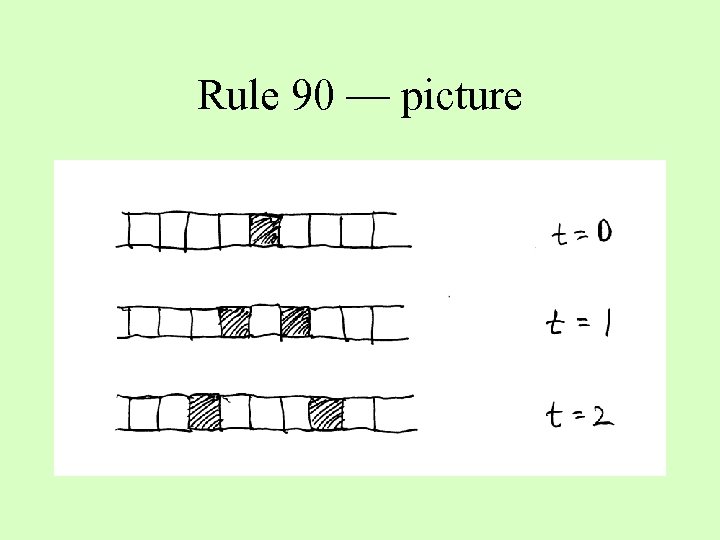
Rule 90 — picture
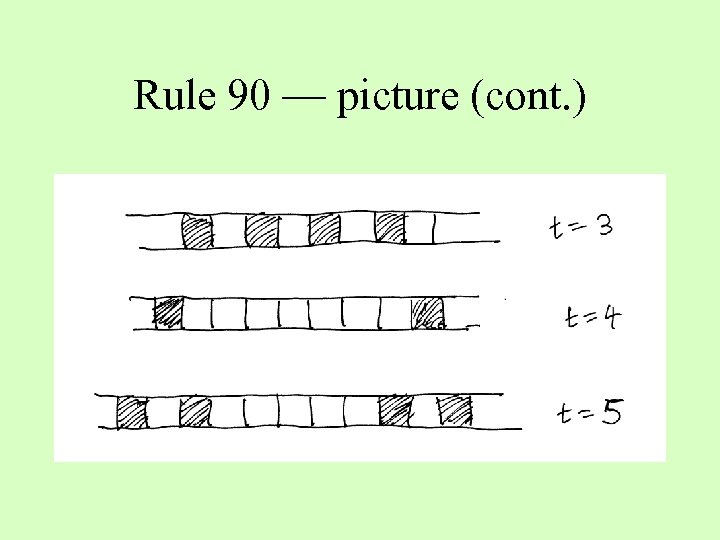
Rule 90 — picture (cont. )
Not presented as design tool • This discussion of cellular automata is directed at creating an analogy for understanding architectural design • Not meant to be used directly • A simple cellular automaton does not have the right complexity to be useful in adaptive design
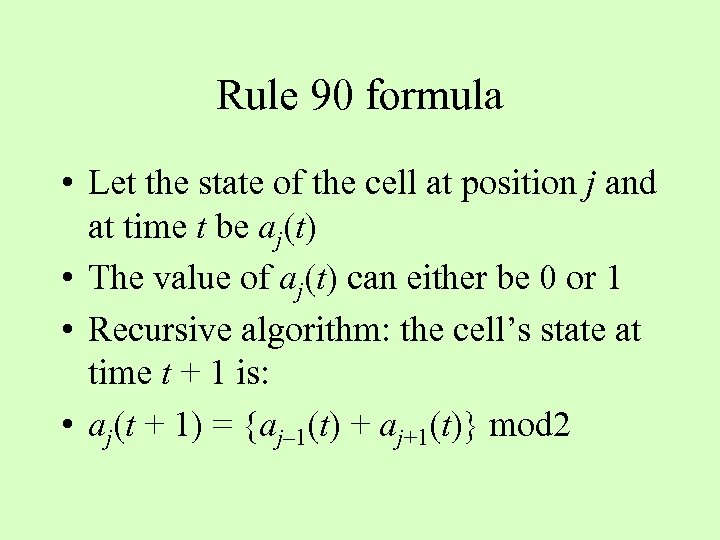
Rule 90 formula • Let the state of the cell at position j and at time t be aj(t) • The value of aj(t) can either be 0 or 1 • Recursive algorithm: the cell’s state at time t + 1 is: • aj(t + 1) = {aj– 1(t) + aj+1(t)} mod 2
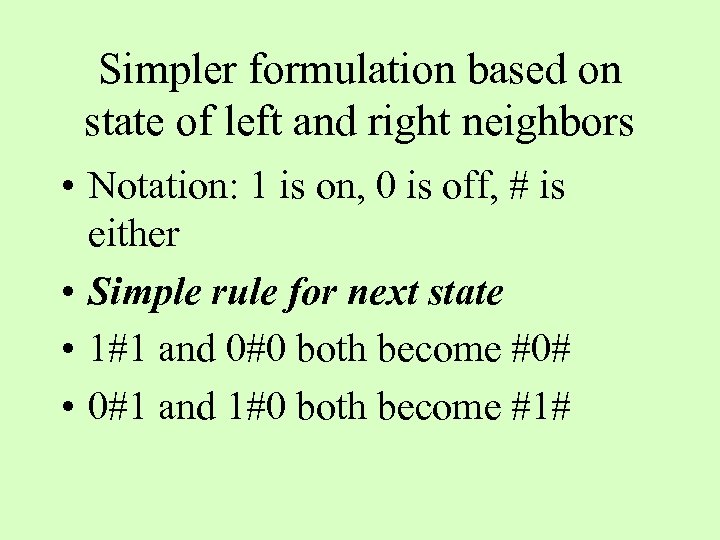
Simpler formulation based on state of left and right neighbors • Notation: 1 is on, 0 is off, # is either • Simple rule for next state • 1#1 and 0#0 both become #0# • 0#1 and 1#0 both become #1#
Initial condition • Next state of a cellular automaton depends upon the previous state • Initial conditions determine all later development • This example began with just one black pixel (on), and the pattern grows to infinite length
Different cellular automata • We used rule 90 in Wolfram’s classification: Stephen Wolfram, “A New Kind of Science”, Wolfram Media, Champaign, Illinois, USA, 2002. • A different rule will define a distinct cellular automaton
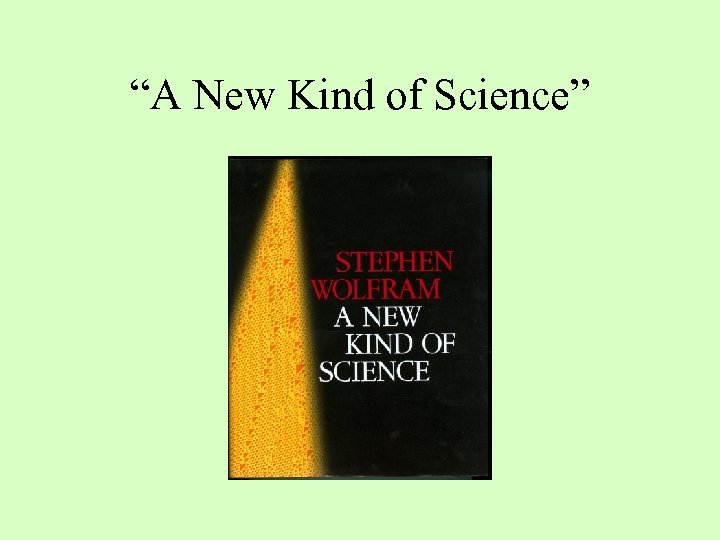
“A New Kind of Science”
Nearest neighbor • Many different types of cellular automata • Rule 90 is a “nearest-neighbor” rule • Simplest interaction of “on” elements — only with their nearest neighbors • Shortest possible interaction distance • LONG-RANGE PATTERN RESULTS FROM THIS RULE
Misguided applications • Some architects are beginning to apply Wolfram’s results directly to design • I believe they are mistaken • Creating non-adaptive forms that look pretty, but are unsuitable for buildings • Wolfram’s cellular automata are just a set of examples useful for analogies, not for design models
B. Sierpinski carpets and seashells • Cellular automaton Rule 90 generates a digitized version of the Sierpinski fractal triangle • Different initial conditions will generate distinct fractal triangles (one is constructed later in this talk)
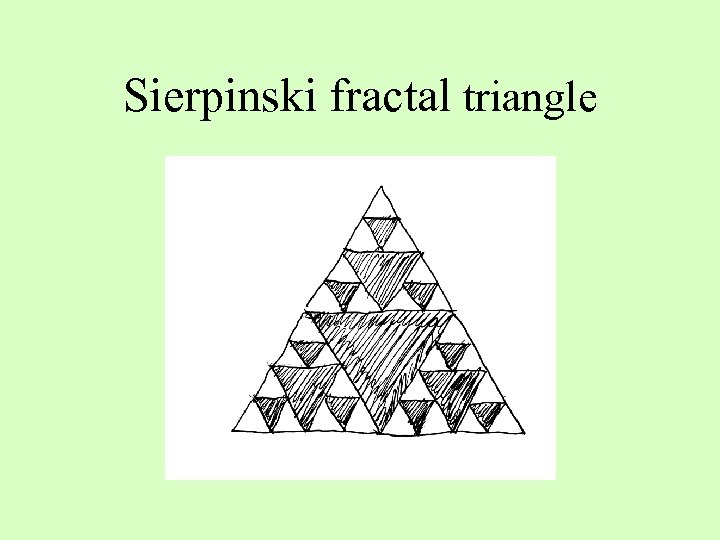
Sierpinski fractal triangle
Algorithmic design rules • I am laying down the logical framework for adaptive algorithms • Design rules should not produce a mathematical fractal, but will generate a complex structure — a building or a city — with many of the coherent features of a fractal
Weaving a carpet • Human activity over Asia, the Middle East, and the entire Islamic world for millennia • Knot one line of the carpet at a time — similar to 1 -D cellular automaton • Some cultures sing the 1 -D pattern that gives each line, as it is being woven • The result is a two-dimensional fabric
Space-time diagram • A 1 -D cellular automaton evolves in time by changing its state/appearance • Show the time dimension of its evolution by displaying its states at different times next to each other. This results in a 2 -D spacetime diagram (with x-t axes) • The diagram is a two-dimensional carpet
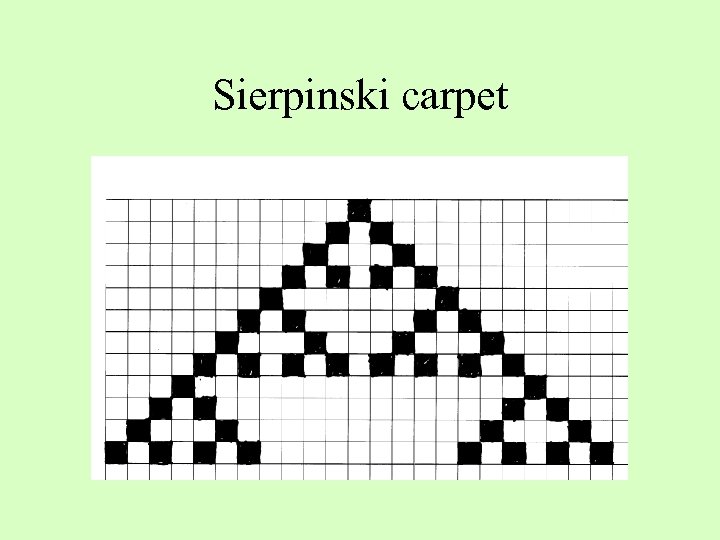
Sierpinski carpet
Sierpinski carpet (cont. ) • Subsequent states of 1 -D cellular automaton Rule 90 “weave” the 2 -D Sierpinski triangle • Carpet is a digitized fractal, because there is a minimum pixel size — one cell • As it adds more weft lines, the Sierpinski carpet gets closer to a mathematical fractal • A perforated fractal has been created by an algorithm
Emergence of patterns • Visual example shows “emergence” • A recursive 1 -D algorithm (on a line) involving only nearest-neighbor interactions generates a nested design — a 2 -D fractal (on a plane) • Nothing in this cellular automaton leads us to expect such complex long-range patterns that can be seen only in 2 -D
Architectural conclusions • Simplest possible 1 -D binary algorithm generates large-scale order • All characteristics of coherence are present — scaling hierarchy, scaling symmetry, scaling distribution, subsymmetries, etc. • Can we use simple rules to create great buildings and cities? • YES! Form languages, Smart Code, etc.
Just proved an important point • New Urbanist codes, like the Smart Code of Andrés Duany and Elizabeth Plater-Zyberk work because they generate adaptive environments • I just showed by analogy that using the correct algorithms, it is possible to generate complex environments
Emergence in general • A very simple rule generates a complex pattern not explicit in the initial code • Self-similarity, scaling coherence, and scaling distribution all arise from an algorithm acting on the smallest scale • Emergent geometrical patterns are seen only in a higher dimension than the one the algorithm acts on
First animal to apply a cellular automaton to build • Marine mollusks generate a fractal pattern on their shells: Tent Olive Shell (South America), Damon’s Volute (Western Australia), Textile Cone (Indo-Pacific), Glory of the Seas (Pacific) • Animal lays down 1 -D pattern one row at a time, as it grows the lip of its shell • Patterns are very roughly Sierpinski-like
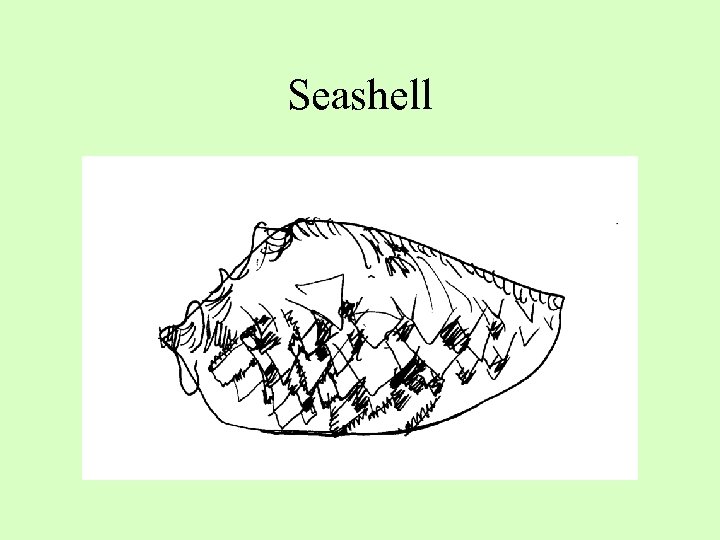
Seashell
Amazing • The mollusk is growing its house using a fractal pattern — algorithmic design! • The mollusk never gets to see the outside of its shell; it never goes out, and its eyes are not as highly developed • While the mollusk is alive, the shell pattern is covered by an organic membrane
The Sierpinski triangle and the Binomial Theorem • Binomial coefficients are numbers in the expansion of a + b to the n-th power • All the binomial coefficients can be computed from Pascal’s triangle • Re-compute Pascal’s triangle modulo 2 (odd = 1, even = 0) • Becomes the digitized Sierpinski triangle
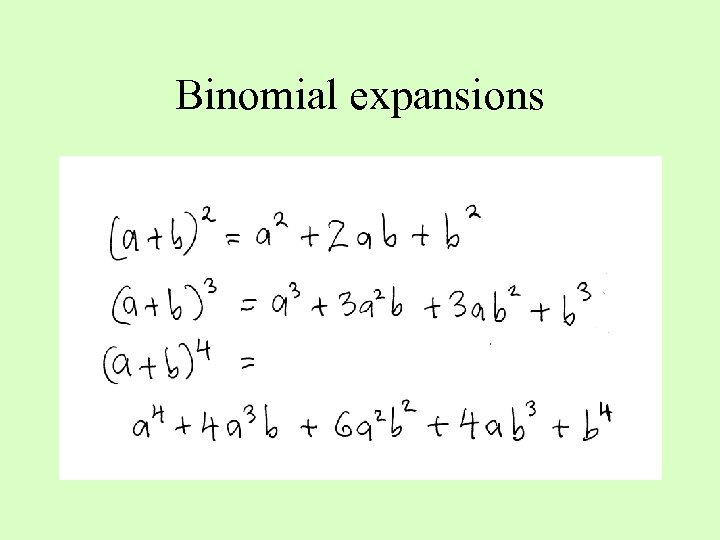
Binomial expansions
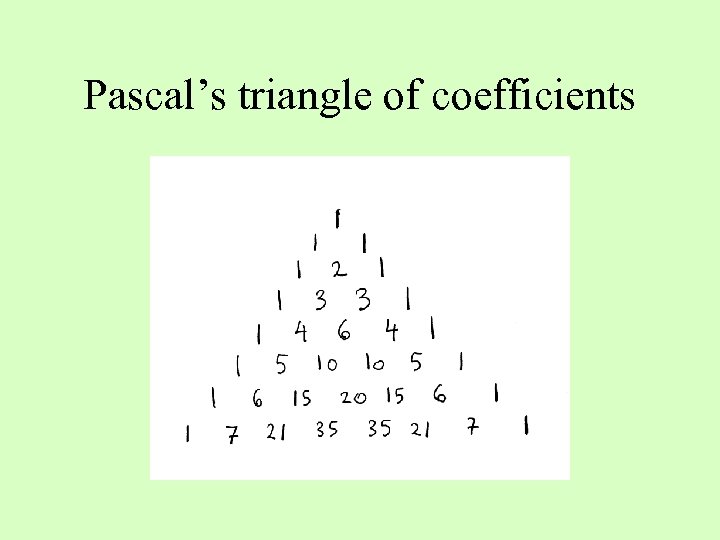
Pascal’s triangle of coefficients
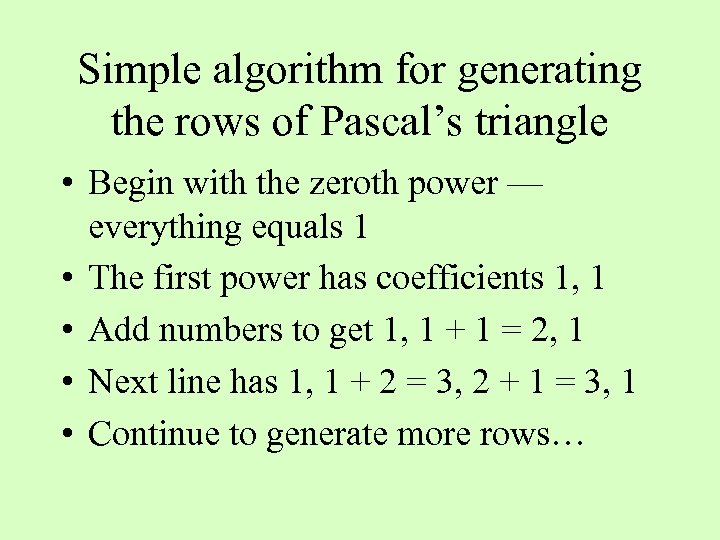
Simple algorithm for generating the rows of Pascal’s triangle • Begin with the zeroth power — everything equals 1 • The first power has coefficients 1, 1 • Add numbers to get 1, 1 + 1 = 2, 1 • Next line has 1, 1 + 2 = 3, 2 + 1 = 3, 1 • Continue to generate more rows…
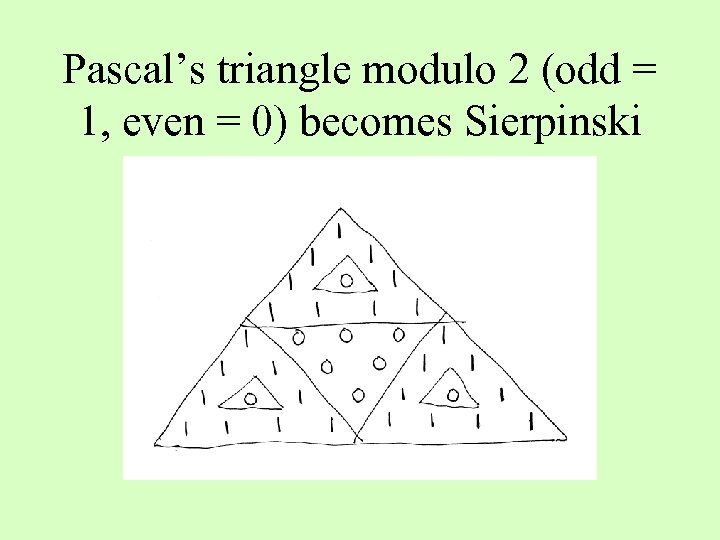
Pascal’s triangle modulo 2 (odd = 1, even = 0) becomes Sierpinski
Classification of cellular automata • Wolfram has classified all 256 possible 1 -D cellular automata with binary states (on-off) and nearest-neighbor interactions • Twenty of them (8%) generate variants of the Sierpinski gasket, others are not regular • Generative codes are very few among all possible architectural algorithms
Selection of algorithms • Even among the simplest cellular automata (nearest-neighbor, two-state systems) the majority does not generate any coherent designs! • There are infinitely more (long-range, multistate, etc. ) cellular automata • Rule 90 is useful because it is seen in biological structures, and is also related to the Binomial Theorem
A different initial condition • Use Rule 90 with different initial condition • The same cellular automaton can generate many distinct nested hierarchical patterns • Development depends upon the initial state • For example, begin with three black pixels (on) distributed as (11001)
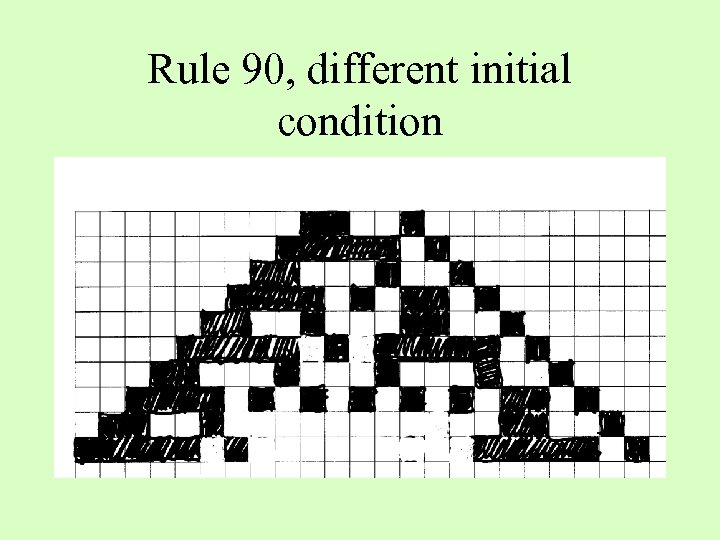
Rule 90, different initial condition
Analogous implications for design • Adaptive design is highly dependent upon initial conditions: existing structures, surroundings, human needs, etc. • The same design algorithm will result in drastically distinct end-products • The proper algorithm can be used to design buildings and cities that are each distinct because they adapt to local conditions
Formal design is not adaptive • Can be of either two forms: • 1. Non-algorithmic, which only imposes preconceived forms • 2. Algorithmic but non-adaptive, not responsive to initial conditions • Formal designs are self-referential — they could all look the same
Algorithms in nature • • Nature only uses sustainable algorithms Non-sustainable algorithms die out! Darwinian selection based on survival This is selection of algorithms instead of selection of forms that we normally think of as the result of evolution
C. Design in hyperspace and connection to the sacred • An entirely speculative direction • Nevertheless, topic is fundamentally important to architecture • For millennia, human beings have sought to connect to the sacred realm through architecture
Metaphysical questions • Christopher Alexander talks about connecting to a larger coherence • We experience this connection — a visceral feeling — in a great religious building or place of great natural beauty • Hassan Fathy talked about the sacred structure in everyday environments
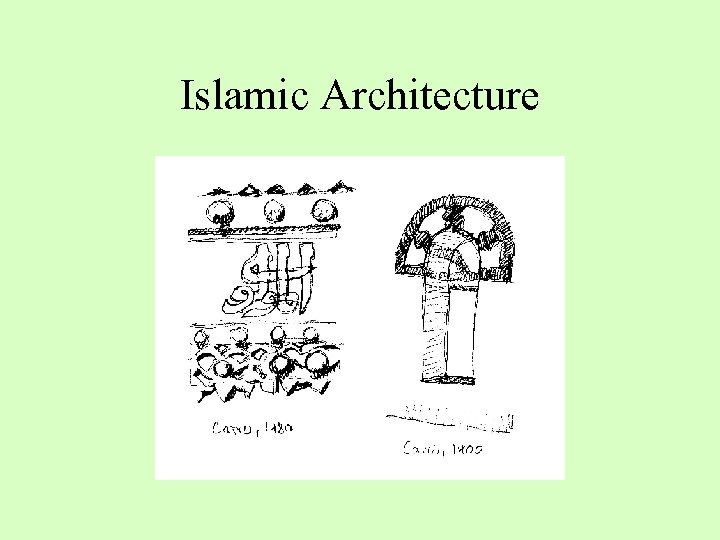
Islamic Architecture
Connecting via architecture • Talking about connecting viscerally to a building makes people profoundly uneasy • For millennia, our ancestors built sacred places and buildings that connect us to something beyond everyday reality • Today’s western culture does not accept this as possible
Excursions to higher dimensions • • Line — one dimension (1 -D) Plane — two dimensions (2 -D) Volume — three dimensions (3 -D) In mathematics, it is perfectly normal to work in any number of dimensions • From physics, we know that ordinary matter exists in several dimensions
Physical dimensions • Three spatial dimensions: x, y, z • Next dimensions distinguish particles • Spin: distinguishes Bosons from Fermions • Isospin: distinguishes Nucleons • Hypercharge: distinguishes shorterlived elementary particles
Architecture in hyperspace • Imagine a complex design or structure defined in more than 3 -D • This structure is richly patterned • We cannot fully perceive its symmetries because of our perceptual limitations • The only features we can see are sections of the whole n-D structure
Central conjecture • We connect to a higher realm only through coherent complex structures • Coherence and symmetries of form make possible the continuation into symmetries in other dimensions • Most 20 th-Century and contemporary buildings restrict forms to 3 -D or less because they are minimalist or disordered
Analogy: design sections • We used a 1 -D cellular automaton to construct the 2 -D Sierpinski carpet • By analogy, people build 3 -D material structures that could generate a larger coherent structure within n-D hyperspace • We could thus connect to the larger n-D entity, which is more than what we can see
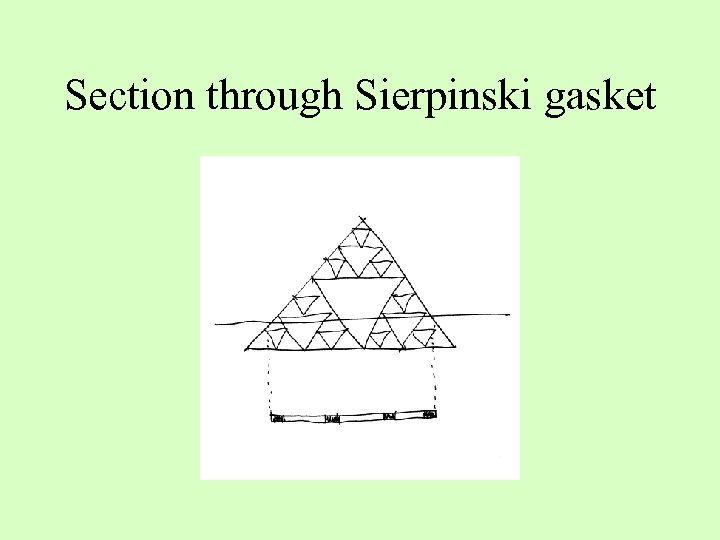
Patterns in n-D • With the Sierpinski gasket, it is not possible to deduce its symmetric large-scale nested patterns from any single section • Nevertheless, we do observe regularity in each cellular automaton with Rule 90 • Geometrical coherence in what we see implies a larger coherence in n-D
Section through Sierpinski gasket
Imagined structure • Sierpinski: patterns shown in any 1 -D section imply that the original has complex, coherent structure in 2 -D • Self-similarity and scaling of the complex 2 -D object show only as reduced coherent patterns on the 1 -D cellular automaton
How can we connect to coherent structures in n-D ? • Actually, this deeper question is easily answered with mathematics • If we inhabit a space that is bounded, then we cannot connect to something outside it • By going to one more dimension, we can jump over the boundary and connect • Example: it is possible to jump in 3 -D space to get over 2 -D boundary
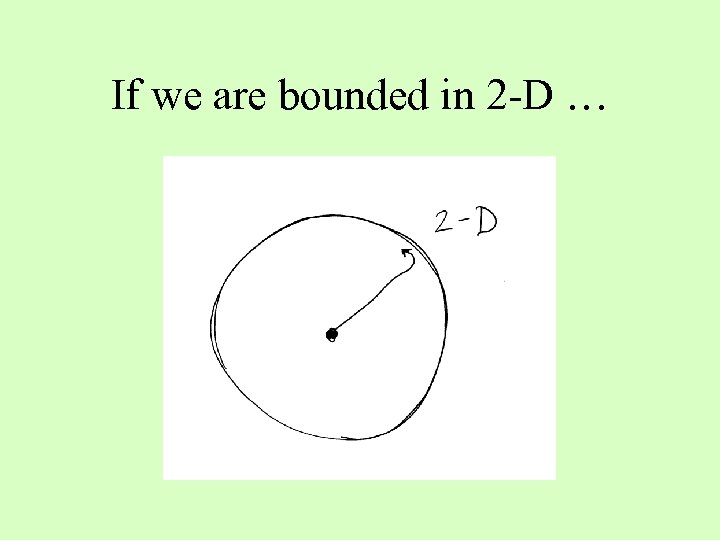
If we are bounded in 2 -D …
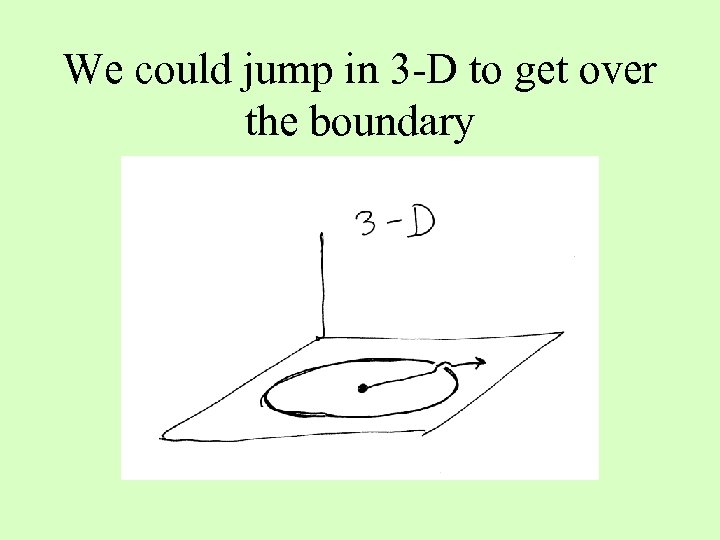
We could jump in 3 -D to get over the boundary
Philosophical/religious questions • We have raised questions — without answering them — about connecting to a higher state of order • How can we make a “jump” out of the physical 3 -D space of buildings so as to connect to a realm beyond 3 -D? • Religions tell us that it is indeed possible
Physical/mathematical questions • Are the additional dimensions of our existence interior or exterior? • Spiritual approach tends to imagine a world “outside” our everyday realm • But physics has discovered dimensions “inside” — the internal symmetries of elementary particles
Connecting • Conjectural picture presented here highlights questions about connecting to a higher order • Alexander addresses this topic, using empirical evidence presented in “The Nature of Order, Book 4: The Luminous Ground”
Limits of biology? • How high can we rise in our emotional connection and still explain it biologically? • Emotional highs come from love, music, art, architecture, poetry, literature • Mechanisms of response are all biological, although the most important elements are still incompletely understood
Conditions for sacred connection • I’m interested in geometrical, not mystical properties • Connection is achieved through dance, music, art, and architecture • Patterns, regularity, repetition, nesting, hierarchy, scaling, fractal structure — common feature of all
Spirituality • Highest artistic expression is related to religion • Bach, Mozart, Botticelli, Michelangelo; anonymous artists and architects of Islamic art and architecture, mystics of the world • By seeking God, human beings attain highest level of connection to universe
Questions that touch on religion • Without specifying any particular organized religion, spirituality can lead to connectivity • Same mechanism as biophilia? Maybe — only more advanced and more intense • Can we transcend biological connection to achieve an even higher spiritual connection?
Manifestation of the sacred • Religious belief itself is abstract, resident in the mind • But connection occurs through geometry, senses, music, rhythm, color • Religious connection is very physical, oftentimes intensely so • This physical connection gives us the materialization of sacred experience
Dance — temporal rhythm • • • Bharatanatyam, classical Indian dancing African shamanic dance Native American religious dance Whirling dervishes in Mevlana, Turkey Hassidic dances Mystical dance forms contain geometric qualities of scaling coherence
Music — rhythm • In the Classical West: Masses of Bach, Haydn, and Mozart • Show fractal temporal structure — inverse power-law scaling • Sacred chant in all religions connects • Holy days: Byzantine Easter service, Passion Plays, Kol Nidre during Yom Kippur, Buddhist ceremonial chant
Sacred architecture • All over the world, the House of God displays the qualities we seek to the highest possible extent • Independent of particular religion or style • Found among all religious building types • Architects of the past instinctively built according to rules for scaling coherence
Conclusion • All the examples I have mentioned have common mathematical qualities • Fractals, symmetries, rhythm, hierarchy, scaling distribution, etc. • Deliberate creations by humanity the world over trying to connect to something out there — or inside?
Скачать презентацию Algorithmic Sustainable Design The Future of Architectural Theory
301bf73707b6fa8b10f0fb2f930ff607.ppt