


 Скачать презентацию Alfred Hitchcock Director Producer Television Personality Screenwriter 1899
Презентация Alfred Hitchcock.pptx
- Количество слайдов: 12
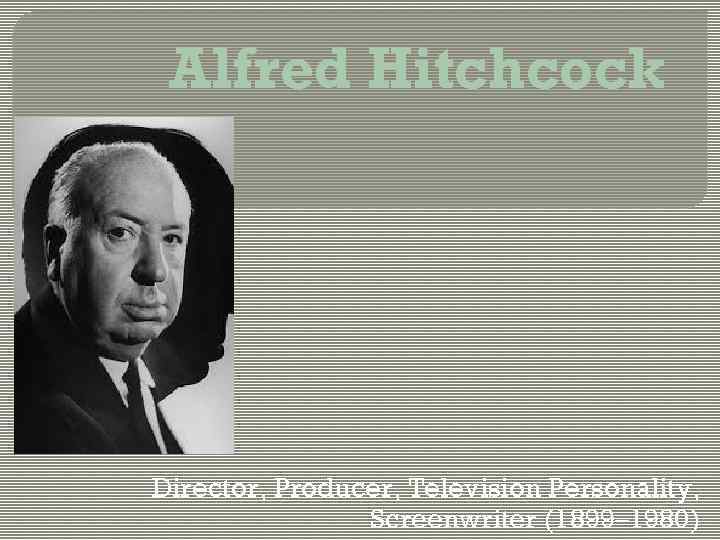 Alfred Hitchcock Director, Producer, Television Personality, Screenwriter (1899– 1980)
 Synopsis Born in London on August 13, 1899, Alfred Hitchcock worked for a short time in engineering before entering the film industry in 1920. He left for Hollywood in 1939, where his first American film, Rebecca, won an Academy Award for best picture. Hitchcock created more than 50 films, including the classics Rear Window, The 39 Steps and Psycho. Nicknamed the "Master of Suspense, " Hitchcock received the AFI's Life Achievement Award in 1979.
 Early Life Director, producer and screenwriter Alfred Joseph Hitchcock was born in London, England, on August 13, 1899, and was raised by strict, Catholic parents. He described his childhood as lonely and sheltered, partly due to his obesity. He once said that he was sent by his father to the local police station with a note asking the officer to lock him away for 10 minutes as punishment for behaving badly. He also remarked that his mother would force him to stand at the foot of her bed for several hours as punishment (a scene alluded to in his film Psycho). This idea of being harshly treated or wrongfully accused would later be reflected in Hitchcock's films.
 A Gift for Suspense Hitchcock attended the Jesuit school St. Ignatius College before going on to attend the University of London, taking art courses. He eventually obtained a job as a draftsman and advertising designer for the cable company Henley's. It was while working at Henley's that he began to write, submitting short articles for the in-house publication. From his very first piece, he employed themes of false accusations, conflicted emotions and twist endings with impressive skill. In 1920, Hitchcock entered the film industry with a full-time position at the Famous Players-Lasky Company designing title cards for silent films. Within a few years, he was working as an assistant director. In 1925, Hitchcock directed his first film and began making the "thrillers" for which he became known the world over. His 1929 film Blackmail is said to be the first British "talkie. " In the 1930 s, he directed such classic suspense films as The Man Who Knew Too Much (1934) and The 39 Steps (1935).
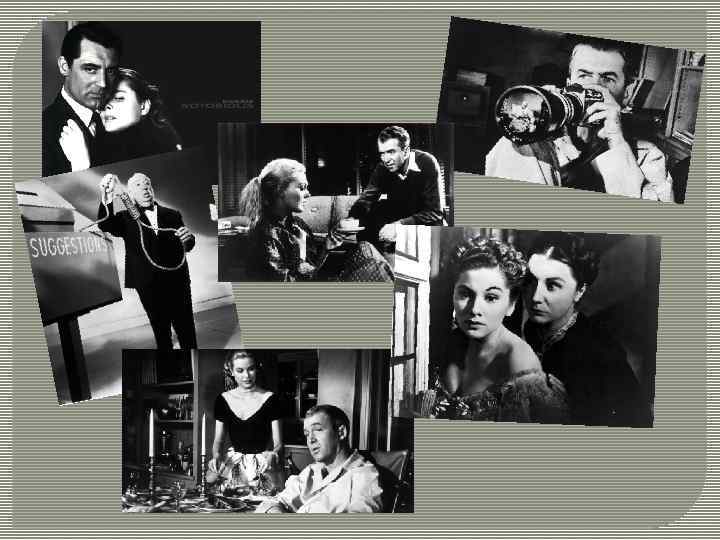
 The Hollywood Years In 1939, Hitchcock left England for Hollywood. The first film he made there, Rebecca (1940), won an Academy Award for best picture. Some of his most famous films include Psycho (1960), The Birds (1963) and Marnie (1964). His works became renowned for their depictions of violence, although many of his plots merely function as decoys meant to serve as a tool for understanding complex psychological characters. His cameo appearances in his own films, as well as his interviews, film trailers and the television program Alfred Hitchcock Presents (1962 -65), made him a cultural icon.
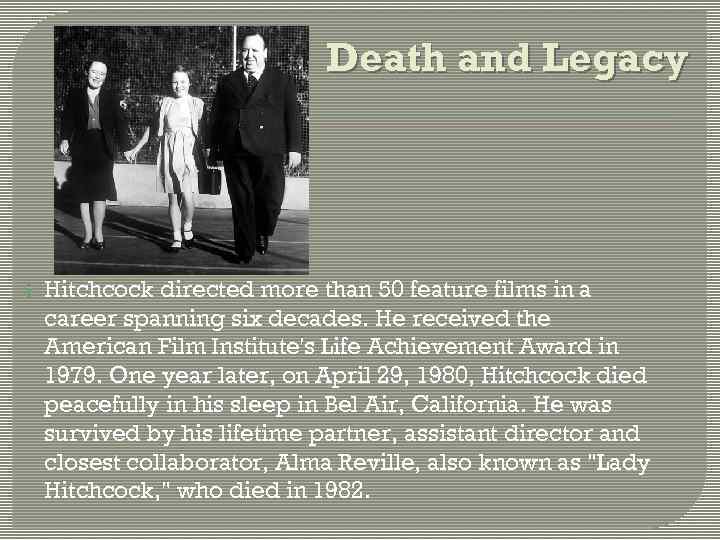 Death and Legacy Hitchcock directed more than 50 feature films in a career spanning six decades. He received the American Film Institute's Life Achievement Award in 1979. One year later, on April 29, 1980, Hitchcock died peacefully in his sleep in Bel Air, California. He was survived by his lifetime partner, assistant director and closest collaborator, Alma Reville, also known as "Lady Hitchcock, " who died in 1982.
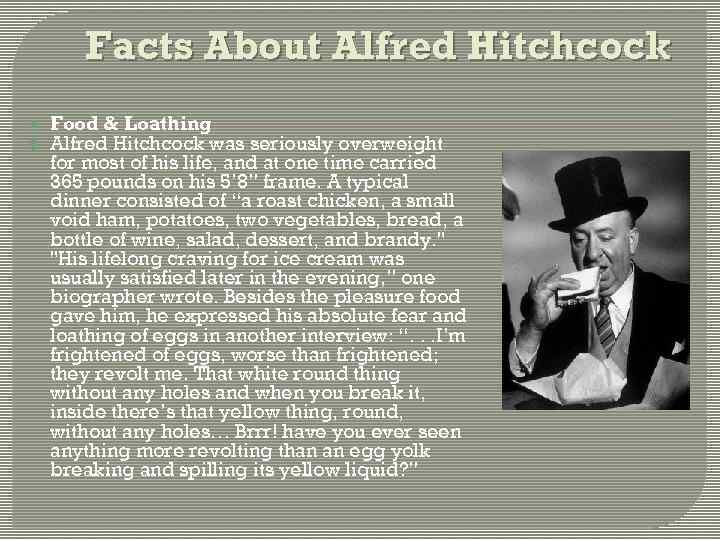 Facts About Alfred Hitchcock Food & Loathing Alfred Hitchcock was seriously overweight for most of his life, and at one time carried 365 pounds on his 5’ 8” frame. A typical dinner consisted of “a roast chicken, a small void ham, potatoes, two vegetables, bread, a bottle of wine, salad, dessert, and brandy. " "His lifelong craving for ice cream was usually satisfied later in the evening, ” one biographer wrote. Besides the pleasure food gave him, he expressed his absolute fear and loathing of eggs in another interview: “. . . I’m frightened of eggs, worse than frightened; they revolt me. That white round thing without any holes and when you break it, inside there’s that yellow thing, round, without any holes… Brrr! have you ever seen anything more revolting than an egg yolk breaking and spilling its yellow liquid? ”
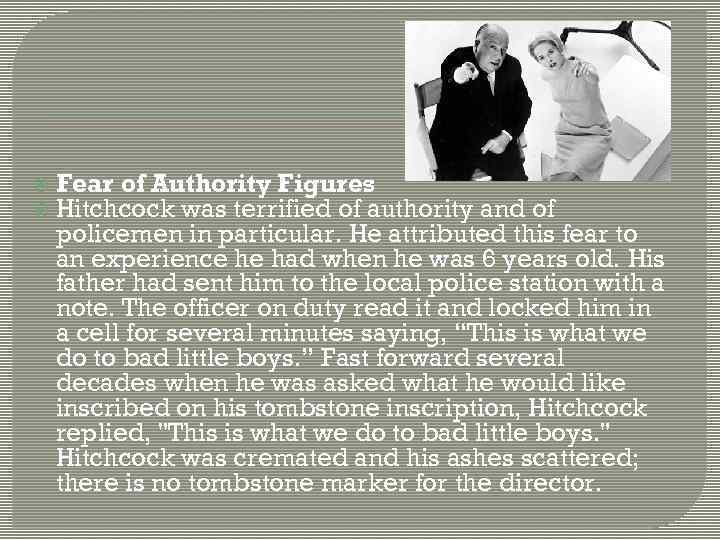 Fear of Authority Figures Hitchcock was terrified of authority and of policemen in particular. He attributed this fear to an experience he had when he was 6 years old. His father had sent him to the local police station with a note. The officer on duty read it and locked him in a cell for several minutes saying, “This is what we do to bad little boys. ” Fast forward several decades when he was asked what he would like inscribed on his tombstone inscription, Hitchcock replied, "This is what we do to bad little boys. " Hitchcock was cremated and his ashes scattered; there is no tombstone marker for the director.
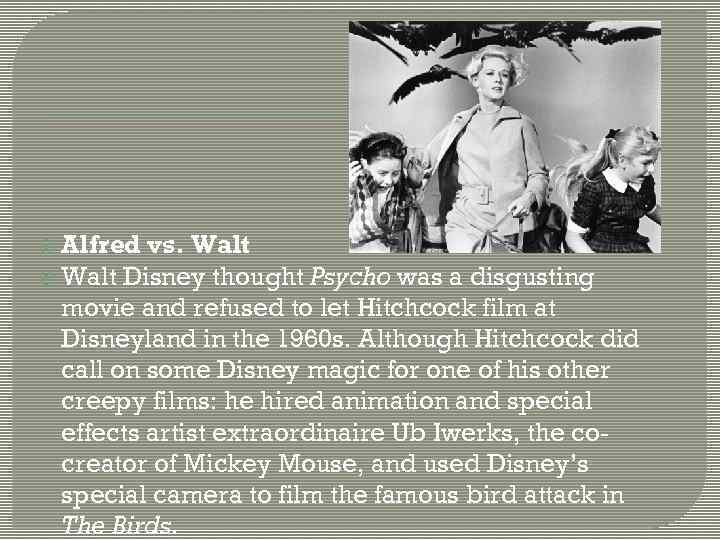 Alfred vs. Walt Disney thought Psycho was a disgusting movie and refused to let Hitchcock film at Disneyland in the 1960 s. Although Hitchcock did call on some Disney magic for one of his other creepy films: he hired animation and special effects artist extraordinaire Ub Iwerks, the cocreator of Mickey Mouse, and used Disney’s special camera to film the famous bird attack in The Birds.
 Wit & Wisdom Hitchcock once said that he migrated to the US as a kind of cultural exchange, only nobody knows what was sent in return because, said Hitch "they are afraid to open it“ On actors and actreses: Ingrid Bergman, triying to make Hitchcock help her understand the motivation for the feelings of her character told Hitchcock: I dont feel like that, I dont think I can give you that kind of emotion and Hitchcock replied: Ingrid -- Fake It To anthony Perkins: Don't wory Tony, it's only a movie When an actress asked Hitchcock if her right or left profile was better, he told her, "My dear, you're sitting on your best profile. " "Actors are cattle" "I didn't say actors are cattle. What I said was, actors should be treated like cattle. “ "When an actor comes to me and wants to discuss his character, I say, 'It's in the script. ' If he says, 'But what's my motivation? , ' I say, 'Your salary. '" "Disney has the best casting. If he doesn't like an actor he just tears him up. " "The best way to do it is with scissors“ On the relationship with his audiences: "The length of a film should be directly related to the endurance of the human bladder“ On his mission in life: "Even my failures make money and become classics a year after I make them. “ "Drama is life with the dull bits left out“
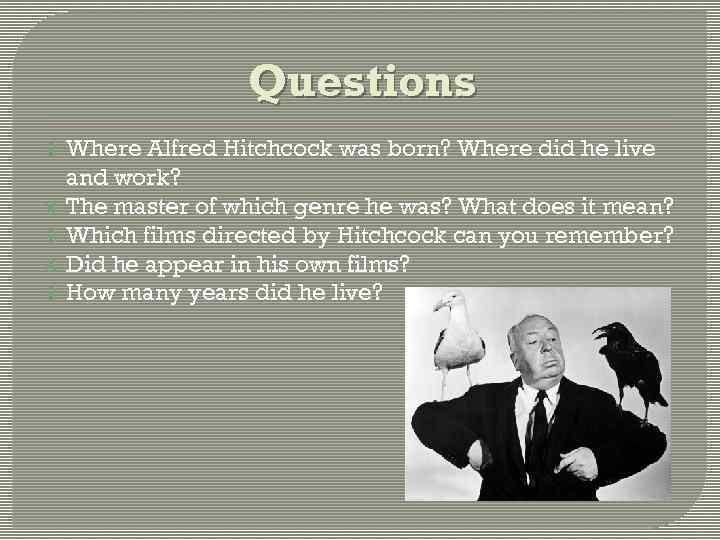 Questions Where Alfred Hitchcock was born? Where did he live and work? The master of which genre he was? What does it mean? Which films directed by Hitchcock can you remember? Did he appear in his own films? How many years did he live?