


 Скачать презентацию ALEXANDER ZALOGIN Acting IECEx Chairman Chairman of Russian
048fe185a3b6b8a014c505005df2abc7.ppt
- Количество слайдов: 24
 ALEXANDER ZALOGIN Acting IECEx Chairman, Chairman of Russian Technical Committee TC 403 "Equipment for explosive atmospheres (Ex-equipment) Convener of WG 16 of IRT TF 8 EU-Russia Convener of WG 16 of IRT Head of Ex. CB, General Director of NANIO CCVE NANIO
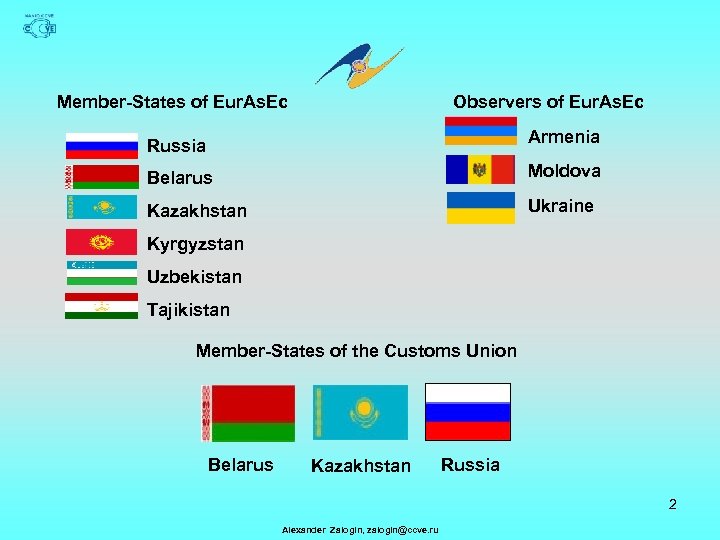 Observers of Eur. As. Ec Member-States of Eur. As. Ec Armenia Russia Belarus Moldova Kazakhstan Ukraine Kyrgyzstan Uzbekistan Tajikistan Member-States of the Customs Union Belarus Kazakhstan Russia 2 Alexander Zalogin, zalogin@ccve. ru
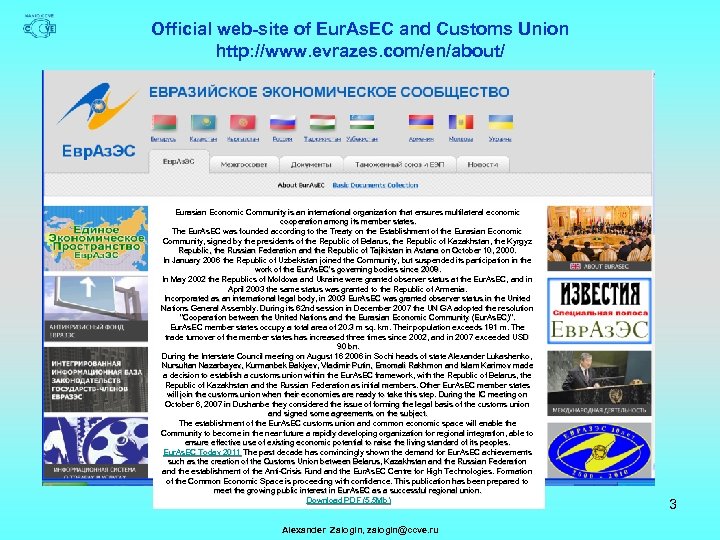 Official web-site of Eur. As. EC and Customs Union http: //www. evrazes. com/en/about/ Eurasian Economic Community is an international organization that ensures multilateral economic cooperation among its member states. The Eur. As. EC was founded according to the Treaty on the Establishment of the Eurasian Economic Community, signed by the presidents of the Republic of Belarus, the Republic of Kazakhstan, the Kyrgyz Republic, the Russian Federation and the Republic of Tajikistan in Astana on October 10, 2000. In January 2006 the Republic of Uzbekistan joined the Community, but suspended its participation in the work of the Eur. As. EC's governing bodies since 2008. In May 2002 the Republics of Moldova and Ukraine were granted observer status at the Eur. As. EC, and in April 2003 the same status was granted to the Republic of Armenia. Incorporated as an international legal body, in 2003 Eur. As. EC was granted observer status in the United Nations General Assembly. During its 62 nd session in December 2007 the UN GA adopted the resolution "Cooperation between the United Nations and the Eurasian Economic Community (Eur. As. EC)". Eur. As. EC member states occupy a total area of 20. 3 m sq. km. Their population exceeds 181 m. The trade turnover of the member states has increased three times since 2002, and in 2007 exceeded USD 90 bn. During the Interstate Council meeting on August 16 2006 in Sochi heads of state Alexander Lukashenko, Nursultan Nazarbayev, Kurmanbek Bakiyev, Vladimir Putin, Emomali Rakhmon and Islam Karimov made a decision to establish a customs union within the Eur. As. EC framework, with the Republic of Belarus, the Republic of Kazakhstan and the Russian Federation as initial members. Other Eur. As. EC member states will join the customs union when their economies are ready to take this step. During the IC meeting on October 6, 2007 in Dushanbe they considered the issue of forming the legal basis of the customs union and signed some agreements on the subject. The establishment of the Eur. As. EC customs union and common economic space will enable the Community to become in the near future a rapidly developing organization for regional integratlon, able to ensure effective use of existing economic potential to raise the living standard of its peoples. Eur. As. EC Today 2011 The past decade has convincingly shown the demand for Eur. As. EC achievements such as the creation of the Customs Union between Belarus, Kazakhstan and the Russian Federation and the establishment of the Anti-Crisis Fund and the Eur. As. EC Centre for High Technologies. Formation of the Common Economic Space is proceeding with confidence. This publication has been prepared to meet the growing public interest in Eur. As. EC as a successful regional union. Download PDF (5, 5 Mb) Alexander Zalogin, zalogin@ccve. ru 3
 Contractual legal framework of the Customs Union and Common Free Market Zone in the area of Technical Regulation • Agreement for the Technical Regulation uniform rules and principles in Republic of Belarus, Republic of Kazakhstan and the Russian Federation • Agreement for circulation of the products subjected to mandatory conformity assessment (confirmation) within the territory of the Customs Union • Mutual Recognition Agreement for accreditation of Certifications Bodies (conformity assessment) and Test Laboratories (centers) performing work on conformity assessment These agreements allow to establish the uniform mandatory requirements to products and uniform rules for Conformity assessment performance Alexander Zalogin, zalogin@ccve. ru
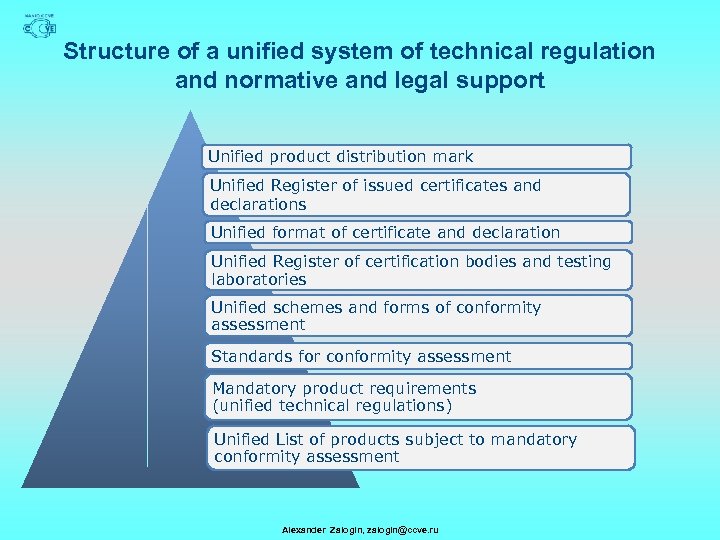 Structure of a unified system of technical regulation and normative and legal support Unified product distribution mark Unified Register of issued certificates and declarations Unified format of certificate and declaration Unified Register of certification bodies and testing laboratories Unified schemes and forms of conformity assessment Standards for conformity assessment Mandatory product requirements (unified technical regulations) Unified List of products subject to mandatory conformity assessment Alexander Zalogin, zalogin@ccve. ru
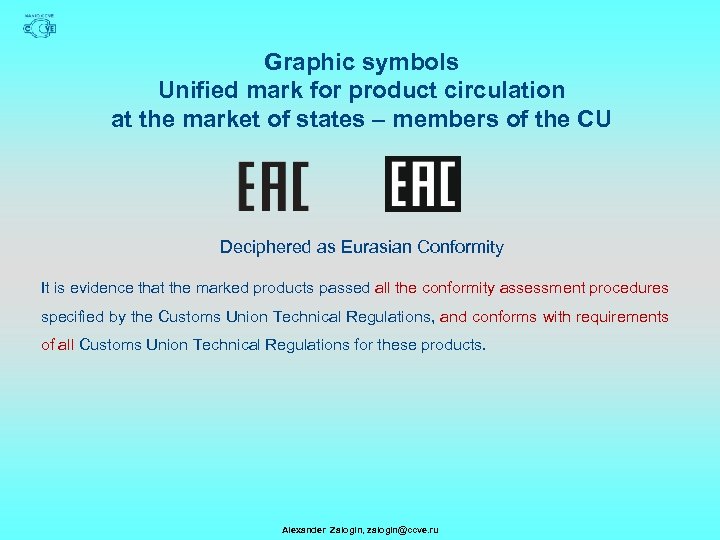 Graphic symbols Unified mark for product circulation at the market of states – members of the CU Deciphered as Eurasian Conformity It is evidence that the marked products passed all the conformity assessment procedures specified by the Customs Union Technical Regulations, and conforms with requirements of all Customs Union Technical Regulations for these products. Alexander Zalogin, zalogin@ccve. ru
 Standards used for conformity assessment To meet the requirements of any CU Technical Regulation two lists of standards shall be approved: product standards which when applied on a voluntary basis ensure the compliance with TR requirements; standards for rules and methods of investigations (testing) to verify the compliance with TR requirements. Status of standards: Intergovernmental standards (GOST), or, in their absence, national standards of Russia (GOST R), Belarus (ST B) and Kazakhstan (ST RK). Alexander Zalogin, zalogin@ccve. ru
 Conformity assessment conditions within the CU with document unified forms issuing Certification carried out by a Certification Body included in the unified Register of CB and TL Certificates and Declarations should be of a unified format Products passed Conformity Assessment procedure in the territory of any part, is put into circularization in the territory of the Customs Union The application for conformity assessment may be submitted by the manufacturer (authorized representative of foreign manufacturer in the territory of the Customs Union), importer in the territory of the Customs Union The manufacturer (authorized representative), importer is responsible for compliance to the Customs Union requirements according to destination part legislation Alexander Zalogin, zalogin@ccve. ru
 Forms and schemes of conformity assessment in the CU Technical Regulations Specified by the Statutory Procedure for applying model schemes of conformity assessment to meet the requirements of CU Technical Regulations (Decision No 621 of CU Commission dated April 7, 2011) As applied to products whose requirements are specified in CU Technical Regulations, conformity assessment shall be in the form of: conformity assessment (declaration of conformity or certification) (state) registration examination testing government control (surveillance) Taking into account the product specifics and the degree of risk of damage, the authors of Technical Regulations have identified the following schemes to be selected: 2 model schemes of state registration 9 model schemes of mandatory certification 6 model schemes of declaration of conformity Alexander Zalogin, zalogin@ccve. ru
 CAB/1108/DL List of the decisions taken at CAB meeting 32, Oslo, 2012 -10 -02 Decision 32/2—Participation of EEC countries in the CA Systems The CAB thanks the IEC delegation which has recently signed a letter of intention with the Eurasian Economic Commission (EEC, representing the customs union of the Federation of Russia, Belarus and Kazakhstan), and stresses how important it is for world trade and the IEC that the three countries should be able to take a full role in the IEC CA Systems. The CAB endorses the steps outlined by the IEC delegation and Mr Zazhigalkin formalizing the cooperation and participation in the IEC CA Systems. In particular, the CAB encourages the IEC and the EEC to sign a suitable Memorandum of Understanding by February 2013, before the relevant technical regulations are put in place. Now the draft of the memorandum has been prepared by IEC and EEC. The approval of this draft is in process. Alexander Zalogin, zalogin@ccve. ru
 Abstract from the “Agreement on the Uniform Principles and Rules of Technical Regulation in the Republic of Belarus, the Republic of Kazakhstan and the Russian Federation of 18 November 2010”, ratified by the Federal Law of the Russian Federation № 152 -FZ of 27. 06. 2011 «Technical regulation of the Customs Union» is the document stipulating requirements that are mandatory for the application and fulfillment in the customs territory of the Customs Union as regards the products or products and related processes of production, assembly, set-up, operation (use), storage, transportation, realization and utilization, as approved by the Commission of the Customs Union. 11 Alexander Zalogin, zalogin@ccve. ru
 Now 32 technical regulations of the Customs Union are approved. • TR CU 004/2011 "On safety of low-voltage equipment “, • ТR CU 010/2011 "On safety of machines and equipment“, • TR CU 012/2011 "On safety of equipment intended for use in explosive atmospheres", • TR CU 020/2011 “Electro magnetic compatibility of the equipment”, etc. 12
 The Technical Regulation of the Customs Union “On safety of equipment intended for use in explosive atmospheres” (TR CU 012/2011) v This Technical Regulation is approved by the Decision of the Customs Union Commission No 825 of 18 October 2011. v The Technical Regulation became effective on 15 February 2013. v The following lists of standards were approved: ● List of standards which can be used on voluntary basis to ensure conformity to the requirements of TR CU 012/2011 ● List of standards with the rules and methods of investigations (tests) and measurements, including sampling selection rules, required for application and fulfillment of the requirements of TR CU 012/2011 13 Alexander Zalogin, zalogin@ccve. ru
 Technical Regulation of the Customs Union “On safety of equipment intended for use in explosive atmospheres” (TR CU 012/2011) v This Technical Regulation of the Customs Union applies to electrical equipment, including Ex-components, and non-electrical equipment intended for use in explosive atmospheres. v An identification criterion of equipment intended for use in explosive atmospheres and Ex-components is the availability of means providing their explosion protection as specified in the manufacturer’s technical documentation, and the explosion-proof marking affixed on the equipment and the Ех-component. 14 Alexander Zalogin, zalogin@ccve. ru
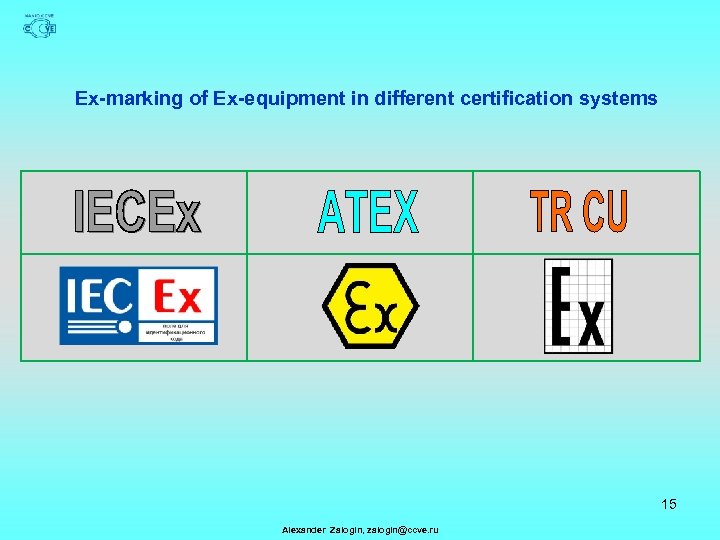 Ex-marking of Ex-equipment in different certification systems 15 Alexander Zalogin, zalogin@ccve. ru
 Technical Regulation of the Customs Union “On safety of equipment intended for use in explosive atmospheres” (TR CU 012/2011) Article 3. Rules of products circulation on the market 1. Equipment intended for use in explosive atmospheres shall be put into circulation in the common territory of the Customs Union provided that it passed all required conformity assessment procedures specified in this Technical Regulation of the Customs Union and other Technical Regulations of the Customs Union and Eur. As. EC that apply to this equipment. 2. Equipment intended for use in explosive atmospheres the conformity of which with the requirements of this Technical Regulation of the Customs Union has not been confirmed shall not be marked with the single Conformity Mark of Member States of the Customs Union, and putting of such equipment into circulation on the market is prohibited. 16 Alexander Zalogin, zalogin@ccve. ru
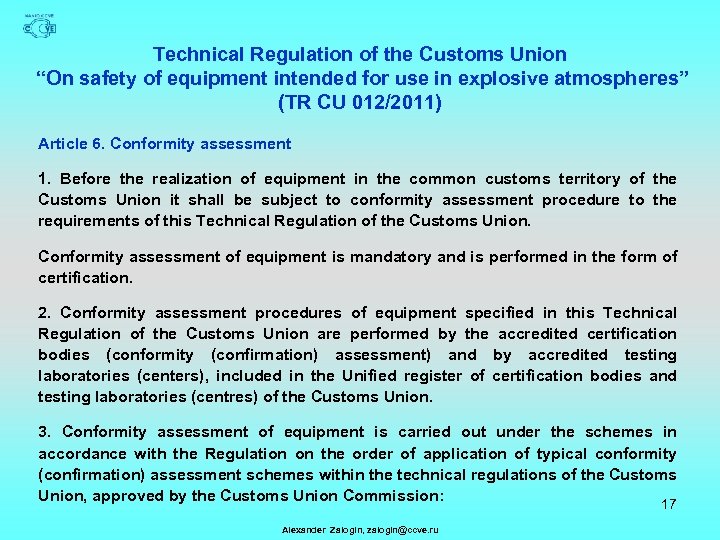 Technical Regulation of the Customs Union “On safety of equipment intended for use in explosive atmospheres” (TR CU 012/2011) Article 6. Conformity assessment 1. Before the realization of equipment in the common customs territory of the Customs Union it shall be subject to conformity assessment procedure to the requirements of this Technical Regulation of the Customs Union. Conformity assessment of equipment is mandatory and is performed in the form of certification. 2. Conformity assessment procedures of equipment specified in this Technical Regulation of the Customs Union are performed by the accredited certification bodies (conformity (confirmation) assessment) and by accredited testing laboratories (centers), included in the Unified register of certification bodies and testing laboratories (centres) of the Customs Union. 3. Conformity assessment of equipment is carried out under the schemes in accordance with the Regulation on the order of application of typical conformity (confirmation) assessment schemes within the technical regulations of the Customs Union, approved by the Customs Union Commission: 17 Alexander Zalogin, zalogin@ccve. ru
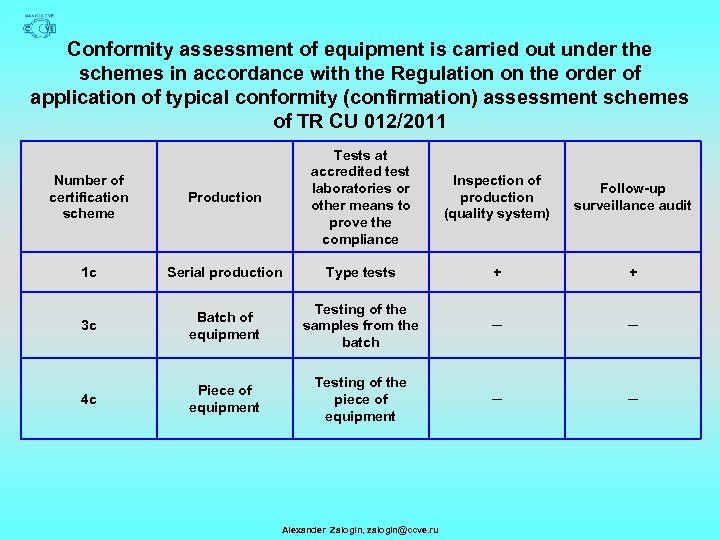 Conformity assessment of equipment is carried out under the schemes in accordance with the Regulation on the order of application of typical conformity (confirmation) assessment schemes of TR CU 012/2011 Number of certification scheme Production Tests at accredited test laboratories or other means to prove the compliance 1 c Serial production Type tests + + 3 c Batch of equipment Testing of the samples from the batch ─ ─ 4 c Piece of equipment Testing of the piece of equipment ─ ─ Alexander Zalogin, zalogin@ccve. ru Inspection of production (quality system) Follow-up surveillance audit
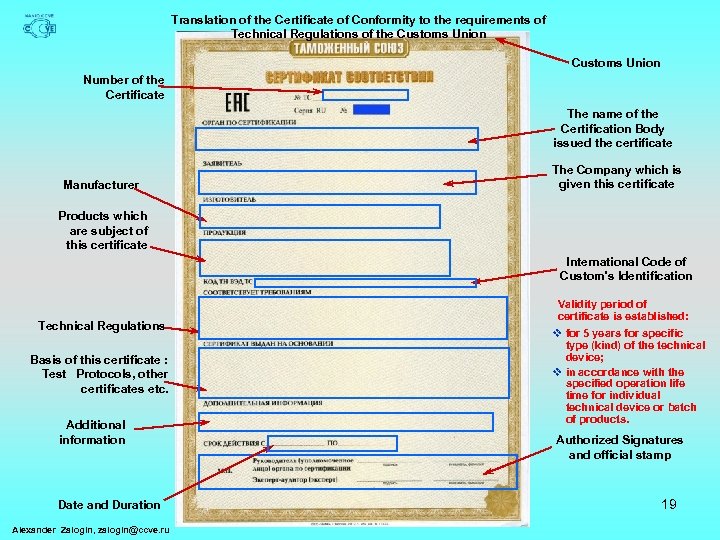 Translation of the Certificate of Conformity to the requirements of Technical Regulations of the Customs Union Number of the Certificate The name of the Certification Body issued the certificate Manufacturer The Company which is given this certificate Products which are subject of this certificate International Code of Custom's Identification Technical Regulations Basis of this certificate : Test Protocols, other certificates etc. Additional information Date and Duration Alexander Zalogin, zalogin@ccve. ru Validity period of certificate is established: v for 5 years for specific type (kind) of the technical device; v in accordance with the specified operation life time for individual technical device or batch of products. Authorized Signatures and official stamp 19
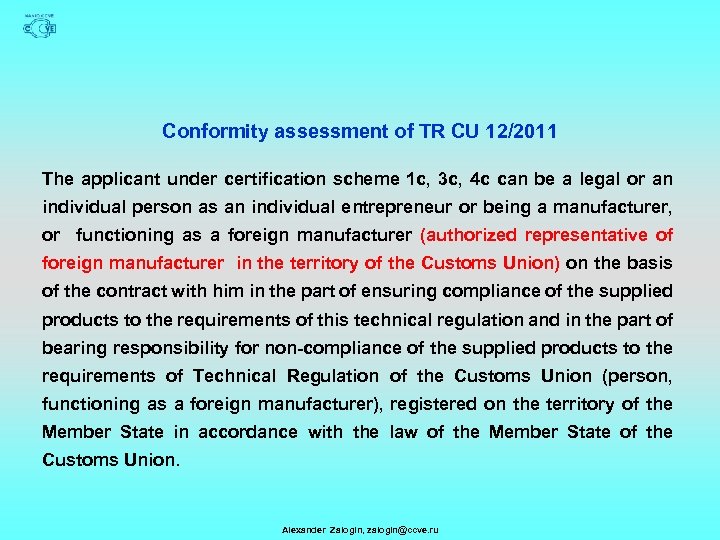 Conformity assessment of TR CU 12/2011 The applicant under certification scheme 1 c, 3 c, 4 c can be a legal or an individual person as an individual entrepreneur or being a manufacturer, or functioning as a foreign manufacturer (authorized representative of foreign manufacturer in the territory of the Customs Union) on the basis of the contract with him in the part of ensuring compliance of the supplied products to the requirements of this technical regulation and in the part of bearing responsibility for non-compliance of the supplied products to the requirements of Technical Regulation of the Customs Union (person, functioning as a foreign manufacturer), registered on the territory of the Member State in accordance with the law of the Member State of the Customs Union. Alexander Zalogin, zalogin@ccve. ru
 Certificates of conformity, issued before 15 February 2013 (effective date of TR CU 012/2011) , shall be valid within the whole validity period, but not longer than 15 March 2015. Certificates of conformity, issued before 18 October 2011 (date of publication of the Decision of the Customs Union Commission No 825) shall be valid within the whole validity period. Alexander Zalogin, zalogin@ccve. ru
 Permit for use At present time according to the changes introduced by the Article 24 of the Federal Law No. 248 -FZ dated July 19, 2011 in the Federal Law No. 116 -FZ «Industrial safety of hazardous production facilities» dated July 21, 1997 to the Article 7, cl. 6: “The technical devices at hazardous industrial facilities can be used provided that the Permit for use is granted by the Federal executive body in industrial safety field (Rostekhnadzor), if other form of compliance assessment of the technical devices, used at hazardous facility, to the mandatory requirements, is not determined by the technical regulations» . The Rostekhnadzor controls the observance of safety requirements at the stages of putting into operation and use of Ex-equipment at hazardous production facilities and the elimination of hazardous production facilities Alexander Zalogin, zalogin@ccve. ru
 Thank you very much for your attention 23 Alexander Zalogin, zalogin@ccve. ru
 Contact NANIO «CCVE» Postal address: 109377, Moscow, P. O. Box 22 Tel. /fax (495) 554 -01 -84, 554 -24 -94, 554 -12 -57, 971 -68 -30 www. ccve. ru e-mail: ссve@ccve. ru 24 Alexander Zalogin, zalogin@ccve. ru