 Скачать презентацию ALEX CARMICHAEL Technical Director BSIA CCTV Standards Framework
8199468940169046f852ae1904ec5856.ppt
- Количество слайдов: 11



ALEX CARMICHAEL Technical Director BSIA CCTV Standards Framework to support the Surveillance Camera Code of Practice 1
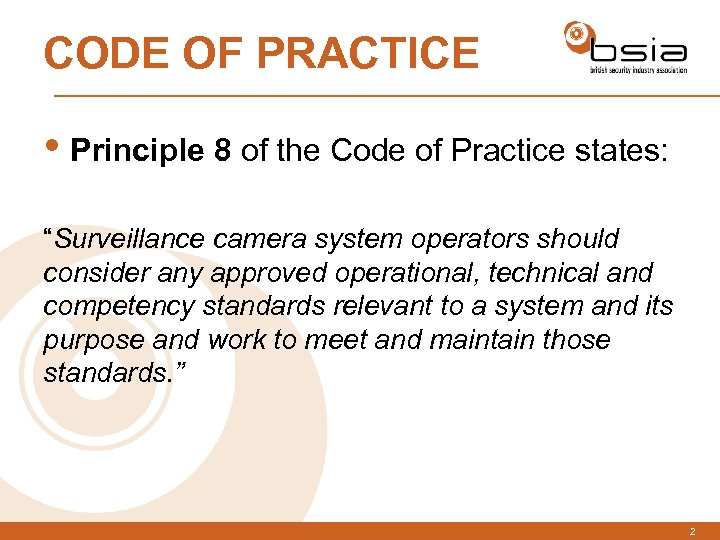
CODE OF PRACTICE • Principle 8 of the Code of Practice states: “Surveillance camera system operators should consider any approved operational, technical and competency standards relevant to a system and its purpose and work to meet and maintain those standards. ” 2
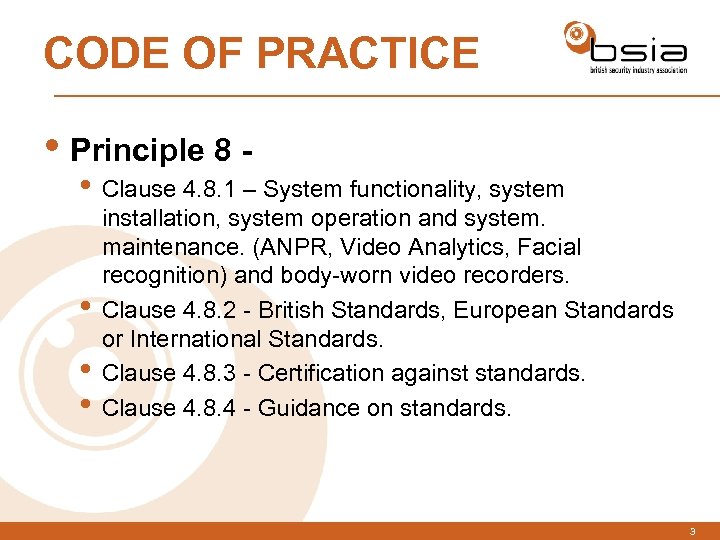
CODE OF PRACTICE • Principle 8 - • Clause 4. 8. 1 – System functionality, system • • • installation, system operation and system. maintenance. (ANPR, Video Analytics, Facial recognition) and body-worn video recorders. Clause 4. 8. 2 - British Standards, European Standards or International Standards. Clause 4. 8. 3 - Certification against standards. Clause 4. 8. 4 - Guidance on standards. 3
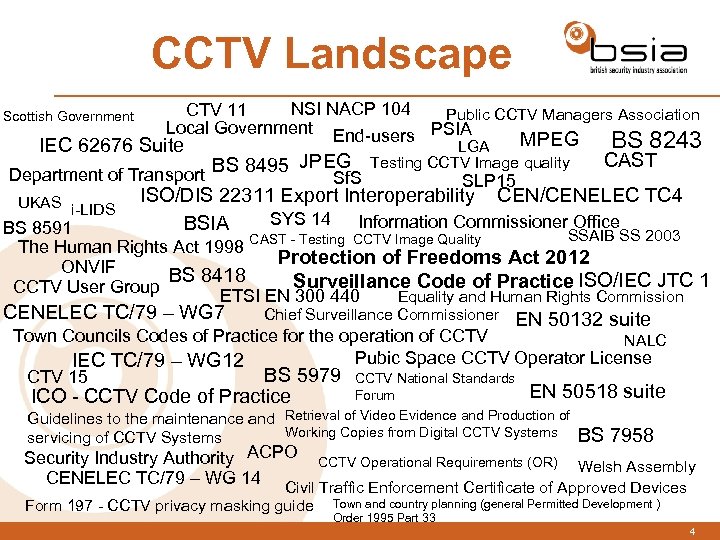
CCTV Landscape Scottish Government NSI NACP 104 CTV 11 Public CCTV Managers Association Local Government End-users PSIA MPEG LGA Testing CCTV Image quality IEC 62676 Suite BS 8243 CAST BS 8495 JPEG Department of Transport Sf. S SLP 15 ISO/DIS 22311 Export Interoperability CEN/CENELEC TC 4 UKAS i-LIDS SYS 14 Information Commissioner Office BSIA BS 8591 SSAIB SS 2003 The Human Rights Act 1998 CAST - Testing CCTV Image Quality Protection of Freedoms Act 2012 ONVIF BS 8418 Surveillance Code of Practice ISO/IEC JTC 1 CCTV User Group Equality and Human Rights Commission ETSI EN 300 440 CENELEC TC/79 – WG 7 Chief Surveillance Commissioner EN 50132 suite Town Councils Codes of Practice for the operation of CCTV NALC Pubic Space CCTV Operator License IEC TC/79 – WG 12 BS 5979 CCTV National Standards CTV 15 EN 50518 suite Forum Guidelines to the maintenance and Retrieval of Video Evidence and Production of Working Copies from Digital CCTV Systems BS 7958 servicing of CCTV Systems ICO - CCTV Code of Practice Security Industry Authority ACPO CENELEC TC/79 – WG 14 CCTV Operational Requirements (OR) Welsh Assembly Civil Traffic Enforcement Certificate of Approved Devices Form 197 - CCTV privacy masking guide Town and country planning (general Permitted Development ) Order 1995 Part 33 4
Standards Framework • The standards framework should: • Cover conception to judgment. • Take account of relevant legislation at each stage of the framework. • Embed the relevant Surveillance Code of Practice Principles in each stage of the framework. • State who is responsibility for relevant stage of the framework. • Use published standards where applicable and suitable. 5
Standards Framework • The standards framework should: • Highlight standards gaps. • Use published guidance where available and suitable. • Highlight guidance gaps. • Highlight available training and training gaps. • Facilitate certification against standards framework – (self certification or 3 rd party). • Be understandable, practical, affordable and give choice (where applicable). 6
SCC Standards Group • Actions: • Standards gaps – Facilitate standards development. • Guidance gaps – Facilitate guidance development • Training gaps – Facilitate training development • Take account of and engage in, where applicable National, European and International standards development. 7
SCC Standards Group • Actions: • Engagement with all parties on standards. guidance and standard development. • Engagement with end users over end user requirements (including advice, guidance, standards) etc. • Look to technology independent standards, not technology dependent standards (where possible). • Produce interpretation of standards and guidance where necessary. 8
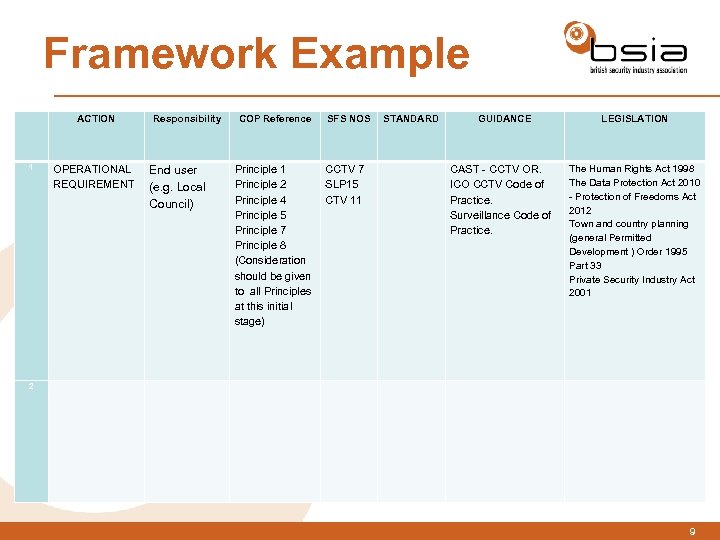
Framework Example 1 ACTION OPERATIONAL REQUIREMENT Responsibility End user (e. g. Local Council) COP Reference SFS NOS Principle 1 CCTV 7 Principle 2 SLP 15 Principle 4 CTV 11 Principle 5 Principle 7 Principle 8 (Consideration should be given to all Principles at this initial stage) STANDARD GUIDANCE LEGISLATION CAST - CCTV OR. ICO CCTV Code of Practice. Surveillance Code of Practice. The Human Rights Act 1998 The Data Protection Act 2010 - Protection of Freedoms Act 2012 Town and country planning (general Permitted Development ) Order 1995 Part 33 Private Security Industry Act 2001 2 9
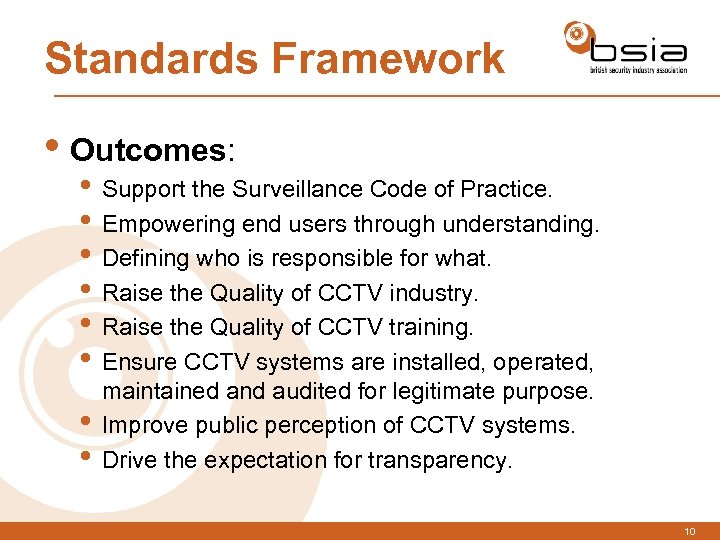
Standards Framework • Outcomes: • Support the Surveillance Code of Practice. • Empowering end users through understanding. • Defining who is responsible for what. • Raise the Quality of CCTV industry. • Raise the Quality of CCTV training. • Ensure CCTV systems are installed, operated, • • maintained and audited for legitimate purpose. Improve public perception of CCTV systems. Drive the expectation for transparency. 10

THANK YOU QUESTIONS 11
Скачать презентацию ALEX CARMICHAEL Technical Director BSIA CCTV Standards Framework
8199468940169046f852ae1904ec5856.ppt