 Скачать презентацию Albuquerque NM Black band lives here Team Members
e42931c8ecc3c3e4f97bc84b37679825.ppt
- Количество слайдов: 35



Albuquerque, NM Black band lives here! Team Members Matt Turner Matt Moore Stu Burgess Andy Birkel Doug Hemink Role Architectural & Foundations Engineer Structural Engineer Fluid Systems Engineer Building Thermal Systems Engineer Solar Thermal Systems Engineer
Agenda Black band lives here! 1. 2. 3. 4. 5. 6. Architectural Foundations Structural Hydronic System Building Thermal Solar Thermal
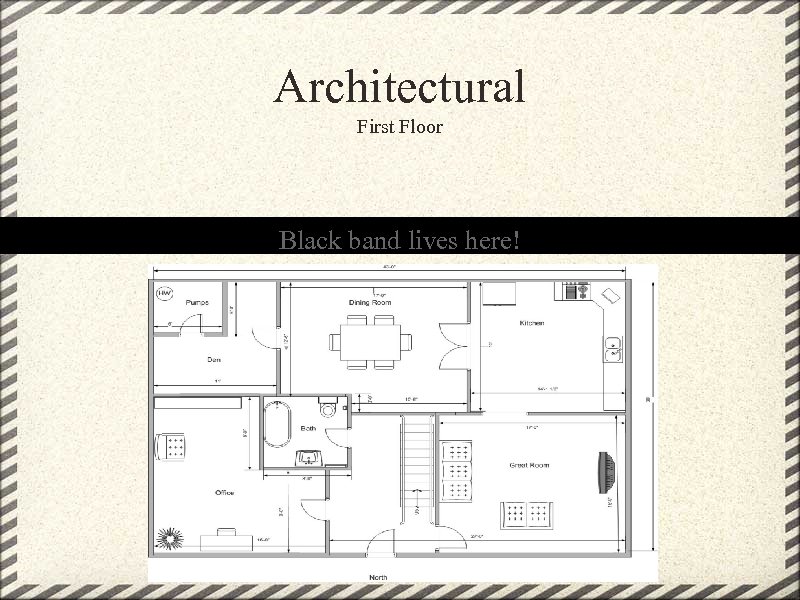
Architectural First Floor Black band lives here!
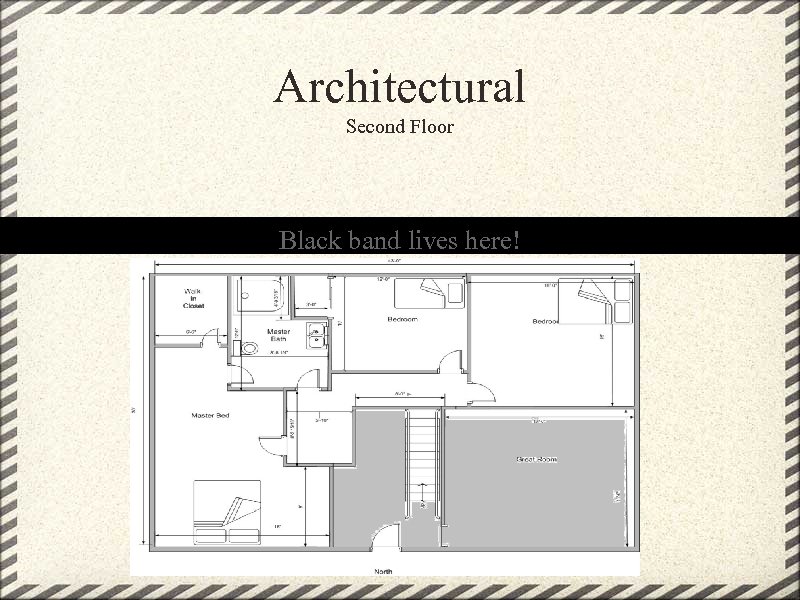
Architectural Second Floor Black band lives here!
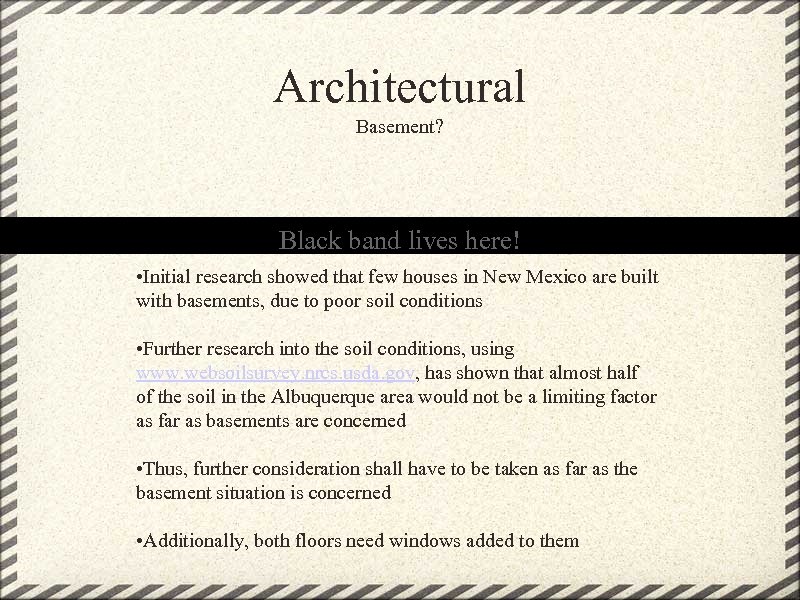
Architectural Basement? Black band lives here! • Initial research showed that few houses in New Mexico are built with basements, due to poor soil conditions • Further research into the soil conditions, using www. websoilsurvey. nrcs. usda. gov, has shown that almost half of the soil in the Albuquerque area would not be a limiting factor as far as basements are concerned • Thus, further consideration shall have to be taken as far as the basement situation is concerned • Additionally, both floors need windows added to them
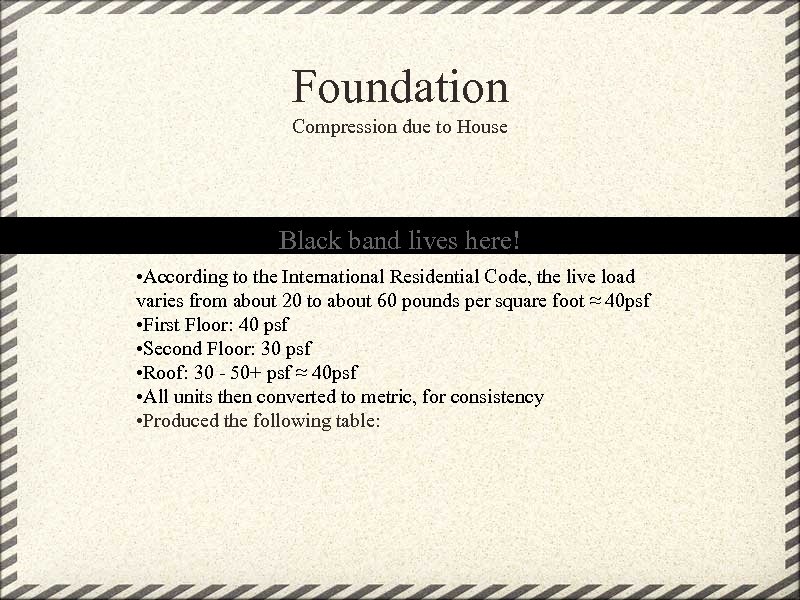
Foundation Compression due to House Black band lives here! • According to the International Residential Code, the live load varies from about 20 to about 60 pounds per square foot ≈ 40 psf • First Floor: 40 psf • Second Floor: 30 psf • Roof: 30 - 50+ psf ≈ 40 psf • All units then converted to metric, for consistency • Produced the following table:
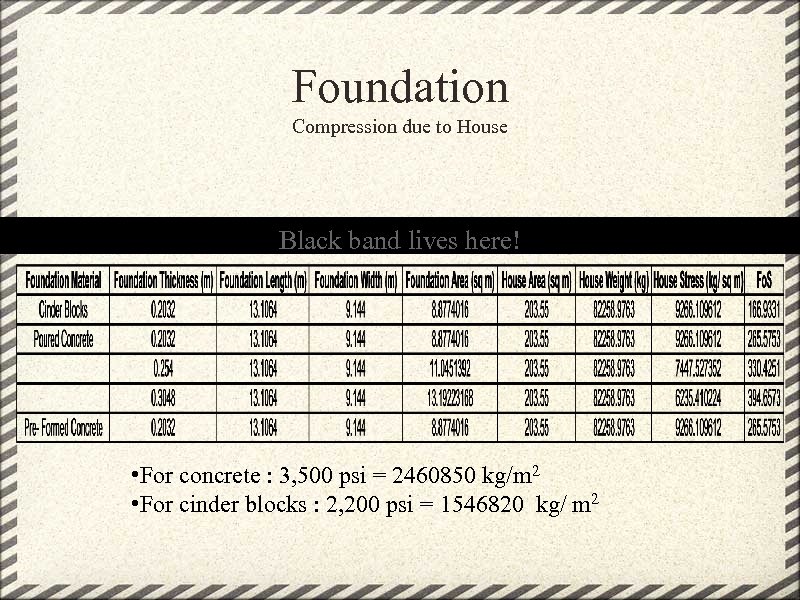
Foundation Compression due to House Black band lives here! • For concrete : 3, 500 psi = 2460850 kg/m 2 • For cinder blocks : 2, 200 psi = 1546820 kg/ m 2
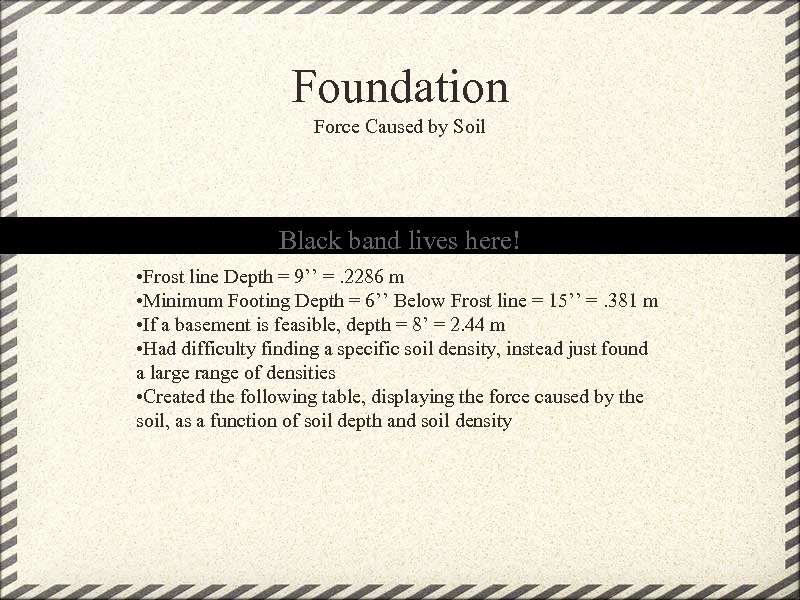
Foundation Force Caused by Soil Black band lives here! • Frost line Depth = 9’’ =. 2286 m • Minimum Footing Depth = 6’’ Below Frost line = 15’’ =. 381 m • If a basement is feasible, depth = 8’ = 2. 44 m • Had difficulty finding a specific soil density, instead just found a large range of densities • Created the following table, displaying the force caused by the soil, as a function of soil depth and soil density
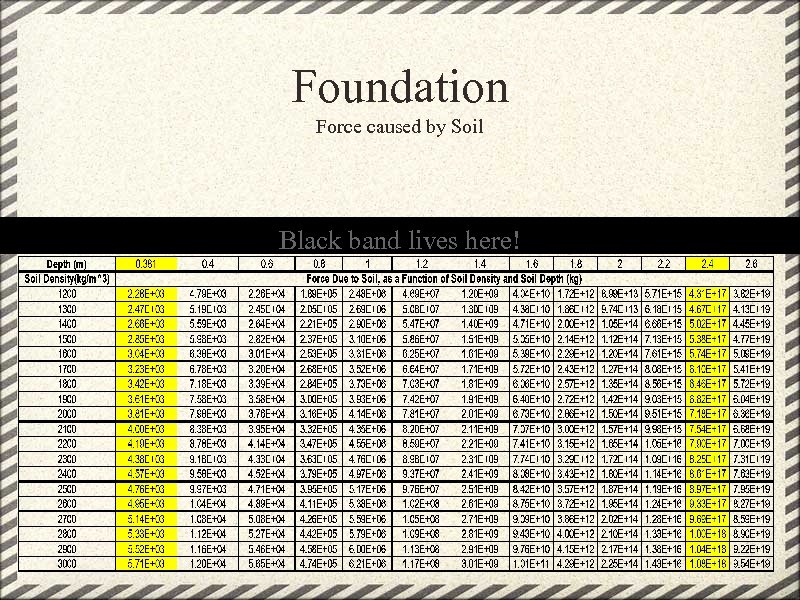
Foundation Force caused by Soil Black band lives here!
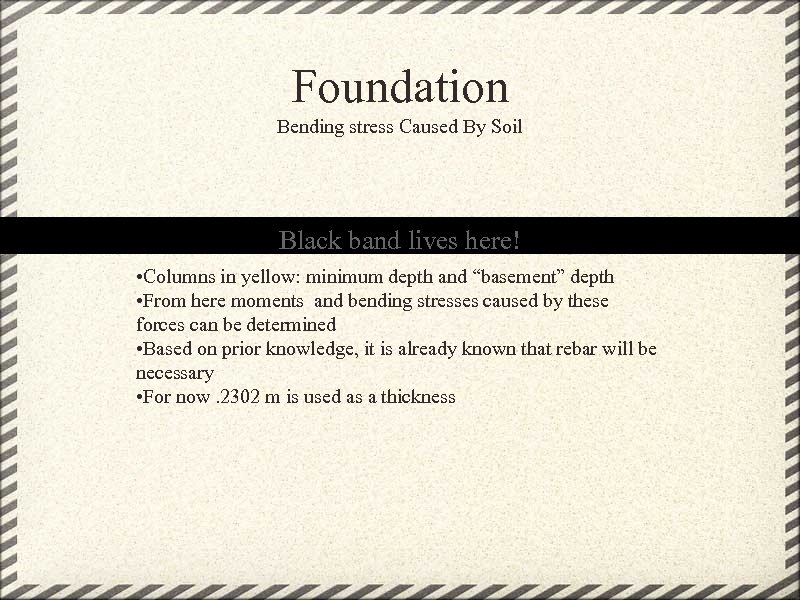
Foundation Bending stress Caused By Soil Black band lives here! • Columns in yellow: minimum depth and “basement” depth • From here moments and bending stresses caused by these forces can be determined • Based on prior knowledge, it is already known that rebar will be necessary • For now. 2302 m is used as a thickness
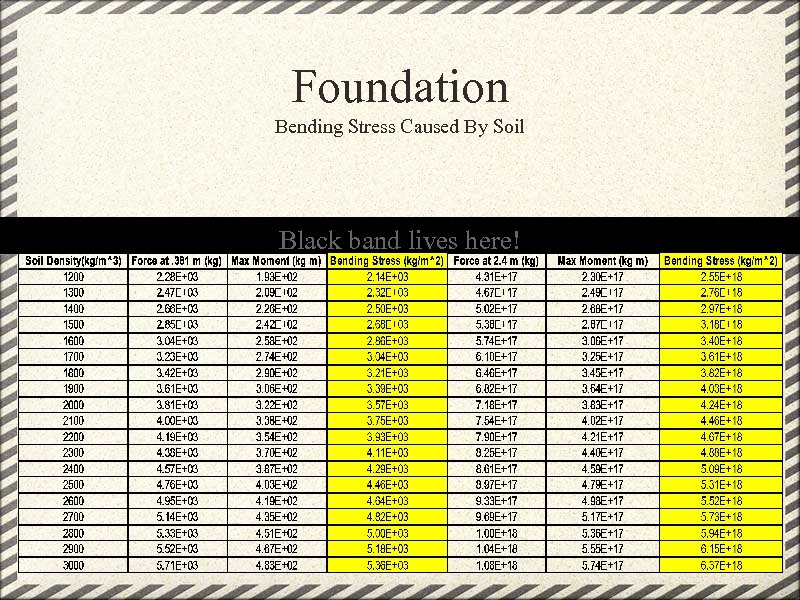
Foundation Bending Stress Caused By Soil Black band lives here!
Foundation What's Next Black band lives here! • From here I need to determine if any of these will give the desired factor of safety • Assuming they won't, I'll need to determine amount of rebar required –Can also determine if the thickness can simply be increased • A cost comparison should also take place • Check to see if any pros/cons from one type significantly outweigh others
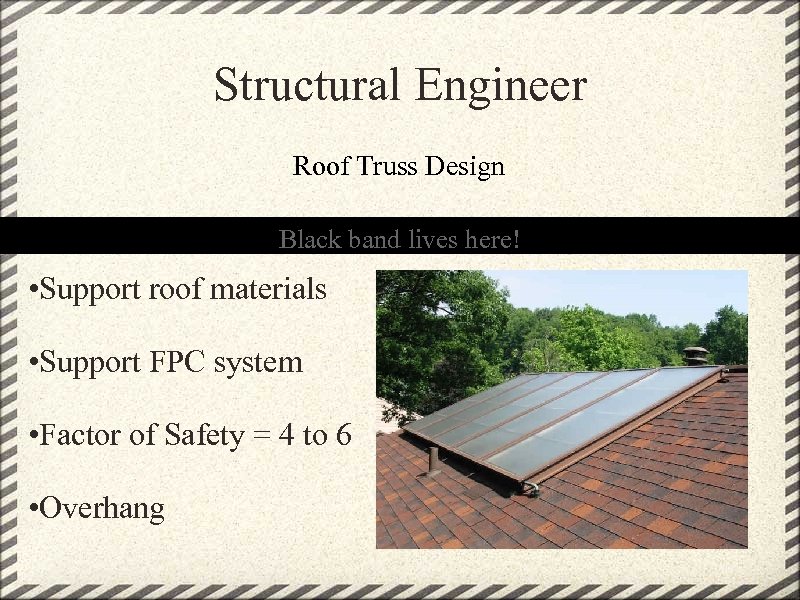
Structural Engineer Roof Truss Design Black band lives here! • Support roof materials • Support FPC system • Factor of Safety = 4 to 6 • Overhang
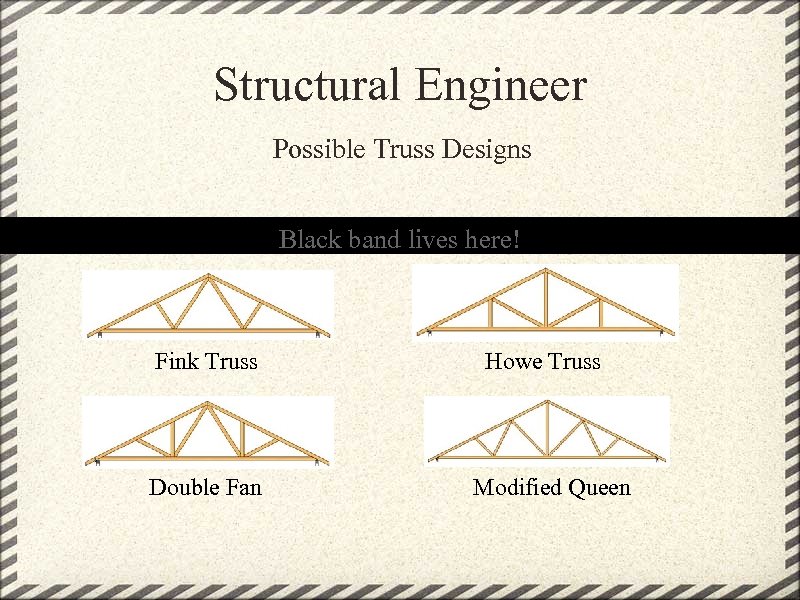
Structural Engineer Possible Truss Designs Black band lives here! Fink Truss Double Fan Howe Truss Modified Queen
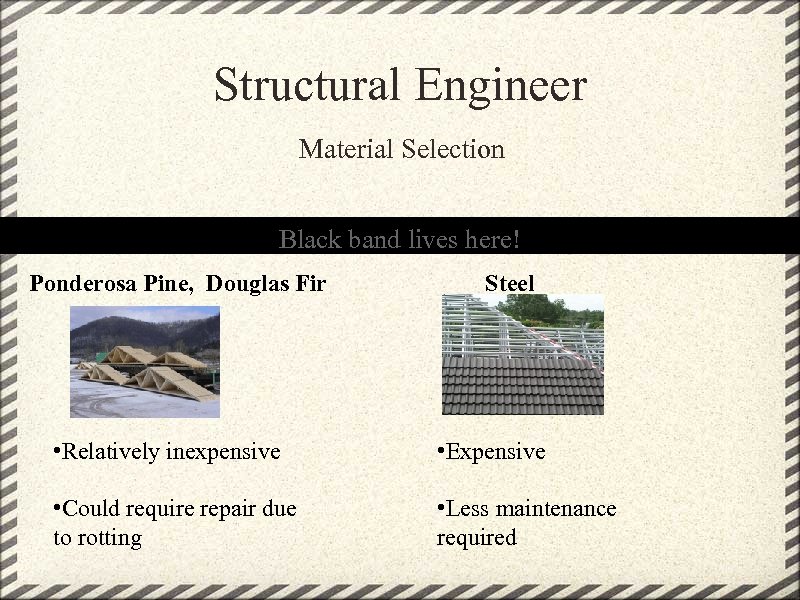
Structural Engineer Material Selection Black band lives here! Ponderosa Pine, Douglas Fir Steel • Relatively inexpensive • Expensive • Could require repair due to rotting • Less maintenance required
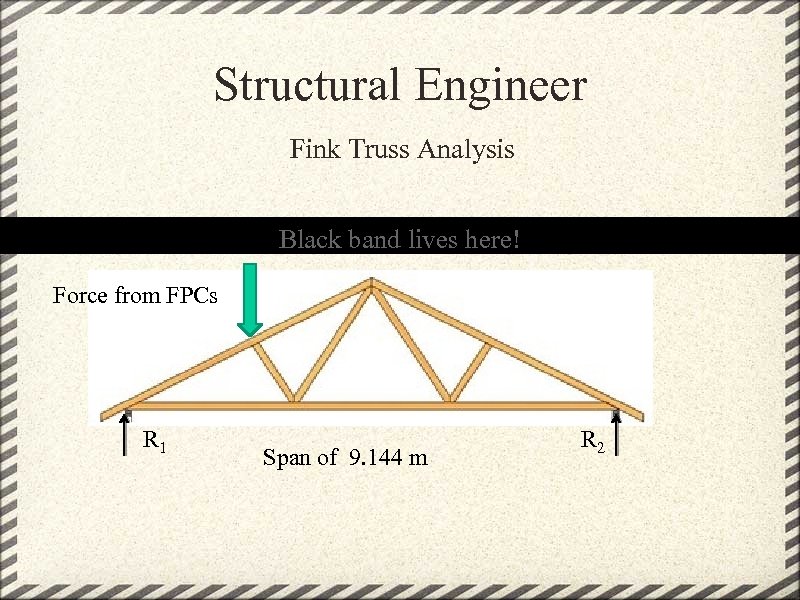
Structural Engineer Fink Truss Analysis Black band lives here! Force from FPCs R 1 Span of 9. 144 m R 2
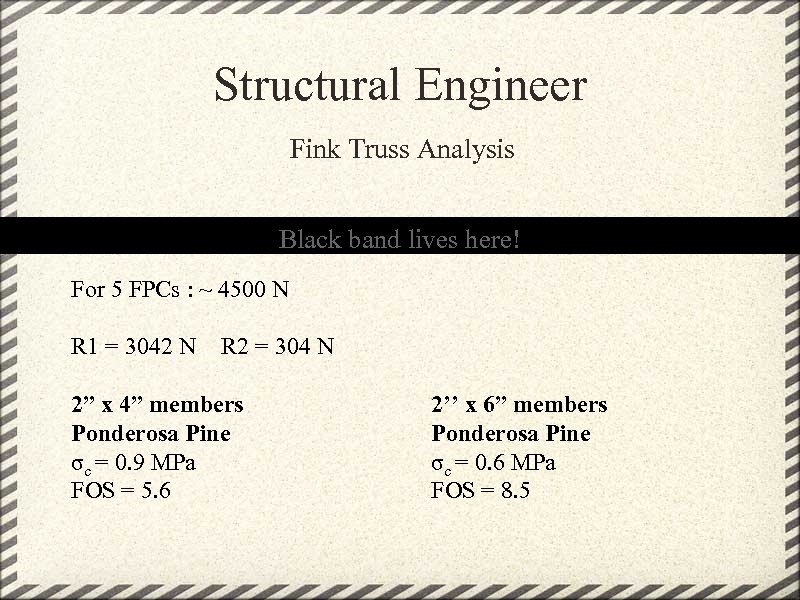
Structural Engineer Fink Truss Analysis Black band lives here! For 5 FPCs : ~ 4500 N R 1 = 3042 N R 2 = 304 N 2” x 4” members Ponderosa Pine σc = 0. 9 MPa FOS = 5. 6 2’’ x 6” members Ponderosa Pine σc = 0. 6 MPa FOS = 8. 5
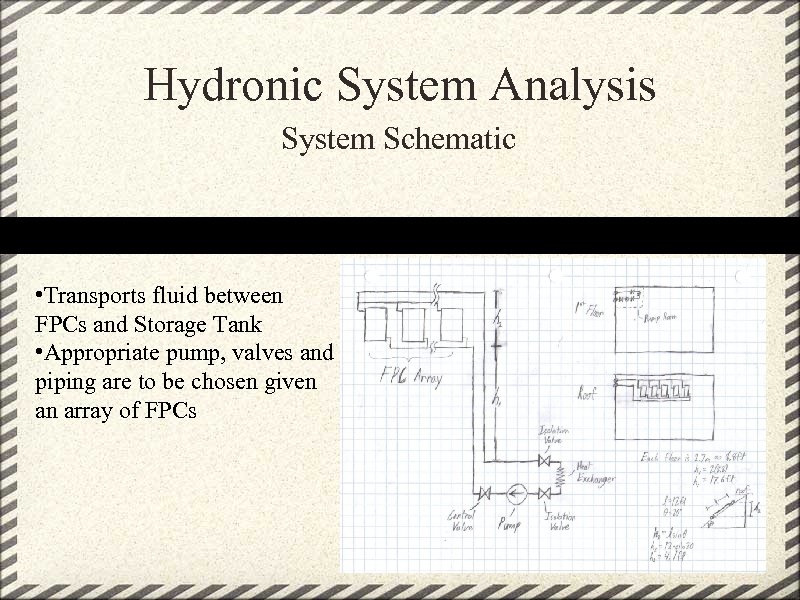
Hydronic System Analysis System Schematic • Transports fluid between FPCs and Storage Tank • Appropriate pump, valves and piping are to be chosen given an array of FPCs
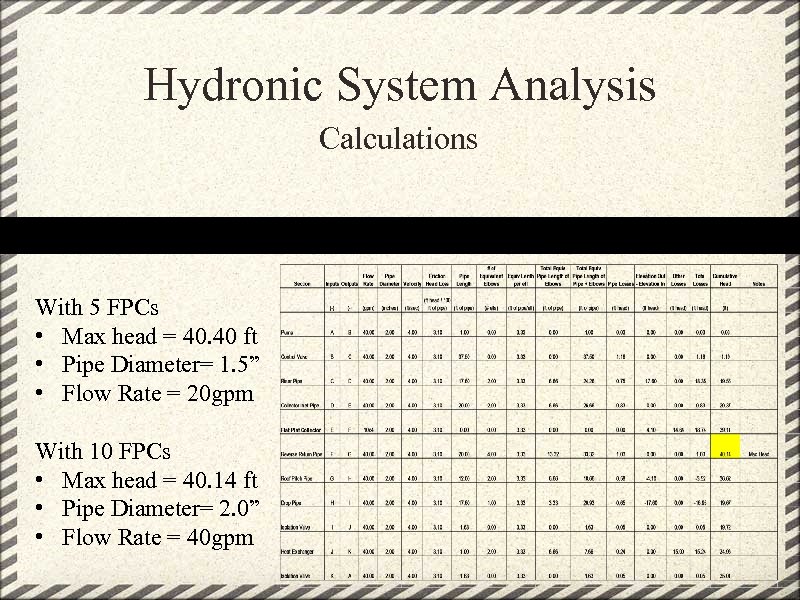
Hydronic System Analysis Calculations With 5 FPCs • Max head = 40. 40 ft • Pipe Diameter= 1. 5” • Flow Rate = 20 gpm With 10 FPCs • Max head = 40. 14 ft • Pipe Diameter= 2. 0” • Flow Rate = 40 gpm
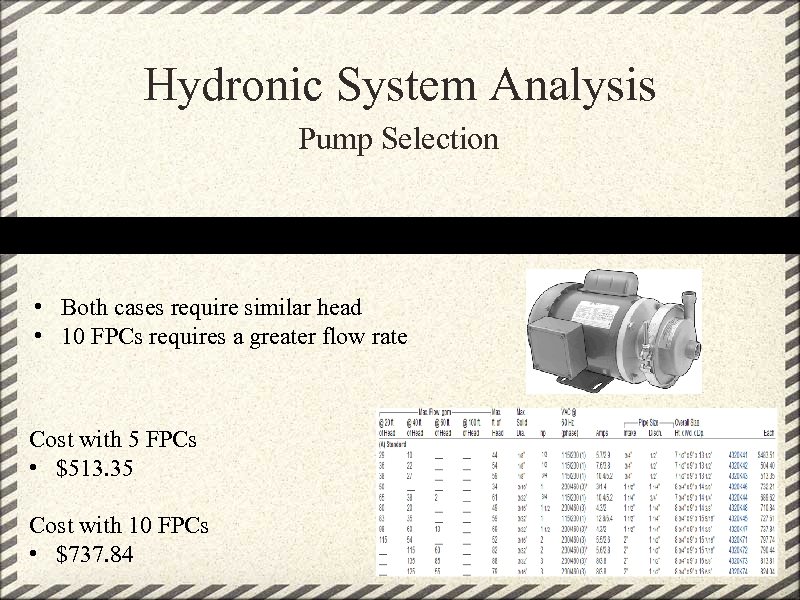
Hydronic System Analysis Pump Selection • Both cases require similar head • 10 FPCs requires a greater flow rate Cost with 5 FPCs • $513. 35 Cost with 10 FPCs • $737. 84
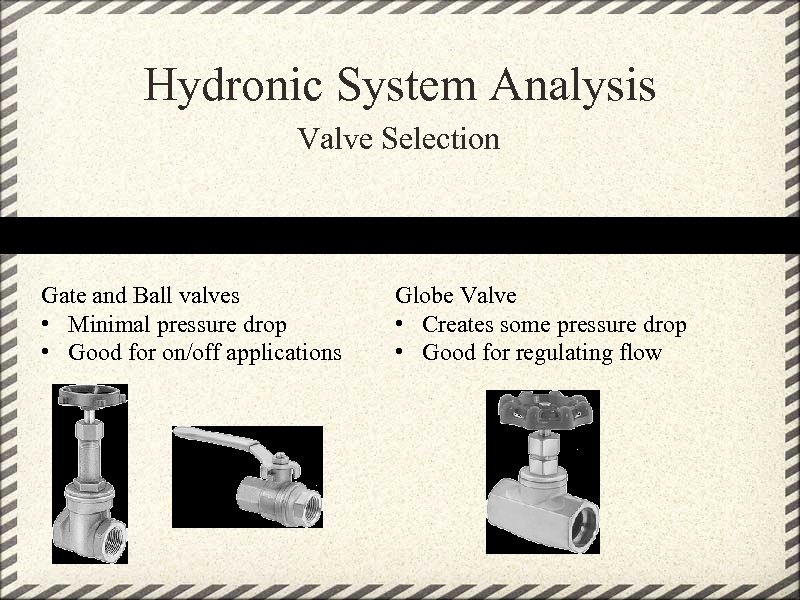
Hydronic System Analysis Valve Selection Gate and Ball valves • Minimal pressure drop • Good for on/off applications Globe Valve • Creates some pressure drop • Good for regulating flow
Hydronic System Analysis Piping materials CPVC • Cheap • Self-insulated • Lightweight • Easy to work with • Can become brittle and discolored when exposed to UV rays Copper • Proven durability • Fire resistant • Requires skilled labor to install/repair PVC • Shares many of the upsides of CPVC • Not suitable for hot water usage Galvanized Steel • High durability • Expensive • Very difficult to repair
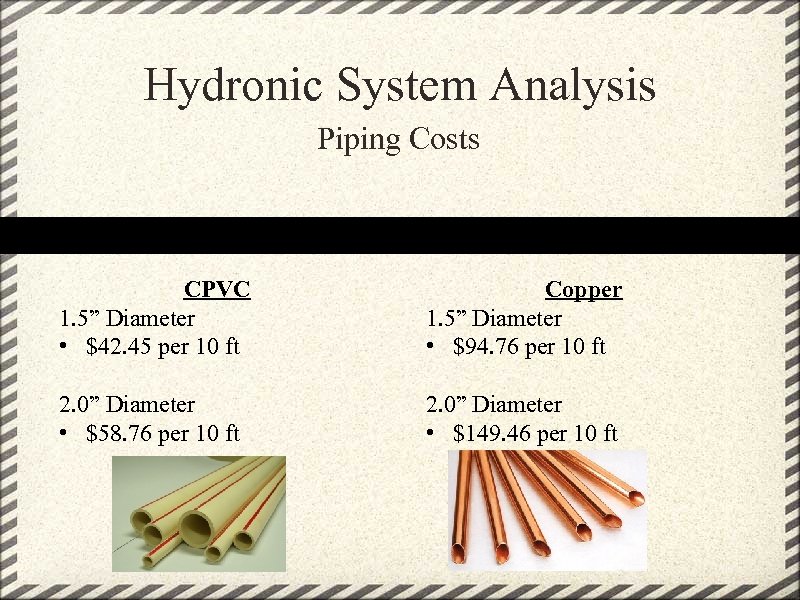
Hydronic System Analysis Piping Costs CPVC 1. 5” Diameter • $42. 45 per 10 ft Copper 1. 5” Diameter • $94. 76 per 10 ft 2. 0” Diameter • $58. 76 per 10 ft 2. 0” Diameter • $149. 46 per 10 ft
Building Thermal Systems Andy Birkel
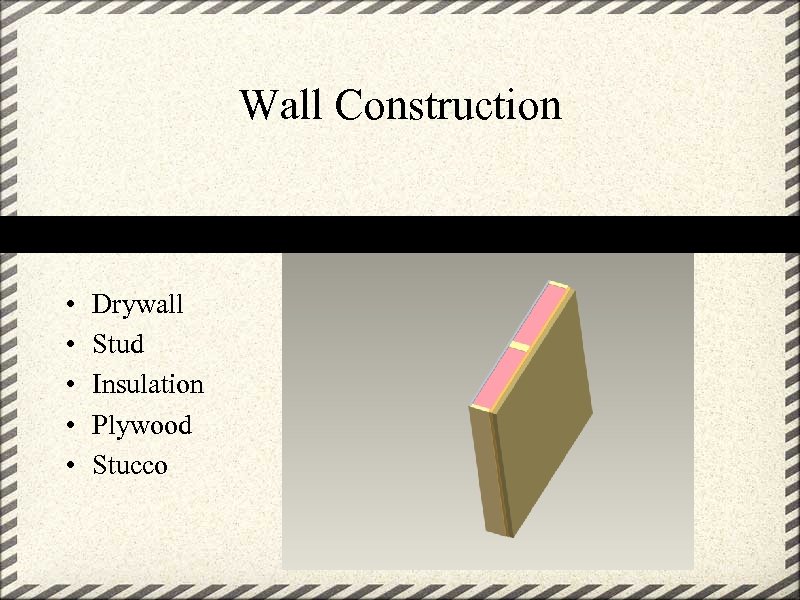
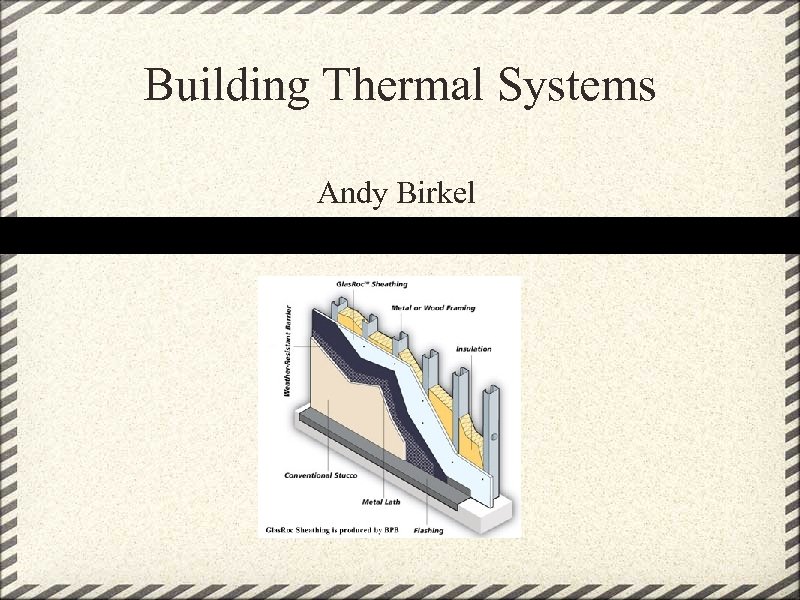
Wall Construction • • • Drywall Stud Insulation Plywood Stucco
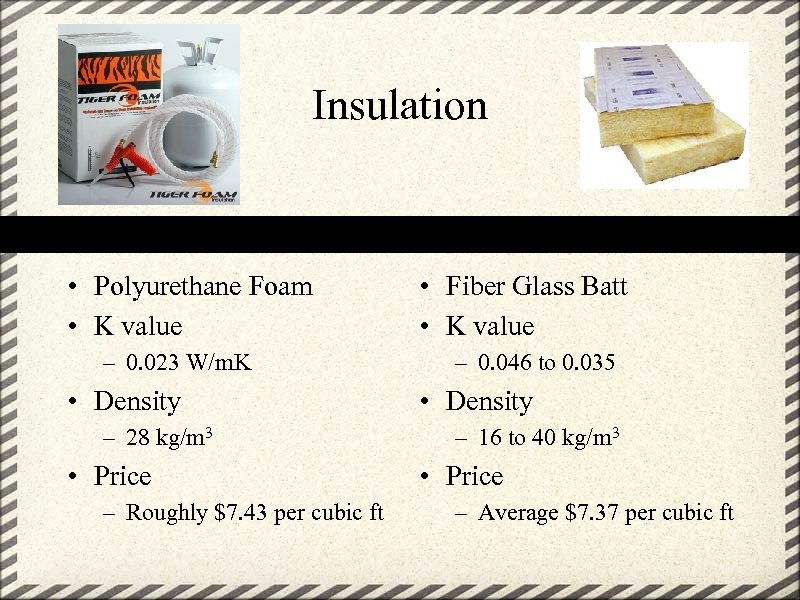
Insulation • Polyurethane Foam • K value – 0. 023 W/m. K • Density – 28 kg/m 3 • Price – Roughly $7. 43 per cubic ft • Fiber Glass Batt • K value – 0. 046 to 0. 035 • Density – 16 to 40 kg/m 3 • Price – Average $7. 37 per cubic ft
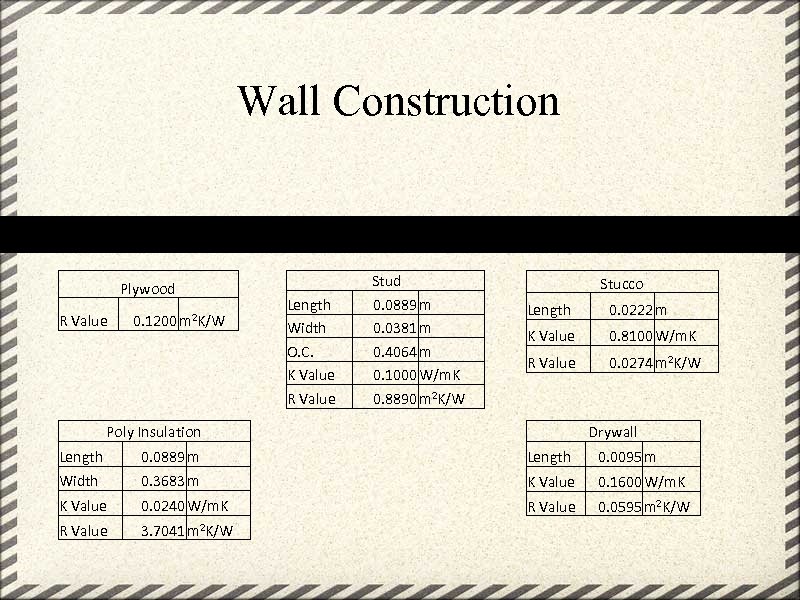
Wall Construction Plywood R Value 0. 1200 m 2 K/W Length Width O. C. K Value R Value Stud 0. 0889 m 0. 0381 m 0. 4064 m 0. 1000 W/m. K 0. 8890 m 2 K/W Stucco Length 0. 0222 m K Value 0. 8100 W/m. K R Value 0. 0274 m 2 K/W Poly Insulation Drywall Length 0. 0889 m Length 0. 0095 m Width 0. 3683 m K Value 0. 1600 W/m. K K Value 0. 0240 W/m. K R Value 0. 0595 m 2 K/W R Value 3. 7041 m 2 K/W
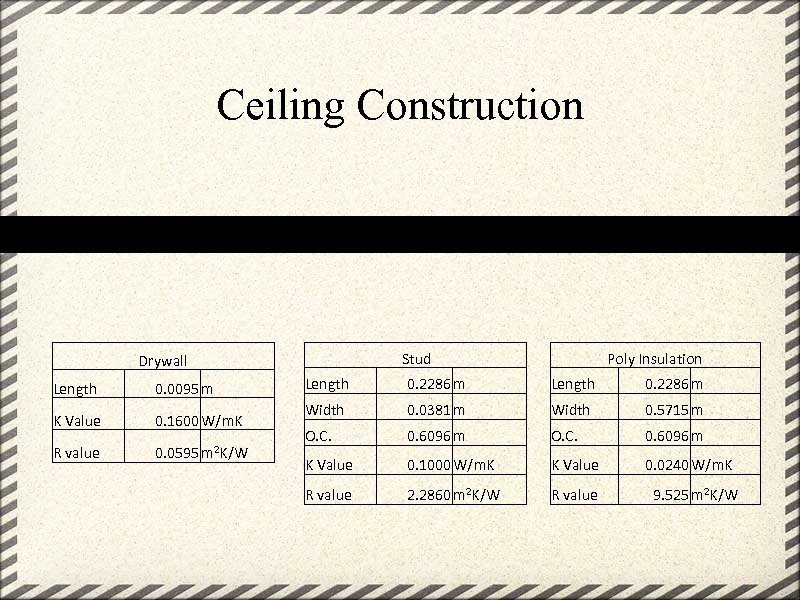
Ceiling Construction Stud Drywall Length 0. 0095 m K Value 0. 1600 W/m. K R value 0. 0595 m 2 K/W Poly Insulation Length 0. 2286 m Length 0. 2286 m Width 0. 0381 m Width 0. 5715 m O. C. 0. 6096 m K Value 0. 1000 W/m. K K Value 0. 0240 W/m. K R value 2. 2860 m 2 K/W R value 9. 525 m 2 K/W
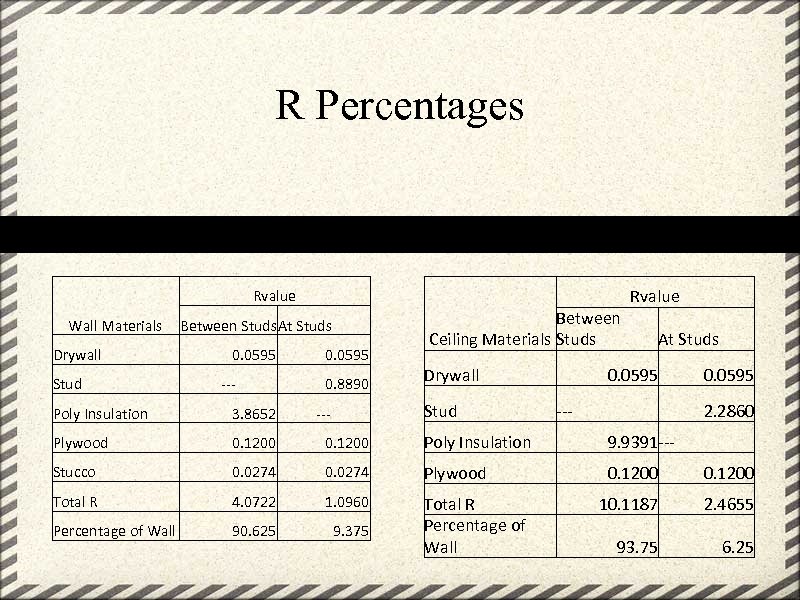
R Percentages Rvalue Wall Materials Drywall Stud Between Studs. At Studs 0. 0595 --- 0. 0595 0. 8890 Between Ceiling Materials Studs Drywall Stud --- Rvalue At Studs 0. 0595 --- 0. 0595 2. 2860 Poly Insulation 3. 8652 Plywood 0. 1200 Poly Insulation 9. 9391 --- Stucco 0. 0274 Plywood 0. 1200 Total R 4. 0722 1. 0960 10. 1187 2. 4655 Percentage of Wall 90. 625 9. 375 Total R Percentage of Wall 93. 75 6. 25
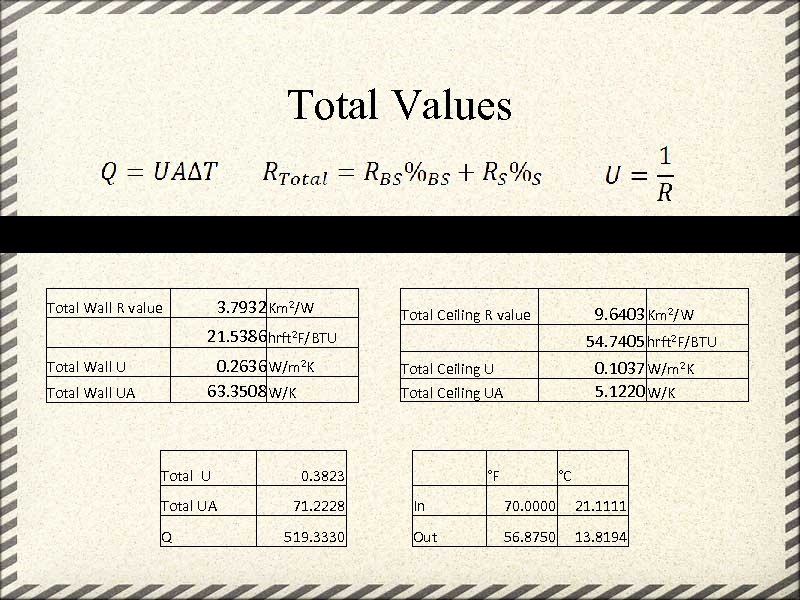
Total Values 3. 7932 Km 2/W Total Wall R value 9. 6403 Km 2/W 54. 7405 hrft 2 F/BTU 0. 1037 W/m 2 K 5. 1220 W/K Total Ceiling R value 21. 5386 hrft 2 F/BTU Total Wall U 0. 2636 W/m 2 K 63. 3508 W/K Total Ceiling UA Total Wall UA Total U 0. 3823 Total UA 71. 2228 In 70. 0000 21. 1111 Out 56. 8750 13. 8194 Q 519. 3330 °F °C
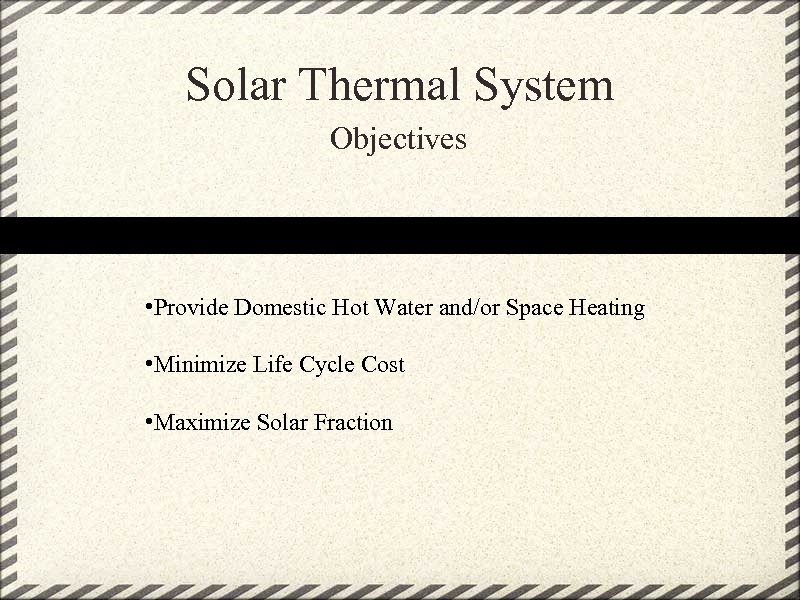
Solar Thermal System Objectives • Provide Domestic Hot Water and/or Space Heating • Minimize Life Cycle Cost • Maximize Solar Fraction
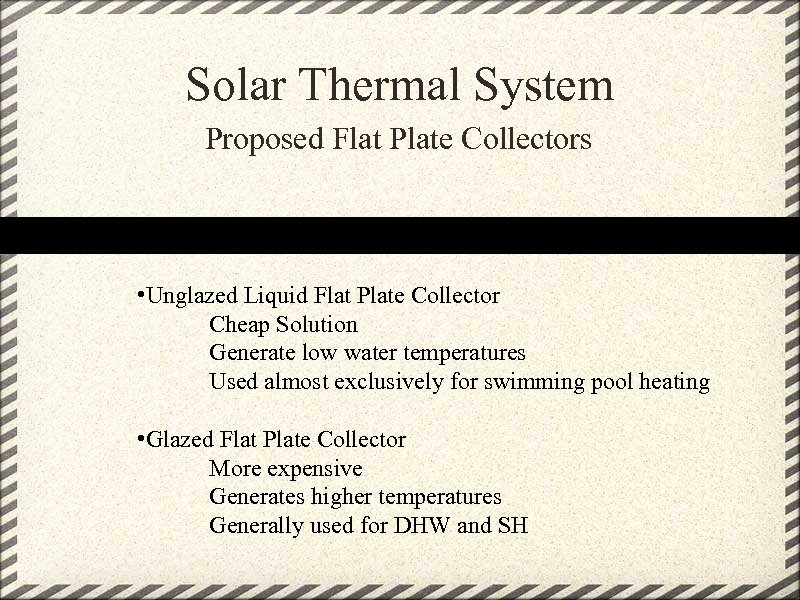
Solar Thermal System Proposed Flat Plate Collectors • Unglazed Liquid Flat Plate Collector Cheap Solution Generate low water temperatures Used almost exclusively for swimming pool heating • Glazed Flat Plate Collector More expensive Generates higher temperatures Generally used for DHW and SH
Solar Thermal System Assumptions • Collector Slope = 57° • Down Payment =$2, 500 • Fuel = Electricity = 0. 1090 $/k. W-hr • Daily hot water usage = 80 Gallons • Water / Environmental temperature = 120°F / 68°F • Used for both DHW and SH • Unglazed Liquid Flat Plate Collector Analyzed using data on Sun Trek Brand • Glazed Flat Plate Collector Analyzed using data on American Energy AE-40 E
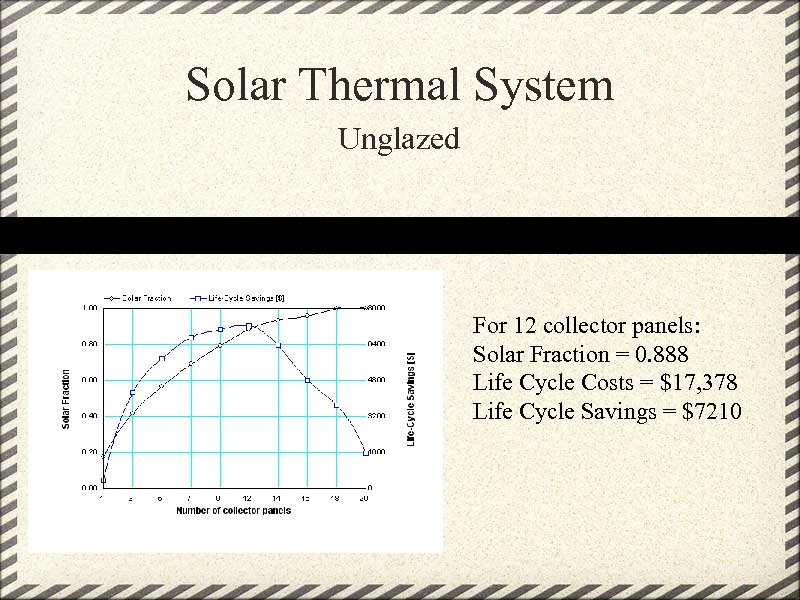
Solar Thermal System Unglazed For 12 collector panels: Solar Fraction = 0. 888 Life Cycle Costs = $17, 378 Life Cycle Savings = $7210
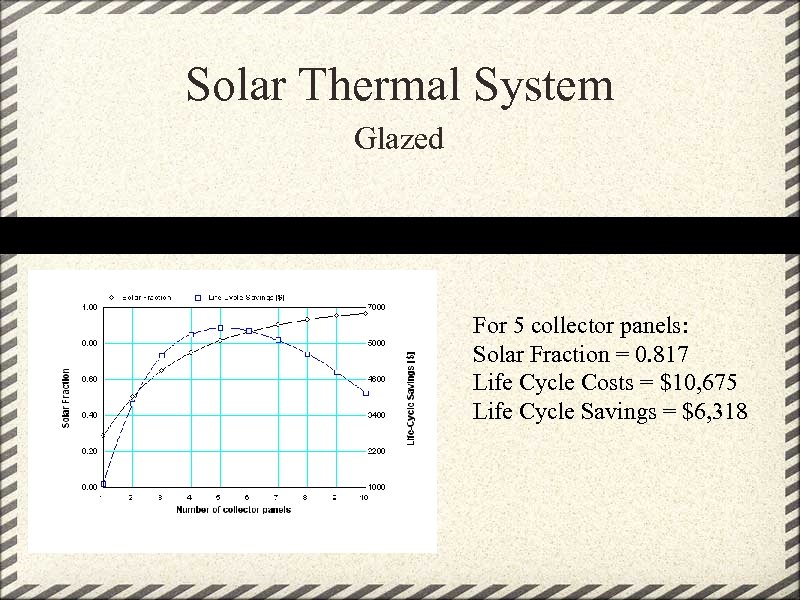
Solar Thermal System Glazed For 5 collector panels: Solar Fraction = 0. 817 Life Cycle Costs = $10, 675 Life Cycle Savings = $6, 318
Скачать презентацию Albuquerque NM Black band lives here Team Members
e42931c8ecc3c3e4f97bc84b37679825.ppt