 Скачать презентацию Alberta OH S and CRC First Aid Created by
5d782e58402443b24d23abcc18d9af27.ppt
- Количество слайдов: 31




Alberta OH&S and CRC First Aid Created by Cezary Giluk Program Development Coordinator Oil Sands & Construction Training & Safety Ltd. info@oscts. ca 780 -983 -0155 www. oscts. ca 1
Alberta OH&S and CRC First Aid Certifications Recognized by OH&S Canadian Red Cross Standard and Emergency First Aid courses have been approved by Alberta Occupational Health and Safety (OH&S). To ensure we continue to meet the requirements of Alberta OH&S, additional requirements for workplace first aid training identified by OHS need to be included. Goal To provide information regarding the Alberta Occupational Health and Safety (OH&S) Code that is relevant to the workplace First Aider. This information must be included in all Red Cross First Aid courses for workplace recognition in Alberta. 2
Alberta OH&S and CRC First Aid Use of copyrighted materials Materials used in this presentation are excerpts from: • FA 015 First Aid (Revised May 2011) – Automated External Defibrillators in the Workplace • FA 012 — First Aid (Revised November 2012) – Developing a First Aid Plan • FA 014— First Aid (Revised May 2011) – Medication in First Aid Kits • FA 011 — First Aid (Revised May 2011) – Workplace First Aiders and Legal Requirements • FA 009 — First Aid (Revised May 2011) – First Aid Records Copyrighted under: © 2009 -2010, Government of Alberta, Employment and Immigration” 3
Alberta OH&S and CRC First Aid Learning objectives: At the end of the session, students will be able to discuss: • The overall principles of the Emergency Medical Aid Act • The overall principles of the OHS Code, Part 11 First Aid, as well as specific sections that apply to the workplace First Aider • The overall principles of the Occupational Health and Safety Act and specifically the section addressing first aid records • The sections of the OHS Code Part 29 Workplace Hazardous Materials Information Systems that apply to chemical exposures and first aid • Specific sections of the Workers Compensation Act that address first aid and injuries in the workplace • How to contact Workplace Health and Safety in Alberta 4
Automated External Defibrillators in the Workplace Health and Safety supports the use of Automated External Defibrillators (AEDs) at the work site provided the employer ensures that AED use is integrated into the first aid program and emergency response plan at the site and can be safely used in the specific work environment intended. AEDs can be effective at improving survival from sudden cardiac arrest due to ventricular fibrillation when their use is incorporated into an emergency response system that includes early recognition of emergency, early notification and access of emergency medical services, early cardiopulmonary resuscitation, early defibrillation, and early advanced cardiac life support. 5
Automated External Defibrillators in the Workplace AEDs are approved for sale as medical devices by Health Canada, Medical Devices Bureau (MDB). They are regulated in Canada as medical devices. The manufacturer is required to license the AED. MDB imposes labeling requirements on these devices as required by the Canadian Medical Devices Regulation. Labels must state indications and conditions for AED use including a requirement that they are used only by properly qualified individuals. Labels must also include directions for the safe use of AEDs in the manner intended. 6
Automated External Defibrillators in the Workplace The OHS Regulation (AR 62/2003), Section 13, requires that workers be competent or be under the supervision of a competent worker. A worker using an AED would have to be “adequately qualified, suitably trained and with sufficient experience” to safely use the AED training is a required component in the Advanced First Aid course. Other first aiders may use AED equipment if they receive training comparable to the training required on the use of AEDs that is part of Advanced First Aid. If the first aider is under the supervision of a licensed medical practitioner, the Alberta College of Physicians and Surgeons has guidelines covering responsibilities of the medical practitioner. The Heart & Stroke Foundation of Canada has guidelines regarding AED use. 7
Automated External Defibrillators in the Workplace Recommendations (1) In considering authorizing the use of AEDs at a work site, an employer should ensure assessment of specific needs of the work site including; • Whether AEDs can be safely used (e. g. not to be used in a flammable environment) • The population at risk - identify hazards of the workplace that increase risk of sudden cardiac arrest • Existing emergency response and • Availability of emergency medical services (2) The employer should ensure AEDs are integrated into the existing emergency response and First Aid programs. (3) Anyone using an AED must be competent therefore; the employer must ensure appropriate training in AEDs for equipment that is present at the worksite. There also must be a system to ensure update of skills and recertification. (4) The employer should ensure there is a quality assurance program in place that includes regular maintenance and inspection of equipment, record keeping and program evaluation. 8
Developing a First Aid Plan Introduction Health and safety programs at the workplace aim to prevent injuries and illnesses. But sometimes, despite the best prevention efforts, injuries and illnesses occur. Planning for emergencies and having a First Aid Plan is not only the right thing to do legally and morally, it makes sense from a business point of view. General considerations When planning for first aid at a work site, the first step is to review the hazards and the types of injuries and illnesses likely to occur. Consider information such as the number of workers at the work site, the type of work that is done, and hazards to which workers are exposed. This helps determine the potential injuries and illnesses and the extent of the first aid that may be required. How close medical treatment services are to the work site will also help determine the services and supplies needed. When developing a First Aid Plan, keep in mind the worst-case scenario. 9
Developing a First Aid Plan First aiders Alberta’s Occupational Health and Safety Code (OHS Code), Part 11 First Aid, specifies the number of first aiders and the level of first aid training required at work sites, based on three criteria: (1) how hazardous the work is, (2) the time it takes to travel to a health care facility, and (3) the number of workers per shift. When assessing a particular work situation, you may find that the supplies and services required by the OHS Code are insufficient to meet the needs of that situation. Employers are encouraged to exceed the minimum requirements in such circumstances. The OHS Code states that designated workplace first aiders must have approved training. Approved training course are listed on the Workplace Health and Safety web site and are updated on a regular basis. 10
Developing a First Aid Plan Equipment and Supplies In addition to first aid services, the OHS Code specifies the equipment and supplies that are required at a work site. Contents of the various required first aid kits are listed in Schedule 2, Table 3, and the requirements for stocking a first aid room is listed in Schedule 2, Table 4, if such a room is needed. Where specialized equipment is made available, the employer must ensure that first aiders are trained and competent in the use of that equipment. It is recommended that medications not be included in first aid kits. Individuals designated to administer medication should have specific written medical directives from a licensed physician. Training standards for the designated workplace first aider do not include administering medications, although first aiders can assist workers in taking their own medications 11
Developing a First Aid Plan First Aid Record Keeping Various written records must be developed and maintained as part of a First Aid Plan. The records to include are: Names of first aiders, including their certificates and training records; First aid supply and equipment inventories; Injury and illness records in accordance with the OHS Code; Procedures for communication, including how to summon help; and Transportation plans for getting injured or ill workers to medical treatment facilities. These records are important both for administrative purposes and to meet the legal requirements. 12
Developing a First Aid Plan Transportation Employers must arrange for the transport of injured or ill workers to a health care facility where medical treatment is available. This is a requirement in section 180 of the OHS Code and applies to all work sites, regardless of the types of injuries and illnesses, the number of workers, the number and level of trained first aiders and the supplies and equipment required. Transportation arrangements must be made prior to dispatching workers to a work site, and therefore advanced planning is needed. Transporting injured or ill workers in urban settings is straightforward and does not normally require any additional, specialized planning since appropriate supplies and transportation services are readily available. There may be cases where potential work exposures require specialized treatment and in these situations, municipal emergency services may need to be contacted ahead of time so that any specialized supplies, equipment, or specific arrangements for transportation or treatment are in place. 13
Developing a First Aid Plan Transportation – Continue More planning is generally required for rural and remote locations where workers may be isolated or working alone. Once again, it is important to consider the extent of possible injuries and illnesses that may occur. The goal for the transportation section of the First Aid Plan is to get medical treatment as soon as possible. Injured or ill workers can be transported by any mode of transportation that meets the requirements of the OHS Code, including a designated vehicle, a ground ambulance from a municipal ambulance service, or emergency air transportation. Prior arrangements should be made with the ambulance service that may be summoned. When appropriate, highly specific latitude and longitude coordinates may need to be provided. It is important to provide specific directions with highway, township or range road numbers and landmarks so that those responding can find the work site. 14
Developing a First Aid Plan Communication is one of the most important elements of the First Aid Plan. Communication involves informing workers about: Who the designated first aiders are; How to summon the first aiders; What the check-in procedures are when working alone or at an isolated work site; Where supplies and equipment are located; When to summon transportation; What type of transportation is available to get injured or ill workers to medical care; Who to call to summon transportation; What the back-up plan is if the first type of transportation is unavailable; and When to report incidents to Workplace Health and Safety 15
Developing a First Aid Plan Finalizing The Plan Once developed, the plan should be endorsed by management and communicated to all workers. It should be in writing and accessible to everyone at the work site. No matter what or where injuries or illnesses occur, everyone at the work site should know how to respond and how to get help. It is recommended that plans be tested before being finalized. Even the best plans can have gaps. It is important to have drills at least once a year, or more often if work locations, workers or other factors change. Before conducting drills, be sure to let emergency response personnel know ahead of time. An effective First Aid Plan is one that provides appropriate, immediate and temporary first aid and, when necessary, medical treatment in a timely manner so that health is preserved, safety is protected, and injury and illnesses are not aggravated. 16
Medication in First Aid Kits In Alberta, first aiders are not allowed to diagnose, prescribe or administer any medication. They are allowed to assist individuals with their own prescribed medications if the casualty identifies the medication on his/her own and is unable to take it without assistance. It is required that employers provide and maintain First Aid kits in their workplaces that meet the requirements as designated in the Alberta Occupational Health and Safety Code. Minimum requirements are stipulated. Additional equipment or supplies may be indicated as a result of a hazard assessment. 17
Medication in First Aid Kits The inclusion of symptom relief medication falls outside of the scope of first aid and should be left to individual choice and access. Routine inclusion of over-the-counter medications in first aid kits is not recommended as there is no established benefit and there are potential adverse outcomes. If it is determined that it is necessary to provide over-thecounter medication, a physician should write policy and procedures to cover their use. Health care professionals would then be designated to administer medications. 18
Workplace First Aiders and Legal Requirements Emergency Medical Aid Act The Emergency Medical Aid Act is the name given to the Alberta’s “Good Samaritan” legislation. First aiders must understand that if they use reasonable skill and care to the level of first aid that they have been taught, they need not fear legal action. Occupational Health and Safety Act The Occupational Health and Safety Act is the umbrella legislation for all occupational health and safety in Alberta. According to the Act, employers, workers, contractors and prime contractors are all responsible for ensuring health and safety at work. Although the Act outlines numerous requirements, subsection 23(2) pertains to first aiders. It allows the Director of Medical Services to ask for first aid reports and requires first aiders to provide them Workplace Compensation for First Aiders Workers who are financially compensated or whose job description includes first aid may not be covered under the Emergency Medical Aid Act. Talk to your employer about your legal status and protection. If you are performing Firs Aider duties without any compensation, you are covered 19
Occupational Health and Safety Code - Part 11 — First Aid The Occupational Health and Safety (OHS) Code requires employers to provide first aid and have designated first aiders at work sites. The OHS Code defines minimum standards in services, equipment and supplies. The OHS Code stipulates the number of first aiders, the level of first aid training required, the type and number of first aid kits required and the type and quantity of supplies and equipment required. These requirements are based on the hazard level of the work performed at the workplace, the number of workers per shift, and the distance of the work site to the nearest health care facility. The OHS Code details record keeping requirements for designated work site first aiders. 20
Occupational Health and Safety Code - Part 11 — First Aid Employers must ensure a means of transportation is available for taking injured or ill workers to a health care facility. If a licensed ambulance service is not available, then the means of transport being used is suitable considering the distance to be travelled, the types of acute illnesses or injuries, must provide protection against the weather, have a means of communication with the health care facility and be large enough to accommodate a stretcher and an accompanying person. 21
Part 29 — Workplace Hazardous Materials Information System Two sections in Part 29 of the OHS Code are relevant to work site first aiders. Section 407 requires employers to ensure that Material Safety Data Sheets (MSDSs) are available to workers who may be exposed to controlled products. MSDSs contain information on proper first aid treatment and can be a valuable resource. Under section 413, physicians or nurses may ask for and are entitled to information on controlled products to diagnose or treat workers. Work site first aiders may be involved in providing the necessary information. 22
Workers’ Compensation Act Section 37 of the Workers’ Compensation Act allows first aid records to be inspected by the Board or a designate of the Board, and by the injured worker to whom the record(s) relates or to that worker’s representative. First aid treatment that is provided by work site first aiders for minor injures does not need to be reported to the Workers Compensation Board (WCB). However, workers and employers must report any workplace incident to the WCB where the injury disables or is likely to disable the worker beyond the day of the incident. Employers must also notify the WCB if the worker has medical aid treatment or other services provided by licensed medical practitioners. 23
First Aid Records The purpose of regulating workplace first aid is to ensure that every work site in the province has the equipment, supplies, and trained staff to provide first aid care in the event of workplace injury or illness. There are minimum requirements specified — employers are free to exceed them based on a site -specific assessment of their workers’ first aid needs. 24
Worker’s duty to report an injury or illness Under Alberta’s Occupational Health and Safety Code, workers are required to report to their employer any work-related physical injury or sudden occurrence of illness experienced while at work. The employer should establish to whom the report is communicated e. g. first aider, foreman, nurse, supervisor, safety person, or some other individual. Prompt reporting ensures complete and accurate information and allows the injury or illness to be assessed and treated as necessary. Such information is also useful in injury surveillance. Similar, recurrent injuries reported by several workers may suggest the need to change some aspect of the work site or the tasks performed by workers. 25
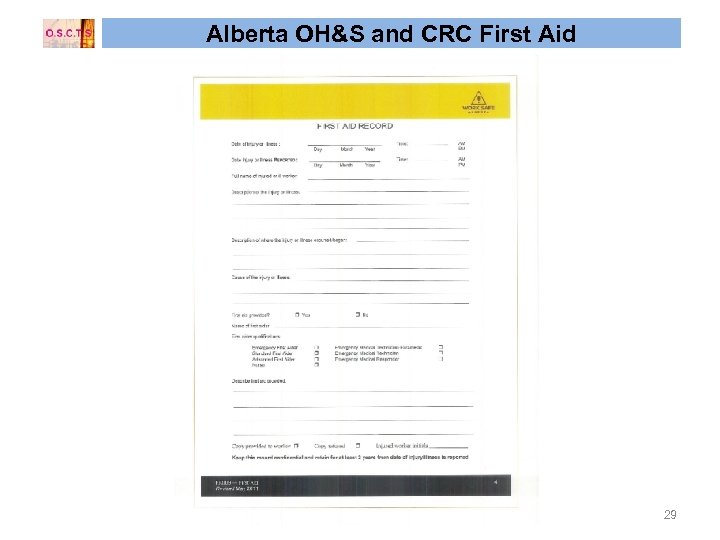
Written record of injury or illness The employer is required to create and maintain an accurate written record of all work-related physical injuries or sudden occurrences of illness that workers experience while at work. Although the cause of the injury or illness may be unknown at the time it is being treated, every effort should be made to determine the cause within a reasonable period of time. The cause of work injuries should be added to the record and if an illness is the result of occupational causes, this information should be also be added. Even if no first aid is administered, an injury or illness reported by a worker must be recorded. An example of a First Aid Record will be presented shortly. It contains the minimum information required. Completed forms should be sent to an individual designated by the employer to keep all first aid records. Each injury or illness record must be retained for a minimum of 3 years from the date on which the injury or illness was reported. Completed records must not be kept in the first aid kit. All first aid records should be kept as this helps demonstrate due diligence with respect to the record keeping requirement. 26
Written record of injury or illness • In respecting worker privacy, the current requirements limit access to first aid records. A person designated by the employer to keep the first aid records must ensure the information is kept confidential and that no person other than the worker has access to the first aid records unless Alberta or Canada legislation grants disclosure of the information; the record is in a form that does not identify the worker; or the worker has given written permission. • The Occupational Health and Safety Act, section 8, allows the occupational health and safety officers and the Director of Medical Services, Occupational Health and Safety Policy, Alberta Employment and Immigration access to the records. Other legislation such as the Workers’ Compensation Act, the Health Information Act (HIA), the Personal Information Protection Act (PIPA) and Canada’s Personal Information Protection and Electronic Documents Act may also have provisions authorizing access, use and disclosure of personal information. 27
Written record of injury or illness Access to records A worker can allow his or her first aid record to be made available to other persons but permission must be in writing indicating the information that can be released, the name of the person to whom the information is to be released, the date and the worker’s signature. Upon request, an employer must provide the worker with a copy of their first aid record. Records binder available A first aid records binder is now available from the Queen’s Printer Bookstore. Designed to fit most standard first aid kits, the 5. 5”x 9. 5” binder comes with 28 first aid records. Additional replacement pages are available. Orders may be placed on-line. See contact information for the Queen’s Printer 28
Alberta OH&S and CRC First Aid 29
Alberta OH&S Contact Information Call any Government of Alberta office toll-free Dial 310 -0000, then the area code and telephone number you want to reach Edmonton (780) 415 -8690 Throughout Alberta 1 -866 -415 -8690 (Toll Free) Deaf or hearing impaired • Edmonton (780) 427 -9999 • Other locations 1 -800 -232 -7215 Getting copies of OHS Act, Regulation & Code: • Queen’s Printer http: //www. qp. alberta. ca • Edmonton (780) 427 -4952 Occupational Health and Safety • http: //employment. alberta. ca/SFW/295. html 30
Alberta OH&S and CRC First Aid Any Questions ? 31
Скачать презентацию Alberta OH S and CRC First Aid Created by
5d782e58402443b24d23abcc18d9af27.ppt