


 Скачать презентацию Alastair M Glass Deputy Minister Ontario Uniquely
8d2dc550ed7c0278b29814b991eb7918.ppt
- Количество слайдов: 26
 Alastair M. Glass Deputy Minister
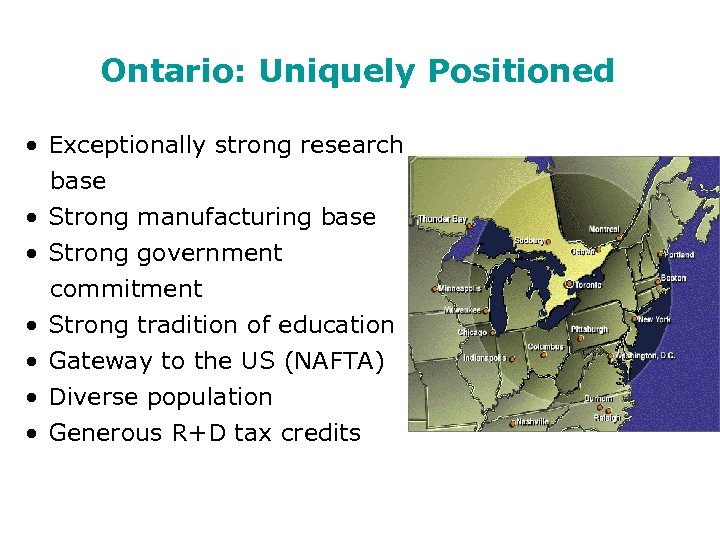 Ontario: Uniquely Positioned • Exceptionally strong research base • Strong manufacturing base • Strong government commitment • Strong tradition of education • Gateway to the US (NAFTA) • Diverse population • Generous R+D tax credits
 The Ministry of Research and Innovation (MRI) • New Ministry of Research and Innovation - focus • The Premier of Ontario is the Minister of Research and Innovation • The Province will invest $1. 7 billion over five years through an integrated set of research, commercialization and outreach programs • The Ontario Research and Innovation Council (ORIC) will provide expert advice to the Premier • Focus on areas of strength and opportunity • Strategic plan launched for consultation
 Ontario innovation imperatives • Continue to build research strength through partnership • Extract economic and social value from research • Attract and build industrial research • Build on tradition of entrepreneurship • Forge industry-academia partnerships/clusters • Showcase Ontario strengths and accomplishments • Inspire the next generation of innovators
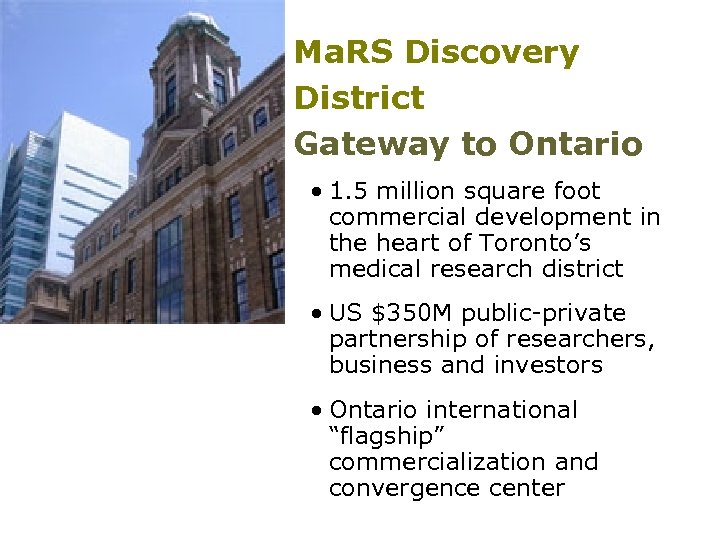 Ma. RS Discovery District Gateway to Ontario • 1. 5 million square foot commercial development in the heart of Toronto’s medical research district • US $350 M public-private partnership of researchers, business and investors • Ontario international “flagship” commercialization and convergence center
 Ontario Centres of Excellence (OCE) • Centre for Energy • Communications and Information Technology Ontario • Earth and Environmental Technologies • Materials and Manufacturing Ontario • Photonics Research Ontario Collectively, the centres promote the economic development of Ontario through directed research, commercialization of technology and training for highly qualified personnel.
 Nano Funding in Canada 1998 -2005 – Natural Sciences and Engineering Research Council (NSERC) – Canadian Institutes of Health Research (CIHR) – Canada Foundation for Innovation – Provincial Programs In excess of $430 million for Canada $150 million for Ontario
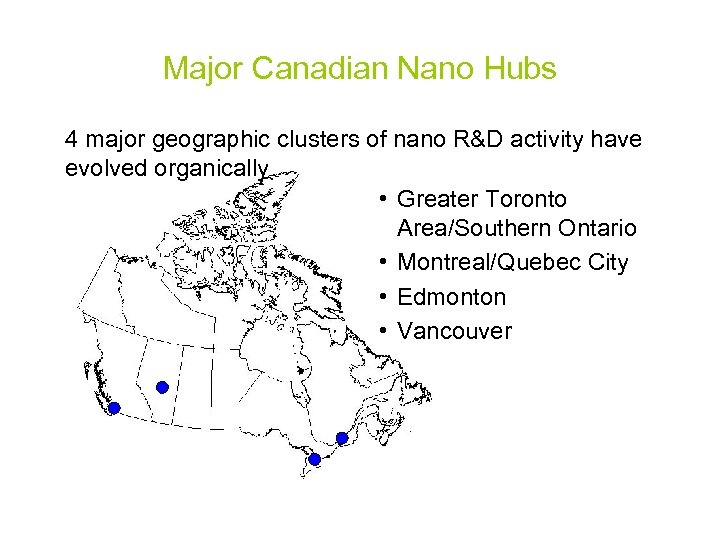 Major Canadian Nano Hubs 4 major geographic clusters of nano R&D activity have evolved organically • Greater Toronto Area/Southern Ontario • Montreal/Quebec City • Edmonton • Vancouver
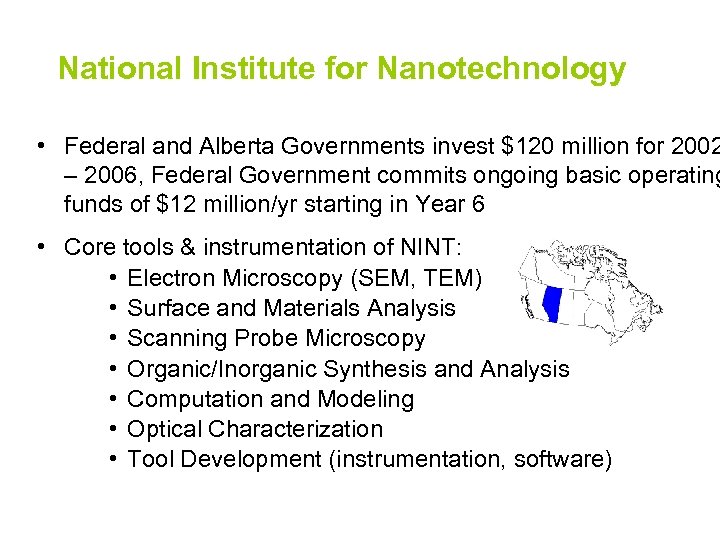 National Institute for Nanotechnology • Federal and Alberta Governments invest $120 million for 2002 – 2006, Federal Government commits ongoing basic operating funds of $12 million/yr starting in Year 6 • Core tools & instrumentation of NINT: • Electron Microscopy (SEM, TEM) • Surface and Materials Analysis • Scanning Probe Microscopy • Organic/Inorganic Synthesis and Analysis • Computation and Modeling • Optical Characterization • Tool Development (instrumentation, software)
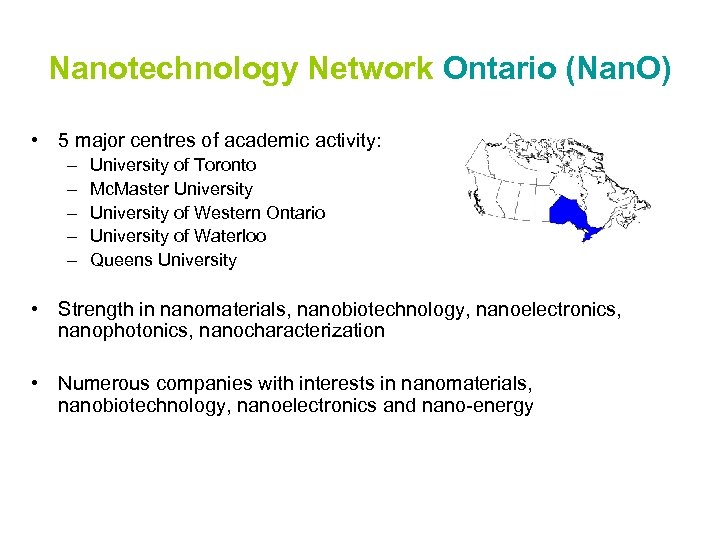 Nanotechnology Network Ontario (Nan. O) • 5 major centres of academic activity: – – – University of Toronto Mc. Master University of Western Ontario University of Waterloo Queens University • Strength in nanomaterials, nanobiotechnology, nanoelectronics, nanophotonics, nanocharacterization • Numerous companies with interests in nanomaterials, nanobiotechnology, nanoelectronics and nano-energy
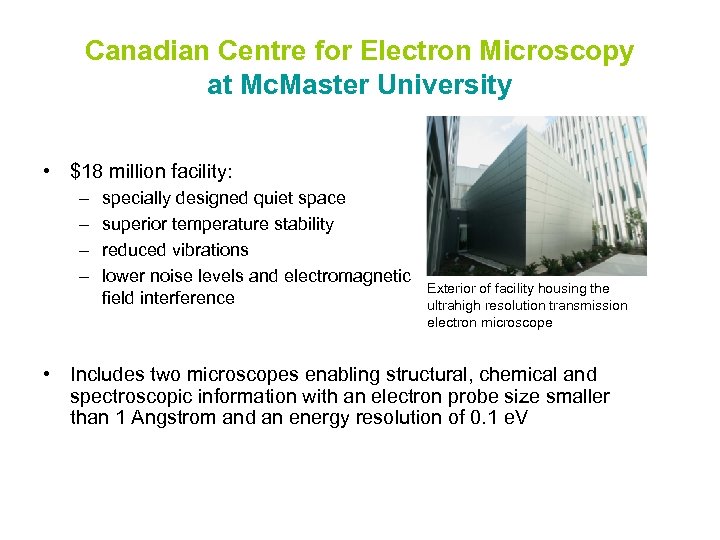 Canadian Centre for Electron Microscopy at Mc. Master University • $18 million facility: – – specially designed quiet space superior temperature stability reduced vibrations lower noise levels and electromagnetic field interference Exterior of facility housing the ultrahigh resolution transmission electron microscope • Includes two microscopes enabling structural, chemical and spectroscopic information with an electron probe size smaller than 1 Angstrom and an energy resolution of 0. 1 e. V
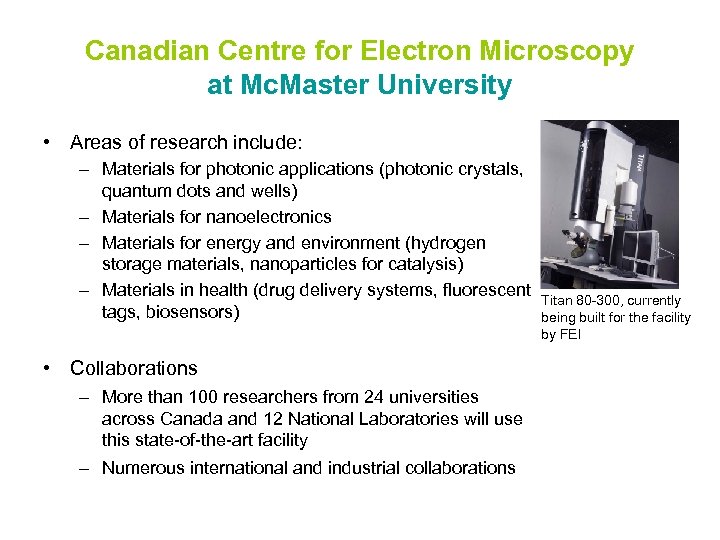 Canadian Centre for Electron Microscopy at Mc. Master University • Areas of research include: – Materials for photonic applications (photonic crystals, quantum dots and wells) – Materials for nanoelectronics – Materials for energy and environment (hydrogen storage materials, nanoparticles for catalysis) – Materials in health (drug delivery systems, fluorescent tags, biosensors) • Collaborations – More than 100 researchers from 24 universities across Canada and 12 National Laboratories will use this state-of-the-art facility – Numerous international and industrial collaborations Titan 80 -300, currently being built for the facility by FEI
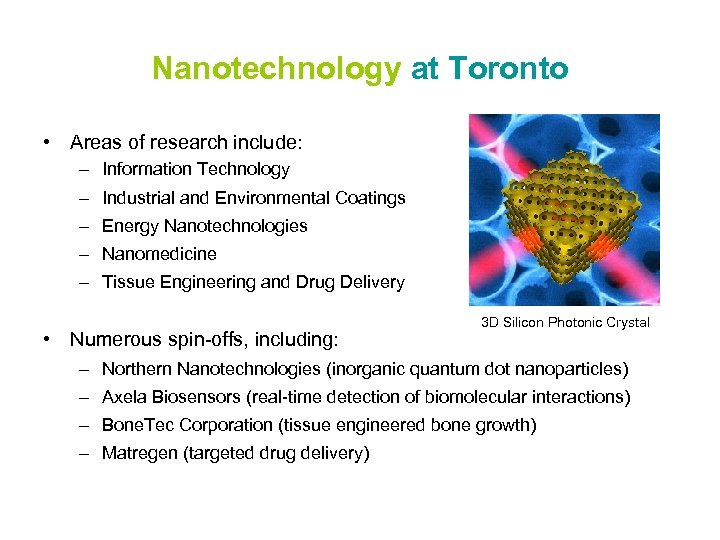 Nanotechnology at Toronto • Areas of research include: – Information Technology – Industrial and Environmental Coatings – Energy Nanotechnologies – Nanomedicine – Tissue Engineering and Drug Delivery • Numerous spin-offs, including: 3 D Silicon Photonic Crystal – Northern Nanotechnologies (inorganic quantum dot nanoparticles) – Axela Biosensors (real-time detection of biomolecular interactions) – Bone. Tec Corporation (tissue engineered bone growth) – Matregen (targeted drug delivery)
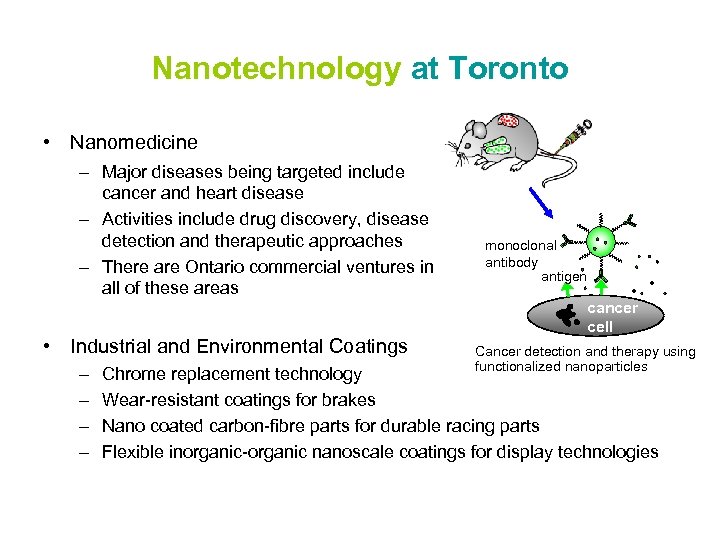 Nanotechnology at Toronto • Nanomedicine – Major diseases being targeted include cancer and heart disease – Activities include drug discovery, disease detection and therapeutic approaches – There are Ontario commercial ventures in all of these areas • Industrial and Environmental Coatings – – monoclonal antibody antigen cancer cell Cancer detection and therapy using functionalized nanoparticles Chrome replacement technology Wear-resistant coatings for brakes Nano coated carbon-fibre parts for durable racing parts Flexible inorganic-organic nanoscale coatings for display technologies
 Ontario is a leader in molecular medicine • Discovery of stem cells (Mc. Culloch and Till 1961) • Discovery and Cloning of T-cell receptor genes (Tak Mak 1984) • Discovery of important genes: - Alzheimers (St George-Hyslop 1995 ) - Cystic Fibrosis (Lap-Chee Tsui 1989) - Parkinson’s disease (St George-Hyslop 1995) • Regenerative medicine
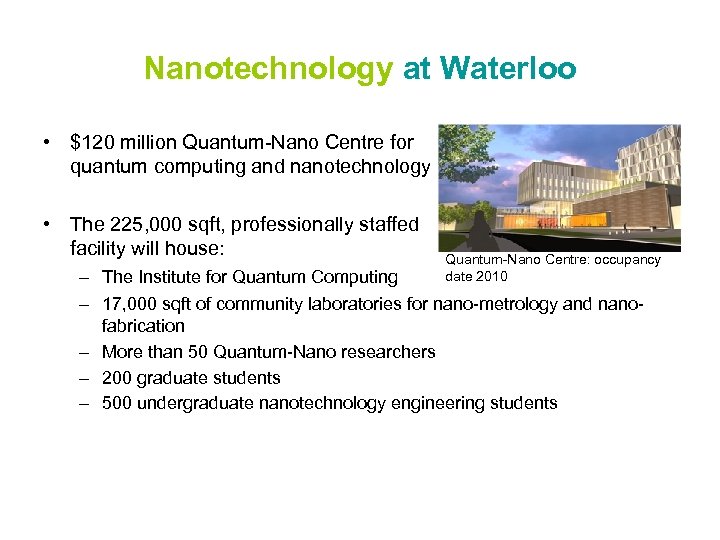 Nanotechnology at Waterloo • $120 million Quantum-Nano Centre for quantum computing and nanotechnology • The 225, 000 sqft, professionally staffed facility will house: Quantum-Nano Centre: occupancy date 2010 – The Institute for Quantum Computing – 17, 000 sqft of community laboratories for nano-metrology and nanofabrication – More than 50 Quantum-Nano researchers – 200 graduate students – 500 undergraduate nanotechnology engineering students
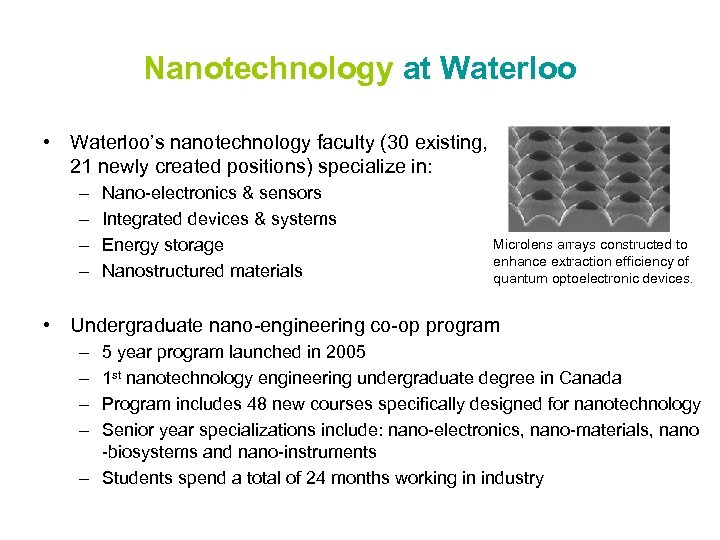 Nanotechnology at Waterloo • Waterloo’s nanotechnology faculty (30 existing, 21 newly created positions) specialize in: – – Nano-electronics & sensors Integrated devices & systems Energy storage Nanostructured materials Microlens arrays constructed to enhance extraction efficiency of quantum optoelectronic devices. • Undergraduate nano-engineering co-op program – – 5 year program launched in 2005 1 st nanotechnology engineering undergraduate degree in Canada Program includes 48 new courses specifically designed for nanotechnology Senior year specializations include: nano-electronics, nano-materials, nano -biosystems and nano-instruments – Students spend a total of 24 months working in industry
 Nanotechnology at the Xerox Research Centre of Canada (XRCC) • Commenced operations in 1974, with global mandate to develop leading-edge materials for all of Xerox, from research concepts to commercial reality – currently employs 120 scientists and engineers • In June 2006, XRCC scientists reached 1000 US patent milestone • XRCC nanotechnology strategy developed in mid-1990’s, and recently updated to reflect: – Injection of new technical competencies, being applied toward core as well as new business applications – Hired highly-skilled researchers with expertise in nanoscale science and engineering – Leveraging of nanotechnology partnerships with universities & government to further expand our programs and facilities
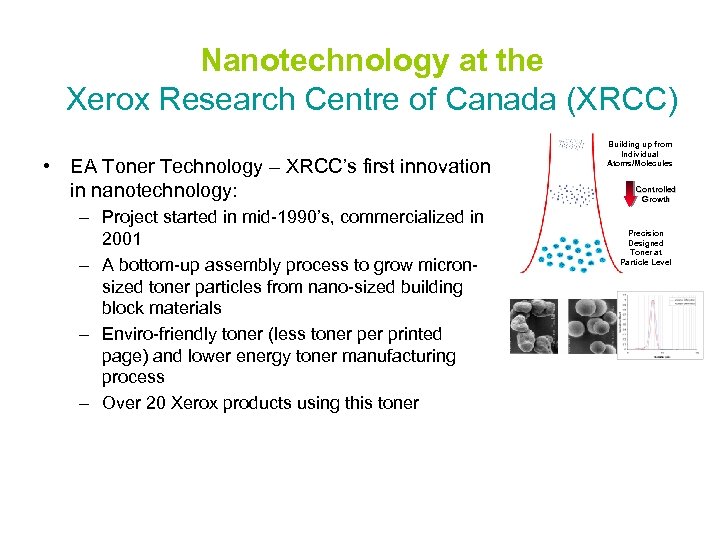 Nanotechnology at the Xerox Research Centre of Canada (XRCC) • EA Toner Technology – XRCC’s first innovation in nanotechnology: – Project started in mid-1990’s, commercialized in 2001 – A bottom-up assembly process to grow micronsized toner particles from nano-sized building block materials – Enviro-friendly toner (less toner printed page) and lower energy toner manufacturing process – Over 20 Xerox products using this toner Building up from Individual Atoms/Molecules Controlled Growth Precision Designed Toner at Particle Level
 Ontario-Alberta Partnership • Xerox Research Centre of Canada, the National Institute for Nanotechnology, the National Research Council of Canada and the Government of Alberta will provide approximately $4. 5 million for research and development of materials-based nanotechnology over the next three years • Funds will contribute to the hiring of 6 – 10 scientists to investigate materials-based nanotechnologies, including document and display -related technologies • Projects will be undertaken at both locations • Collaboration will be jointly managed by Vice-President and Director of Xerox Research Centre of Canada, and Director General of NINT
 Alastair M. Glass Deputy Minister
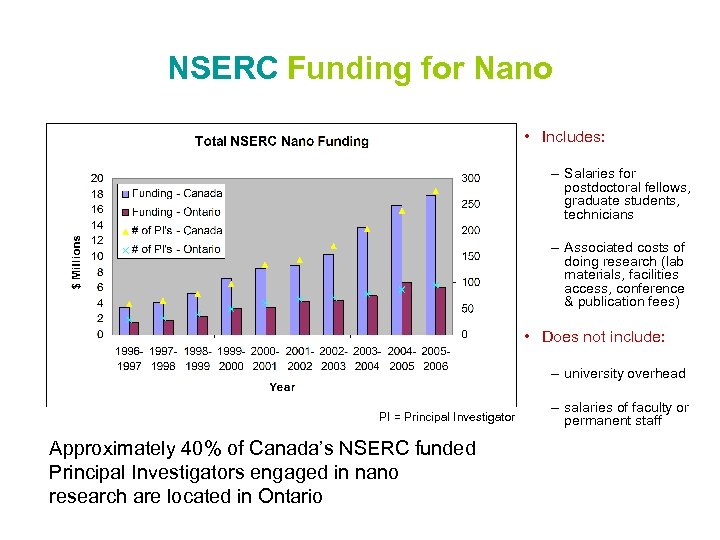 NSERC Funding for Nano • Includes: – Salaries for postdoctoral fellows, graduate students, technicians – Associated costs of doing research (lab materials, facilities access, conference & publication fees) • Does not include: – university overhead PI = Principal Investigator Approximately 40% of Canada’s NSERC funded Principal Investigators engaged in nano research are located in Ontario – salaries of faculty or permanent staff
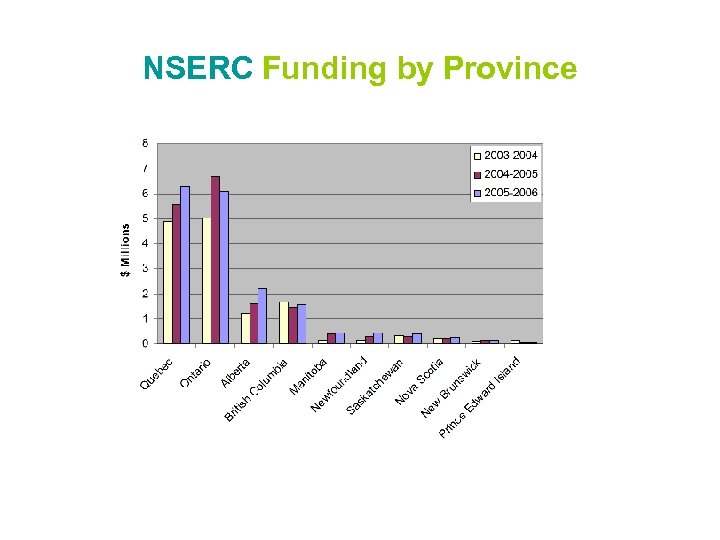 NSERC Funding by Province
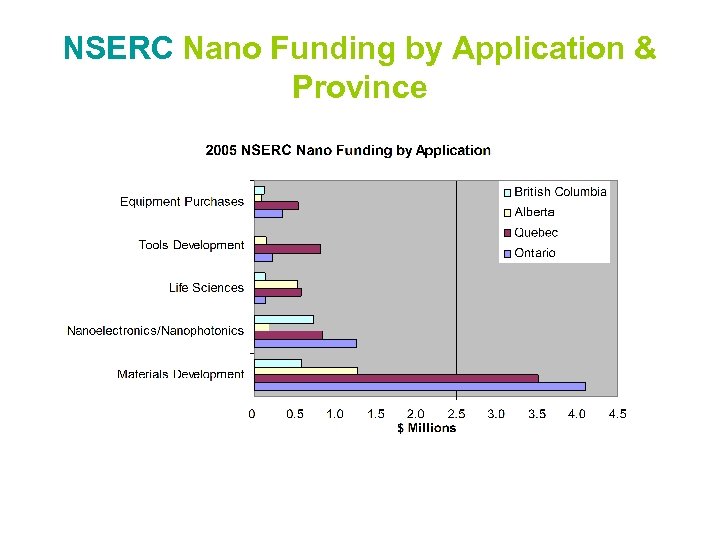 NSERC Nano Funding by Application & Province
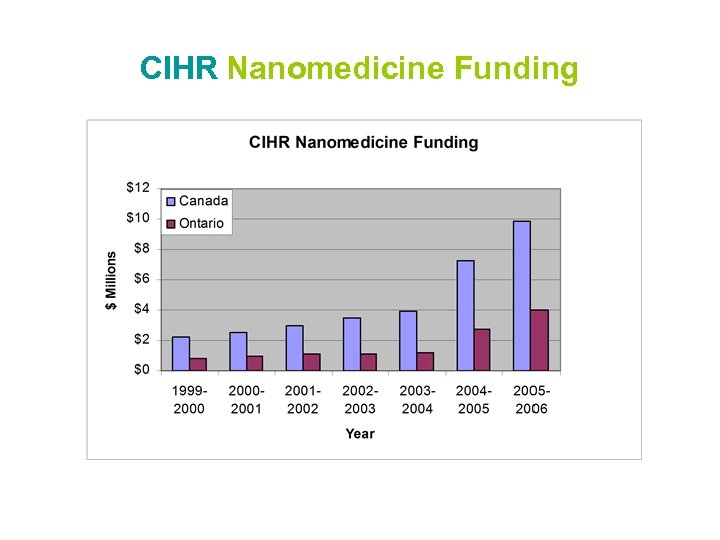 CIHR Nanomedicine Funding
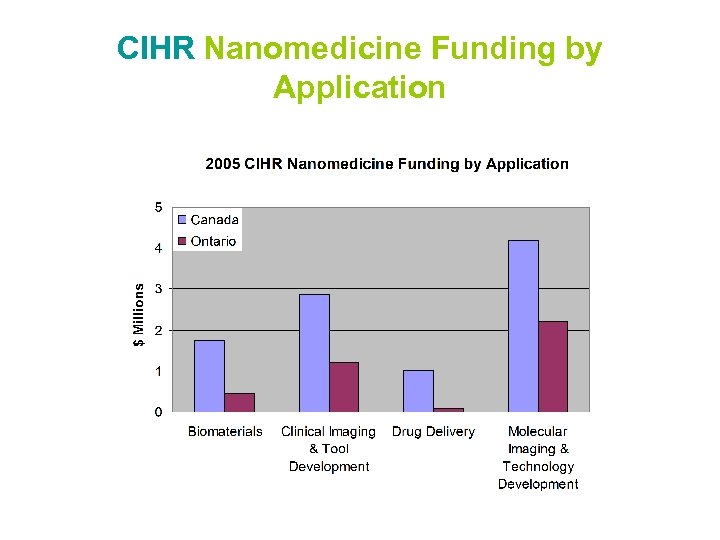 CIHR Nanomedicine Funding by Application