


 Скачать презентацию Akershus University College Norway Center for Research on
- Количество слайдов: 14
 Akershus University College, Norway Center for Research on Education and Work Ronny Sannerud: ronny. sannerud@hiak. no Arne Roar Lier: arne. lier@hiak. no Içara da Silva Holmesland: icara. holmesland@hiak. no *** 35 th Annual Conference of the Association for Teacher Education in Europe ’Responsibility, challenge and support in teachers’ life-long development’ ***
 "Lifelong development of vocational education teachers at the crossroads of higher education, the school system and the work life” The paper adresses (indirectly? ) the main questions of the conference: • Who has the responsibility for life-long development? • Which are the challenges of life-long development? • How to support teachers’ life-long development?
 Vocational teacher education in Norway VET programmes in Norway are part of the upper secondary schools since 1974 when classic academic and vocational education and training became part of a single comprehensive school General theoretical education and vocational education and training have been offered side by side, often in the same school building, in classrooms and in school workshops.
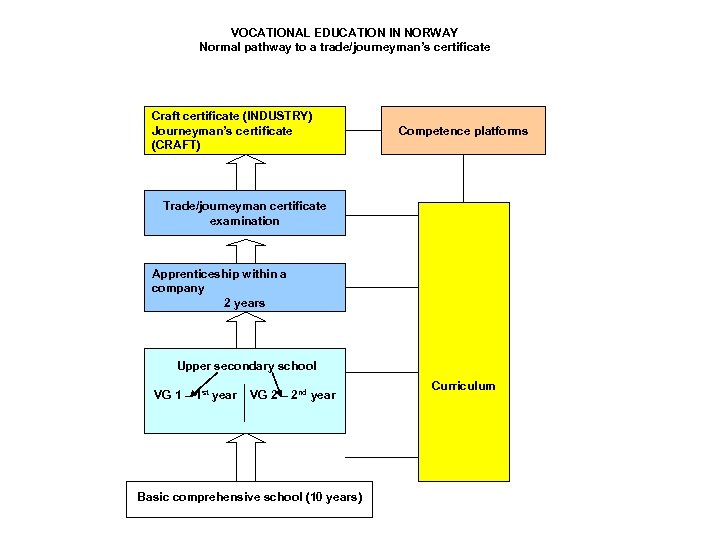 VOCATIONAL EDUCATION IN NORWAY Normal pathway to a trade/journeyman’s certificate Craft certificate (INDUSTRY) Journeyman’s certificate (CRAFT) Competence platforms Trade/journeyman certificate examination Apprenticeship within a company 2 years Upper secondary school VG 1 – 1 st year VG 2 – 2 nd year Basic comprehensive school (10 years) Curriculum
 Teachers in vocational and academic education work side by side VET teachers in all trades face some (great? ) challenges: They must have both deep and broad competences; They have to know their specific trade in depth and must also have a broad knowledge that includes the related professions; Example from Building and Construction: in spite of the differences between carpentry, painting and plumbing, a teacher in either area must also be able to teach one of the other disciplines in the first year of upper secondary school. Same rule applies to teachers in Electricity and Electronics, in Restaurant and Food Processing, in Health and Social Care and the other programmes
 Lifelong development of teachers of vocational education and training Recruitment of teachers for VET in Norway is done among professional workers that have: • a trade certificate earned after 12 years of education in the school • system two years of practice as an apprentice in a company • two years of practice in the work life Akershus University College has the responsibility for offering a pedagogical education for VET teachers VET is rooted in four main principles that guide the curriculum
 Four main principles of the curriculum 1. 2. 3. 4. • TE for VET is a double practice field, anchored in the teaching occupation and the profession for which the training qualifies; TE for VET has specific training traditions and methods; TE for VET requires comprehensiveness and logical connections in the programme of studies. TE for TVET is as equally valuable an education, as other forms of teacher education and of education for other professionoriented education at the universities and university-college. Thus: VET must be understood as strongly linked to the work life within which the aspiring teacher has his/her qualifications.
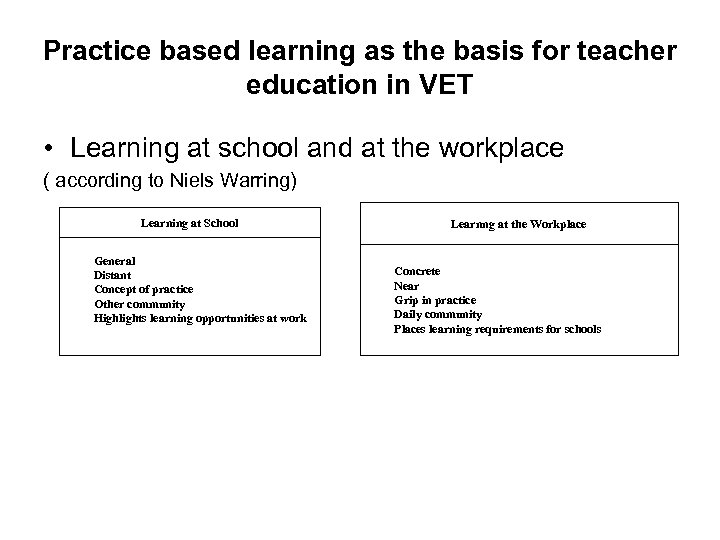 Practice based learning as the basis for teacher education in VET • Learning at school and at the workplace ( according to Niels Warring) Learning at School General Distant Concept of practice Other community Highlights learning opportunities at work Learnng at the Workplace Concrete Near Grip in practice Daily community Places learning requirements for schools
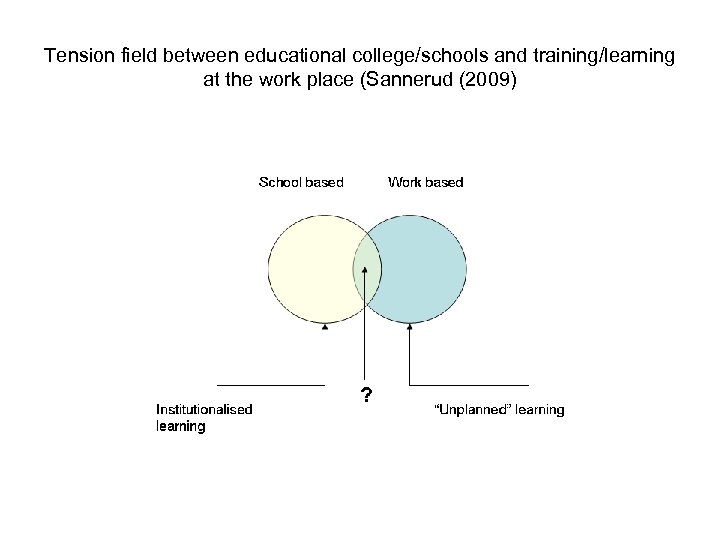 Tension field between educational college/schools and training/learning at the work place (Sannerud (2009)
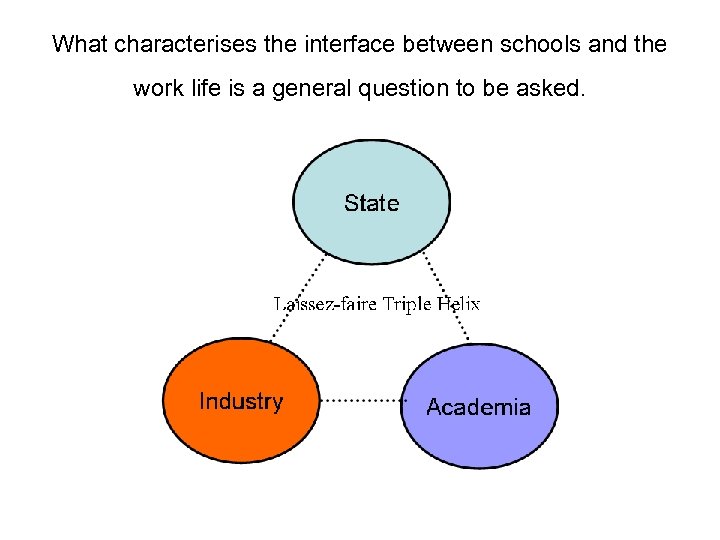 What characterises the interface between schools and the work life is a general question to be asked.
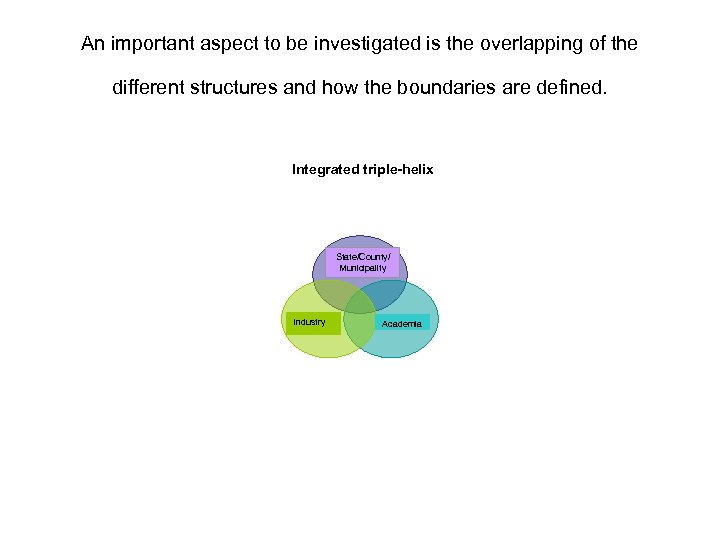 An important aspect to be investigated is the overlapping of the different structures and how the boundaries are defined. Integrated triple-helix State/County/ Municipality Industry Academia
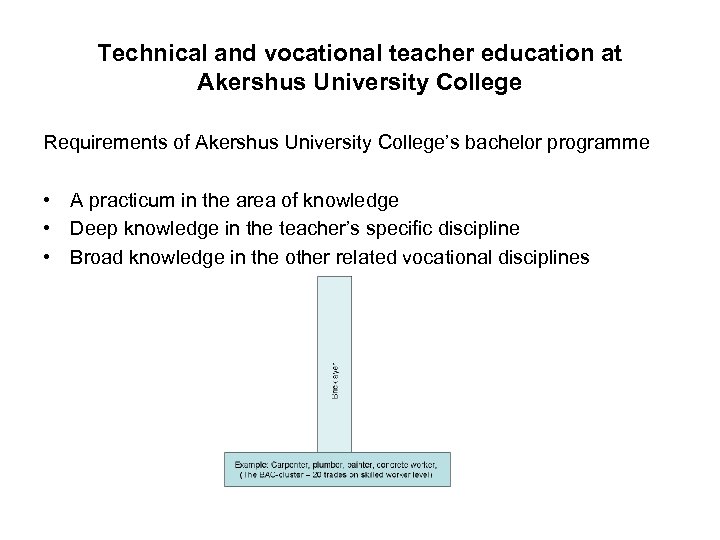 Technical and vocational teacher education at Akershus University College Requirements of Akershus University College’s bachelor programme • A practicum in the area of knowledge • Deep knowledge in the teacher’s specific discipline • Broad knowledge in the other related vocational disciplines
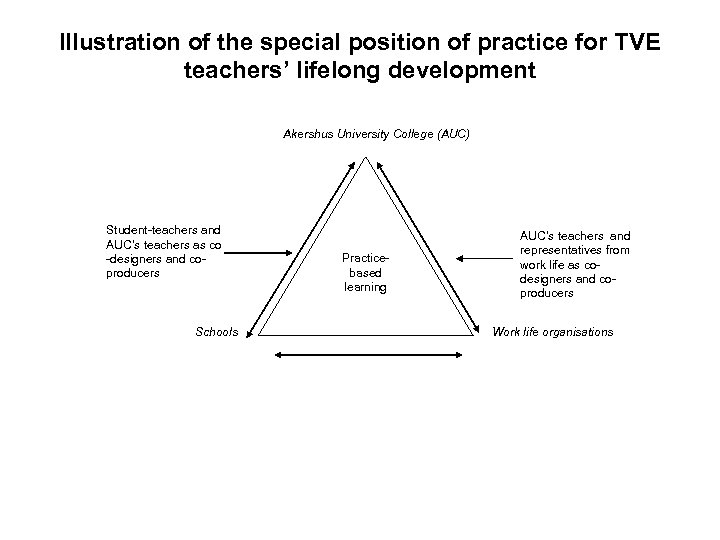 Illustration of the special position of practice for TVE teachers’ lifelong development Akershus University College (AUC) Student-teachers and AUC’s teachers as co -designers and coproducers Schools Practicebased learning AUC’s teachers and representatives from work life as codesigners and coproducers Work life organisations
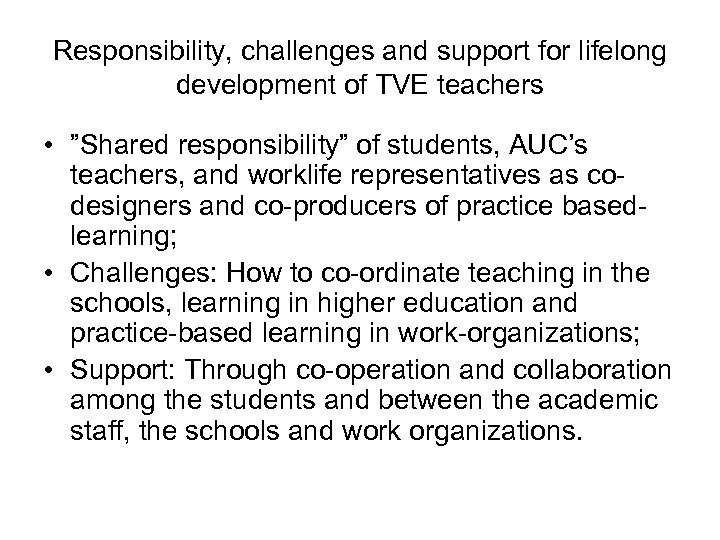 Responsibility, challenges and support for lifelong development of TVE teachers • ”Shared responsibility” of students, AUC’s teachers, and worklife representatives as codesigners and co-producers of practice basedlearning; • Challenges: How to co-ordinate teaching in the schools, learning in higher education and practice-based learning in work-organizations; • Support: Through co-operation and collaboration among the students and between the academic staff, the schools and work organizations.