


 Скачать презентацию Airport and Airline Access Dr Richard de Neufville
ea045c61a3007fd5000189faff2b9468.ppt
- Количество слайдов: 38
 Airport and Airline Access Dr. Richard de Neufville Professor of Engineering Systems and Civil and Environmental Engineering Massachusetts Institute of Technology Airport Systems Planning & Design / Rd. N
 Airport and Airline Access Objective: To identify key issues, provide guidelines, and present current situation Airport Access User Needs vs Standard Notions Q Cost Effectiveness Analysis Q Policy Conclusions and Guidelines Q Worldwide deployment Q On Airport People movers Q Catalyst of Major Changes in Airport Form Airport Systems Planning & Design / Rd. N
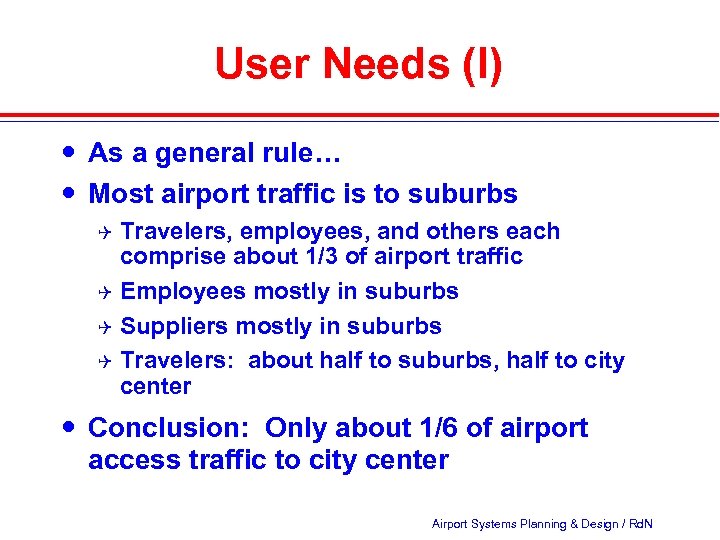 User Needs (I) As a general rule… Most airport traffic is to suburbs Travelers, employees, and others each comprise about 1/3 of airport traffic Q Employees mostly in suburbs Q Suppliers mostly in suburbs Q Travelers: about half to suburbs, half to city center Q Conclusion: Only about 1/6 of airport access traffic to city center Airport Systems Planning & Design / Rd. N
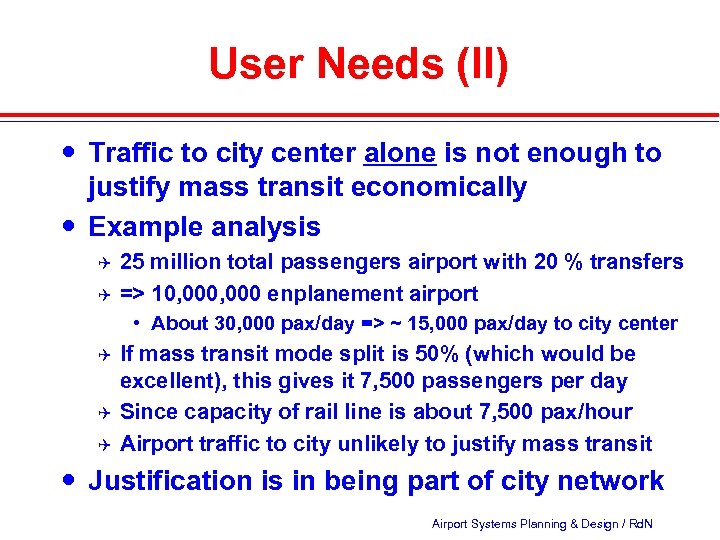 User Needs (II) Traffic to city center alone is not enough to justify mass transit economically Example analysis Q Q 25 million total passengers airport with 20 % transfers => 10, 000 enplanement airport • About 30, 000 pax/day => ~ 15, 000 pax/day to city center Q Q Q If mass transit mode split is 50% (which would be excellent), this gives it 7, 500 passengers per day Since capacity of rail line is about 7, 500 pax/hour Airport traffic to city unlikely to justify mass transit Justification is in being part of city network Airport Systems Planning & Design / Rd. N
 User Needs (III) Travelers’ priority: reliability of travel time Making the flight is most important Q Direct travel, without changing modes, is an important part of travelers’ confidence in reliability of access Q Travelers do not put priority on speed of travel to airport Travelers typically arrive early Q “ 50% arrive an hour early” Q Airport Systems Planning & Design / Rd. N
 A Standard Concept of Airport Access Travel to/from airport is too slow Q Crawling in traffic is absurd compared to speed of aircraft Solution: High speed link between airport and city center Examples Paris -- RER Q London -- Paddington/Heathrow express Q Airport Systems Planning & Design / Rd. N
 Rail Access often “over sold” Heathrow Express: “you can be in the centre of London… in just 15 minutes” Actually, schedule is 23 min from Terminal 4 Q To Paddington, 20 to 30 minutes from “center” Q Need to buy tix, wait for train – it’s an hour trip Q New York Air. Train 2006: “Airport to downtown in “less than 45 minutes” If you happen to want to be in Penn Station!!! Q 2007 brochure more correctly gives travel times of 60 min to PSta. ; 75 to Canal St; 85 to 125 th. Q Airport Systems Planning & Design / Rd. N
 Rail often not cost competitive Heathrow Express, 2007: $30 1 -way adult (1/2 for child) Q Price for family of three, including taxi to station between $90 – 110; about same as direct taxi Air. Train, 2007: $5/person + $2 subway Compare to $45 flat taxi fee from Airport Q Ok but generally much longer Q Note: Employees get subsidized fare -- $1/ride Q Note: Air. Train subsidized by Airport Passenger facility charge: ~$100 million/yr or $25/rider in 2006 Q Airport Systems Planning & Design / Rd. N
 A Standard Objection to High Speed Airport Access An issue of social justice: Why should air travelers get special treatment, compared to commuters? Q Air travelers a fraction of urban congestion Q Air travelers also only a fraction of rush hour traffic to/from airport Q • Balance are airport employees, etc. • Example: 20% at San Francisco Examples of these objections Q New York -- Newark and Kennedy to downtown Airport Systems Planning & Design / Rd. N
 Cost-Effectiveness Analysis of Airport Access For a Range of Conditions Q Size of Airport, Distance from city center Looked at Cost & Speed of Many Modes Q Taxi, Car, Bus on own right-of-way Q Rail, High-Speed Rail, Helicopter Can determine most attractive mode for various values of time Airport Systems Planning & Design / Rd. N
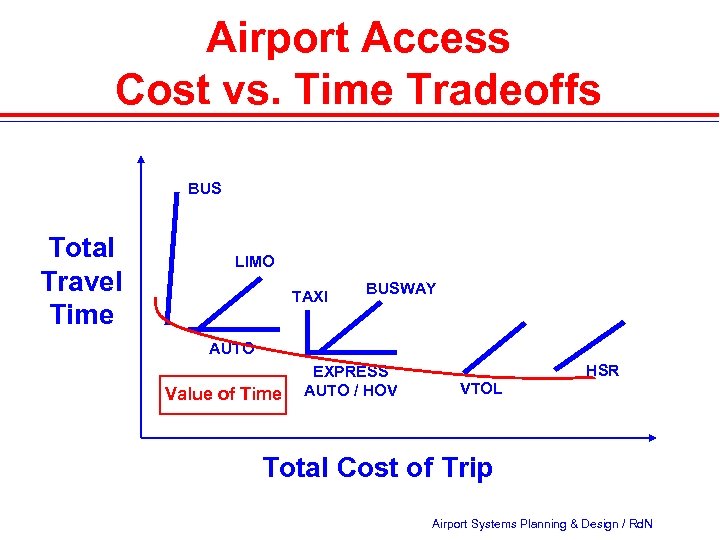 Airport Access Cost vs. Time Tradeoffs BUS Total Travel Time LIMO TAXI BUSWAY AUTO Value of Time EXPRESS AUTO / HOV HSR VTOL Total Cost of Trip Airport Systems Planning & Design / Rd. N
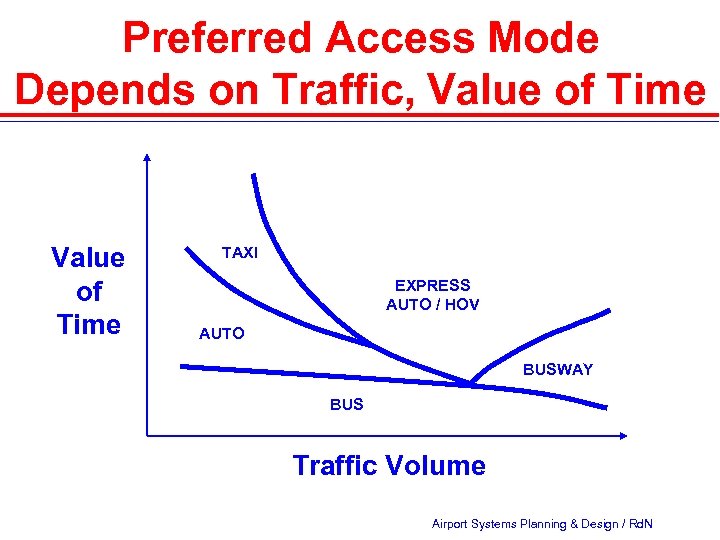 Preferred Access Mode Depends on Traffic, Value of Time TAXI EXPRESS AUTO / HOV AUTO BUSWAY BUS Traffic Volume Airport Systems Planning & Design / Rd. N
 Results of Cost-Effectiveness Analysis Customers prefer Rubber-tired access These offer better service to most customers because they are: Faster: direct service (no need to go to station) that eliminates schedule delay Q Cheaper: Less Capital intensive (at margin: people own cars) Q Q Also (not included in analysis) these vehicles can distribute traffic around city, not just to central city, this is most important to employees Airport Systems Planning & Design / Rd. N
 When is rail access effective? A metropolitan rail net exists, so that: …. cost of extension to airport is relatively small Highway access difficult (example: to airport islands or congested areas) As a pollution control measure Thus: Many rail systems exist and many being developed Airport Systems Planning & Design / Rd. N
 Rail Access To Airports (Europe, part 1) Airport Systems Planning & Design / Rd. N
 Rail Access To Airports (Europe, part 2) Airport Systems Planning & Design / Rd. N
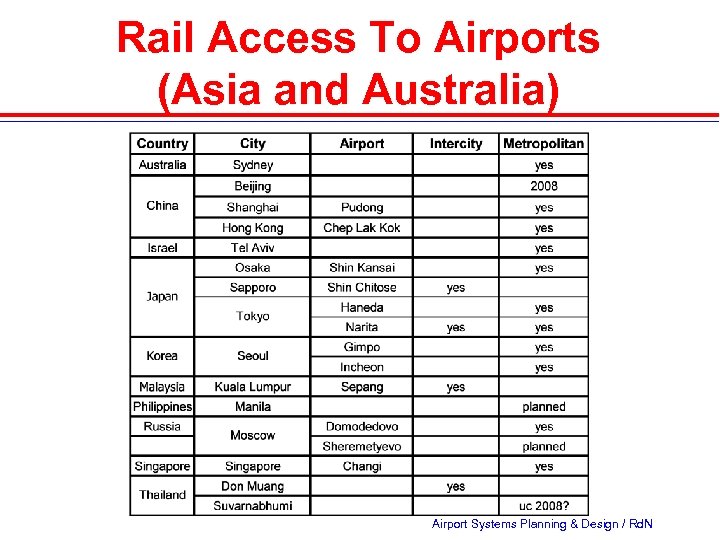 Rail Access To Airports (Asia and Australia) Airport Systems Planning & Design / Rd. N
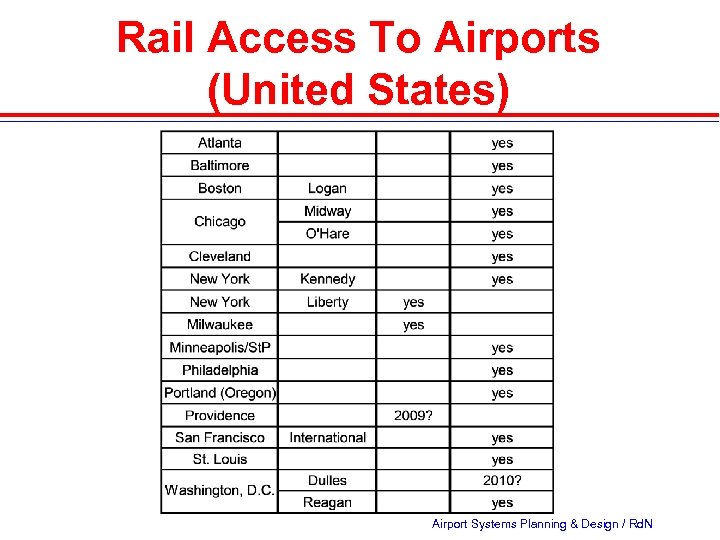 Rail Access To Airports (United States) Airport Systems Planning & Design / Rd. N
 Effect of Low-Cost Airlines? Low-cost airlines are transforming industry – effect on airport access? Let’s examine possibilities… ‘Planning Airport Access in an Era of Low-Cost Airlines, ” J. of Am. Planning Assn, Summer 2006, 72(3), pp 347 -356. R. de Neufville Airport Systems Planning & Design / Rd. N
 Possible Logical Chain Low-cost airlines associated with Q Secondary airports – often remote Q Inexpensive facilities Q Cost-conscious passengers This is not a market favorable to expensive rail projects Airport Systems Planning & Design / Rd. N
 Rubber-tired Alternatives are coaches, vans “Super Shuttle” – US consortium of shared-ride operators, 22 cities and 8 million pax in 2007 http: //www. supershuttle. com Q “Airport Shuttle” 100 airports in US, Canada, Mexico, France, Italy, Scotland, England http: //www. goairportshuttle. com Q Boston: Logan Express 4 routes to suburbs Q BRT – Bus Rapid Transit – Silver Line in Boston Q Many Regulatory issues to be solved… Airport Systems Planning & Design / Rd. N
 Another form of access PEOPLE MOVERS Airport Systems Planning & Design / Rd. N
 Role of People Movers People movers are “trains” that cover short distances -- “horizontal elevators” They constitute major innovation in design of passenger buildings They resolve tension between Desire to concentrate passengers Q Need to space aircraft widely Q They link landside and airside buildings or landside and remote parking, stations. . . Q A way to reduce curb congestion and pollution Airport Systems Planning & Design / Rd. N
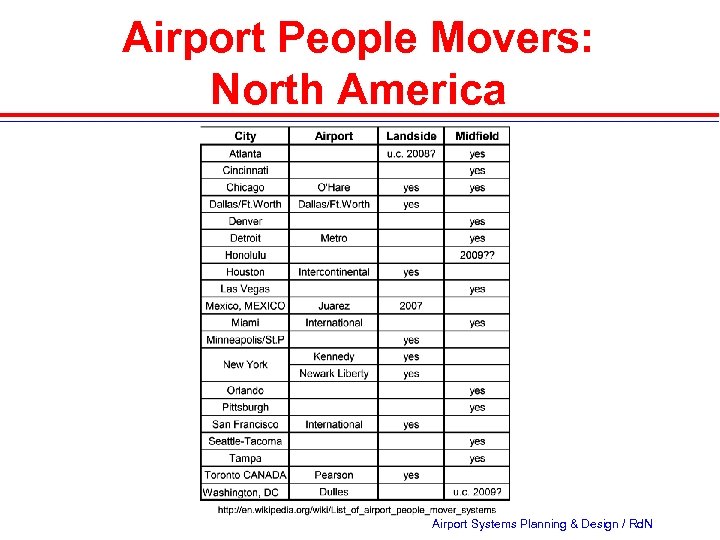 Airport People Movers: North America Airport Systems Planning & Design / Rd. N
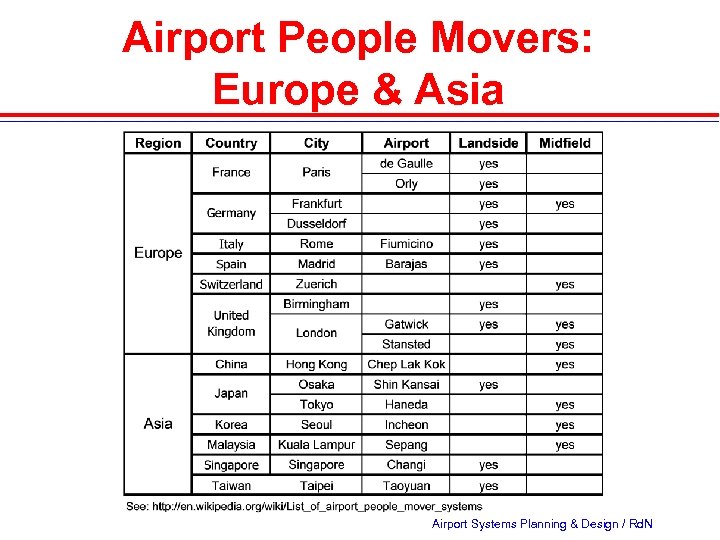 Airport People Movers: Europe & Asia Airport Systems Planning & Design / Rd. N
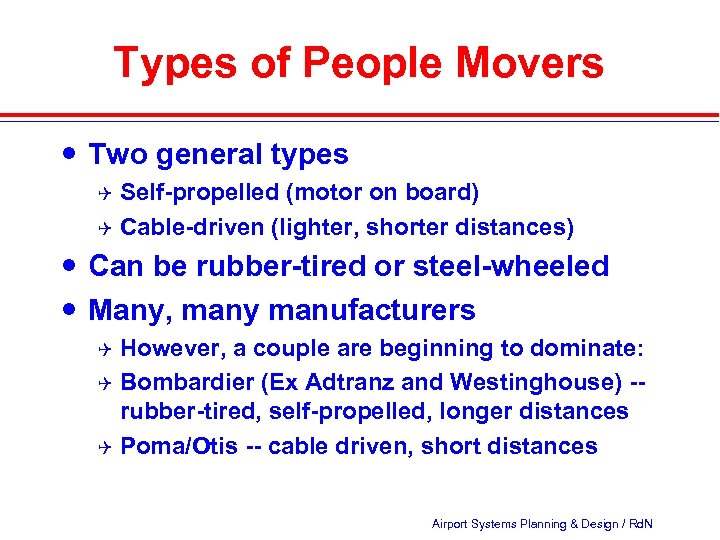 Types of People Movers Two general types Self-propelled (motor on board) Q Cable-driven (lighter, shorter distances) Q Can be rubber-tired or steel-wheeled Many, many manufacturers However, a couple are beginning to dominate: Q Bombardier (Ex Adtranz and Westinghouse) -rubber-tired, self-propelled, longer distances Q Poma/Otis -- cable driven, short distances Q Airport Systems Planning & Design / Rd. N
 Examples of People Movers Following 10 slides from presentation by Harley Moore, Chairman, Lea + Elliott Drawn from their extensive, world-leading practice in the design and implementation of people-movers Airport Systems Planning & Design / Rd. N
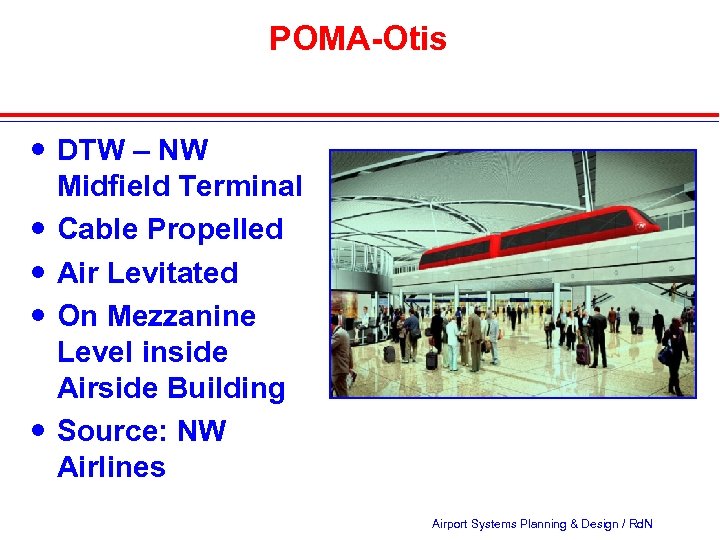 POMA-Otis DTW – NW Midfield Terminal Cable Propelled Air Levitated On Mezzanine Level inside Airside Building Source: NW Airlines Airport Systems Planning & Design / Rd. N
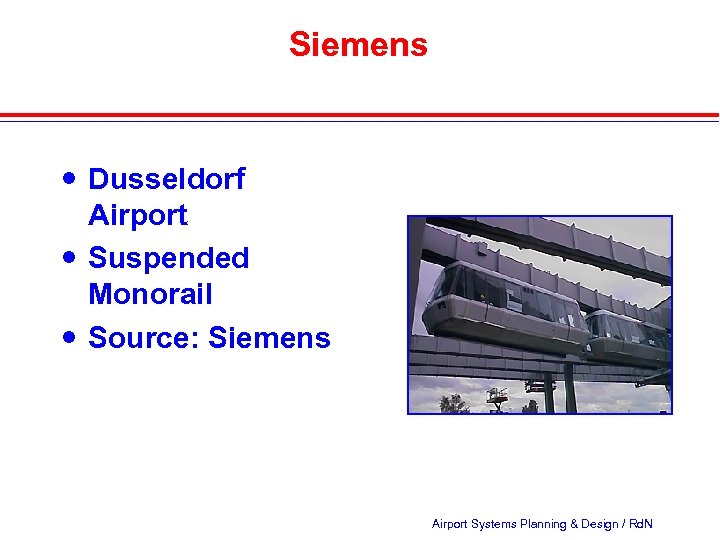 Siemens Dusseldorf Airport Suspended Monorail Source: Siemens Airport Systems Planning & Design / Rd. N
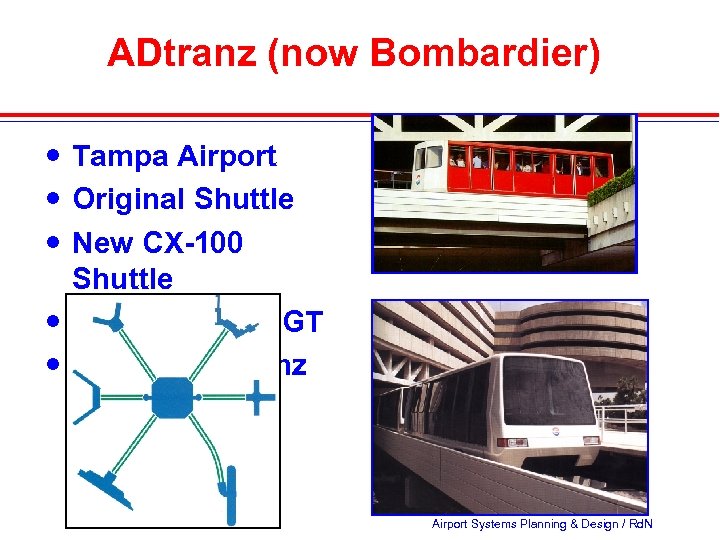 ADtranz (now Bombardier) Tampa Airport Original Shuttle New CX-100 Shuttle Rubber-tired AGT Source: ADtranz Airport Systems Planning & Design / Rd. N
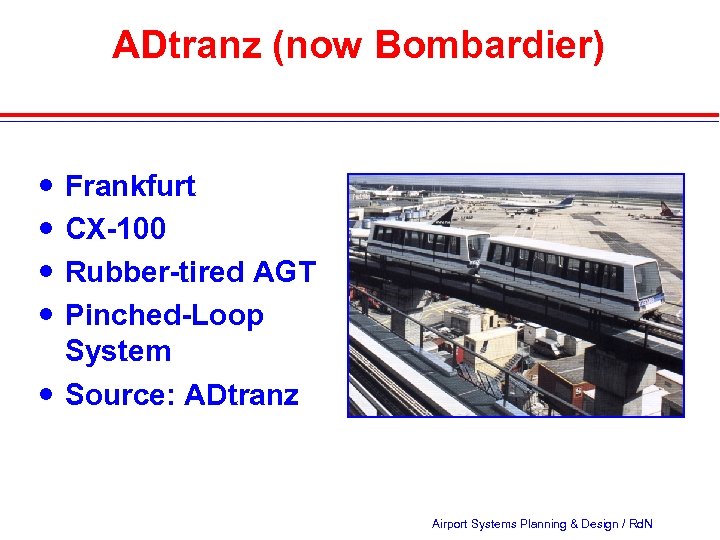 ADtranz (now Bombardier) Frankfurt CX-100 Rubber-tired AGT Pinched-Loop System Source: ADtranz Airport Systems Planning & Design / Rd. N
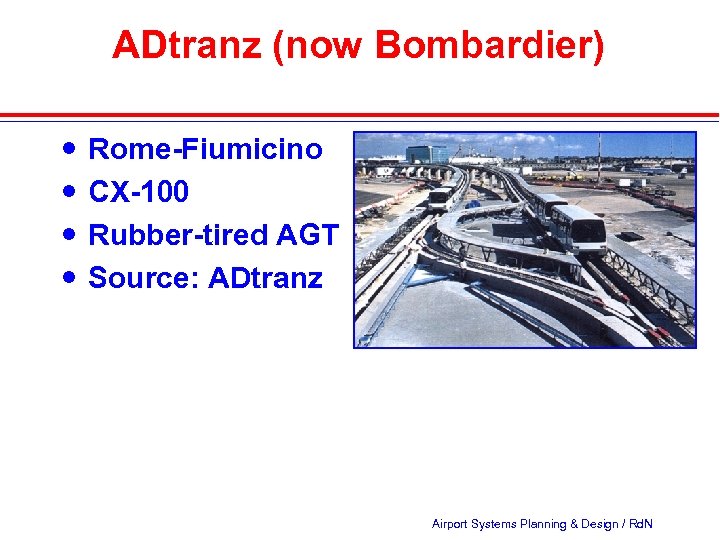 ADtranz (now Bombardier) Rome-Fiumicino CX-100 Rubber-tired AGT Source: ADtranz Airport Systems Planning & Design / Rd. N
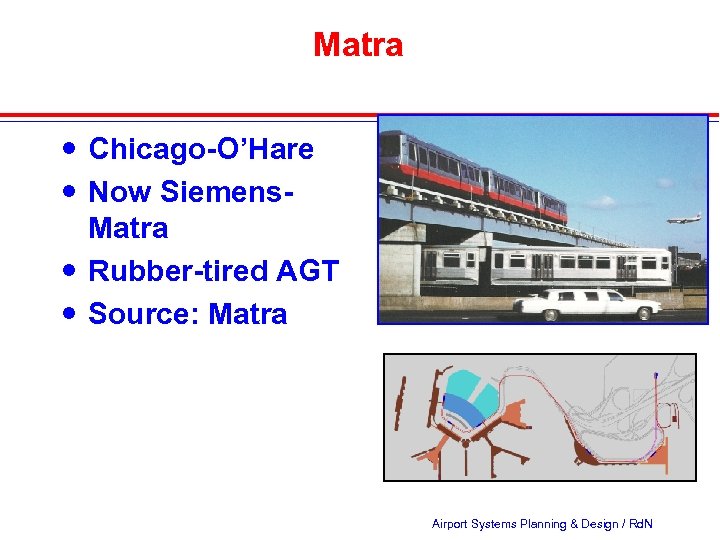 Matra Chicago-O’Hare Now Siemens. Matra Rubber-tired AGT Source: Matra Airport Systems Planning & Design / Rd. N
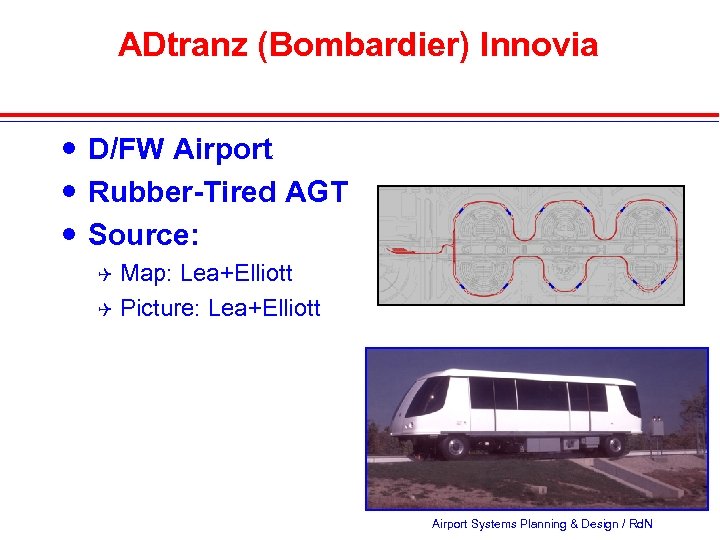 ADtranz (Bombardier) Innovia D/FW Airport Rubber-Tired AGT Source: Map: Lea+Elliott Q Picture: Lea+Elliott Q Airport Systems Planning & Design / Rd. N
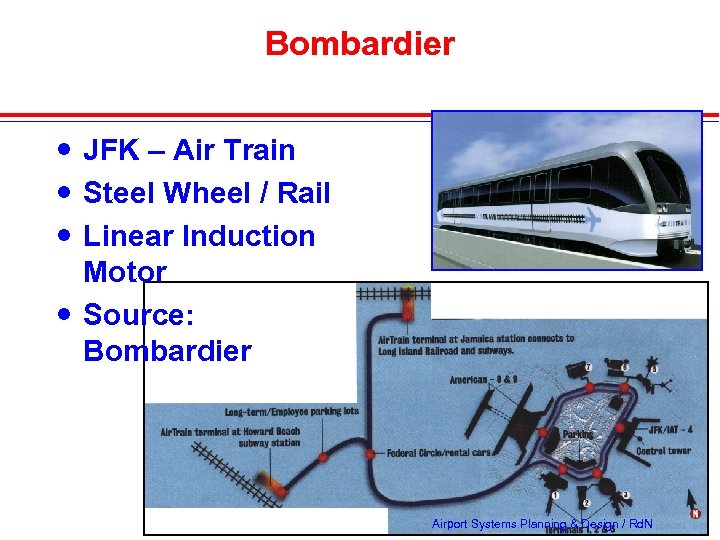 Bombardier JFK – Air Train Steel Wheel / Rail Linear Induction Motor Source: Bombardier Airport Systems Planning & Design / Rd. N
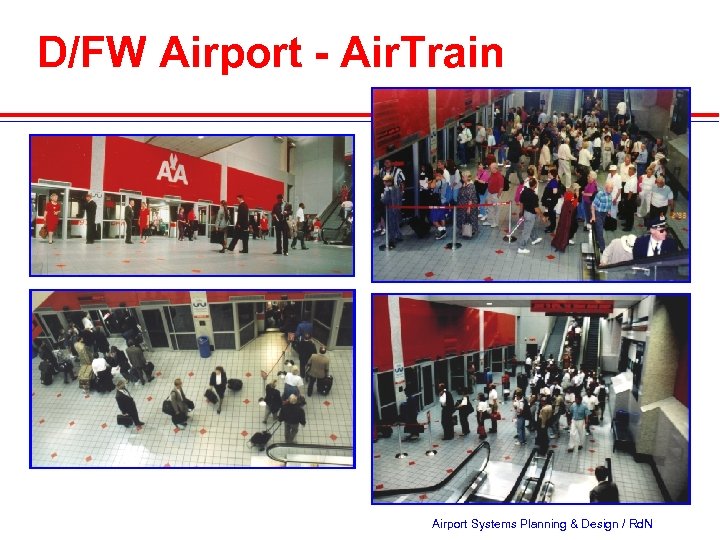 D/FW Airport - Air. Train Airport Systems Planning & Design / Rd. N
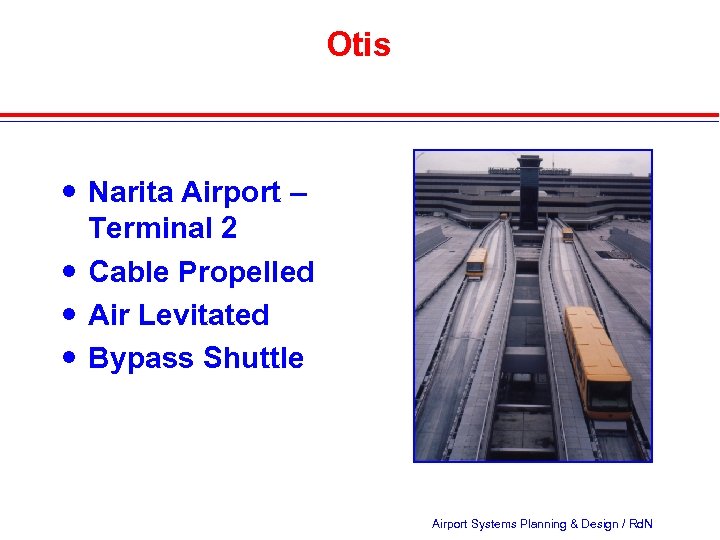 Otis Narita Airport – Terminal 2 Cable Propelled Air Levitated Bypass Shuttle Airport Systems Planning & Design / Rd. N
 Summary Rail Transportation now a common feature at major airports worldwide Role as much for employees as for passengers – speed not critical factor On-airport “rail” allows designers to spread out passenger facilities and provide good service for big airports Airport Systems Planning & Design / Rd. N