


 Скачать презентацию Airlines Industry Yield Management Ken Homa Airlines
b19c214559c6e64c30b87d5710ac73b3.ppt
- Количество слайдов: 26
 Airlines Industry Yield Management Ken Homa
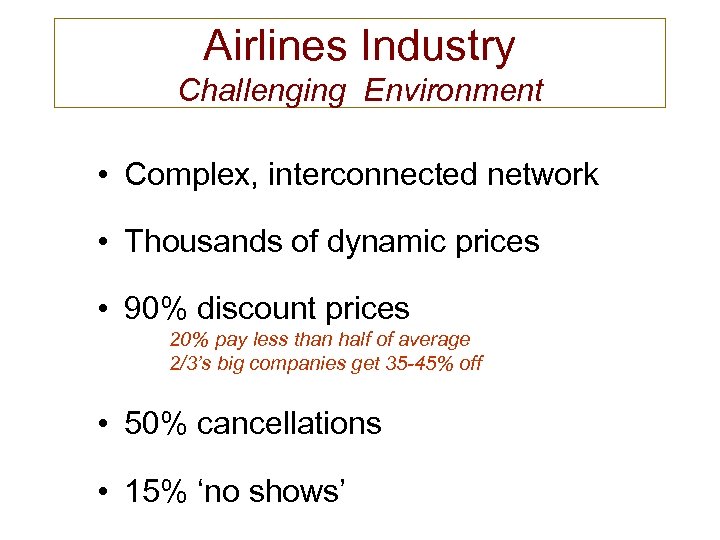 Airlines Industry Challenging Environment • Complex, interconnected network • Thousands of dynamic prices • 90% discount prices 20% pay less than half of average 2/3’s big companies get 35 -45% off • 50% cancellations • 15% ‘no shows’
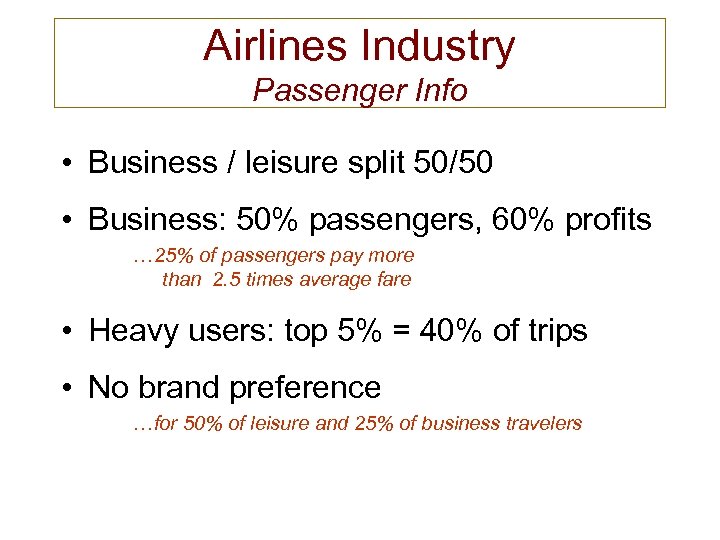 Airlines Industry Passenger Info • Business / leisure split 50/50 • Business: 50% passengers, 60% profits … 25% of passengers pay more than 2. 5 times average fare • Heavy users: top 5% = 40% of trips • No brand preference …for 50% of leisure and 25% of business travelers
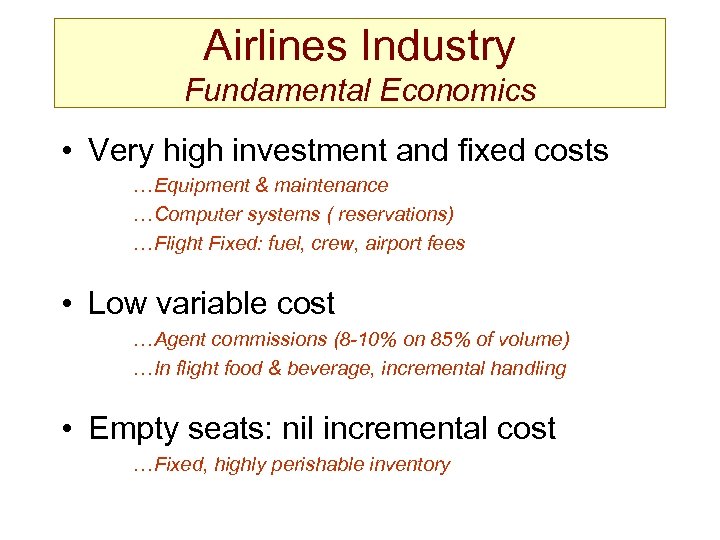 Airlines Industry Fundamental Economics • Very high investment and fixed costs …Equipment & maintenance …Computer systems ( reservations) …Flight Fixed: fuel, crew, airport fees • Low variable cost …Agent commissions (8 -10% on 85% of volume) …In flight food & beverage, incremental handling • Empty seats: nil incremental cost …Fixed, highly perishable inventory
 Airlines Industry ’Low Frills’ Economics • Variablize the fixed costs …Source services & personnel • Streamline offerings …Precisely match segment’s value function • Accept lower margins …Lower relative investment
 Anybody Remember People. Express? • Simple strategy: low frills, low price • (Too) rapid expansion • No infrastructure (I/T, res system) • Very low average cost, but … • AA killed People. Express AA marginal cost < PE average cost AA attacked with ‘laser fars’
 Airlines Industry Performance Metrics • Available Passenger Miles (APM) …Gross measure of capacity • Revenue Passenger Miles (RPM) …Number of passengers weighted by distance flown • Load Factor …RPM divided by APM • Yield Factor …Revenue per RPM Fly full with high paying passengers
 Airlines Marketing • Network routing • Capacity planning • Flight Scheduling • Yield Management
 Network Routings • Point to point OD pairs (origin - destination) • Originating & continuation flights • Hub-and-spoke connections …Roughly 2/3’s passengers arriving at a hub connect to other flights
 Capacity Planning • Aggregate Seats and configurations • Route-specific Through flight considerations • Load factors The performance metric
 Flight Scheduling • Customer preferences …Peaks & valleys • Connections • Planes & crews • Disruptions …Weather, equipment
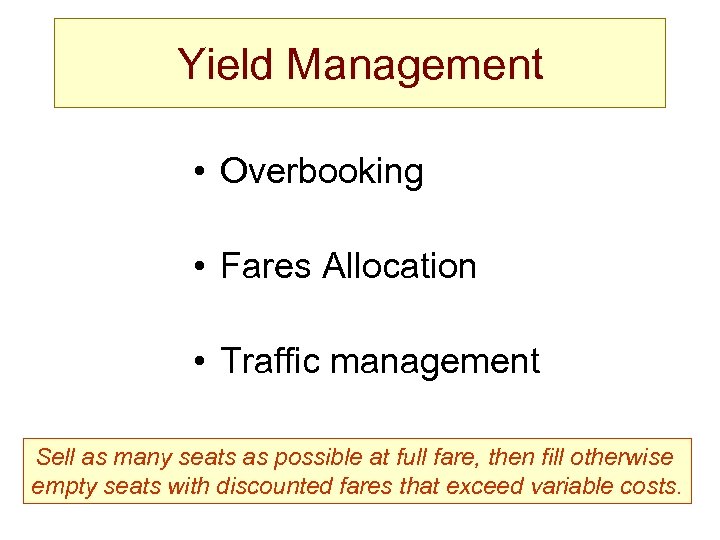
 Yield Management • Overbooking • Fares Allocation • Traffic management Sell as many seats as possible at full fare, then fill otherwise empty seats with discounted fares that exceed variable costs.
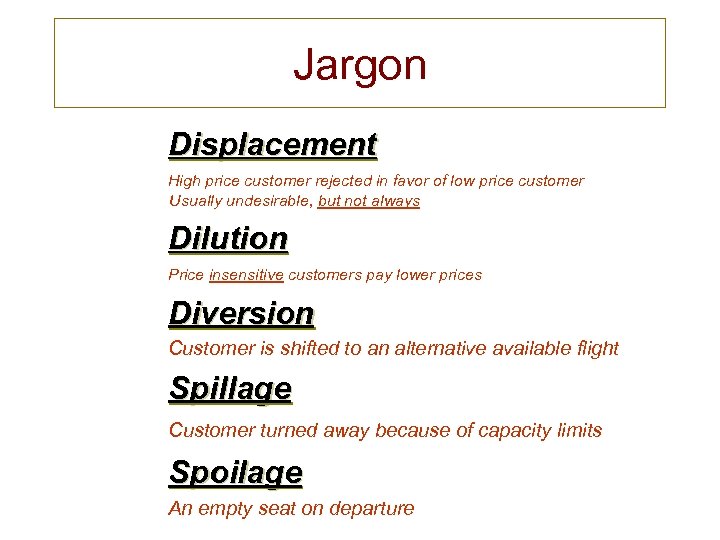 Jargon Displacement High price customer rejected in favor of low price customer Usually undesirable, but not always Dilution Price insensitive customers pay lower prices Diversion Customer is shifted to an alternative available flight Spillage Customer turned away because of capacity limits Spoilage An empty seat on departure
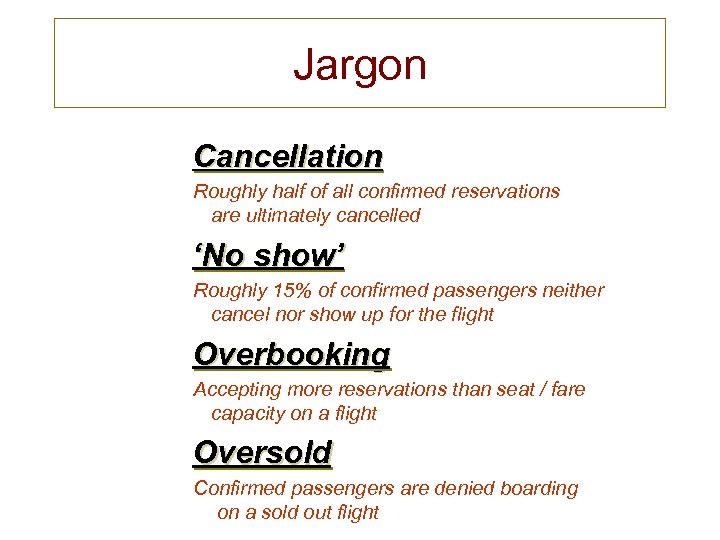 Jargon Cancellation Roughly half of all confirmed reservations are ultimately cancelled ‘No show’ Roughly 15% of confirmed passengers neither cancel nor show up for the flight Overbooking Accepting more reservations than seat / fare capacity on a flight Oversold Confirmed passengers are denied boarding on a sold out flight
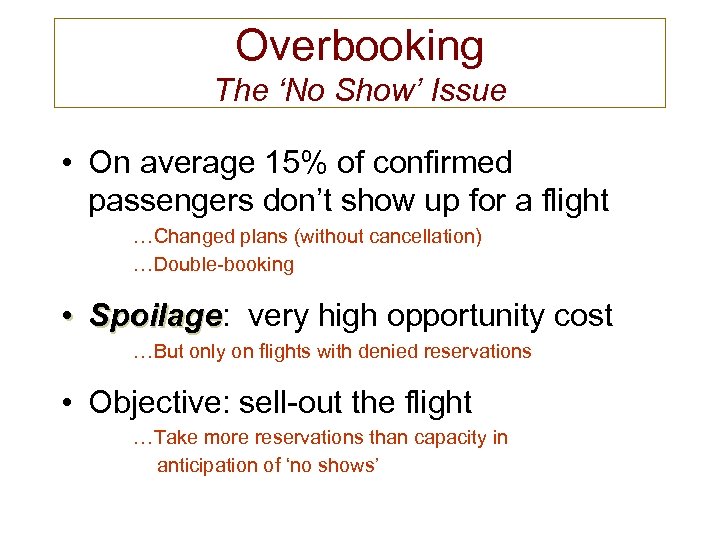 Overbooking The ‘No Show’ Issue • On average 15% of confirmed passengers don’t show up for a flight …Changed plans (without cancellation) …Double-booking • Spoilage: very high opportunity cost Spoilage …But only on flights with denied reservations • Objective: sell-out the flight …Take more reservations than capacity in anticipation of ‘no shows’
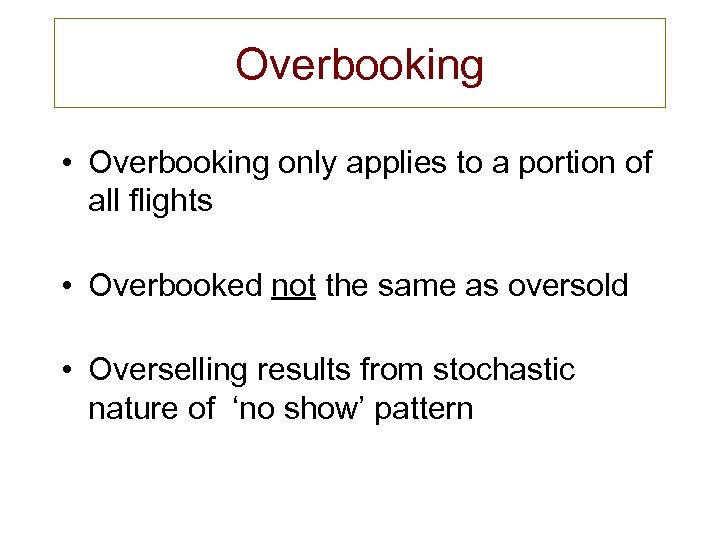 Overbooking • Overbooking only applies to a portion of all flights • Overbooked not the same as oversold • Overselling results from stochastic nature of ‘no show’ pattern
 Overbooking Costs • Volunteer Inducements • Rerouting costs • Hospitality concessions • Loss of goodwill (involuntary denials)
 Volunteer Inducement • Magnitude of inducement Increases with number of seats oversold • Ultimate cost depends on the method of fulfilling the incentive … Space available …negligible cost, except possible fare dilution (to free) … Space constrained … displacement / opportunity cost … unless controlled • Credit certificates. . . …Dilutive or stimulative?
 Rerouting • Cost dependent on fulfillment method Space available …negligible cost Sold out … displacement / opportunity cost 2 nd round oversale Competitor flight … cash cost (at premium fare)
 Overbooking The Number • Ceiling to limit goodwill impact • Estimate (and re-estimate) no show probability function • Calculate expected cost of overselling …Probability of occurrence …Cost of remedial action • Calculate expected opportunity cost of possible spoilage • Marginal cost = marginal benefit
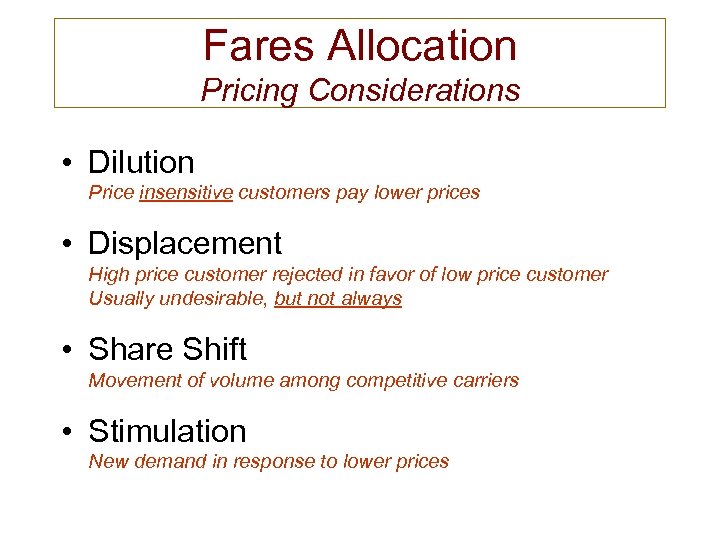 Fares Allocation Pricing Considerations • Dilution Price insensitive customers pay lower prices • Displacement High price customer rejected in favor of low price customer Usually undesirable, but not always • Share Shift Movement of volume among competitive carriers • Stimulation New demand in response to lower prices
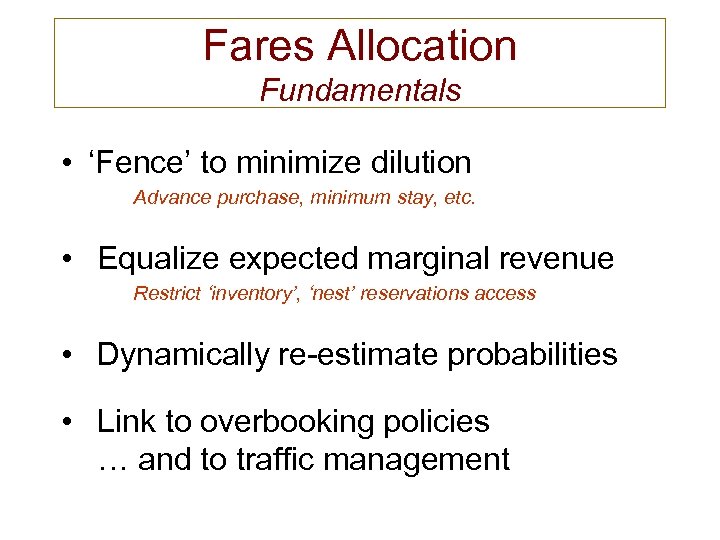 Fares Allocation Fundamentals • ‘Fence’ to minimize dilution Advance purchase, minimum stay, etc. • Equalize expected marginal revenue Restrict ‘inventory’, ‘nest’ reservations access • Dynamically re-estimate probabilities • Link to overbooking policies … and to traffic management
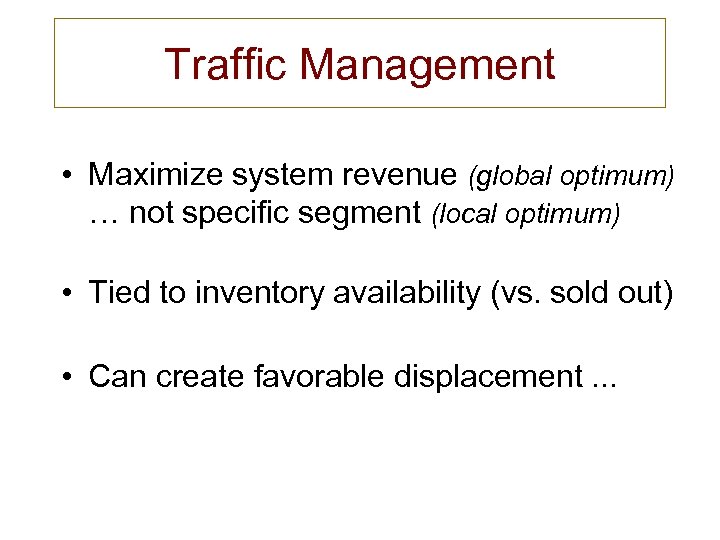 Traffic Management • Maximize system revenue (global optimum) … not specific segment (local optimum) • Tied to inventory availability (vs. sold out) • Can create favorable displacement. . .
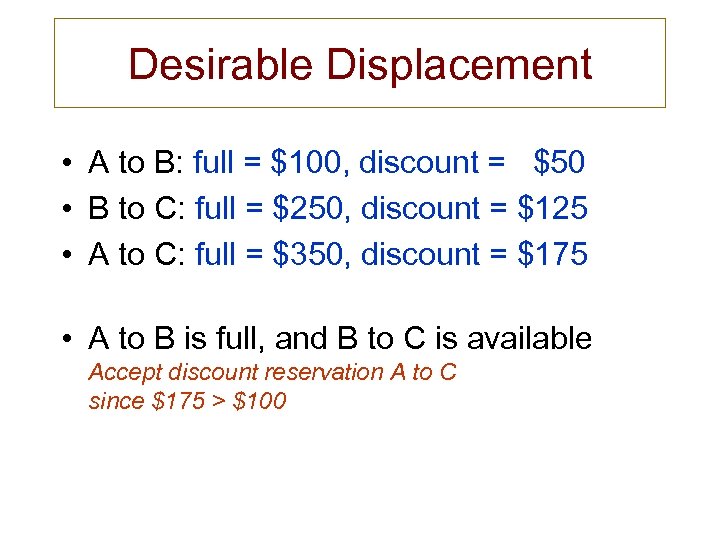 Desirable Displacement • A to B: full = $100, discount = $50 • B to C: full = $250, discount = $125 • A to C: full = $350, discount = $175 • A to B is full, and B to C is available Accept discount reservation A to C since $175 > $100
 Yield Management • Overbooking • Fares Allocation • Traffic management Sell as many seats as possible at full fare, then fill otherwise empty seats with discounted fares that exceed variable costs.
 Airlines Industry Yield Management