


 Скачать презентацию Airless Cleaning Systems TSC Airless Cleaning Systems
2b67584d1bc4857160be08d59ee80645.ppt
- Количество слайдов: 19
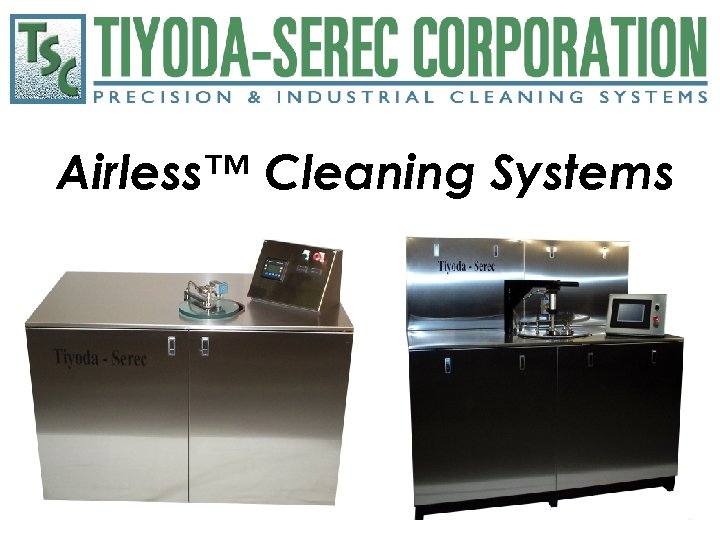 Airless™ Cleaning Systems
 TSC Airless™ Cleaning Systems • TSC Airless™ Cleaning Systems are distillable solvent cleaning systems where the process occurs in a vacuum chamber for the ultimate in efficiency, performance and environmental responsibility. • TSC Airless™ units can address applications of all sizes. • TSC Airless™ units provide the lowest utility consumption, highest repeatability, lowest environmental impact and lowest operational cost of any cleaning process. • TSC Airless™ systems accommodate virtually all common distillable chemistry cleaning agents.
 TSC Airless™ Applications & Benefits Applications • • • Aerospace Tube Cleaning Bearings Castings Dewaxing Electronic Assemblies Machined Parts Medical Optics & Photonics Powdered / Sintered Metals • Screw Machined Parts • Semiconductors Benefits • Clean Dry Parts • Near Zero Emissions • Closed Loop Design • Exceeds EPA / OSHA Regulations • Saves Solvent • Easy To Maintain • Multi Solvent Compatibility • Low Utility Consumption
 TSC Airless™ Processing Options • • • Ultrasonic cavitation 360 O spray impingement Filtration Multiple process chambers Integrated automation Part rotation or tumbling within process chamber • Auxiliary distillation • Integrated chiller & boiler (available as required)
 TSC Airless™ Compatible Solvents • • • HFCs (Du. Pont Vertrel) HFEs (3 M Novec Fluids) n-propyl bromide HCFCs (AK-225) Chlorinated solvents (trichloroethylene, perchloroethylene, methylene chloride) Azeotropes & blends Hydrocarbons Isopropyl alcohol Combustible & flammable solvents
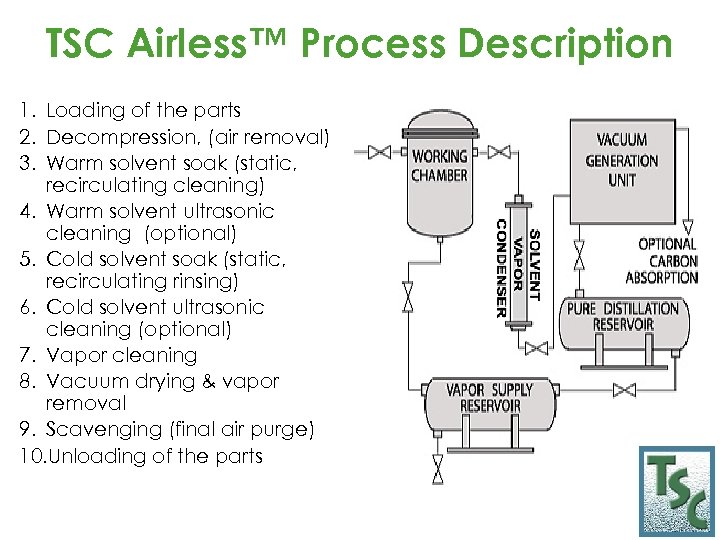 TSC Airless™ Process Description 1. Loading of the parts 2. Decompression, (air removal) 3. Warm solvent soak (static, recirculating cleaning) 4. Warm solvent ultrasonic cleaning (optional) 5. Cold solvent soak (static, recirculating rinsing) 6. Cold solvent ultrasonic cleaning (optional) 7. Vapor cleaning 8. Vacuum drying & vapor removal 9. Scavenging (final air purge) 10. Unloading of the parts
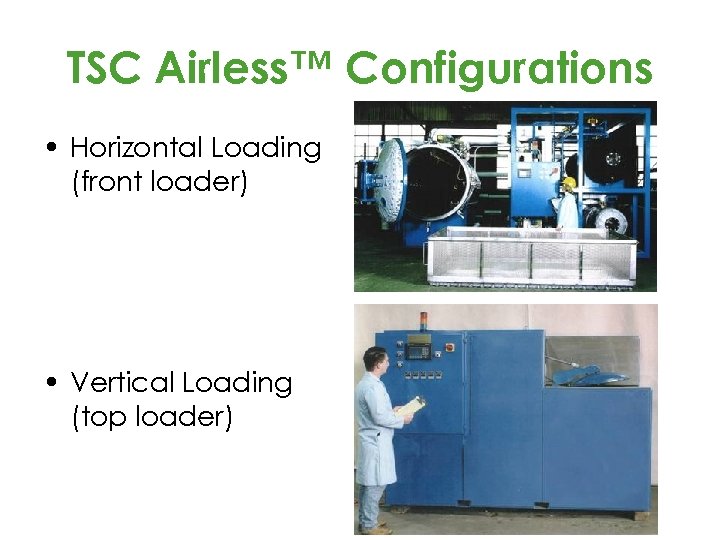 TSC Airless™ Configurations • Horizontal Loading (front loader) • Vertical Loading (top loader)
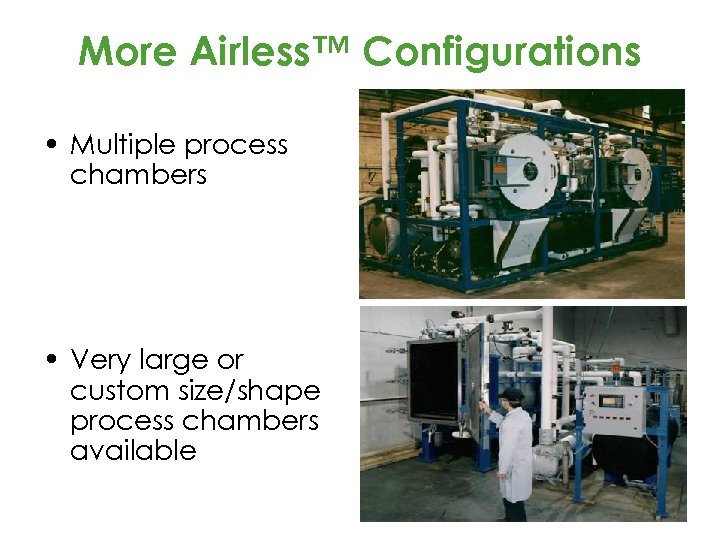 More Airless™ Configurations • Multiple process chambers • Very large or custom size/shape process chambers available
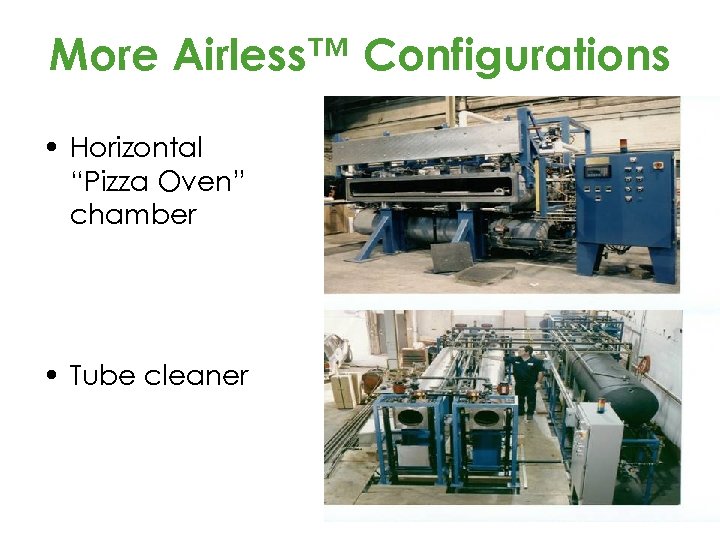 More Airless™ Configurations • Horizontal “Pizza Oven” chamber • Tube cleaner
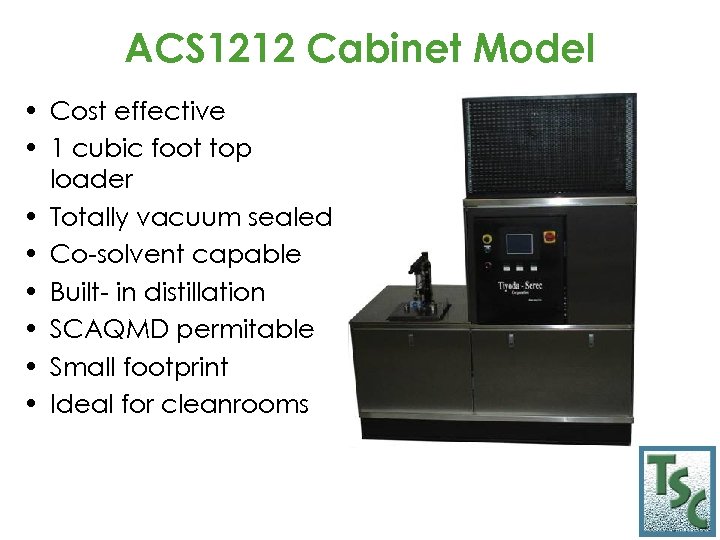 ACS 1212 Cabinet Model • Cost effective • 1 cubic foot top loader • Totally vacuum sealed • Co-solvent capable • Built- in distillation • SCAQMD permitable • Small footprint • Ideal for cleanrooms
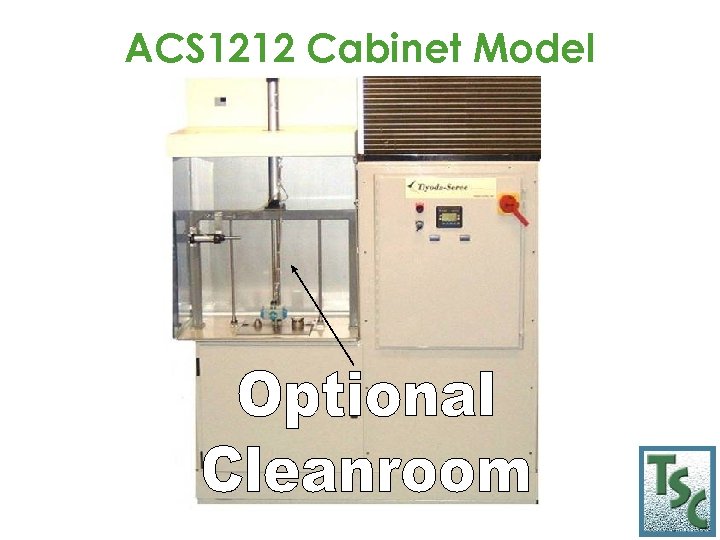 ACS 1212 Cabinet Model
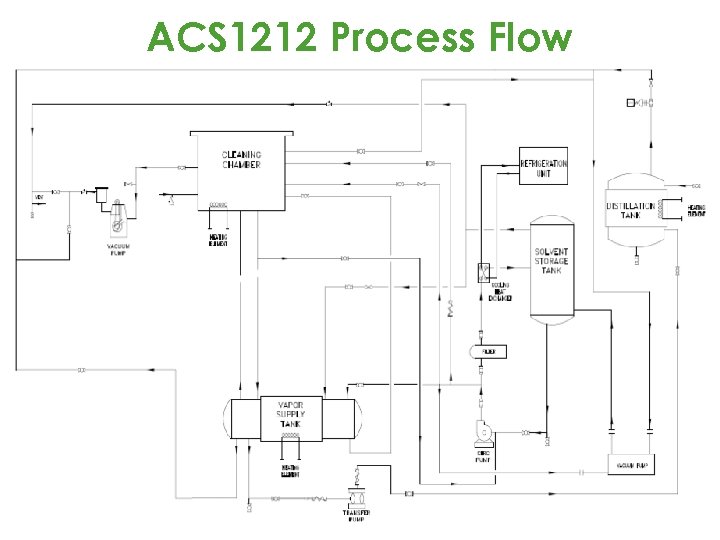 ACS 1212 Process Flow
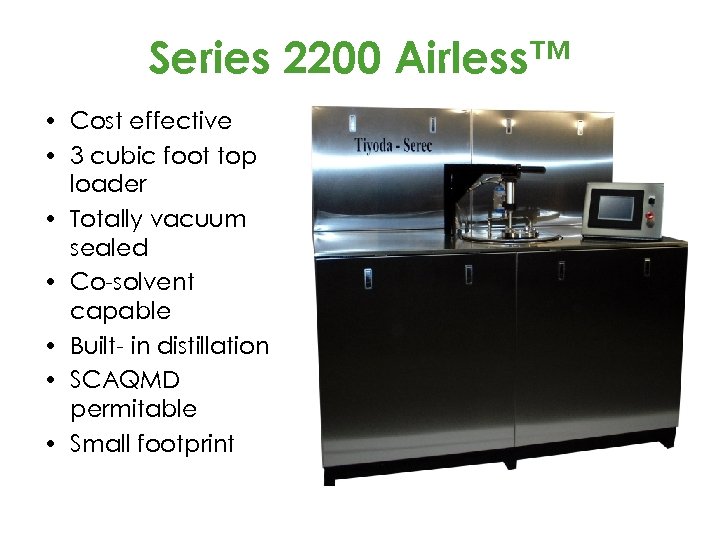 Series 2200 Airless™ • Cost effective • 3 cubic foot top loader • Totally vacuum sealed • Co-solvent capable • Built- in distillation • SCAQMD permitable • Small footprint
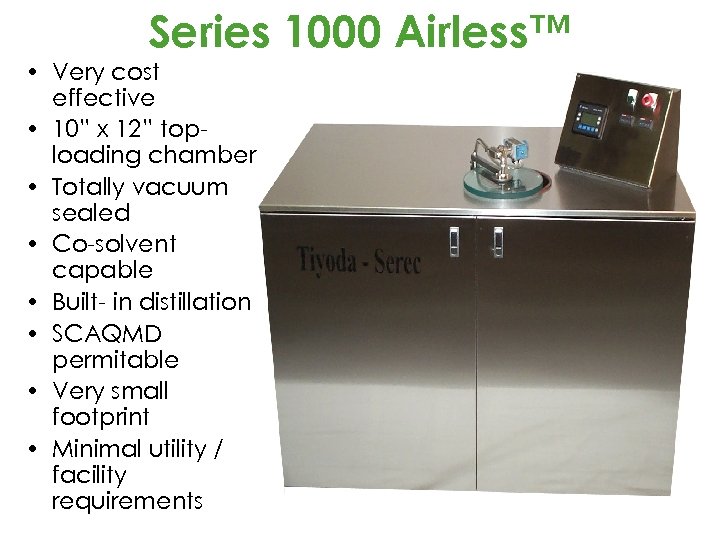 Series 1000 Airless™ • Very cost effective • 10” x 12” toploading chamber • Totally vacuum sealed • Co-solvent capable • Built- in distillation • SCAQMD permitable • Very small footprint • Minimal utility / facility requirements
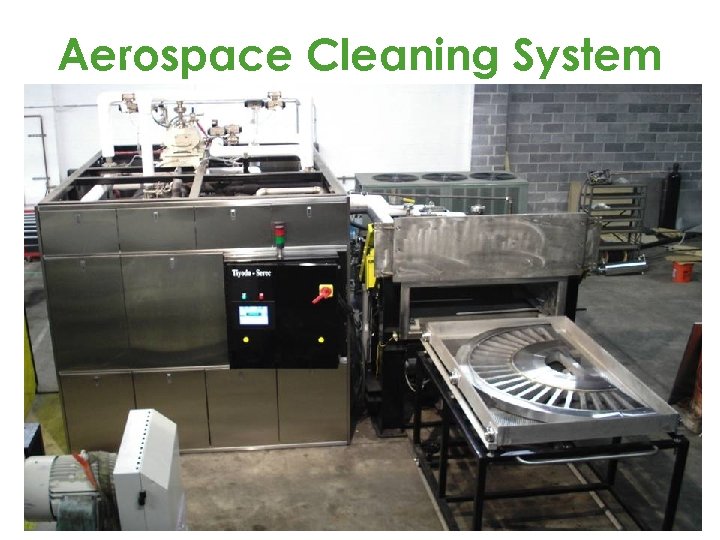 Aerospace Cleaning System
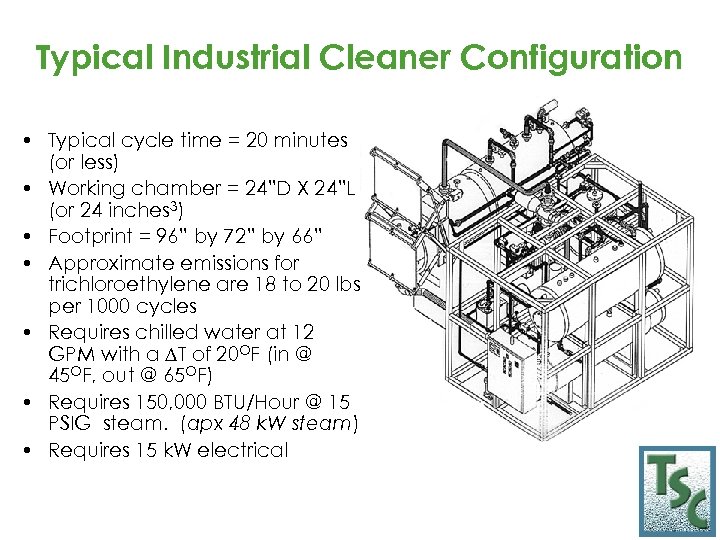 Typical Industrial Cleaner Configuration • Typical cycle time = 20 minutes (or less) • Working chamber = 24”D X 24”L (or 24 inches 3) • Footprint = 96” by 72” by 66” • Approximate emissions for trichloroethylene are 18 to 20 lbs. per 1000 cycles • Requires chilled water at 12 GPM with a ∆T of 20 OF (in @ 45 OF, out @ 65 OF) • Requires 150, 000 BTU/Hour @ 15 PSIG steam. (apx 48 k. W steam) • Requires 15 k. W electrical
 Benefits Of Vacuum Technology • Solvent Emission Reduction Initially the air in the cleaning chamber is evacuated so that the solvent and the air are not interfaced with each other to eliminate the solvent emissions. • De-gassing the Solvent When the solvent is placed under vacuum, the air dissolved in the solvent is eliminated to enhance the ultrasonic power — this means cleaner parts. • Drying the Parts Completely In the vacuum drying process, the vacuum created in the cleaning chamber depresses the boiling point of the solvent: becoming 75% of its boiling point at atmospheric pressure. The higher the vacuum, the lower the solvent boiling point. The heat capacity of the parts helps boil the solvent and the evaporated vapor is recaptured and recycled in the system.
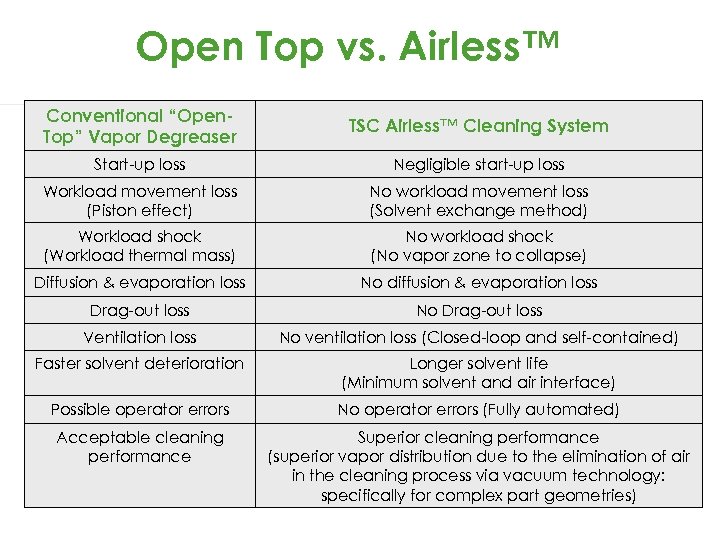 Open Top vs. Airless™ Conventional “Open. Top” Vapor Degreaser TSC Airless™ Cleaning System Start-up loss Negligible start-up loss Workload movement loss (Piston effect) No workload movement loss (Solvent exchange method) Workload shock (Workload thermal mass) No workload shock (No vapor zone to collapse) Diffusion & evaporation loss No diffusion & evaporation loss Drag-out loss No Drag-out loss Ventilation loss No ventilation loss (Closed-loop and self-contained) Faster solvent deterioration Longer solvent life (Minimum solvent and air interface) Possible operator errors No operator errors (Fully automated) Acceptable cleaning performance Superior cleaning performance (superior vapor distribution due to the elimination of air in the cleaning process via vacuum technology: specifically for complex part geometries)
 342 Compass Circle North Kingstown, RI 02852 Phone 401 -667 -7370 Toll-free 1 -866 -298 -0098 Fax 401 -667 -7375 sales@tiyoda-serec. com www. tiyoda-serec. com