


 Скачать презентацию Air-quality Modeling of PM 2 5 Mass and
6c8ac68109540c82616b504b95e34139.ppt
- Количество слайдов: 24
 Air-quality Modeling of PM 2. 5 Mass and Composition in Atlanta: Results from a Two-Year Simulation and Implications for Use in Health Studies 10/19/2004, Models 3 workshop Amit Marmur, Jim Mulholland Ted Russell Georgia Institute of Technology
 Overview • Characterization and health-effects of PM 2. 5 in Atlanta: – SEARCH/ ASACA: PM 2. 5 measurements (ARA, GA-Tech) – SOPHIA/ ARIES: health effects of PM 2. 5 (Emory University) • Spatial representativeness and error estimation in PM 2. 5 components • Use of 3 D air quality models in epidemiologic studies Georgia Institute of Technology
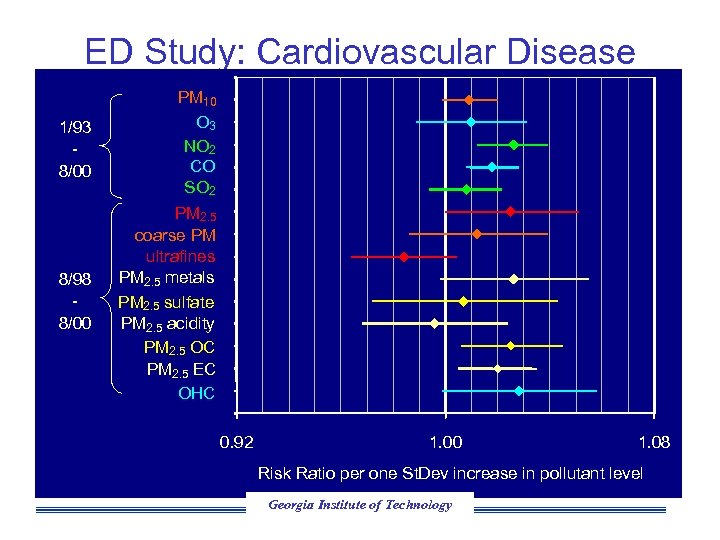 ED Study: Cardiovascular Disease 1/93 8/00 PM 10 O 3 NO 2 CO SO 2 8/98 8/00 PM 2. 5 coarse PM ultrafines PM 2. 5 metals PM 2. 5 sulfate PM 2. 5 acidity PM 2. 5 OC PM 2. 5 EC OHC 0. 92 1. 00 1. 08 Risk Ratio per one St. Dev increase in pollutant level Georgia Institute of Technology
 Issues • The use of data from a single (central) monitoring site in epidemiologic studies: – How representative is it of the entire city/region? – What are the associated errors (measurement + “exposure” error) • Can air-quality models provide useful information, either on coarse (central value) or fine (local exposure) domains? – Do AQ models capture the day-to-day variability? • Is the cause of the health outcome measured? Is it necessarily a single pollutant? – Health outcomes from specific sources, rather than specific pollutants (receptor modeling) Georgia Institute of Technology
 Spatial Representativeness Georgia Institute of Technology
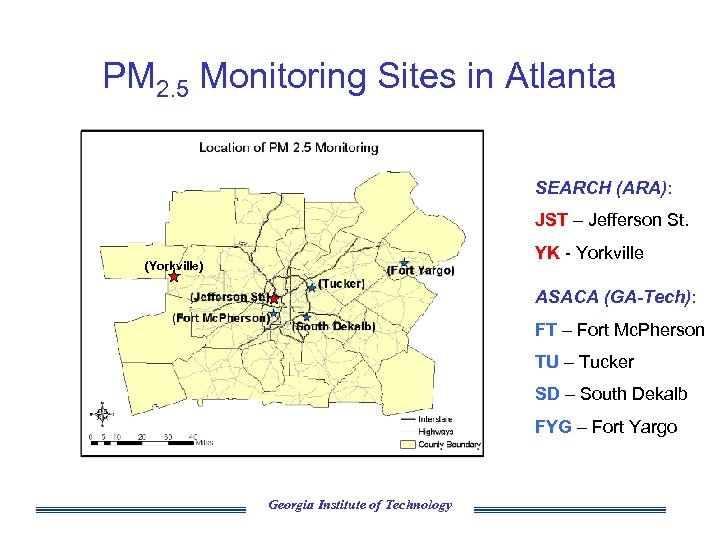 PM 2. 5 Monitoring Sites in Atlanta SEARCH (ARA): JST – Jefferson St. YK - Yorkville (Yorkville) ASACA (GA-Tech): FT – Fort Mc. Pherson TU – Tucker SD – South Dekalb FYG – Fort Yargo Georgia Institute of Technology
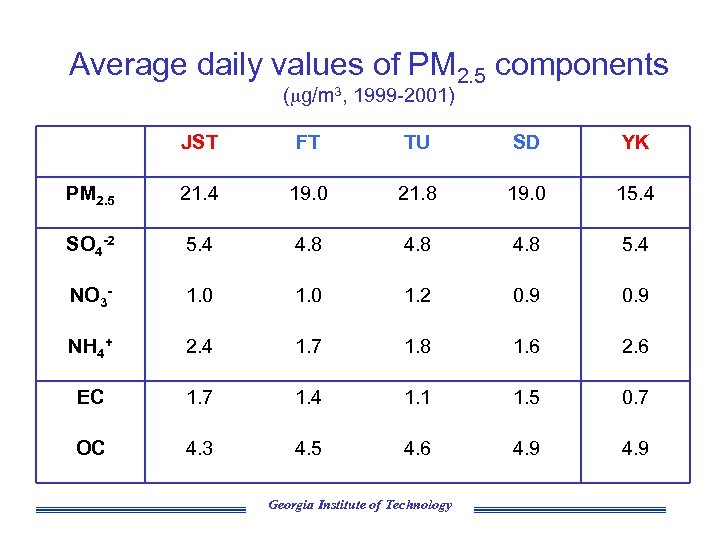 Average daily values of PM 2. 5 components ( g/m 3, 1999 -2001) JST FT TU SD YK PM 2. 5 21. 4 19. 0 21. 8 19. 0 15. 4 SO 4 -2 5. 4 4. 8 5. 4 NO 3 - 1. 0 1. 2 0. 9 NH 4+ 2. 4 1. 7 1. 8 1. 6 2. 6 EC 1. 7 1. 4 1. 1 1. 5 0. 7 OC 4. 3 4. 5 4. 6 4. 9 Georgia Institute of Technology
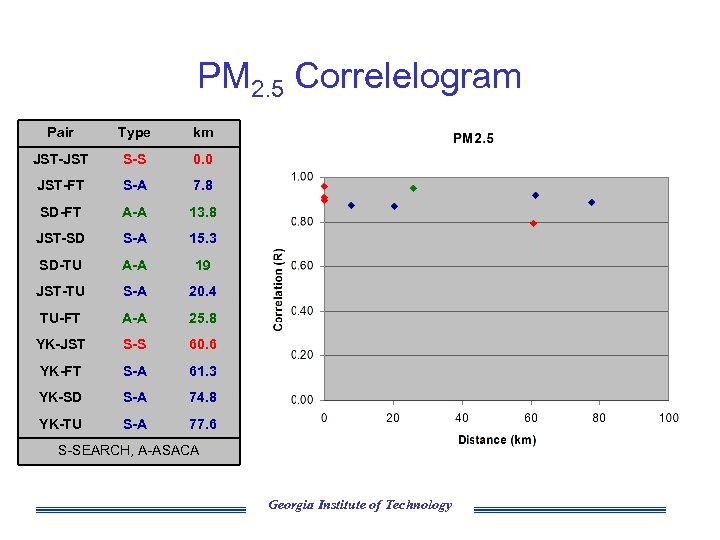 PM 2. 5 Correlelogram Pair Type km JST-JST S-S 0. 0 JST-FT S-A 7. 8 SD-FT A-A 13. 8 JST-SD S-A 15. 3 SD-TU A-A 19 JST-TU S-A 20. 4 TU-FT A-A 25. 8 YK-JST S-S 60. 6 YK-FT S-A 61. 3 YK-SD S-A 74. 8 YK-TU S-A 77. 6 S-SEARCH, A-ASACA Georgia Institute of Technology
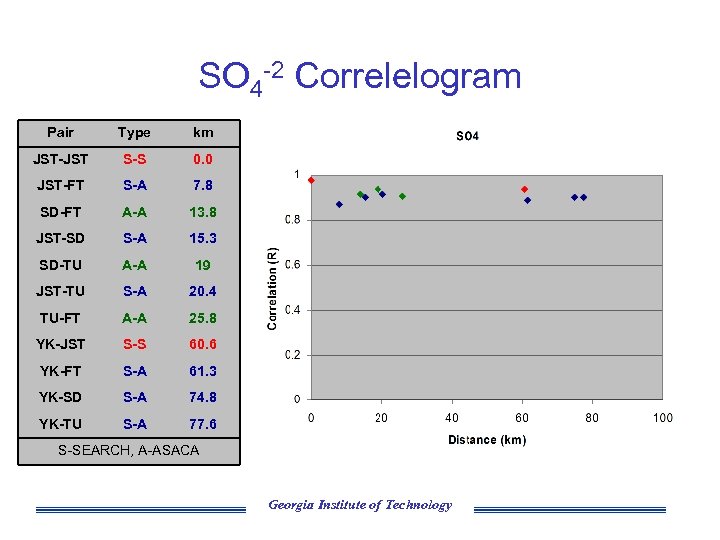 SO 4 -2 Correlelogram Pair Type km JST-JST S-S 0. 0 JST-FT S-A 7. 8 SD-FT A-A 13. 8 JST-SD S-A 15. 3 SD-TU A-A 19 JST-TU S-A 20. 4 TU-FT A-A 25. 8 YK-JST S-S 60. 6 YK-FT S-A 61. 3 YK-SD S-A 74. 8 YK-TU S-A 77. 6 S-SEARCH, A-ASACA Georgia Institute of Technology
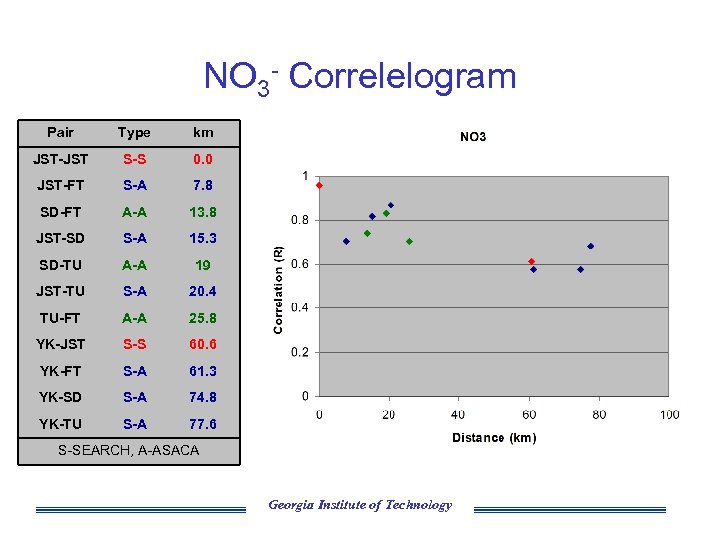 NO 3 - Correlelogram Pair Type km JST-JST S-S 0. 0 JST-FT S-A 7. 8 SD-FT A-A 13. 8 JST-SD S-A 15. 3 SD-TU A-A 19 JST-TU S-A 20. 4 TU-FT A-A 25. 8 YK-JST S-S 60. 6 YK-FT S-A 61. 3 YK-SD S-A 74. 8 YK-TU S-A 77. 6 S-SEARCH, A-ASACA Georgia Institute of Technology
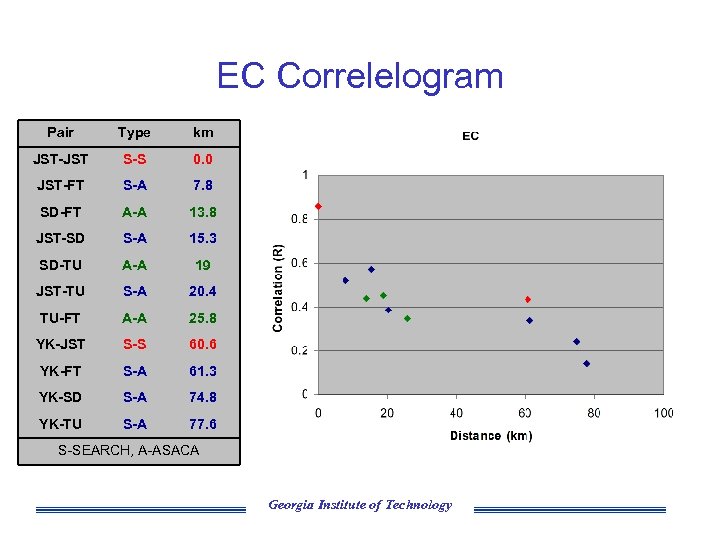 EC Correlelogram Pair Type km JST-JST S-S 0. 0 JST-FT S-A 7. 8 SD-FT A-A 13. 8 JST-SD S-A 15. 3 SD-TU A-A 19 JST-TU S-A 20. 4 TU-FT A-A 25. 8 YK-JST S-S 60. 6 YK-FT S-A 61. 3 YK-SD S-A 74. 8 YK-TU S-A 77. 6 S-SEARCH, A-ASACA Georgia Institute of Technology
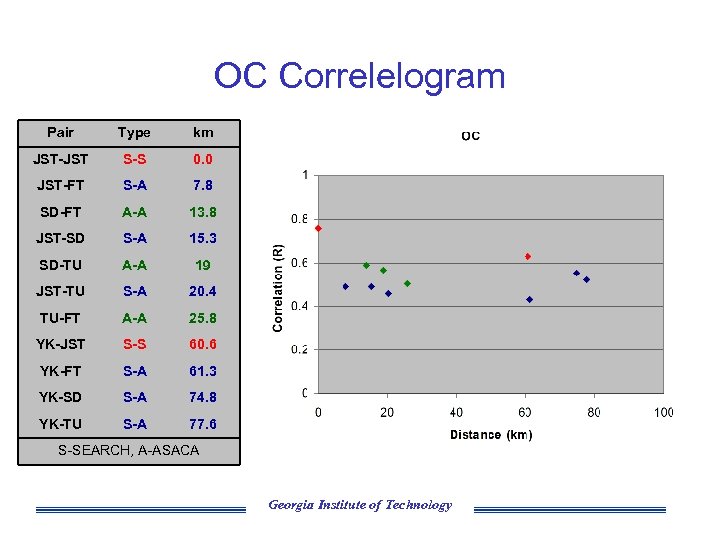 OC Correlelogram Pair Type km JST-JST S-S 0. 0 JST-FT S-A 7. 8 SD-FT A-A 13. 8 JST-SD S-A 15. 3 SD-TU A-A 19 JST-TU S-A 20. 4 TU-FT A-A 25. 8 YK-JST S-S 60. 6 YK-FT S-A 61. 3 YK-SD S-A 74. 8 YK-TU S-A 77. 6 S-SEARCH, A-ASACA Georgia Institute of Technology
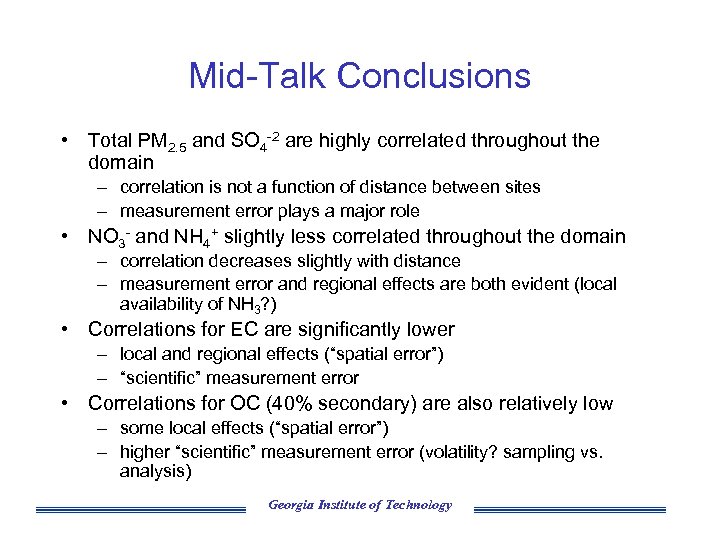 Mid-Talk Conclusions • Total PM 2. 5 and SO 4 -2 are highly correlated throughout the domain – correlation is not a function of distance between sites – measurement error plays a major role • NO 3 - and NH 4+ slightly less correlated throughout the domain – correlation decreases slightly with distance – measurement error and regional effects are both evident (local availability of NH 3? ) • Correlations for EC are significantly lower – local and regional effects (“spatial error”) – “scientific” measurement error • Correlations for OC (40% secondary) are also relatively low – some local effects (“spatial error”) – higher “scientific” measurement error (volatility? sampling vs. analysis) Georgia Institute of Technology
 Use of 3 D Air-Quality Models Georgia Institute of Technology
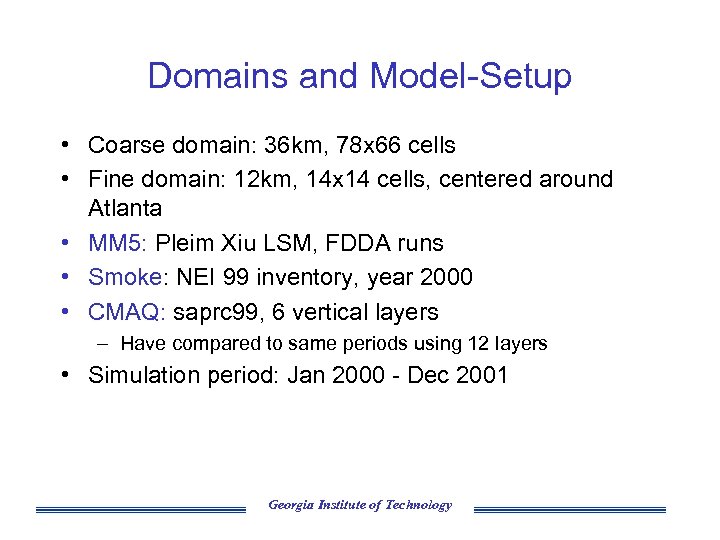 Domains and Model-Setup • Coarse domain: 36 km, 78 x 66 cells • Fine domain: 12 km, 14 x 14 cells, centered around Atlanta • MM 5: Pleim Xiu LSM, FDDA runs • Smoke: NEI 99 inventory, year 2000 • CMAQ: saprc 99, 6 vertical layers – Have compared to same periods using 12 layers • Simulation period: Jan 2000 - Dec 2001 Georgia Institute of Technology
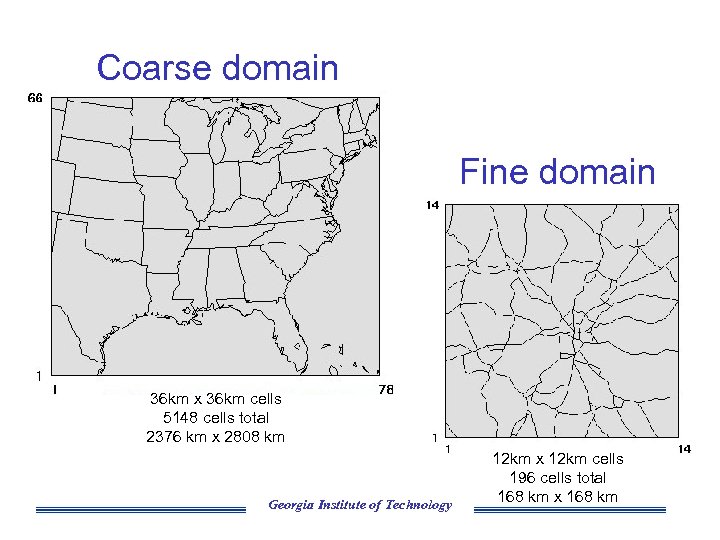 Coarse domain Fine domain 36 km x 36 km cells 5148 cells total 2376 km x 2808 km Georgia Institute of Technology 12 km x 12 km cells 196 cells total 168 km x 168 km
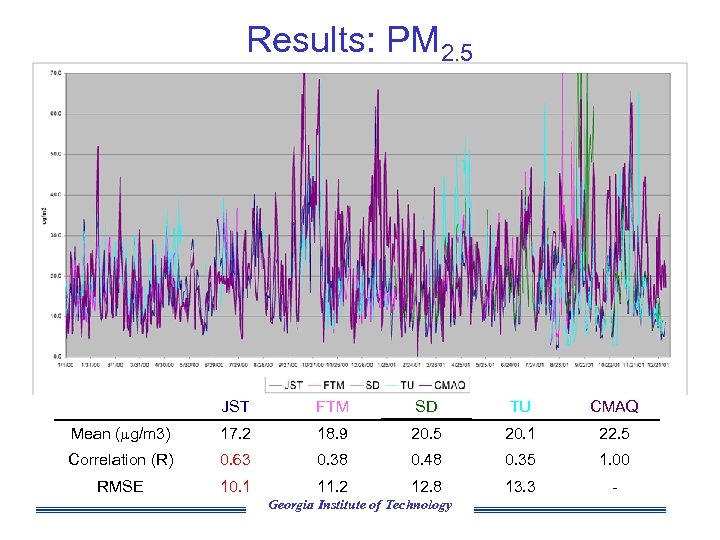 Results: PM 2. 5 JST FTM SD TU CMAQ Mean ( g/m 3) 17. 2 18. 9 20. 5 20. 1 22. 5 Correlation (R) 0. 63 0. 38 0. 48 0. 35 1. 00 RMSE 10. 1 11. 2 12. 8 13. 3 - Georgia Institute of Technology
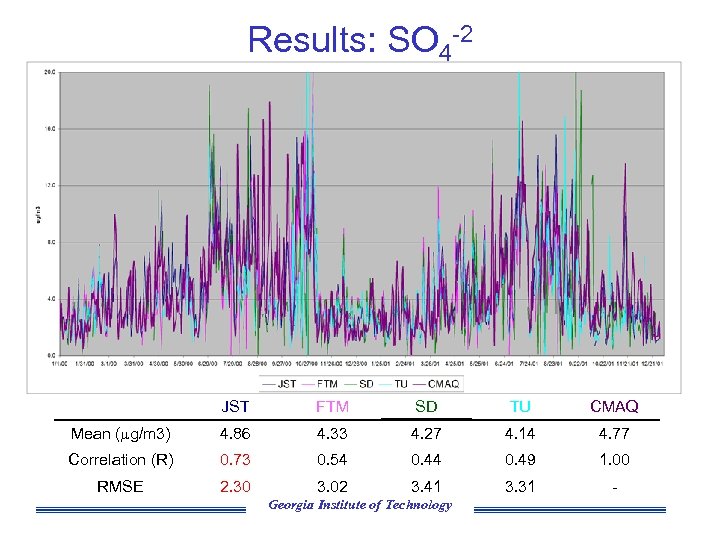 Results: SO 4 -2 JST FTM SD TU CMAQ Mean ( g/m 3) 4. 86 4. 33 4. 27 4. 14 4. 77 Correlation (R) 0. 73 0. 54 0. 49 1. 00 RMSE 2. 30 3. 02 3. 41 3. 31 - Georgia Institute of Technology
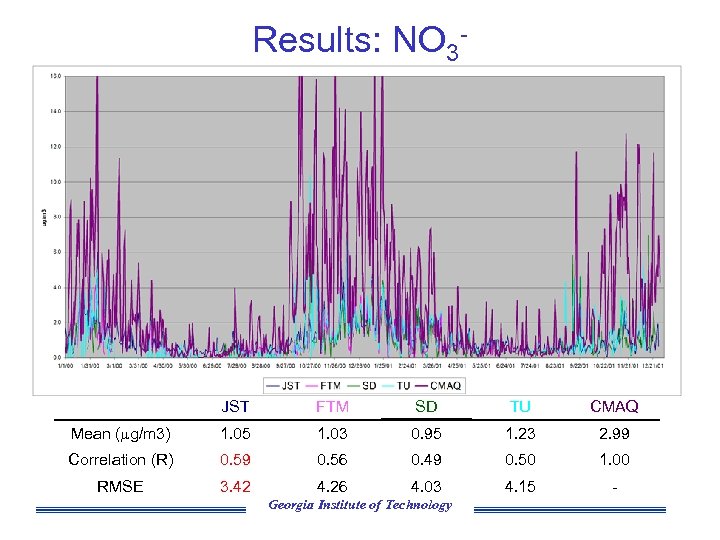 Results: NO 3 - JST FTM SD TU CMAQ Mean ( g/m 3) 1. 05 1. 03 0. 95 1. 23 2. 99 Correlation (R) 0. 59 0. 56 0. 49 0. 50 1. 00 RMSE 3. 42 4. 26 4. 03 4. 15 - Georgia Institute of Technology
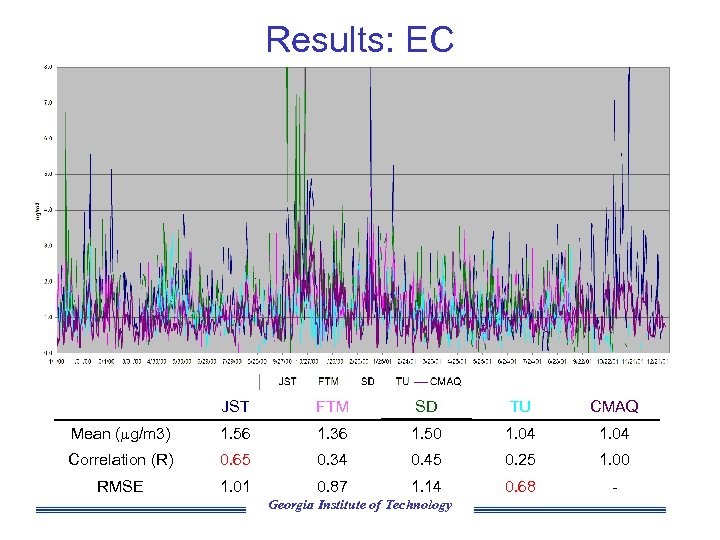 Results: EC JST FTM SD TU CMAQ Mean ( g/m 3) 1. 56 1. 36 1. 50 1. 04 Correlation (R) 0. 65 0. 34 0. 45 0. 25 1. 00 RMSE 1. 01 0. 87 1. 14 0. 68 - Georgia Institute of Technology
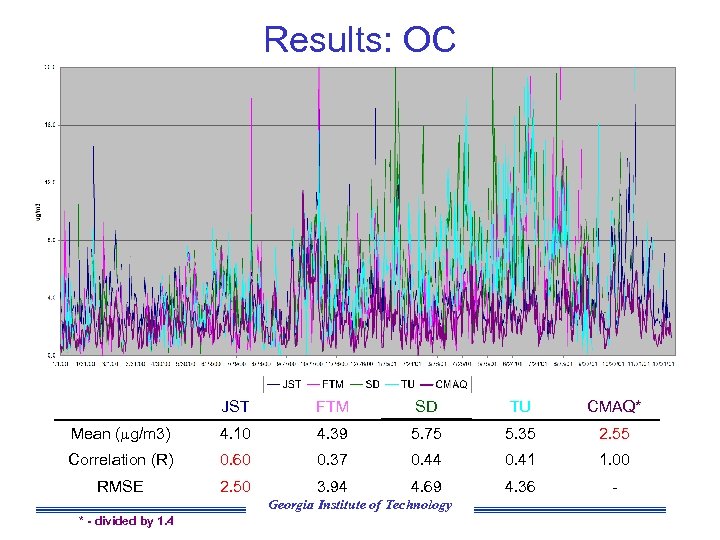 Results: OC JST FTM SD TU CMAQ* Mean ( g/m 3) 4. 10 4. 39 5. 75 5. 35 2. 55 Correlation (R) 0. 60 0. 37 0. 44 0. 41 1. 00 RMSE 2. 50 3. 94 4. 69 4. 36 - Georgia Institute of Technology * - divided by 1. 4
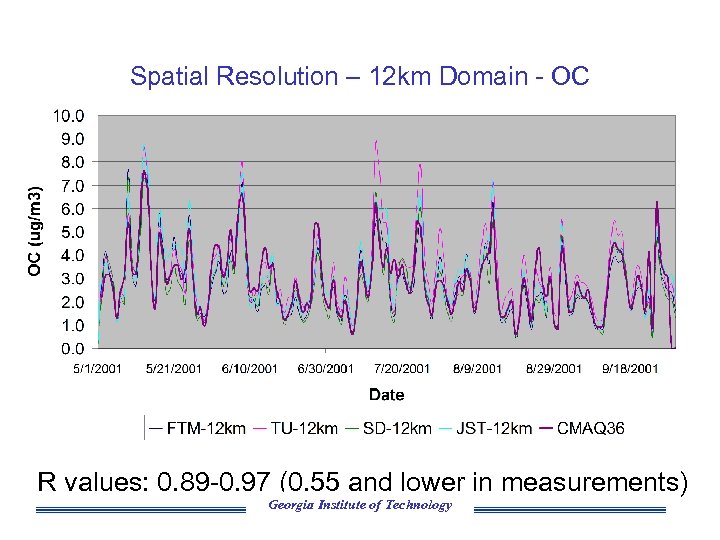 Spatial Resolution – 12 km Domain - OC R values: 0. 89 -0. 97 (0. 55 and lower in measurements) Georgia Institute of Technology
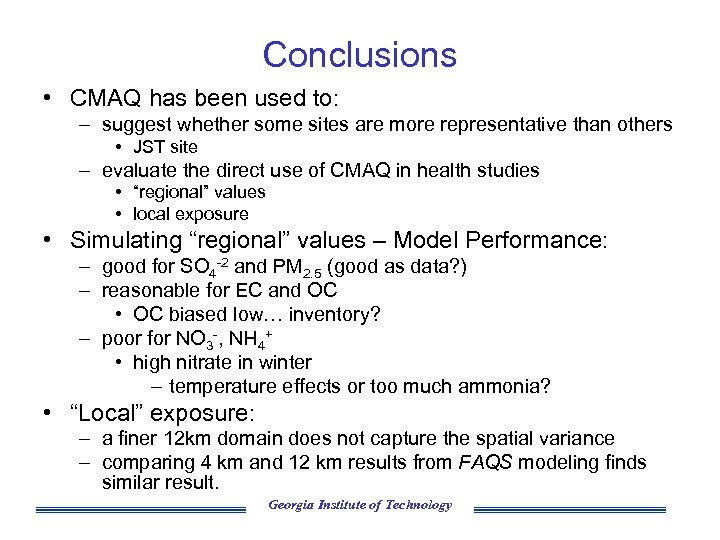 Conclusions • CMAQ has been used to: – suggest whether some sites are more representative than others • JST site – evaluate the direct use of CMAQ in health studies • “regional” values • local exposure • Simulating “regional” values – Model Performance: – good for SO 4 -2 and PM 2. 5 (good as data? ) – reasonable for EC and OC • OC biased low… inventory? – poor for NO 3 -, NH 4+ • high nitrate in winter – temperature effects or too much ammonia? • “Local” exposure: – a finer 12 km domain does not capture the spatial variance – comparing 4 km and 12 km results from FAQS modeling finds similar result. Georgia Institute of Technology
 Acknowledgments • This work was supported by subcontractors to Emory University under grants from the U. S. Environmental Protection Agency (R 82921301 -0, RD 83096001), the National Institute of Environmental Health Sciences (R 01 ES 11199 and R 01 ES 11294), and Georgia Power/ Southern Company. • We would also like to thank ARA (Atmospheric Research and Analysis) for both providing access to data used in this analysis and ongoing discussions. Georgia Institute of Technology