


 Скачать презентацию Air Pollutants Policy Greenhouse Gases Control Prediction
8176958c58cc5084495d68ec3aee2d86.ppt
- Количество слайдов: 28
 Air Pollutants Policy Greenhouse Gases Control & Prediction
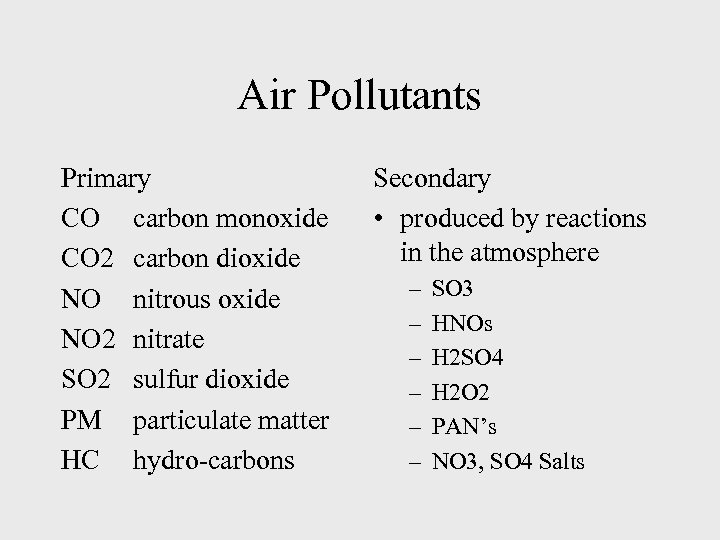 Air Pollutants Primary CO carbon monoxide CO 2 carbon dioxide NO nitrous oxide NO 2 nitrate SO 2 sulfur dioxide PM particulate matter HC hydro-carbons Secondary • produced by reactions in the atmosphere – – – SO 3 HNOs H 2 SO 4 H 2 O 2 PAN’s NO 3, SO 4 Salts
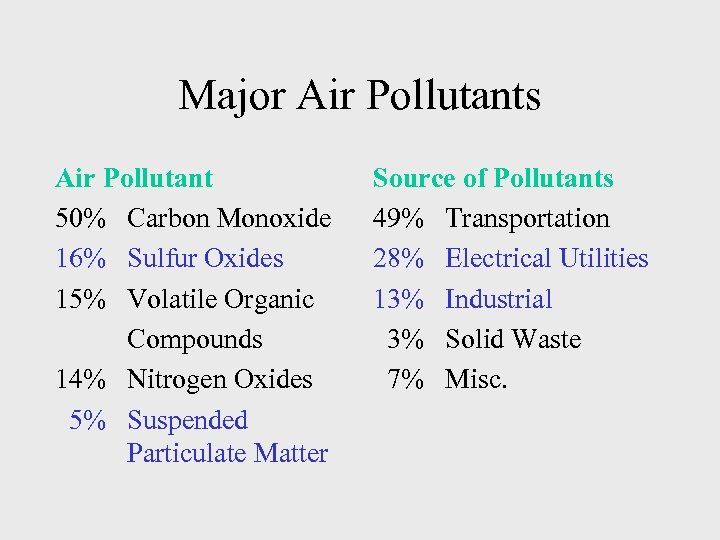 Major Air Pollutants Air Pollutant 50% Carbon Monoxide 16% Sulfur Oxides 15% Volatile Organic Compounds 14% Nitrogen Oxides 5% Suspended Particulate Matter Source of Pollutants 49% Transportation 28% Electrical Utilities 13% Industrial 3% Solid Waste 7% Misc.
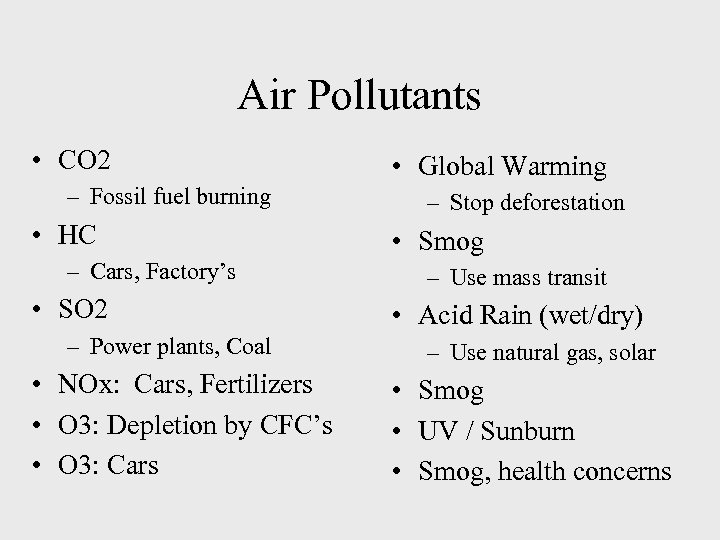 Air Pollutants • CO 2 – Fossil fuel burning • HC – Cars, Factory’s • SO 2 – Power plants, Coal • NOx: Cars, Fertilizers • O 3: Depletion by CFC’s • O 3: Cars • Global Warming – Stop deforestation • Smog – Use mass transit • Acid Rain (wet/dry) – Use natural gas, solar • Smog • UV / Sunburn • Smog, health concerns
 Human Impact (2 overheads) • Chest Cavity • Large PM expelled by bronchial tubes • Visible PM – easiest to capture with pollution control equipment – easiest for public to see improvement • Particle Size • Visible – greater than 1 micron • Invisible – less than 1 micron – more damaging to lung tissues
 NAAQS & NAA • National Ambient Air Quality Standards – a measure of background pollution – how much the environment can assimilate and still remain healthy • Non-Attainment Areas – Class I: Can not have any increases • National Parks, mostly out west – Class II: Allows moderate growth of sources – Class III: Allows for significant development of new sources
 PSD’s & NSPS • Prevention of Significant Deterioration – clean up of current sources – prevent air from getting worse New Sources Performance Standards (NSPS) – don’t want to stop economic growth, – but don’t let new factory’s from add to the problem
 NESHAP’s & PSI • National Emissions Standards for Hazardous Pollutants (NESHAPS) – set standards for hazardous, man-made pollutants • Pollution Standards Index – report to the public on how ‘clean’ the air is – helps pressure industry to clean up – public health awareness from air pollution
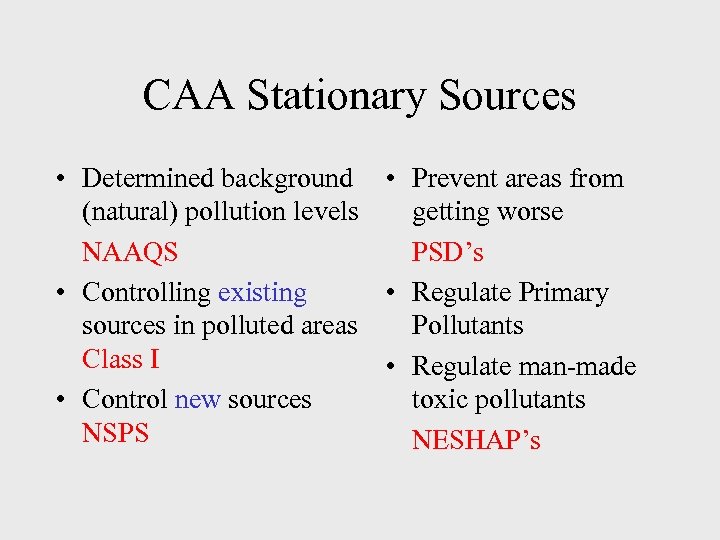 CAA Stationary Sources • Determined background • Prevent areas from (natural) pollution levels getting worse NAAQS PSD’s • Controlling existing • Regulate Primary sources in polluted areas Pollutants Class I • Regulate man-made • Control new sources toxic pollutants NSPS NESHAP’s
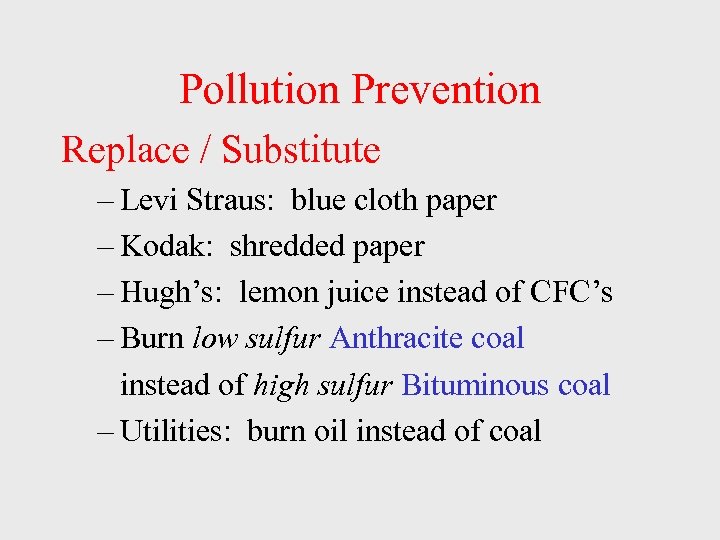 Pollution Prevention Replace / Substitute – Levi Straus: blue cloth paper – Kodak: shredded paper – Hugh’s: lemon juice instead of CFC’s – Burn low sulfur Anthracite coal instead of high sulfur Bituminous coal – Utilities: burn oil instead of coal
 Pollution Prevention Replace / Substitute – Hazardous Materials reductions – Natural Gas for use on buses & trucks – Emissions Trading Policy
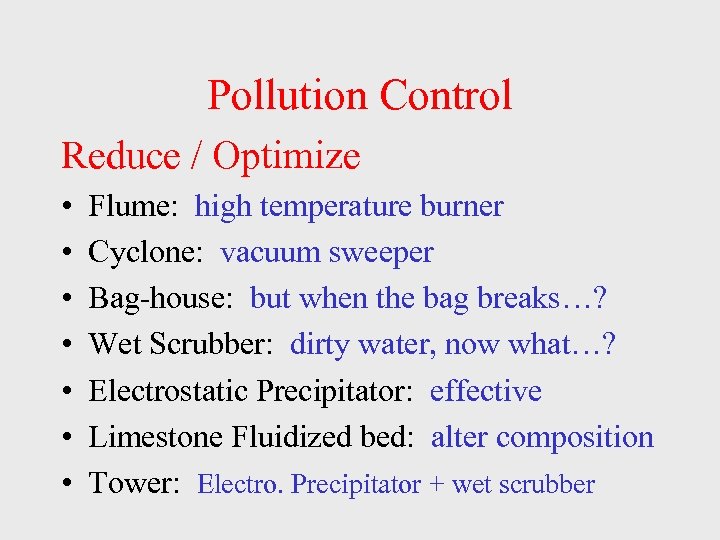 Pollution Control Reduce / Optimize • • Flume: high temperature burner Cyclone: vacuum sweeper Bag-house: but when the bag breaks…? Wet Scrubber: dirty water, now what…? Electrostatic Precipitator: effective Limestone Fluidized bed: alter composition Tower: Electro. Precipitator + wet scrubber
 Pollution Reduction Recycle / Reuse – EGR valve on cars – CH 4 in wastewater systems – Levi Straus: blue cloth paper – Kodak: shredded paper for shipping – Electric utilities use wastewater for coolant – St. Petersburg lawn water reuse
 4 R’s = 4 P’s • Regulation = Polluter Pays Principle • Replace / Substitute = Pollution Prevention • Reduce / Optimize = Pollution Control • Recycle / Reuse = Pollution Reduction
 Acid Rain • Utilities & Factory’s – Electricity from turbines – Turbines run on steam – Steam produced by heat – Heat created by burning coal – Coal contains Sulfur • Combusted Sulfur reacts with water to form Sulfuric Acid (HSO 3)
 Acid Rain • Sulfuric Acid (HSO 3) falls to the ground as – Dry Deposition (dust, acidification) – Wet Deposition (Acid Rain) • Acidic water bodies can not support life • Lime Soils buffer & neutralize Acid Rain • In other soils, Acidic rain leaches metals out of the soil and make them bio-available • Metals bio-accumulate and become toxic
 Acid Rain: Cross Media Impact • Sulfuric Acid (HSO 3) falls to the ground as – Dry Deposition (dust, acidification) – Wet Deposition (Acid Rain) • Acidic water bodies can not support life • Lime Soils buffer & neutralize Acid Rain • In other soils, Acidic rain leaches metals out of the soil and make them bio-available • Metals bio-accumulate and become toxic
 Atmosphere • Mesosphere – (overhead) • Stratosphere • Troposphere – Nitrogen 78% – Oxygen 21%
 Greenhouse Gases • SO 2 Sulfur Dioxide: coal / electricity • CO 2 Carbon Dioxide: people, fossil fuel • NOx Nitrous Oxide: fertilizer, fossil fuel, cars » also involved in ozone depletion
 Greenhouse Gases • CO Carbon Monoxide: cars • CH 4 Methane: animals, biodegration • Pb Lead: 1970 - 1985 = 90% reduction • HC Hydrocarbons (VOC’s): fossil fuels • CFC’s Chloroflourocarbons: aerosols » mainly involved in ozone depletion
 • CO 2 Greenhouse Effect – naturally occurring in Troposphere – is used by plants for photosynthesis – by-product of fossil fuel combustion – COx traps heat, keeps the Earth warm • Hawaii Statistics • Deforestation in Brazil & Asia – loss of plants taking in CO 2 – what is the precautionary approach?
 Ozone Hole • • • Ozone located in the upper troposphere Ozone filter UV radiation CFC’s gobble up Ozone (1000 : 1) Increase UV = Increase Skin Cancer HFC’s substitute for CFC’s at minimal cost Precautionary Approach to Management – we don’t know, & it isn’t costly: so be cautious
 PAN’s / SMOG (overhead) • NOx & COx produced by cars • Reacts with oxygen to produce Ozone • Ozone filters (captures) sunlight just like in stratosphere, but on dirt & dust particles • Particles cause haze “Smog” • Serious health hazard at high levels
 Atmospheric Patterns • Curiolis Effect • Pressure Zones (diagrams) – High & Low, Wind, Moisture – Urban Bubble - heat sink • Inversions – (Warm Sunny Days, Clear Cool Nights) – Nocturnal Inversion – Subsidence Inversion – Stagnation: Denver, Pgh, WVa
 Stationary Source Plumes (diagrams) • • Adiabatic Expansion Rate Mean Mixing depth Coning Plume Looping Plume Fanning Plume Trapping Plume Fumigating Plume
 Dispersion Models • • • Linear Box Multi-box Gaussian Mobile
 Mobile Sources • Trucks & Buses – Natural gas, big tanks, diesel • Trains & Planes – oil, electric, new engine designs: ACRID AIR • Cars – mufflers, EGR, fuel injection, catalytic converter, mpg, weight, SUV’s
 Air Pollution • • What is regulated What are the sources What are the controls Why are pollutants a health concern Role of atmospheric conditions Role of chemical reactions Pre-cautionary principle