 Скачать презентацию Air-Ground Integration Ed Bailey Airborne Project Leader
8ece07b1c263363fb787de0952415cda.ppt
- Количество слайдов: 29



Air-Ground Integration Ed Bailey, Airborne Project Leader & Ian Wilson, PATs Project Leader 1
The Aim : What is air-ground integration l How was it done l How should it have been done l How it worked in practice - technical story of a flight l 2
PHARE Objective: l “The objective of PHARE is to organise, co-ordinate and conduct on a collaborative basis, experiments and trials aiming at proving and demonstrating the feasibility and merits of a future air ground integrated air traffic management system in all phases of flight. ” 3
PHARE Air/Ground Integration n Integration in PHARE was limited to Trajectory Negotiation n Trajectory Negotiation did not involve ‘exchange of trajectories’ or ‘Remote Procedure Calls’ n Simply Trajectory Negotiation was: n Trajectory from the aircraft n Constraints from the ground n Equivalent to: “Here is my intent - is it safe, if not, make it safe” 4
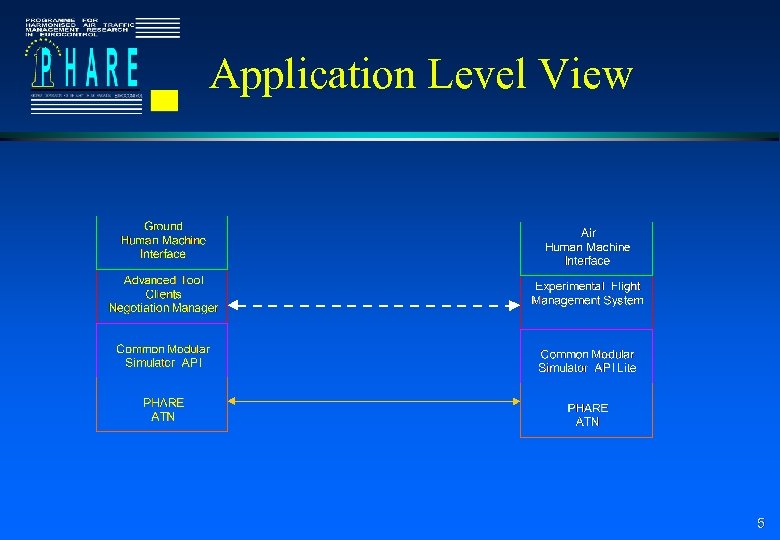
Application Level View 5
Ideal Trajectory Negotiation n Aircraft downlinks User Preferred Trajectory n Ground checks trajectory for conflicts adding constraints if necessary to deconflict and to sequence departure and arrival, then uplinks the constraints to the aircraft n Aircraft modifies User Preferred Trajectory and downlinks it to the ground n Ground checks the new User Preferred Trajectory for conflicts, broken constraints and infringements and if none uplinks deviation parameters to the aircraft n Aircraft generates trajectory and downlinks ‘Accept’ 6
Its NOT that simple n Problem areas n Is the first downlink really the User Preferred Trajectory ? n What ‘ground checks’ are really needed ? n Does the controller need to see a trajectory that has no conflicts ? n Is there a need to co-ordinate sector-sector on trajectory changes and what is the place of Letters of Agreement ? n Delay during checks causes asynchronous work for controller 7
User Preferred Trajectory ? Ideally Blue Sky trajectory l But it includes known ATC restrictions such as Flight Levels and posslibly routings l If the user does not get the request the alternative may be very different l 8
Ground Checks l Negotiation Manager Software checks for l Conflicts caused in current and neighbour sectors l Constraints not met l Changes in entry exit conditions at sector boundaries Conflicts must be checked, but the other checks may be unnecessary l Forcing co-ordination not appreciated l l Time delay means controller may need to multi-task 9
Controller display l l Does a trajectory without problems need to be displayed ? Depends on: l l l Trust in system Method of controller working - with tools it is not strictly necessary The ‘Big Picture’ - is it still required by controllers with automated support ? 10
Shortened Procedures Standard Trajectory Negotiation may be too long in some circumstances. l Shortened procedures: l l From Air - Pre-Emptive Negotiation l From Ground - Formal Clearance 11
Pre-Emptive Negotiation The aircraft is doing something therefore the ground is told not asked. l Sequence: l l Trajectory sent to ground l Deviation parameters and accept l Equivalent to: “Here is what I am flying - is it safe ? If not, make it safe. ” 12
Formal Clearance The ground requires an aircraft to do something now therefore the aircraft is told not asked. l Sequence: l l Set of constraints and deviation parameters are sent to the aircraft l The aircraft generates a trajectory and flies it when the pilot accepts l Equivalent to: “Fly this trajectory. ” 13
Flight Planning to 40 Mins Nominal values to process the information l Trajectory Predictor Generates Initial Trajectory into Flight Data Base l Flight Database distribution l Conflict Probe on Trajectory l Initial Arrival and Departure sequencing commences l 14
Air Trajectory Prediction The Trajectory is generated for the entire flight. l SID and STAR (plus any procedural routings) are used for initial constraints. l Trajectory is in 3 main ‘Phases’: l l Climb, l Cruise, l Descent. 15
Ground Trajectory Prediction For ‘what-if’ modelling of all flights, by the controller and by the sequencing tools. l For provision of advisories to the Tactical Controller to pass to non-equipped aircraft. l l Non-equipped - either without Datalink or with a less capable FMS. 16
Aircraft Log In to Datalink l Aircraft Provides trajectory based on aircraft data. l Get Meteo data l Derive vertical profile and 3 D plus relative times l Pilot checks then ‘Negotiate’s First Trajectory Negotiation to Ground l Ground sequences the flight and constraints passed for push-back and take-off l 17
Take Off DAP or trajectory indicating Take Off l Trajectory now certain l Re-negotiate Trajectory if required l New contract if required l 18
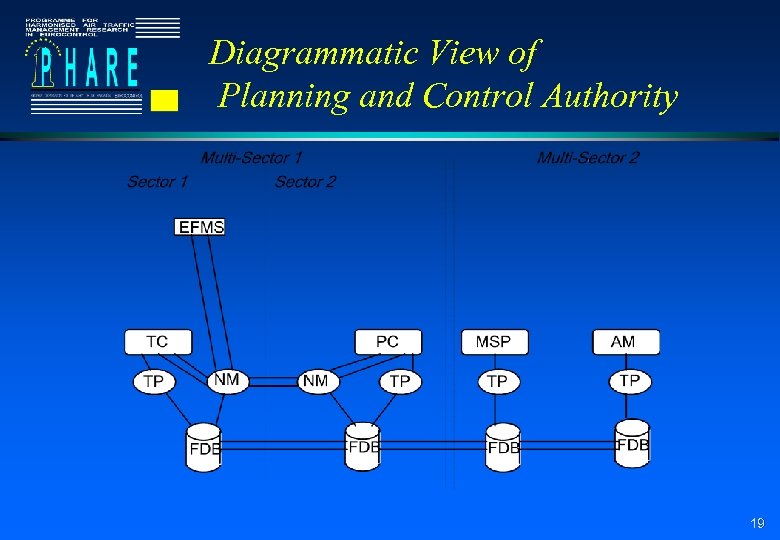
Diagrammatic View of Planning and Control Authority 19
Post Take-off Planning ‘Next’ Planner plans and deconflicts (using CP, CT, PS, TP, NM) l Tactical controller monitors (using FPM and CT, PS, TP, NM if change required) l Multi-Sector Planner 30 minutes away - checks loadings on the sectors (Using TLS and TP, NM if change required) l 20
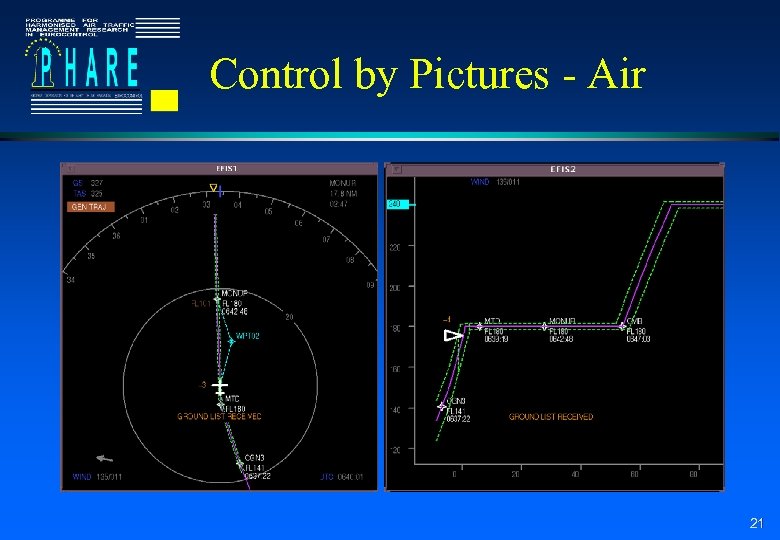
Control by Pictures - Air 21
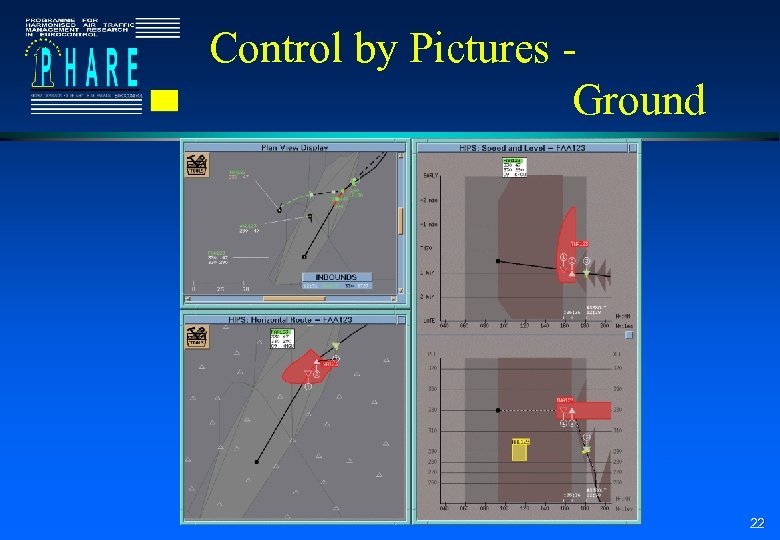
Control by Pictures Ground 22
Airborne Route Amendments Pilot amends route on AHMI l Aircraft generates trajectory based on aircraft data. l Constraints provided from the ground for en-route deconfliction and Arrival l Aircraft recomputes trajectory to meet constraints and datalinks down l Checked and Agreed with ground l 23
Automated Holds - Stacks Long lookahead to avoid holds… l If hold required trajectory predictors in the EFMS and on the ground create one l If there are other aircraft in the hold a Stack Manager process on the ground provides descent constraints. l 24
Arrivals Sequencing continual while aircraft are en-route with sequence arrival times defined l Changes of Time of Arrival only ‘negotiated’ when change exceeds parameter time l Automated sequencing frozen prior to descent l 25
Automated Approaches Expedite and Retard using trombones or approach fans l Aircraft uses the area of the trombone or fan to amend its trajectory to achieve accuracies within 5 seconds at the approach gate l Always misunderstood by controllers l 26
Problems - Communications l Datalink l l l Slow, very low bandwidth Trajectory Information Structure System l l Some single threaded - resulted in unworkable delay If multi-threaded, controller also has to ‘multi-thread’ 27
Achievement of Concept PHARE integrated the aircraft and ground systems l The aircraft generates the trajectory held in the ground flight database l The aircraft is only ‘constrained’ if required to avoid conflict l Similar control by pictures approach both in the air and on the ground l Data-Link with sufficient bandwidth is essential for full benefit 28 l
Air-Ground Integration Ed Bailey, Airborne Project Leader & Ian Wilson, PATs Project Leader 29
Скачать презентацию Air-Ground Integration Ed Bailey Airborne Project Leader
8ece07b1c263363fb787de0952415cda.ppt