


 Скачать презентацию Air freight logistic trends and key issues and
269fc0571a3d45917e0b347dc3c9f9d9.ppt
- Количество слайдов: 37
 Air freight logistic trends and key issues and challenges A Qantas perspective 20 May 2004
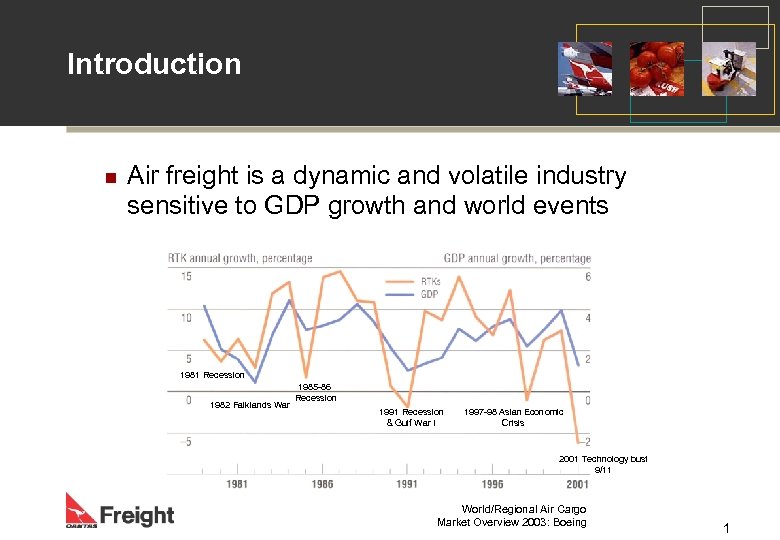 Introduction n Air freight is a dynamic and volatile industry sensitive to GDP growth and world events 1981 Recession 1982 Falklands War 1985 -86 Recession 1991 Recession & Gulf War I 1997 -98 Asian Economic Crisis 2001 Technology bust 9/11 World/Regional Air Cargo Market Overview 2003: Boeing 1
 Introduction n Constant ‘shocks’ in the global arena • economic downturns, technology bust, fallout from 9/11, Iraq War and SARS n Responding to rapid change is our biggest challenge 2
 Introduction QF primarily a passenger airline n Air freight part of core business • freight carried in underfloor space of aircraft • additional capacity on leased or joint venture freighter aircraft n Combination passenger and freighter capacity offers QF flexibility and maximises yield 3
 Introduction A newcomer to the industry n Objective look at air freight n Qantas Freight Commercial portfolio covers everything outside of terminal operations & capacity • includes: strategy, marketing, sales, customs, ebusiness and customer relations 4
 Introduction QF markets three products on all international flights: n Cargo n Mail and n Express services Domestic Freight n Australian air Express (Aa. E) – a joint venture between QF and Aus Post 5
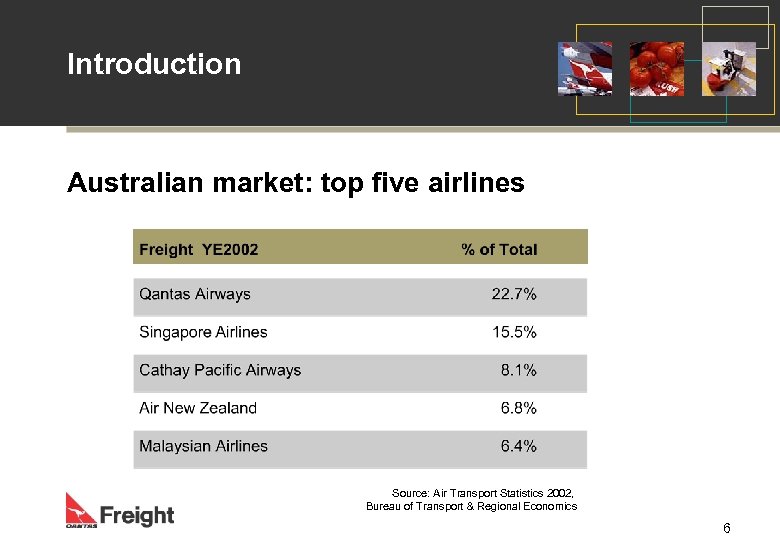 Introduction Australian market: top five airlines Source: Air Transport Statistics 2002, Bureau of Transport & Regional Economics 6
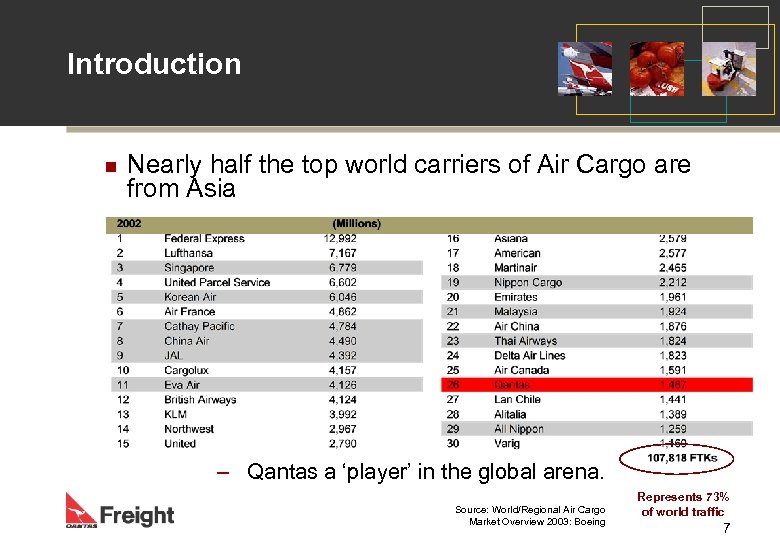 Introduction n Nearly half the top world carriers of Air Cargo are from Asia – Qantas a ‘player’ in the global arena. Source: World/Regional Air Cargo Market Overview 2003: Boeing Represents 73% of world traffic 7
 Background Where we’ve come from. . . n QF world’s second oldest airline n Carrying freight since inaugural service Nov 1922 n 1935 QF’s first international flight carrying mail to the UK via Darwin and Singapore 8
 Background n In the early days passengers jammed into cabin just another bit of freight n We’ve come a long way since those early days 9
 Background • Today QF operates around 540 international services p/w to 85 destinations & 35 countries n Freight on every one of those flights global airline industry with over 700 airlines n Freight a by-product of passenger continues to grow – multi-billion dollar industry n Shippers, forwarders, passenger and freighter airlines and integrators n Moving in excess of 10 m tonnes per year 10
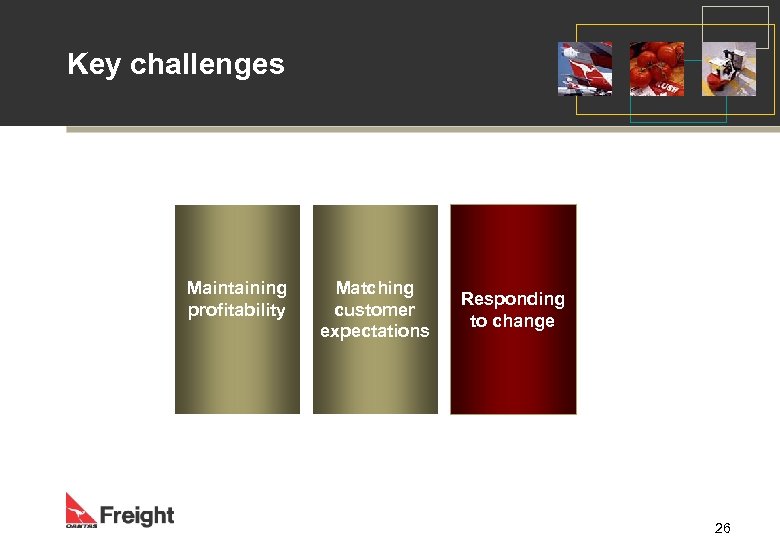
 Key challenges We’ve come a long way…but QF and the industry face enormous challenges ahead • Key challenges n Maintaining profitability (reducing costs) n Matching our customers expectations • keeping to service levels and turnaround times n Responding to the challenges of a constantly changing market 11
 Key challenges Maintaining profitability Matching customer expectations Responding to change 12
 Profitability: yield & load factors n As companies looked for increases in efficiency and profitability emergence of dedicated cargo businesses within airlines • Lufthansa, Singapore Airlines, Emirates, Cathay and Malaysian airlines • October 2003 QF announced an organisational restructure n Performance at the bottom line 13
 Profitability: yield & load factors n n n Struggle to put a value on the belly space of passenger flights a by-product of the core passenger airline Marginal costing contributed to downward pressure on yields Yields through mix and load factor improvements …tailoring products and services to meet changing customer needs 14
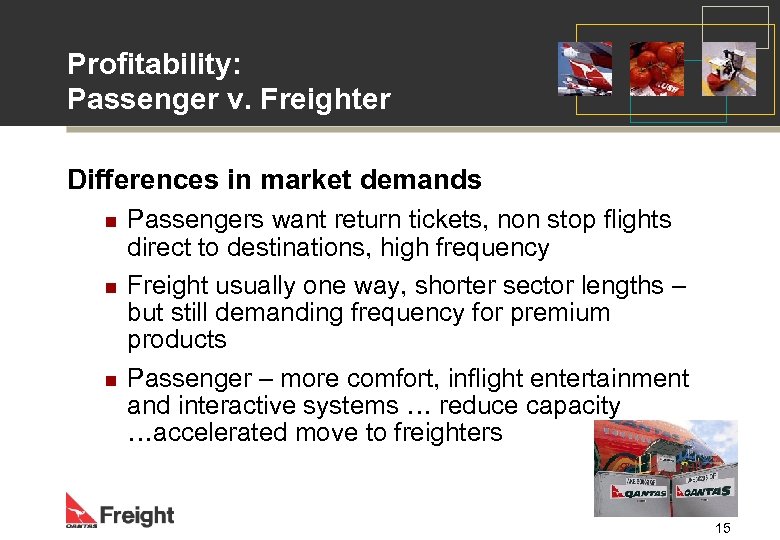 Profitability: Passenger v. Freighter Differences in market demands n n n Passengers want return tickets, non stop flights direct to destinations, high frequency Freight usually one way, shorter sector lengths – but still demanding frequency for premium products Passenger – more comfort, inflight entertainment and interactive systems … reduce capacity …accelerated move to freighters 15
 Profitability: Passenger v. Freighter Why fly freighters. . . n Means of generating revenue and profit n Complement pax belly space and provide a service n Freighters will continue to grow but if you get it wrong, they are a great way to tear up money n Profitability linked to keeping market offerings in line with market demands n Dedicated freighter services play vital role but underfloor capacity in pax is a major force 16
 Profitability: Passenger v. Freighter n On some routes underfloor capacity offers greater flexibility and cost efficiencies • Asia’s economic boom, new destinations come online, air trade opportunities will increase, particularly intra-asia • Intra-asian cargo growth a resilient annual growth of 10. 4% per year, significantly higher than other regions • QF devotes nearly 1/4 of seats across international passenger network to service Asia region …whatever happens in Asia will affect our interests 17
 Key challenges Maintaining profitability Matching customer expectations Responding to change 18
 Matching customer expectations: Products and service reliability Airlines slow to match their products and capacity to customer demands? n Failure to meet customer expectations … challenge we face is to evolve our product range to match those expectations and at the same time to do it profitably n Two-pronged effect – allows us to improve yield through better mix n Customers (shippers/forwarders) say reliability is the most important factor in making their decision 19
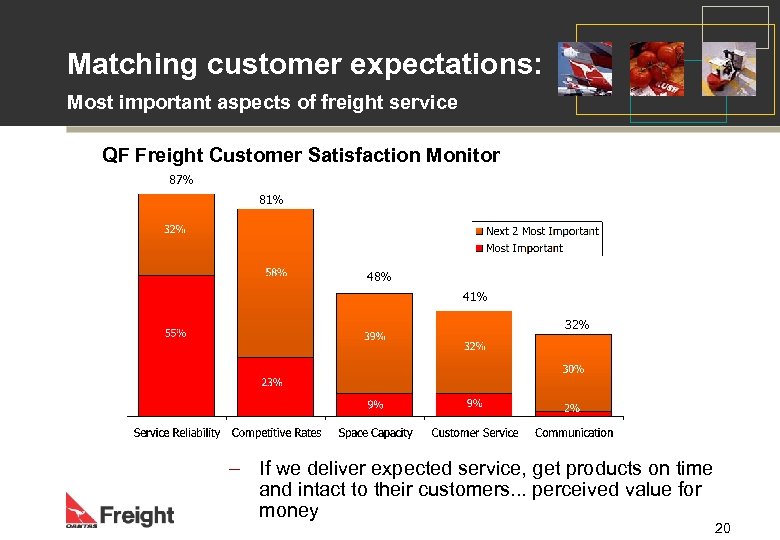 Matching customer expectations: Most important aspects of freight service QF Freight Customer Satisfaction Monitor 87% 81% 48% 41% 32% – If we deliver expected service, get products on time and intact to their customers. . . perceived value for money 20
 Matching customer expectations: Terminals Potential barriers to service delivery n Terminals geared to handle general cargo n Tendency to automate old practices – not create new n Latest technology in place but need to constantly review processes, practices refined and upgraded n Terminals a direct pipeline from aircraft to customer 21
 Matching customer expectations: Terminals of the future. . . n Everywhere you look change is occurring – terminals no different n To meet current and future customer expectations service standards must be measured, recorded and be ever more demanding n Moving target n Technology a key player 22
 Matching customer expectations: Information systems Accelerate the pace … n Customers are demanding to know where their freight is from comfort of office or wherever they may be n Internet not enough, proactively notified, SMS n Technology constantly changing n QF at forefront of industry but need to maintain the momentum 23
 Matching customer expectations: Electronic trading exchanges 1990 s saw dot com boom come and go … not many dot coms survived n QF time and effort assessing situation n Concentrated on developing qantasfreight. com n Leading edge n Benefits: productivity and customer satisfaction 24
 Matching customer expectations: Electronic trading exchanges Recent initiative …launch of Ezycargo internet cargo portal n QF along with Singapore Airlines Cargo, Cathay Pacific and Japan Airlines founding member n Customers can now select information, book space with multiple carriers on a single site …one stop portal n Efficiency and ease of doing business for customers 25
 Key challenges Maintaining profitability Matching customer expectations Responding to change 26
 Responding to change: Security Post 9/11 threat of terrorism remains n n n Nationally and internationally aviation industry faced with an increased regulatory environment Changes to customs reporting and increased security measures will put pressure on airlines to keep to service levels and turn-around times Australia: • CMR program • Aus government committed A$100 m to tighten airport security, inc. screening of freight 27
 Responding to change: Increased regulatory environment n USA: • shippers moving goods in/out of US required to provide details about cargo before it arrives at US borders • airlines required to provide advanced manifest information 4 hours prior to arrival of goods into US • house air waybill data required n Several options available. Preferred option direct from forwarders host system, or via qantasfreight. com 28
 Responding to change: Submit FHL function n As of July 2004 you’ll be able to submit HAWB data for consolidated shipments online at qantasfreight. com • Submit FHL application is easy to use, convenient and one of the many free online services we offer to qantasfreight. com registered users 29
 Responding to change: Increased regulatory environment n Implications: • significant changes to way we do business in order to comply with changes • lots of work to be done in a short time • immediate short-term threat of increased cycle times and costs 30
 Responding to change: New initiatives Route changes n n n 2002/3 rationalised approach to route management Many unprofitable or low yield routes disappeared Tailored approach better yield management 2002/3 QF boosted international freight capacity with intro of 6 x 747 -400 Extended Range aircraft serving North America … increased capacity June 2004 commence 3 x 747 - 400 direct services ex BNE to LAX 2004 new India and China services 31
 Responding to change: New initiatives Australian Airlines n Launch of AO, international, all economy class full service carrier • services key Asian routes inc. Singapore, Japan, Hong Kong and Malaysia n This month AO commences twice weekly 767 -300 services to Singapore via Darwin and Cairns … expanding capacity to Asia 32
 Responding to change: New initiatives Shanghai service n February 2004 QF commenced twice weekly freighter service to Shanghai via Sydney and Singapore… • growing demand for capacity generated by China’s economic boom • Shanghai emerging as a leading hub in Asia region n Currently evaluating expansion of Shanghai services • recently negotiated Taipei, Korea and Hong Kong rights 33
 Summary n Growing industry expanding in volume and some regions growing in double digit numbers • volatile but resilient industry … relatively quick recovery from SARS • future looks optimistic, remains need to review business practices, reduce costs, improve service levels and match customer expectations • increasing demands placed on technology … reduction in paper flows • information systems facility increase in security and screening 34
 Summary n Our customers will demand get integrated solutions to their distribution with guaranteed service standards • only efficient, effective and competitive will survive …airlines, integrators and forwarders • big will get bigger and small will probably be reduced to niche players or be absorbed • Asia and in particular China will play a major role as the region continues economic transition n Future optimistic but tough and competitive 35
 The End 36