 Скачать презентацию Air Force Satellite Control Network Interoperability Space Internet
e0989a06d7c3931a654b8941cd31762a.ppt
- Количество слайдов: 15



Air Force Satellite Control Network Interoperability Space Internet Workshop #4 June 2004 John Pietras Global Science and Technology, Inc 1
Contents • Background of the AFSCN Interoperability Project • CCSDS Space Link Extension – candidate for AFSCN interoperability • Summary of Interoperability Project Phase 3 – Completed in Summer 2003 • Transition from legacy- to standards-based infrastructure • Overview of Phase 4 activities – Spring-Summer 2004 • Interoperability with other US space organizations 2
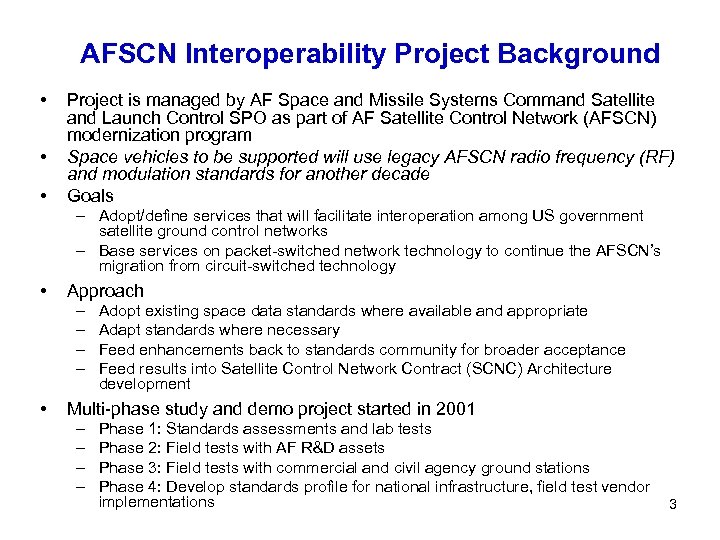
AFSCN Interoperability Project Background • • • Project is managed by AF Space and Missile Systems Command Satellite and Launch Control SPO as part of AF Satellite Control Network (AFSCN) modernization program Space vehicles to be supported will use legacy AFSCN radio frequency (RF) and modulation standards for another decade Goals – Adopt/define services that will facilitate interoperation among US government satellite ground control networks – Base services on packet-switched network technology to continue the AFSCN’s migration from circuit-switched technology • Approach – – • Adopt existing space data standards where available and appropriate Adapt standards where necessary Feed enhancements back to standards community for broader acceptance Feed results into Satellite Control Network Contract (SCNC) Architecture development Multi-phase study and demo project started in 2001 – – Phase 1: Standards assessments and lab tests Phase 2: Field tests with AF R&D assets Phase 3: Field tests with commercial and civil agency ground stations Phase 4: Develop standards profile for national infrastructure, field test vendor implementations 3
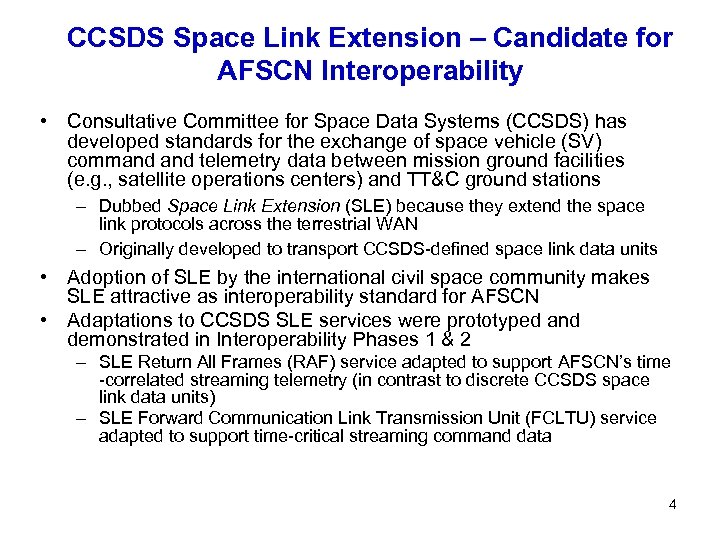
CCSDS Space Link Extension – Candidate for AFSCN Interoperability • Consultative Committee for Space Data Systems (CCSDS) has developed standards for the exchange of space vehicle (SV) command telemetry data between mission ground facilities (e. g. , satellite operations centers) and TT&C ground stations – Dubbed Space Link Extension (SLE) because they extend the space link protocols across the terrestrial WAN – Originally developed to transport CCSDS-defined space link data units • Adoption of SLE by the international civil space community makes SLE attractive as interoperability standard for AFSCN • Adaptations to CCSDS SLE services were prototyped and demonstrated in Interoperability Phases 1 & 2 – SLE Return All Frames (RAF) service adapted to support AFSCN’s time -correlated streaming telemetry (in contrast to discrete CCSDS space link data units) – SLE Forward Communication Link Transmission Unit (FCLTU) service adapted to support time-critical streaming command data 4
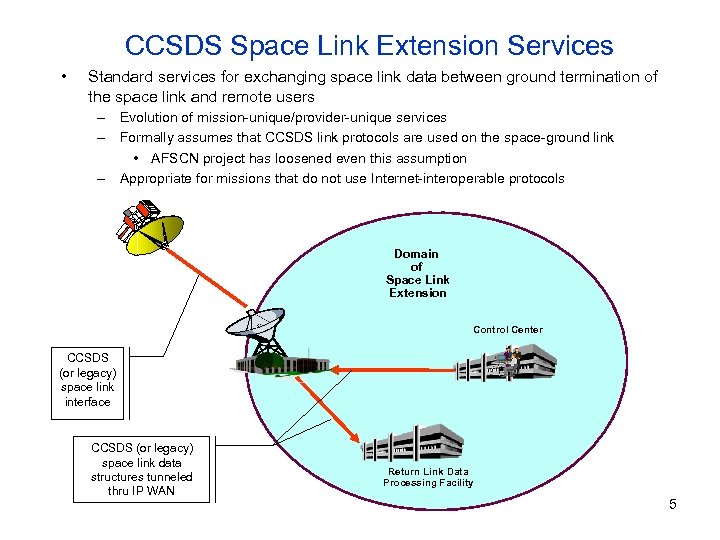
CCSDS Space Link Extension Services • Standard services for exchanging space link data between ground termination of the space link and remote users – Evolution of mission-unique/provider-unique services – Formally assumes that CCSDS link protocols are used on the space-ground link • AFSCN project has loosened even this assumption – Appropriate for missions that do not use Internet-interoperable protocols Domain of Space Link Extension Control Center CCSDS (or legacy) space link interface CCSDS (or legacy) space link data structures tunneled thru IP WAN Return Link Data Processing Facility 5
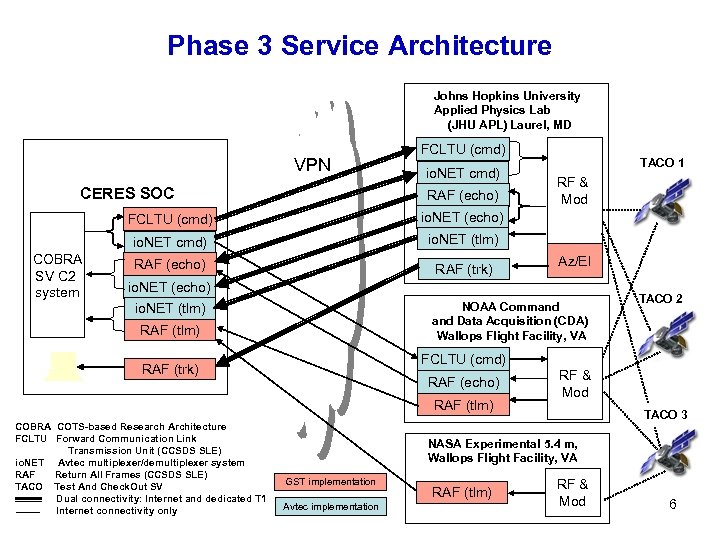
Phase 3 Service Architecture Johns Hopkins University Applied Physics Lab (JHU APL) Laurel, MD VPN CERES SOC FCLTU (cmd) io. NET cmd) RAF (echo) FCLTU (cmd) COBRA SV C 2 system io. NET (tlm) RAF (echo) RAF (trk) RF & Mod io. NET (echo) io. NET cmd) TACO 1 Az/El io. NET (echo) NOAA Command Data Acquisition (CDA) Wallops Flight Facility, VA io. NET (tlm) RAF (tlm) FCLTU (cmd) RAF (trk) RAF (echo) RAF (tlm) COBRA COTS-based Research Architecture FCLTU Forward Communication Link Transmission Unit (CCSDS SLE) io. NET Avtec multiplexer/demultiplexer system RAF Return All Frames (CCSDS SLE) TACO Test And Check. Out SV Dual connectivity: Internet and dedicated T 1 Internet connectivity only TACO 2 RF & Mod TACO 3 NASA Experimental 5. 4 m, Wallops Flight Facility, VA GST implementation Avtec implementation RAF (tlm) RF & Mod 6
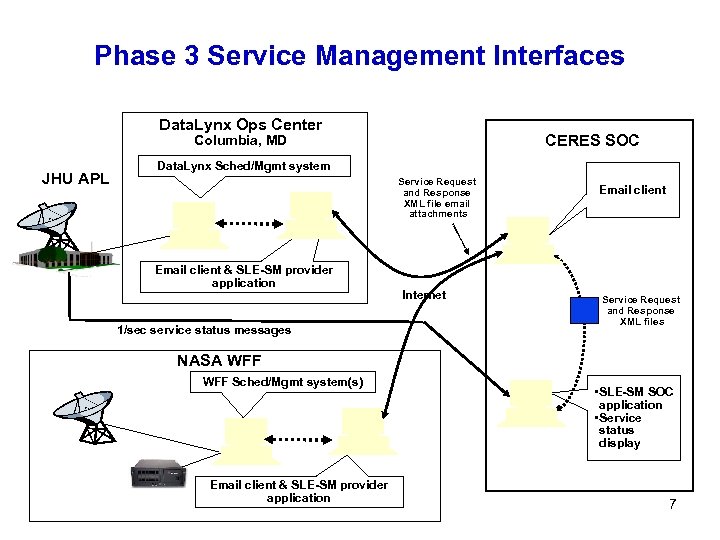
Phase 3 Service Management Interfaces Data. Lynx Ops Center CERES SOC Columbia, MD JHU APL Data. Lynx Sched/Mgmt system Service Request and Response XML file email attachments Email client & SLE-SM provider application 1/sec service status messages Internet Email client Service Request and Response XML files NASA WFF Sched/Mgmt system(s) Email client & SLE-SM provider application • SLE-SM SOC application • Service status display 7
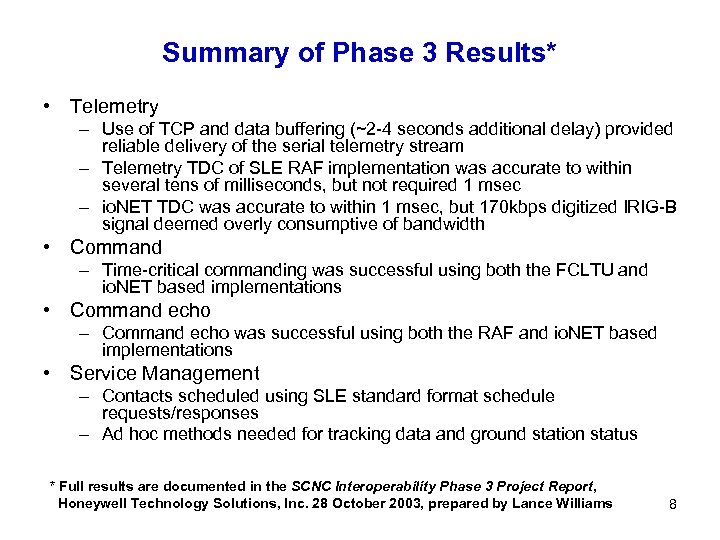
Summary of Phase 3 Results* • Telemetry – Use of TCP and data buffering (~2 -4 seconds additional delay) provided reliable delivery of the serial telemetry stream – Telemetry TDC of SLE RAF implementation was accurate to within several tens of milliseconds, but not required 1 msec – io. NET TDC was accurate to within 1 msec, but 170 kbps digitized IRIG-B signal deemed overly consumptive of bandwidth • Command – Time-critical commanding was successful using both the FCLTU and io. NET based implementations • Command echo – Command echo was successful using both the RAF and io. NET based implementations • Service Management – Contacts scheduled using SLE standard format schedule requests/responses – Ad hoc methods needed for tracking data and ground station status * Full results are documented in the SCNC Interoperability Phase 3 Project Report, Honeywell Technology Solutions, Inc. 28 October 2003, prepared by Lance Williams 8
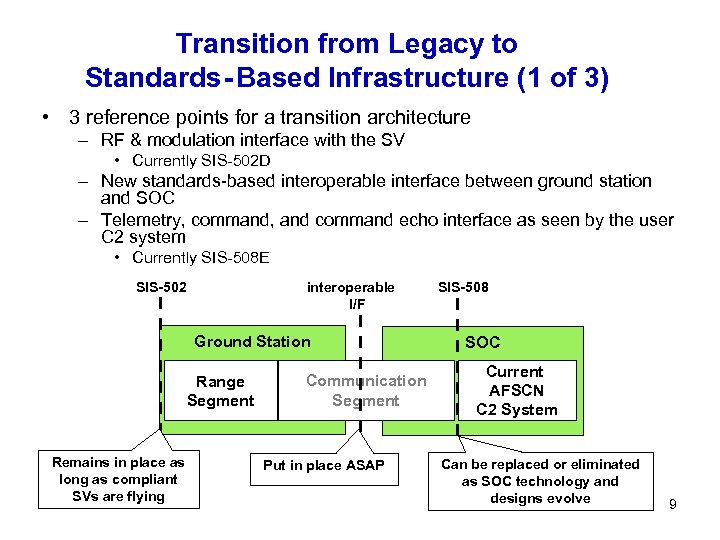
Transition from Legacy to Standards - Based Infrastructure (1 of 3) • 3 reference points for a transition architecture – RF & modulation interface with the SV • Currently SIS-502 D – New standards-based interoperable interface between ground station and SOC – Telemetry, command, and command echo interface as seen by the user C 2 system • Currently SIS-508 E SIS-502 interoperable I/F Ground Station Range Segment Remains in place as long as compliant SVs are flying Communication Segment Put in place ASAP SIS-508 SOC Current AFSCN C 2 System Can be replaced or eliminated as SOC technology and designs evolve 9
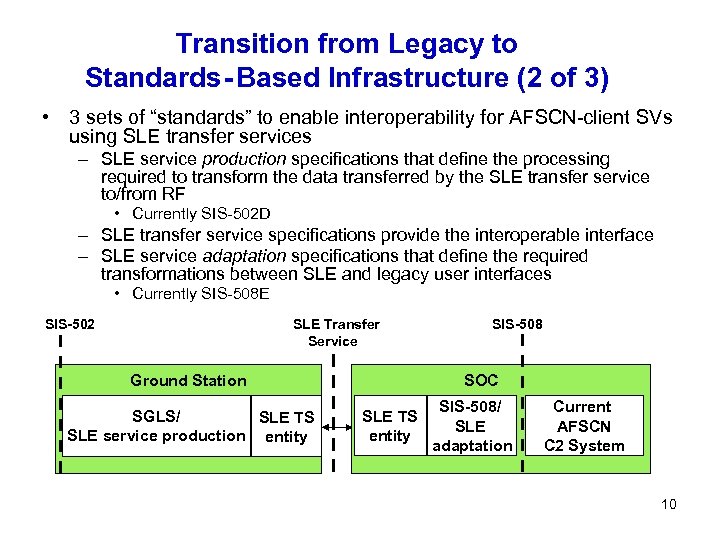
Transition from Legacy to Standards - Based Infrastructure (2 of 3) • 3 sets of “standards” to enable interoperability for AFSCN-client SVs using SLE transfer services – SLE service production specifications that define the processing required to transform the data transferred by the SLE transfer service to/from RF • Currently SIS-502 D – SLE transfer service specifications provide the interoperable interface – SLE service adaptation specifications that define the required transformations between SLE and legacy user interfaces • Currently SIS-508 E SIS-502 SLE Transfer Service Ground Station SGLS/ SLE TS SLE service production entity SIS-508 SOC SLE TS entity SIS-508/ SLE adaptation Current AFSCN C 2 System 10
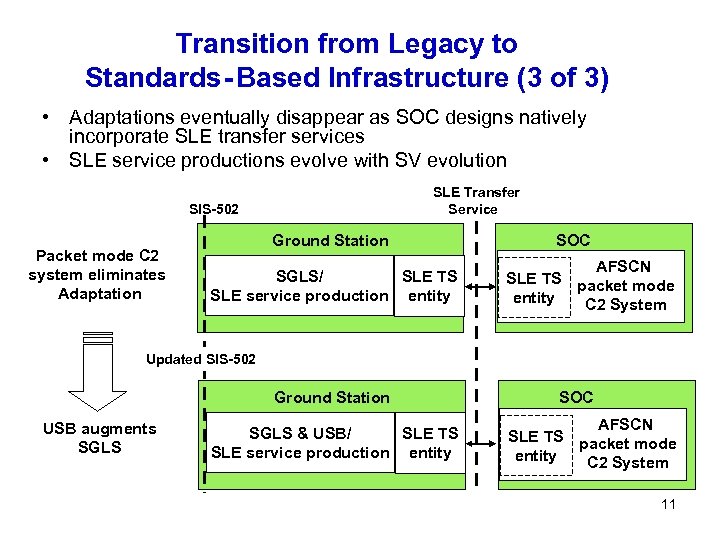
Transition from Legacy to Standards - Based Infrastructure (3 of 3) • Adaptations eventually disappear as SOC designs natively incorporate SLE transfer services • SLE service productions evolve with SV evolution SLE Transfer Service SIS-502 Packet mode C 2 system eliminates Adaptation Ground Station SGLS/ SLE TS SLE service production entity SOC AFSCN SLE TS packet mode entity C 2 System Updated SIS-502 Ground Station USB augments SGLS & USB/ SLE TS SLE service production entity SOC AFSCN SLE TS packet mode entity C 2 System 11
Phase 4 Implementation of SLE Services • Telemetry – Vendor-supported implementation of prototype modifications of RAF SLE service to transfer and time-correlate serial stream of telemetry data • Command – Vendor-supported implementation of prototype modifications of FCLTU SLE service to transfer AFSCN SGLS-formatted command data – SGLS command FCLTU service supports two modes: • Discrete commands (inter-command idle added at ground station) • Streaming commands (all symbols, including inter-command idle) used to transfer discrete commands • Command Echo – Vendor-supported implementation of prototype modifications of RAF SLE service to transfer serial stream of command echo symbols • Service Management – Continue exploring use of SLE scheduling and configuration standards 12
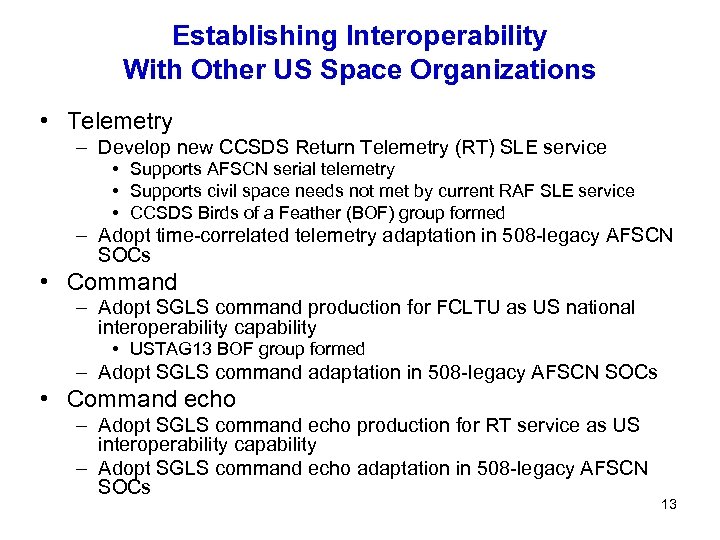
Establishing Interoperability With Other US Space Organizations • Telemetry – Develop new CCSDS Return Telemetry (RT) SLE service • Supports AFSCN serial telemetry • Supports civil space needs not met by current RAF SLE service • CCSDS Birds of a Feather (BOF) group formed – Adopt time-correlated telemetry adaptation in 508 -legacy AFSCN SOCs • Command – Adopt SGLS command production for FCLTU as US national interoperability capability • USTAG 13 BOF group formed – Adopt SGLS command adaptation in 508 -legacy AFSCN SOCs • Command echo – Adopt SGLS command echo production for RT service as US interoperability capability – Adopt SGLS command echo adaptation in 508 -legacy AFSCN SOCs 13
Acknowledgements • U. S. Air Force Space and Missile Systems Center Satellite and Launch Control SPO (SMC/RN) – AJ Ashby, 1 Lt, USAF, project officer – Carl Sunshine, The Aerospace Corporation, technical lead • Satellite Control Network Contract – Lance Williams, Interoperability project lead – JHU APL ground station • • AF Center for Research Support (CERES) NASA WFF and NOAA Wallops CDA ground stations Avtec Systems General Dynamics Advanced Information Systems 14
Phase 4 Participants • U. S. Air Force Space and Missile Systems Center Satellite and Launch Control SPO (SMC/RN) • Satellite Control Network Contract • The Aerospace Corporation • GST, Inc. • AF Center for Research Support (CERES) • Avtec Systems • NOAA WFF • GD-AIS • L 3 Com • RTLogic • JPL, NASA 15
Скачать презентацию Air Force Satellite Control Network Interoperability Space Internet
e0989a06d7c3931a654b8941cd31762a.ppt