


 Скачать презентацию Aid Education in Eritrea Teacher Education and
01701ca8ac7e6998005491f05db3c81d.ppt
- Количество слайдов: 13
 Aid & Education in Eritrea: Teacher Education and Education Sector Reform 2007 - 2011
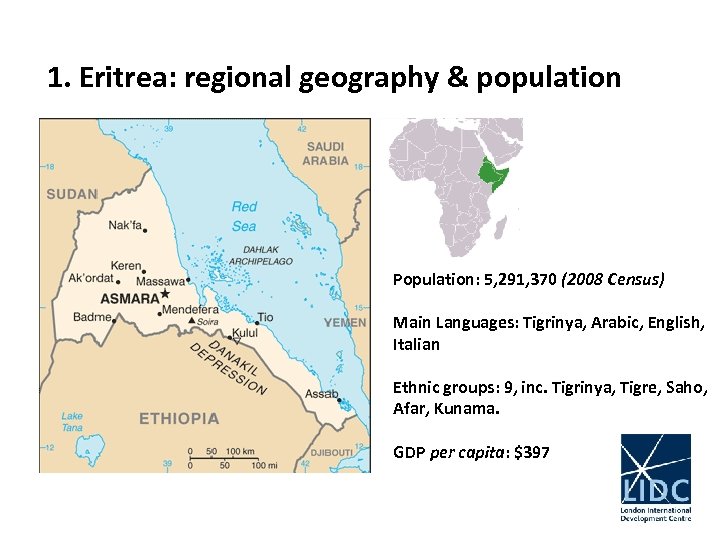 1. Eritrea: regional geography & population Population: 5, 291, 370 (2008 Census) Main Languages: Tigrinya, Arabic, English, Italian Ethnic groups: 9, inc. Tigrinya, Tigre, Saho, Afar, Kunama. GDP per capita: $397
 2. Eritrea: history & politics Ancient history: C. 25 th BC: Land of Punt; C. 8 th – 5 th BC: Kingdom of D’mt; C. 1 st BC – 940 AD: Aksumite Empire Middle history: C. 10 th – C. 18 th: Trading links with and partial colonisation by Egypt; Yemen; Portuguese Goa; Ottoman Empire; British Empire Modern history: 1890 – 1941: Italian colony (following Italian invasion in 1870 s) 1941 – 1951: British administration 1951: Federated with Ethiopia, under US-led UN resolution 1961 – 1991: Insurgency against Ethiopian Government 1993: UN recognition of Eritrean independence 1998: Eritrean-Ethiopian War Present: On-going border dispute with Ethiopia; A one-party state governed by People’s Front for Democracy & Justice; President: Isaisas Aferwerki
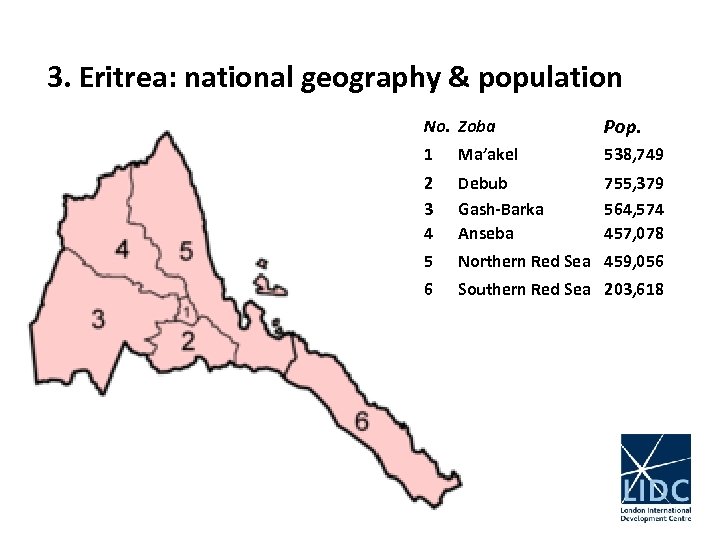 3. Eritrea: national geography & population No. Zoba Pop. 1 Ma’akel 538, 749 2 3 4 Debub Gash-Barka Anseba 755, 379 564, 574 457, 078 5 Northern Red Sea 459, 056 6 Southern Red Sea 203, 618
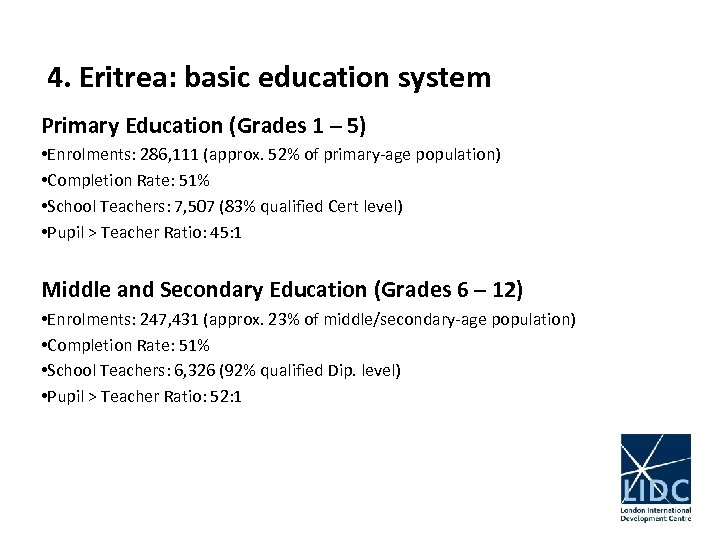 4. Eritrea: basic education system Primary Education (Grades 1 – 5) • Enrolments: 286, 111 (approx. 52% of primary-age population) • Completion Rate: 51% • School Teachers: 7, 507 (83% qualified Cert level) • Pupil > Teacher Ratio: 45: 1 Middle and Secondary Education (Grades 6 – 12) • Enrolments: 247, 431 (approx. 23% of middle/secondary-age population) • Completion Rate: 51% • School Teachers: 6, 326 (92% qualified Dip. level) • Pupil > Teacher Ratio: 52: 1
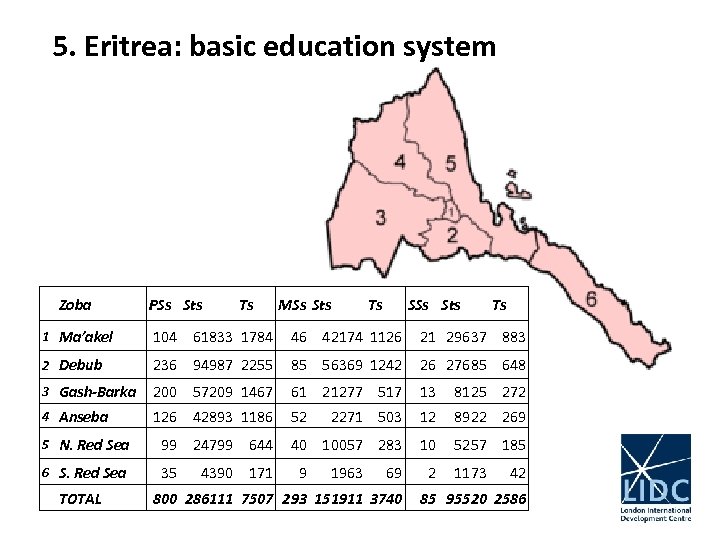 5. Eritrea: basic education system Zoba PSs Sts Ts MSs Sts Ts SSs Sts Ts 1 Ma’akel 104 61833 1784 46 42174 1126 21 29637 883 2 Debub 236 94987 2255 85 56369 1242 26 27685 648 3 Gash-Barka 200 57209 1467 61 21277 517 13 8125 272 4 Anseba 126 42893 1186 52 2271 503 12 8922 269 40 10057 283 10 5257 185 5 N. Red Sea 99 24799 644 6 S. Red Sea 35 TOTAL 4390 171 9 1963 69 800 286111 7507 293 151911 3740 2 1173 42 85 95520 2586
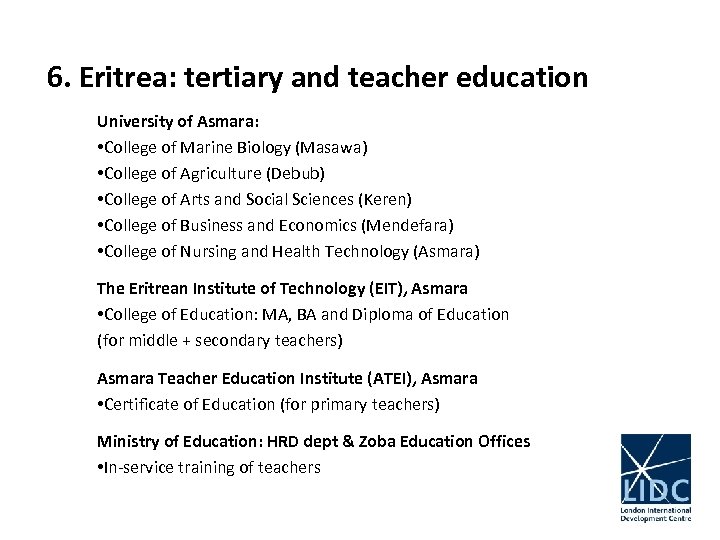 6. Eritrea: tertiary and teacher education University of Asmara: • College of Marine Biology (Masawa) • College of Agriculture (Debub) • College of Arts and Social Sciences (Keren) • College of Business and Economics (Mendefara) • College of Nursing and Health Technology (Asmara) The Eritrean Institute of Technology (EIT), Asmara • College of Education: MA, BA and Diploma of Education (for middle + secondary teachers) Asmara Teacher Education Institute (ATEI), Asmara • Certificate of Education (for primary teachers) Ministry of Education: HRD dept & Zoba Education Offices • In-service training of teachers
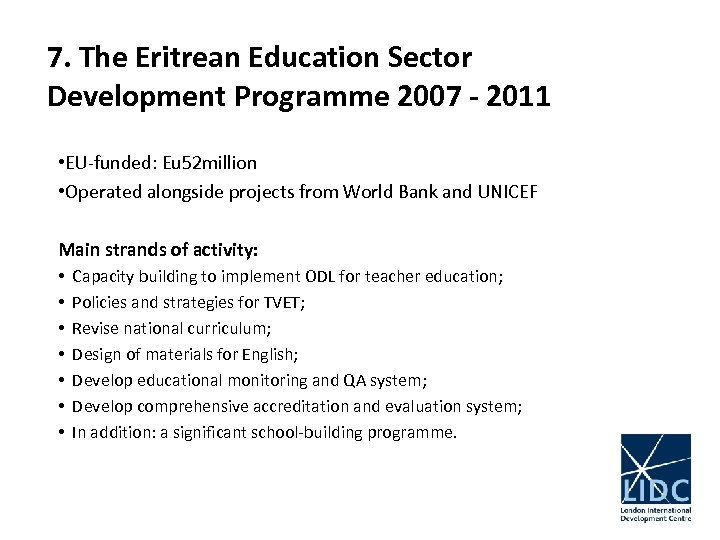 7. The Eritrean Education Sector Development Programme 2007 - 2011 • EU-funded: Eu 52 million • Operated alongside projects from World Bank and UNICEF Main strands of activity: • • Capacity building to implement ODL for teacher education; Policies and strategies for TVET; Revise national curriculum; Design of materials for English; Develop educational monitoring and QA system; Develop comprehensive accreditation and evaluation system; In addition: a significant school-building programme.
 8. ESDP: Teacher Education inputs Outputs: • EIT’s ODL Middle School Teacher Upgrading Programme (MSTUP) • ATEI’s Self-study Elementary Teacher Upgrading Programme Inputs A: capacity-building activities: • ODL management and admin training for Mo. E, Zoba and EIT/ATEI staff • ODL materials design training for EIT / ATEI staff • training of tutors, sub-Zoba support staff etc. Inputs B: programme design activities: • Financial management; • Admin and delivery systems; • Institutional roles • Content and materials design • Assessment systems etc.
 9. ESDP: Teacher Education ODL programmes • EIT’s ODL Middle School Teacher Upgrading Programme (MSTUP) • ATEI’s Self-study Elementary Teacher Upgrading Programme Basic design model: • 2 years in-service study • Blended learning: self-study materials plus local tutorial sessions & residential summer school • Assessment : written assignments; classroom observation; end-of-year exams Basic delivery model: • EIT / ATEI: materials design & distribution; examinations; awards • Zoba Offices: tutor recruitment; learner support; sub-Zoba co-ordination; assignment collection • Mo. E Dept of HRD: finances; monitoring; liaison
 10. ESDP: Teacher Education ODL programmes Design issues: • Skepticism about ODL • Emphasis on academic rather than practitioner content (esp. EIT) • Preference for high face-to-face contact Delivery issues: • EIT / ATEI: low institutional capacity for undertaking field activities • Zoba Offices: low institutional capacity for sub-Zoba activities • Unclear lines of communication and authority between stakeholders • Low levels of training and support for sub-Zoba staff (tutors; schools) • Schedule delays not always passed to learners and tutors • Irregular monitoring and follow-up by stakeholders • Regional disparity in terms of access to resources, travel time & costs
 11. ESDP: ODL programme outcomes Successes: • Good final pass rates (85% on both programmes) • High levels of student satisfaction with materials and content • Establishment of basic national frameworks for ODL delivery in education • Enhanced understanding and capacity in ODL practice across all national stakeholders Necessary improvements: • Low levels of student satisfaction with learner support and communications • Improve communications between central stakeholders • Address resourcing issues for stakeholders undertaking field activities • Improve programme engagement at sub-Zoba level • Identify potential for de-centralised initiatives to address local needs
 chris. joynes@lidc. bloomsbury. ac. uk