


 Скачать презентацию AI and Automation Media and Culture Lecture 9
98ccf3543bed952efb7a81e514707d1d.ppt
- Количество слайдов: 24
 AI and Automation Media and Culture Lecture 9 John Lee
 Introduction: what is “AI”? • Two major areas where “AI” is talked about: – engineering/automation – studying, perhaps emulating, human cognition • In practice, these do not often overlap – (maybe they do in this video!) – but at a theoretical level they share many issues and approaches … • Crucial general issue: how do we bring formal techniques to bear in an informal world? – “In logic, mathematics, and computer science, a formal system is a formal grammar used for modelling purposes. Formalization is the act of creating a formal system, in an attempt to capture the essential features of a real-world or conceptual system in formal language. ” (Wikipedia, 26. 10. 05)
 An unusual case …
 Examples of formal systems • Arithmetic (formal theory and calculus of numbers) • Logic (formal theory and calculus of propositions) • Natural language grammars – Chomsky and all that … • Shape grammars – (http: //www. mit. edu/~tknight/IJDC/) • Music grammars – (Lehrdahl, F. and R. Jackendoff. 1983. A Generative Theory of Tonal Music, Cambridge,
Mass: MIT Press) • • Databases Knowledge bases Meteorological models (fluid dynamics) Economic models
Examples of formal systems • Arithmetic (formal theory and calculus of numbers) • Logic (formal theory and calculus of propositions) • Natural language grammars – Chomsky and all that … • Shape grammars – (http: //www. mit. edu/~tknight/IJDC/) • Music grammars – (Lehrdahl, F. and R. Jackendoff. 1983. A Generative Theory of Tonal Music, Cambridge,
Mass: MIT Press) • • Databases Knowledge bases Meteorological models (fluid dynamics) Economic models
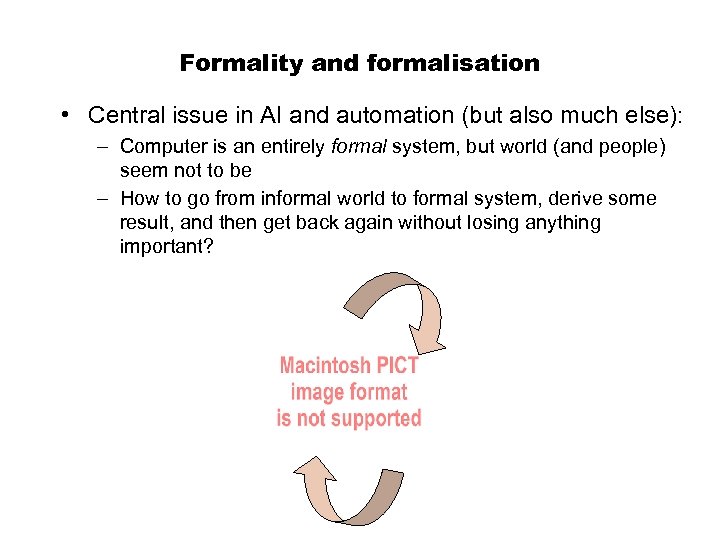 Formality and formalisation • Central issue in AI and automation (but also much else): – Computer is an entirely formal system, but world (and people) seem not to be – How to go from informal world to formal system, derive some result, and then get back again without losing anything important?
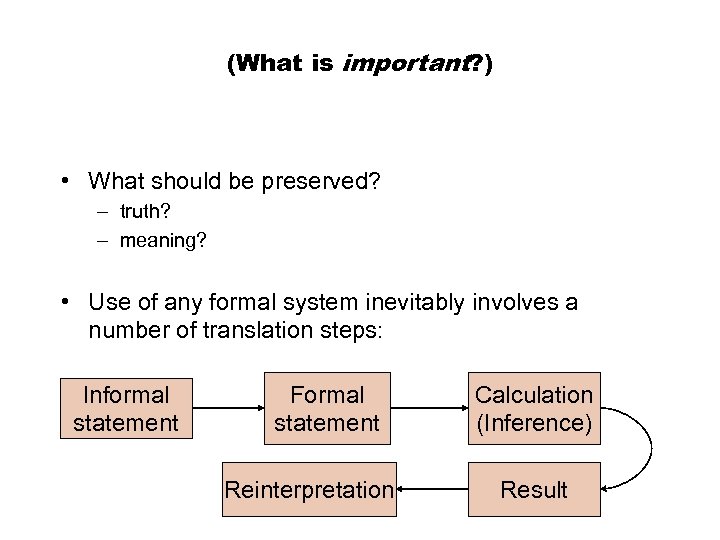 (What is important? ) • What should be preserved? – truth? – meaning? • Use of any formal system inevitably involves a number of translation steps: Informal statement Formal statement Reinterpretation Calculation (Inference) Result
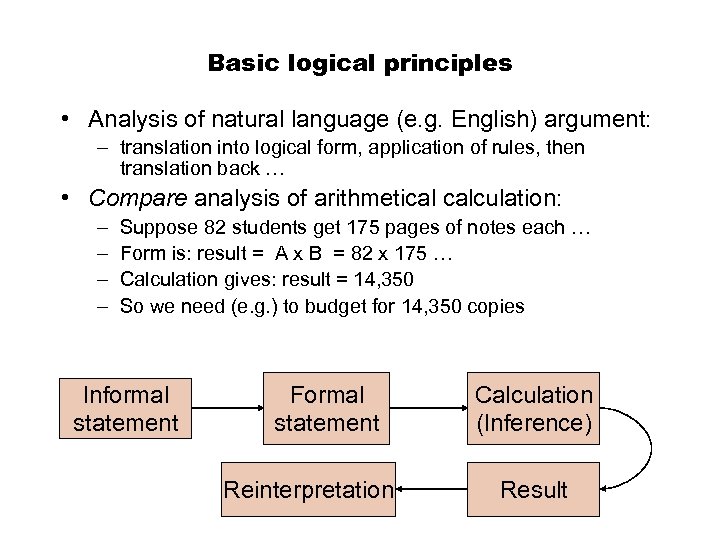 Basic logical principles • Analysis of natural language (e. g. English) argument: – translation into logical form, application of rules, then translation back … • Compare analysis of arithmetical calculation: – – Suppose 82 students get 175 pages of notes each … Form is: result = A x B = 82 x 175 … Calculation gives: result = 14, 350 So we need (e. g. ) to budget for 14, 350 copies Informal statement Formal statement Reinterpretation Calculation (Inference) Result
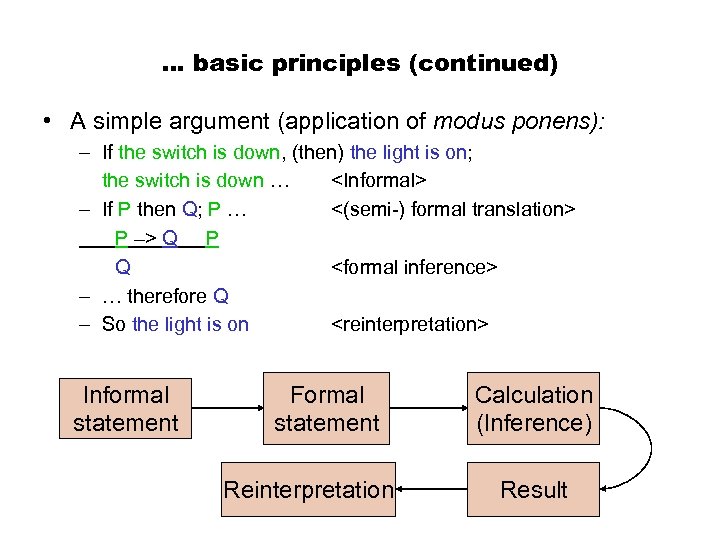 … basic principles (continued) • A simple argument (application of modus ponens): – If the switch is down, (then) the light is on; the switch is down …
 COMPUTATION • What is it? • Why is it important?
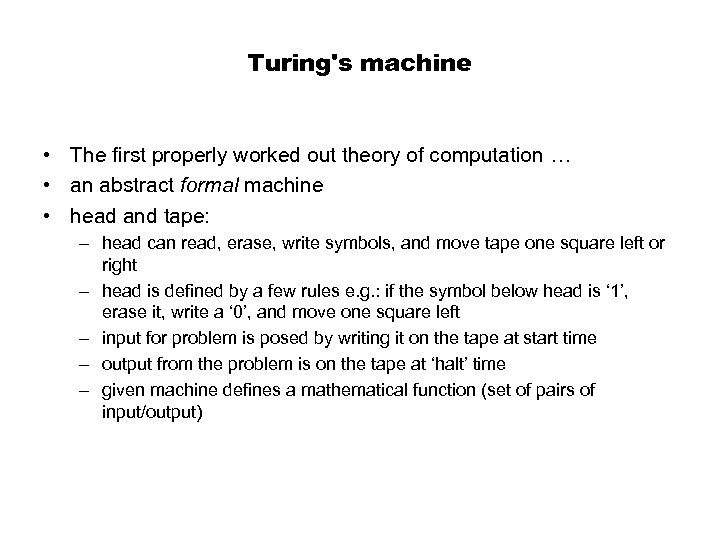 Turing's machine • The first properly worked out theory of computation … • an abstract formal machine • head and tape: – head can read, erase, write symbols, and move tape one square left or right – head is defined by a few rules e. g. : if the symbol below head is ‘ 1’, erase it, write a ‘ 0’, and move one square left – input for problem is posed by writing it on the tape at start time – output from the problem is on the tape at ‘halt’ time – given machine defines a mathematical function (set of pairs of input/output)
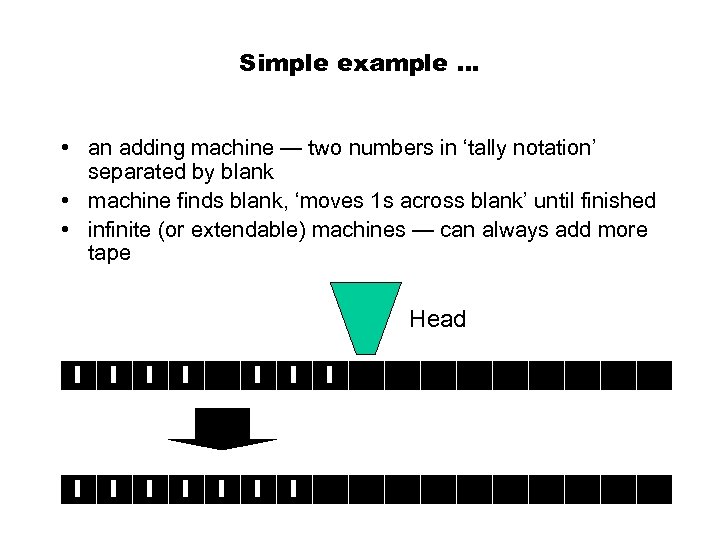 Simple example … • an adding machine — two numbers in ‘tally notation’ separated by blank • machine finds blank, ‘moves 1 s across blank’ until finished • infinite (or extendable) machines — can always add more tape Head I I I I
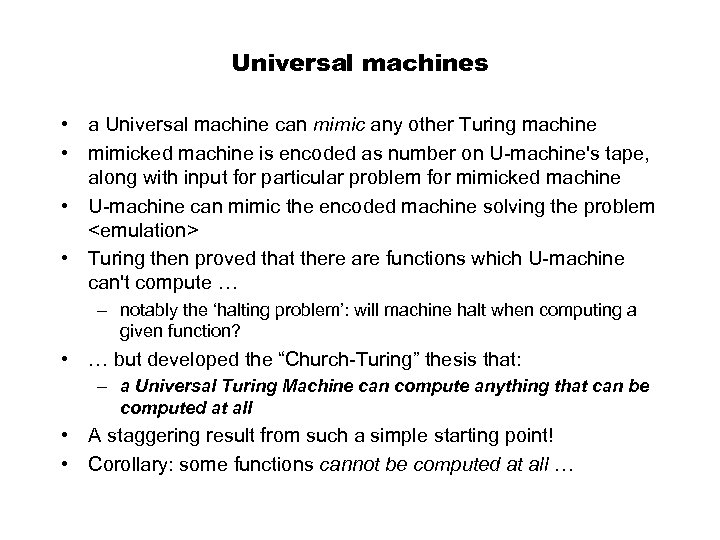 Universal machines • a Universal machine can mimic any other Turing machine • mimicked machine is encoded as number on U-machine's tape, along with input for particular problem for mimicked machine • U-machine can mimic the encoded machine solving the problem
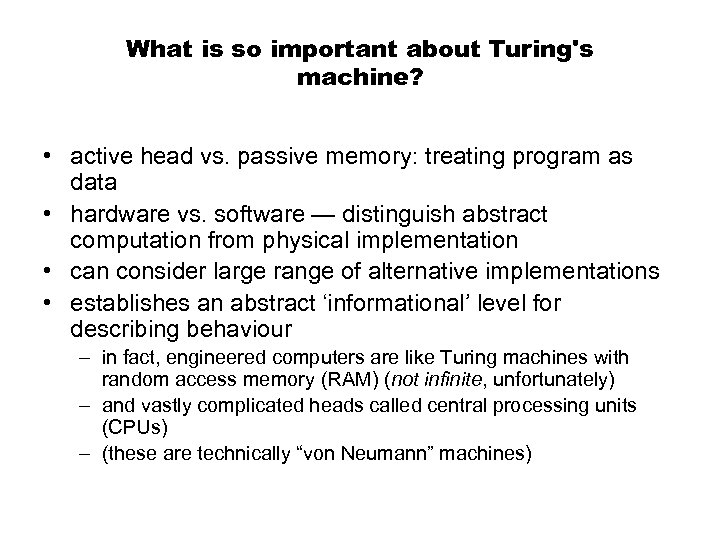 What is so important about Turing's machine? • active head vs. passive memory: treating program as data • hardware vs. software — distinguish abstract computation from physical implementation • can consider large range of alternative implementations • establishes an abstract ‘informational’ level for describing behaviour – in fact, engineered computers are like Turing machines with random access memory (RAM) (not infinite, unfortunately) – and vastly complicated heads called central processing units (CPUs) – (these are technically “von Neumann” machines)
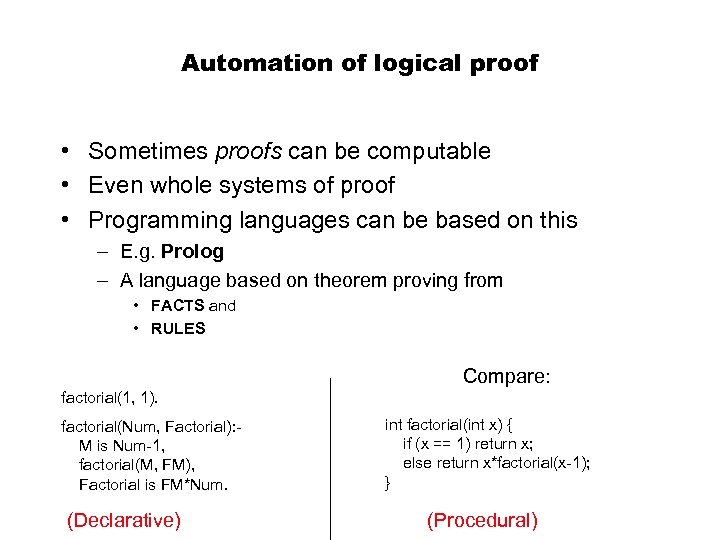 Automation of logical proof • Sometimes proofs can be computable • Even whole systems of proof • Programming languages can be based on this – E. g. Prolog – A language based on theorem proving from • FACTS and • RULES Compare: factorial(1, 1). factorial(Num, Factorial): M is Num-1, factorial(M, FM), Factorial is FM*Num. (Declarative) int factorial(int x) { if (x == 1) return x; else return x*factorial(x-1); } (Procedural)
 Applications of AI • What can we do with these ideas, and how?
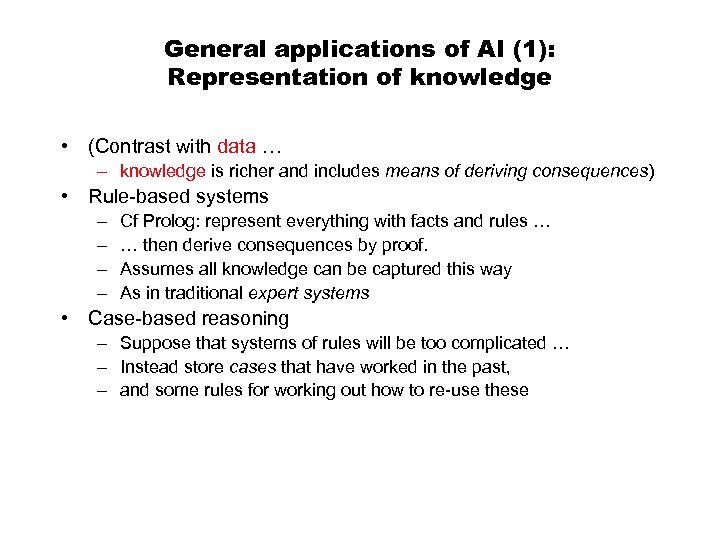 General applications of AI (1): Representation of knowledge • (Contrast with data … – knowledge is richer and includes means of deriving consequences) • Rule-based systems – – Cf Prolog: represent everything with facts and rules … … then derive consequences by proof. Assumes all knowledge can be captured this way As in traditional expert systems • Case-based reasoning – Suppose that systems of rules will be too complicated … – Instead store cases that have worked in the past, – and some rules for working out how to re-use these
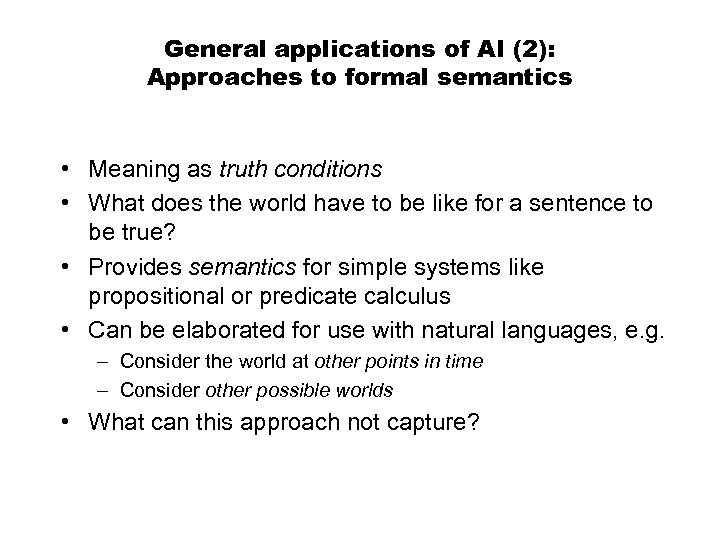 General applications of AI (2): Approaches to formal semantics • Meaning as truth conditions • What does the world have to be like for a sentence to be true? • Provides semantics for simple systems like propositional or predicate calculus • Can be elaborated for use with natural languages, e. g. – Consider the world at other points in time – Consider other possible worlds • What can this approach not capture?
 Understanding humans • How can we use computational theories to understand the workings of the human mind? • Is this an illusory goal?
 Representational theories of mind • The Computational Metaphor: hard and soft AI • Contrast between focus on representation and focus on behaviour • What is "intelligence"? – Is it what you can do or is it how you do it? • The Turing Test – The Loebner Prize – http: //hps. elte. hu/~gk/Loebner/TT. html – Eliza • Dennett, the "Intentional Stance" and instrumentalism – Idea that notions like “intelligence” are attributed – Linked to anti-essentialism and anti-realism
 Connectionist approaches and non-representationalism • Connectionism, or “neural-net”-based theories – Distributed processing – No explicit locus of symbols or syntactic structures • Emergence – The sum of a system can be more than its parts • Environmental embedding and situated action – Lucy Suchman • Compare philosophical approaches of, e. g. – Heidegger (existential embedding) – Wittgenstein (social embedding)
 Two classic critiques • Dreyfus – phenomenology & Heidegger – Winograd & Flores – Fundamentalist anti-representationalism – Strong AI is impossible in principle • Searle – the “Chinese Room” – More pragmatic argument – Homunculus knows nothing, hence system cannot be a locus of understanding – Extended as claim that no mere symbol -processing system could ever “understand” anything at all – Claimed to be an “in-principle” argument 近义词
 AI in practical use • What is actually being done using these ideas?
 Practical considerations: AI as software engineering • Various general application fields – Expert systems • Either rule-based or case-based – Verification systems • To prove e. g. properties of safety-critical software – Language engineering – LSA – etc. • Used e. g. to mark essays • Information extraction, e. g. as in Edinburgh-Stanford Link • Combined maybe with text/speech generation: www. dj 4 me. com – Dialogue systems • Increasingly multimodal: speech, gesture, etc. • Telephone sales etc. applications; commercial “chatbots” • Entertainment, e. g. the BBC’s Jamie Kane – ITSs • Will teachers be replaced by computers? • Importance of the social …
 Design/architecture applications • Representation of design knowledge (contrast with Schön!) – Cf. Coyne et al. Knowledge-Based Design Systems • • Intelligent information design and presentation Automated musical composition Shape grammars (http: //www. mit. edu/~tknight/IJDC/) CBR Building performance evaluation systems Standardisation and automation in construction Issues of “prescriptiveness” …