


 Скачать презентацию AHRQ Quality Indicators Recent validation efforts Patrick S
a9299653fe5b25186b4a50223359d6c5.ppt
- Количество слайдов: 32
 AHRQ Quality Indicators Recent validation efforts Patrick S. Romano, MD MPH UC Davis Center for Healthcare Policy and Research AHRQ QI Users Meeting Bethesda, MD; September 28, 2007
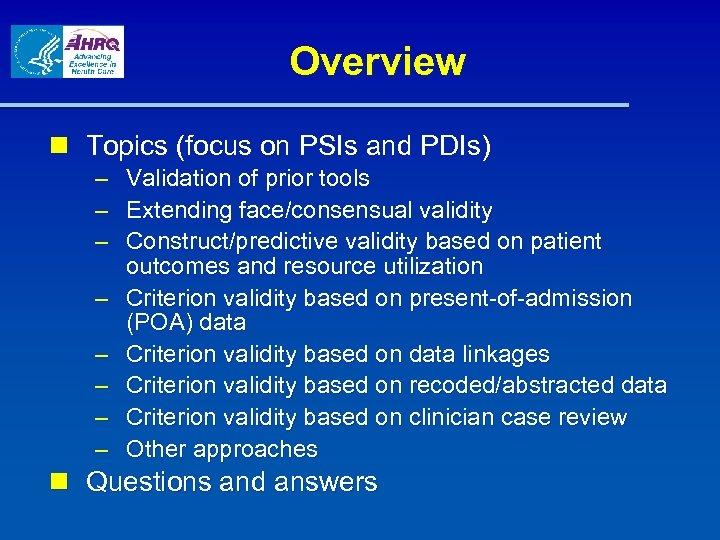 Overview n Topics (focus on PSIs and PDIs) – Validation of prior tools – Extending face/consensual validity – Construct/predictive validity based on patient outcomes and resource utilization – Criterion validity based on present-of-admission (POA) data – Criterion validity based on data linkages – Criterion validity based on recoded/abstracted data – Criterion validity based on clinician case review – Other approaches n Questions and answers
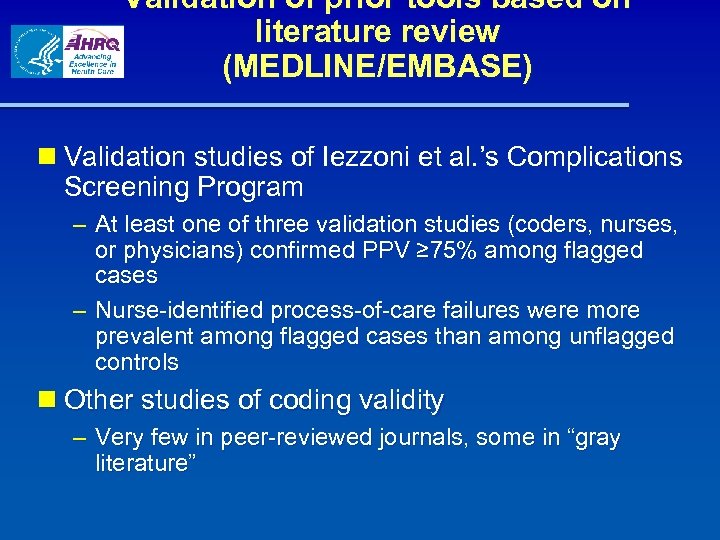 Validation of prior tools based on literature review (MEDLINE/EMBASE) n Validation studies of Iezzoni et al. ’s Complications Screening Program – At least one of three validation studies (coders, nurses, or physicians) confirmed PPV ≥ 75% among flagged cases – Nurse-identified process-of-care failures were more prevalent among flagged cases than among unflagged controls n Other studies of coding validity – Very few in peer-reviewed journals, some in “gray literature”
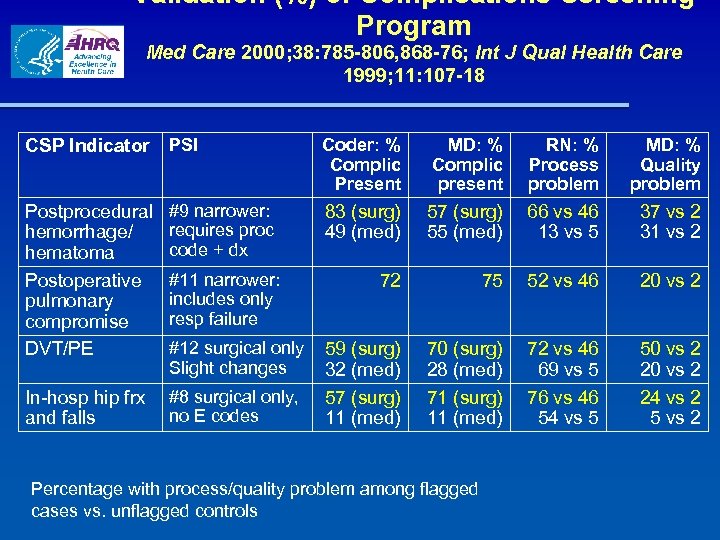 Validation (%) of Complications Screening Program Med Care 2000; 38: 785 -806, 868 -76; Int J Qual Health Care 1999; 11: 107 -18 CSP Indicator PSI Coder: % Complic Present MD: % Complic present RN: % Process problem MD: % Quality problem Postprocedural hemorrhage/ hematoma Postoperative pulmonary compromise DVT/PE #9 narrower: requires proc code + dx 83 (surg) 49 (med) 57 (surg) 55 (med) 66 vs 46 13 vs 5 37 vs 2 31 vs 2 72 75 52 vs 46 20 vs 2 In-hosp hip frx and falls #8 surgical only, no E codes 59 (surg) 32 (med) 57 (surg) 11 (med) 70 (surg) 28 (med) 71 (surg) 11 (med) 72 vs 46 69 vs 5 76 vs 46 54 vs 5 50 vs 2 24 vs 2 5 vs 2 #11 narrower: includes only resp failure #12 surgical only Slight changes Percentage with process/quality problem among flagged cases vs. unflagged controls
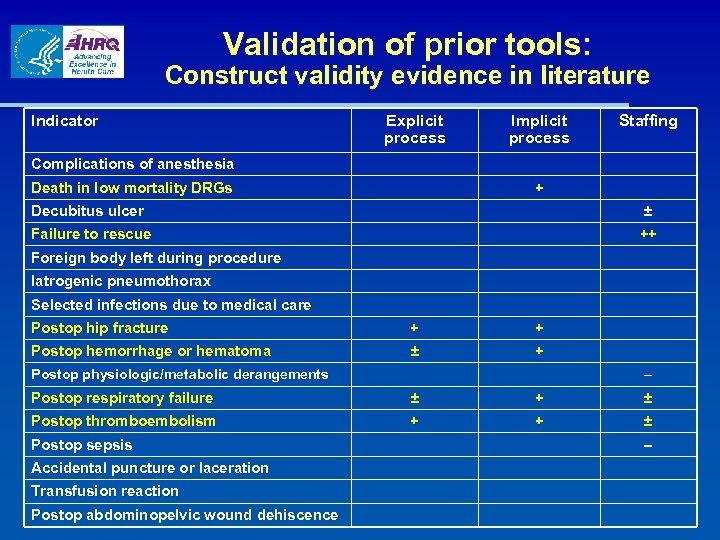 Validation of prior tools: Construct validity evidence in literature Indicator Explicit process Implicit process Staffing Complications of anesthesia Death in low mortality DRGs + Decubitus ulcer ± Failure to rescue ++ Foreign body left during procedure Iatrogenic pneumothorax Selected infections due to medical care Postop hip fracture + + Postop hemorrhage or hematoma ± + Postop physiologic/metabolic derangements – Postop respiratory failure ± + ± Postop thromboembolism + + ± Postop sepsis Accidental puncture or laceration Transfusion reaction Postop abdominopelvic wound dehiscence –
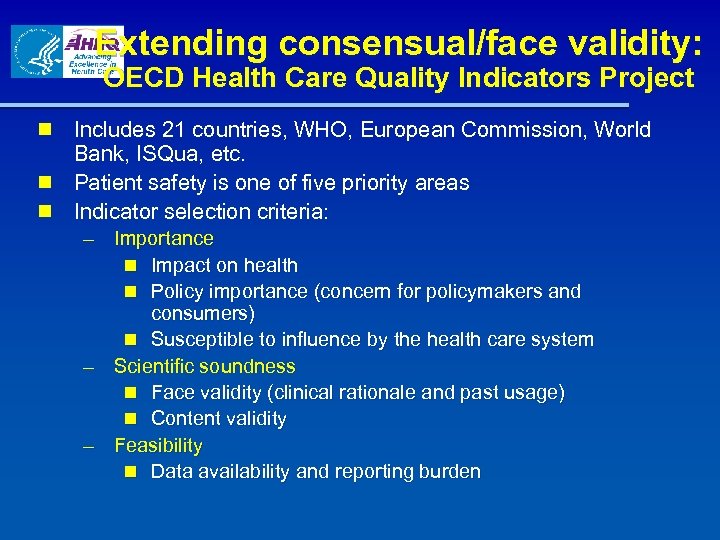 Extending consensual/face validity: OECD Health Care Quality Indicators Project n Includes 21 countries, WHO, European Commission, World Bank, ISQua, etc. n Patient safety is one of five priority areas n Indicator selection criteria: Importance n Impact on health n Policy importance (concern for policymakers and consumers) n Susceptible to influence by the health care system – Scientific soundness n Face validity (clinical rationale and past usage) n Content validity – Feasibility n Data availability and reporting burden –
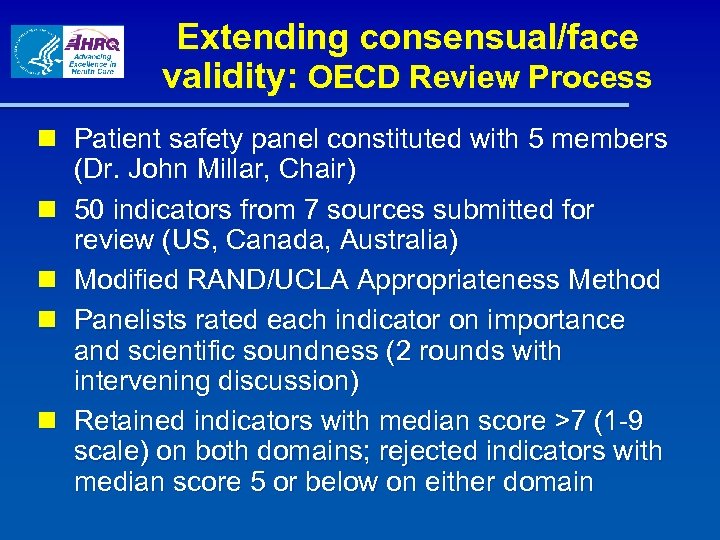 Extending consensual/face validity: OECD Review Process n Patient safety panel constituted with 5 members (Dr. John Millar, Chair) n 50 indicators from 7 sources submitted for review (US, Canada, Australia) n Modified RAND/UCLA Appropriateness Method n Panelists rated each indicator on importance and scientific soundness (2 rounds with intervening discussion) n Retained indicators with median score >7 (1 -9 scale) on both domains; rejected indicators with median score 5 or below on either domain
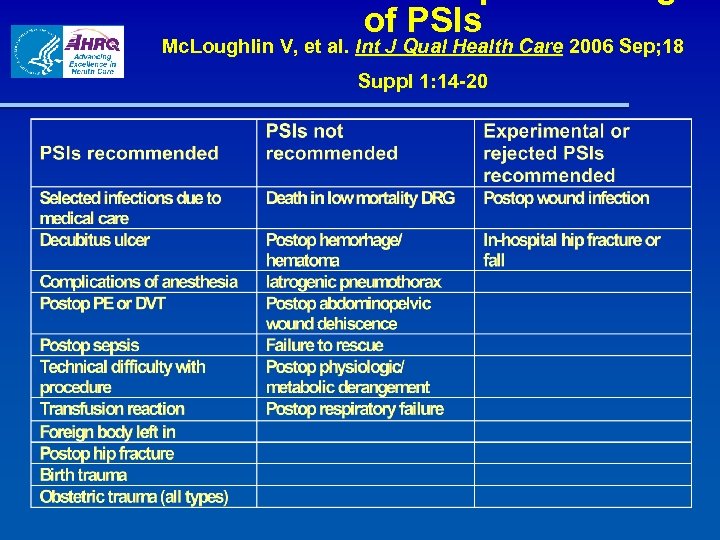 of PSIs Mc. Loughlin V, et al. Int J Qual Health Care 2006 Sep; 18 Suppl 1: 14 -20
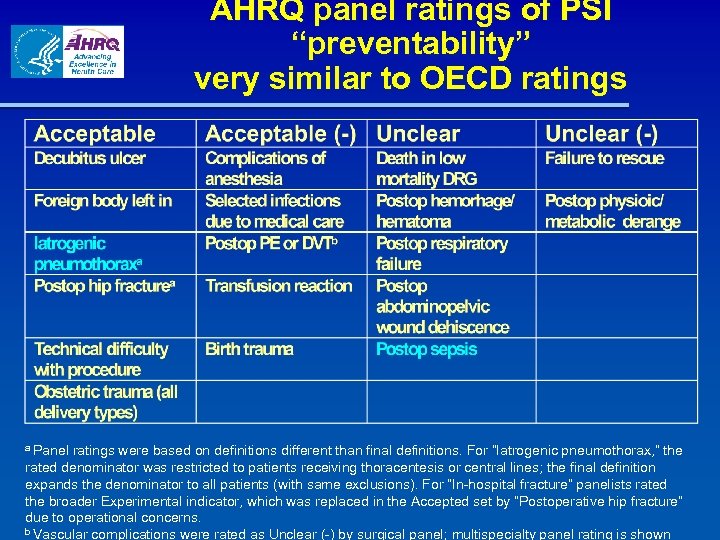 AHRQ panel ratings of PSI “preventability” very similar to OECD ratings a Panel ratings were based on definitions different than final definitions. For “Iatrogenic pneumothorax, ” the rated denominator was restricted to patients receiving thoracentesis or central lines; the final definition expands the denominator to all patients (with same exclusions). For “In-hospital fracture” panelists rated the broader Experimental indicator, which was replaced in the Accepted set by “Postoperative hip fracture” due to operational concerns. b Vascular complications were rated as Unclear (-) by surgical panel; multispecialty panel rating is shown
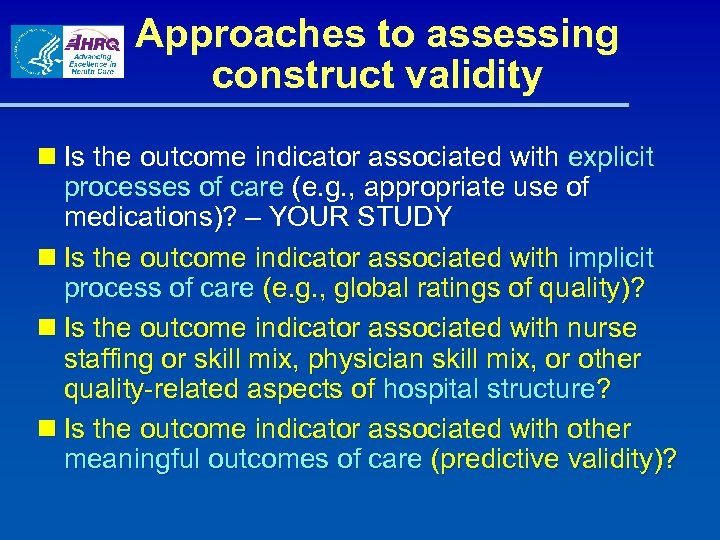 Approaches to assessing construct validity n Is the outcome indicator associated with explicit processes of care (e. g. , appropriate use of medications)? – YOUR STUDY n Is the outcome indicator associated with implicit process of care (e. g. , global ratings of quality)? n Is the outcome indicator associated with nurse staffing or skill mix, physician skill mix, or other quality-related aspects of hospital structure? n Is the outcome indicator associated with other meaningful outcomes of care (predictive validity)?
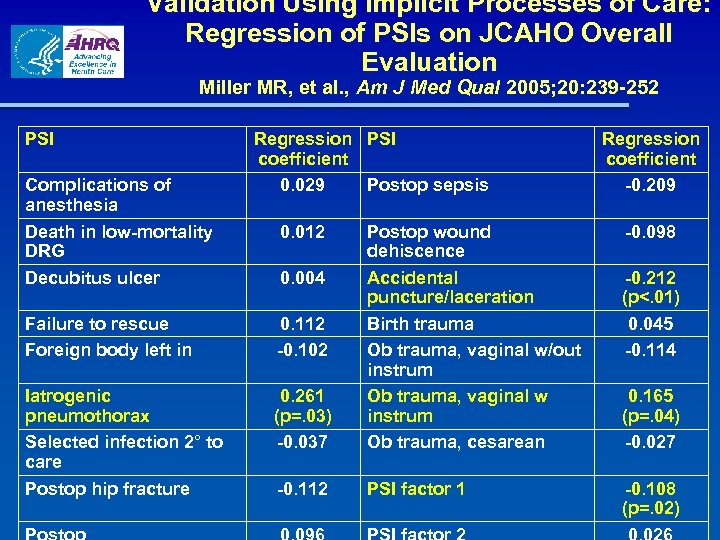 Validation Using Implicit Processes of Care: Regression of PSIs on JCAHO Overall Evaluation Miller MR, et al. , Am J Med Qual 2005; 20: 239 -252 PSI Complications of anesthesia Death in low-mortality DRG Decubitus ulcer Regression PSI coefficient 0. 029 Postop sepsis 0. 012 Failure to rescue Foreign body left in 0. 112 -0. 102 Iatrogenic pneumothorax Selected infection 2° to care Postop hip fracture 0. 261 (p=. 03) -0. 037 Postop wound dehiscence Accidental puncture/laceration Birth trauma Ob trauma, vaginal w/out instrum Ob trauma, vaginal w instrum Ob trauma, cesarean -0. 112 PSI factor 1 0. 004 Regression coefficient -0. 209 -0. 098 -0. 212 (p<. 01) 0. 045 -0. 114 0. 165 (p=. 04) -0. 027 -0. 108 (p=. 02)
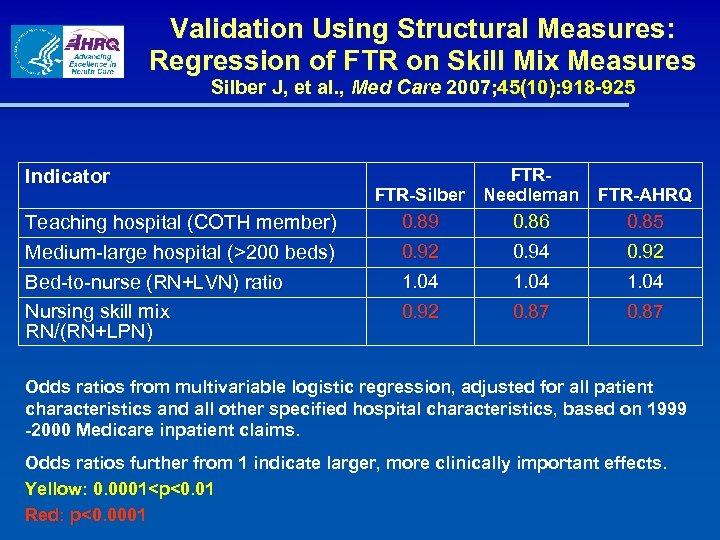 Validation Using Structural Measures: Regression of FTR on Skill Mix Measures Silber J, et al. , Med Care 2007; 45(10): 918 -925 Indicator Teaching hospital (COTH member) Medium-large hospital (>200 beds) Bed-to-nurse (RN+LVN) ratio Nursing skill mix RN/(RN+LPN) FTRFTR-Silber Needleman FTR-AHRQ 0. 89 0. 86 0. 85 0. 92 0. 94 0. 92 1. 04 0. 92 0. 87 Odds ratios from multivariable logistic regression, adjusted for all patient characteristics and all other specified hospital characteristics, based on 1999 -2000 Medicare inpatient claims. Odds ratios further from 1 indicate larger, more clinically important effects. Yellow: 0. 0001
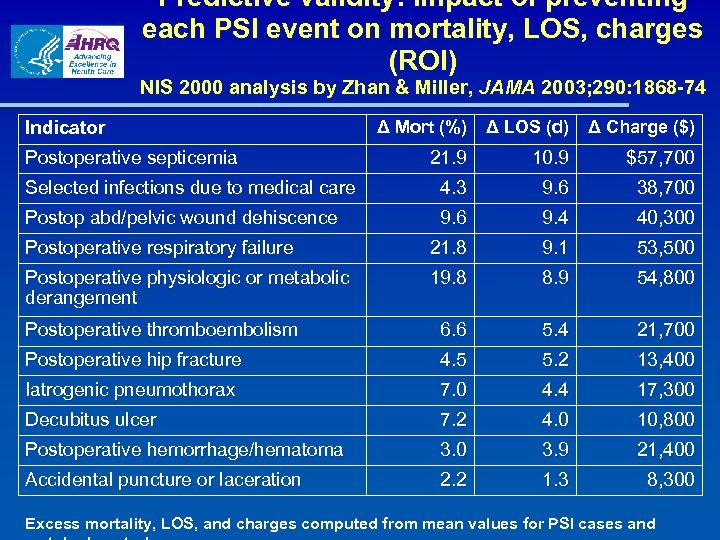 Predictive validity: Impact of preventing each PSI event on mortality, LOS, charges (ROI) NIS 2000 analysis by Zhan & Miller, JAMA 2003; 290: 1868 -74 Indicator Δ Mort (%) Δ LOS (d) Δ Charge ($) 21. 9 10. 9 $57, 700 Selected infections due to medical care 4. 3 9. 6 38, 700 Postop abd/pelvic wound dehiscence 9. 6 9. 4 40, 300 Postoperative respiratory failure 21. 8 9. 1 53, 500 Postoperative physiologic or metabolic derangement 19. 8 8. 9 54, 800 Postoperative thromboembolism 6. 6 5. 4 21, 700 Postoperative hip fracture 4. 5 5. 2 13, 400 Iatrogenic pneumothorax 7. 0 4. 4 17, 300 Decubitus ulcer 7. 2 4. 0 10, 800 Postoperative hemorrhage/hematoma 3. 0 3. 9 21, 400 Accidental puncture or laceration 2. 2 1. 3 8, 300 Postoperative septicemia Excess mortality, LOS, and charges computed from mean values for PSI cases and
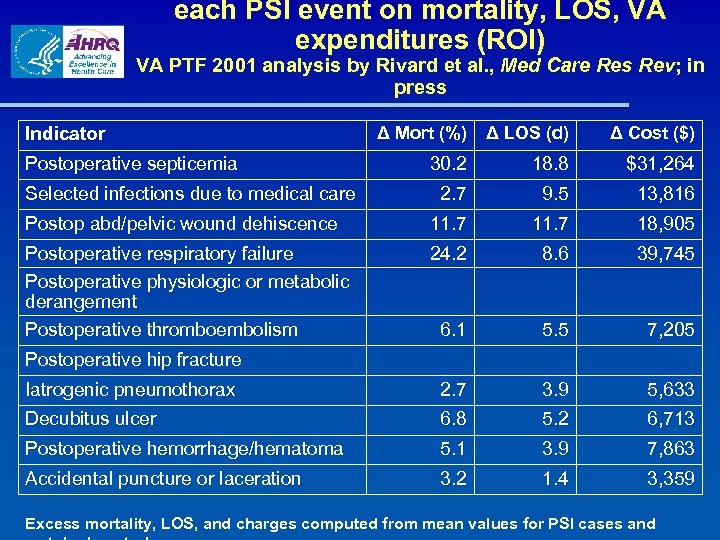 each PSI event on mortality, LOS, VA expenditures (ROI) VA PTF 2001 analysis by Rivard et al. , Med Care Res Rev; in al press Indicator Δ Mort (%) Δ LOS (d) Δ Cost ($) 30. 2 18. 8 $31, 264 2. 7 9. 5 13, 816 Postop abd/pelvic wound dehiscence 11. 7 18, 905 Postoperative respiratory failure Postoperative physiologic or metabolic derangement Postoperative thromboembolism 24. 2 8. 6 39, 745 6. 1 5. 5 7, 205 Iatrogenic pneumothorax 2. 7 3. 9 5, 633 Decubitus ulcer 6. 8 5. 2 6, 713 Postoperative hemorrhage/hematoma 5. 1 3. 9 7, 863 Accidental puncture or laceration 3. 2 1. 4 3, 359 Postoperative septicemia Selected infections due to medical care Postoperative hip fracture Excess mortality, LOS, and charges computed from mean values for PSI cases and
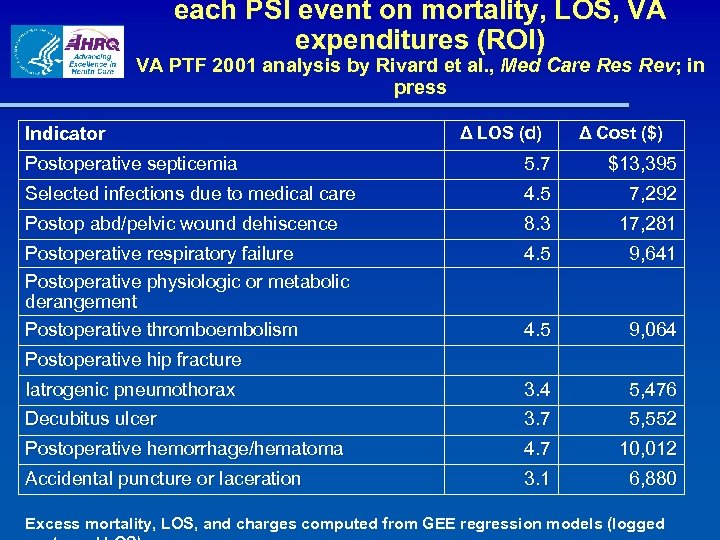 each PSI event on mortality, LOS, VA expenditures (ROI) VA PTF 2001 analysis by Rivard et al. , Med Care Res Rev; in al press Indicator Δ LOS (d) Δ Cost ($) Postoperative septicemia 5. 7 $13, 395 Selected infections due to medical care 4. 5 7, 292 Postop abd/pelvic wound dehiscence 8. 3 17, 281 Postoperative respiratory failure Postoperative physiologic or metabolic derangement Postoperative thromboembolism 4. 5 9, 641 4. 5 9, 064 Iatrogenic pneumothorax 3. 4 5, 476 Decubitus ulcer 3. 7 5, 552 Postoperative hemorrhage/hematoma 4. 7 10, 012 Accidental puncture or laceration 3. 1 6, 880 Postoperative hip fracture Excess mortality, LOS, and charges computed from GEE regression models (logged
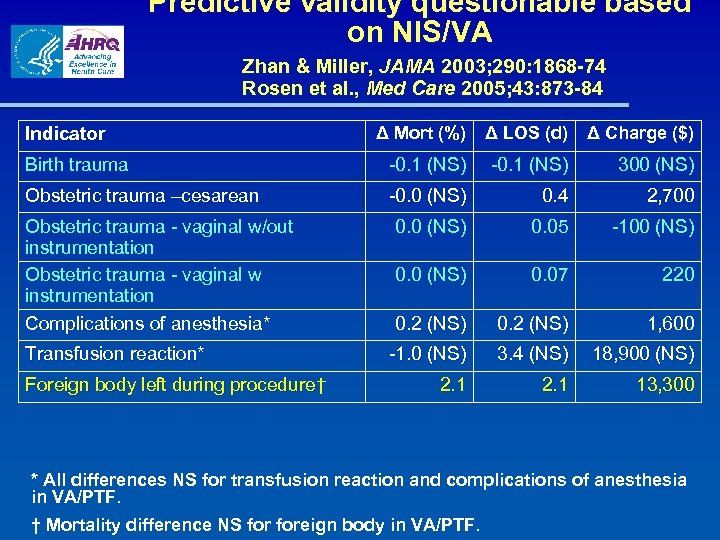 Predictive validity questionable based on NIS/VA Zhan & Miller, JAMA 2003; 290: 1868 -74 Rosen et al. , Med Care 2005; 43: 873 -84 Indicator Δ Mort (%) Δ LOS (d) Δ Charge ($) Birth trauma -0. 1 (NS) 300 (NS) Obstetric trauma –cesarean -0. 0 (NS) 0. 4 2, 700 0. 0 (NS) 0. 05 -100 (NS) 0. 07 220 0. 2 (NS) 1, 600 -1. 0 (NS) 3. 4 (NS) 18, 900 (NS) 2. 1 13, 300 Obstetric trauma - vaginal w/out instrumentation Obstetric trauma - vaginal w instrumentation Complications of anesthesia* Transfusion reaction* Foreign body left during procedure† * All differences NS for transfusion reaction and complications of anesthesia in VA/PTF. † Mortality difference NS foreign body in VA/PTF.
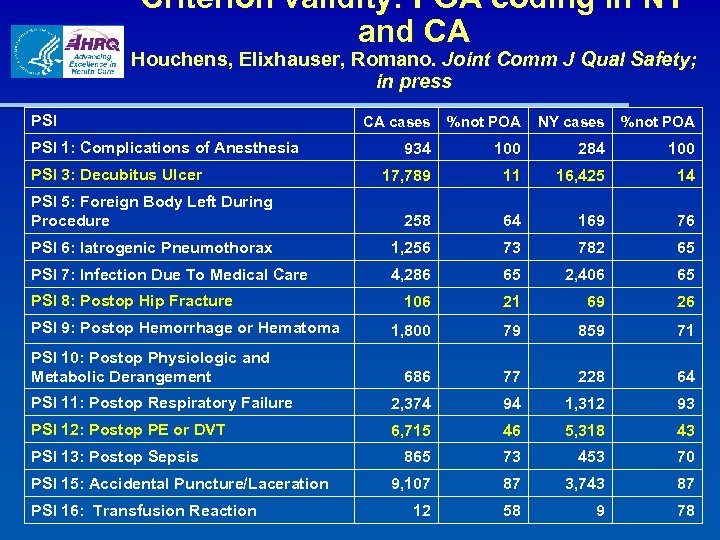 Criterion validity: POA coding in NY and CA Houchens, Elixhauser, Romano. Joint Comm J Qual Safety; in press PSI CA cases %not POA NY cases %not POA 934 100 284 100 17, 789 11 16, 425 14 PSI 5: Foreign Body Left During Procedure 258 64 169 76 PSI 6: Iatrogenic Pneumothorax 1, 256 73 782 65 PSI 7: Infection Due To Medical Care 4, 286 65 2, 406 65 106 21 69 26 1, 800 79 859 71 686 77 228 64 PSI 11: Postop Respiratory Failure 2, 374 94 1, 312 93 PSI 12: Postop PE or DVT 6, 715 46 5, 318 43 865 73 453 70 9, 107 87 3, 743 87 12 58 9 78 PSI 1: Complications of Anesthesia PSI 3: Decubitus Ulcer PSI 8: Postop Hip Fracture PSI 9: Postop Hemorrhage or Hematoma PSI 10: Postop Physiologic and Metabolic Derangement PSI 13: Postop Sepsis PSI 15: Accidental Puncture/Laceration PSI 16: Transfusion Reaction
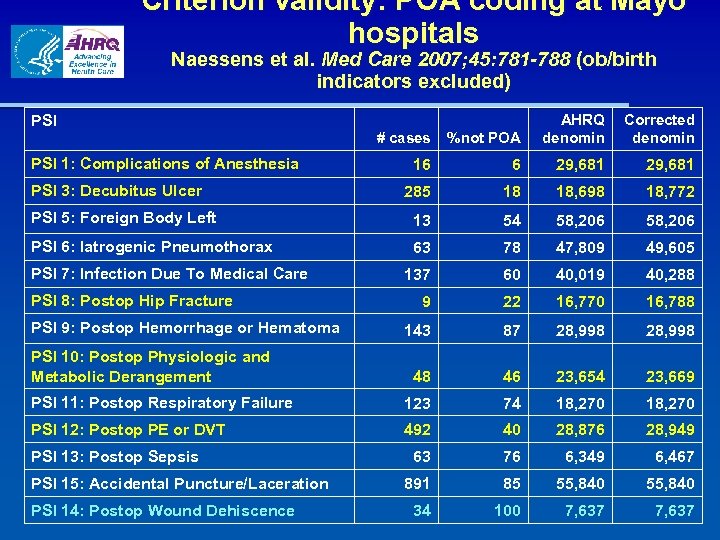 Criterion validity: POA coding at Mayo hospitals Naessens et al. Med Care 2007; 45: 781 -788 (ob/birth indicators excluded) # cases %not POA AHRQ denomin 16 6 29, 681 285 18 18, 698 18, 772 PSI 5: Foreign Body Left 13 54 58, 206 PSI 6: Iatrogenic Pneumothorax 63 78 47, 809 49, 605 137 60 40, 019 40, 288 9 22 16, 770 16, 788 143 87 28, 998 48 46 23, 654 23, 669 PSI 11: Postop Respiratory Failure 123 74 18, 270 PSI 12: Postop PE or DVT 492 40 28, 876 28, 949 63 76 6, 349 6, 467 891 85 55, 840 34 100 7, 637 PSI 1: Complications of Anesthesia PSI 3: Decubitus Ulcer PSI 7: Infection Due To Medical Care PSI 8: Postop Hip Fracture PSI 9: Postop Hemorrhage or Hematoma PSI 10: Postop Physiologic and Metabolic Derangement PSI 13: Postop Sepsis PSI 15: Accidental Puncture/Laceration PSI 14: Postop Wound Dehiscence Corrected denomin
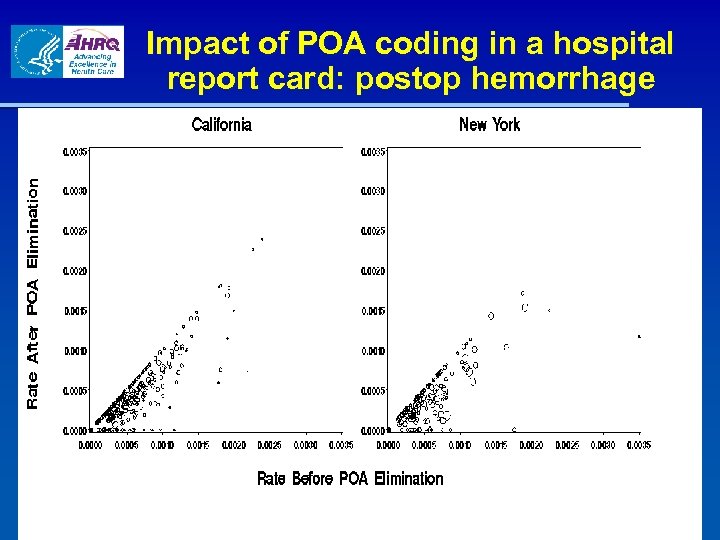 Impact of POA coding in a hospital report card: postop hemorrhage
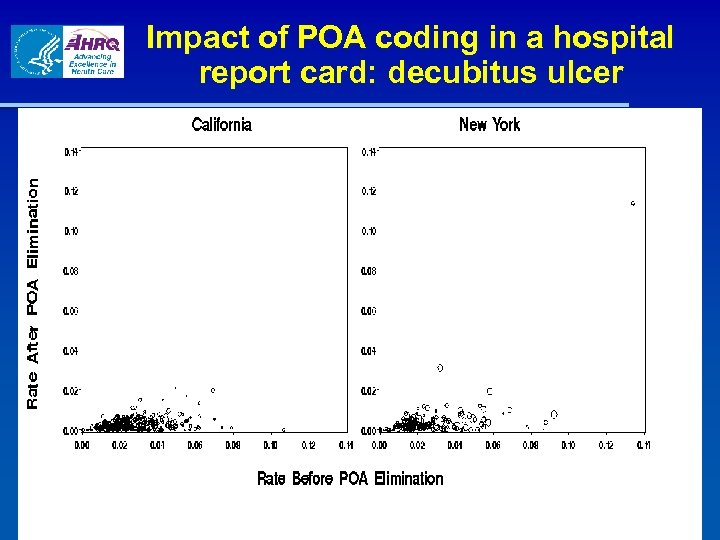 Impact of POA coding in a hospital report card: decubitus ulcer
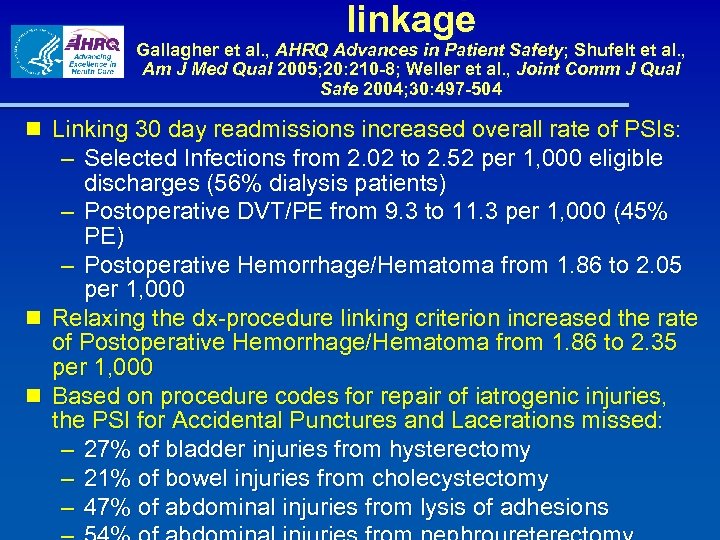 linkage Gallagher et al. , AHRQ Advances in Patient Safety; Shufelt et al. , Am J Med Qual 2005; 20: 210 -8; Weller et al. , Joint Comm J Qual Safe 2004; 30: 497 -504 n Linking 30 day readmissions increased overall rate of PSIs: – Selected Infections from 2. 02 to 2. 52 per 1, 000 eligible discharges (56% dialysis patients) – Postoperative DVT/PE from 9. 3 to 11. 3 per 1, 000 (45% PE) – Postoperative Hemorrhage/Hematoma from 1. 86 to 2. 05 per 1, 000 n Relaxing the dx-procedure linking criterion increased the rate of Postoperative Hemorrhage/Hematoma from 1. 86 to 2. 35 per 1, 000 n Based on procedure codes for repair of iatrogenic injuries, the PSI for Accidental Punctures and Lacerations missed: – 27% of bladder injuries from hysterectomy – 21% of bowel injuries from cholecystectomy – 47% of abdominal injuries from lysis of adhesions
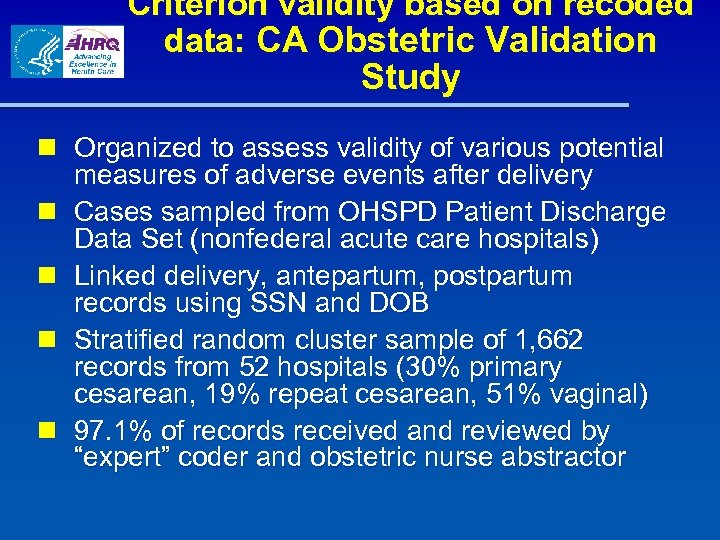 Criterion validity based on recoded data: CA Obstetric Validation Study n Organized to assess validity of various potential measures of adverse events after delivery n Cases sampled from OHSPD Patient Discharge Data Set (nonfederal acute care hospitals) n Linked delivery, antepartum, postpartum records using SSN and DOB n Stratified random cluster sample of 1, 662 records from 52 hospitals (30% primary cesarean, 19% repeat cesarean, 51% vaginal) n 97. 1% of records received and reviewed by “expert” coder and obstetric nurse abstractor
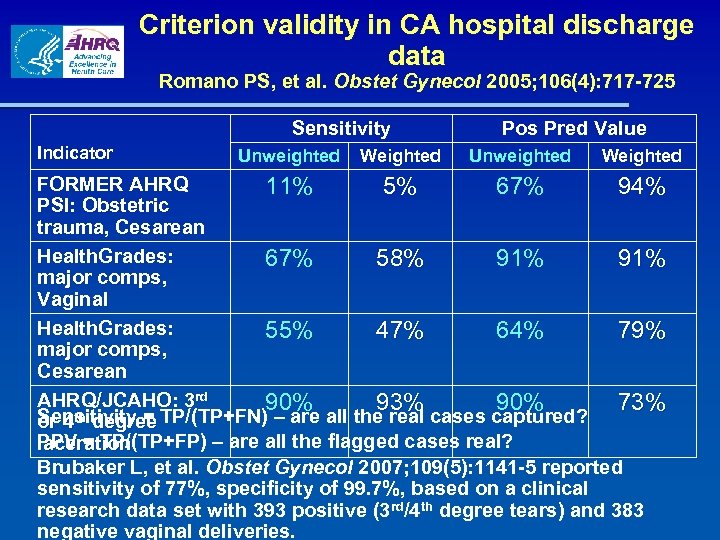 Criterion validity in CA hospital discharge data Romano PS, et al. Obstet Gynecol 2005; 106(4): 717 -725 Sensitivity Indicator Unweighted Weighted Pos Pred Value Unweighted Weighted FORMER AHRQ 11% 5% 67% 94% PSI: Obstetric trauma, Cesarean Health. Grades: 67% 58% 91% major comps, Vaginal Health. Grades: 55% 47% 64% 79% major comps, Cesarean AHRQ/JCAHO: 3 rd 90% 93% 90% 73% th degree Sensitivity = TP/(TP+FN) – are all the real cases captured? or 4 PPV = TP/(TP+FP) – are all the flagged cases real? laceration Brubaker L, et al. Obstet Gynecol 2007; 109(5): 1141 -5 reported sensitivity of 77%, specificity of 99. 7%, based on a clinical research data set with 393 positive (3 rd/4 th degree tears) and 383 negative vaginal deliveries.
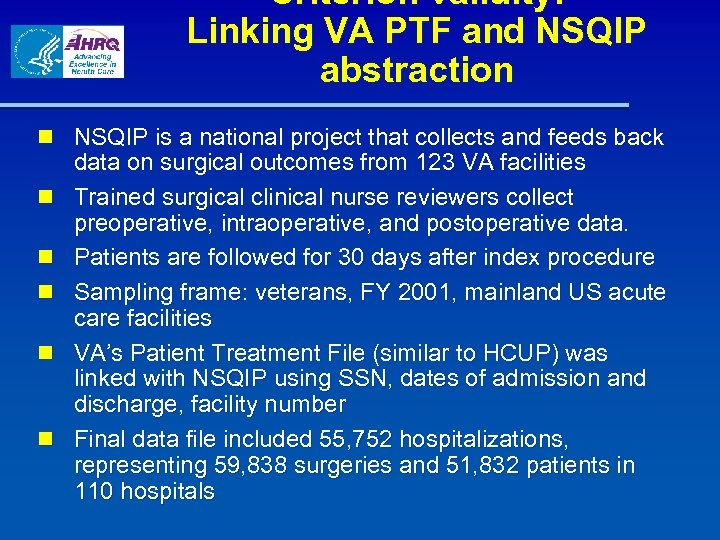 Criterion validity: Linking VA PTF and NSQIP abstraction n NSQIP is a national project that collects and feeds back data on surgical outcomes from 123 VA facilities n Trained surgical clinical nurse reviewers collect preoperative, intraoperative, and postoperative data. n Patients are followed for 30 days after index procedure n Sampling frame: veterans, FY 2001, mainland US acute care facilities n VA’s Patient Treatment File (similar to HCUP) was linked with NSQIP using SSN, dates of admission and discharge, facility number n Final data file included 55, 752 hospitalizations, representing 59, 838 surgeries and 51, 832 patients in 110 hospitals
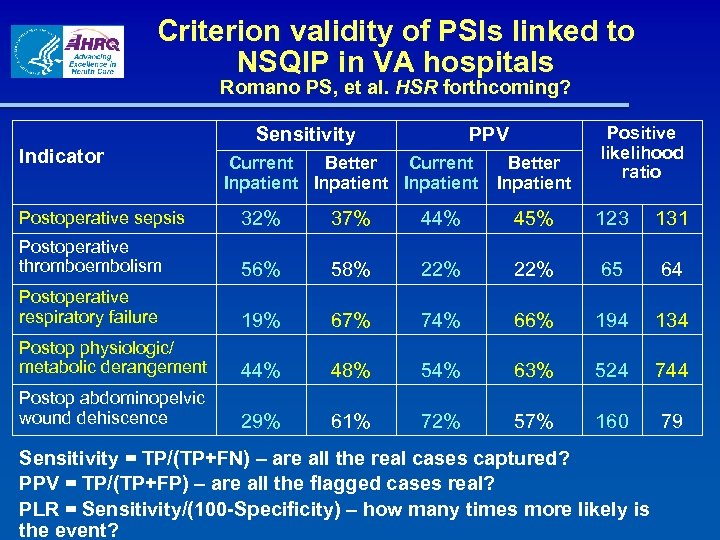 Criterion validity of PSIs linked to NSQIP in VA hospitals Romano PS, et al. HSR forthcoming? Indicator Sensitivity PPV Current Better Current Inpatient Better Inpatient Positive likelihood ratio Postoperative sepsis 32% 37% 44% 45% 123 131 Postoperative thromboembolism 56% 58% 22% 65 64 Postoperative respiratory failure 19% 67% 74% 66% 194 134 Postop physiologic/ metabolic derangement 44% 48% 54% 63% 524 744 Postop abdominopelvic wound dehiscence 29% 61% 72% 57% 160 79 Sensitivity = TP/(TP+FN) – are all the real cases captured? PPV = TP/(TP+FP) – are all the flagged cases real? PLR = Sensitivity/(100 -Specificity) – how many times more likely is the event?
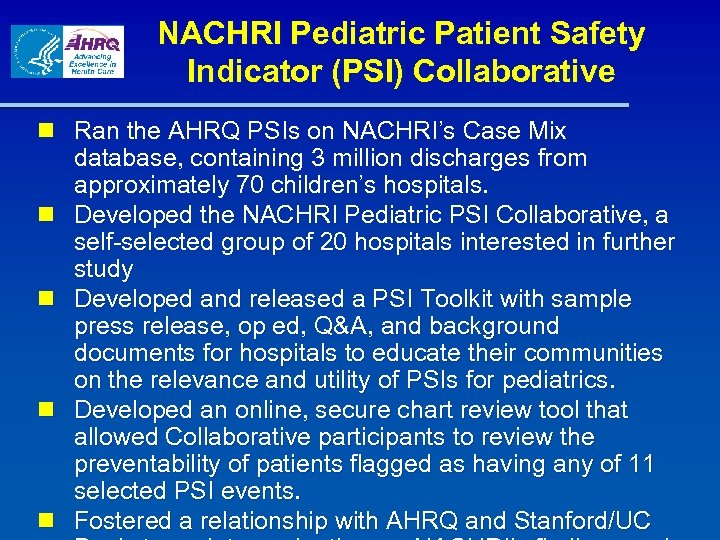 NACHRI Pediatric Patient Safety Indicator (PSI) Collaborative n Ran the AHRQ PSIs on NACHRI’s Case Mix database, containing 3 million discharges from approximately 70 children’s hospitals. n Developed the NACHRI Pediatric PSI Collaborative, a self-selected group of 20 hospitals interested in further study n Developed and released a PSI Toolkit with sample press release, op ed, Q&A, and background documents for hospitals to educate their communities on the relevance and utility of PSIs for pediatrics. n Developed an online, secure chart review tool that allowed Collaborative participants to review the preventability of patients flagged as having any of 11 selected PSI events. n Fostered a relationship with AHRQ and Stanford/UC
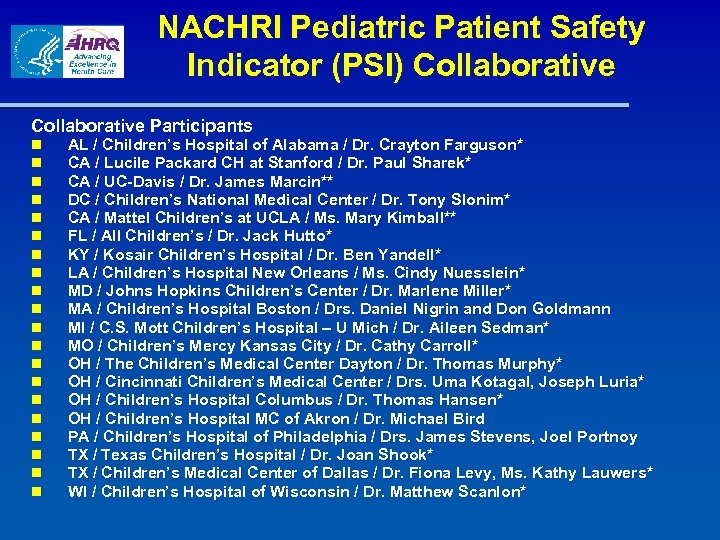 NACHRI Pediatric Patient Safety Indicator (PSI) Collaborative Participants n n n n n AL / Children’s Hospital of Alabama / Dr. Crayton Farguson* CA / Lucile Packard CH at Stanford / Dr. Paul Sharek* CA / UC-Davis / Dr. James Marcin** DC / Children’s National Medical Center / Dr. Tony Slonim* CA / Mattel Children’s at UCLA / Ms. Mary Kimball** FL / All Children’s / Dr. Jack Hutto* KY / Kosair Children’s Hospital / Dr. Ben Yandell* LA / Children’s Hospital New Orleans / Ms. Cindy Nuesslein* MD / Johns Hopkins Children’s Center / Dr. Marlene Miller* MA / Children’s Hospital Boston / Drs. Daniel Nigrin and Don Goldmann MI / C. S. Mott Children’s Hospital – U Mich / Dr. Aileen Sedman* MO / Children’s Mercy Kansas City / Dr. Cathy Carroll* OH / The Children’s Medical Center Dayton / Dr. Thomas Murphy* OH / Cincinnati Children’s Medical Center / Drs. Uma Kotagal, Joseph Luria* OH / Children’s Hospital Columbus / Dr. Thomas Hansen* OH / Children’s Hospital MC of Akron / Dr. Michael Bird PA / Children’s Hospital of Philadelphia / Drs. James Stevens, Joel Portnoy TX / Texas Children’s Hospital / Dr. Joan Shook* TX / Children’s Medical Center of Dallas / Dr. Fiona Levy, Ms. Kathy Lauwers* WI / Children’s Hospital of Wisconsin / Dr. Matthew Scanlon*
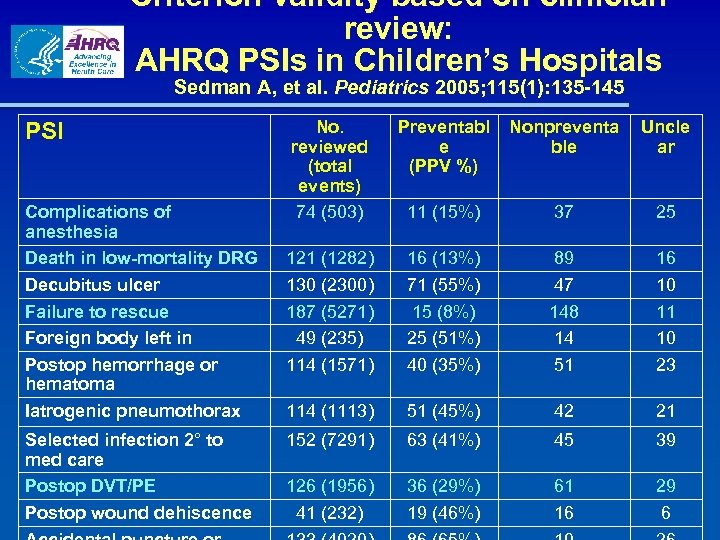 Criterion validity based on clinician review: AHRQ PSIs in Children’s Hospitals Sedman A, et al. Pediatrics 2005; 115(1): 135 -145 PSI Complications of anesthesia Death in low-mortality DRG Decubitus ulcer Failure to rescue Foreign body left in Postop hemorrhage or hematoma Iatrogenic pneumothorax Selected infection 2° to med care Postop DVT/PE Postop wound dehiscence No. reviewed (total events) 74 (503) Preventabl e (PPV %) Nonpreventa ble Uncle ar 11 (15%) 37 25 121 (1282) 130 (2300) 187 (5271) 49 (235) 114 (1571) 16 (13%) 71 (55%) 15 (8%) 25 (51%) 40 (35%) 89 47 148 14 51 16 10 11 10 23 114 (1113) 51 (45%) 42 21 152 (7291) 63 (41%) 45 39 126 (1956) 41 (232) 36 (29%) 19 (46%) 61 16 29 6
 Key findings from NACHRI’s PSI physician case reviews “…while 40% to 50% may seem low for positive predictive value, in terms of real patients, this means that 4 or 5 out of 10 children had a preventable event for this indicator. This is worth looking at and the things we are finding in some instances, will allow for immediate changes that may impact outcomes for future patients. ” [Collaborative physician reviewer]
 Examples from NACHRI’s PSI physician case reviews § § § During removal of non functioning port cath the end of the catheter was noted to be "irregular and not smoooth cut". It appeared the tip had been embolized for an unknown duration… During replacement of pacemaker lead, a fragment of the lead broke off, embolized and ended up lodged (puncture) in the anterolateral papillary muscle. No notation in original operative note or nursing record that sponge/needle counts were done and correct. Count was reported as correct. Sponge discovered on xray due to complaints of abdominal pain by patient. Child with bone tumor who had mandible removed with subsequent bone graft and much packing in wound. This was supposedly removed before extubation, but at the time of extubation a remaining pack blocked her airway causing reintubation with pack removal.
 Romano’s Conclusions n Several studies addressing PSI/PDI validity have been published, and several more are on the way. n Most PSIs have domestic and international consensual (face) validity. n Most PSIs have strong evidence of predictive (construct) validity in both VA and non-VA data. n 3 PSIs have significant “POA problems”: postoperative DVT/PE, postoperative hip fracture, decubitus ulcer. n Linked readmissions data may be helpful in ruling in/out early discharge as a cause of low PSI rates. n “Complications of Anesthesia” may be problematic. n Coding validity looks strong for obstetric PSIs, and mixed for postoperative PSIs, but very limited data. n Case review suggests 33 -67% of most PSIs are potentially preventable (in children), except lower for death-based PSIs,
 Questions?