


 Скачать презентацию AHECs Catalysts for Systems Change National AHEC Organization
c4779e6d369bc06f0978be3051d26395.ppt
- Количество слайдов: 39
 AHECs Catalysts for Systems Change National AHEC Organization June 24, 2010 Asma Aftab, MD, MPH, Research Assistant Professor University of Miami AHEC Program Debbie Hawkins, MPA, Associate Director University of Florida AHEC Program
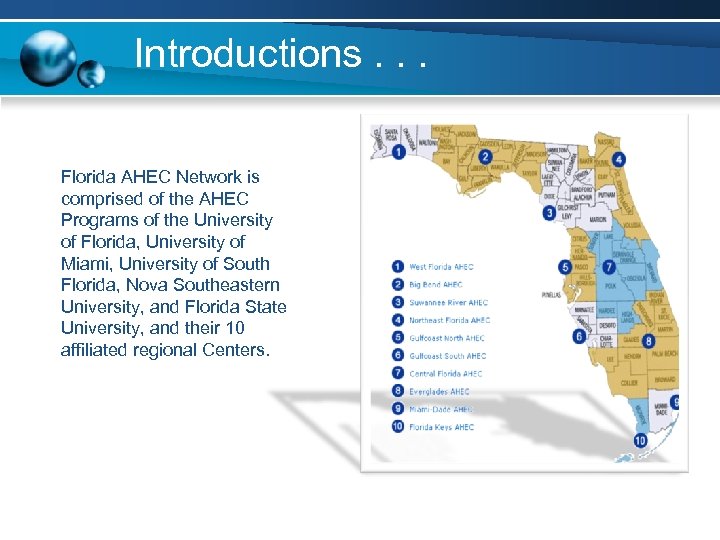 Introductions. . . Florida AHEC Network is comprised of the AHEC Programs of the University of Florida, University of Miami, University of South Florida, Nova Southeastern University, and Florida State University, and their 10 affiliated regional Centers.
 Session Learning Objectives • Identify characteristics of policy and system change in undergraduate medical education. • Understand the importance of tobacco dependency treatment as a designated mandatory curriculum component in undergraduate medical education. • Identify strategies for implementing sustainable systems change. • Identify strategies for implementing evidenced-based tobacco curriculum and assessment protocols in undergraduate medicine education and in the community-based educational experience.
 Importance of Systems Change – Dominant framework through which local, state, and national funders are approaching their work – Purpose is to achieve better outcomes and improve the status quo
 Defining Systems Change • Systems change initiatives are rooted in the assumption that significant improvements in the outcomes of a targeted population will not occur unless the surrounding system adjusts to accommodate the desired goals (Cohen & Lavach, 1995). • Systems change is an intentional process designed to alter the status quo by shifting and realigning the form and function of a targeted system (Foster, 2007).
 Defining System “The System” is the set of actors, activities, and settings that are directly or indirectly perceived to have influence in or be affected by a given problem situation (Foster, 2007). Systems change agents are individuals or groups that help or encourage progress or change. Agents have the ability to influence, cause or sponsor change. Systems change endeavors seek to alter the policies, routines, relationships, resources, power structures, and values (Foster, 2007).
 Systems Change and AHECs • Systems Change – Addresses problems holistically and at multiple levels and domains – Engages stakeholders/leadership in the design and implementation – Promotes sustainable systems change
 Traditional Roles of AHECs • Form partnerships with • Create opportunities for community and academic networking and coalition groups building • Foster collaboration among and within communities • Facilitate academic & community-based activities and initiatives • Provide financial and other support to academic and community partners
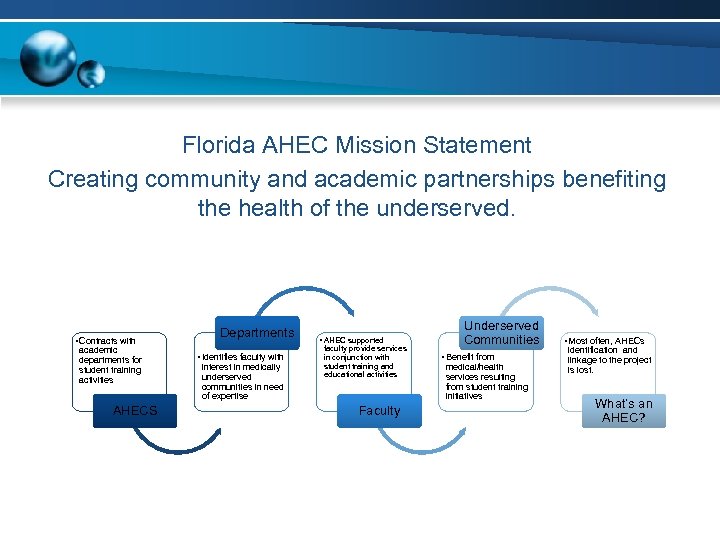 Florida AHEC Mission Statement Creating community and academic partnerships benefiting the health of the underserved. • Contracts with academic departments for student training activities AHECS Departments • Identifies faculty with interest in medically underserved communities in need of expertise • AHEC supported faculty provide services in conjunction with student training and educational activities Faculty Underserved Communities • Benefit from medical/health services resulting from student training initiatives • Most often, AHECs identification and linkage to the project is lost. What’s an AHEC?
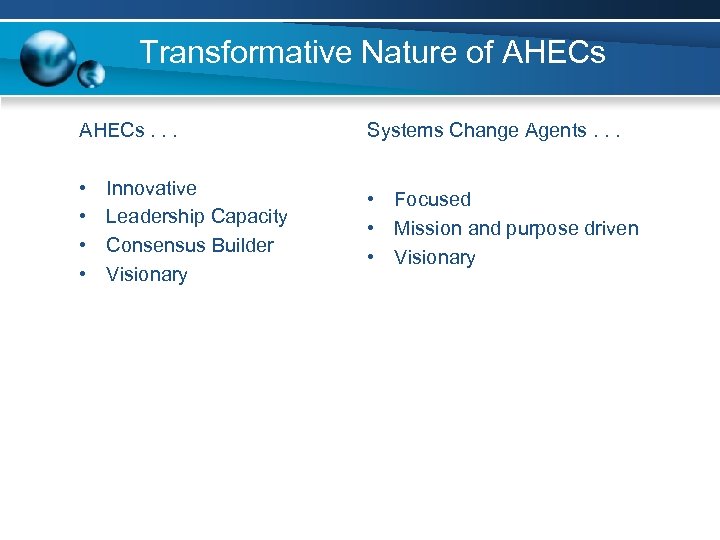 Transformative Nature of AHECs. . . Systems Change Agents. . . • • • Focused • Mission and purpose driven • Visionary Innovative Leadership Capacity Consensus Builder Visionary
 Making the Case for Systems Change FLORIDA AHEC TOBACCO TRAINING AND CESSATION INITIATIVE
 AHEC Tobacco Initiative Background In July 2007, Governor Charlie Crist signed into law a bill that included an appropriation of 10 million dollars each year for two years to the Florida Area Health Education Centers (AHEC) Network. The funding was allocated to provide tobacco cessation and prevention training to current and future health professionals and to expand tobacco cessation services to each county of the state. This appropriation was part of a larger, constitutionally mandated yearly appropriation to the Department of Health totaling approximately $57 million per year for anti-tobacco activities.
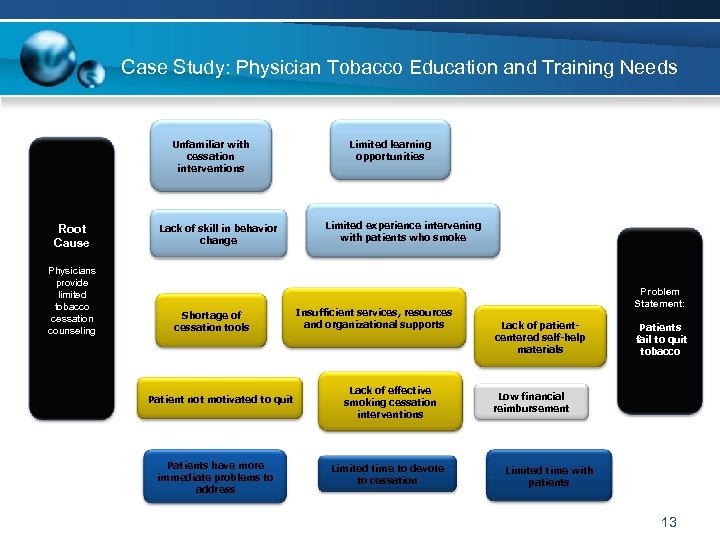 Case Study: Physician Tobacco Education and Training Needs Unfamiliar with cessation interventions Root Cause Physicians provide limited tobacco cessation counseling Lack of skill in behavior change Shortage of cessation tools Patient not motivated to quit Patients have more immediate problems to address Limited learning opportunities Limited experience intervening with patients who smoke Insufficient services, resources and organizational supports Lack of effective smoking cessation interventions Limited time to devote to cessation Problem Statement: Lack of patientcentered self-help materials Patients fail to quit tobacco Low financial reimbursement Limited time with patients 13
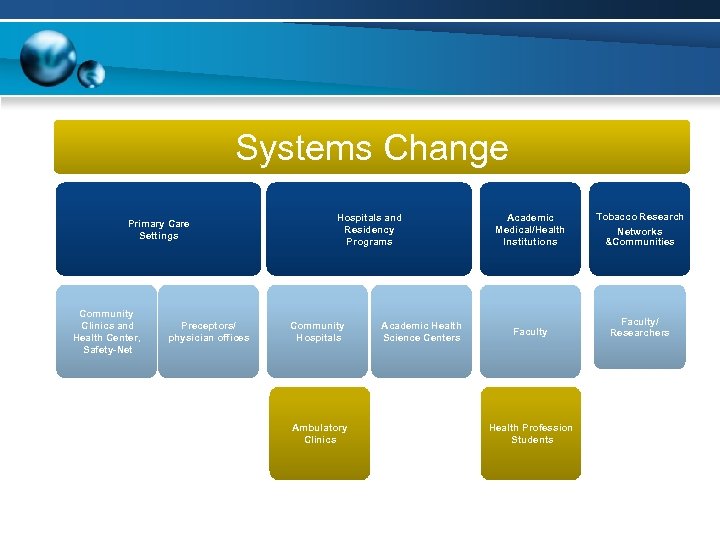 Systems Change Primary Care Settings Community Clinics and Health Center, Safety-Net Preceptors/ physician offices Hospitals and Residency Programs Community Hospitals Ambulatory Clinics Academic Health Science Centers Academic Medical/Health Institutions Tobacco Research Networks &Communities Faculty/ Researchers Health Profession Students
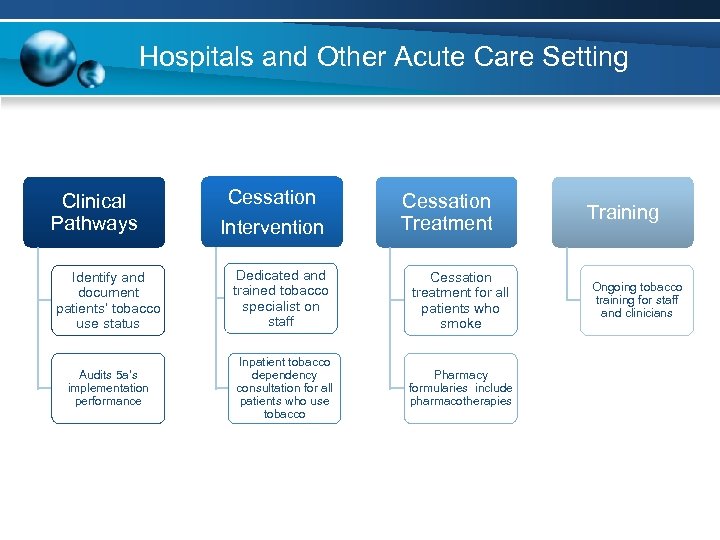 Hospitals and Other Acute Care Setting Clinical Pathways Cessation Intervention Cessation Treatment Identify and document patients’ tobacco use status Dedicated and trained tobacco specialist on staff Cessation treatment for all patients who smoke Audits 5 a’s implementation performance Inpatient tobacco dependency consultation for all patients who use tobacco Pharmacy formularies include pharmacotherapies Training Ongoing tobacco training for staff and clinicians
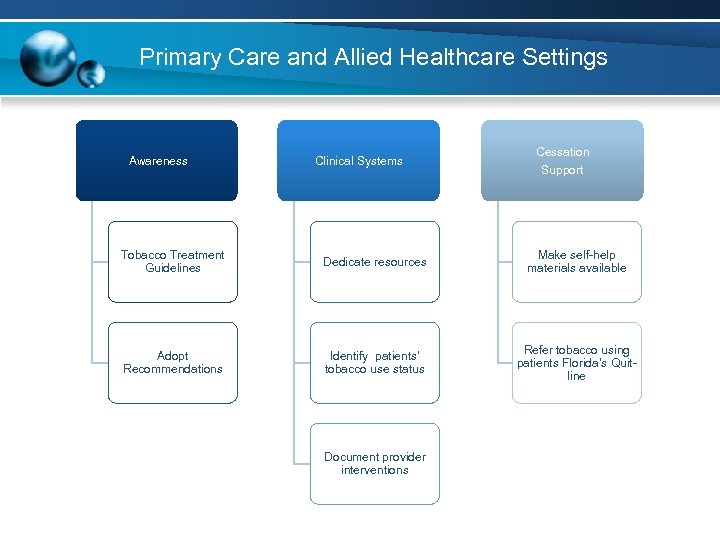 Primary Care and Allied Healthcare Settings Awareness Clinical Systems Cessation Support Tobacco Treatment Guidelines Dedicate resources Make self-help materials available Adopt Recommendations Identify patients’ tobacco use status Refer tobacco using patients Florida’s Quitline Document provider interventions
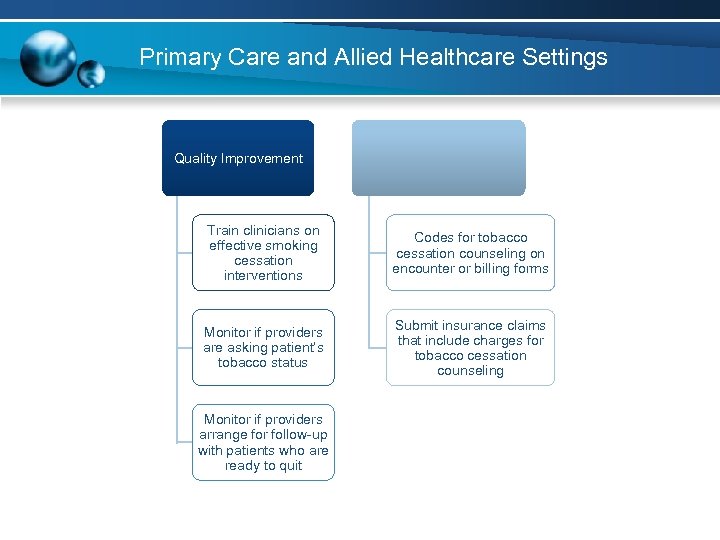 Primary Care and Allied Healthcare Settings Quality Improvement Reimbursement Train clinicians on effective smoking cessation interventions Codes for tobacco cessation counseling on encounter or billing forms Monitor if providers are asking patient’s tobacco status Submit insurance claims that include charges for tobacco cessation counseling Monitor if providers arrange for follow-up with patients who are ready to quit
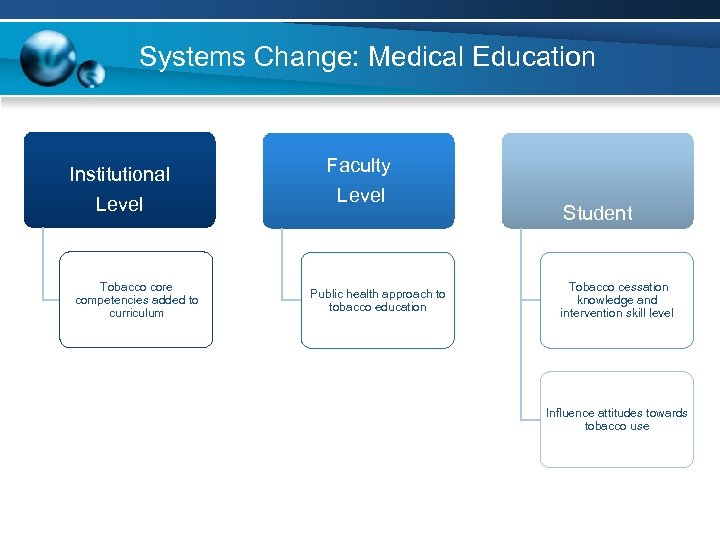 Systems Change: Medical Education Institutional Level Faculty Level Student Level Tobacco core competencies added to curriculum Public health approach to tobacco education Tobacco cessation knowledge and intervention skill level Influence attitudes towards tobacco use
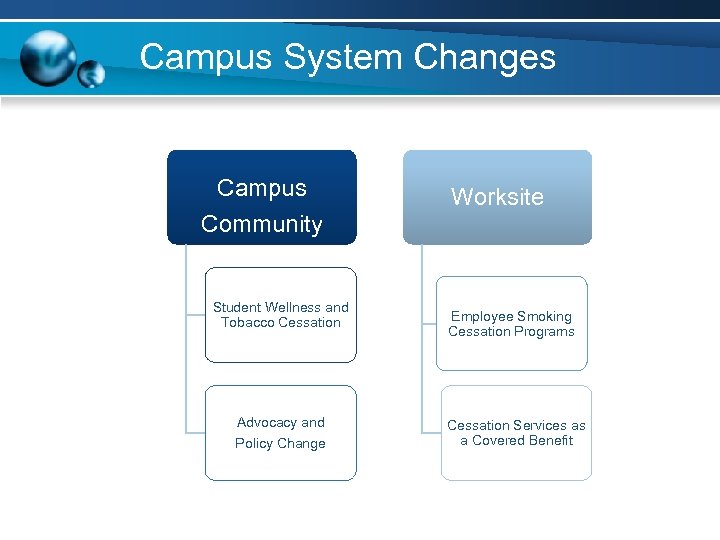 Campus System Changes Campus Community Student Wellness and Tobacco Cessation Advocacy and Policy Change Worksite Employee Smoking Cessation Programs Cessation Services as a Covered Benefit
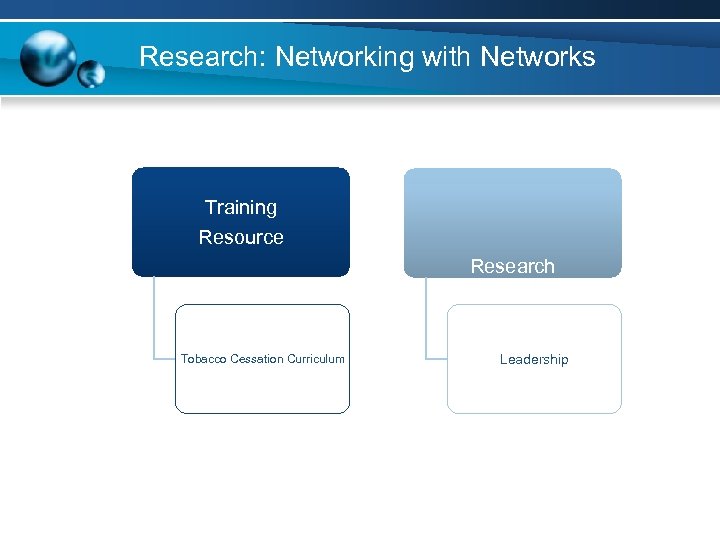 Research: Networking with Networks Training Resource Research Tobacco Cessation Curriculum Leadership
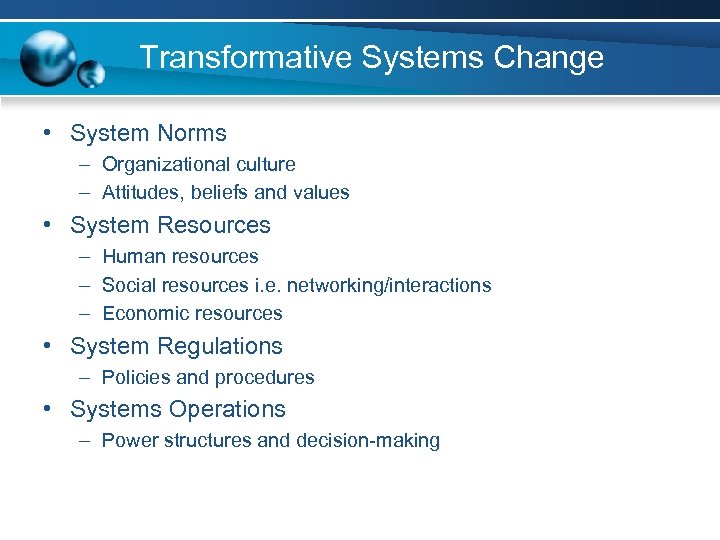 Transformative Systems Change • System Norms – Organizational culture – Attitudes, beliefs and values • System Resources – Human resources – Social resources i. e. networking/interactions – Economic resources • System Regulations – Policies and procedures • Systems Operations – Power structures and decision-making
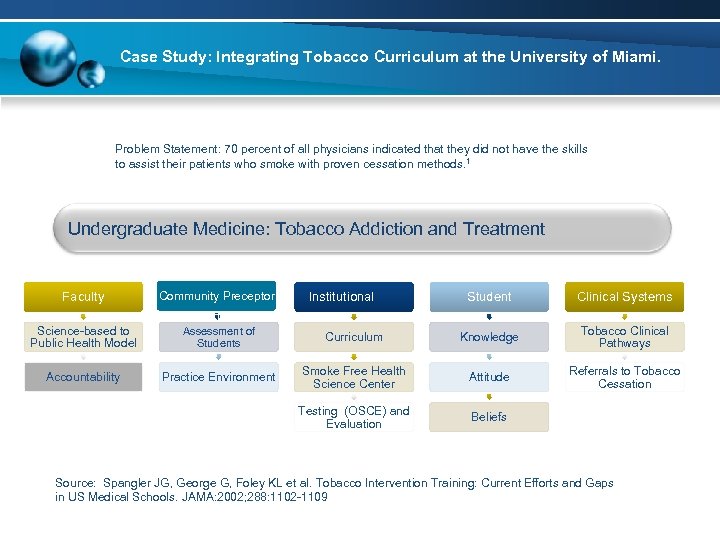 Case Study: Integrating Tobacco Curriculum at the University of Miami. Problem Statement: 70 percent of all physicians indicated that they did not have the skills to assist their patients who smoke with proven cessation methods. 1 Undergraduate Medicine: Tobacco Addiction and Treatment Faculty Community Preceptor Institutional Student Clinical Systems Science-based to Public Health Model Assessment of Students Curriculum Knowledge Tobacco Clinical Pathways Accountability Practice Environment Smoke Free Health Science Center Attitude Referrals to Tobacco Cessation Testing (OSCE) and Evaluation Beliefs Source: Spangler JG, George G, Foley KL et al. Tobacco Intervention Training: Current Efforts and Gaps in US Medical Schools. JAMA: 2002; 288: 1102 -1109
 AHEC Catalyst for System Change University of Miami Case Study
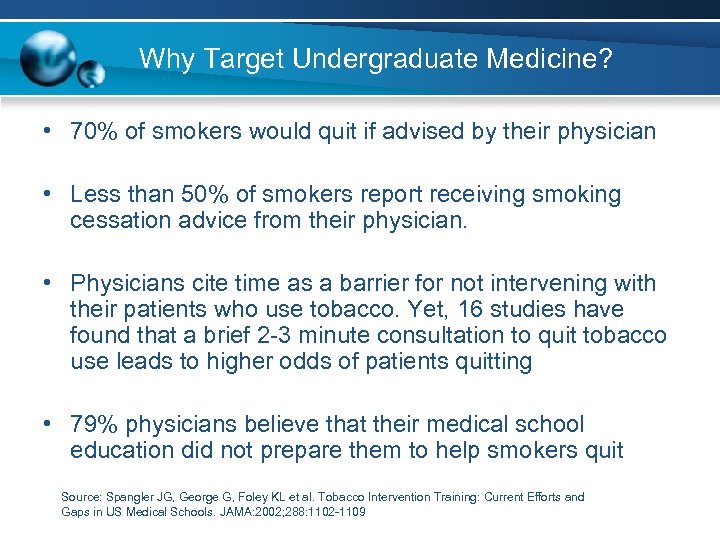 Why Target Undergraduate Medicine? • 70% of smokers would quit if advised by their physician • Less than 50% of smokers report receiving smoking cessation advice from their physician. • Physicians cite time as a barrier for not intervening with their patients who use tobacco. Yet, 16 studies have found that a brief 2 -3 minute consultation to quit tobacco use leads to higher odds of patients quitting • 79% physicians believe that their medical school education did not prepare them to help smokers quit Source: Spangler JG, George G, Foley KL et al. Tobacco Intervention Training: Current Efforts and Gaps in US Medical Schools. JAMA: 2002; 288: 1102 -1109
 Reasons for Incorporating Tobacco Education in Medical Student Training • As role models in not smoking, or quitting smoking. • In counseling patients not to smoke. • In providing smoking cessation treatment. • In organizing and speaking out publicly and lobbying for comprehensive public policies to control tobacco use. Source: Spangler JG, George G, Foley KL et al. Tobacco Intervention Training: Current Efforts and Gaps in US Medical Schools. JAMA: 2002; 288: 1102 -1109
 Missed Opportunities in Medical Schools 122 Medical School were surveyed; • Only 3 had a required course devoted to tobacco treatment • 31. 4% Schools spent 3 or less hours teaching smoking counseling • Most medical schools (69. 2%) did not require clinical training in smoking intervention techniques • No national curricular model guideline exist for schools to determine the content of tobacco dependence, instruction or implementation
 American Medical Association: “Tobacco dependence is a chronic illness, much like diabetes or high blood pressure, and it requires that doctors take the same long-term treatment approach to help patients succeed”.
 Chronic Care Model for Tobacco Dependence* • • Systematically ask and document tobacco use Strongly advise all smokers to quit at each encounter Assess the motivation to quit Assist smokers to build self-efficacy through counseling, medication and social support • Track all smokers • Support policies such as smoke free environment and tobacco user fee *Treating Tobacco Use and Dependence: 2008 Update. Available at: http: //www. ahrq. gov/path/tobacco. htm
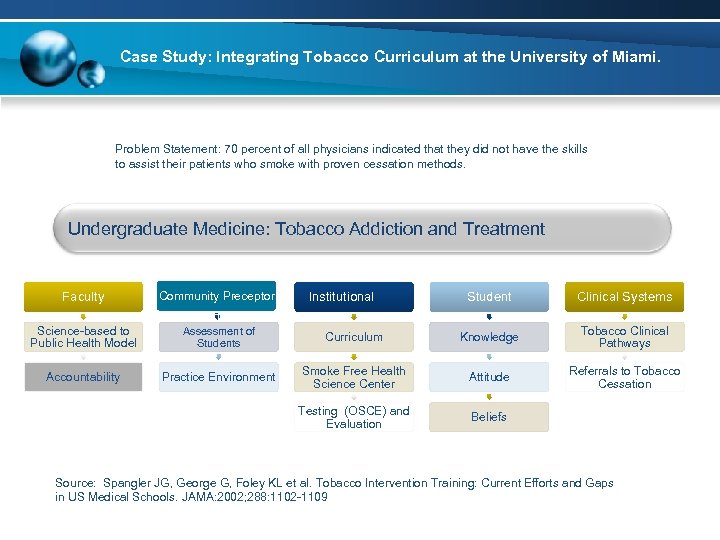 Case Study: Integrating Tobacco Curriculum at the University of Miami. Problem Statement: 70 percent of all physicians indicated that they did not have the skills to assist their patients who smoke with proven cessation methods. Undergraduate Medicine: Tobacco Addiction and Treatment Faculty Community Preceptor Institutional Student Clinical Systems Science-based to Public Health Model Assessment of Students Curriculum Knowledge Tobacco Clinical Pathways Accountability Practice Environment Smoke Free Health Science Center Attitude Referrals to Tobacco Cessation Testing (OSCE) and Evaluation Beliefs Source: Spangler JG, George G, Foley KL et al. Tobacco Intervention Training: Current Efforts and Gaps in US Medical Schools. JAMA: 2002; 288: 1102 -1109
 Institutional System Change Curriculum • Traditional Didactic approach; – Lectures, assigned reading and online Tobacco. CME • Patient Centered Methods – Students trained in behavior modification skills through motivational interviewing – Role plays where students act themselves as a smoker and physicians with a given script to practice counseling skills
 Institutional System Change Curriculum • Standardized Patient Instructors – Acts as patients who smoke following a standardized script and gives students objective feedback • Evaluation – Pre-Post Tests – Objective Structured Clinical Examination (OSCE)
 Institutional System Change Students • Medical students volunteer as smoke free campus ambassadors as UM campus goes smoke-free • Take lead in organizing and running anti-tobacco events like Great American Smoke Out • Department of Community Services (DOCs) have initiated a new tobacco intervention station at all of their 8 health fairs • Preventive Medicine Club has included tobacco counseling training as part of club’s activities for students
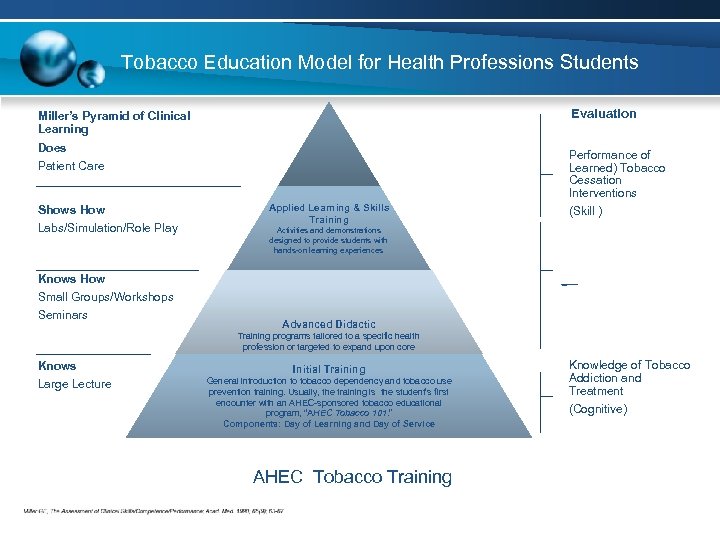 Tobacco Education Model for Health Professions Students Evaluation Miller’s Pyramid of Clinical Learning Does Patient Care Shows How Labs/Simulation/Role Play OSCE, Applied Learning & Skills Clinical Training, Activities and demonstrations Service designed to provide students with Learning hands-on learning experiences Knows How Small Groups/Workshops Seminars Knows Large Lecture Performance of Learned) Tobacco Cessation Interventions (Skill ) Self Efficacy of Cessation Intervention (Affective) Advanced Didactic Training programs tailored to a specific health profession or targeted to expand upon core concepts covered in the initial training. These Knowledge of Tobacco trainings build upon knowledge gained and serve Initial Training Addiction and as a booster to “AHEC Tobacco 101”. General introduction to tobacco dependency and tobacco use prevention training. Usually, the training is the student’s first Treatment encounter with an AHEC-sponsored tobacco educational (Cognitive) program, “AHEC Tobacco 101. ” Components: Day of Learning and Day of Service AHEC Tobacco Training
 Medical School Faculty • Faculty embraces the public health model of addressing agent, host, vector, and environment for tobacco reflects a systems approach based on lessons from the communicable disease community can be highly effective. • Faculty gets audited for a set tobacco curriculum required by the school curriculum committee • Clinical practices adds clinical systems for tobacco referrals and as part of students practicing tobacco at their sites
 Community Preceptors • Students practice tobacco skills as part of their clerkship rotation in community clinics • Preceptor practices tobacco assessment themselves as well as assess their students skills • Preceptors initiate a tobacco referral system in their clinics
 Clinical Systems Change • Students and Residents teams incorporate tobacco intervention as part of in patients admission intake • Tobacco prompts added in the electronic medical records system • In patient tobacco referral system and Pharmacotherapy Protocol established
 Policy Change • Smoke-Free Campus – Integration of tobacco training and systems – Stakeholders buy-in – Students, Residents, Faculty, Researchers, Leadership champions
 Implications for the Future • Future funding – Acquisition of multi-year funding • NIH, CDC, NCI – Public health focus • Health care reform – Transition to new practice environment • Systems-based programming
 Conclusion • In the ancient, revered Egyptian myth, the goddess Isis breathed clean air into her late husband Osiris to restore him to life. • AHECs strive to contemporize the myth by developing a tobacco program within the context of system change to help people breath cleaner air and be restored to a smoke-free life