


 Скачать презентацию Agriculture Ventilation Fans A National Energy Efficiency Standard
38eb8d160d5e6ce08e7b030fb6504555.ppt
- Количество слайдов: 22
 Agriculture Ventilation Fans: A National Energy Efficiency Standard R. D. Mac. Donald, P. Eng, M. E. Armstrong, P. Eng, and K. Gibb, Agviro, Inc. , Guelph, ON
 Introduction • • • Increased energy costs and demand management issues have made ventilation fans a large opportunity for utilities and farmers to save $$$ There is no agricultural fan ventilation standard in North America Developing standard that classifies fans into two tiers of energy efficiency Designed for easy cross referencing Method of energy efficiency labeling also proposed.
 Fan Test Method Based on the ASHRAE Fan Test Standard modified for agriculture by the BESS lab and ASABE Standards and Efficiency Standard EP. Fan Testing • ASABE S 565 OCT 2005 Agricultural Ventilation Constant Speed Fan Test Standard Fan Efficiency • ASAE/EP 566 DEC 01
 Fan Test Method Independent Third Party Fan Performance and Efficiency Verification are: • AMCA (Air Movement and Conditioning Association) • University of Illinois BESS Laboratory There are no other independent labs in N. America willing to perform these 3 rd party tests at this time.
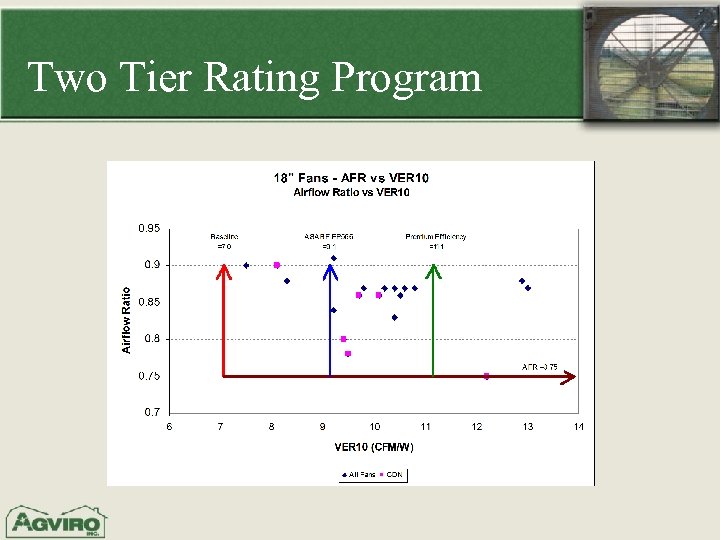
 Fan Test Performance Data Measurement Criteria • AIR 10: AIRflow performance at a static pressure of 0. 10” water column • VER 10: Ventilation Efficiency Ratio at a static pressure of 0. 10” w. c • AFR: Airflow Ratio. The Air Flow Ratio at a static pressure of 0. 2” w. c. divided by the airflow at a static pressure of 0. 05” w. c • AFR vs. VER 10: An analysis considering the combination of AFR and VER 10
![Efficiency Metrics 1. • VER 10 [CFM/W] Example with 18” fans Standard label used](https://present5.com/presentation/38eb8d160d5e6ce08e7b030fb6504555/image-6.jpg "Efficiency Metrics 1. • VER 10 [CFM/W] Example with 18” fans Standard label used") Efficiency Metrics 1. • VER 10 [CFM/W] Example with 18” fans Standard label used by BESS to identify fan performance, at 0. 10” (VER 05 at m 0. 05” was previously used)
Efficiency Metrics 1. • VER 10 [CFM/W] Example with 18” fans Standard label used by BESS to identify fan performance, at 0. 10” (VER 05 at m 0. 05” was previously used)
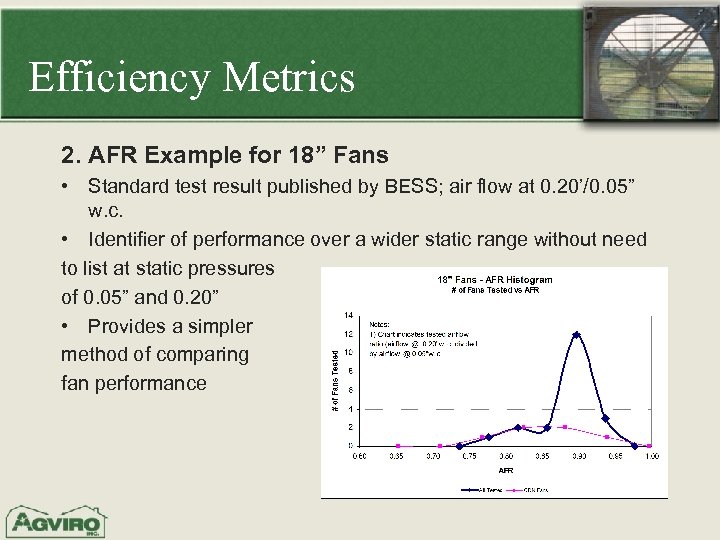 Efficiency Metrics 2. AFR Example for 18” Fans • Standard test result published by BESS; air flow at 0. 20’/0. 05” w. c. • Identifier of performance over a wider static range without need to list at static pressures of 0. 05” and 0. 20” • Provides a simpler method of comparing fan performance
 Fan Size Categories • Method to categorize fans is based on fan diameter in inches; most common N. American sales units • Selected sizes: 10”, 12”, 14”, 16”, 18”, 20”, 24”, 36”, 48”, 50 -53” • Analysis was conducted and final results were designed to ensure at least one Canadian manufacturer per category
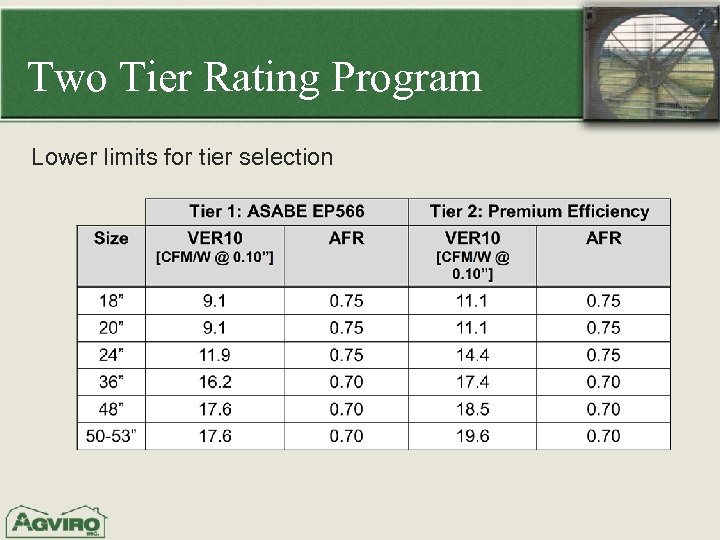
 Two Tier Rating Program Tier 1: ASABE EP 566 VER 10 Values 24, 36 and 48” fans • ASABE EP 566 VER 10 values for recommended efficiency levels 18” and 20” fans • The average value of all Canadian fans tested minus ½ of 1 standard deviation. 50 -53” fans • The value was taken as the same value for 48” fans from the ASABE EP 566 as this was similar to the average value minus ½ of 1 standard deviation
 Two Tier Rating Program Tier 2: Premium Efficiency VER 10 Values • The values determined for an Premium Efficiency VER 10 rating were calculated as being 1 standard deviation above the average values for all Canadian fans tested Tier 1& 2 Air Flow Ratio (AFR) Need fan diameters to match the AFR • Minimum level of 0. 7 for summer ventilation fans. • 0. 75 or higher for smaller minimum ventilation fans.
 Two Tier Rating Program
 Two Tier Rating Program Lower limits for tier selection
 Sample Report
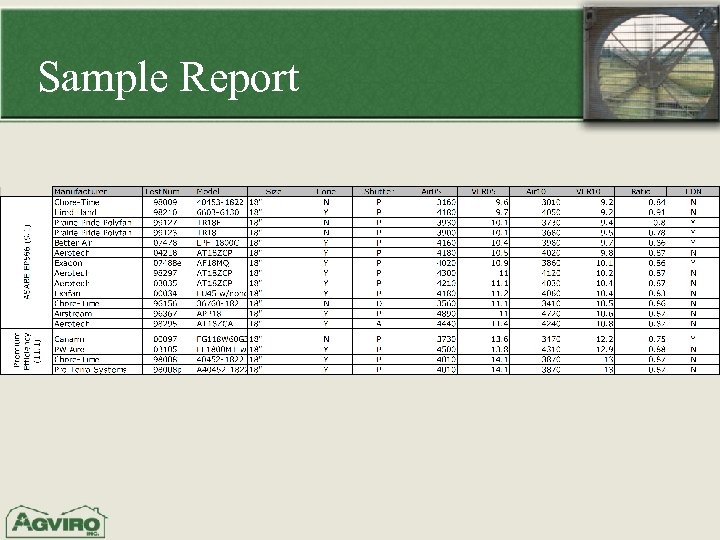
 Qualification & Labeling Qualification • Fans must be listed on the BESS Ventilation Fan Performance Test website • Fans must meet the criteria as a Tier 1 or Tier 2 energy efficient product Labeling • Fans are currently available with AMCA or BESS labeling, but with minimal information • Proposed labeling will provide more information than existing labels
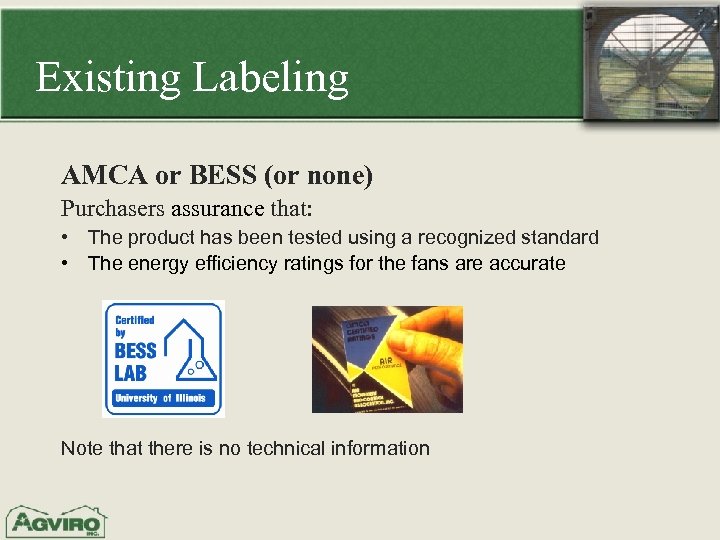 Existing Labeling AMCA or BESS (or none) Purchasers assurance that: • The product has been tested using a recognized standard • The energy efficiency ratings for the fans are accurate Note that there is no technical information
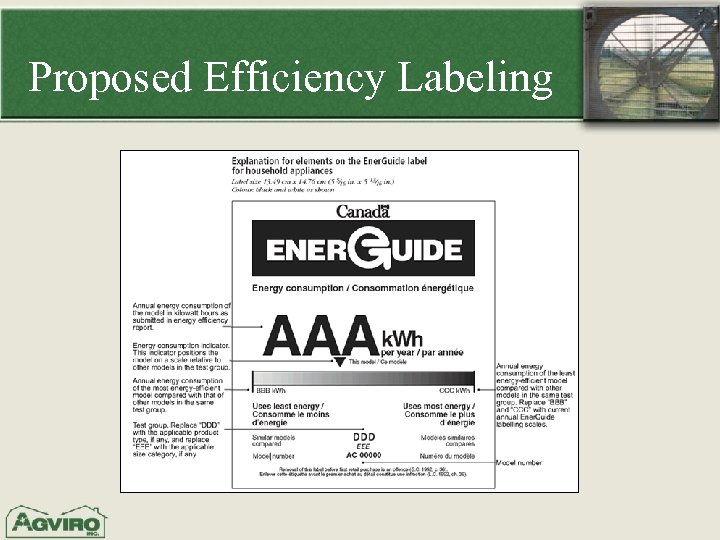
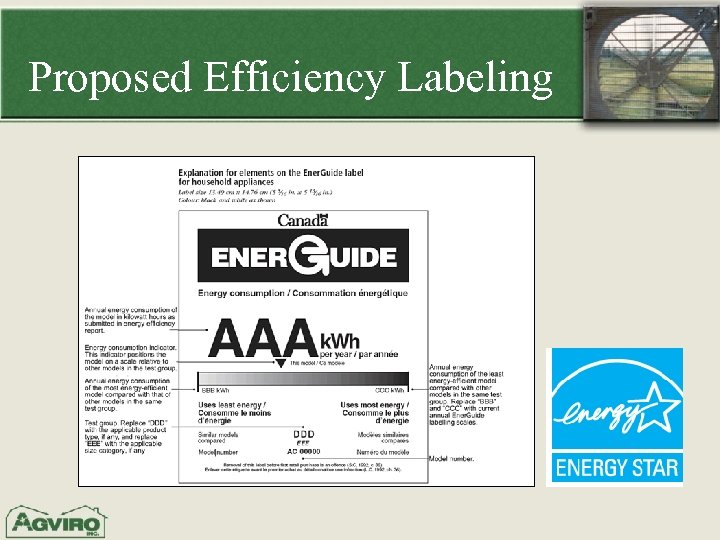
 Proposed Efficiency Labeling Tier 1: ASABE EP 566 VER 10 - Energuide The Tier 1 rating system should consist of the following: • Standard Energuide label • Rating by diameter with a daily 24 hour k. Wh minimum to maximum scale (allows users to calculate annual usage) • Rating by AMCA or BESS that meets or exceeds AFR and CFM/W ratings @ 0. 10” w. c. s. p.
 Proposed Efficiency Labeling
 Proposed Efficiency Labeling Tier 2: Premium Efficiency VER 10 The Tier 2 rating system should consist of the following: • Standard Energuide label • Rating by diameter with a daily 24 hour k. Wh minimum to maximum scale • Rating by AMCA or BESS that meets or exceeds AFR and CFM/W ratings @ 0. 10” w. c. s. p. • Premium efficiency label similar to the Energy Star label
 Proposed Efficiency Labeling
 Potential For Energy Star • Introduced as a voluntary labeling program in 1992 by the U. S. Environmental Protection Agency • Designed to promote energy efficient products that reduce GHG • 1996 merged with the Department of Energy • Provide labeling on all major appliances in the residential, commercial, and industrial sectors • Must meet strict guidelines set by the EPA to earn the energy star label • 3 rd party verification • 2007: provided customers with total savings of $16 billion on utility bills and avoided GHG equivalent to those from 27 million cars
 Stakeholders • Piloted the concept in March 2007 with 3 manufacturers. Good buy-in; but concerns where they did not have 3 rd party testing • Also surveyed utilities, Government and other parties for feedback • Currently refining the standard and will resend to stakeholders for final feedback
 Summary • An agricultural fan test standard has been developed – Grouped based on fan diameter – Subdivided into fans meeting ASABE EP 566 and Premium Efficiency standards – Contains at least one Canadian manufacturer per category – Designed for easy referencing – Utilities can use for programs, farms for selecting EE fans • Looking to release by the end of 2008