 Скачать презентацию Agricultural Policy and Law New Developments Pressing Issues by
835236efe372818e2ff4405f0069ec1f.ppt
- Количество слайдов: 72



Agricultural Policy and Law: New Developments/Pressing Issues by Donald L. Uchtmann and Robert J. Hauser
Law and Policy Topics 2002 Farm Bill Protecting Farmers & Lenders from Elevator Failure Liability Risks in Growing Tx Crops (E. g. , Root Worm Resistant Bt Corn) 2
Topic: 2002 Farm Bill Robert J. Hauser Agricultural and Consumer Economics University of Illinois 3
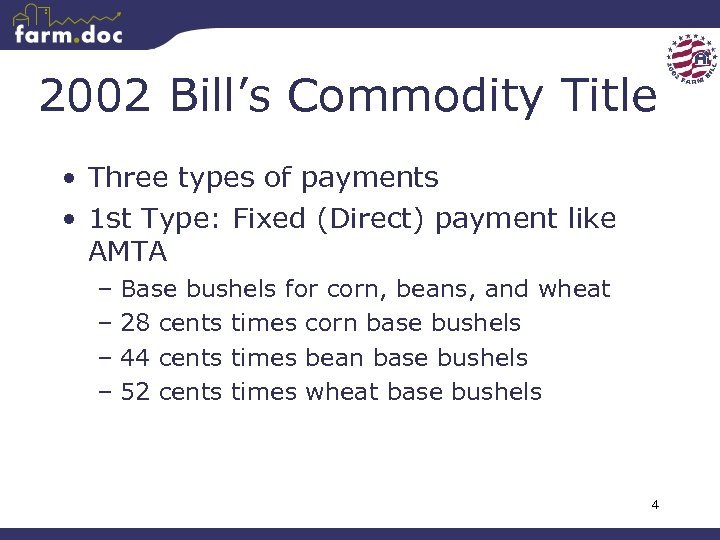
2002 Bill’s Commodity Title • Three types of payments • 1 st Type: Fixed (Direct) payment like AMTA – Base bushels for corn, beans, and wheat – 28 cents times corn base bushels – 44 cents times bean base bushels – 52 cents times wheat base bushels 4
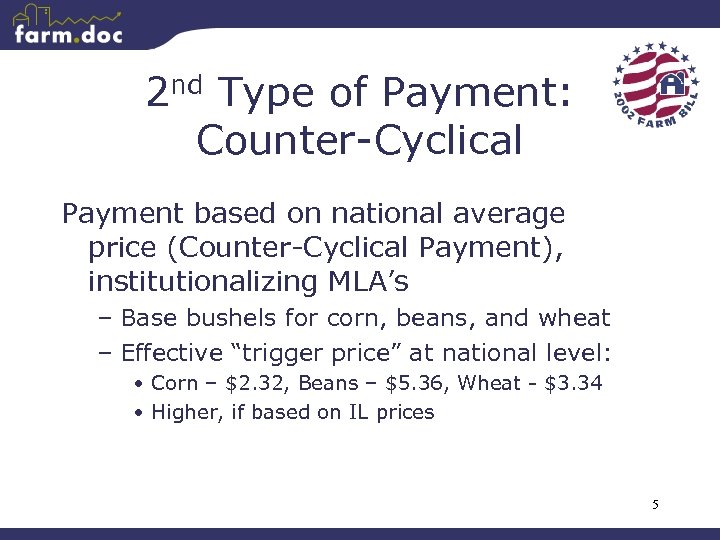
2 nd Type of Payment: Counter-Cyclical Payment based on national average price (Counter-Cyclical Payment), institutionalizing MLA’s – Base bushels for corn, beans, and wheat – Effective “trigger price” at national level: • Corn – $2. 32, Beans – $5. 36, Wheat - $3. 34 • Higher, if based on IL prices 5
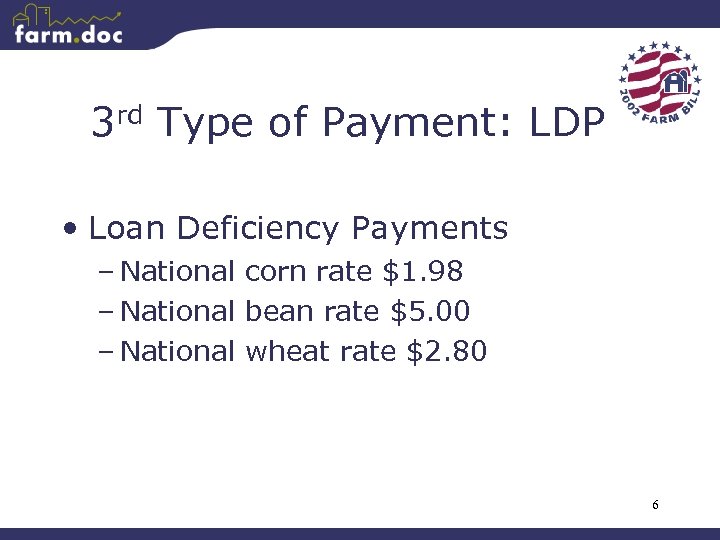
3 rd Type of Payment: LDP • Loan Deficiency Payments – National corn rate $1. 98 – National bean rate $5. 00 – National wheat rate $2. 80 6

7

8

9
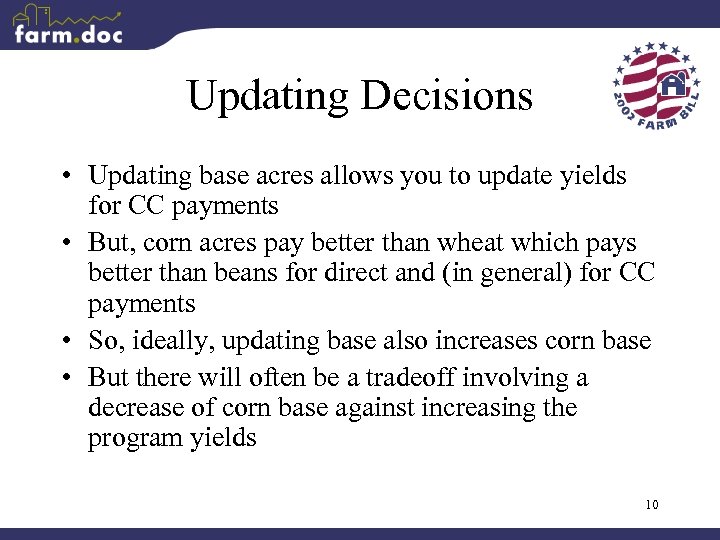
Updating Decisions • Updating base acres allows you to update yields for CC payments • But, corn acres pay better than wheat which pays better than beans for direct and (in general) for CC payments • So, ideally, updating base also increases corn base • But there will often be a tradeoff involving a decrease of corn base against increasing the program yields 10

11
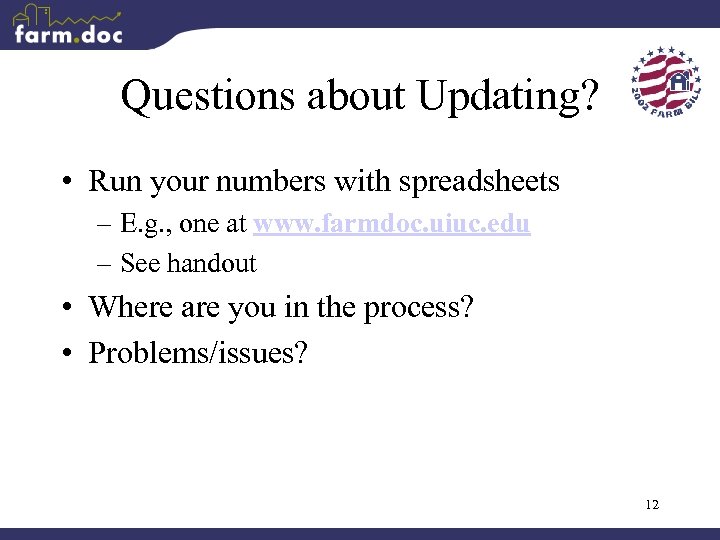
Questions about Updating? • Run your numbers with spreadsheets – E. g. , one at www. farmdoc. uiuc. edu – See handout • Where are you in the process? • Problems/issues? 12
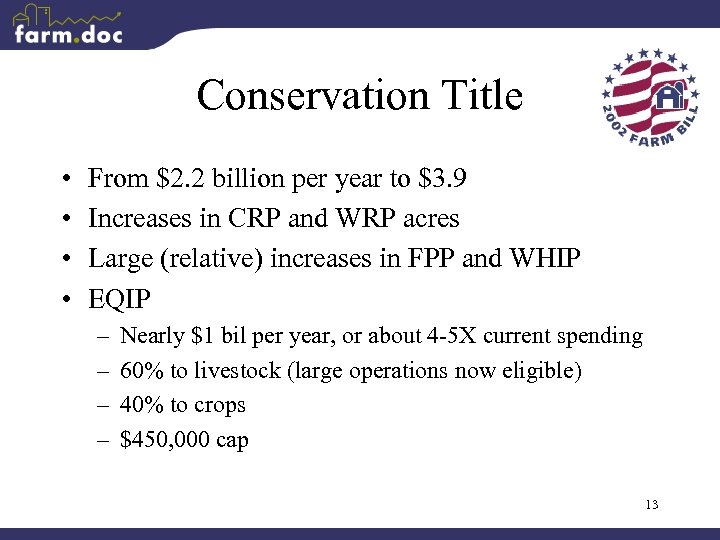
Conservation Title • • From $2. 2 billion per year to $3. 9 Increases in CRP and WRP acres Large (relative) increases in FPP and WHIP EQIP – – Nearly $1 bil per year, or about 4 -5 X current spending 60% to livestock (large operations now eligible) 40% to crops $450, 000 cap 13
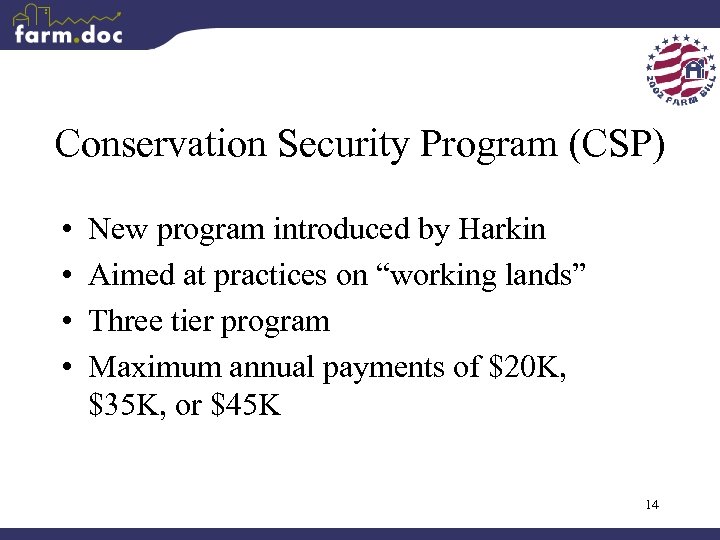
Conservation Security Program (CSP) • • New program introduced by Harkin Aimed at practices on “working lands” Three tier program Maximum annual payments of $20 K, $35 K, or $45 K 14
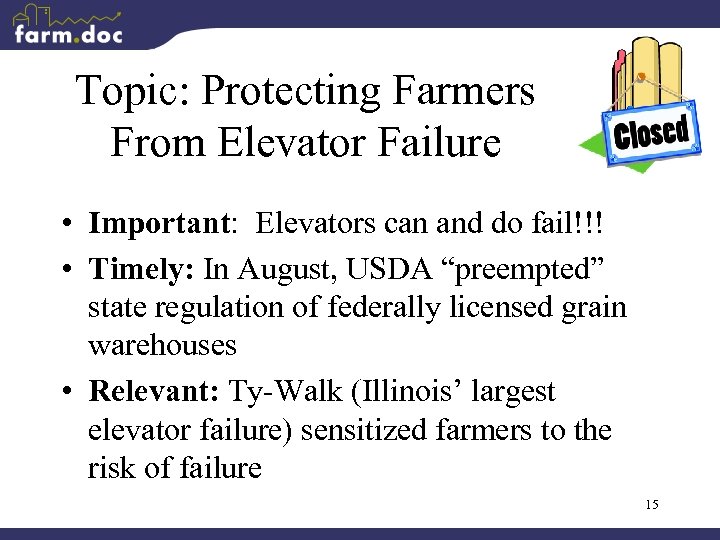
Topic: Protecting Farmers From Elevator Failure • Important: Elevators can and do fail!!! • Timely: In August, USDA “preempted” state regulation of federally licensed grain warehouses • Relevant: Ty-Walk (Illinois’ largest elevator failure) sensitized farmers to the risk of failure 15
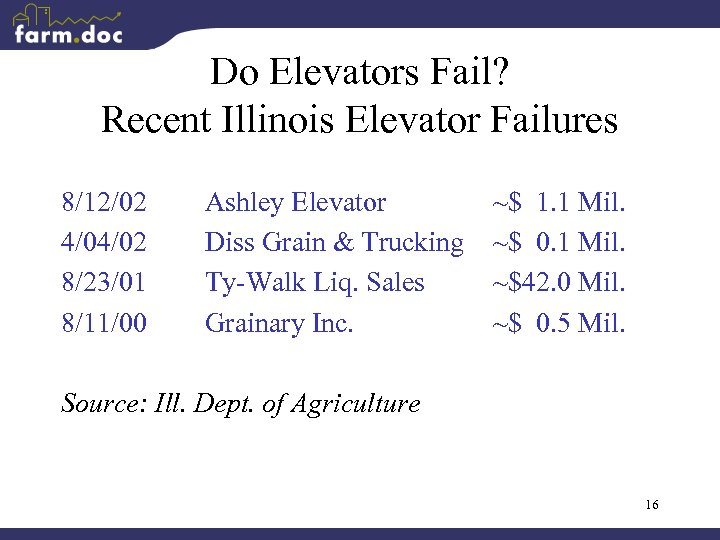
Do Elevators Fail? Recent Illinois Elevator Failures 8/12/02 4/04/02 8/23/01 8/11/00 Ashley Elevator Diss Grain & Trucking Ty-Walk Liq. Sales Grainary Inc. ~$ 1. 1 Mil. ~$ 0. 1 Mil. ~$42. 0 Mil. ~$ 0. 5 Mil. Source: Ill. Dept. of Agriculture 16
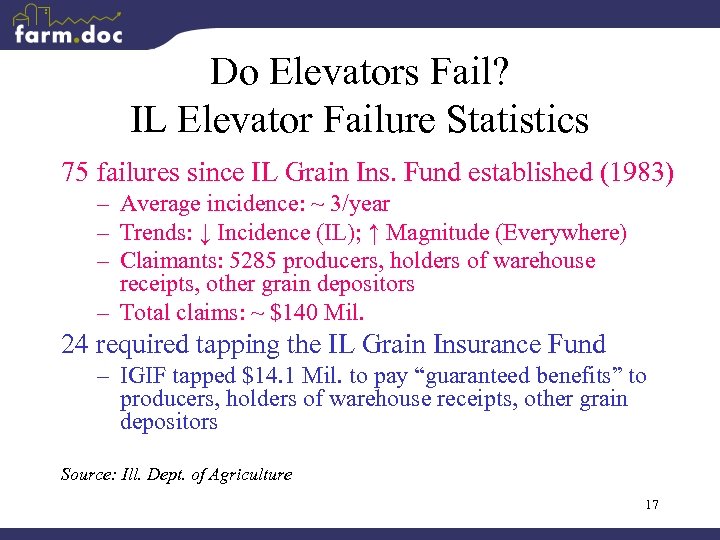
Do Elevators Fail? IL Elevator Failure Statistics 75 failures since IL Grain Ins. Fund established (1983) – Average incidence: ~ 3/year – Trends: ↓ Incidence (IL); ↑ Magnitude (Everywhere) – Claimants: 5285 producers, holders of warehouse receipts, other grain depositors – Total claims: ~ $140 Mil. 24 required tapping the IL Grain Insurance Fund – IGIF tapped $14. 1 Mil. to pay “guaranteed benefits” to producers, holders of warehouse receipts, other grain depositors Source: Ill. Dept. of Agriculture 17
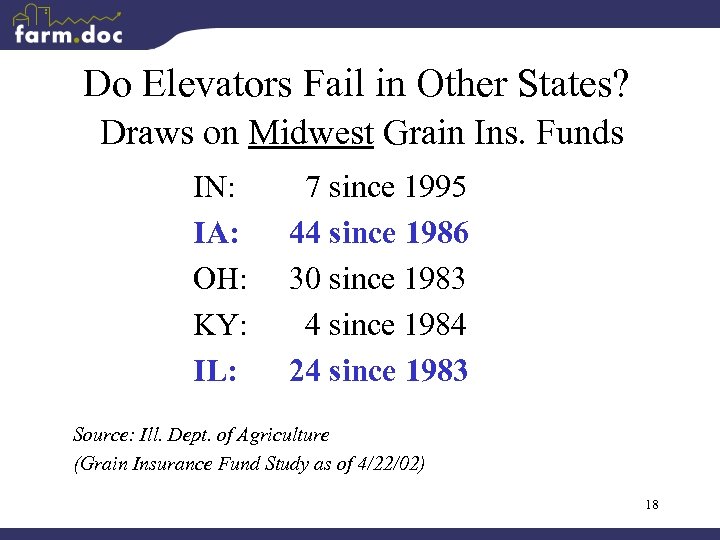
Do Elevators Fail in Other States? Draws on Midwest Grain Ins. Funds IN: IA: OH: KY: IL: 7 since 1995 44 since 1986 30 since 1983 4 since 1984 24 since 1983 Source: Ill. Dept. of Agriculture (Grain Insurance Fund Study as of 4/22/02) 18
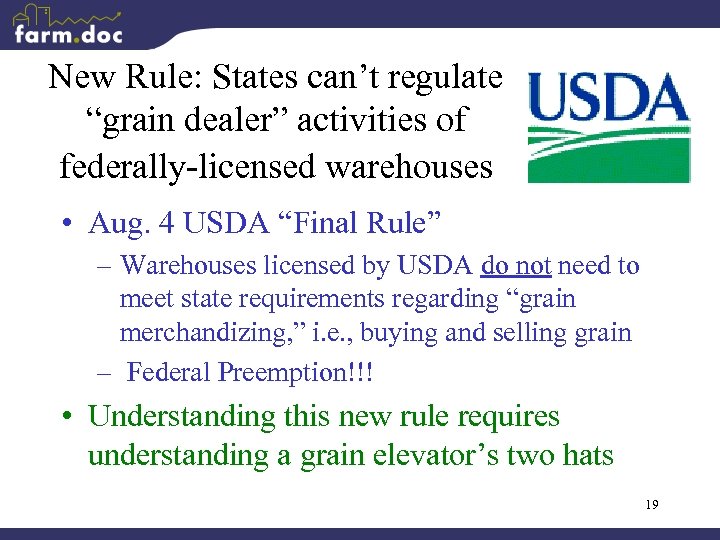
New Rule: States can’t regulate “grain dealer” activities of federally-licensed warehouses • Aug. 4 USDA “Final Rule” – Warehouses licensed by USDA do not need to meet state requirements regarding “grain merchandizing, ” i. e. , buying and selling grain – Federal Preemption!!! • Understanding this new rule requires understanding a grain elevator’s two hats 19
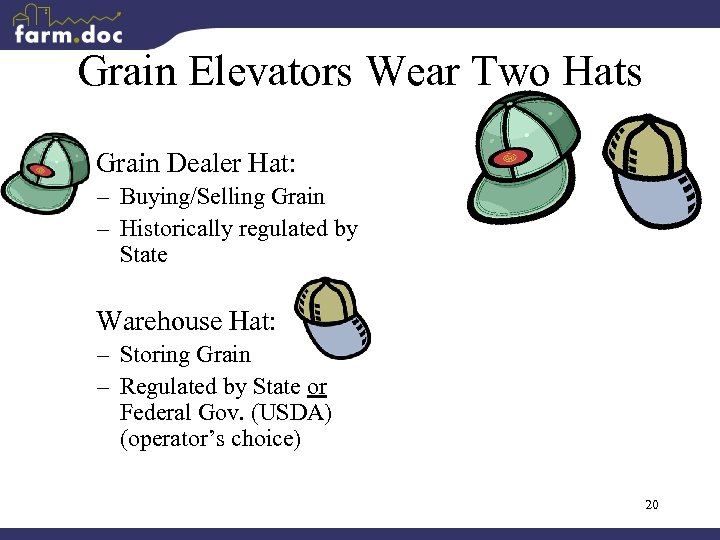
Grain Elevators Wear Two Hats Grain Dealer Hat: – Buying/Selling Grain – Historically regulated by State Warehouse Hat: – Storing Grain – Regulated by State or Federal Gov. (USDA) (operator’s choice) 20
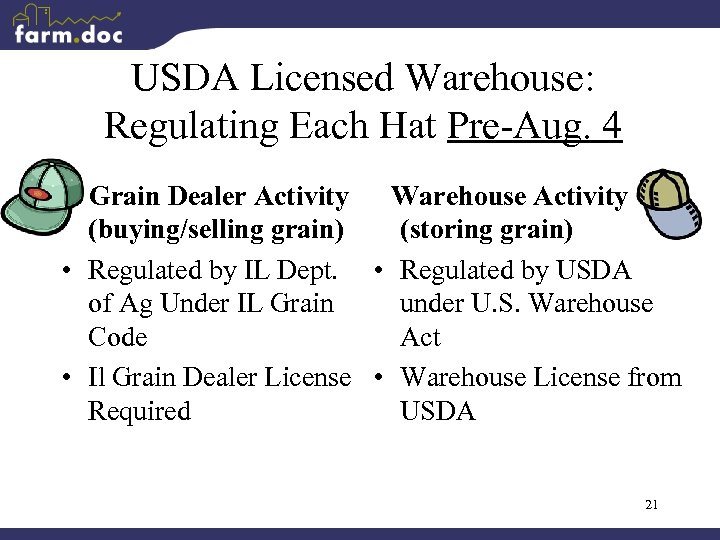
USDA Licensed Warehouse: Regulating Each Hat Pre-Aug. 4 Grain Dealer Activity Warehouse Activity (buying/selling grain) (storing grain) • Regulated by IL Dept. • Regulated by USDA of Ag Under IL Grain under U. S. Warehouse Code Act • Il Grain Dealer License • Warehouse License from Required USDA 21
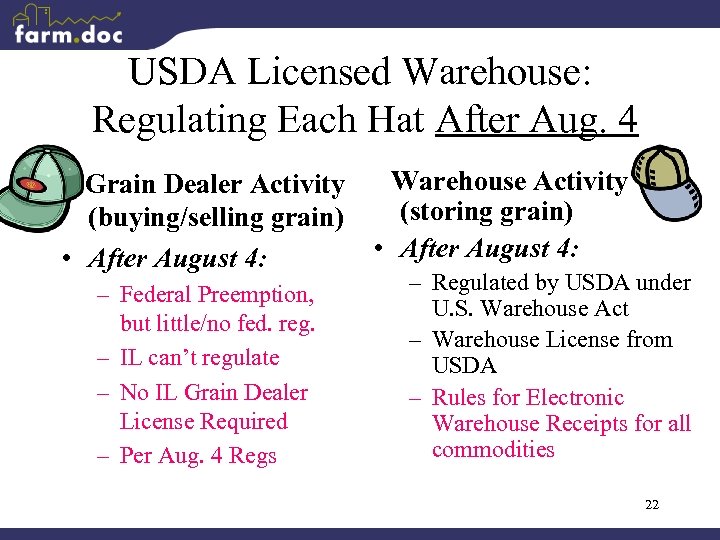
USDA Licensed Warehouse: Regulating Each Hat After Aug. 4 Grain Dealer Activity (buying/selling grain) • After August 4: – Federal Preemption, but little/no fed. reg. – IL can’t regulate – No IL Grain Dealer License Required – Per Aug. 4 Regs Warehouse Activity (storing grain) • After August 4: – Regulated by USDA under U. S. Warehouse Act – Warehouse License from USDA – Rules for Electronic Warehouse Receipts for all commodities 22
IL Elevators Affected by New Rule 28 federally-licensed warehouses But temporarily participating in IGIF 331 state-licensed warehouses could “switch” to federal But 90 -day moratorium on accepting new license applications from state licensed warehouses -Undersecretary J. B. Penn, Oct. 9, 2002 What happens January 2003? 23
What if federally licensed warehouse in IL fails in future? Assuming Federal Preemption Sticks: • Unpaid producers can’t access IGIF • Depositors of grain and Lenders with warehouse receipts can’t access IGIF – Unless warehouse voluntarily participates Note: All federally licensed warehouses have opted to participate in Grain Dealer portion of IGIF for the present, so their customers are currently protected 24
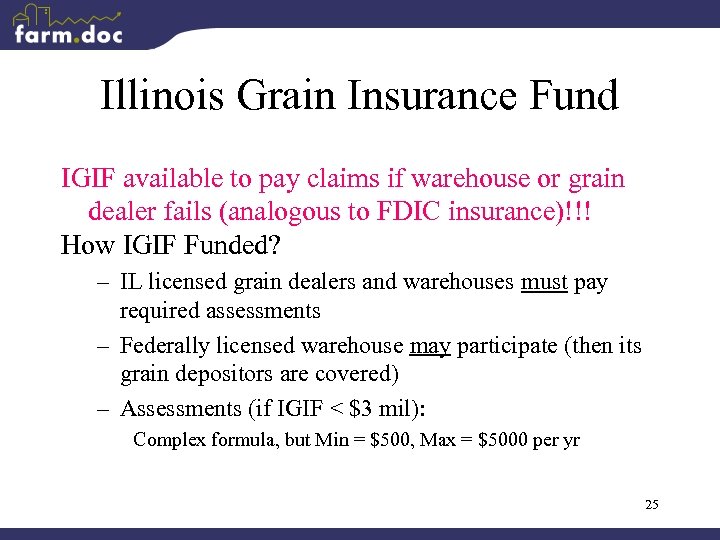
Illinois Grain Insurance Fund IGIF available to pay claims if warehouse or grain dealer fails (analogous to FDIC insurance)!!! How IGIF Funded? – IL licensed grain dealers and warehouses must pay required assessments – Federally licensed warehouse may participate (then its grain depositors are covered) – Assessments (if IGIF < $3 mil): Complex formula, but Min = $500, Max = $5000 per yr 25
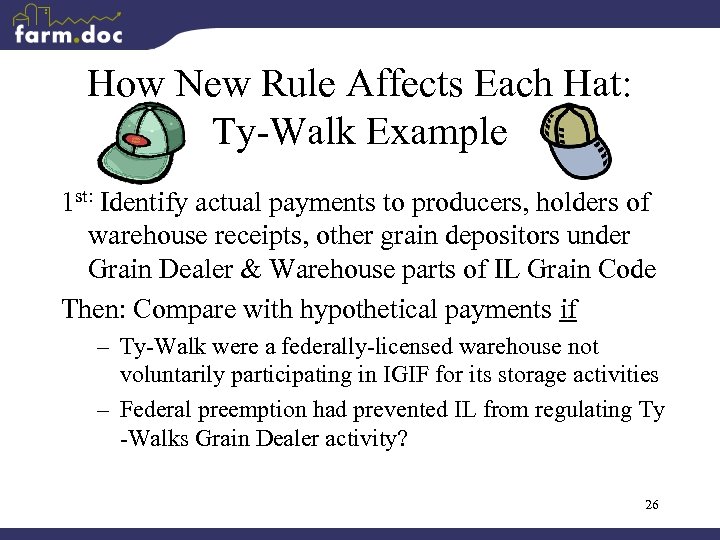
How New Rule Affects Each Hat: Ty-Walk Example 1 st: Identify actual payments to producers, holders of warehouse receipts, other grain depositors under Grain Dealer & Warehouse parts of IL Grain Code Then: Compare with hypothetical payments if – Ty-Walk were a federally-licensed warehouse not voluntarily participating in IGIF for its storage activities – Federal preemption had prevented IL from regulating Ty -Walks Grain Dealer activity? 26
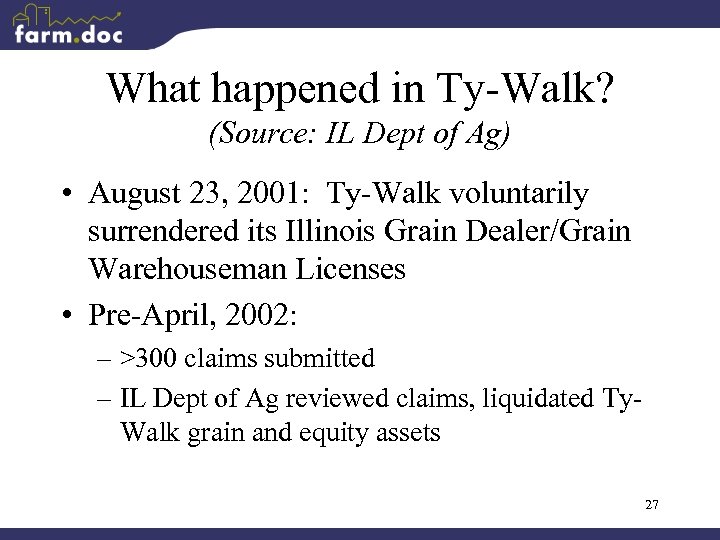
What happened in Ty-Walk? (Source: IL Dept of Ag) • August 23, 2001: Ty-Walk voluntarily surrendered its Illinois Grain Dealer/Grain Warehouseman Licenses • Pre-April, 2002: – >300 claims submitted – IL Dept of Ag reviewed claims, liquidated Ty. Walk grain and equity assets 27
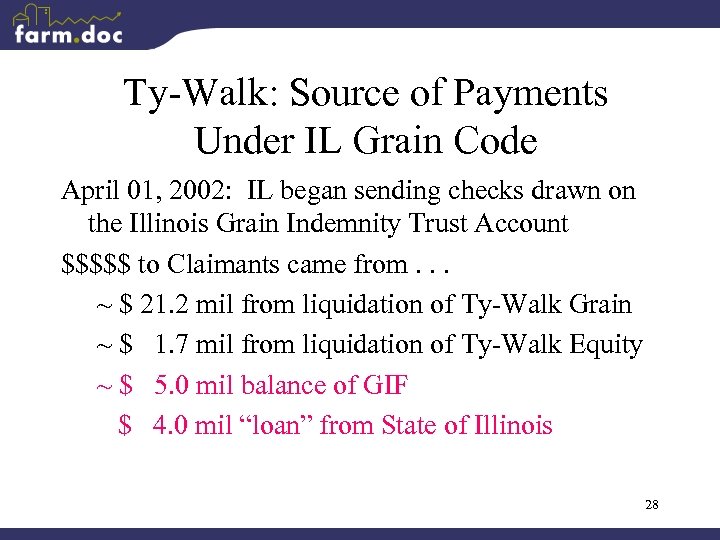
Ty-Walk: Source of Payments Under IL Grain Code April 01, 2002: IL began sending checks drawn on the Illinois Grain Indemnity Trust Account $$$$$ to Claimants came from. . . ~ $ 21. 2 mil from liquidation of Ty-Walk Grain ~ $ 1. 7 mil from liquidation of Ty-Walk Equity ~ $ 5. 0 mil balance of GIF $ 4. 0 mil “loan” from State of Illinois 28
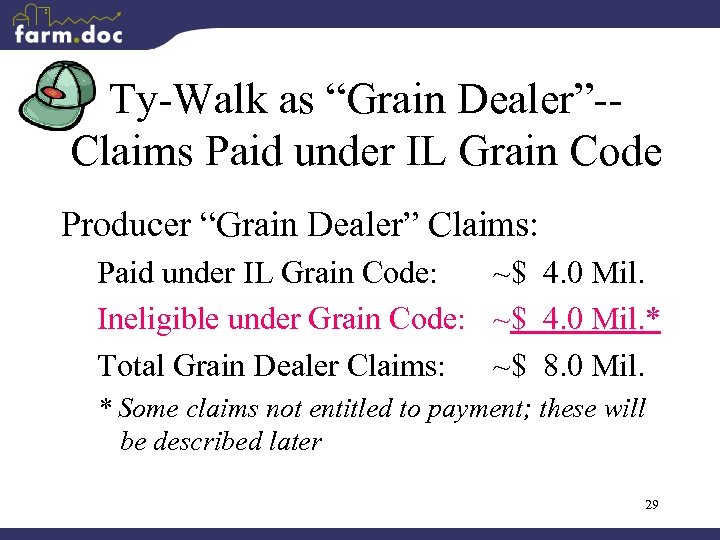
Ty-Walk as “Grain Dealer”-Claims Paid under IL Grain Code Producer “Grain Dealer” Claims: Paid under IL Grain Code: ~$ 4. 0 Mil. Ineligible under Grain Code: ~$ 4. 0 Mil. * Total Grain Dealer Claims: ~$ 8. 0 Mil. * Some claims not entitled to payment; these will be described later 29
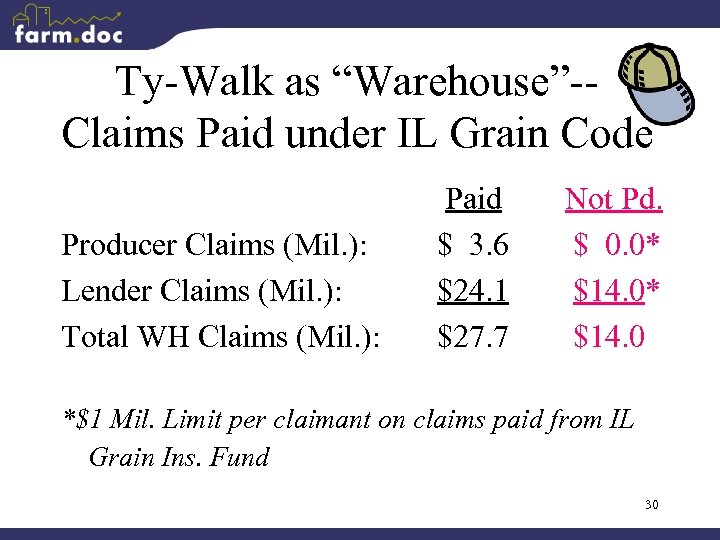
Ty-Walk as “Warehouse”-Claims Paid under IL Grain Code Producer Claims (Mil. ): Lender Claims (Mil. ): Total WH Claims (Mil. ): Paid $ 3. 6 $24. 1 $27. 7 Not Pd. $ 0. 0* $14. 0 *$1 Mil. Limit per claimant on claims paid from IL Grain Ins. Fund 30
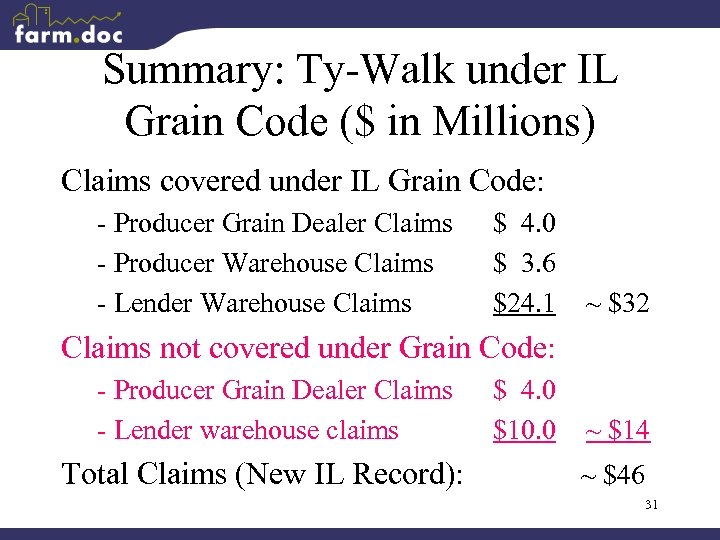
Summary: Ty-Walk under IL Grain Code ($ in Millions) Claims covered under IL Grain Code: - Producer Grain Dealer Claims - Producer Warehouse Claims - Lender Warehouse Claims $ 4. 0 $ 3. 6 $24. 1 ~ $32 Claims not covered under Grain Code: - Producer Grain Dealer Claims - Lender warehouse claims Total Claims (New IL Record): $ 4. 0 $10. 0 ~ $14 ~ $46 31
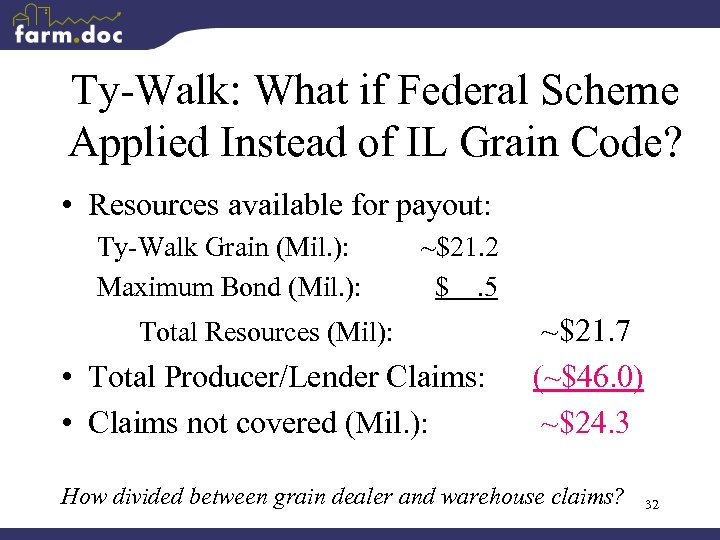
Ty-Walk: What if Federal Scheme Applied Instead of IL Grain Code? • Resources available for payout: Ty-Walk Grain (Mil. ): Maximum Bond (Mil. ): ~$21. 2 $. 5 Total Resources (Mil): • Total Producer/Lender Claims: • Claims not covered (Mil. ): ~$21. 7 (~$46. 0) ~$24. 3 How divided between grain dealer and warehouse claims? 32
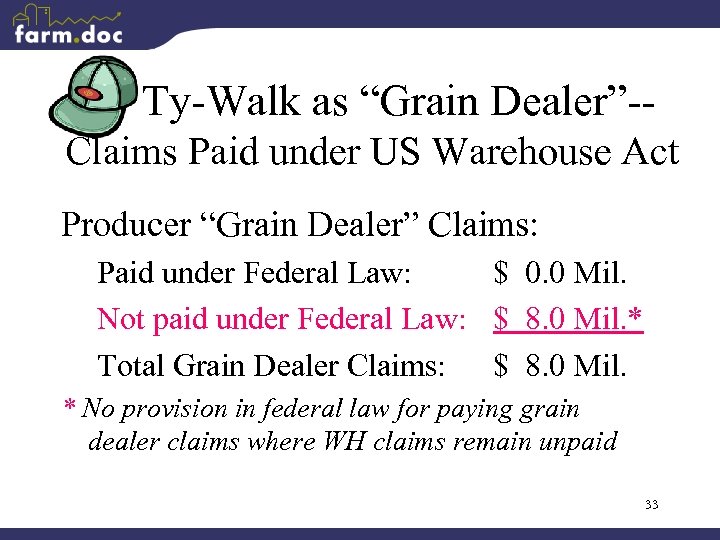
Ty-Walk as “Grain Dealer”-Claims Paid under US Warehouse Act Producer “Grain Dealer” Claims: Paid under Federal Law: $ 0. 0 Mil. Not paid under Federal Law: $ 8. 0 Mil. * Total Grain Dealer Claims: $ 8. 0 Mil. * No provision in federal law for paying grain dealer claims where WH claims remain unpaid 33
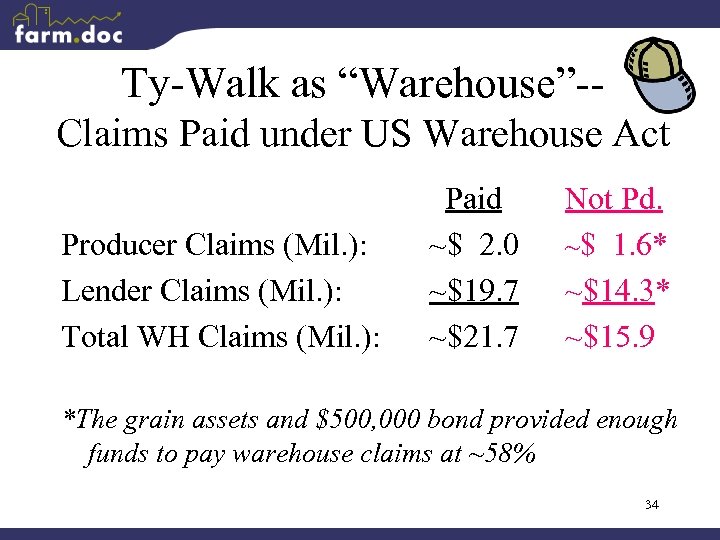
Ty-Walk as “Warehouse”-Claims Paid under US Warehouse Act Producer Claims (Mil. ): Lender Claims (Mil. ): Total WH Claims (Mil. ): Paid ~$ 2. 0 ~$19. 7 ~$21. 7 Not Pd. ~$ 1. 6* ~$14. 3* ~$15. 9 *The grain assets and $500, 000 bond provided enough funds to pay warehouse claims at ~58% 34
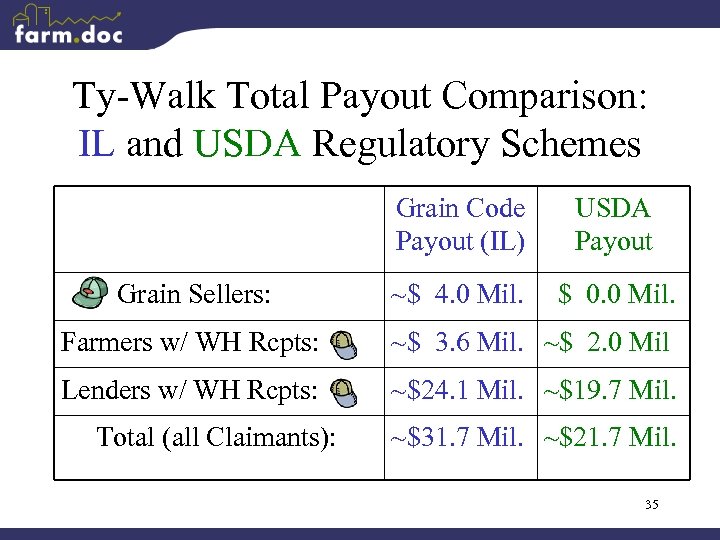
Ty-Walk Total Payout Comparison: IL and USDA Regulatory Schemes Grain Code Payout (IL) Grain Sellers: USDA Payout ~$ 4. 0 Mil. $ 0. 0 Mil. Farmers w/ WH Rcpts: ~$ 3. 6 Mil. ~$ 2. 0 Mil Lenders w/ WH Rcpts: ~$24. 1 Mil. ~$19. 7 Mil. Total (all Claimants): ~$31. 7 Mil. ~$21. 7 Mil. 35
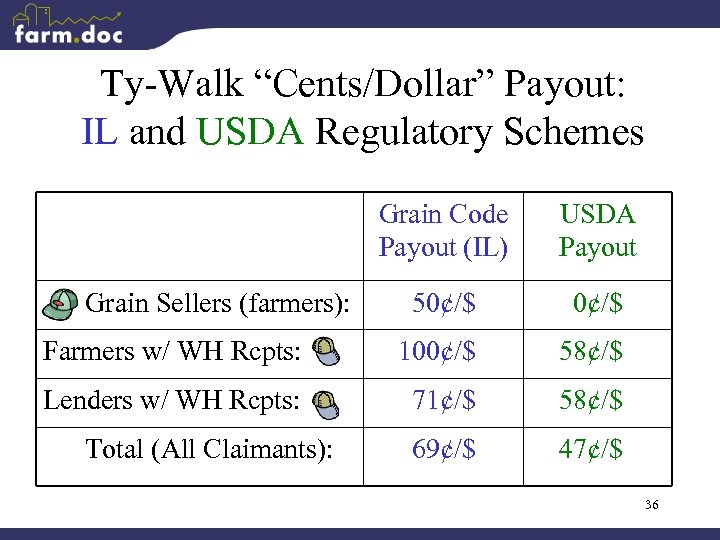
Ty-Walk “Cents/Dollar” Payout: IL and USDA Regulatory Schemes Grain Code Payout (IL) USDA Payout 50¢/$ Farmers w/ WH Rcpts: 100¢/$ 58¢/$ Lenders w/ WH Rcpts: 71¢/$ 58¢/$ 69¢/$ 47¢/$ Grain Sellers (farmers): Total (All Claimants): 36
Policy/Strategy Options Re: Federal Preemption 1. Accept federal preemption? 2. Accept federal preemption, but ask USDA to expand its regulation of “grain dealers”? 3. Challenge USDA preemption in courts? 4. Seek a legislative “rollback” of federal preemption? 5. Seek a USDA “rollback” of its new rule? Great uncertainty! Resolution needed quickly!!! 37
Different Issue: How fix IL Grain Insurance Fund and Grain Code? • IGIF needs to be replenished – New target balance? – Assessments on Sellers as well as warehouses & grain dealers? What about lenders? • Increase oversight responsibility for farmer marketing programs of grain dealers? 38
Grain Code Amendment: Funding/Replenishing the IGIF? Balance triggering assessments (target balance)? – $3 Mil: Current Law – $7 Mil: Task Force Recommendation – $5 Mil: SB 1573 (died last spring) Replenish? – Must pay $4 Mil. “loan” + build target bal. Assessment Reform? – Current annual assessment on licensees: ~ $800, 000 – Double this? Also assess 1 st sellers (e. g. , @. 0005 x sales)? – Also assess lenders using warehouse receipts as collateral? 39
Grain Code Amendment: Oversight of Farmer Marketing Programs? • Ty-Walks Farmer Marketing Program – A complicated “farmer marketing program” – Involved trades on the Chicago Board of Trade – Participating producers had an “account balance” in the producer’s name on Ty-Walk’s books (many disputed!) – These FMP Accounts Receivable totaled ~$26 Mil. • Should such programs be more closely regulated? If so, how? By whom? With what resources? 40

Different Issue: How can Farmers & Lenders reduce the adverse consequences of elevator failure? What does the Ty-Walk example tell us? 41
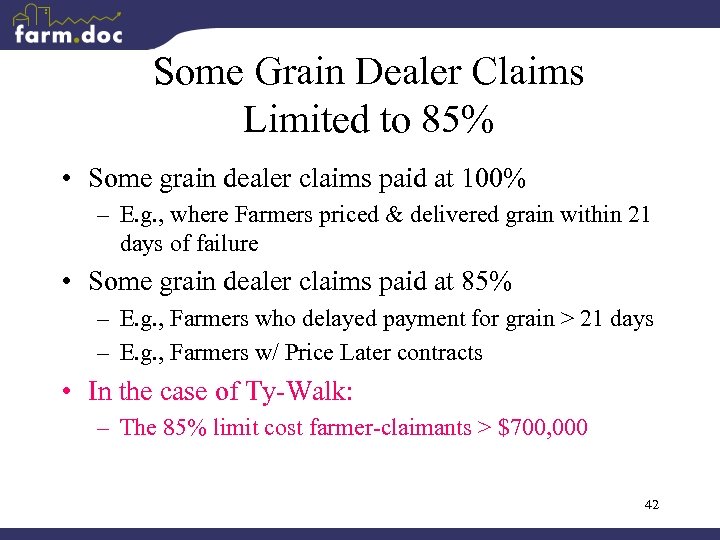
Some Grain Dealer Claims Limited to 85% • Some grain dealer claims paid at 100% – E. g. , where Farmers priced & delivered grain within 21 days of failure • Some grain dealer claims paid at 85% – E. g. , Farmers who delayed payment for grain > 21 days – E. g. , Farmers w/ Price Later contracts • In the case of Ty-Walk: – The 85% limit cost farmer-claimants > $700, 000 42
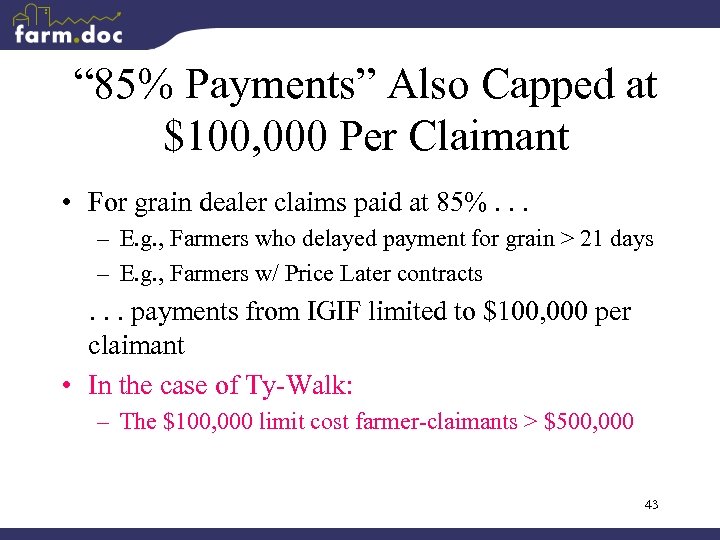
“ 85% Payments” Also Capped at $100, 000 Per Claimant • For grain dealer claims paid at 85%. . . – E. g. , Farmers who delayed payment for grain > 21 days – E. g. , Farmers w/ Price Later contracts . . . payments from IGIF limited to $100, 000 per claimant • In the case of Ty-Walk: – The $100, 000 limit cost farmer-claimants > $500, 000 43
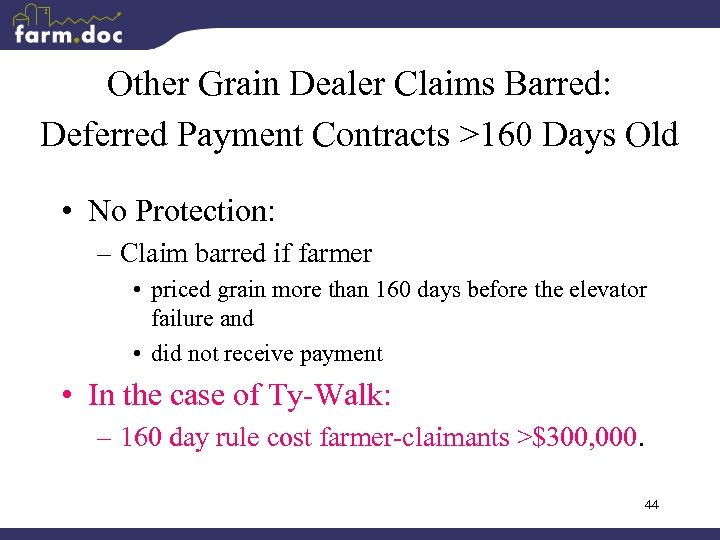
Other Grain Dealer Claims Barred: Deferred Payment Contracts >160 Days Old • No Protection: – Claim barred if farmer • priced grain more than 160 days before the elevator failure and • did not receive payment • In the case of Ty-Walk: – 160 day rule cost farmer-claimants >$300, 000. 44
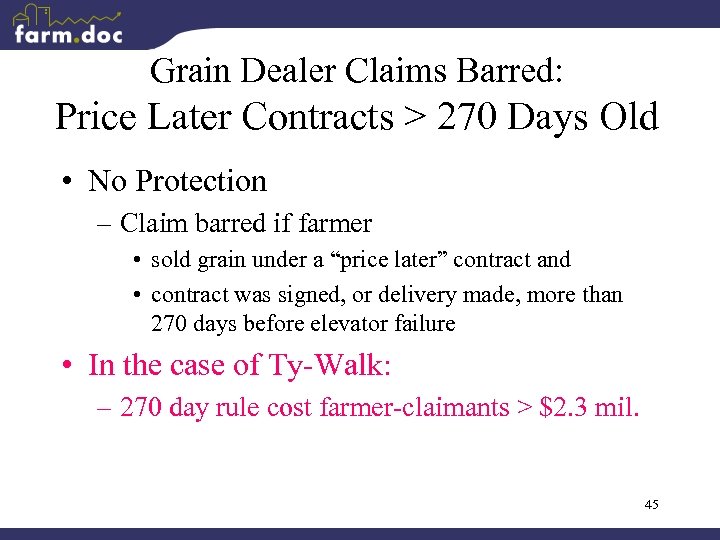
Grain Dealer Claims Barred: Price Later Contracts > 270 Days Old • No Protection – Claim barred if farmer • sold grain under a “price later” contract and • contract was signed, or delivery made, more than 270 days before elevator failure • In the case of Ty-Walk: – 270 day rule cost farmer-claimants > $2. 3 mil. 45
$1, 000 Limit Per Claimant • Payouts from IL Grain Insurance Fund are limited to $1, 000 per claimant • In the case of Ty-Walk: – Five creditors collectively experienced uncovered losses of almost $10 million because of the $1, 000 limit on IGIF payouts to any one claimant – But no producers were affected by this limit 46
Protecting yourself from the risks of elevator failure • What’s the most important step farmers can take to reduce their risk if an elevator fails? • What’s the most important step lenders can take? 47
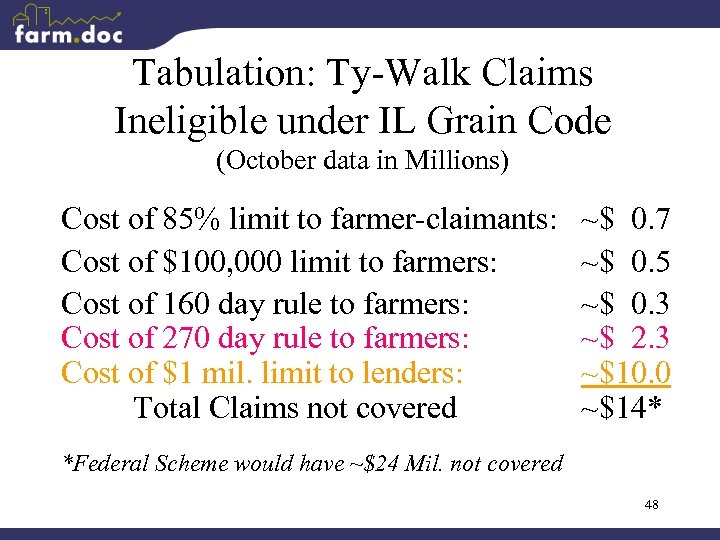
Tabulation: Ty-Walk Claims Ineligible under IL Grain Code (October data in Millions) Cost of 85% limit to farmer-claimants: Cost of $100, 000 limit to farmers: Cost of 160 day rule to farmers: Cost of 270 day rule to farmers: Cost of $1 mil. limit to lenders: Total Claims not covered ~$ 0. 7 ~$ 0. 5 ~$ 0. 3 ~$ 2. 3 ~$10. 0 ~$14* *Federal Scheme would have ~$24 Mil. not covered 48
Summary: Protecting Farmers From Elevator Failure • Federal preemption of state’s traditional role of regulating grain dealer activity – IL regime has “defined benefit”; US regime has defined contribution (grain assets plus bond) – Impacts on producers/lenders using Ty-Walk example – Policy options: • Undo preemption? If so, how? • Enhance federal regulatory scheme? If so, how? 49
Summary Continued: Protecting Farmers. . • Need to “fix” IL Grain Code – How fund/replenish the IL Grain Insurance Fund? – Increase oversight responsibility for farmer marketing programs of grain dealers? • Protecting yourself from elevator failure – Most important step for farmers, in light of Ty-Walk? – Most important step for lenders, in light of Ty-Walk? 50
Topic: Brief Update on IL Landlord’s Lien • P. A. 92 -0819, effective August 21, 2002, eliminates the requirement for landlords to file a UCC 1 with the IL Sec. of State • Illinois’ Statutory Landlord’s Lien once again has priority, automatically, over other security interests in the crop • See farmdoc web site for more info http: //www. farmdoc. uiuc. edu/legal/securing. Ag_rent__text. html 51
Topic: Liability Risks in Growing “Tx” Crops • Examples of Transgenic (Tx) Crops • Damages that could theoretically result from growing Tx Crops • Potential grower liability for such damages • Potential steps to manage the liability risk 52
Examples of Tx Crops • Bt Corn approved for feed/food use in US – Varieties approved in major export markets – Varieties awaiting approval overseas, e. g. , • Round-up Ready • Herculex I • Yield. Gard Rootworm (U. S. approval pending) • Roundup Ready™ Beans • Tx Crops for pharmaceutical or industrial use (not approved for food or feed use in US) 53
Growing Tx Crops: Theoretical Damages • • Damage to human health Damage to environment Damage to property Damage for patent infringement 54
Damage to Human Health and Environment • Tx crops undergo rigorous US regulatory review of health/environmental risks • Tx crops approved for feed/food use are deemed to be – Safe for human consumption – Safe for environment when grown as directed 55
Damage to Human Health and Environment • Even if someone did get sick, e. g. , allergic reaction, grower liability is unlikely • Even if the environment is damaged, grower liability unlikely – Especially if grown as directed, e. g. , refuge requirements for Bt corn are met 56
Special Case: Pharmaceutical or Industrial Tx Crops Growing pharmaceutical or industrial Tx crops creates additional liability risk – Such Tx crops may not be approved for food/feed use (may not be safe as food/feed) – Obvious potential liability if farmer allows such crops to be channeled into food/feed use and people or animals are injured as a result Growing of pharma crops in future likely to be totally controlled of pharma company 57
Prodi. Gene Example (but problem for Company, not Farmer) • 2001: Prodi. Gene used Neb. test plot to grow/test Tx corn producing pharmaceuticals • 2002: Test plot used to grow soybeans • October 2002: APHIS inspectors discovered volunteer Tx corn in the test plot (a violation of test plot limitations) – Ordered company to remove volunteer corn – Ordered “hold” on harvested beans from plot – beans now in local elevator containing 500, 000 Bu. of soybeans • Cost of buy and destroy 500 k Bu. : ~$2. 7 Mil. • In Iowa, a similar Prodi. Gene situation: – Prodi. Gene “incinerated” 115 acres of corn adjacent to test plot 58
Biotechnology Industry Organization (BIO) Statement: “Spurred by growing fear that drugs or chemicals made in gene-altered plants will taint the food supply, . . . [BIO] is adopting a broad moratorium on planting certain types of crops in major foodproducing regions. The voluntary ban, . . . beyond any proposed government regulation, is designed to prevent the spread of exotic genes into field crops likely to be used for food or animal feed. - Washington Post, 10/22/02, p. E 01 59
Real Concern: Damage to Property by Pollen Drift or Commingling of Tx Crops Fully Approved in US • E. g. , neighbor’s Bt corn pollen drifts and pollinates farmer’s GMO-free corn crop; farmer’s crop damaged, i. e. , not eligible for GMO-free “premium” • E. g. , farmer inadvertently sells Bt corn to corn processor; processor’s shipment of corn gluten feed is damaged by GMO “contamination, ” i. e. , rejected or discounted by European buyer 60
“Tool Kit” of Plaintiff’s Attorneys have various legal theories on which to base a liability suit, e. g. , . . . – Negligence, Nuisance, Trespass, – Strict liability, Breach of Contract Each theory has its particular “elements” that must be proven by the Plaintiff Synthesis of these theories suggests some steps to reduce risk of farmer-liability. . . 61
Property Damage: Managing the Liability Risk • Know the varieties you are growing and which buyers will accept these varieties • If growing Tx crop varieties with limited markets: – Talk to your neighbors selling to special markets so each can act reasonably to limit cross-pollination – Keep these varieties segregated • Channeling Tx crops to appropriate market & use • Be truthful when asked what varieties you are delivering for sale 62
Property Damage: Managing Contract Liability Be very cautious with contract language E. g. , don’t sign contracts saying your crop. . . – has no GMO germplasm (or no DNA of a particular type) – is not contaminated by any pollen drift, or – is not contaminated by mechanical handling. Such assurances probably beyond farmer’s control. 63
Managing Contract Liability Continued But contract could say (assuming it’s true), e. g. , • • • only the following seed varieties, as represented by the seed company, were (will be) planted [include names of seed varieties]; buffer areas, as required by the tags on any seed varieties, were (will be) installed and handled as specified in the written requirements; and reasonable care was (will be) taken to avoid mechanical contamination by any seed varieties requiring special handling. 64
Where Liability Is Clear: . . . Patent Infringement • Utility Patent: Utility patent provides right to exclude others from making, selling, or using within the United States the patented invention for twenty years • Patent Infringement: Making, selling, or using the patented invention w/o permission • Damages for Infringement: – Not less than a reasonable royalty for use of the technology – Possibly “treble damages, ” where infringement willful – Reasonable attorney fees in some cases 65
Roundup Ready™ Beans • Monsanto's utility patents cover – – Glyphosate-tolerant plants (Roundup Ready plants) Genetically modified seeds for such plants Specific modified genes Method of producing Tx plants • Using/selling Roundup Ready soybeans, seeds, or genes within territorial boundaries of US without authority from Monsanto is an infringement 66
Recent Federal Cases -Saving Roundup Ready Seeds Monsanto v. Mc. Farling (Fed. Cir. 2002) and Monsanto v. Trantham (Tenn. 2001) are recent federal court cases where Farmers. . . – Saved Roundup Ready beans for planting – Were sued by Monsanto for patent infringement or breach of contract – Were not successful in challenging the legal barriers to saving Roundup Ready beans for seed 67
Lessons from Trantham & Mc. Farling • Right to save seed from plants registered under the Plant Variety Protection Act does not convey to farmers the right to save seed from plants, like Roundup Ready soybeans, containing technologies patented under Patent Act • Doctrines of patent exhaustion and first sale do not prevent Monsanto from enforcing its restrictive agreements and patent rights in Roundup Ready beans 68
Lessons - Continued • Monsanto’s agreement with all seed dealers, that anyone buying Roundup Ready seeds must sign a technology agreement that prohibits saving seed, is not an unreasonable restraint of trade under the Sherman Act • Allegations that Monsanto is guilty of monopolization in violation of Sherman Act are not supported by the evidence 69
Final Lessons • Monsanto is not precluded, because the price of Roundup Ready soybean seeds is high (especially when compared to the price charged in Argentina), from enforcing its patent rights against U. S. farmers who saved seed • Where – seed dealer forged farmer’s signature on technology agreement – this farmer saves seeds the doctrine of unclean hands does not bar Monsanto from suing for patent infringement – but Monsanto could be barred from enforcing other terms of the technology agreement 70
Saving Patented Seeds: The Bottom Line • Many farmers dislike the legal barriers to saving Roundup Ready beans for seed • Legal barriers (e. g. , patent rights) have been upheld by federal courts when challenged by farmers caught saving beans for seed • It’s unlikely that farmers who – disregard the legal barriers to saving seed – or acquire “pirated” seeds from another can successfully defend such conduct in court 71
The End 2002 Farm Bill Protecting Farmers & Lenders from Elevator Failure Liability Risks in Growing Tx Crops (E. g. , Root Worm Resistant Bt Corn) By Donald L. Uchtmann and Robert J. Hauser 72
Скачать презентацию Agricultural Policy and Law New Developments Pressing Issues by
835236efe372818e2ff4405f0069ec1f.ppt