 Скачать презентацию Agricultural and Environmental Sustainability Issues and Research AGR SWS
1430995756959ee5c04a5cfe888c8e25.ppt
- Количество слайдов: 32



Agricultural and Environmental Sustainability: Issues and Research (AGR/SWS 6932) Norm Leppla University of Florida, IFAS
Agricultural and Environmental Sustainability (75 Minutes) • What is IPM? • IPM Practices • UF/IFAS and Related IPM Resources • Access to IPM Information for Florida Crops • IPM Education, Training and Credentials
What is IPM? National Road Map for Integrated Pest Management (USDA, Office of Pest Management Policy) May 17, 2004 Integrated Pest Management, or IPM, is a longstanding, science-based, decision-making process that identifies and reduces risks from pests and pest management related strategies. http: //www. ipmcenters. org/Docs/IPMRoad. Map. pdf
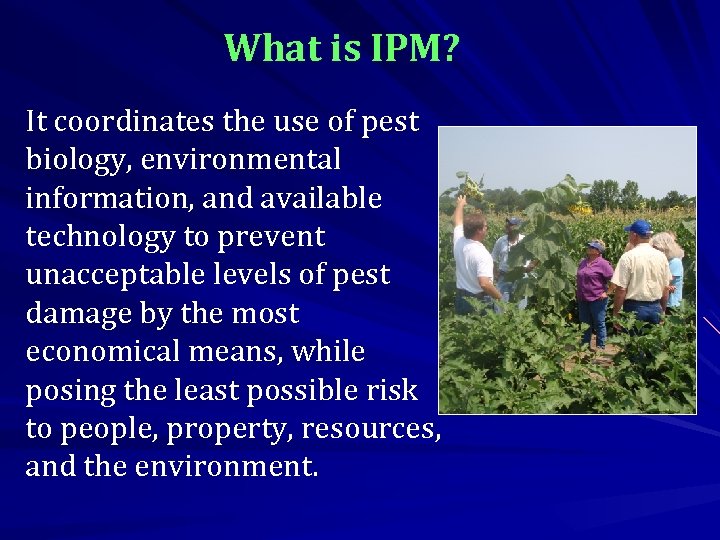
What is IPM? It coordinates the use of pest biology, environmental information, and available technology to prevent unacceptable levels of pest damage by the most economical means, while posing the least possible risk to people, property, resources, and the environment.
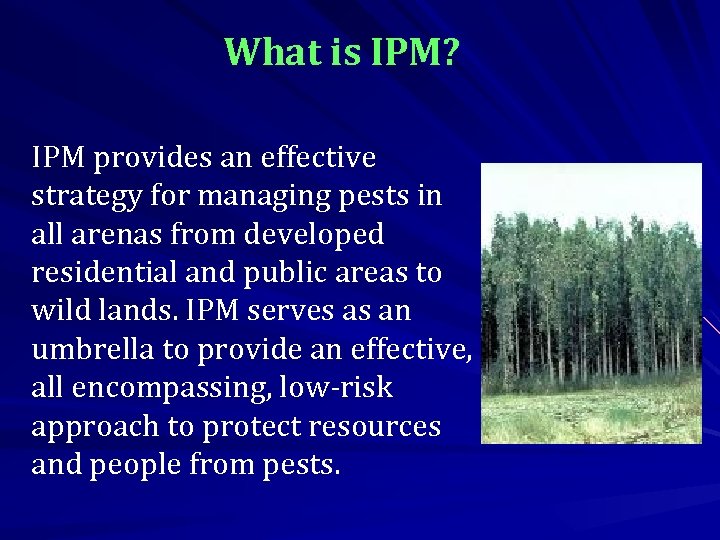
What is IPM? IPM provides an effective strategy for managing pests in all arenas from developed residential and public areas to wild lands. IPM serves as an umbrella to provide an effective, all encompassing, low-risk approach to protect resources and people from pests.
7 th International IPM Symposium Due to its tremendous success & acceptance, IPM is in: Ø Sustainable and organic agriculture Ø Food security, safety and quality Ø Community and school IPM Ø Environmental, conservation Ø Federal and state regulatory activities Ø Public health, renewable energy, etc. http: //www. ipmcenters. org/ipmsymposium 12/
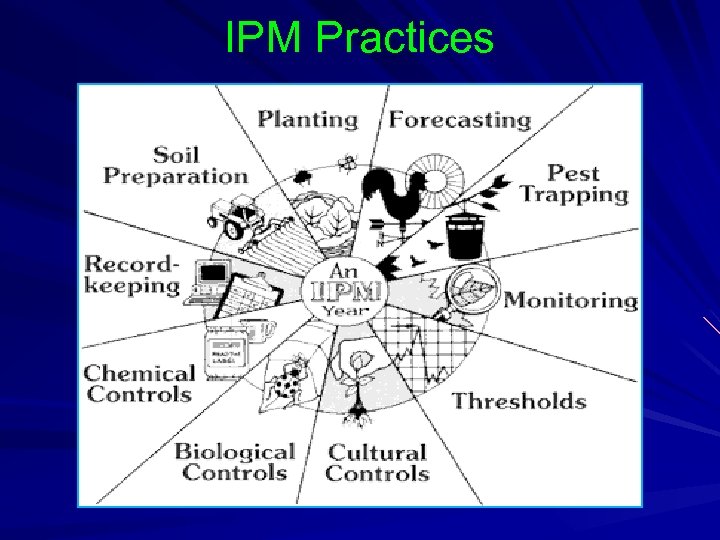
IPM Practices
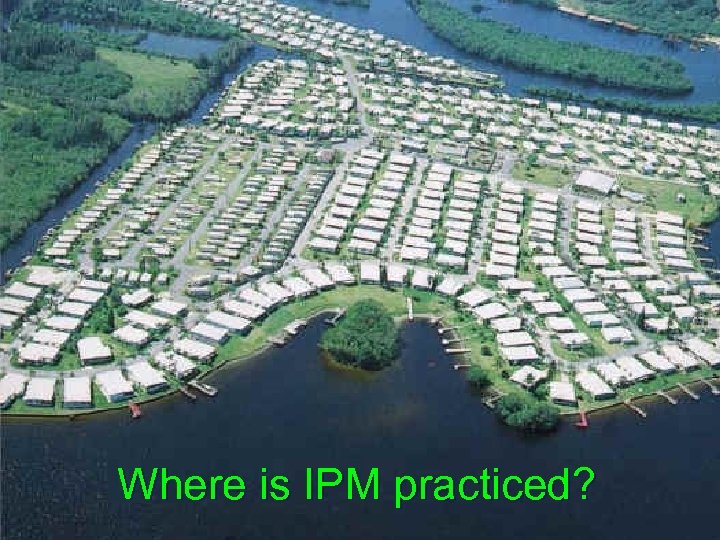
Where is IPM practiced?
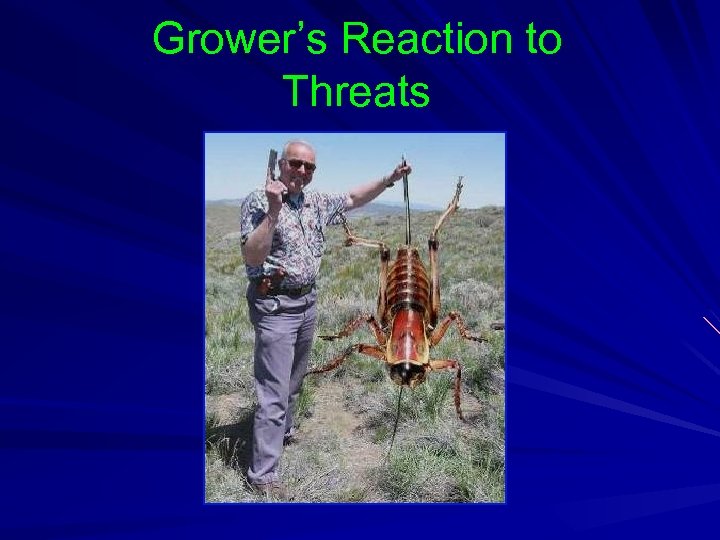
Grower’s Reaction to Threats
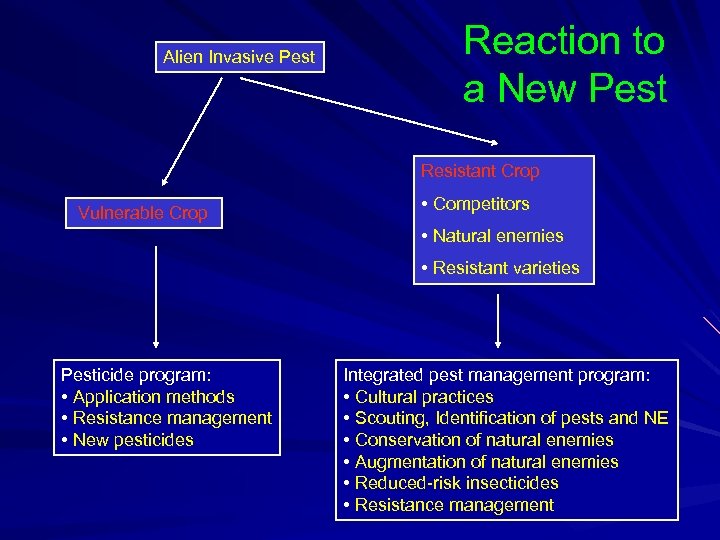
Alien Invasive Pest Reaction to a New Pest Resistant Crop Vulnerable Crop • Competitors • Natural enemies • Resistant varieties Pesticide program: • Application methods • Resistance management • New pesticides Integrated pest management program: • Cultural practices • Scouting, Identification of pests and NE • Conservation of natural enemies • Augmentation of natural enemies • Reduced-risk insecticides • Resistance management
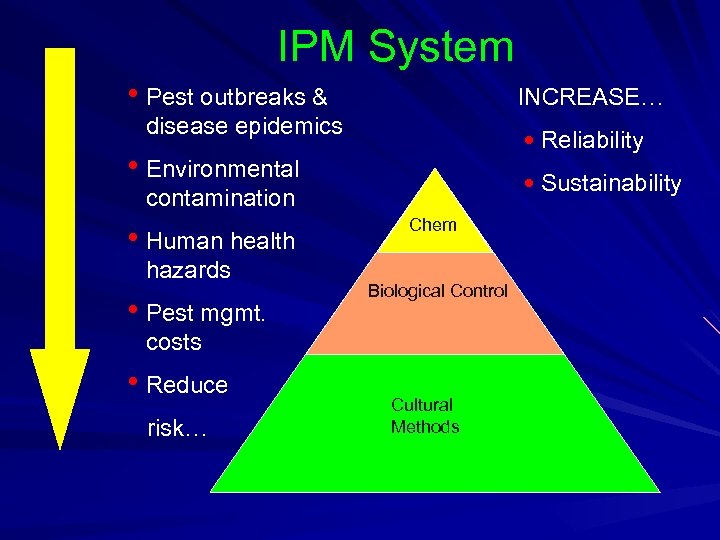
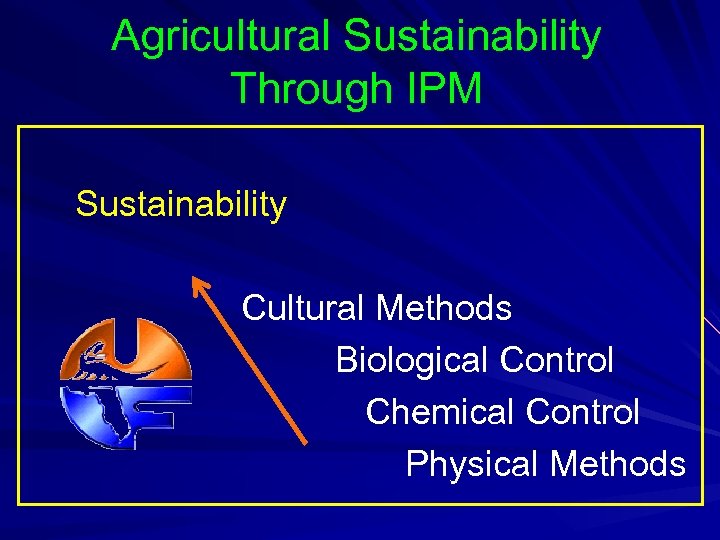
IPM System • Pest outbreaks & INCREASE… disease epidemics • Reliability • Environmental • Sustainability contamination • Human health hazards • Pest mgmt. Chem Biological Control costs • Reduce risk… Cultural Methods
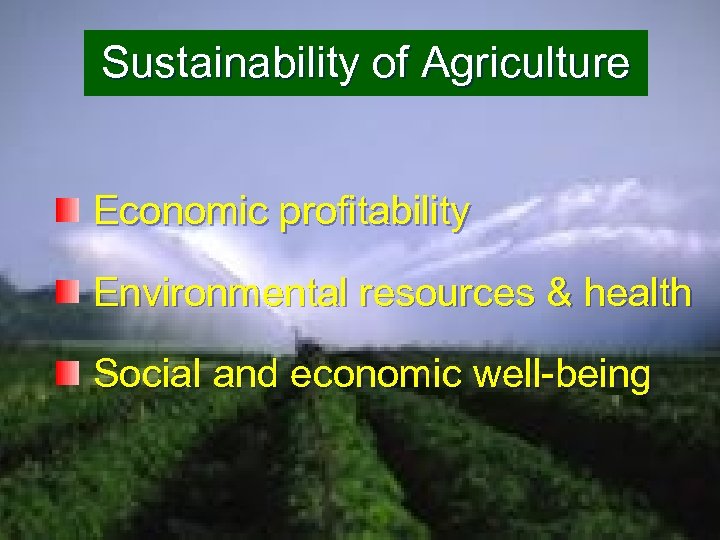
Sustainability of Agriculture Economic profitability Environmental resources & health Social and economic well-being
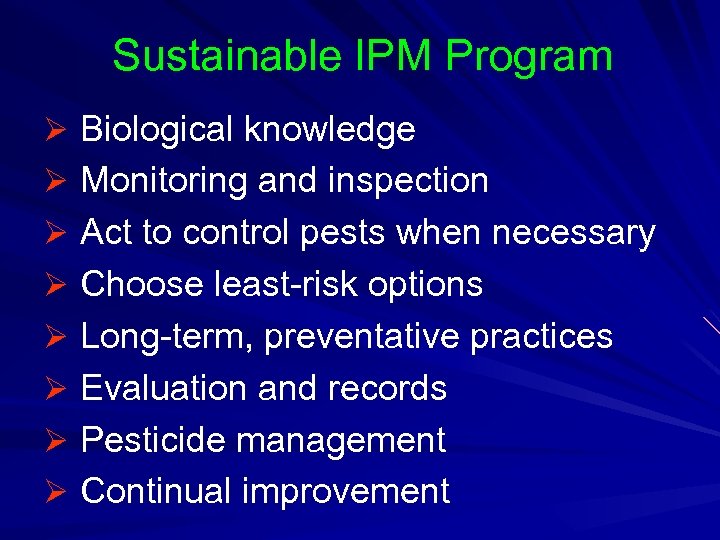
Sustainable IPM Program Ø Biological knowledge Ø Monitoring and inspection Ø Act to control pests when necessary Ø Choose least-risk options Ø Long-term, preventative practices Ø Evaluation and records Ø Pesticide management Ø Continual improvement
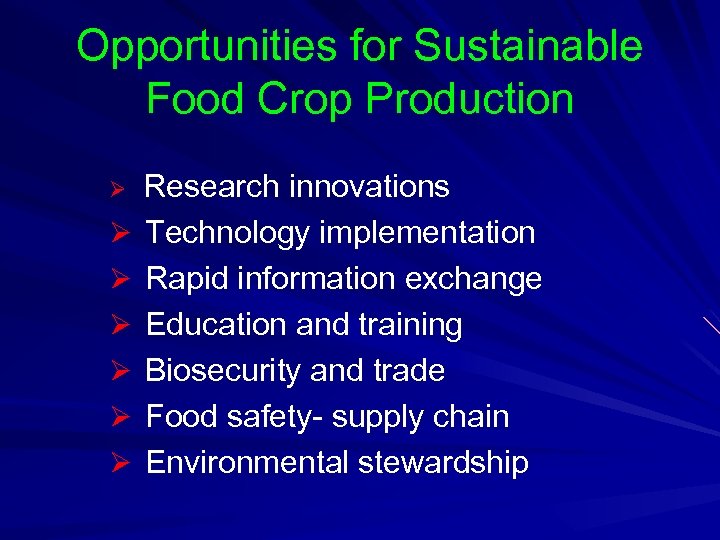
Opportunities for Sustainable Food Crop Production Ø Research innovations Ø Technology implementation Ø Rapid information exchange Ø Education and training Ø Biosecurity and trade Ø Food safety- supply chain Ø Environmental stewardship
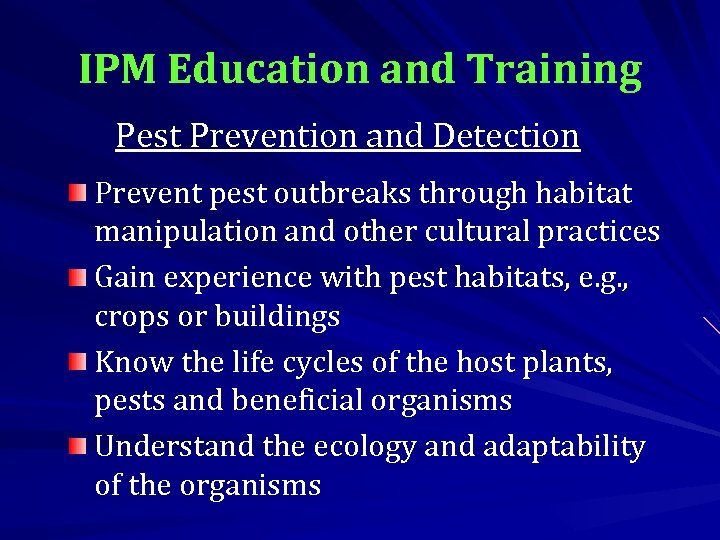
IPM Education and Training Pest Prevention and Detection Prevent pest outbreaks through habitat manipulation and other cultural practices Gain experience with pest habitats, e. g. , crops or buildings Know the life cycles of the host plants, pests and beneficial organisms Understand the ecology and adaptability of the organisms
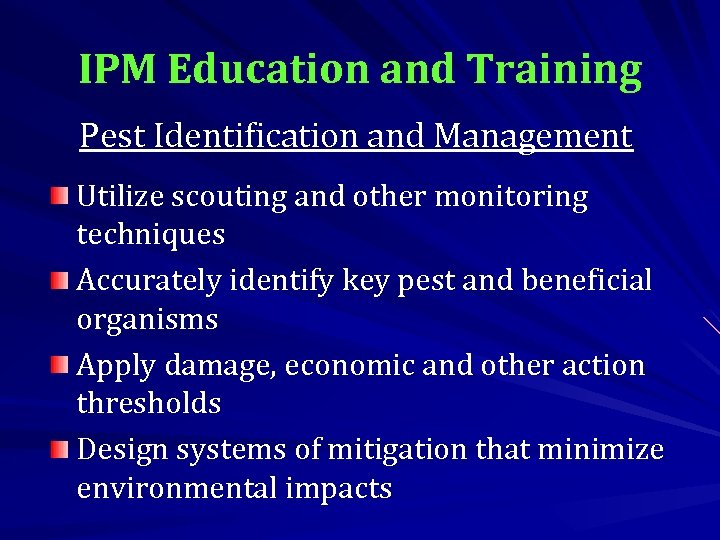
IPM Education and Training Pest Identification and Management Utilize scouting and other monitoring techniques Accurately identify key pest and beneficial organisms Apply damage, economic and other action thresholds Design systems of mitigation that minimize environmental impacts
IPM Education and Training General Knowledge and Professionalism Practice safe and appropriate use of pesticides and other IPM tactics Know current laws and regulations pertinent to pest management Be able to rapidly access pest management information Be involved in pest management and related organizations
IPM Capabilities Education & experience. An interdisciplinary education in the traditional scientific disciplines plus hands-on, practical experience is essential. Synthesis & integration. Education and training prepare pest managers to synthesize knowledge from across disciplines and integrate pest management within entire production systems.
IPM Capabilities Problem solving & critical thinking. Experience is gained in accurately diagnosing and rapidly solving plant health problems while minimizing environmental impacts and economic losses. Speaking & writing effectively. Superior communication skills, both written and verbal, are required to effectively communicate IPM principles and practices.
IPM Education, Training and Credentials University of Florida (http: //entnemdept. ifas. ufl. edu) • B. S. , M. S. (thesis or not-thesis), Ph. D. degrees in Entomology or Nematology • Distance M. S. degree with a specialization in Entomology or Pest Management, or a Certificate in Urban Pest Management, Landscape Pest Management, or Pest Control Technology • Doctor of Plant Medicine (non-thesis, interdisciplinary)
IPM Education, Training and Credentials University of Nebraska- Doctor of Plant Health University M. S. programs IPM 3 distance education program (U. Minnesota) Entomological Society of America- BCE, ACE American Society of Agronomy- Certified Crop Advisor (CCA), Certified Professional Agronomist (CP-Ag), Certified Professional Plant Pathologist National Alliance of Independent Crop Consultants- Crop Certification State CCA, e. g. , California
IPM Florida provides statewide, interdisciplinary and inter-unit coordination and assistance for UF/IFAS integrated pest management research Extension and education faculty http: //ipm. ifas. ufl. edu
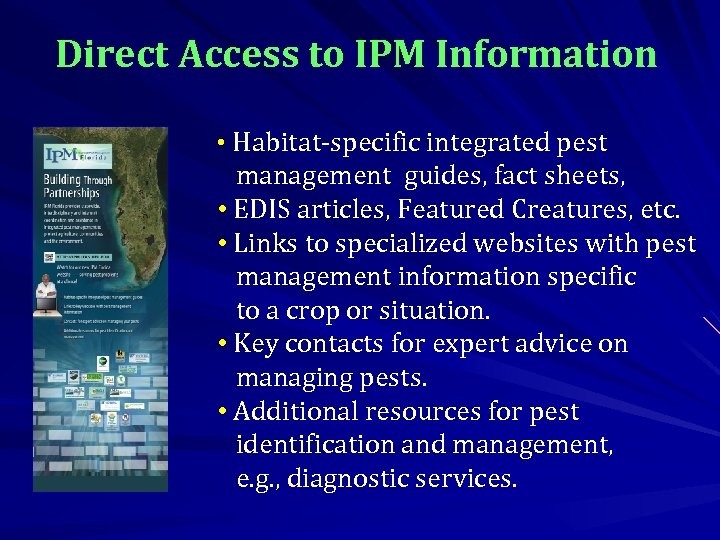
Direct Access to IPM Information • Habitat-specific integrated pest management guides, fact sheets, • EDIS articles, Featured Creatures, etc. • Links to specialized websites with pest management information specific to a crop or situation. • Key contacts for expert advice on managing pests. • Additional resources for pest identification and management, e. g. , diagnostic services.
Electronic Data Information Source (EDIS) The EDIS website is a comprehensive, single-source repository of all current UF/IFAS numbered peer-reviewed publications (about 7, 500). http: //edis. ifas. ufl. edu/
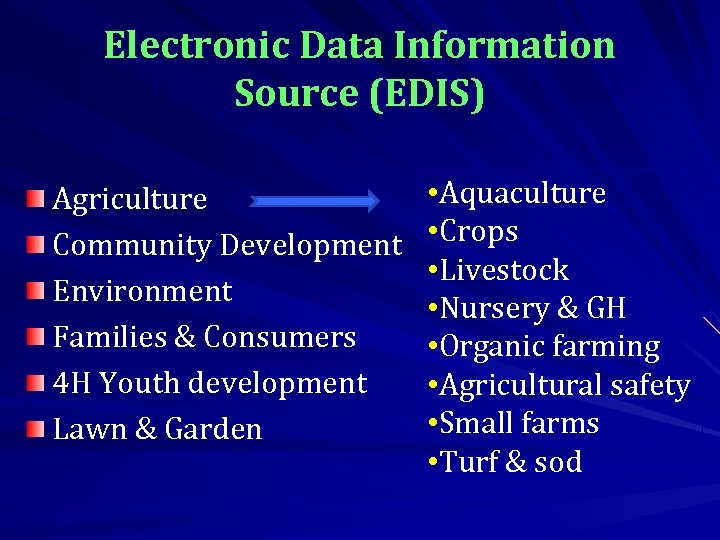
Electronic Data Information Source (EDIS) Agriculture Community Development Environment Families & Consumers 4 H Youth development Lawn & Garden • Aquaculture • Crops • Livestock • Nursery & GH • Organic farming • Agricultural safety • Small farms • Turf & sod
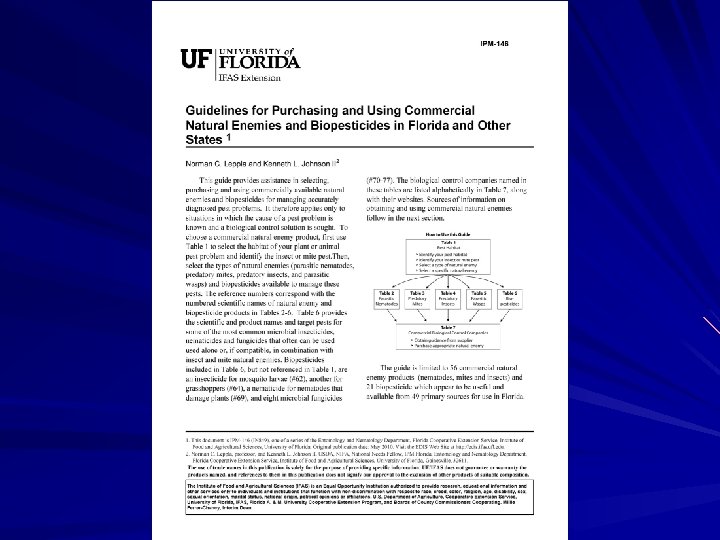
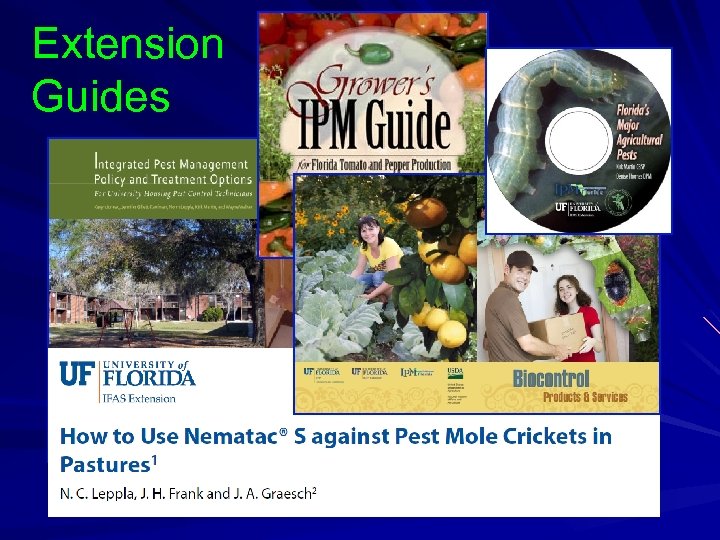
Extension Guides
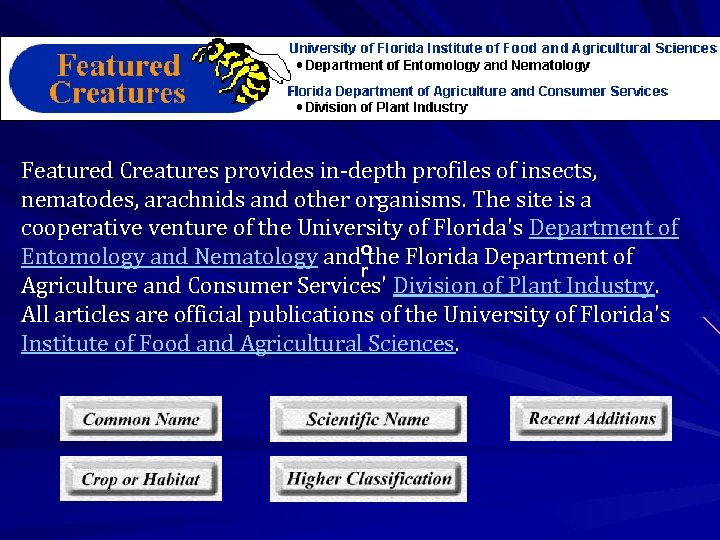
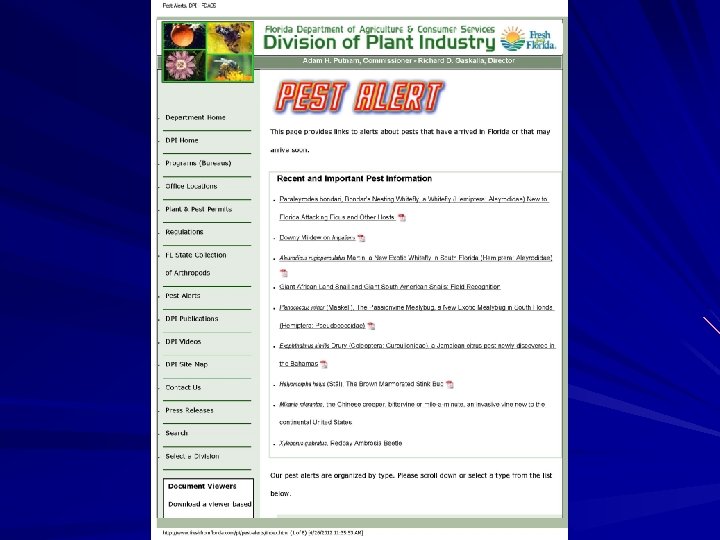
Featured Creatures provides in-depth profiles of insects, nematodes, arachnids and other organisms. The site is a cooperative venture of the University of Florida's Department of o Entomology and Nematology and the Florida Department of r Agriculture and Consumer Services' Division of Plant Industry. All articles are official publications of the University of Florida's Institute of Food and Agricultural Sciences.
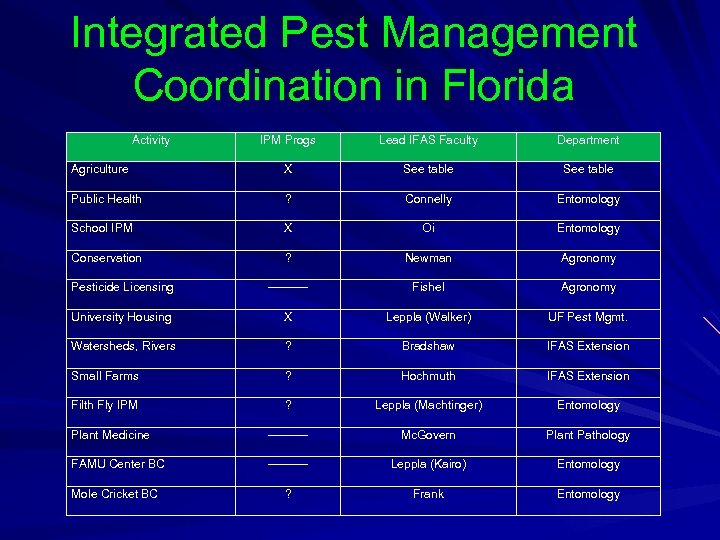
Integrated Pest Management Coordination in Florida Activity IPM Progs Lead IFAS Faculty Department Agriculture X See table Public Health ? Connelly Entomology School IPM X Oi Entomology Conservation ? Newman Agronomy Pesticide Licensing ----- Fishel Agronomy University Housing X Leppla (Walker) UF Pest Mgmt. Watersheds, Rivers ? Bradshaw IFAS Extension Small Farms ? Hochmuth IFAS Extension Filth Fly IPM ? Leppla (Machtinger) Entomology Plant Medicine ----- Mc. Govern Plant Pathology FAMU Center BC ----- Leppla (Kairo) Entomology Mole Cricket BC ? Frank Entomology
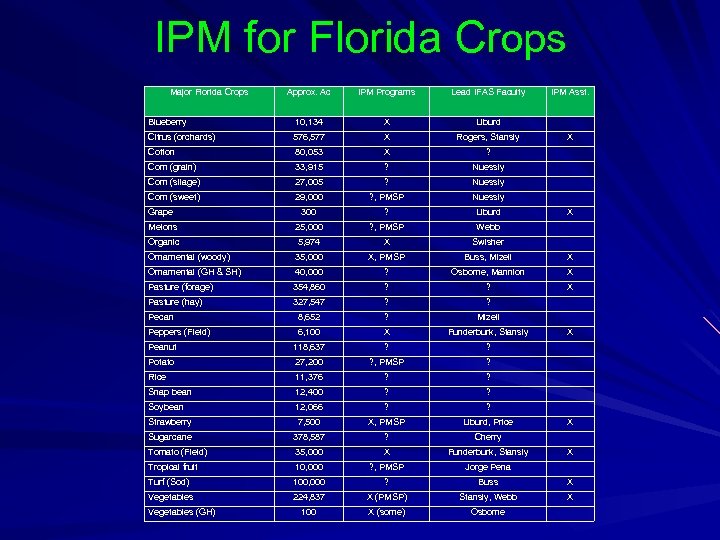
IPM for Florida Crops Major Florida Crops Approx. Ac IPM Programs Lead IFAS Faculty Blueberry 10, 134 X Liburd Citrus (orchards) 576, 577 X Rogers, Stansly Cotton 80, 053 X ? Corn (grain) 33, 915 ? Nuessly Corn (silage) 27, 005 ? Nuessly Corn (sweet) 29, 000 ? , PMSP Nuessly Grape 300 ? Liburd Melons 25, 000 ? , PMSP IPM Asst. Webb X X Organic 5, 974 X Swisher Ornamental (woody) 35, 000 X, PMSP Buss, Mizell X Ornamental (GH & SH) 40, 000 ? Osborne, Mannion X Pasture (forage) 354, 860 ? ? X Pasture (hay) 327, 547 ? ? Pecan 8, 652 ? Mizell Peppers (Field) 6, 100 X Funderburk, Stansly Peanut 118, 637 ? ? Potato 27, 200 ? , PMSP ? Rice 11, 376 ? ? Snap bean 12, 400 ? ? Soybean 12, 066 ? ? Strawberry 7, 500 X, PMSP Liburd, Price Sugarcane 378, 587 ? Cherry Tomato (Field) 35, 000 X Funderburk, Stansly Tropical fruit 10, 000 ? , PMSP Jorge Pena Turf (Sod) 100, 000 ? Buss X Vegetables 224, 837 X (PMSP) Stansly, Webb X 100 X (some) Osborne Vegetables (GH) X X X
Agricultural Sustainability Through IPM Sustainability Cultural Methods Biological Control Chemical Control Physical Methods
Скачать презентацию Agricultural and Environmental Sustainability Issues and Research AGR SWS
1430995756959ee5c04a5cfe888c8e25.ppt