Скачать презентацию AGRARIAN DISTRESS IN INDIA DR ANIL K WAVARE
831f87cb8e02db1c3ce51ad3954a7ee9.ppt
- Количество слайдов: 46
 AGRARIAN DISTRESS IN INDIA DR. ANIL K. WAVARE DEpart. MEnt OF ECOn. OMi. Cs, rayat shikshan sanstha’s Chhatrapati shi. Va. Ji COLLEGE, satara E-mail- anilwavare 75@rediffmail. com
 OUR WORRIES n n n Population continue to grow at unsustainable levels Cultivated land is shrinking due to urbanization Land fertility is reduced due to various reasons Natural calamities drought, cold, rains are affecting the production Lack of disease alarming systems in crops and animals Real farmers are not having technological skills Infertility is increasing in animals Increasing shelf life of farmer’s product To minimize the risk of cultivation How to reduce poverty and improve nutrition of our masses Climate change causing damages
 Challenges n n n n n • • • Shrinking land resources Climate change Declining Water resources Demand for Organic Farming Shortages of Plant Nutrients High cost of Inputs Inadequate credit availability High Energy costs Soil health problem Negative Thinking
 Shrinking land resource n n n n • • Urbanisation, Industrilisation, New roads. New railway tracks, New Airports, Ports, About 50 % population in cities Desertification, water logging More & more from less & less lands Adoption of farming system Home stead farming, urban agriculture
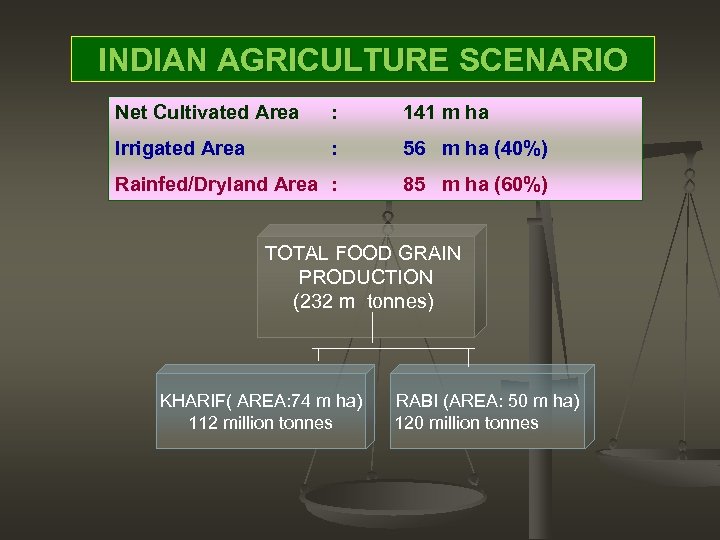 INDIAN AGRICULTURE SCENARIO Net Cultivated Area : 141 m ha Irrigated Area : 56 m ha (40%) Rainfed/Dryland Area : 85 m ha (60%) TOTAL FOOD GRAIN PRODUCTION (232 m tonnes) KHARIF( AREA: 74 m ha) 112 million tonnes RABI (AREA: 50 m ha) 120 million tonnes
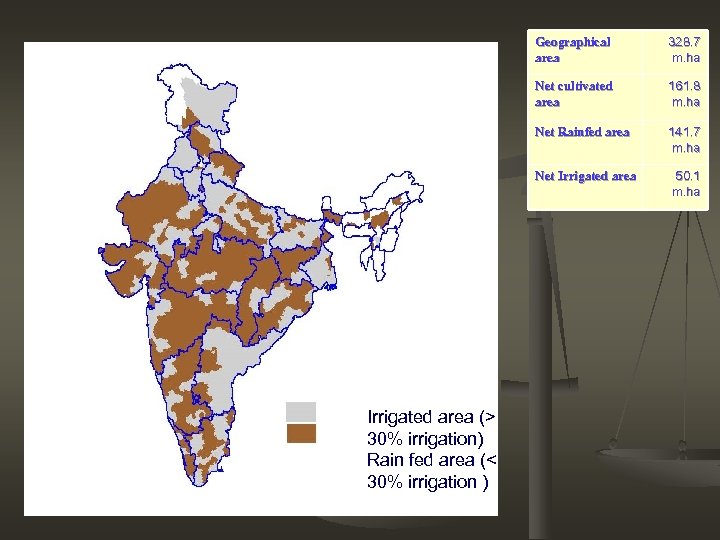 Geographical area Net cultivated area 161. 8 m. ha Net Rainfed area 141. 7 m. ha Net Irrigated area (> 30% irrigation) Rain fed area (< 30% irrigation ) 328. 7 m. ha 50. 1 m. ha
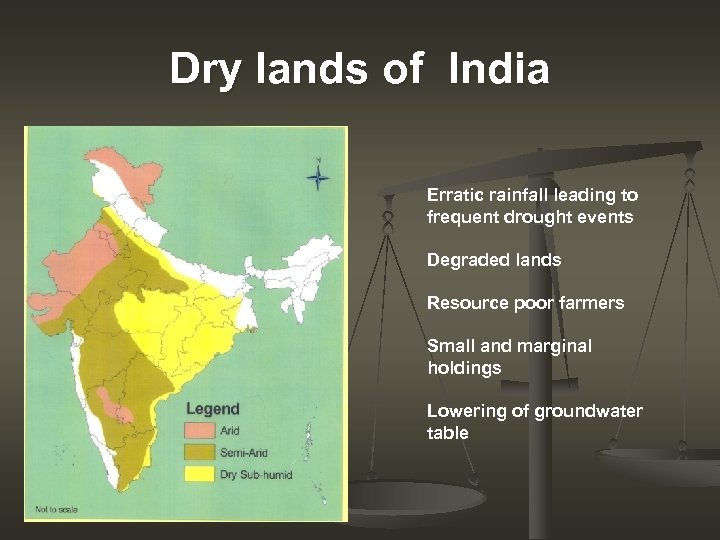 Dry lands of India Erratic rainfall leading to frequent drought events Degraded lands Resource poor farmers Small and marginal holdings Lowering of groundwater table
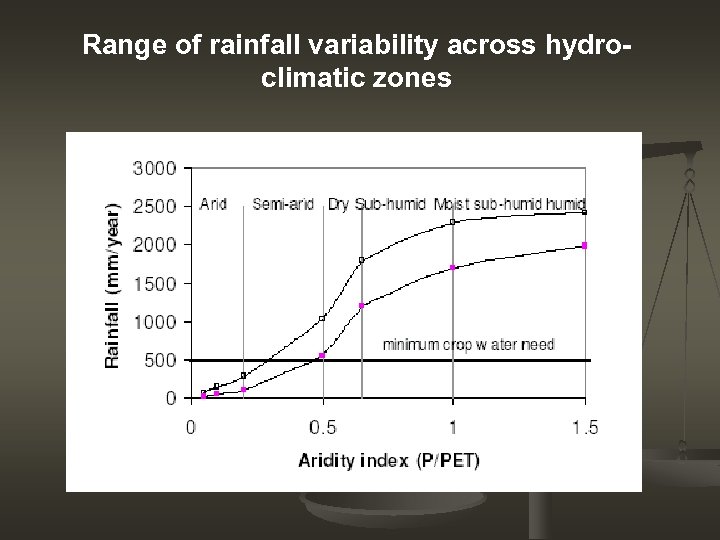 Range of rainfall variability across hydroclimatic zones
 Three Phases n n n Reform and consolidation of agriculture during 1950’s & 1960’s on the lines decided during the freedom struggle. Green revolution and the growth of political populism during 1970’s & 1980’s. Liberalization and the deterioration of the farmers condition during 1990’s and after.
 Water scarcity n n n n • • HD for agriculture, industry Human & livestock Underground water arsenic Apply water at critical stages Crop & varieties needing less water More use of Micro- irrigation system Rain fed horticulture Water & soil conservation
 Agrarian Distress n n n Agriculture in India passing through a difficult time. Something is terribly wrong in the country side. The most extreme manifestation of the crisis is in the suicides of farmers. Between 2001 -2006 there were 8900 suicides by farmers. Suicides have been reported from the states which are relatively agriculturally developed.
 Suicides n n n Suicides have been reported from the states which have seen strong peasant movements. Where the leadership of the political parties has come from farming communities. Karnataka, Kerala, Tamil Nadu, A. P, Maharashtra, Gujarat and Punjab are the worst affected states.
 Suiside Prone Area-Vidarbha Region n n n n Background: Area: 97404 sq. km. (1/3 of Maharashtra, 307713 sq. km Two Revenue divisions: Amarawati (46027 sq. k. m) and Nagpur (51377 sq. km. ) Cultivable area: 56540 sq. km. Area under Crop: 57% Area under Forest: 28% Population: 21 million (1/5 of Maharashtra) 60% of States mineral production comes from Vodarbha 80% Forest land in Vidarbha
 Suiside Prone Area-Vidarbha Region n n Electricity generation: 2400 million units while it’s own requirement is 1100 million units leaving a surplus of 1300 million units which is supplied to rest of Maharashtra Such a rich area of Vidarbha is languishing in Economic backwardness. Largest cotton and orange production Largest untapped irrigation potential
 Suiside Prone Area-Vidarbha Region n n Largest industrial estate Centrally located Basic infrastructure with good road, rail and air network and large trained manpower. Vidarbhas economy is linked to the economic condition of the cotton growers and cotton based industries.
 Suiside Prone Area-Vidarbha Region n More than 17 lakhs hectare in Vidarbha is under cotton cultivation. Out of this about 97% is rain fed. The productivity of cotton is lowest, which is hardly 160 k. g. lint per hectare. As against the national average of 300 k. g. lint per hect.
 Suiside Prone Area-Vidarbha Region n n n Suicide All India level: Farming- 15. 13% Housewife 19. 96%, Self employment 16. 78% Maharashtra: Farming- 24. 19% Housewife 22. 92%, Self employment 20. 41% Causes: stress in rural areas, isolated families, feeling insecurities due to crop failure, land alienation and indebtedness. Agrarian distress caused in some of the districts of Vidarbha.
 Indian farmer’s future is an endless night Some Basic Facts: n Suicide Mortality Rate (SMR) per lakh of population was highest in Kerala. n There are 6 States Maharashtra, West Bengal, Karnataka, Tamil Nadu, Andhra Pradesh and Kerala where 2/3 rd of suicides have taken place. n Maharashtra- max. percentage of share of suicides across states 13. 47%.
 Indian Agriculture -Risky, Expensive and Water Dependent n n Rural non-farm employment opportunities have not increased. Increase in the proportion of small and marginal farmers and agricultural laborers. The small and marginal farmer is thinking big and willing to experiment and take risks. Bad monsoon leading to crop failure can put him into indebtedness and crashing of dreams.
 Serious energy crisis n n n n • • Agriculture-energy intensive Needs diesel, electricity –sky rocketing price Rs 180, 000 subsidy after price hike About 70% crude oil imported Increase use efficiency Use of non tradition energy-solar, hydro, etc. Energy saving is energy creation
 AGRICULTURE TOMMAROW n n n n Variable tillage by soil type, relief, etc. Adjustments with various seed varieties and varying rates of their application Adjustments with varying NPK fertilizer rates Variable use of pesticides Remote Sensing images through the season – scouting, nutrients, drainage and yield Yield maps showing variation by location Use of Nano-technology
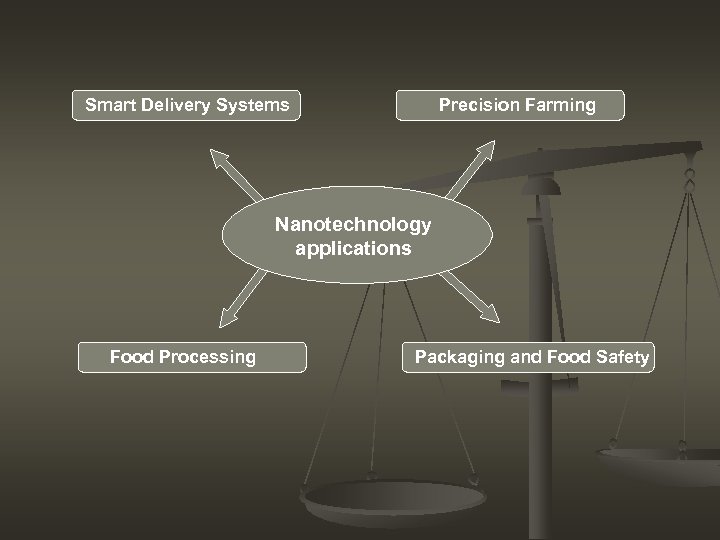 Smart Delivery Systems Precision Farming Nanotechnology applications Food Processing Packaging and Food Safety
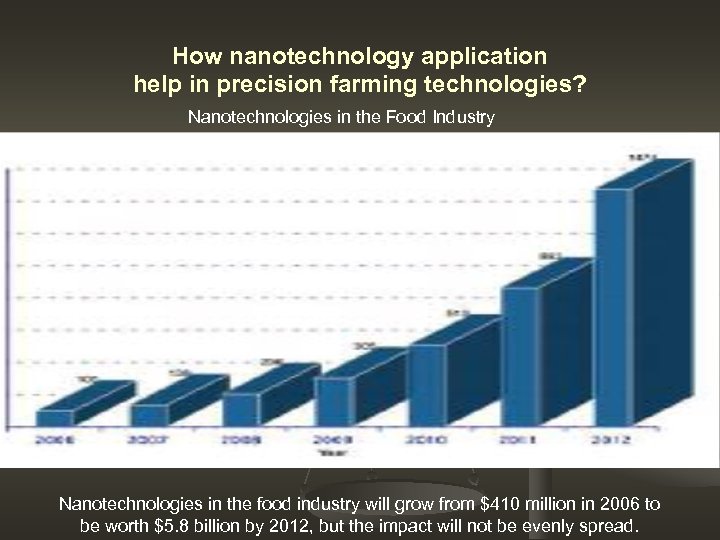 How nanotechnology application help in precision farming technologies? Nanotechnologies in the Food Industry Nanotechnologies in the food industry will grow from $410 million in 2006 to be worth $5. 8 billion by 2012, but the impact will not be evenly spread.
 Adjustments with the change in monsoon meteorology n n n Dispersal of rainfall, Need to change the date of sowing as per the mansoon meteorology, Change in cropping pattern based on rain resistance and drought resistance crops, Access of the use of GM crop technology, Watershed development (not EGS) in drought zone, Hydrological and biological engineering activities.
 Demand for organic farming n n n • • • Of demand increasing Feed ever-increasing population 10 ha land to produce 1 ha Nature has no quarrel with inorganic Water is inorganic” Pran “ Plants take nutrients in inorganic form
 Precession farming n n n n It is also known as site-specific management, describes a bundle of new information technologies applied to the management of large -scale, commercial agriculture. Precision farming technologies includes: 1. personal computers 2. satellite-positioning systems 3. geographic information systems 4. automated machine guidance 5. remote sensing devices and telecommunications
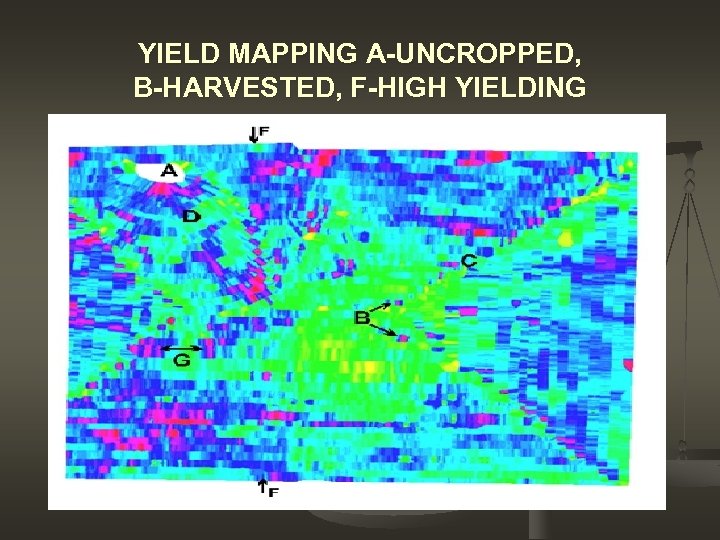 YIELD MAPPING A-UNCROPPED, B-HARVESTED, F-HIGH YIELDING
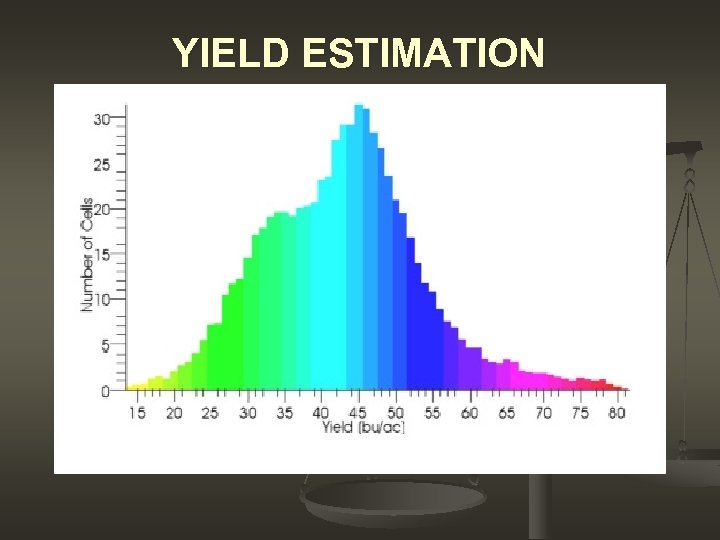 YIELD ESTIMATION
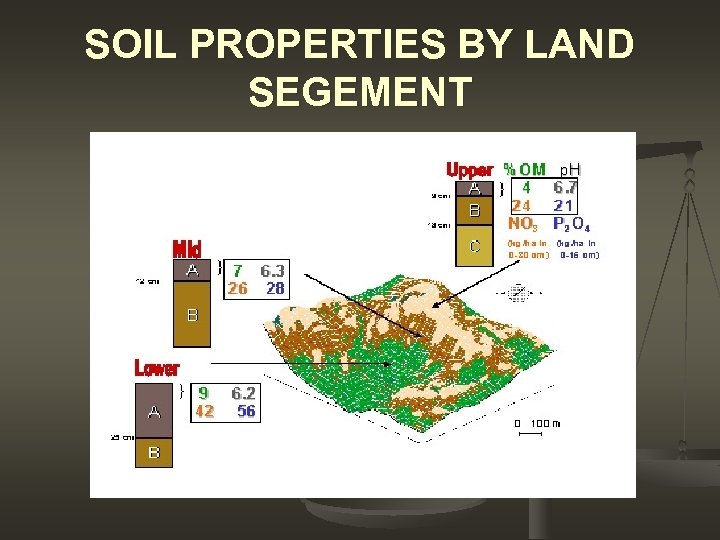 SOIL PROPERTIES BY LAND SEGEMENT
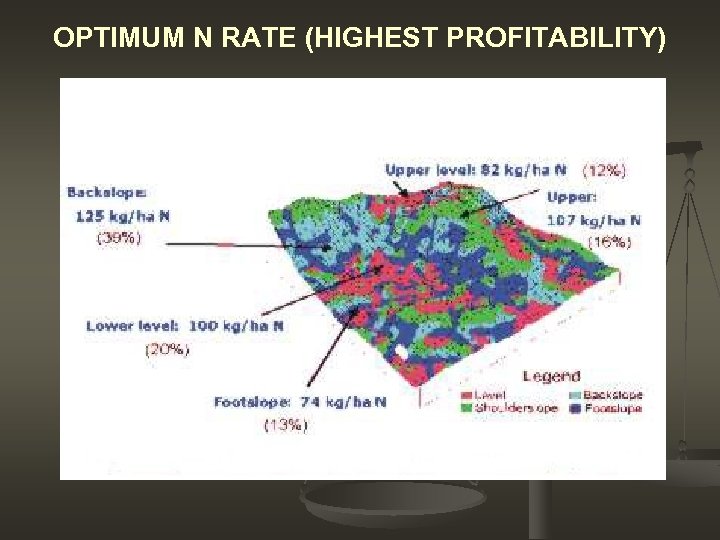 OPTIMUM N RATE (HIGHEST PROFITABILITY)
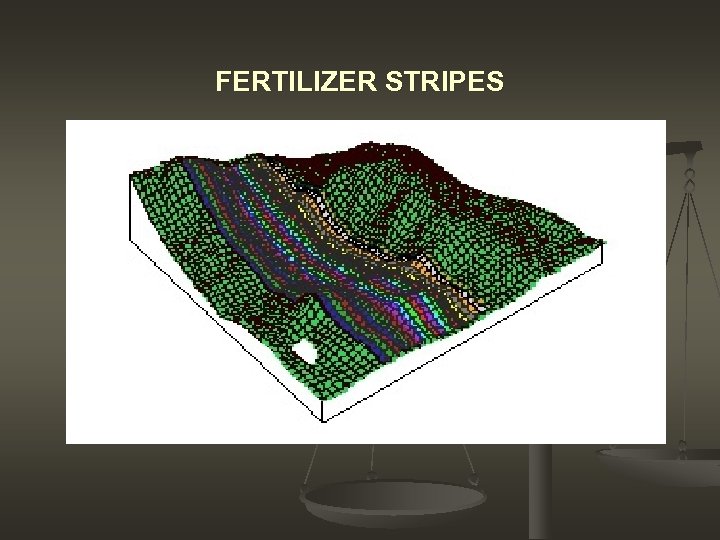 FERTILIZER STRIPES
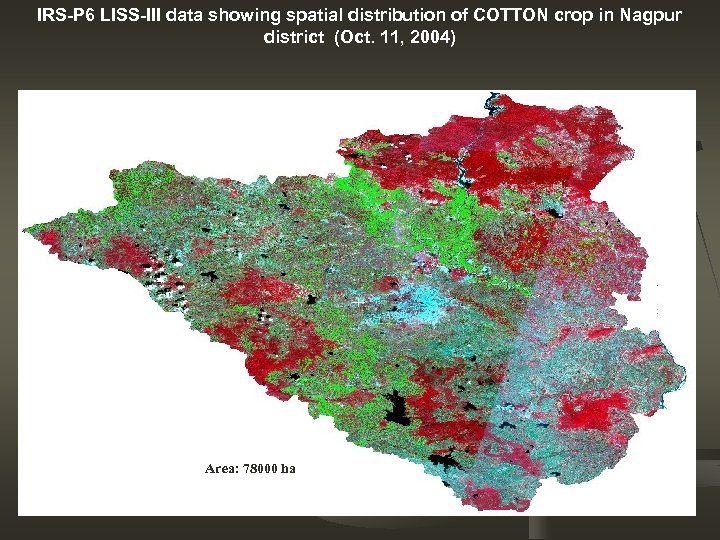 IRS-P 6 LISS-III data showing spatial distribution of COTTON crop in Nagpur district (Oct. 11, 2004) Area: 78000 ha
 AGRIBUSINESS MODEL n n n Continuous involvement with the promotion of agriculture through public-private partnerships, we have experimented with many different models. setting up of Agribusiness Centres (ABCs). In recent past many Banks have also come forward to support the Agribusiness Centres under a tripartite arrangement. During the year 2003 -04, through a long process of negotiations a comprehensive approach has been evolved in joint collaboration with ICICI Bank Limited. Similar offers from HDFC Bank Limited as well as from a newly setup Yes Bank Limited. Even the regional office of NABARD, the apex refinance institution for agricultural credit in India has also offered to support this initiative.
 Step-by-Step Activities to Establish Agribusiness Centres Selection of Agripreneurs. Based on location, qualification, aptitude, investment capacity, ability to mobilize resources, etc. for potential clusters identified. Training and capacity building of Agripreneurs in Agribusiness management. Through both formal as well as informal programmes being conducted under Agriclinic scheme of GOI Skill development in Agri-Biotechnologies and precision farming for organic agriculture. Through a structured training course offered on cost reimbursement basis. Agripreneur - location specific Agribusiness plan development. By adopting cluster approach and through organic agriculture potential assessment exercise jointly. Resource mobilization, linkages and tie-ups for Agribusiness Centre. By joint efforts and with minimum 20 -50% contribution by the Agripreneur. Agriculture extension services in the catchment's area for identification of client farmers and rapport building with them. Standard procedures and programmes can be developed for early success. Micro planning and Organic Certification for client farmers. Based on standard documents developed for organic agriculture.
 Step-by-Step Activities to Establish Agribusiness Centres Procurement and marketing of inputs. Demand based, organized through a network. Production and marketing of location-crop specific inputs. Based on Agri. Biotechnology, first unit is set up for vermiculture. Subsequently, soil conditioners and probiotic applications are added. Conduct in-house research, trials and demonstrations for establishing package of practices to be disseminated to client farmers. It also generates initial revenues. Introduction of precision farming techniques including processing activities. For selected crops based on future potential for procurement of farm produce, complete set of technical inputs including advice and material support is delivered. This activity becomes second major source of revenues. Procurement of farm produce and processing. Based on forward linkages in terms of marketing contracts, necessary post harvest processing and storage activities are carried out. Marketing of farm produce. Based on capacity and either alone (i. e. on his own) or under suitable tie-ups. Contract farming. Turnkey services with linkages for value added agriculture and organic farming.
 Pre-requisite of an Agripreneur and his/her background n A potential Agripreneur could preferably be with an agriculture background (both qualification as well as experience can be the qualifying criteria) must have locationspecific intentions to setup Agribusiness Centre in any part of the country.
 Opportunities n Enterprise promotion as an Agribusiness plan backed by proper training (skill development), supported by suitable infrastructure (resource mobilization) and implemented with appropriate linkages (tie-ups) in the form of Agriclinics /Agribusiness Centres has become big opportunity for unemployed youths on one hand sustainable and economically viable agriculture on other hand.
 Opportunities n n n • Scope of Food production exists • • • Adoption of Farming System OF in Selected Crops and Areas Contract Farming Precision Farming Corporate & Co-operate Farming Use of Non traditional energy Nutrient Fortified crop Plants Use of Genetic Engineering Use of Information Tech Urban Agriculture
 IMPORTANCE OF STRENGTHENING DRY LAND FARMING Ø 60% of cultivated area - about 85 million ha Ø Contributes approx. 40% of total food production Ø Native to many nutritious crops (Dicoccum wheat, ragi, pearl millet, pulses, oilseeds, fruits, etc. ) Ø Successive years of deficient rainfall Ø No. of farm holdings affected 54. 6 m
 What to do ? 1. 2. 3. 4. 5. Need to re-invent country’s monsoon agriculture through change in policy & approach Target dry land areas for diversification- livestock, horticulture, silviculture, grassland, fodder in keeping with natural resource availability Improve in-situ moisture conservation through ground water recharge Adopt dry land farming approach- raised bed, ridge furrow, zero tillage, mulching Integrate with multiple watershed development programmes of other agencies/Ministries
 SOCIO-ECONOMIC IMPACT OF NO INTERVENTION Ø Loss of crop Ø Reduced productivity and loss of income Ø Loss of wages unemployment to labourers & Ø Increased drought relief Ø Migration of farm labourers and farmers Ø High indebtedness and debt trap for farming community Ø Migration and loss of animal/ livestock 41
 Impact of climate change n n n • Global warming—wars, famine, population reduction • Half population risk of conflict • Forty six nations-2. 7 bn people conflicts • Dam Smith, Secretary General by 2020
 Value-added Agriculture n n These businesses exploit a location, production, servicing, technology, branding, or systems aspect to give them the differential advantage. Markets will be 80% domestic and 20% international, with a focus on natural and organic foods and emerging energy and natural resource products, such as ethanol, biodiesel, wind power, water, and mineral harvesting aspects. Special units or teams will evolve to handle these entrepreneurial entities across institutions and even with competitors. This agricultural segment is in dire need of new credit underwriting standards that capture the risk and components of a successful entity. Needs of these enterprises from lenders include business planning, strategy development, growth management, coaching, working capital and cash management, and networking across markets and sectors. Profits and sustainability, along with risk, are high as this group takes on the characteristics of entrepreneurial small businesses.
 Agri-entertainer n Finally, the fastest growing model will be coined as the agri-entertainer. Financing of lodges for hunting, pumpkin festivals, bed and breakfasts, the urban farmer's market, horse trails, or all-terrain vehicle recreational sites will become more commonplace. This model can be easily integrated into any of the previously mentioned entities as a side venture. Lifestyle, value-added, and the agri-entertainer models will attract a new set of youth and adults bringing needed energy to North American agriculture as they seek to fulfill their dreams.
 Conclusions n n Presently, a broadly defined approach for an ABC has been evolved. However, for each location i. e. for an individual entrepreneur he/she will have to undertake separate exercise. To help facilitate this exercise, Morarka Foundation has developed a complete set of standard formats. Envision the future of agricultural lending as it evolves over the next 15 years. By recognizing current trends and looking toward the future, individuals can strategically position their businesses and people to proactively mitigate risk in adverse events and capitalize on opportunities.