 Скачать презентацию Agr Ability NTW Mc Gill QOL Indianapolis IN
17d58f5bafa365a585ee59f95ae0c8ad.ppt
- Количество слайдов: 42



Agr. Ability NTW Mc. Gill QOL Indianapolis, IN November 9, 2011 11: 15 -12: 00 By Robert J. Fetsch, et al. Extension Specialist, Professor Emeritus & Director, Colorado Agr. Ability Project, Human Development & Family Studies Colorado State University AANTWMc. Gill. QOL 11. 0911 (Rev. 11. 0211)
Increasing Our Agr. Ability Clients’ Quality of Life Levels —What Works? (Panel Discussion) By Robert J. Fetsch (CSU), Sheila Simmons (KU), Vicki Janish (UW), Vincent Luke (CSU/Goodwill Denver), Kirk Ballin (ESVA), Bob Aherin (UIL), Inetta Fluharty (WVU), Sharry Nielsen (UN), & Tina Little (CSU)
Our Agr. Ability Mission The Agr. Ability Mission is to enhance and protect quality of life and preserve livelihoods. It’s about supporting and promoting growth and independence. Ultimately it’s about hope. Source: National Agr. Ability Project. (2011). It’s about hope [DVD]. Author: Purdue University.
Brief Review of the Literature on the MQOL • Meyer and Fetsch (2006) reported the impacts of Agr. Ability on 618 clients from 8 states. • Today’s report is on the second multistate Agr. Ability study with 98 farmers and ranchers with disabilities. Source: Meyer, R. H. , & Fetsch, R. J. (2006). National Agr. Ability Project impact on farmers and ranchers with disabilities. Journal of Agricultural Safety and Health, 12(4), 275 -291.
History of National Agr. Ability Evaluation Committee • Early 2006—Kathryn Pereira, Evaluation Specialist NAP U of WI, invited all SRAP’s to join in an Agr. Ability evaluation study. • The National Agr. Ability Evaluation Committee (NAEC) met approximately bi-monthly (2007 Present) via teleconference/face-to-face (N = 6 -25 participants/meeting).
History of National Agr. Ability Evaluation Committee • Who is an Agr. Ability Client? An Agr. Ability client is an individual with a disability engaged in production agriculture as an owner/operator, family member, or employee who has received professional services from Agr. Ability project staff during an on-site visit.
History of National Agr. Ability Evaluation Committee • 5 Questions: – Do our Agr. Ability clients increase their QOL? – Are our Agr. Ability clients more able to live on, operate, and manage their farms/ranches if they choose? – Are our group mean scores the same as those from the population group’s mean scores? – Is the Mc. Gill QOL Survey sensitive to the effects of Agr. Ability information, education, & service? – Who else will join us?
History of National Agr. Ability Evaluation Committee • Six SRAP’s conducted a four-year study to answer the first 4 questions (June 2007 -July 2011). • Mc. Gill QOL—CO, KS, NE, VA, WI & WV
Measures Used in CO, KS, NE, VA, WI, & WV Study • Mc. Gill Quality of Life Survey & Agr. Ability Independent Living & Operating Survey (ILOS) • NAP Demographic Data
History of National Agr. Ability Evaluation Committee • CO, KS, NE, VA, WI & WV obtained IRB approval from their Land-Grant Universities. • As of 7/13/11 NE & WV have pre-survey data only. • Today we will focus on the results of the 98 closed cases with matched pre-post survey data from CO, KS, VA, & WI.
Protocol • Procedure—CO, KS, VA, and WI mailed each new client the Pre-Survey, a cover letter, Mc. Gill Pre-Survey, and a stamped, selfaddressed envelope with an invitation to complete and return it.
Protocol • Participants were given the choice of completing the survey themselves or of having the items read aloud by the Agr. Ability team member. No one was coerced to complete and return their surveys.
History of National Agr. Ability Evaluation Committee • By July 13, 2011 CO, KS, VA, & WI entered their 98 matched pre-post-survey data into Excel files and e-mailed them to CO for entering and analyzing. – KS 49 – WI 31 – CO 15 – VA 3 – Total 98
Who Were the Participants in the Study? (N = 98) • All 98 clients completed Agr. Ability. • 70 (71%) were male; 27 (28%) were female. 1 did not report (1%). • 66 (67%) were new; 24 (25%) were ongoing; five (5%) were re-opened; and one (1%) was closed in current grant year.
Who Were the Participants in the Study? (N = 98) • Ages ranged from 11 to 95 (M = 57. 6; SD = 18. 7; N = 94). • For U. S. farmers and ranchers, the average was 57. 1 in 2007. * • Original disability occurred 1934 -2010. *Source: Retrieved April 27, 2004 from http: //nass. usda. gov/census/
What Was the Range and Average Length of Time with Agr. Ability? • The amount of time spent with Agr. Ability ranged from 1 to 38 months (M = 11. 8; SD = 6. 1; N = 81).
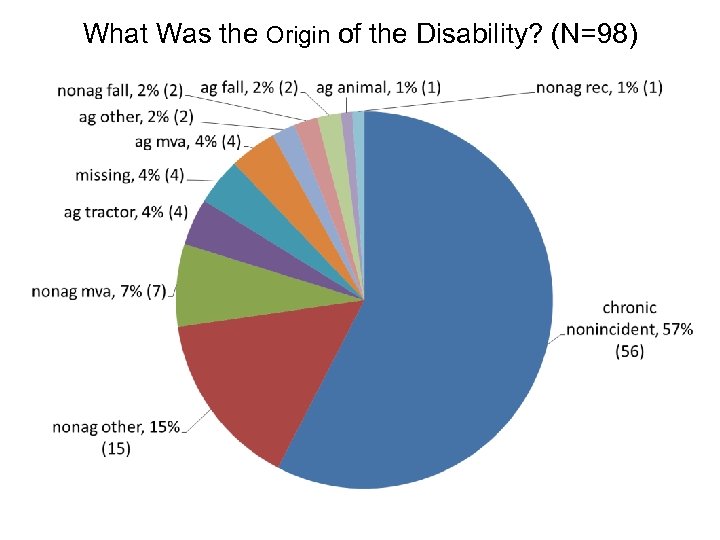
What Was the Origin of the Disability? (N=98)
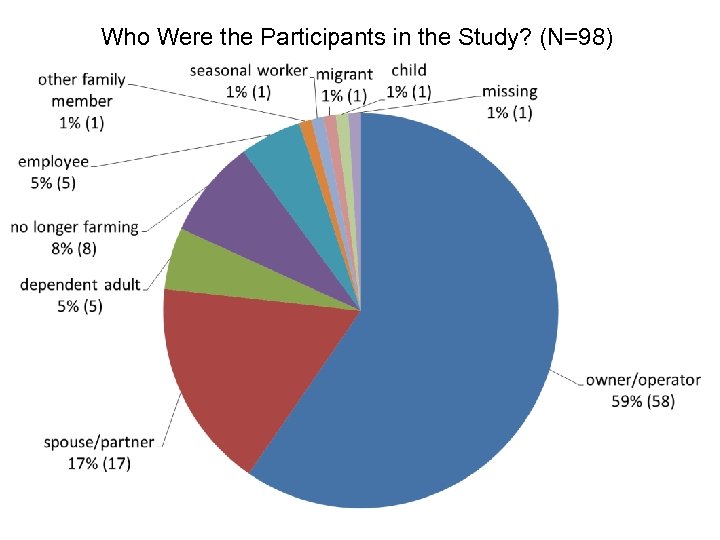
Who Were the Participants in the Study? (N=98)
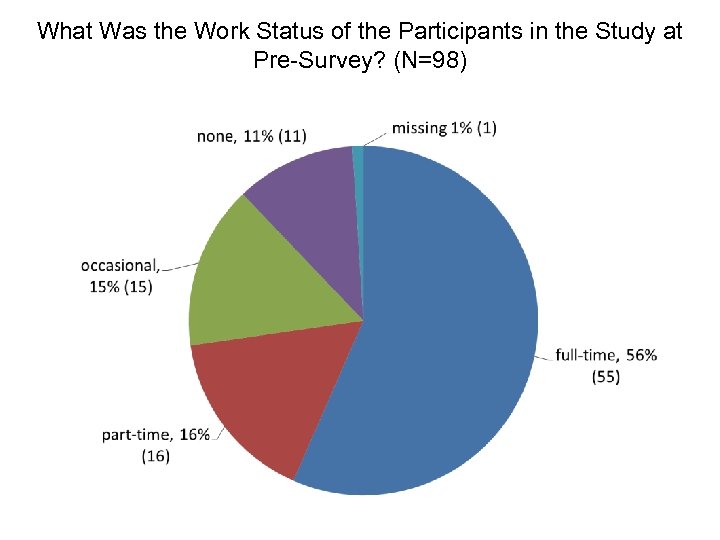
What Was the Work Status of the Participants in the Study at Pre-Survey? (N=98)
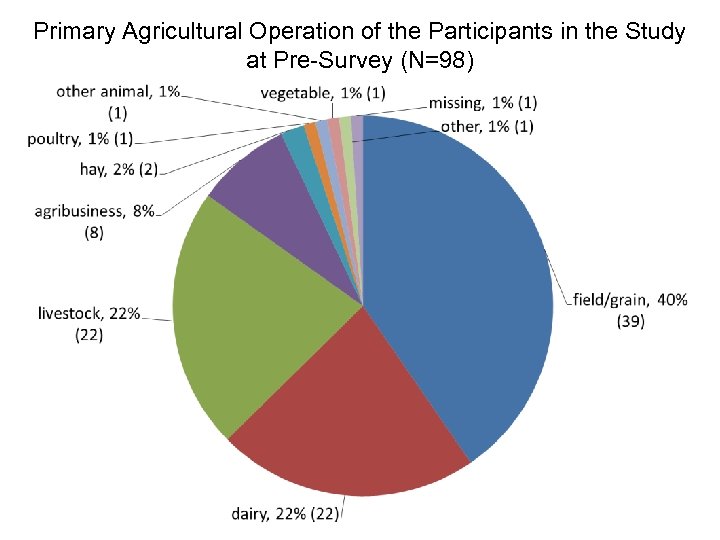
Primary Agricultural Operation of the Participants in the Study at Pre-Survey (N=98)
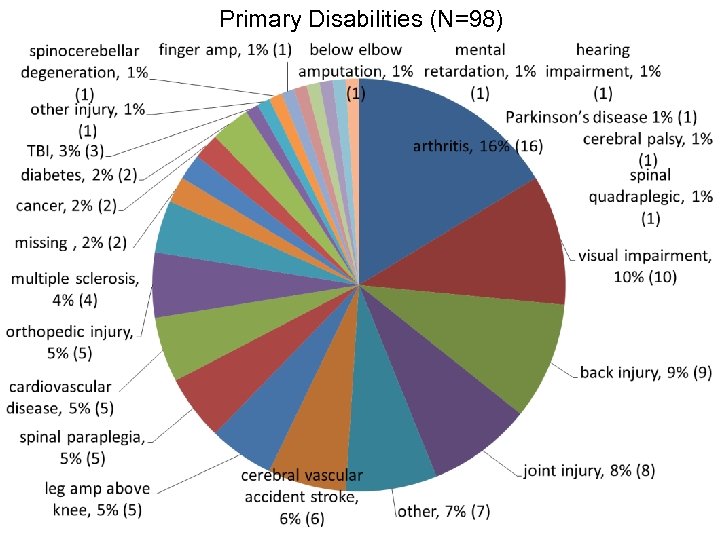
Primary Disabilities (N=98)
What Were the Purposes of This Four-Year Study? (N = 98) • To determine whether the Mc. Gill QOL and the Agr. Ability ILOS were sensitive to the effects of Agr. Ability. • To determine pre-post service changes in clients’ QOL levels and in their ability to live on, operate, and manage their farms/ranches.
Q: Do Our Agr. Ability Clients Increase Their QOL? A: ?
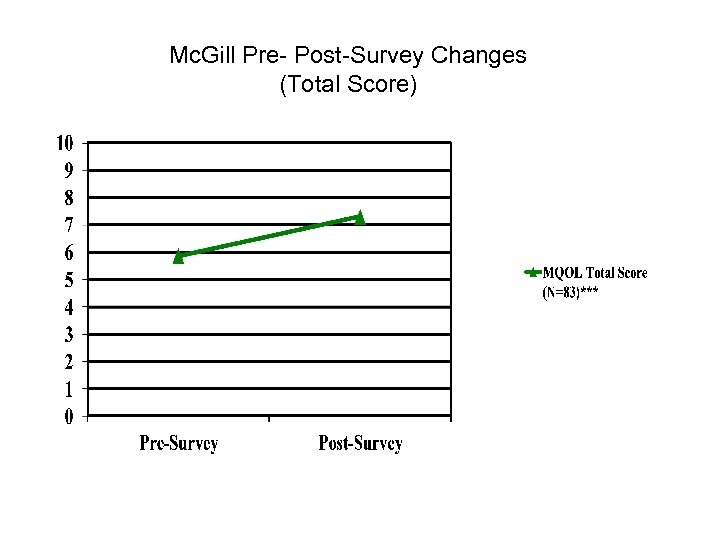
Mc. Gill Pre- Post-Survey Changes (Total Score)
Q: Do Our Agr. Ability Clients Increase Their QOL? A: Yes, they improve on the Total QOL Scale plus on all 6 subscales!
Q: Are Our Agr. Ability Clients More Able to Live on, Operate, and Manage Their Farms/Ranches if They Choose? A: ?
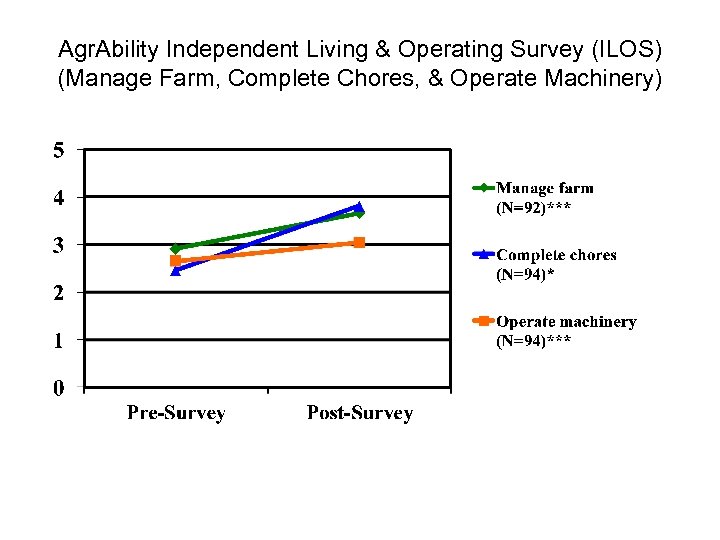
Agr. Ability Independent Living & Operating Survey (ILOS) (Manage Farm, Complete Chores, & Operate Machinery)
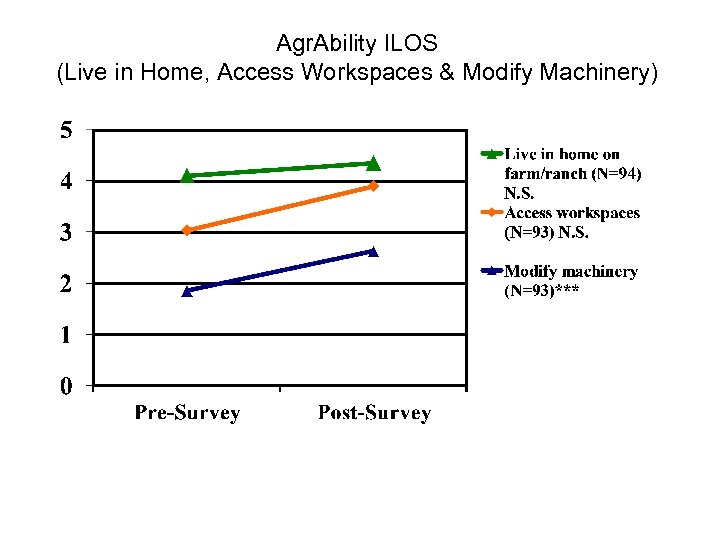
Agr. Ability ILOS (Live in Home, Access Workspaces & Modify Machinery)
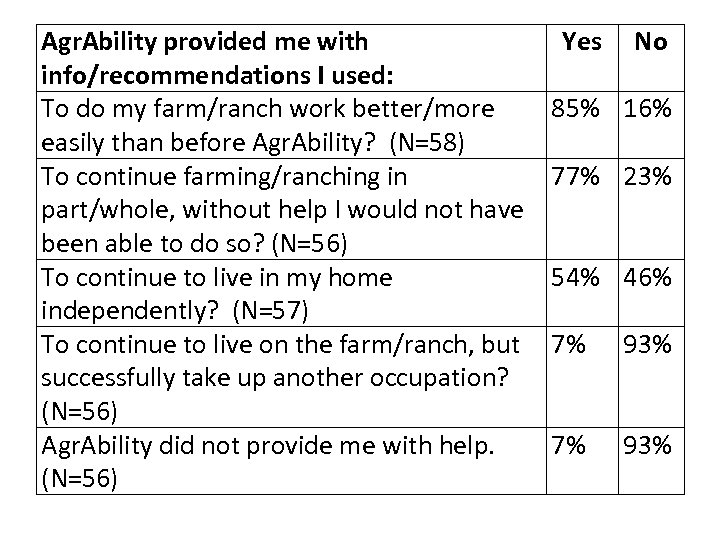
Agr. Ability provided me with info/recommendations I used: To do my farm/ranch work better/more easily than before Agr. Ability? (N=58) To continue farming/ranching in part/whole, without help I would not have been able to do so? (N=56) To continue to live in my home independently? (N=57) To continue to live on the farm/ranch, but successfully take up another occupation? (N=56) Agr. Ability did not provide me with help. (N=56) Yes No 85% 16% 77% 23% 54% 46% 7% 93%
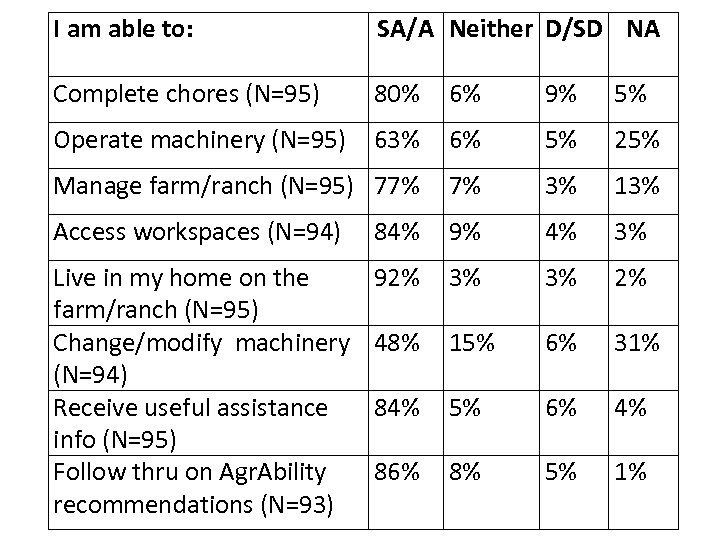
I am able to: SA/A Neither D/SD NA Complete chores (N=95) 80% 6% 9% 5% Operate machinery (N=95) 63% 6% 5% 25% Manage farm/ranch (N=95) 77% 7% 3% 13% Access workspaces (N=94) 84% 9% 4% 3% Live in my home on the farm/ranch (N=95) Change/modify machinery (N=94) Receive useful assistance info (N=95) Follow thru on Agr. Ability recommendations (N=93) 92% 3% 3% 2% 48% 15% 6% 31% 84% 5% 6% 4% 86% 8% 5% 1%
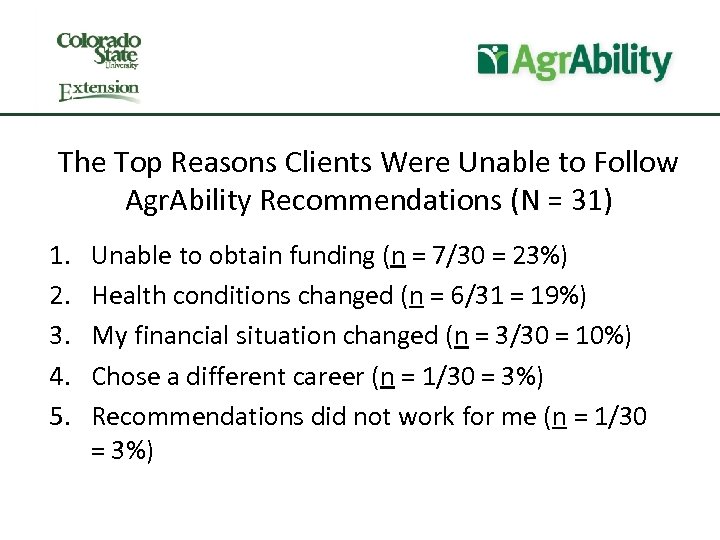
The Top Reasons Clients Were Unable to Follow Agr. Ability Recommendations (N = 31) 1. 2. 3. 4. 5. Unable to obtain funding (n = 7/30 = 23%) Health conditions changed (n = 6/31 = 19%) My financial situation changed (n = 3/30 = 10%) Chose a different career (n = 1/30 = 3%) Recommendations did not work for me (n = 1/30 = 3%)
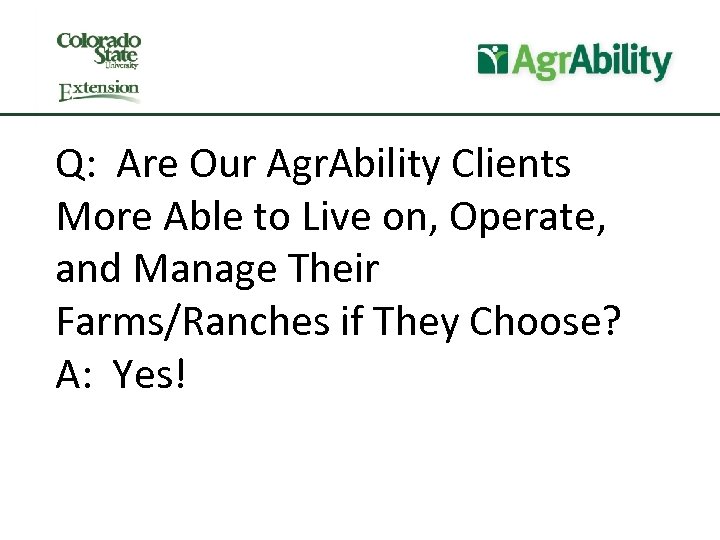
Q: Are Our Agr. Ability Clients More Able to Live on, Operate, and Manage Their Farms/Ranches if They Choose? A: Yes!
Q: What do these 4 SRAPs do well? A: They have pre-post survey data that show statistically significant increases (p <. 001) in: -QOL levels -”I am able to manage my farm/ranch. ” -”I am able to operate machinery. ” -”I am able to change or modify my machinery in order to accommodate my needs. ”
Q: What do the results say we can improve? A: We can do more as we assist farm and ranch families: -”to complete chores on my farm/ranch” (p <. 05) (M=2. 46 3. 81). -”to access workspaces on my farm/ranch” (N. S. ) (M=3. 03 3. 90).
Q: Is the Mc. Gill QOL Survey Sensitive to the Effects of Agr. Ability Information, Education, & Service? A: Yes!
Why Join Us? 1. Document your project’s effectiveness at increasing QOL and ILOS. 2. Enhance your chances of receiving funding next time with empirical evidence of your SRAP’s quality and effectiveness. 3. Increase your chances for outside funding by demonstrating your accountability. 4. Contribute to Agr. Ability’s Mission.
Our Agr. Ability Mission The Agr. Ability Mission is to enhance and protect quality of life and preserve livelihoods. It’s about supporting and promoting growth and independence. Ultimately it’s about hope. Source: National Agr. Ability Project. (2011). It’s about hope [DVD]. Author: Purdue University.

Won’t You Join Us? Here’s how: 1. Send an email to robert. fetsch@colostate. edu. 2. Seek IRB approval from your Land-Grant University. 3. Study and use the same protocol. 4. Adapt CO to __ on pp. 1 -2 & mail. 5. Enter your data into an Excel file that we will provide, proof perfectly & email to me.
Thank you very much!
Increasing Our Agr. Ability Clients’ Quality of Life Levels —What Works? (Panel Discussion) By Robert J. Fetsch (CSU), Sheila Simmons (KU), Vicki Janish (UW), Vincent Luke (CSU/Goodwill Denver), Kirk Ballin (ESVA), Bob Aherin (UIL), Inetta Fluharty (WVU), Sharry Nielsen (UN), & Tina Little (CSU) &
Panel Discussion (KS, WI, IL, VA, WV, NE, CO) 1. What works in our state to increase Agr. Ability clients’ QOL and ILOS levels? 2. How can other SRAP’s increase their clients’ QOL levels?
Thank you very much!
Скачать презентацию Agr Ability NTW Mc Gill QOL Indianapolis IN
17d58f5bafa365a585ee59f95ae0c8ad.ppt