


 Скачать презентацию AGING-IN-PLACE AND UNIVERSAL DESIGN A LOOK AT THE
4f57ba0ce93c9bc1d0f18bb86eb9f038.ppt
- Количество слайдов: 88
 AGING-IN-PLACE AND UNIVERSAL DESIGN: A LOOK AT THE HOME AGING-IN-PLACE AND UNIVERSAL DESIGN: A LOOK AT THE HOME
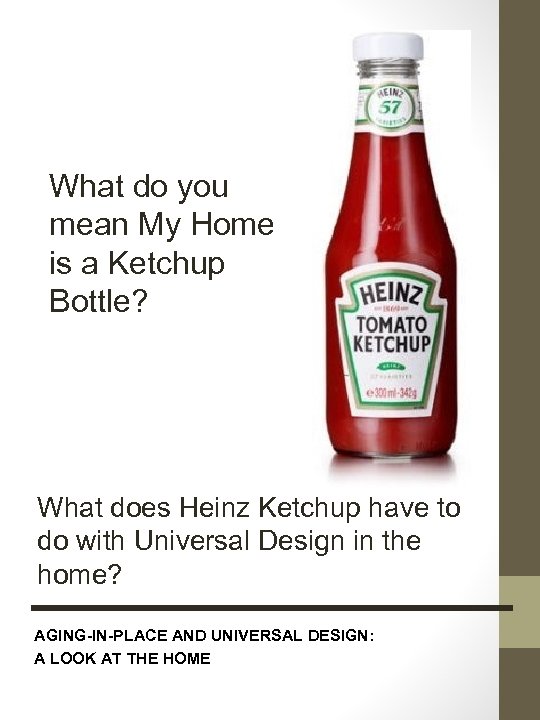 What do you mean My Home is a Ketchup Bottle? What does Heinz Ketchup have to do with Universal Design in the home? AGING-IN-PLACE AND UNIVERSAL DESIGN: A LOOK AT THE HOME
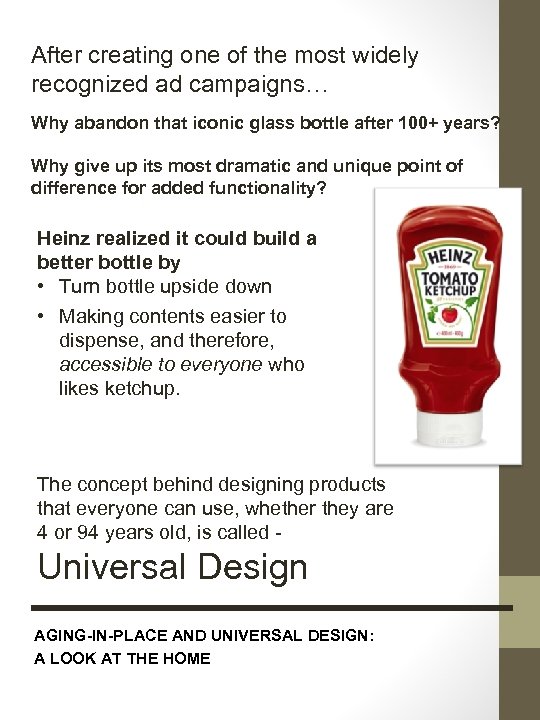 After creating one of the most widely recognized ad campaigns… Why abandon that iconic glass bottle after 100+ years? Why give up its most dramatic and unique point of difference for added functionality? Heinz realized it could build a better bottle by • Turn bottle upside down • Making contents easier to dispense, and therefore, accessible to everyone who likes ketchup. The concept behind designing products that everyone can use, whether they are 4 or 94 years old, is called - Universal Design AGING-IN-PLACE AND UNIVERSAL DESIGN: A LOOK AT THE HOME
 We are currently building homes following the same conventions Heinz followed for more than 120 years – “WE DO IT THIS WAY BECAUSE WE’VE ALWAYS DONE IT THIS WAY” AGING-IN-PLACE AND UNIVERSAL DESIGN: A LOOK AT THE HOME
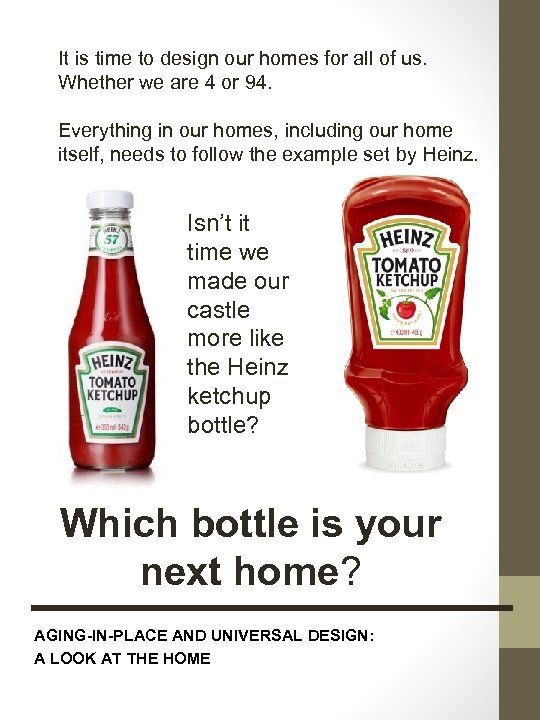 It is time to design our homes for all of us. Whether we are 4 or 94. Everything in our homes, including our home itself, needs to follow the example set by Heinz. Isn’t it time we made our castle more like the Heinz ketchup bottle? Which bottle is your next home? AGING-IN-PLACE AND UNIVERSAL DESIGN: A LOOK AT THE HOME
 THINK UNIVERSAL DESIGN AGING-IN-PLACE AND UNIVERSAL DESIGN: A LOOK AT THE HOME
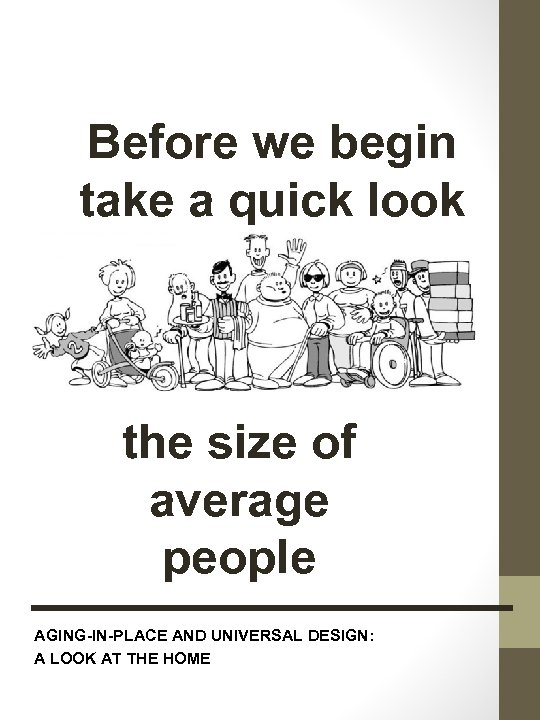 Before we begin take a quick look at the size of average people AGING-IN-PLACE AND UNIVERSAL DESIGN: A LOOK AT THE HOME
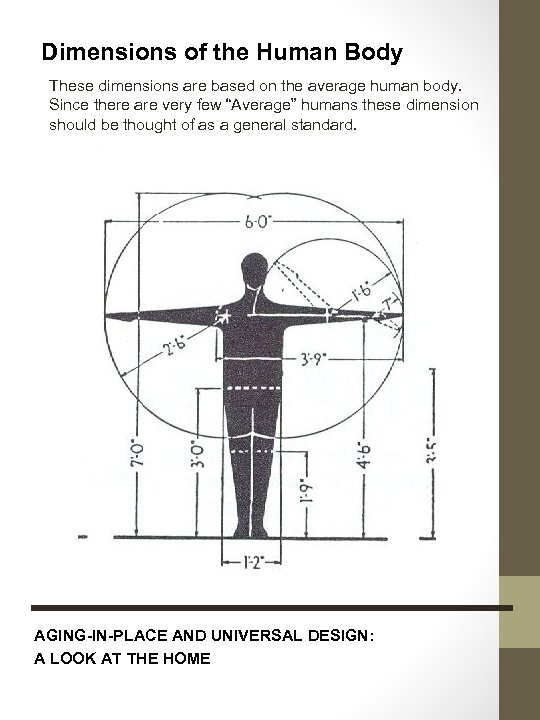 Dimensions of the Human Body These dimensions are based on the average human body. Since there are very few “Average” humans these dimension should be thought of as a general standard. AGING-IN-PLACE AND UNIVERSAL DESIGN: A LOOK AT THE HOME
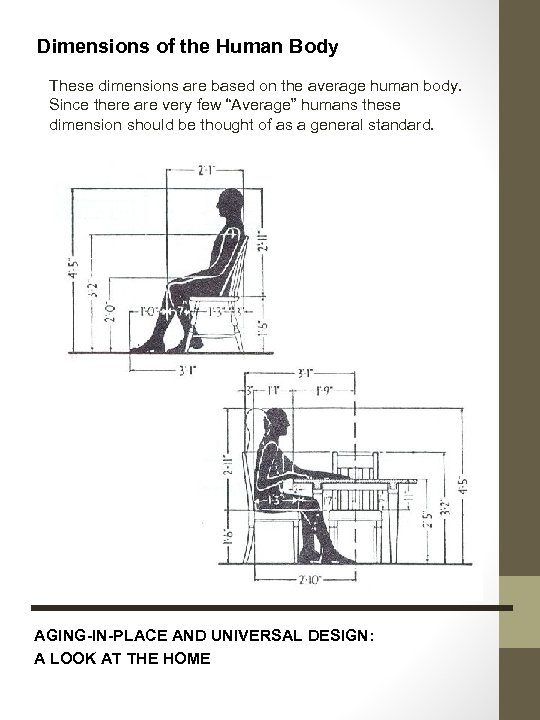 Dimensions of the Human Body These dimensions are based on the average human body. Since there are very few “Average” humans these dimension should be thought of as a general standard. AGING-IN-PLACE AND UNIVERSAL DESIGN: A LOOK AT THE HOME
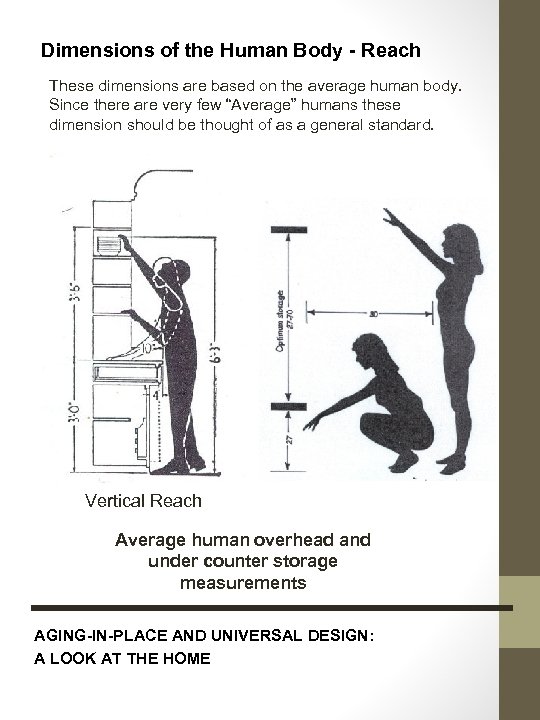 Dimensions of the Human Body - Reach These dimensions are based on the average human body. Since there are very few “Average” humans these dimension should be thought of as a general standard. Vertical Reach Average human overhead and under counter storage measurements AGING-IN-PLACE AND UNIVERSAL DESIGN: A LOOK AT THE HOME
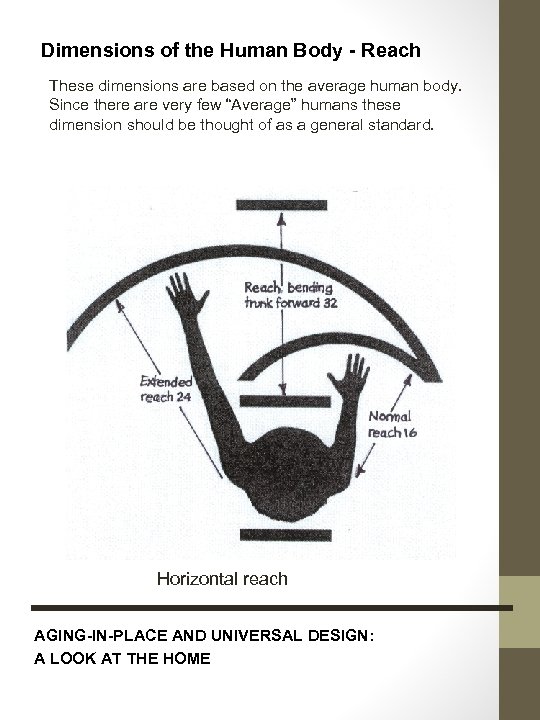 Dimensions of the Human Body - Reach These dimensions are based on the average human body. Since there are very few “Average” humans these dimension should be thought of as a general standard. Horizontal reach AGING-IN-PLACE AND UNIVERSAL DESIGN: A LOOK AT THE HOME
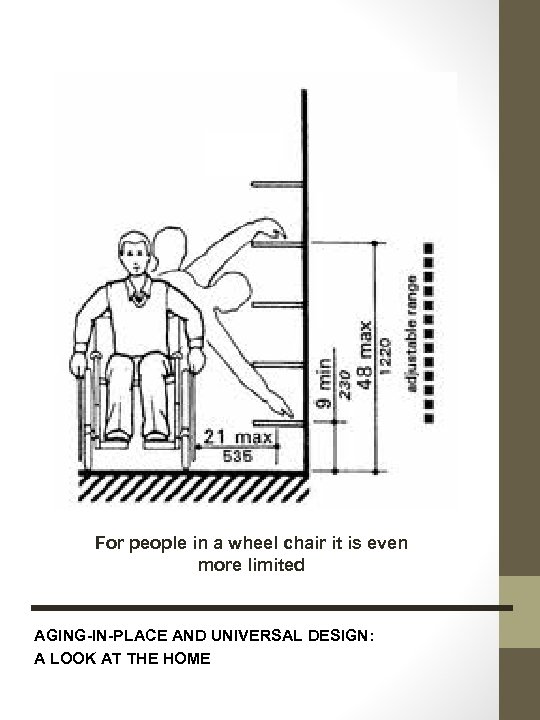 For people in a wheel chair it is even more limited AGING-IN-PLACE AND UNIVERSAL DESIGN: A LOOK AT THE HOME
 Many Universal Design features will add to the cost of a home But let’ s take a quick look at the alternative to building to allow Aging-In-Place. AGING-IN-PLACE AND UNIVERSAL DESIGN: A LOOK AT THE HOME
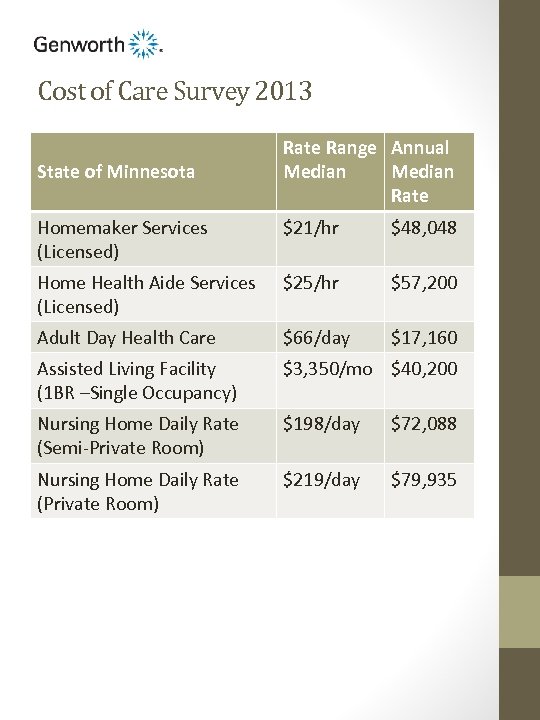 Cost of Care Survey 2013 State of Minnesota Rate Range Annual Median Rate Homemaker Services (Licensed) $21/hr $48, 048 Home Health Aide Services (Licensed) $25/hr $57, 200 Adult Day Health Care $66/day $17, 160 Assisted Living Facility (1 BR –Single Occupancy) $3, 350/mo $40, 200 Nursing Home Daily Rate (Semi-Private Room) $198/day $72, 088 Nursing Home Daily Rate (Private Room) $219/day $79, 935
 So let’s look at the home in all its parts. Here’s how to apply Universal Design AGING-IN-PLACE AND UNIVERSAL DESIGN: A LOOK AT THE HOME
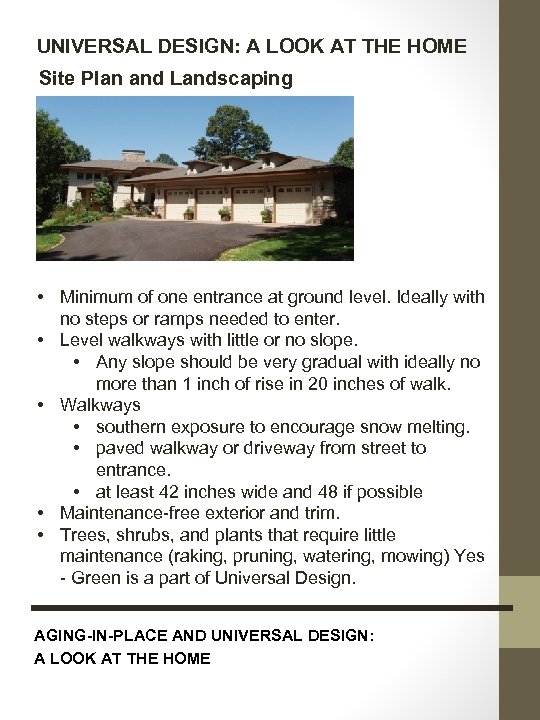 UNIVERSAL DESIGN: A LOOK AT THE HOME Site Plan and Landscaping • Minimum of one entrance at ground level. Ideally with no steps or ramps needed to enter. • Level walkways with little or no slope. • Any slope should be very gradual with ideally no more than 1 inch of rise in 20 inches of walk. • Walkways • southern exposure to encourage snow melting. • paved walkway or driveway from street to entrance. • at least 42 inches wide and 48 if possible • Maintenance-free exterior and trim. • Trees, shrubs, and plants that require little maintenance (raking, pruning, watering, mowing) Yes - Green is a part of Universal Design. AGING-IN-PLACE AND UNIVERSAL DESIGN: A LOOK AT THE HOME
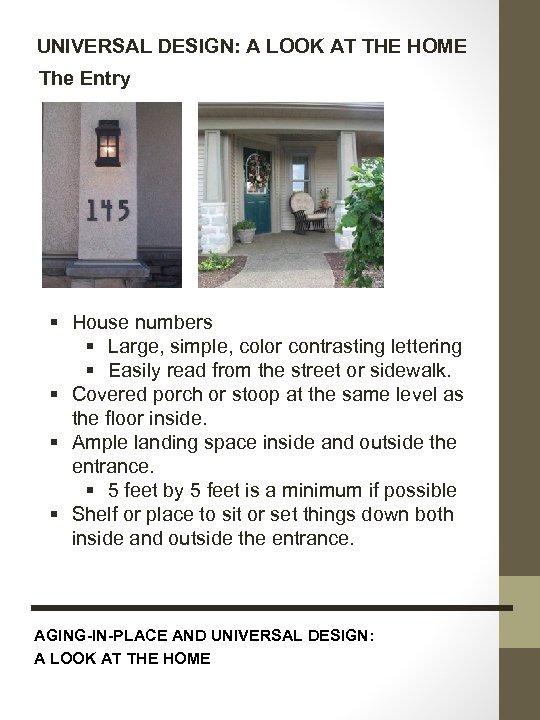 UNIVERSAL DESIGN: A LOOK AT THE HOME The Entry § House numbers § Large, simple, color contrasting lettering § Easily read from the street or sidewalk. § Covered porch or stoop at the same level as the floor inside. § Ample landing space inside and outside the entrance. § 5 feet by 5 feet is a minimum if possible § Shelf or place to sit or set things down both inside and outside the entrance. AGING-IN-PLACE AND UNIVERSAL DESIGN: A LOOK AT THE HOME
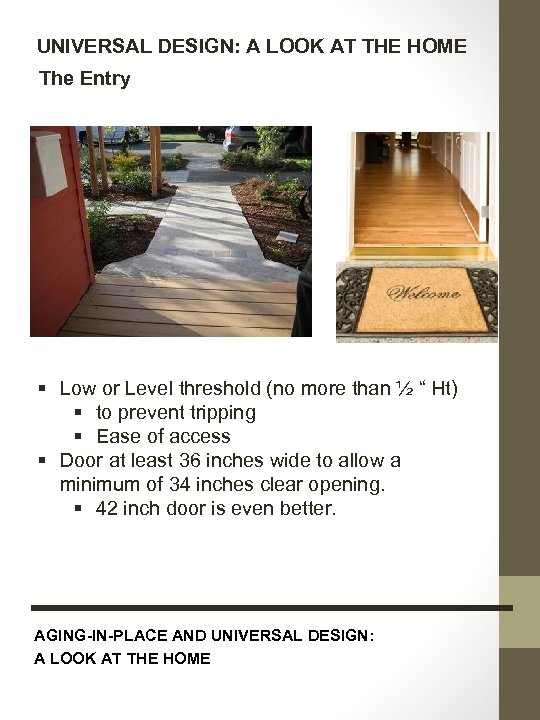 UNIVERSAL DESIGN: A LOOK AT THE HOME The Entry § Low or Level threshold (no more than ½ “ Ht) § to prevent tripping § Ease of access § Door at least 36 inches wide to allow a minimum of 34 inches clear opening. § 42 inch door is even better. AGING-IN-PLACE AND UNIVERSAL DESIGN: A LOOK AT THE HOME
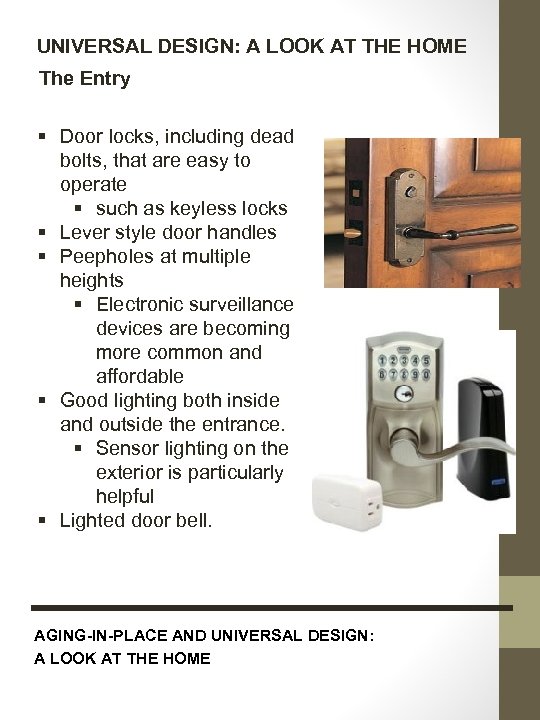 UNIVERSAL DESIGN: A LOOK AT THE HOME The Entry § Door locks, including dead bolts, that are easy to operate § such as keyless locks § Lever style door handles § Peepholes at multiple heights § Electronic surveillance devices are becoming more common and affordable § Good lighting both inside and outside the entrance. § Sensor lighting on the exterior is particularly helpful § Lighted door bell. AGING-IN-PLACE AND UNIVERSAL DESIGN: A LOOK AT THE HOME
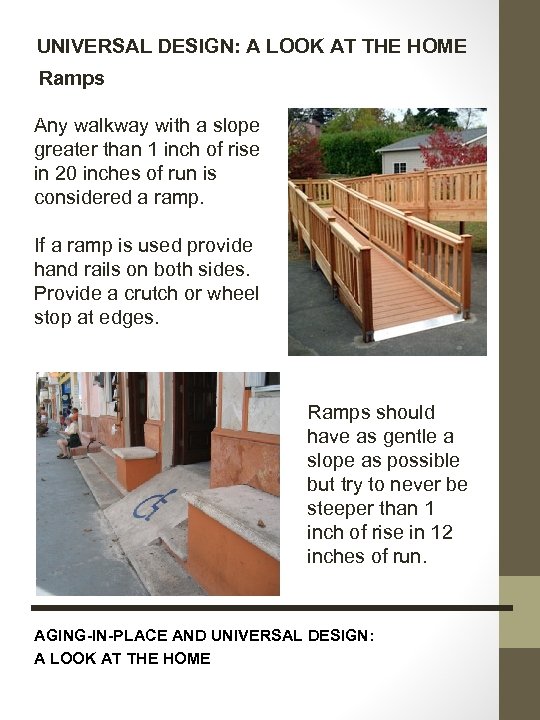 UNIVERSAL DESIGN: A LOOK AT THE HOME Ramps Any walkway with a slope greater than 1 inch of rise in 20 inches of run is considered a ramp. If a ramp is used provide hand rails on both sides. Provide a crutch or wheel stop at edges. Ramps should have as gentle a slope as possible but try to never be steeper than 1 inch of rise in 12 inches of run. AGING-IN-PLACE AND UNIVERSAL DESIGN: A LOOK AT THE HOME
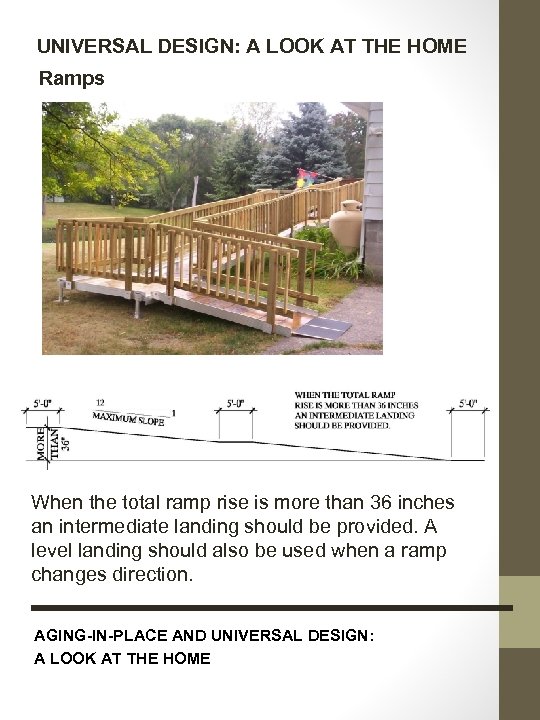 UNIVERSAL DESIGN: A LOOK AT THE HOME Ramps When the total ramp rise is more than 36 inches an intermediate landing should be provided. A level landing should also be used when a ramp changes direction. AGING-IN-PLACE AND UNIVERSAL DESIGN: A LOOK AT THE HOME
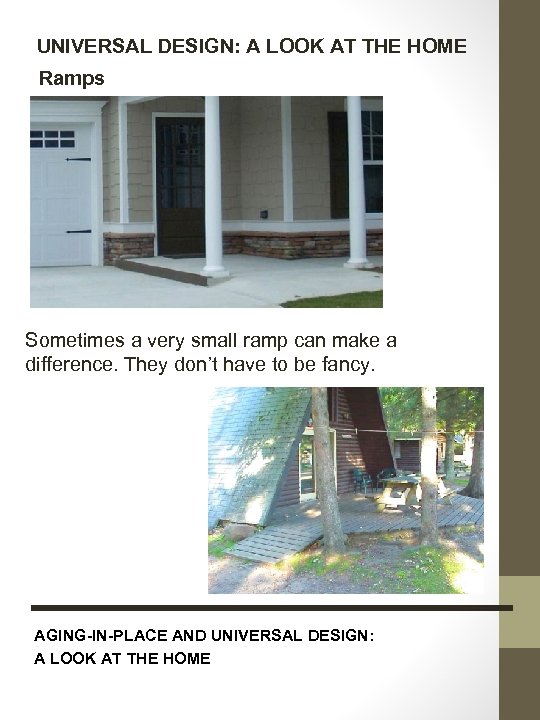 UNIVERSAL DESIGN: A LOOK AT THE HOME Ramps Sometimes a very small ramp can make a difference. They don’t have to be fancy. AGING-IN-PLACE AND UNIVERSAL DESIGN: A LOOK AT THE HOME
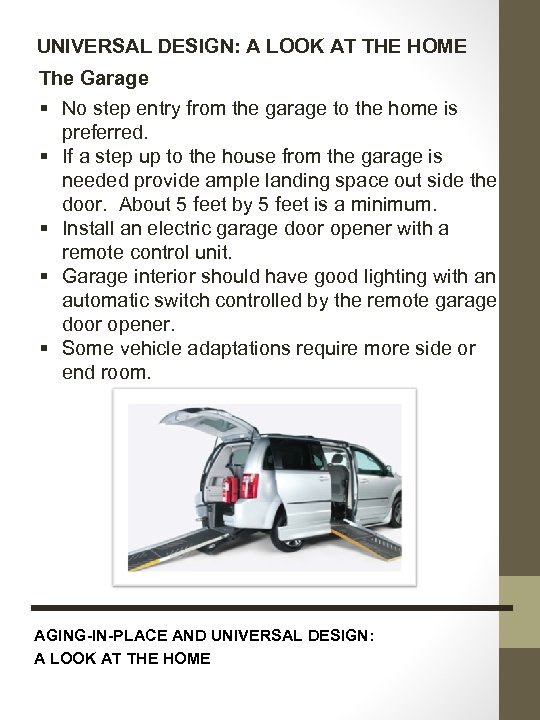 UNIVERSAL DESIGN: A LOOK AT THE HOME The Garage § No step entry from the garage to the home is preferred. § If a step up to the house from the garage is needed provide ample landing space out side the door. About 5 feet by 5 feet is a minimum. § Install an electric garage door opener with a remote control unit. § Garage interior should have good lighting with an automatic switch controlled by the remote garage door opener. § Some vehicle adaptations require more side or end room. AGING-IN-PLACE AND UNIVERSAL DESIGN: A LOOK AT THE HOME
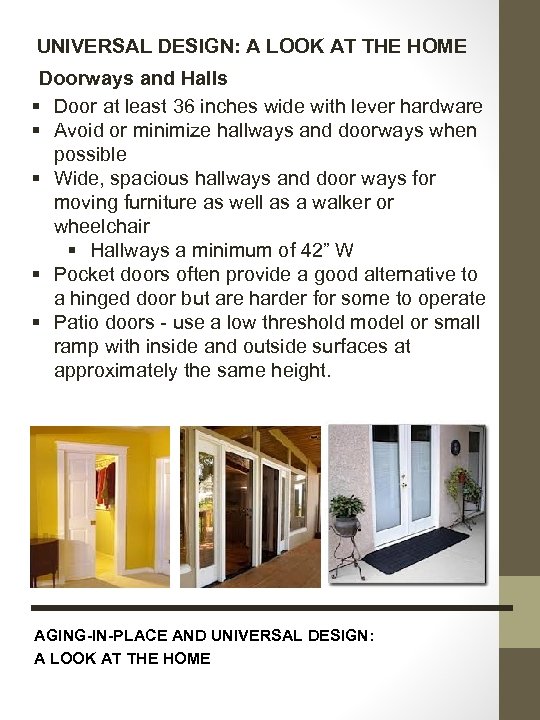 UNIVERSAL DESIGN: A LOOK AT THE HOME Doorways and Halls § Door at least 36 inches wide with lever hardware § Avoid or minimize hallways and doorways when possible § Wide, spacious hallways and door ways for moving furniture as well as a walker or wheelchair § Hallways a minimum of 42” W § Pocket doors often provide a good alternative to a hinged door but are harder for some to operate § Patio doors - use a low threshold model or small ramp with inside and outside surfaces at approximately the same height. AGING-IN-PLACE AND UNIVERSAL DESIGN: A LOOK AT THE HOME
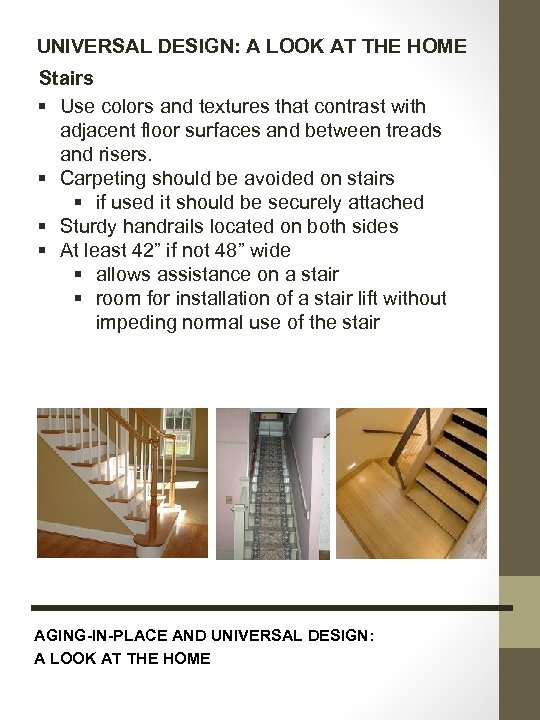 UNIVERSAL DESIGN: A LOOK AT THE HOME Stairs § Use colors and textures that contrast with adjacent floor surfaces and between treads and risers. § Carpeting should be avoided on stairs § if used it should be securely attached § Sturdy handrails located on both sides § At least 42” if not 48” wide § allows assistance on a stair § room for installation of a stair lift without impeding normal use of the stair AGING-IN-PLACE AND UNIVERSAL DESIGN: A LOOK AT THE HOME
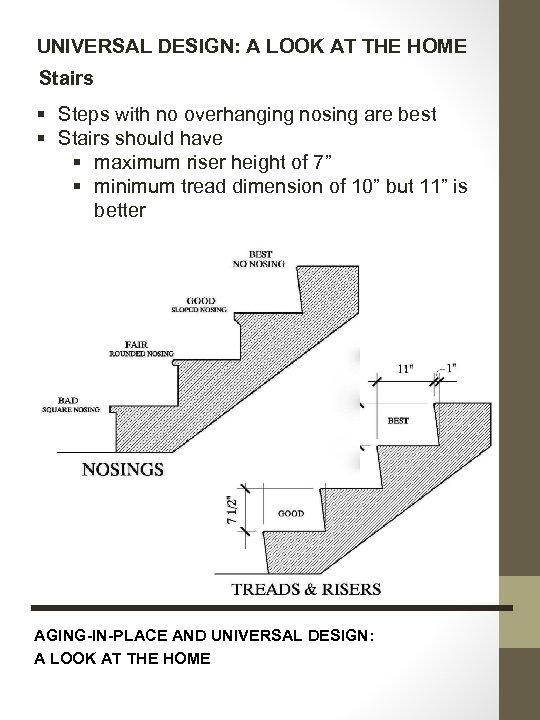 UNIVERSAL DESIGN: A LOOK AT THE HOME Stairs § Steps with no overhanging nosing are best § Stairs should have § maximum riser height of 7” § minimum tread dimension of 10” but 11” is better AGING-IN-PLACE AND UNIVERSAL DESIGN: A LOOK AT THE HOME
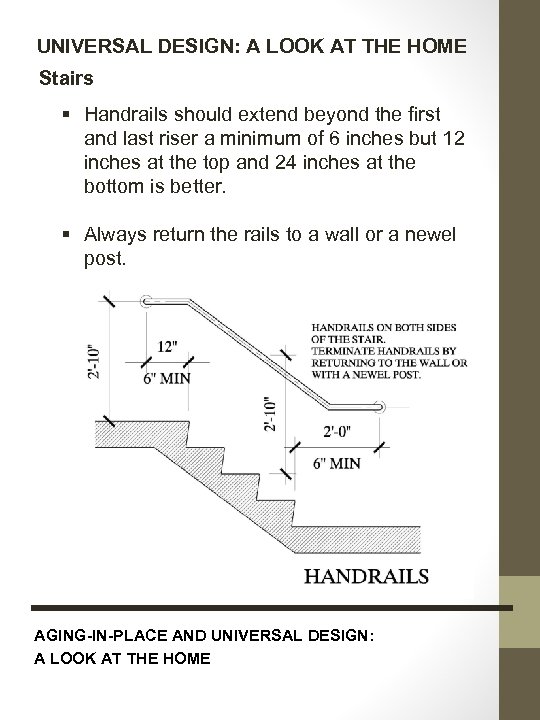 UNIVERSAL DESIGN: A LOOK AT THE HOME Stairs § Handrails should extend beyond the first and last riser a minimum of 6 inches but 12 inches at the top and 24 inches at the bottom is better. § Always return the rails to a wall or a newel post. AGING-IN-PLACE AND UNIVERSAL DESIGN: A LOOK AT THE HOME
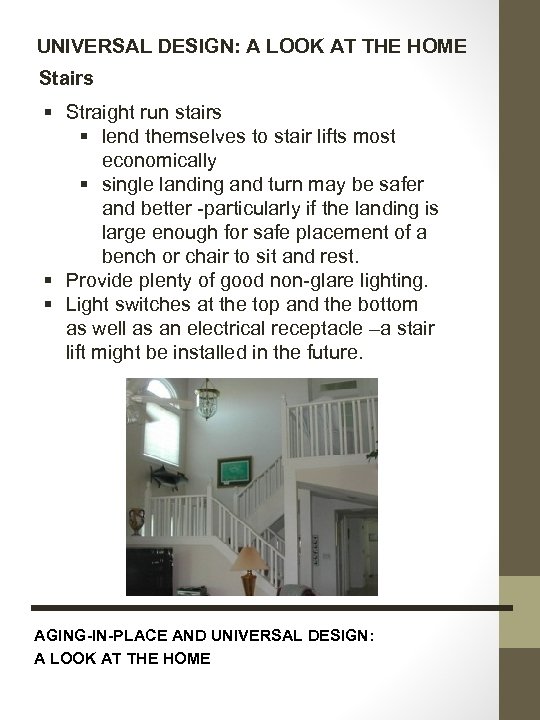 UNIVERSAL DESIGN: A LOOK AT THE HOME Stairs § Straight run stairs § lend themselves to stair lifts most economically § single landing and turn may be safer and better -particularly if the landing is large enough for safe placement of a bench or chair to sit and rest. § Provide plenty of good non-glare lighting. § Light switches at the top and the bottom as well as an electrical receptacle –a stair lift might be installed in the future. AGING-IN-PLACE AND UNIVERSAL DESIGN: A LOOK AT THE HOME
 UNIVERSAL DESIGN: A LOOK AT THE HOME Lifts The words used when discussing “lifts, ” “elevating devices, ” “elevators” and “hoists” can be confusing as the terms are often used interchangeably and consequently, inappropriately. Be very clear what it is you are talking about. Vertical Lifts - typically used to provide access between different floors of a house, or from the ground level outside the house to an inside floor level There are three main types of lifts: § Vertical platform lift § Inclined platform lift § Stair lift A chair lift usually refers to a special type of chair that rises and tips to help an individual get out of the chair. Residential elevator commonly used term for a lift that is enclosed in a shaft and travels vertically between floors. The term “hoist” may refer to a device used to transfer/move a person in a sling and usually is connected to a lifting mechanism such as a ceiling mounted rail or a floor mounted dolly. Transfer system is an appropriate description. The best bet is to NOT use the terms “Hoist, or Chair Lift” unless you are very clear what you are talking about. AGING-IN-PLACE AND UNIVERSAL DESIGN: A LOOK AT THE HOME
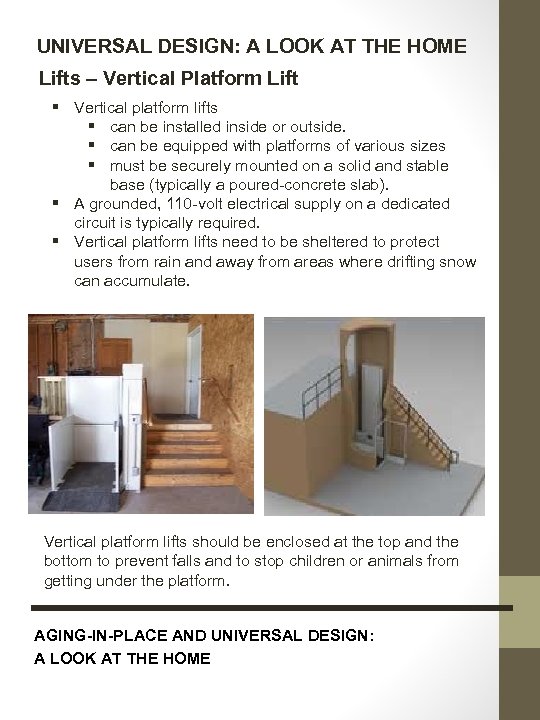 UNIVERSAL DESIGN: A LOOK AT THE HOME Lifts – Vertical Platform Lift § Vertical platform lifts § can be installed inside or outside. § can be equipped with platforms of various sizes § must be securely mounted on a solid and stable base (typically a poured-concrete slab). § A grounded, 110 -volt electrical supply on a dedicated circuit is typically required. § Vertical platform lifts need to be sheltered to protect users from rain and away from areas where drifting snow can accumulate. Vertical platform lifts should be enclosed at the top and the bottom to prevent falls and to stop children or animals from getting under the platform. AGING-IN-PLACE AND UNIVERSAL DESIGN: A LOOK AT THE HOME
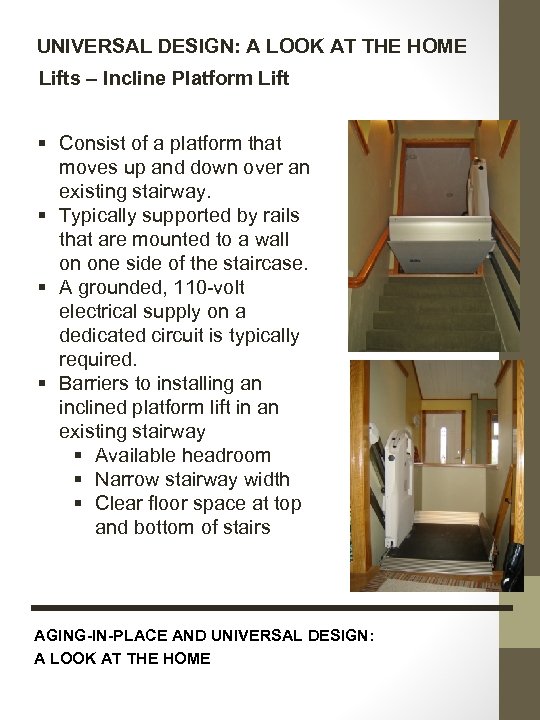 UNIVERSAL DESIGN: A LOOK AT THE HOME Lifts – Incline Platform Lift § Consist of a platform that moves up and down over an existing stairway. § Typically supported by rails that are mounted to a wall on one side of the staircase. § A grounded, 110 -volt electrical supply on a dedicated circuit is typically required. § Barriers to installing an inclined platform lift in an existing stairway § Available headroom § Narrow stairway width § Clear floor space at top and bottom of stairs AGING-IN-PLACE AND UNIVERSAL DESIGN: A LOOK AT THE HOME
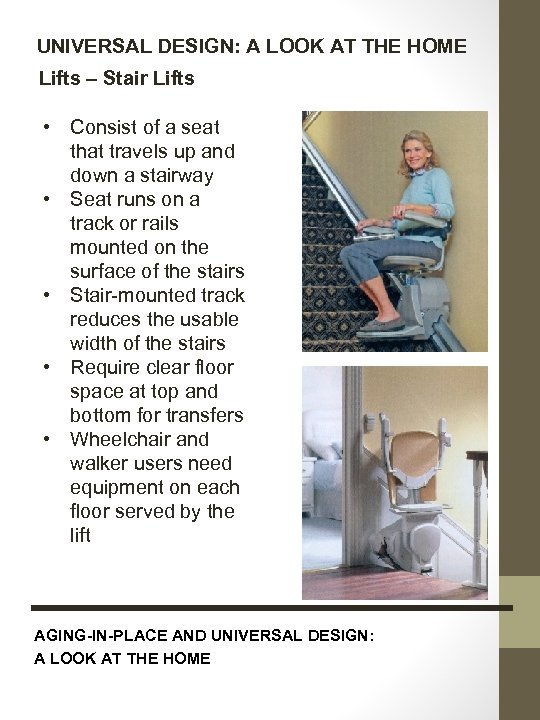 UNIVERSAL DESIGN: A LOOK AT THE HOME Lifts – Stair Lifts • Consist of a seat that travels up and down a stairway • Seat runs on a track or rails mounted on the surface of the stairs • Stair-mounted track reduces the usable width of the stairs • Require clear floor space at top and bottom for transfers • Wheelchair and walker users need equipment on each floor served by the lift AGING-IN-PLACE AND UNIVERSAL DESIGN: A LOOK AT THE HOME
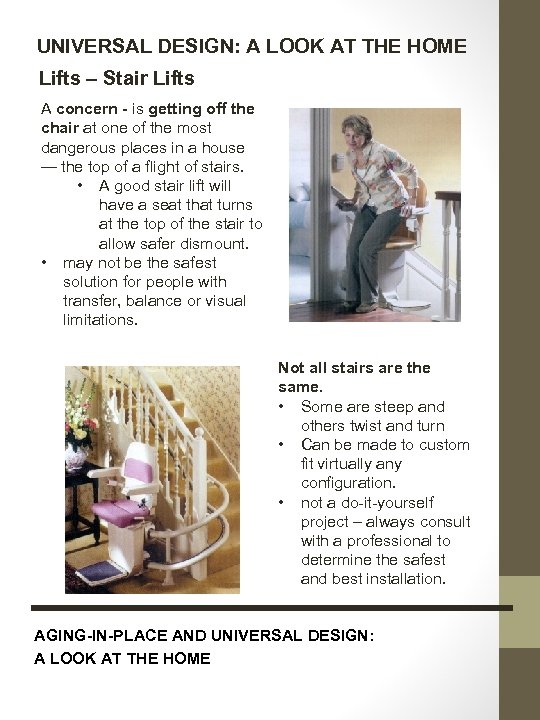 UNIVERSAL DESIGN: A LOOK AT THE HOME Lifts – Stair Lifts A concern - is getting off the chair at one of the most dangerous places in a house — the top of a flight of stairs. • A good stair lift will have a seat that turns at the top of the stair to allow safer dismount. • may not be the safest solution for people with transfer, balance or visual limitations. Not all stairs are the same. • Some are steep and others twist and turn • Can be made to custom fit virtually any configuration. • not a do-it-yourself project – always consult with a professional to determine the safest and best installation. AGING-IN-PLACE AND UNIVERSAL DESIGN: A LOOK AT THE HOME
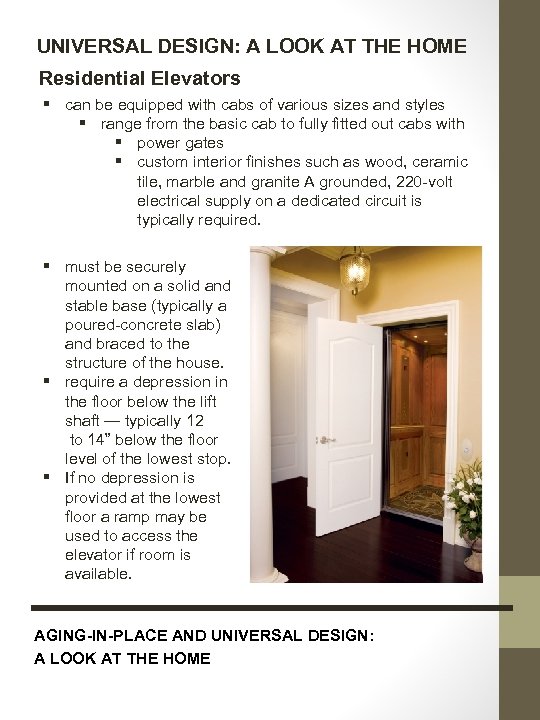 UNIVERSAL DESIGN: A LOOK AT THE HOME Residential Elevators § can be equipped with cabs of various sizes and styles § range from the basic cab to fully fitted out cabs with § power gates § custom interior finishes such as wood, ceramic tile, marble and granite A grounded, 220 -volt electrical supply on a dedicated circuit is typically required. § must be securely mounted on a solid and stable base (typically a poured-concrete slab) and braced to the structure of the house. § require a depression in the floor below the lift shaft — typically 12 to 14” below the floor level of the lowest stop. § If no depression is provided at the lowest floor a ramp may be used to access the elevator if room is available. AGING-IN-PLACE AND UNIVERSAL DESIGN: A LOOK AT THE HOME
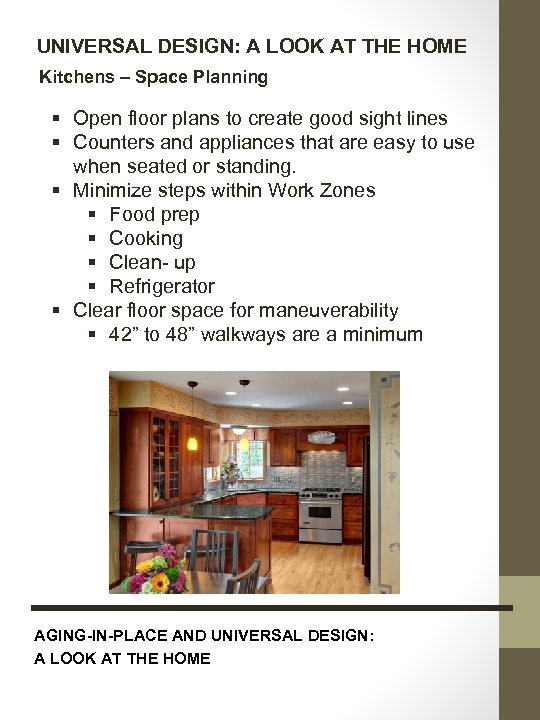 UNIVERSAL DESIGN: A LOOK AT THE HOME Kitchens – Space Planning § Open floor plans to create good sight lines § Counters and appliances that are easy to use when seated or standing. § Minimize steps within Work Zones § Food prep § Cooking § Clean- up § Refrigerator § Clear floor space for maneuverability § 42” to 48” walkways are a minimum AGING-IN-PLACE AND UNIVERSAL DESIGN: A LOOK AT THE HOME
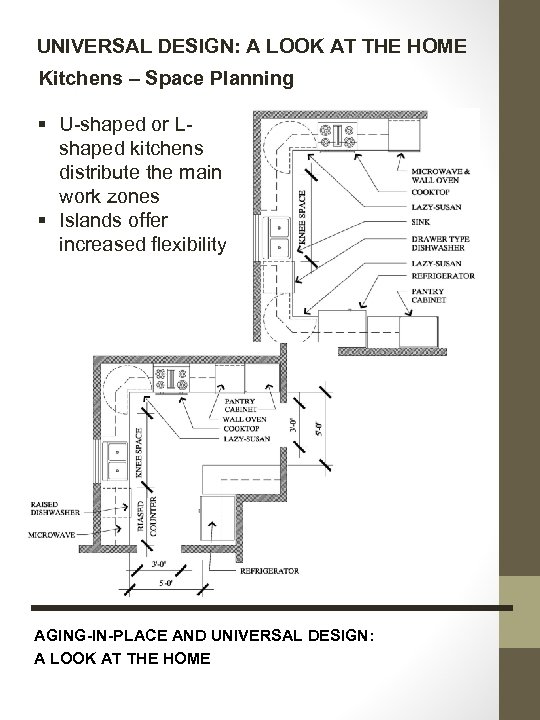 UNIVERSAL DESIGN: A LOOK AT THE HOME Kitchens – Space Planning § U-shaped or Lshaped kitchens distribute the main work zones § Islands offer increased flexibility AGING-IN-PLACE AND UNIVERSAL DESIGN: A LOOK AT THE HOME
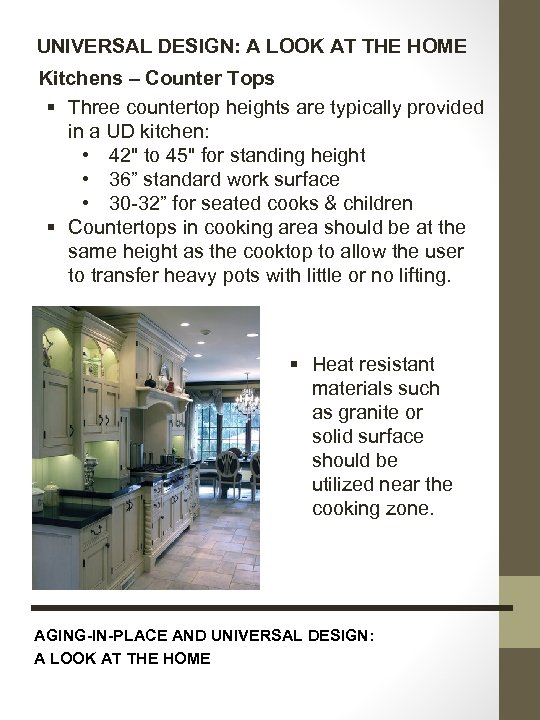 UNIVERSAL DESIGN: A LOOK AT THE HOME Kitchens – Counter Tops § Three countertop heights are typically provided in a UD kitchen: • 42" to 45" for standing height • 36” standard work surface • 30 -32” for seated cooks & children § Countertops in cooking area should be at the same height as the cooktop to allow the user to transfer heavy pots with little or no lifting. § Heat resistant materials such as granite or solid surface should be utilized near the cooking zone. AGING-IN-PLACE AND UNIVERSAL DESIGN: A LOOK AT THE HOME
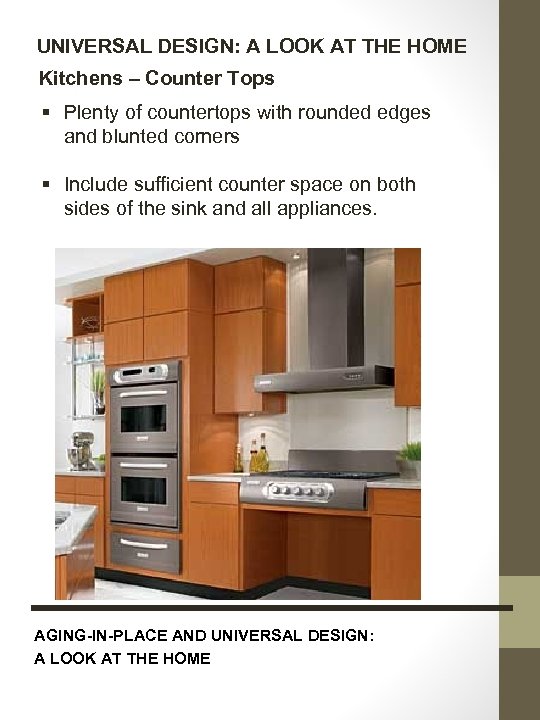 UNIVERSAL DESIGN: A LOOK AT THE HOME Kitchens – Counter Tops § Plenty of countertops with rounded edges and blunted corners § Include sufficient counter space on both sides of the sink and all appliances. AGING-IN-PLACE AND UNIVERSAL DESIGN: A LOOK AT THE HOME
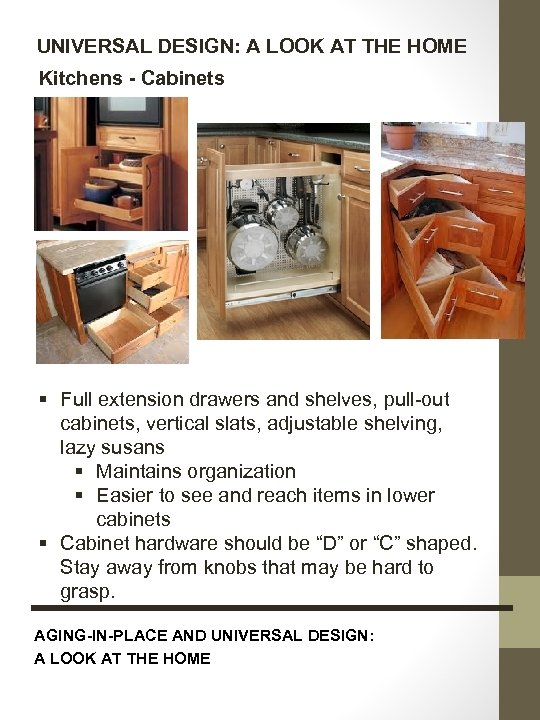 UNIVERSAL DESIGN: A LOOK AT THE HOME Kitchens - Cabinets § Full extension drawers and shelves, pull-out cabinets, vertical slats, adjustable shelving, lazy susans § Maintains organization § Easier to see and reach items in lower cabinets § Cabinet hardware should be “D” or “C” shaped. Stay away from knobs that may be hard to grasp. AGING-IN-PLACE AND UNIVERSAL DESIGN: A LOOK AT THE HOME
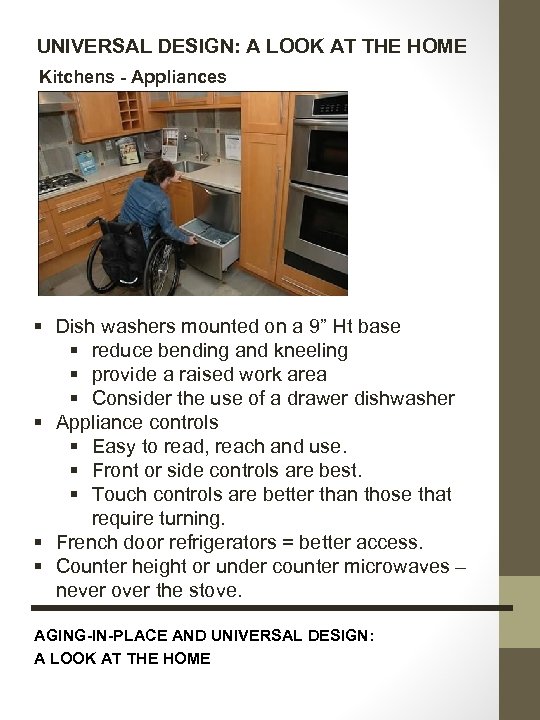 UNIVERSAL DESIGN: A LOOK AT THE HOME Kitchens - Appliances § Dish washers mounted on a 9” Ht base § reduce bending and kneeling § provide a raised work area § Consider the use of a drawer dishwasher § Appliance controls § Easy to read, reach and use. § Front or side controls are best. § Touch controls are better than those that require turning. § French door refrigerators = better access. § Counter height or under counter microwaves – never over the stove. AGING-IN-PLACE AND UNIVERSAL DESIGN: A LOOK AT THE HOME
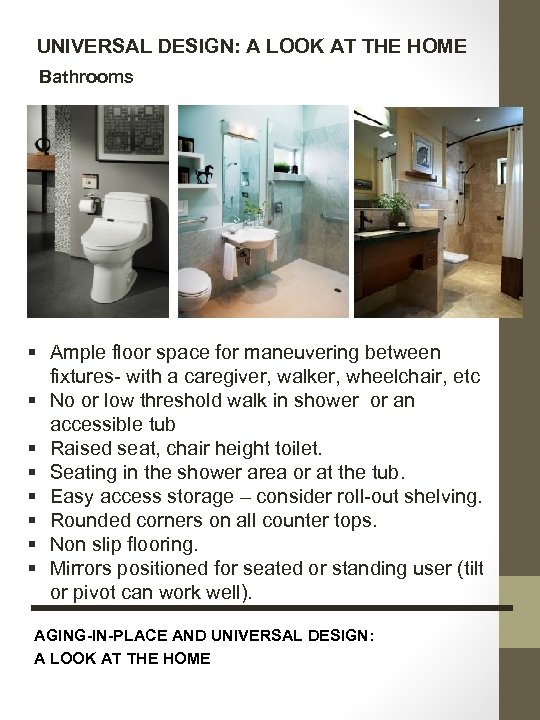 UNIVERSAL DESIGN: A LOOK AT THE HOME Bathrooms § Ample floor space for maneuvering between fixtures- with a caregiver, walker, wheelchair, etc § No or low threshold walk in shower or an accessible tub § Raised seat, chair height toilet. § Seating in the shower area or at the tub. § Easy access storage – consider roll-out shelving. § Rounded corners on all counter tops. § Non slip flooring. § Mirrors positioned for seated or standing user (tilt or pivot can work well). AGING-IN-PLACE AND UNIVERSAL DESIGN: A LOOK AT THE HOME
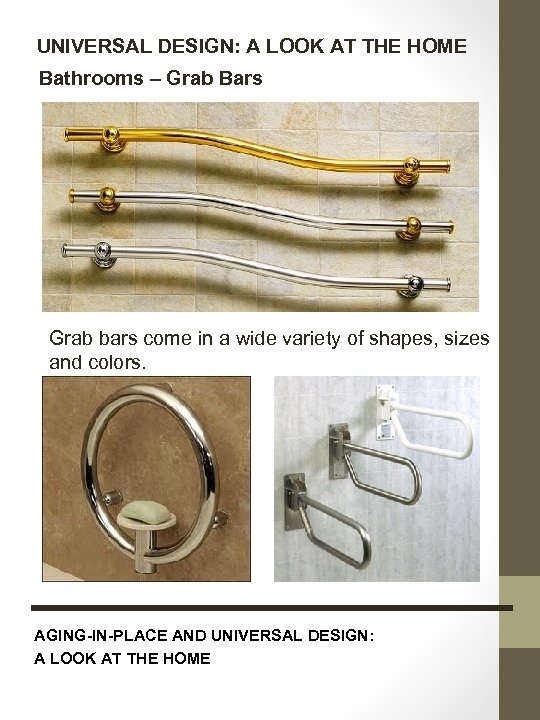 UNIVERSAL DESIGN: A LOOK AT THE HOME Bathrooms – Grab Bars Grab bars come in a wide variety of shapes, sizes and colors. AGING-IN-PLACE AND UNIVERSAL DESIGN: A LOOK AT THE HOME
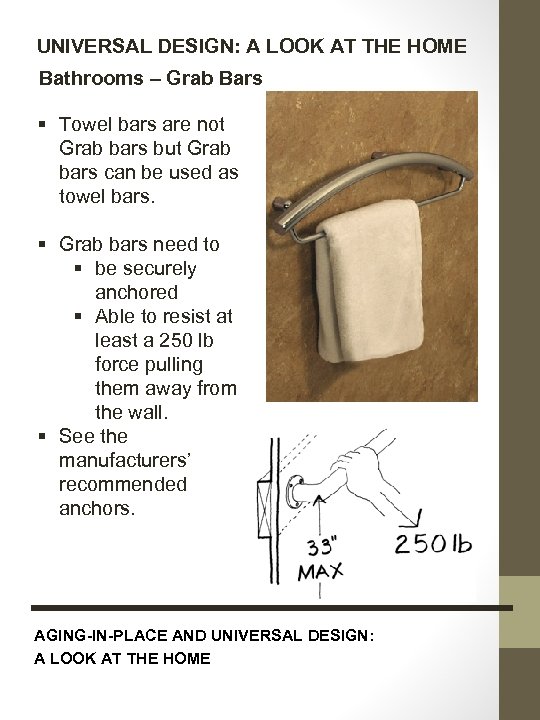 UNIVERSAL DESIGN: A LOOK AT THE HOME Bathrooms – Grab Bars § Towel bars are not Grab bars but Grab bars can be used as towel bars. § Grab bars need to § be securely anchored § Able to resist at least a 250 lb force pulling them away from the wall. § See the manufacturers’ recommended anchors. AGING-IN-PLACE AND UNIVERSAL DESIGN: A LOOK AT THE HOME
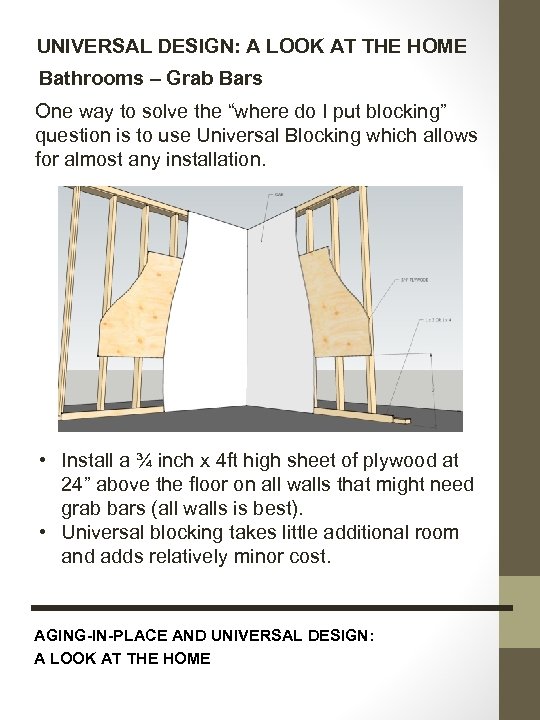 UNIVERSAL DESIGN: A LOOK AT THE HOME Bathrooms – Grab Bars One way to solve the “where do I put blocking” question is to use Universal Blocking which allows for almost any installation. • Install a ¾ inch x 4 ft high sheet of plywood at 24” above the floor on all walls that might need grab bars (all walls is best). • Universal blocking takes little additional room and adds relatively minor cost. AGING-IN-PLACE AND UNIVERSAL DESIGN: A LOOK AT THE HOME
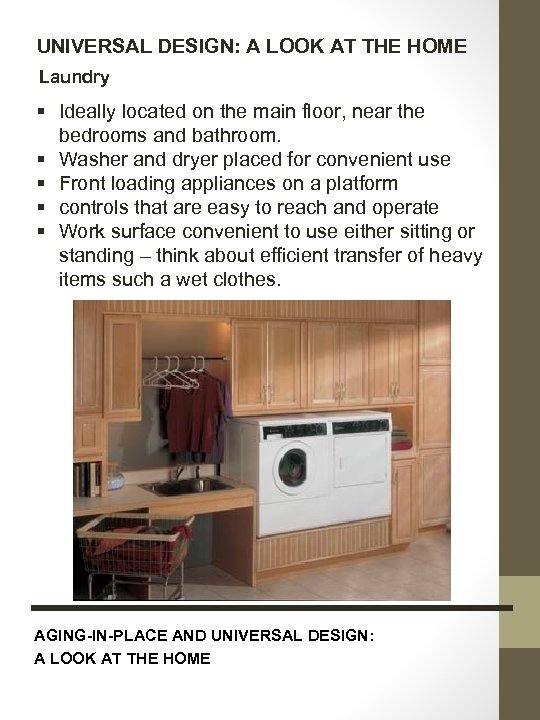 UNIVERSAL DESIGN: A LOOK AT THE HOME Laundry § Ideally located on the main floor, near the bedrooms and bathroom. § Washer and dryer placed for convenient use § Front loading appliances on a platform § controls that are easy to reach and operate § Work surface convenient to use either sitting or standing – think about efficient transfer of heavy items such a wet clothes. AGING-IN-PLACE AND UNIVERSAL DESIGN: A LOOK AT THE HOME
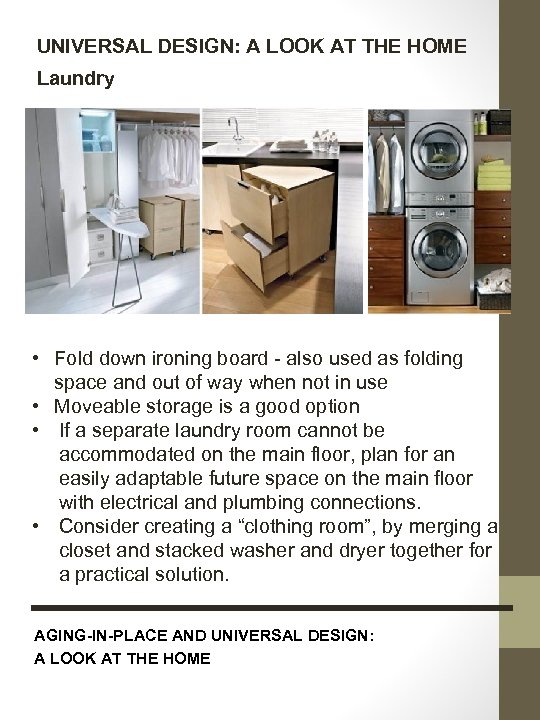 UNIVERSAL DESIGN: A LOOK AT THE HOME Laundry • Fold down ironing board - also used as folding space and out of way when not in use • Moveable storage is a good option • If a separate laundry room cannot be accommodated on the main floor, plan for an easily adaptable future space on the main floor with electrical and plumbing connections. • Consider creating a “clothing room”, by merging a closet and stacked washer and dryer together for a practical solution. AGING-IN-PLACE AND UNIVERSAL DESIGN: A LOOK AT THE HOME
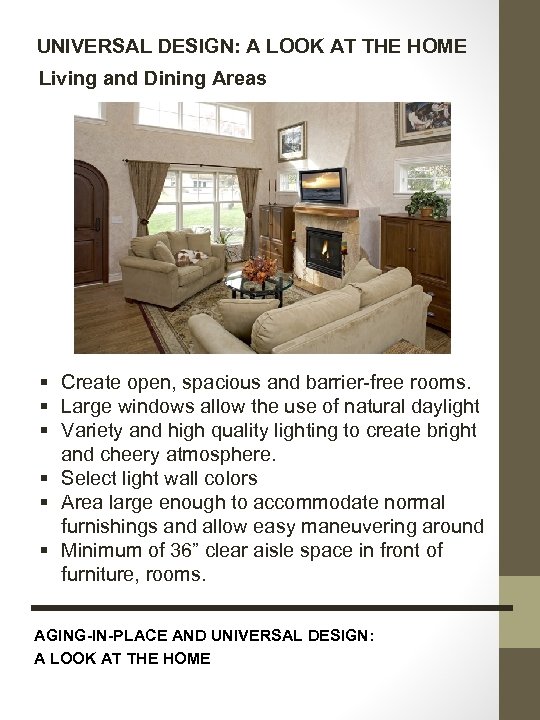 UNIVERSAL DESIGN: A LOOK AT THE HOME Living and Dining Areas § Create open, spacious and barrier-free rooms. § Large windows allow the use of natural daylight § Variety and high quality lighting to create bright and cheery atmosphere. § Select light wall colors § Area large enough to accommodate normal furnishings and allow easy maneuvering around § Minimum of 36” clear aisle space in front of furniture, rooms. AGING-IN-PLACE AND UNIVERSAL DESIGN: A LOOK AT THE HOME
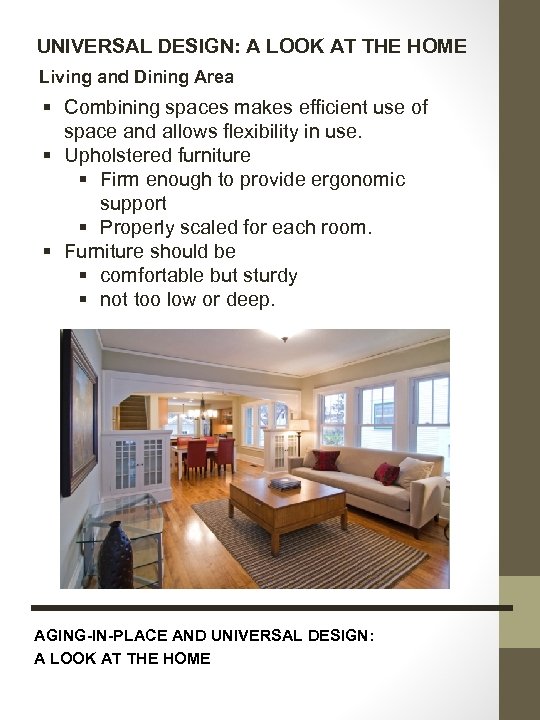 UNIVERSAL DESIGN: A LOOK AT THE HOME Living and Dining Area § Combining spaces makes efficient use of space and allows flexibility in use. § Upholstered furniture § Firm enough to provide ergonomic support § Properly scaled for each room. § Furniture should be § comfortable but sturdy § not too low or deep. AGING-IN-PLACE AND UNIVERSAL DESIGN: A LOOK AT THE HOME
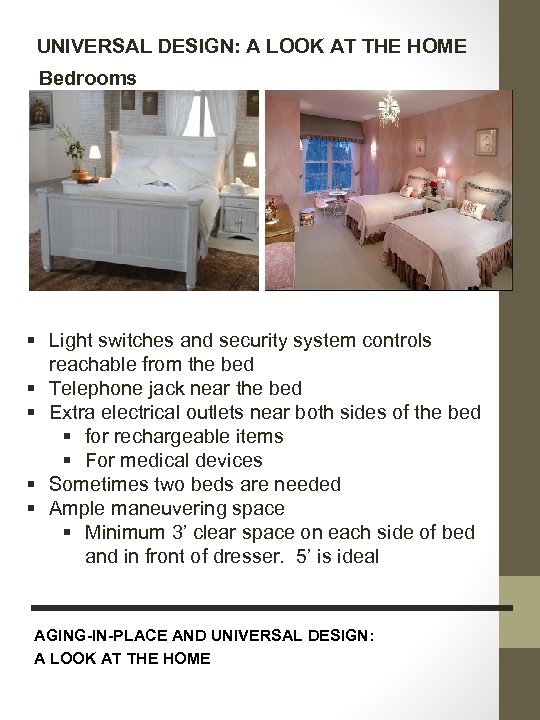 UNIVERSAL DESIGN: A LOOK AT THE HOME Bedrooms § Light switches and security system controls reachable from the bed § Telephone jack near the bed § Extra electrical outlets near both sides of the bed § for rechargeable items § For medical devices § Sometimes two beds are needed § Ample maneuvering space § Minimum 3’ clear space on each side of bed and in front of dresser. 5’ is ideal AGING-IN-PLACE AND UNIVERSAL DESIGN: A LOOK AT THE HOME
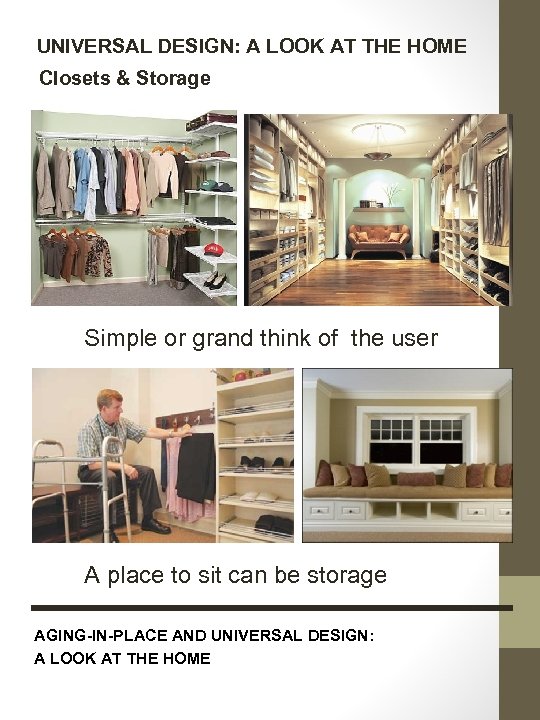 UNIVERSAL DESIGN: A LOOK AT THE HOME Closets & Storage Simple or grand think of the user A place to sit can be storage AGING-IN-PLACE AND UNIVERSAL DESIGN: A LOOK AT THE HOME
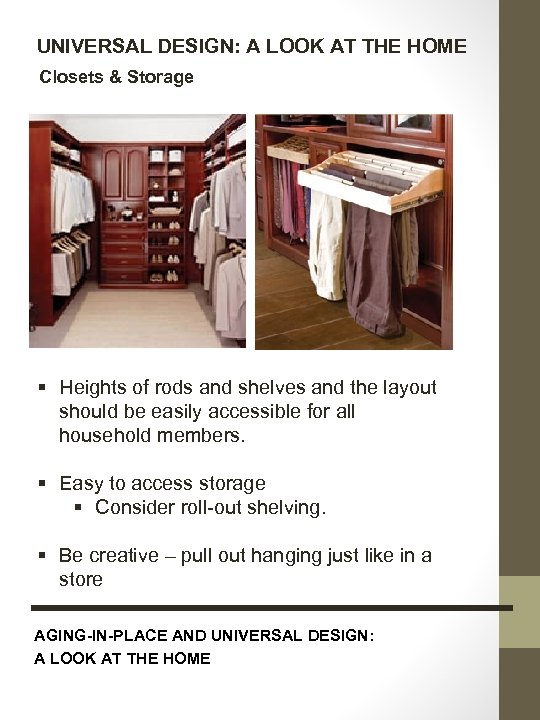 UNIVERSAL DESIGN: A LOOK AT THE HOME Closets & Storage § Heights of rods and shelves and the layout should be easily accessible for all household members. § Easy to access storage § Consider roll-out shelving. § Be creative – pull out hanging just like in a store AGING-IN-PLACE AND UNIVERSAL DESIGN: A LOOK AT THE HOME
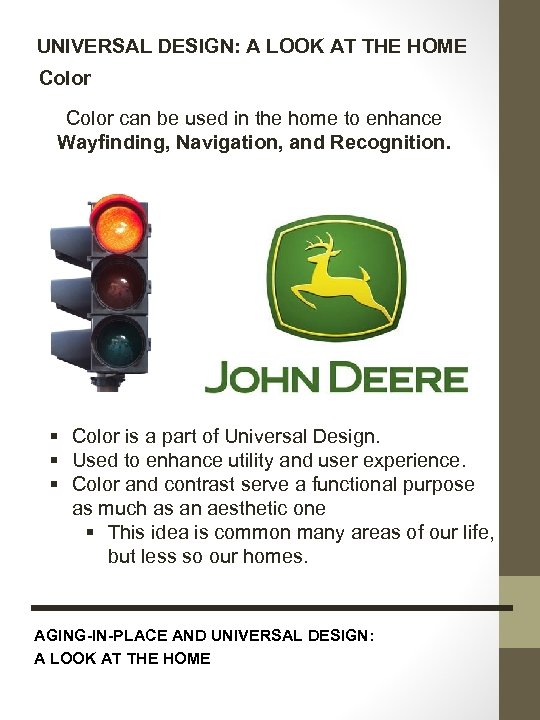 UNIVERSAL DESIGN: A LOOK AT THE HOME Color can be used in the home to enhance Wayfinding, Navigation, and Recognition. § Color is a part of Universal Design. § Used to enhance utility and user experience. § Color and contrast serve a functional purpose as much as an aesthetic one § This idea is common many areas of our life, but less so our homes. AGING-IN-PLACE AND UNIVERSAL DESIGN: A LOOK AT THE HOME
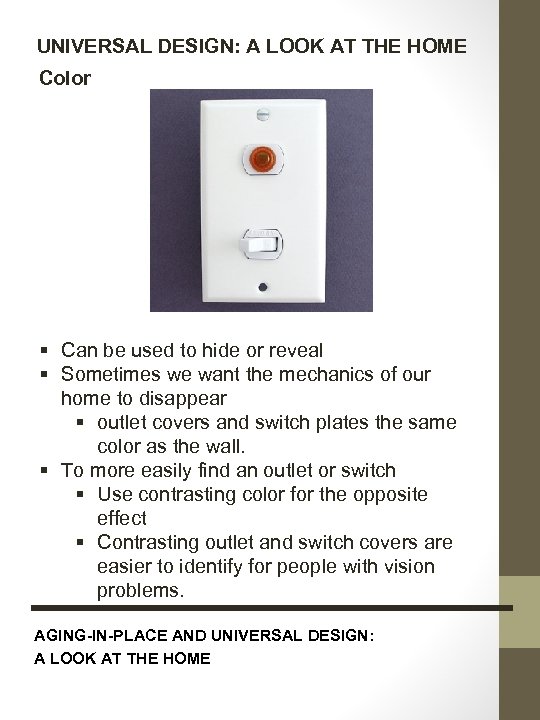 UNIVERSAL DESIGN: A LOOK AT THE HOME Color § Can be used to hide or reveal § Sometimes we want the mechanics of our home to disappear § outlet covers and switch plates the same color as the wall. § To more easily find an outlet or switch § Use contrasting color for the opposite effect § Contrasting outlet and switch covers are easier to identify for people with vision problems. AGING-IN-PLACE AND UNIVERSAL DESIGN: A LOOK AT THE HOME
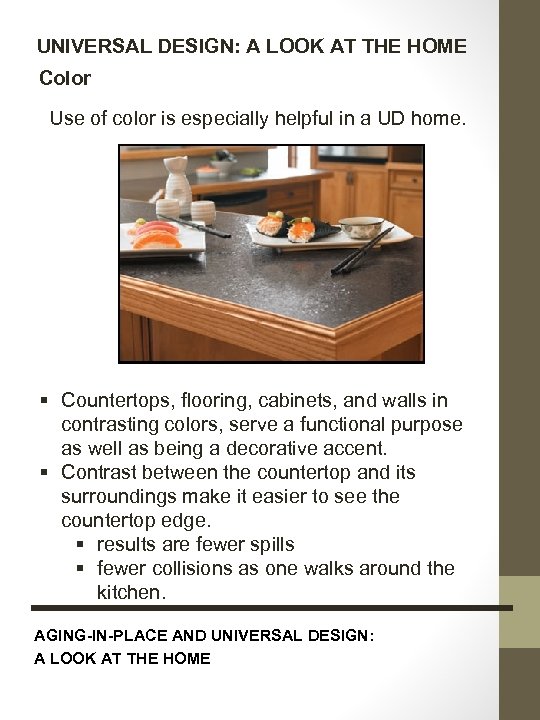 UNIVERSAL DESIGN: A LOOK AT THE HOME Color Use of color is especially helpful in a UD home. § Countertops, flooring, cabinets, and walls in contrasting colors, serve a functional purpose as well as being a decorative accent. § Contrast between the countertop and its surroundings make it easier to see the countertop edge. § results are fewer spills § fewer collisions as one walks around the kitchen. AGING-IN-PLACE AND UNIVERSAL DESIGN: A LOOK AT THE HOME
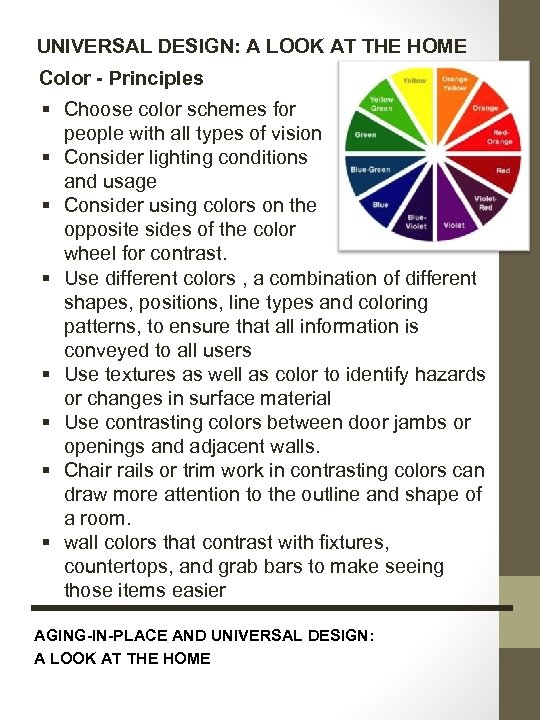 UNIVERSAL DESIGN: A LOOK AT THE HOME Color - Principles § Choose color schemes for people with all types of vision § Consider lighting conditions and usage § Consider using colors on the opposite sides of the color wheel for contrast. § Use different colors , a combination of different shapes, positions, line types and coloring patterns, to ensure that all information is conveyed to all users § Use textures as well as color to identify hazards or changes in surface material § Use contrasting colors between door jambs or openings and adjacent walls. § Chair rails or trim work in contrasting colors can draw more attention to the outline and shape of a room. § wall colors that contrast with fixtures, countertops, and grab bars to make seeing those items easier AGING-IN-PLACE AND UNIVERSAL DESIGN: A LOOK AT THE HOME
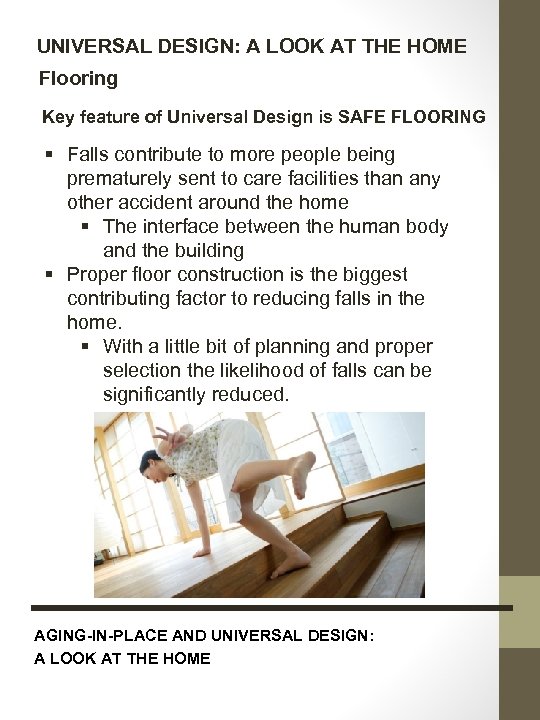 UNIVERSAL DESIGN: A LOOK AT THE HOME Flooring Key feature of Universal Design is SAFE FLOORING § Falls contribute to more people being prematurely sent to care facilities than any other accident around the home § The interface between the human body and the building § Proper floor construction is the biggest contributing factor to reducing falls in the home. § With a little bit of planning and proper selection the likelihood of falls can be significantly reduced. AGING-IN-PLACE AND UNIVERSAL DESIGN: A LOOK AT THE HOME
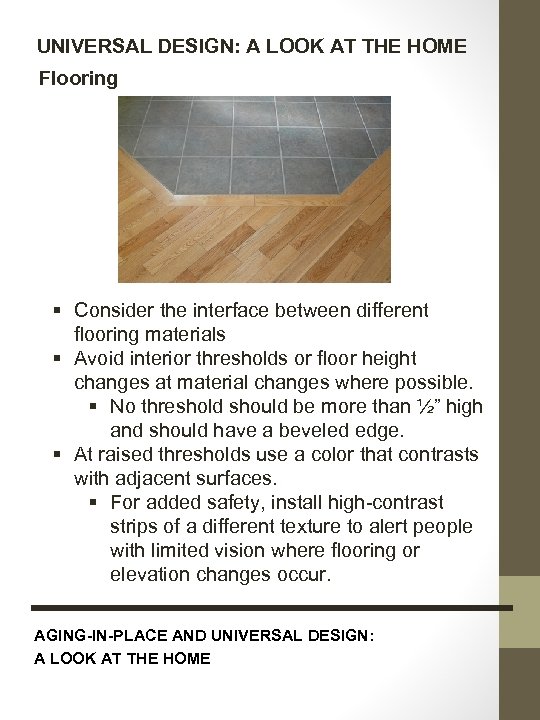 UNIVERSAL DESIGN: A LOOK AT THE HOME Flooring § Consider the interface between different flooring materials § Avoid interior thresholds or floor height changes at material changes where possible. § No threshold should be more than ½” high and should have a beveled edge. § At raised thresholds use a color that contrasts with adjacent surfaces. § For added safety, install high-contrast strips of a different texture to alert people with limited vision where flooring or elevation changes occur. AGING-IN-PLACE AND UNIVERSAL DESIGN: A LOOK AT THE HOME
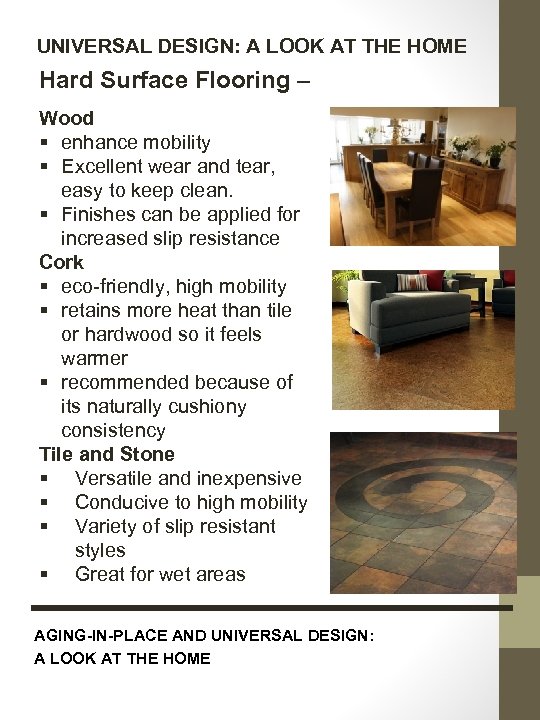 UNIVERSAL DESIGN: A LOOK AT THE HOME Hard Surface Flooring – Wood § enhance mobility § Excellent wear and tear, easy to keep clean. § Finishes can be applied for increased slip resistance Cork § eco-friendly, high mobility § retains more heat than tile or hardwood so it feels warmer § recommended because of its naturally cushiony consistency Tile and Stone § Versatile and inexpensive § Conducive to high mobility § Variety of slip resistant styles § Great for wet areas AGING-IN-PLACE AND UNIVERSAL DESIGN: A LOOK AT THE HOME
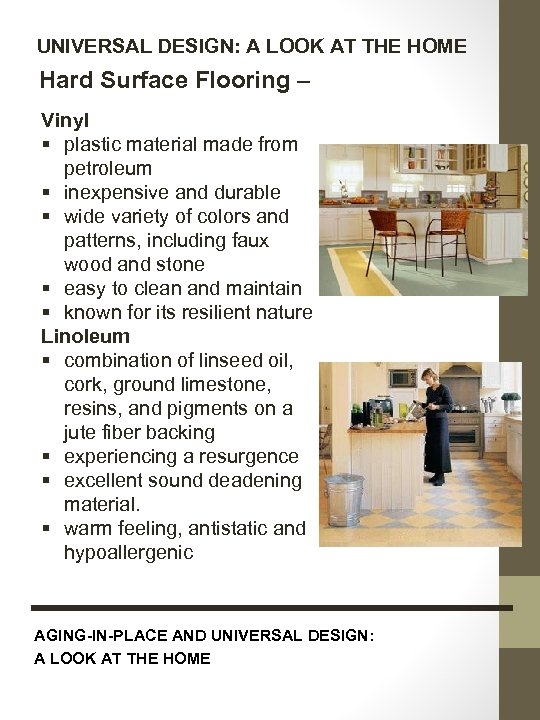 UNIVERSAL DESIGN: A LOOK AT THE HOME Hard Surface Flooring – Vinyl § plastic material made from petroleum § inexpensive and durable § wide variety of colors and patterns, including faux wood and stone § easy to clean and maintain § known for its resilient nature Linoleum § combination of linseed oil, cork, ground limestone, resins, and pigments on a jute fiber backing § experiencing a resurgence § excellent sound deadening material. § warm feeling, antistatic and hypoallergenic AGING-IN-PLACE AND UNIVERSAL DESIGN: A LOOK AT THE HOME
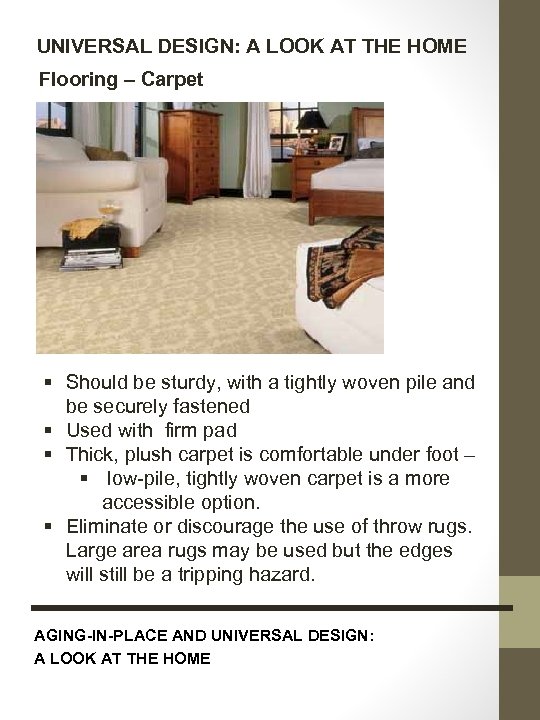 UNIVERSAL DESIGN: A LOOK AT THE HOME Flooring – Carpet § Should be sturdy, with a tightly woven pile and be securely fastened § Used with firm pad § Thick, plush carpet is comfortable under foot – § low-pile, tightly woven carpet is a more accessible option. § Eliminate or discourage the use of throw rugs. Large area rugs may be used but the edges will still be a tripping hazard. AGING-IN-PLACE AND UNIVERSAL DESIGN: A LOOK AT THE HOME
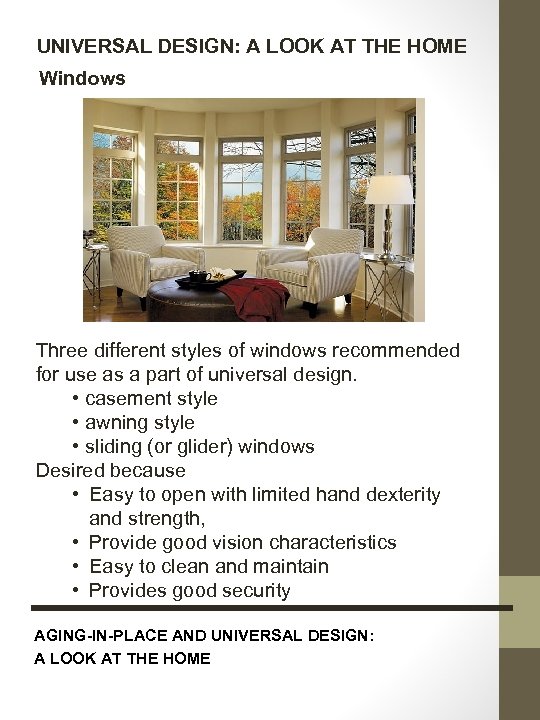 UNIVERSAL DESIGN: A LOOK AT THE HOME Windows Three different styles of windows recommended for use as a part of universal design. • casement style • awning style • sliding (or glider) windows Desired because • Easy to open with limited hand dexterity and strength, • Provide good vision characteristics • Easy to clean and maintain • Provides good security AGING-IN-PLACE AND UNIVERSAL DESIGN: A LOOK AT THE HOME
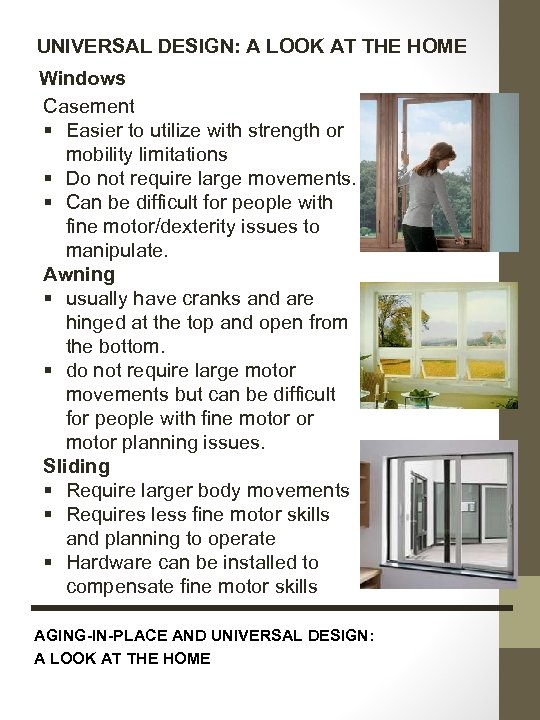 UNIVERSAL DESIGN: A LOOK AT THE HOME Windows Casement § Easier to utilize with strength or mobility limitations § Do not require large movements. § Can be difficult for people with fine motor/dexterity issues to manipulate. Awning § usually have cranks and are hinged at the top and open from the bottom. § do not require large motor movements but can be difficult for people with fine motor or motor planning issues. Sliding § Require larger body movements § Requires less fine motor skills and planning to operate § Hardware can be installed to compensate fine motor skills AGING-IN-PLACE AND UNIVERSAL DESIGN: A LOOK AT THE HOME
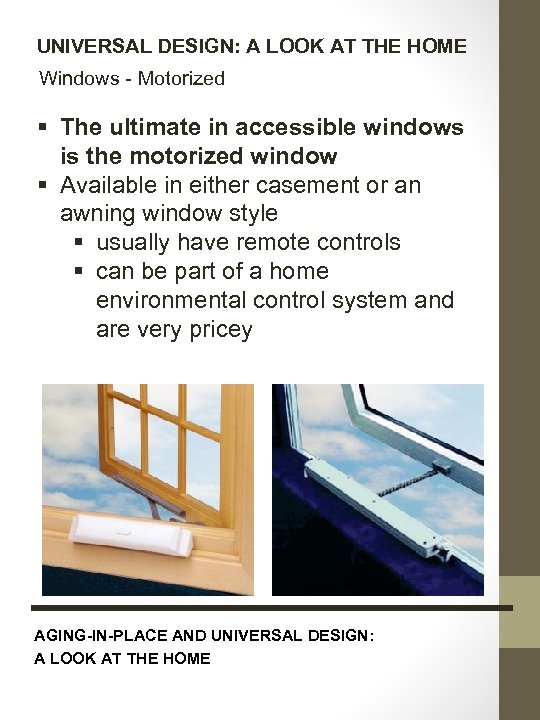 UNIVERSAL DESIGN: A LOOK AT THE HOME Windows - Motorized § The ultimate in accessible windows is the motorized window § Available in either casement or an awning window style § usually have remote controls § can be part of a home environmental control system and are very pricey AGING-IN-PLACE AND UNIVERSAL DESIGN: A LOOK AT THE HOME
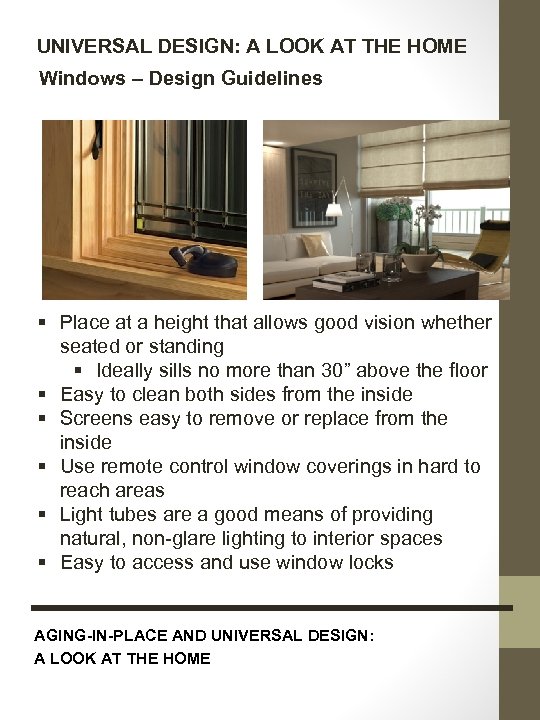 UNIVERSAL DESIGN: A LOOK AT THE HOME Windows – Design Guidelines § Place at a height that allows good vision whether seated or standing § Ideally sills no more than 30” above the floor § Easy to clean both sides from the inside § Screens easy to remove or replace from the inside § Use remote control window coverings in hard to reach areas § Light tubes are a good means of providing natural, non-glare lighting to interior spaces § Easy to access and use window locks AGING-IN-PLACE AND UNIVERSAL DESIGN: A LOOK AT THE HOME
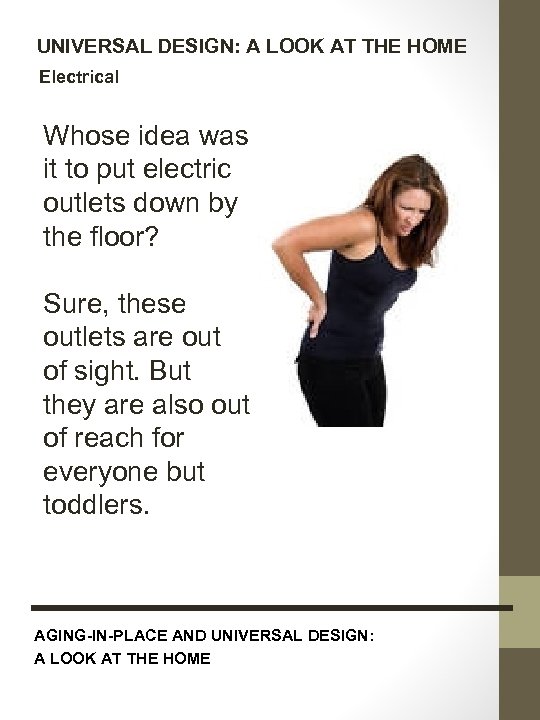 UNIVERSAL DESIGN: A LOOK AT THE HOME Electrical Whose idea was it to put electric outlets down by the floor? Sure, these outlets are out of sight. But they are also out of reach for everyone but toddlers. AGING-IN-PLACE AND UNIVERSAL DESIGN: A LOOK AT THE HOME
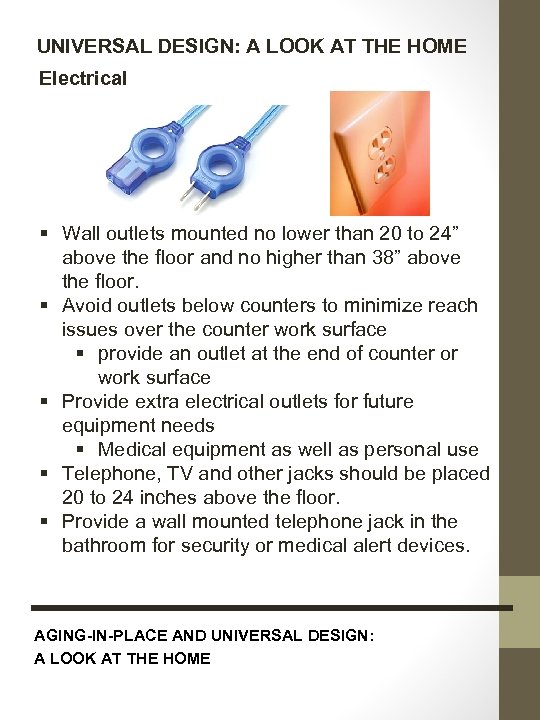 UNIVERSAL DESIGN: A LOOK AT THE HOME Electrical § Wall outlets mounted no lower than 20 to 24” above the floor and no higher than 38” above the floor. § Avoid outlets below counters to minimize reach issues over the counter work surface § provide an outlet at the end of counter or work surface § Provide extra electrical outlets for future equipment needs § Medical equipment as well as personal use § Telephone, TV and other jacks should be placed 20 to 24 inches above the floor. § Provide a wall mounted telephone jack in the bathroom for security or medical alert devices. AGING-IN-PLACE AND UNIVERSAL DESIGN: A LOOK AT THE HOME
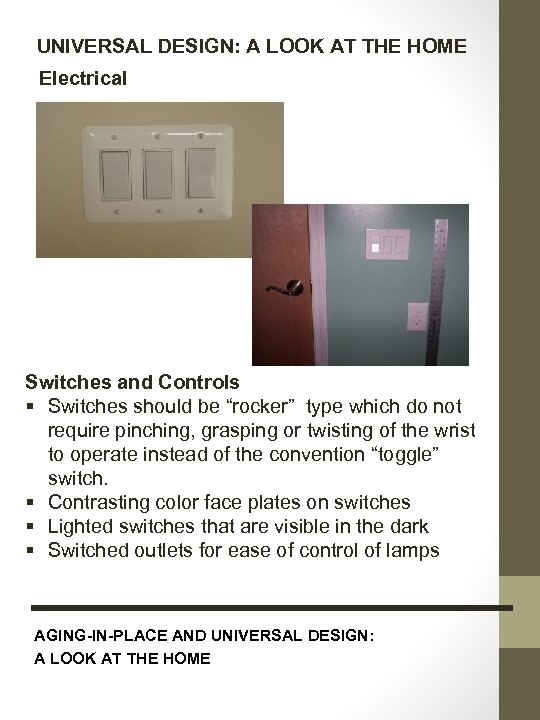 UNIVERSAL DESIGN: A LOOK AT THE HOME Electrical Switches and Controls § Switches should be “rocker” type which do not require pinching, grasping or twisting of the wrist to operate instead of the convention “toggle” switch. § Contrasting color face plates on switches § Lighted switches that are visible in the dark § Switched outlets for ease of control of lamps AGING-IN-PLACE AND UNIVERSAL DESIGN: A LOOK AT THE HOME
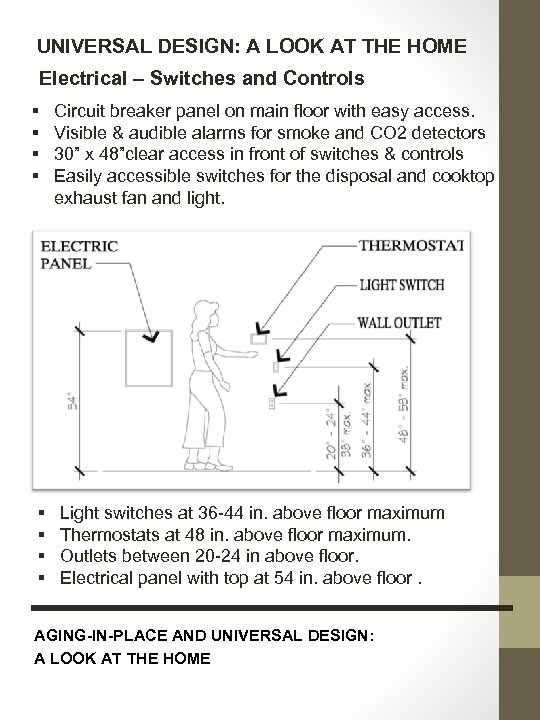 UNIVERSAL DESIGN: A LOOK AT THE HOME Electrical – Switches and Controls § § § § Circuit breaker panel on main floor with easy access. Visible & audible alarms for smoke and CO 2 detectors 30” x 48”clear access in front of switches & controls Easily accessible switches for the disposal and cooktop exhaust fan and light. Light switches at 36 -44 in. above floor maximum Thermostats at 48 in. above floor maximum. Outlets between 20 -24 in above floor. Electrical panel with top at 54 in. above floor. AGING-IN-PLACE AND UNIVERSAL DESIGN: A LOOK AT THE HOME
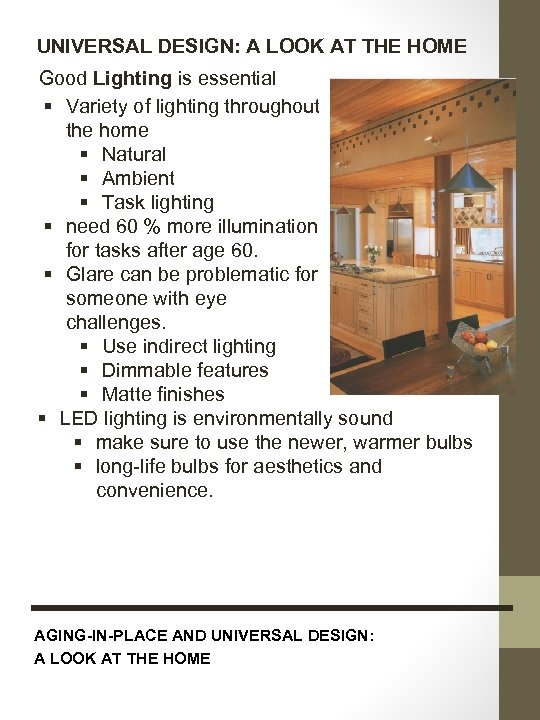 UNIVERSAL DESIGN: A LOOK AT THE HOME Good Lighting is essential § Variety of lighting throughout the home § Natural § Ambient § Task lighting § need 60 % more illumination for tasks after age 60. § Glare can be problematic for someone with eye challenges. § Use indirect lighting § Dimmable features § Matte finishes § LED lighting is environmentally sound § make sure to use the newer, warmer bulbs § long-life bulbs for aesthetics and convenience. AGING-IN-PLACE AND UNIVERSAL DESIGN: A LOOK AT THE HOME
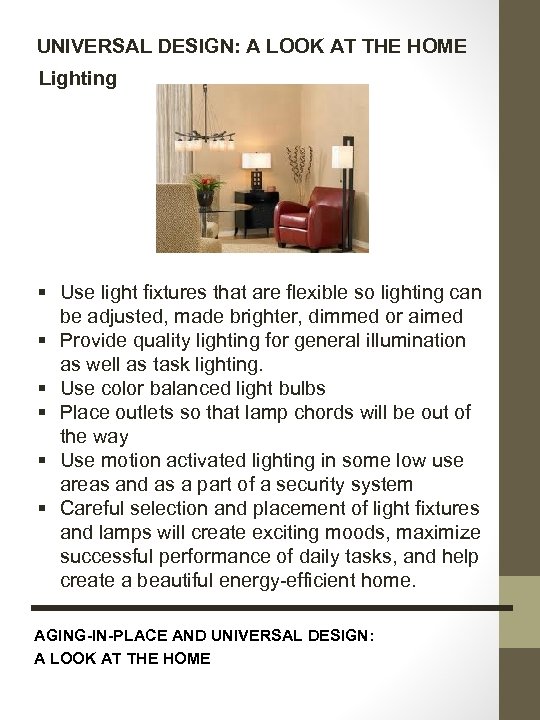 UNIVERSAL DESIGN: A LOOK AT THE HOME Lighting § Use light fixtures that are flexible so lighting can be adjusted, made brighter, dimmed or aimed § Provide quality lighting for general illumination as well as task lighting. § Use color balanced light bulbs § Place outlets so that lamp chords will be out of the way § Use motion activated lighting in some low use areas and as a part of a security system § Careful selection and placement of light fixtures and lamps will create exciting moods, maximize successful performance of daily tasks, and help create a beautiful energy-efficient home. AGING-IN-PLACE AND UNIVERSAL DESIGN: A LOOK AT THE HOME
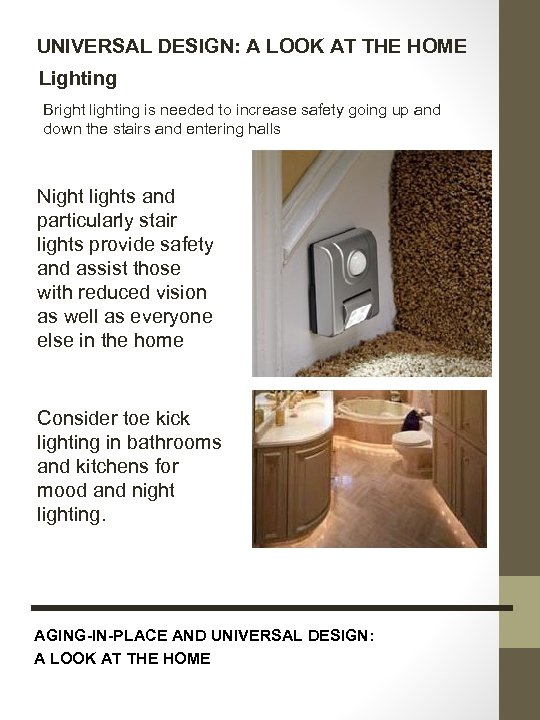 UNIVERSAL DESIGN: A LOOK AT THE HOME Lighting Bright lighting is needed to increase safety going up and down the stairs and entering halls Night lights and particularly stair lights provide safety and assist those with reduced vision as well as everyone else in the home Consider toe kick lighting in bathrooms and kitchens for mood and night lighting. AGING-IN-PLACE AND UNIVERSAL DESIGN: A LOOK AT THE HOME
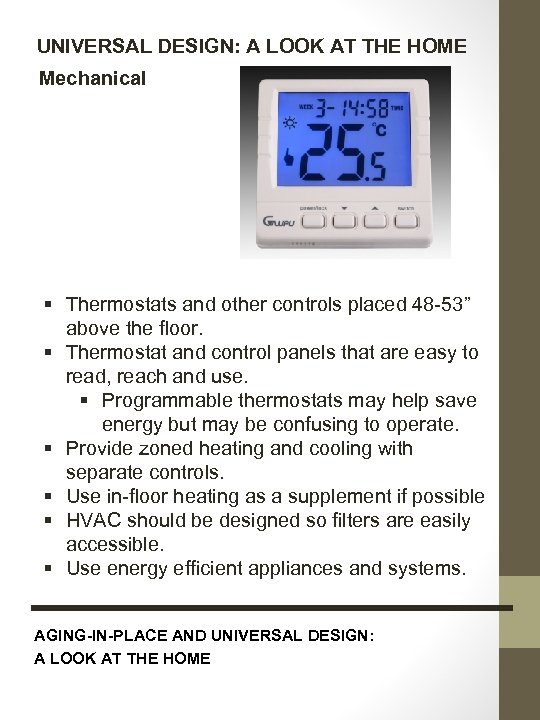 UNIVERSAL DESIGN: A LOOK AT THE HOME Mechanical § Thermostats and other controls placed 48 -53” above the floor. § Thermostat and control panels that are easy to read, reach and use. § Programmable thermostats may help save energy but may be confusing to operate. § Provide zoned heating and cooling with separate controls. § Use in-floor heating as a supplement if possible § HVAC should be designed so filters are easily accessible. § Use energy efficient appliances and systems. AGING-IN-PLACE AND UNIVERSAL DESIGN: A LOOK AT THE HOME
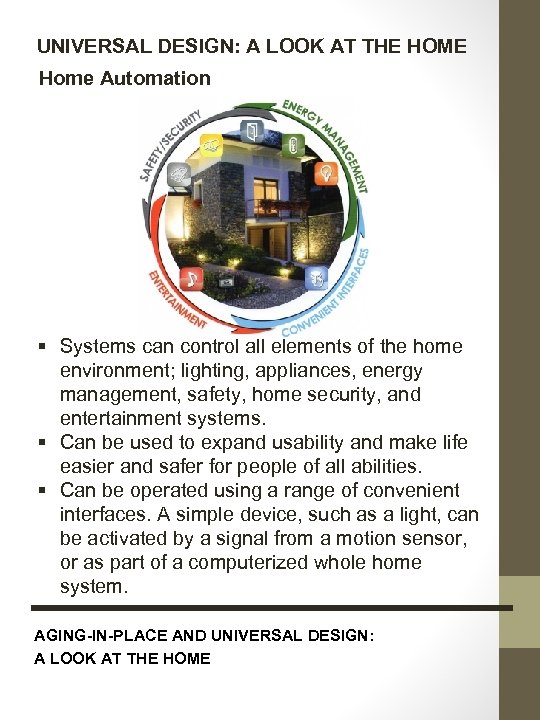 UNIVERSAL DESIGN: A LOOK AT THE HOME Home Automation § Systems can control all elements of the home environment; lighting, appliances, energy management, safety, home security, and entertainment systems. § Can be used to expand usability and make life easier and safer for people of all abilities. § Can be operated using a range of convenient interfaces. A simple device, such as a light, can be activated by a signal from a motion sensor, or as part of a computerized whole home system. AGING-IN-PLACE AND UNIVERSAL DESIGN: A LOOK AT THE HOME
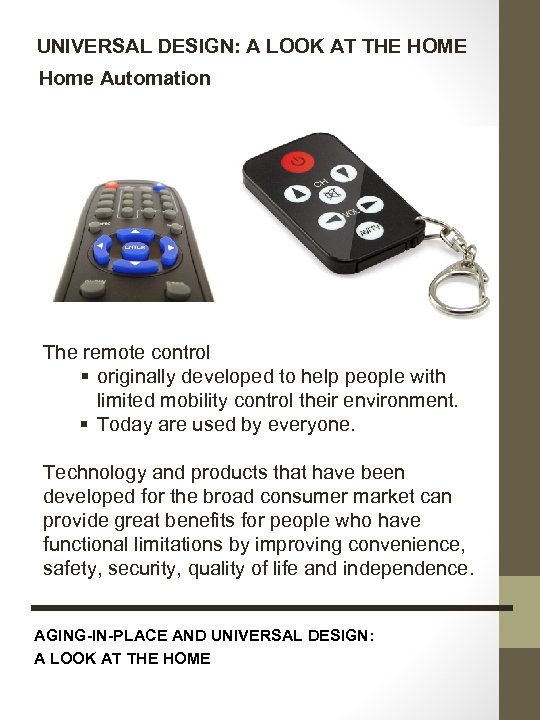 UNIVERSAL DESIGN: A LOOK AT THE HOME Home Automation The remote control § originally developed to help people with limited mobility control their environment. § Today are used by everyone. Technology and products that have been developed for the broad consumer market can provide great benefits for people who have functional limitations by improving convenience, safety, security, quality of life and independence. AGING-IN-PLACE AND UNIVERSAL DESIGN: A LOOK AT THE HOME
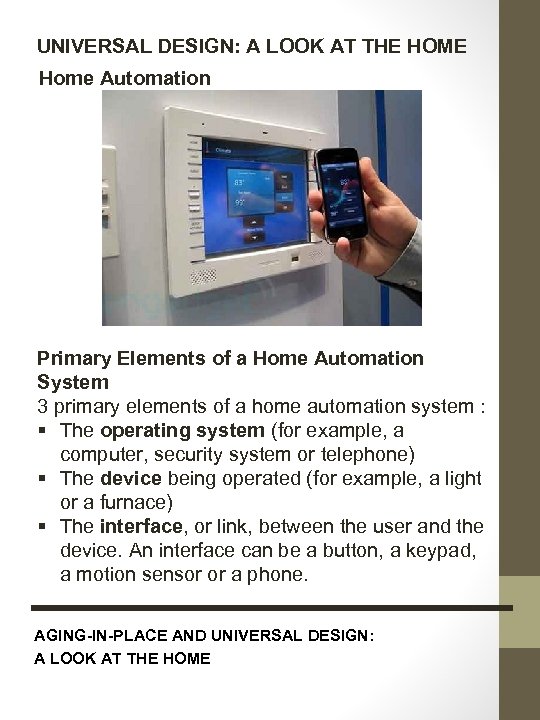 UNIVERSAL DESIGN: A LOOK AT THE HOME Home Automation Primary Elements of a Home Automation System 3 primary elements of a home automation system : § The operating system (for example, a computer, security system or telephone) § The device being operated (for example, a light or a furnace) § The interface, or link, between the user and the device. An interface can be a button, a keypad, a motion sensor or a phone. AGING-IN-PLACE AND UNIVERSAL DESIGN: A LOOK AT THE HOME
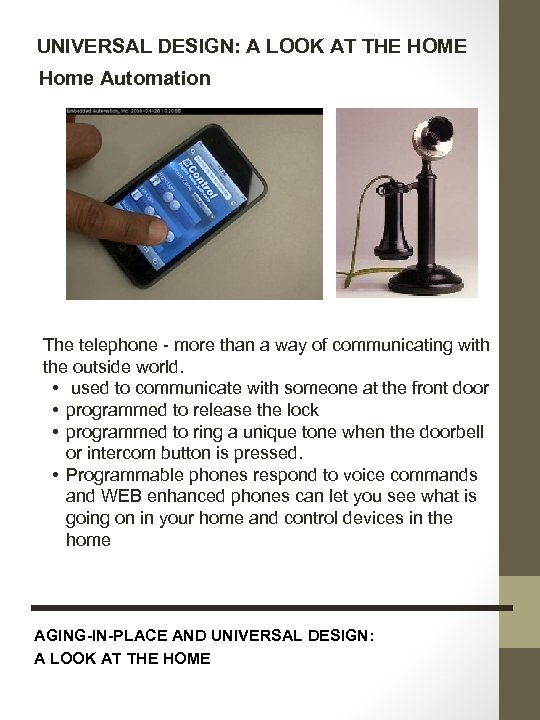 UNIVERSAL DESIGN: A LOOK AT THE HOME Home Automation The telephone - more than a way of communicating with the outside world. • used to communicate with someone at the front door • programmed to release the lock • programmed to ring a unique tone when the doorbell or intercom button is pressed. • Programmable phones respond to voice commands and WEB enhanced phones can let you see what is going on in your home and control devices in the home AGING-IN-PLACE AND UNIVERSAL DESIGN: A LOOK AT THE HOME
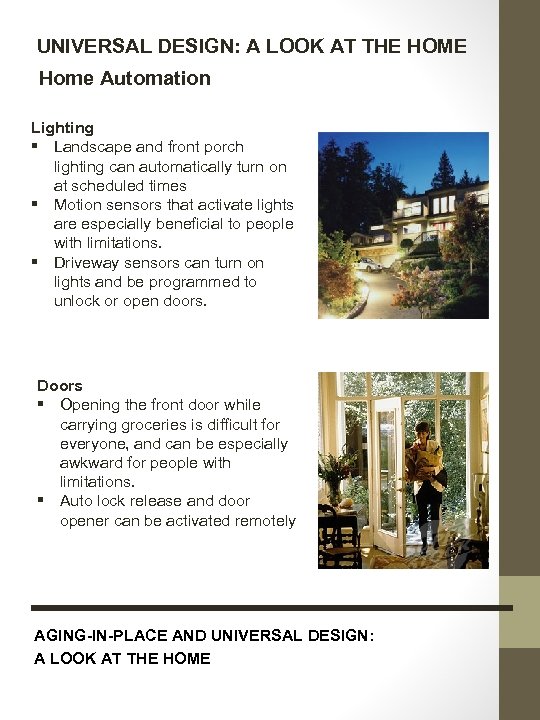 UNIVERSAL DESIGN: A LOOK AT THE HOME Home Automation Lighting § Landscape and front porch lighting can automatically turn on at scheduled times § Motion sensors that activate lights are especially beneficial to people with limitations. § Driveway sensors can turn on lights and be programmed to unlock or open doors. Doors § Opening the front door while carrying groceries is difficult for everyone, and can be especially awkward for people with limitations. § Auto lock release and door opener can be activated remotely AGING-IN-PLACE AND UNIVERSAL DESIGN: A LOOK AT THE HOME
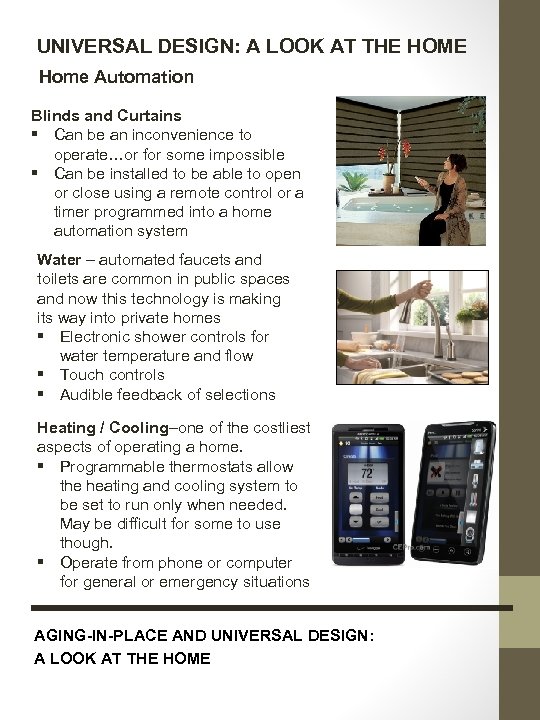 UNIVERSAL DESIGN: A LOOK AT THE HOME Home Automation Blinds and Curtains § Can be an inconvenience to operate…or for some impossible § Can be installed to be able to open or close using a remote control or a timer programmed into a home automation system Water – automated faucets and toilets are common in public spaces and now this technology is making its way into private homes § Electronic shower controls for water temperature and flow § Touch controls § Audible feedback of selections Heating / Cooling–one of the costliest aspects of operating a home. § Programmable thermostats allow the heating and cooling system to be set to run only when needed. May be difficult for some to use though. § Operate from phone or computer for general or emergency situations AGING-IN-PLACE AND UNIVERSAL DESIGN: A LOOK AT THE HOME
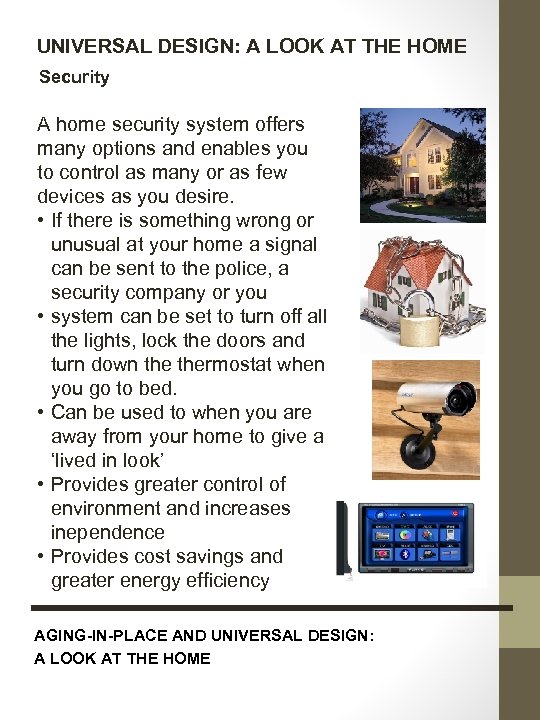 UNIVERSAL DESIGN: A LOOK AT THE HOME Security A home security system offers many options and enables you to control as many or as few devices as you desire. • If there is something wrong or unusual at your home a signal can be sent to the police, a security company or you • system can be set to turn off all the lights, lock the doors and turn down thermostat when you go to bed. • Can be used to when you are away from your home to give a ‘lived in look’ • Provides greater control of environment and increases inependence • Provides cost savings and greater energy efficiency AGING-IN-PLACE AND UNIVERSAL DESIGN: A LOOK AT THE HOME
 UNIVERSAL DESIGN: A LOOK AT THE HOME Home Automation and Security Systems To ensure that you get a system that meets your needs for today and tomorrow ask yourself the following 7 ? ’s 1. Can the system be easily used by members of the family? 2. Can the system be cost effectively and simply adapted to meet changing needs over time, or to suit different users? 3. Is it simple and intuitive to use regardless of experience, knowledge, language skills or current concentration level? 4. Does the system communicate necessary info effectively to the user, regardless of ambient conditions or the user’s sensory abilities? 5. Is there forgiveness for error? 6. Does the system resent to default settings? 7. Will it save, time, money or energy? Recognize those questions? That is Universal Design! AGING-IN-PLACE AND UNIVERSAL DESIGN: A LOOK AT THE HOME
 7 BASIC PRINCIPALS OF UNIVERSAL DESIGN 1. Equitable Use – the design is useful and marketable to people with diverse abilities. 2. Flexibility in Use – the design accommodates a wide range of individual preferences and abilities. 3. Simple and Intuitive – use of the design is easy to understand, regardless of the user’s experience, knowledge, language skills, or current concentration level. 4. Perceptible Information – the design communicates necessary information effectively to the user, regardless of ambient conditions or the user’s sensory abilities. 5. Tolerance for Error – the design minimizes hazards and the adverse consequences of accidental or unintended actions. 6. Low Physical Effort – the design can be used efficiently and comfortably with a minimum of effort or fatigue. 7. Size and Space for Approach and Use – appropriate size and space is provided for approach, reach, manipulation, and use regardless of users body size, posture or mobility. AGING-IN-PLACE AND UNIVERSAL DESIGN: A LOOK AT THE HOME
 Universal Design Remember all though we have been talking about Universal Design as it pertains to older adults and their homes this is really only a small part of Universal Design is an approach to design of all products and environments to be as usable as possible by as many people as possible regardless of age, ability or situation without the need for adaption or specialized design AGING-IN-PLACE AND UNIVERSAL DESIGN: A LOOK AT THE HOME
 UNIVERSAL DESIGN: A LOOK AT THE HOME In Conclusion A review of the supplemental handouts. 1. Tips and Thoughts 3. Universal Design Home Check list. AGING-IN-PLACE AND UNIVERSAL DESIGN: A LOOK AT THE HOME
 UNIVERSAL DESIGN A LOOK AT THE HOME Tips and Thoughts AGING-IN-PLACE AND UNIVERSAL DESIGN: A LOOK AT THE HOME
 Universal Design Tips and Thoughts This handout is intended to be a brief summary of the principles of Universal Design. • Basics of Demographics and why our aging population are such a driving force in UD. • Brief look at what is meant by “Aging in Place”. • Points out some of the differences between the needs of the aging population in urban areas versus rural areas. • Brief outline of basic features to look to implement in to promote aging in place in our homes. We hope our presentations will inspire you to look at the many possibilities that can help make a home meet the needs of everyone and to better understand the changes each and everyone of us go through as we age. AGING-IN-PLACE AND UNIVERSAL DESIGN: A LOOK AT THE HOME
 Universal Design Home Check List Intended to be used as a guide only. • The first 20 items should be considered extremely vital to achieving the idea of a Universal Design Home. • The balance of the items are included to inspire one to look at the many possibilities that can help make a home meet the needs of everyone. • This list is divided by rooms or areas to help focus, but certainly items listed under one heading can be applied to many other areas of the home. • There is no passing grade or score that can be achieved to make a home a UD success. That judgment rests with the user and the success will be reached over time as lifestyle and needs change. AGING-IN-PLACE AND UNIVERSAL DESIGN: A LOOK AT THE HOME
 UNIVERSAL DESIGN: A LOOK AT THE HOME Think Universal Design for your customers/clients, your products and services and for yourself. AGING-IN-PLACE AND UNIVERSAL DESIGN: A LOOK AT THE HOME
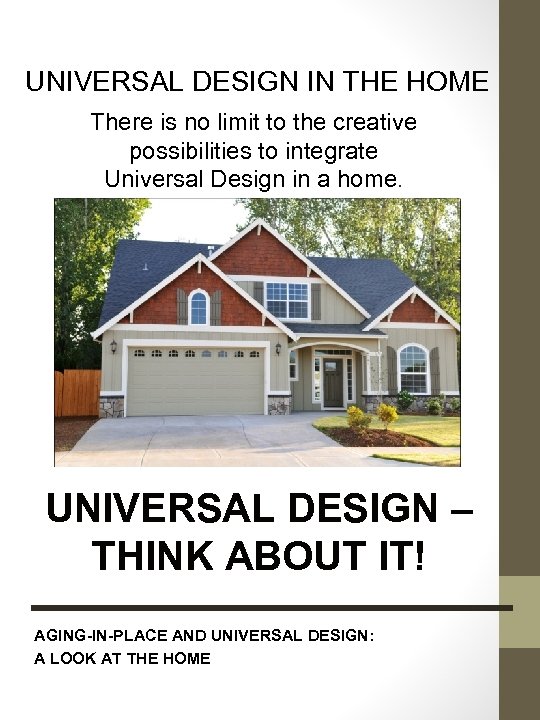 UNIVERSAL DESIGN IN THE HOME There is no limit to the creative possibilities to integrate Universal Design in a home. UNIVERSAL DESIGN – THINK ABOUT IT! AGING-IN-PLACE AND UNIVERSAL DESIGN: A LOOK AT THE HOME