 Скачать презентацию Agile Software Construction Textbook Agile Software Construction
7f0b40157068d49db1aa598848525d30.ppt
- Количество слайдов: 96



Agile Software Construction
Textbook Agile Software Construction Author: John Hunt Springer-Verlag. 2006. 2
Introduction This chapter will bring together a range of the most popular agile methods and presents them back to back allowing you to gain an insight into what it means to be agile, what agile methods are, what Agile Modeling is and what XP (Extreme Programming) is. It tells you how to actually plan, organize and approach software systems in an Agile Manner. 3
What is Agile Software Development? Agile software development is an attempt to put the software being developed first and to acknowledge that the user requirements change. It is agile because it can respond quickly to the users’ changing needs. Agile software development, in general, advocates frequent and regular, software releases. This allows new versions of the software to be released to users quickly and frequently. In turn, users can respond frequently and quickly to these releases with feedback, changing requirements and general comments (such as “that’s not what we meant!”). As the releases are frequent, the time taken for the users to see the results of their comments is short and they are then able to respond to the new version quickly. 4
Cont. In turn, agile software development puts the software first, because almost any activity undertaken must be to the benefit of the software that will be delivered. For example, if I create a model of some problem domain, then that model is not the actual delivered software, although it may help me to understand the problem better, in order that I can write the executable software. However, if the only use I make of the model is to help me understand the problem, then I shouldn’t worry about updating it after the implementation varies from the design – at least not until I need the model again. That way, the effort is focused on developing the software, rather than spending time on other supporting (but ultimately less productive) activities. 5
Why Be Agile? You may be wondering at this point “Why would I even want to be agile? ” “What difference can agile software development make? ” or “What has Extreme Programming and Agile Modeling got to do with me? ” The answer to these questions is in this chapter, but the essence of the whole of the agile movement is the production of working software systems, on time and within budget. 6
Cont. So why should you consider adopting agile development methods – the answer is simple – because they can help you produce software within budget and agreed timescales, that actually does what the users want! And we all want that right! 7
Cont. Today we live in a fast-moving, uncertain world, in which users’ requirements seem to be as changeable. Traditional, single iteration, waterfall development approaches often can’t cope. Other approaches have been proposed and new technologies created. Yet, still software is late, or over budget, or both. Even when delivered it often has numerous requirements removed or contains undesirable features/bugs. Being agile doesn’t guarantee the removal of all bugs, but it does help produce useful software within a project framework that can adapt to changing requirements. 8
What this Chapter is about? This chapter is about exploiting as many features of the agile movement as possible to enhance our software development processes. It is about selling you the concept of agile software development. It is about how to make your projects agile. This chapter is thus a guide to the agile software development methods currently available! 9
Where to Go Online? There is also a wealth of information available online. There are websites out there that deal with the agile movement in general, with Extreme Programming, with Agile Modeling, etc. Some of these are listed below. Agile Movement in General www. agilealliance. org Agile Software Development Alliance Agile Modeling www. agilemodeling. com Agile Modeling mailing list Extreme Programming http: //extremeprogramming. org/ http: //www. xpuniverse. com http: //www. pairprogramming. com/ 10
Agile Methods and the Agile Manifesto In this section, you will be introduced to the concept, motivations, goals and principles behind the Agile Movement. You will also learn what the common features of all agile methods are. Following this, a brief review of a number of the core agile methods currently available will be presented 11
What is Agile? The Oxford Paper Back dictionary defines Agile as: Agile adj. nimble, quick-moving And possibly surprisingly for a computing term this actually reflects the primary goal of the various methods that have been grouped under the term agile. That is, they aim to be nimble and quick moving in response to changes in requirements, to the people that comprise the development teams and to issues that arise during the software development process. These methods are not trying to be “nimble” just for the sake of it; instead they have focused on the fact that the primary purpose of software development is to produce a working piece of software! Do what is useful, productive and generally good for the development of the software and question anything else that you are doing. 12
Cont. Agile also implies being both effective and sufficient for the current situation. By this I mean: effective in terms of producing working, defectfree (as far as possible) software, sufficient in terms of meeting its requirements both in the short-term and in the long-term (for example, the documentation required to support a long-lived project will be greater than for a shortlived one). 13
Cont. Note the use of the word “sufficient, ” this also implies that it should not be over sufficient. That is, engineering support into your software for things that might never be needed is in general considered unnecessary. So what is an Agile Methodology? Well, it is a method that tries to be responsive to the needs of the software development process, that is based on practice and experience, and that focuses on being effective and sufficient! 14
The Agile Manifesto There is a growing movement that promotes the use of an agile development philosophy. This movement (see references at the end of this chapter) came together in February 2001 to form the Agile Software Development Alliance (often referred to as the Agile Alliance). They produced a manifesto that they hoped embraced the philosophies that they commonly supported, and that they believed to help produce better software. From this manifesto, they defined a set of principles for Agile Software Development. 15
Manifesto’s values The manifesto proposed the following values (very briefly) summarized below: 1) Individuals and interactions over processes and tools. This refers to the fact that it is the people involved and how they communicate that typically has the largest bearing on the success (or failure) of a software project. Yes, software development processes, methodologies, tools, etc. , can help but they are still not the overriding influence. Thus, you should encourage the best people and group interactions. 16
Cont. 2) Working software over comprehensive documentation. There are times when (and I am sure I am not alone in this) you can feel that all you seem to be doing is producing reams and reams of documentation. Sometimes, this is aided (even determined) by the CASE tool you might be using and sometimes it is merely the process being followed. However, at the end of the day it is the software produced by a development project that will be used by a user and not the documentation. Therefore, documentation should not be a major goal in and of itself. Instead, it should be a supporting medium for the actual product – the software. 17
Cont. 3) Customer collaboration over contract negotiation. Remember these are values – thus, time should be spent on working with customers and in getting them involved in the software development rather than on detailed contract negotiations. However, of course in the real world this can be difficult, as although your direct clients may buy into this philosophy, their legal and financial departments may not. For example, we have worked with a number of clients where the legal (and/or financial) departments have imposed a contract and associated negotiations because they want something to hit us with, if things go wrong. 18
Cont. 4) Responding to change over following a plan. Finally, agile software development embraces change rather than saying “it’s not in the requirements or the plan, so we can’t do it. ” That is development progresses in response to user feedback, rather than as a reaction to a fixed plan. Note that does not mean that there is no plan and that planning isn’t important – actually, it is very important but the project adapts itself to its environment – that is it is agile! 19
Agile Principles Based on the previous value statements, a set of 12 principles have been identified. The aim of these principles is twofold. First, they are intended to help people gain a better understanding of what agile software development is all about. Second, they can be used to help to determine whether you as a developer are following an agile methodology or not. Note that these principles do not specify a method, etc. , but rather define a set of guiding statements that any approach that wishes to be grouped under the banner “Agile, ” should conform to. Thus, agile methodologies should conform to these principles: 20
1. 2. 3. 4. 5. 6. 7. 8. 9. Highest priority is to satisfy the customer. Welcome change. Deliver working software frequently. Business people and developers must work together daily. Build projects around motivated individuals. Face-to-face communication is best. Working software is the primary measure of progress. Promote sustainable development. Continuous attention to technical excellence and good design enhances agility. 10. Simplicity – the art of maximizing the amount of work not done – is essential. 11. The best architectures, requirements and design emerge form selforganizing teams. 12. Introspection – teams should regularly review itself and its processes to try and improve. 21
Cont. Some of the above may seem obvious and others may appear more contentious. In general, they appear quite vague (“Welcome Change”). However, they have been defined to help guide agile methodologies rather than to actually be a methodology. For example, an agile methodology should promote the frequent delivery of working systems rather than a single big bang delivery. One way this can be interpreted is that an iterative and incremental approach is better than the more traditional waterfall approach to software production. 22
Cont. Of course, this last statement is a little simplistic and it would be more accurate to state that the “Agile” movement has a desire to meet the needs of the sort of rapidly changing and uncertain business world that we find ourselves working within today. From this, agile methodologists have tried to devise methods that move from _ heavyweight to lightweight processes, _ document-oriented to code-oriented objectives, _ predictive to adaptive methods, 23
Agile Methods and Agile Modeling
What are Agile Methods? The common theme about agile methodologies is that they are all focused on: w Trying to produce a working solution and w Be able to respond to changing user/client requirements. Of course traditional development methods are also trying to develop working solutions, but it is in the focus on changing requirements that the core difference lies. 25
In an agile method it is the time available and the resources available that are generally considered to be fixed, while the functionality is considered more flexible. Thus, the aim is usually to set a fixed delivery date at which point something will be delivered and to prioritise the functionality that must be implemented so that what can be implemented will be implemented, but to acknowledge that not everything may be delivered. 26
Cont. In contrast, any software development projects have overrun because management has considered the functionality to be fixed, but the time available and the number of resources that can be applied are variable. There are of course situations where all the functionality must be provided, but in many (most? ) cases, functionality varies between n the must have, n the nice to have, n the may possibly be useful and n the never used at all! Thus, prioritising such functionalities can result in a leaner, more effective solution being delivered on time and within budget. 27
Cont. For example, a fundamental assumption of Dynamic Systems Development Method (DSDM) is that nothing is built perfectly first time, but that a usable and useful 80% of the proposed system can be produced in 20% of the time it would take to produce the total system. The implication being that the remaining 20% may never be required, or at worst will be required in later deliveries. 28
What are these so-called Agile Methods? Without trying to provide a complete list of every possible method that might try and bring itself under the umbrella of the term Agile, there are five core methods being worked on and with at the present time. These are: Agile Modeling, e. Xtreme Programming (or XP), DSDM, SCRUM and Feature-Driven Development (FDD). 29
Agile Modeling applies the philosophy of the agile movement to the software modeling process. It tries to find an appropriate balance between too little modeling, and too much modeling, at the design stage. That is, the point at which you have modeled enough to explore and document your system effectively, but not so much that it becomes a burden. 30
Cont. Agile Modeling provides guidelines on how to create effective models and how to be an efficient modeler. This does not necessarily mean that less modeling will be performed while adopting Agile Modeling rather that the models that are produced are those required for useful, necessary purposes. Like other Agile Methods, it is trying to promote lightweight processes, in this case within the modeling arena (as opposed to the programming arena with XP). 31
Main goals To this end Agile modeling has three main goals: 1) The definition and promotion of a set of values, principles and practices that help to produce the appropriate models. 2) Guidance on how to apply modeling to an agile software development. 3) Guidance on how to apply agile modeling to other software processes (such as RUP). 32
A set of criteria that an agile model should meet: Agile models provide positive value. That is, is there a real need for the model, will it help in the general aim of producing the final deliverable software? If not, then within the Agile Modeling philosophy it is not required. Agile models fulfill their purpose (and no more). For example, if that purpose is for John to explain to Steve and Dave how their code should integrate with his, then a drawing on a white board may be good enough to serve its purpose (so don’t use a heavyweight tool such as Rational Rose to do this!). 33
Cont. Agile models are understandable to their intended audience but not necessarily to everyone. That is, the level of detail and the content needs to be appropriate for Steve and Dave, but not necessarily to any software engineer from any other project. 34
Cont. Agile models are sufficiently accurate. Recently, I had to explain how the Java- Mail API worked to some colleagues. I was doing so in order that they could have a general understanding of what our software was doing. As it had been awhile since I had last looked at the Java-Mail API, I gave then an overview in which I got the general ideas across (using a mixture of UML like diagrams and flow charts). I was even unsure of the exact names of some of the classes but I still got the point across! 35
Cont. Agile models are sufficiently consistent. If one model has more detail than another, so what! As long as they are both understandable by their target audiences it does not matter. Agile models are sufficiently detailed. For example, when John explains to Steve and Dave about the structure they need to integrate with, many details not relevant to them can be left out – it may be sufficient merely to get the general concepts across. 36
Cont. Agile models are as simple as possible. The less information within a model, the easier it is for the reader to absorb. Within UML, there a wide range of notational elements that can be applied to most diagrams. However, very few UML diagrams employ as many of these as is possible and in my experience very few of them need as many as they have. 37
Extreme Programming (XP)
![Extreme Programming The first Extreme Programming project was started March 6, 1996 [1]. Extreme](https://present5.com/presentation/7f0b40157068d49db1aa598848525d30/image-39.jpg "Extreme Programming The first Extreme Programming project was started March 6, 1996 [1]. Extreme")
Extreme Programming The first Extreme Programming project was started March 6, 1996 [1]. Extreme Programming is one of several popular Agile Processes. It has already been proven to be very successful at many companies of all different sizes and industries world wide [1]. 39
Cont. Extreme Programming is successful because it stresses customer satisfaction. Instead of delivering everything you could possibly want on some date far in the future this process delivers the software you need as you need it. Extreme Programming empowers your developers to confidently respond to changing customer requirements, even late in the life cycle. 40
Cont. Extreme Programming, or as it is more commonly known XP, was originally designed as a way of supporting small development teams working within uncertain and changing requirements. It was a response to many of the more traditional heavyweight approaches that are often overkill for small software developments. However, it was not an attempt to throw everything away and just program (which is a common misinterpretation of XP). Rather, XP was designed as an approach based on software engineering principles, but focused on the timely delivery of software that meets users’ requirements. 41
Cont. Extreme Programming also places great emphasis on the software development team and team work Extreme Programming emphasizes teamwork. Managers, customers, and developers are all equal partners in a collaborative team. Extreme Programming implements a simple, yet effective environment enabling teams to become highly productive. The team self-organizes around the problem to solve it as efficiently as possible. 42
Cont. The team, in turn, incorporates management, technical personnel and end users all cooperating towards the common good. It takes as one of its aims that teams communicate and constantly pay attention to all the details necessary to make sure that the software being developed matches the user requirements, to help to produce quality software. 43
XP’s basic principles Communication – it is good to talk (particularly, between users and developers). Simplicity – keep it simple and grow the system as and when required. Feedback – let users provide feedback early and often. Courage – to go with such an approach. 44
XP’s Key ideas The previous four basic principles have led to the following key ideas presented within XP: Code in pairs. This is probably the thing that people first hear with relation to XP. The idea is that all software is developed in pairs (i. e. , with two programmers at one screen). The concept is that if code reviews are good, because they force at least one other person to consider your code, then constantly working in pairs results in constant reviewing of code and feedback between the two developers. 45
Cont. Stay in contact with the customer. For example, place a customer representative in the team, so that you have access to them all of the time. Meet regularly with the customer to give information and receive feedback. Create tests before coding then test heavily. Developers should write the unit tests before the code to be tested. Part of the argument is that if you can’t write the test (i. e. , don’t know what the inputs and outputs should be), then you shouldn’t be writing the code. You should then automate testing so that you can regularly re-run the tests to make sure that nothing that has been done breaks earlier results. 46
Cont. Short iterations. Each iteration should be relatively short allowing for rapid and frequent feedback. Thus, a minimal system may be produced and possibly even put into production quickly and the system will grow in whatever directions prove most valuable. Keep it simple. Start projects with a simple design that can evolve later as required by future iterations. This removes unnecessary complexity from early iterations. It also removes the need to code in additional functionalities believed to be required by future iterations, but which may actually never be needed. 47
Cont. Don’t anticipate: code for current needs. That is, don’t over-engineer solutions based on what they may one day need to do, rather focus on what they need to do now and leave tomorrow’s functionality to tomorrow. Collective ownership. Everyone within the team owns the software and has responsibility for it. When something goes wrong, no one should ever consider it not to be his or her problem because Bill wrote that piece of code. In turn, XP does not support a culture of blame and recrimination – everyone is responsible for all the code. As a result of this, everyone is responsible for fixing a problem when they find it rather than ignoring it. 48
The XP Project Lifecycle We had briefly considered, last lecture, the primary goals and principles of XP, but what is XP? Is it just programming in pairs? No, XP does provide a software development lifecycle model as well as guidelines on the organization of a software development team. The XP lifecycle is presented in Figure 4. 1. 49
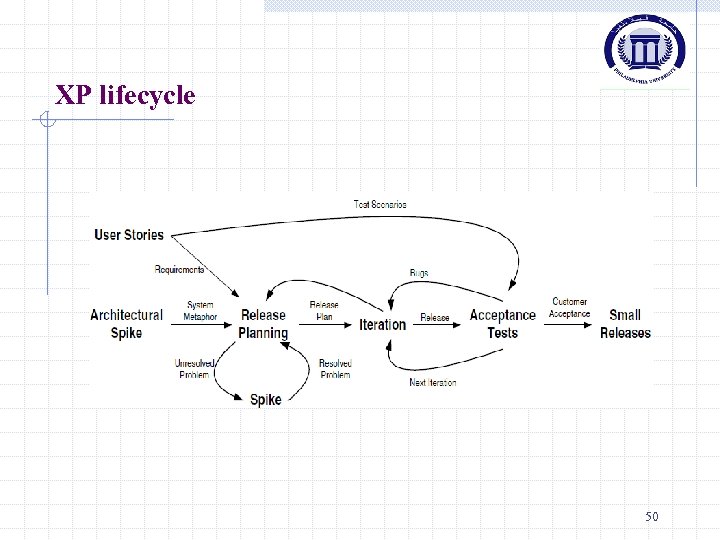
XP lifecycle 50
User Stories User stories are similar in some respects to Use Cases in that they aim to capture how the user will use the system. However, they are written by the users themselves and not by the development team. Note that the users should not be limited to describing just the user interface. Rather the user stories should describe how the user would use the system to accomplish something. 51
Cont. It is worth noting that User Stories are not detailed requirements. These will be obtained during the iterations, when and if the aspect of the system covered by a particular user story is to be implemented. 52
User stories characteristics User stories should be: Only detailed enough to allow a reasonable estimate to be made of the time taken to implement them under ideal conditions for the planning meeting. Short (e. g. , about three sentences long) Use the terminology of the user and not the terminology of the software development team. Fed into the release-planning meeting and to the creation of the user acceptance tests. 53
Architectural Spike A Spike in XP terms is an attempt to reduce the risk associated with an unknown area of the system, technology or application domain. A Spike may involve some investigation, research and possibly some software to evaluate or elucidate the problem. At this stage research and analysis of the architecture to use should be carried out and fed into the release planning meeting. Other spikes are used during the project-planning phase to determine unresolved issues. 54
Release Planning A release-planning meeting is used to create the release plan, which lays out the overall project. That is, the release plan indicates which user stories will be implemented and in which release this will happen. It also indicates how many iterations are planned and when each iteration will be delivered. This is done by negotiation between the interested parties using estimates derived from the user stories. The estimates are produced by the technical members of the team potentially with input from the users. 55
The users prioritise the user stories possibly with input from the technical team members. From this, the timescales for the project, the delivery dates of various iterations, and the final system delivery are all negotiated. If it is found that management or users are unhappy about the proposed delivery dates, then one or more of the features of the system, the resources available or the time taken must be modified until all participants are happy Note that individual iterations are planned just before the iteration commences, not in advance. 56
Iterations Each iteration within the project adds to the agility of the development team. That is, at the start of each iteration changes can be made to what will be done and when it will be done. The shorter the iteration, the quicker the development team can respond to changes (indeed within XP it is recommended that iterations last only a matter of weeks). 57
Cont. At the beginning of each iteration, an Iteration Planning meeting is held to determine exactly what will happen within that iteration (such as what programming tasks there will be and when they will be done). Such just-in-time planning is considered an easy way to stay on top of changing user requirements. 58
Cont. If, however, it looks like the iteration will not manage to achieve all that was planned for it, then further iteration planning meetings should be called during the iteration to respond to these concerns. These meetings might need to re-estimate current and future tasks and determine what can and can’t be achieved. The overriding concern here should be to concentrate your efforts on completing the most important tasks as chosen by your users rather than having several unfinished tasks chosen by the developers. 59
Acceptance Testing The acceptance tests are created from the user stories, written at the start of the project. Each iteration implements one or more user stories; these stories will be translated into a series of acceptance tests during the iteration. To do this, the customer must specify scenarios to test whether a user story has been correctly implemented. 60
Cont. A story is not limited to one acceptance test and may be related to many acceptance tests (depending on the complexity of the scenario). Interestingly, it is the users who assess the results of the acceptance tests and reviewing test scores to decide which failed tests are of highest priority. Acceptance tests are also used as regression tests prior to a production release. 61
Cont. Thus, Acceptance tests should be automated so they can be run often. Indeed in each iteration, all previous Acceptance tests should be run to ensure that nothing has been broken. Indeed, contrary to some popular misconceptions, XP has Software QA at its heart and encourages the QA team to be very closely related to the development team. 62
Release XP promotes the concept of “small releases” and “release often. ” The release planning meeting should identify meaning “chucks” of system functionality that makes business sense in relation to the users and to the state of the system at various intervals. These meaningful releases should be made available to users when available. This will allow early and frequent feedback from the users rather than relying on the big bang approach and then worrying about the consequences. 63
Why is XP Controversial XP has had some mixed receptions in the press and within the wider developer community. Why is this? In the following brief section, we will try to answer some of the issues that have been raised about XP. 64
XP is a hackers paradise or at the very least encourages hacking. Some people believe that XP is all about programming with little or no emphasis on design, documentation or indeed testing. Yet, the reality is that XP tries to focus the developer on their core activity (writing code) and not to get bogged down in less relevant tasks. However, the key here is “less relevant tasks. ” XP does not mean that there is no need to document, or to design or indeed to test. In fact testing is considered to be extremely important within XP and design and documentation should be carried out but when, where and as required, rather than just mindlessly created. 65
XP Programmers get to work in pairs! So that means that we now need double the number of programmers and that one programmer can just ride along on the coat tails of the other programmer? Yes? Well no! The idea is that two programmers working on the code together will produce more effective code, quicker and with less bugs in, because they are monitoring what each other are doing, and are both analyzing the problem – i. e. , two heads are better than one. 66
XP doesn’t force team members to specialize and become analysts, architects, programmers, testers and integrators – every XP programmer participates in all of these critical activities every day. Actually this is true, but is not necessarily a bad thing, particularly in small software development teams where it can be very useful to have everyone familiar with all aspects of the development process. 67
XP doesn’t conduct a complete up-front analysis and design of the system. Rather an XP project starts with a quick analysis of the entire system, and XP programmers continue to make analysis and design decisions throughout development. This is particularly troublesome for those entrenched in more traditional (and particularly waterfall based) development models. But then the point of XP is that it is agile, and that what might be thought to be needed upfront may change during the lifetime of the project! 68
XP does not encourage the creation and maintenance of implementation documentation. code is not self documenting and some documentation is always, and will always, be needed. 69
XP is not a complete methodology. It is a lot like a jigsaw puzzle. There are many small pieces. Individually, the pieces make no sense, but when combined together a complete picture can be seen. This is a significant departure from traditional software development methods, indeed XP is not really a fully fledged development method, rather it is a development philosophy with proposed procedures, approaches and strategies. 70
Dynamic System Development Method (DSDM)
DSDM or The Dynamic Systems Development Method provides a framework of controls and best practice for Rapid Application Development (RAD). It is particularly suitable for application development projects that need to develop complex business solutions within tight timeframes. 72
A worldwide consortium of systems developers initially designed (and indeed are still evolving) DSDM (now in Version 4. 1). Their goal was to produce what at the time they referred to as a RAD methodology which has evolved into an Agile Method model that is time, quality and cost sensitive, producing deliverables quickly and accurately – rapid and right. 73
Since its inception in 1995, more than 20, 000 practitioners have been trained and thousands of developers have used DSDM successfully. As with a number of the approaches described in the text book, in DSDM, time is fixed for the life of a project, and resources are fixed as far as possible. This means that it is the requirements that will be satisfied that are allowed to change. 74
DSDM Principles DSDM is based on seven overriding principles, these are: 1) Active user involvement is imperative. 2) The focus is on frequent delivery of products. 3) Fitness for business purpose is the essential criterion for acceptance of deliverables. 75
4) Iterative and incremental development is necessary to converge on an accurate business solution. 5) All changes during development are reversible. 6) Testing is integrated throughout the life cycle. 7) Collaboration and cooperation is essential. 76
Ambassador Users To emphasis this particular aspect of DSDM, the key users within a DSDM project are know as Ambassador Users are so called because they have an ambassadorial role between the project team and the actual end users. They promote two-way communication and compromise between the end user community and the project development team. 77
Of course, they are not the only users who should be involved, not least as they may only have a view of part of the whole project. Rather they help to identify other users who should become directly involved as and when necessary. If this is not practical, then they must represent the input and ideas of other users. They should not have a passive role in the project as they should be involved not only with determining the features the system must include but also in the testing, direction and overall solution produced. 78
DSDM lifecycle The actual DSDM lifecycle is broken down into seven different phases, these are: 1) Pre-Project Phase, 2) Feasibility Study, 3) Business Case Study, 4) the Functional Model Iteration (FMI), 5) the Design and Build Iteration (DBI), 6) the Implementation Phase and 7) the Post-Project Phase. These are illustrated in Figure 4. 2. 79
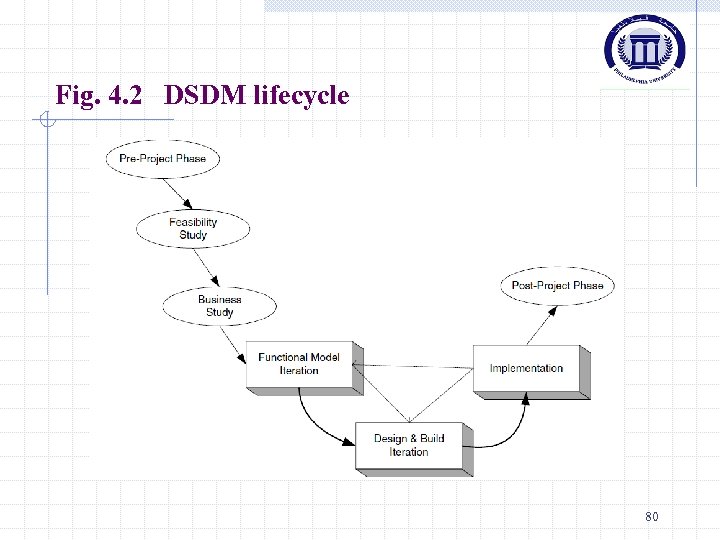
Fig. 4. 2 DSDM lifecycle 80
The first three phases (namely, the Pre-Project, Feasibility and Business Studies phases) are done sequentially in order. These phases set the ground rules for the rest of development process allowing users and teams to understand the world within which the application must execute as well as what will be expected of the end product. 81
Feasibility Study The Feasibility Study phase is expected only to last a few weeks. The output of this phase is a “feasibility report” that assesses whether or not to use DSDM for the particular project. It should also consider issues surrounding the people and organizations involved, and define the general scope of the project and its objectives. This phase should also produce an outline plan for the development of the end product. 82
Business Study The Business Study phase of the project should have three outputs; these should be the Business Area Definition (BAD), the System Architecture Definition (SAD) and the Outline Prototyping plan: Business Area Definition. Identifies the high-level requirements and provides a process description of the end product. System Architecture Definition. Sketches out the architecture of end system. Note that it is likely that this will evolve over the life of the project. Outline Prototyping Plan. This states the prototyping strategy to be adopted for the development of the end product. 83
FMI The core phases of the DSDM are the FMI, the DBI and the Implementation Phase The FMI Phase involves: Analysis of the features to be designed and implemented. The production of the Functional Model. This is the primary output of this phase. It may include prototype code as well as analysis models. Coding and prototyping. Prototypes may be used to help improve the analysis or understanding of the system. These prototypes may continue to evolve (particularly in the next phase) until the quality level achieved is high enough that they can be used in the delivered system. 84
DBI The DBI Phase involves: Designing and Building the features to be implemented during this phase. This involves reviewing the designs produced so far, the functional prototypes, as well as the creation of code to implement the required functionality. The primary output of this state is the tested system. This system must meet all the requirements selected as essential in the particular iteration being implemented. 85
Implementation Phase The Implementation Phase involves: The transfer of the completed system from the development environment to the production environment. The provision of other deliverables such as User training, the creation of the User Manual and the Project Review Report. If issues arise, then the project can be reiterated back to the appropriate phase. 86
The core three phases, the FMI, the DBI and the Implementation Phase are expected to be iterative and incremental. However, exactly how these three phases overlap and merge is left to a particular project to decide. 87
Post-Project After the project has delivered the end product, the project team can be disbanded and the Post-Project activities initiated. This phase may cover such diverse activities as providing a help desk for users to ensure that the product operates effectively and checking that the expected business benefits have been achieved. 88
Timebox Within the two main product creation phases (the FMI and DBI) the primary mechanism used for handling the uncertainty considered inherent in the development process is the timebox. In any project, there is a fixed completion date, which provides an overall timebox for the work to be carried out. DSDM refines the concept of timeboxing by nesting shorter timeboxes of 2– 6 weeks within the overall time frame. 89
Each timebox will typically pass through three phases. Investigation – a quick pass to see whether the team is taking the right direction. Refinement – to build on the comments resulting from the review at the end of investigation. Consolidation – the final part of the timebox to tie up any loose ends. 90
Each timebox has an immovable end date and a prioritized set of requirements assigned to it. Some of these are mandatory, some are of a lesser priority. The prioritisation of the requirements throughout the timebox is checked and possibly reassigned using the Mo. SCo. W Rules. 91
Mo. SCo. W Rules The Mo. SCo. W rules provide the basis on which decisions are made over the entire project, and during any timebox. As timeboxes are fixed, the deliverables from the timebox may vary according to the amount of time left. Essential work must be done – less critical work can be omitted. So, the Mo. SCo. W rules are applied. 92
Mo. SCo. W rules Mo. SCo. W stands for: Must haves: fundamental to the projects success “on time” Should haves: important but the projects success does not rely on these Could haves: can easily be left out without impacting on the project “on budget” Won’t have this time round: can be left out this time and done at a later date. 93
A clear prioritization is developed ensuring that the essential work is completed within the given timeframe. Recent trends within the DSDM community have been to combine DSDM with XP to gain the benefits of DSDM’s project management framework and business focus with XP’s high efficiency and high-quality development practices, what has been called Enterprise XP or EXP (Craddock, 2002). 94
![References [1] http//: www. extremeprogramming. org/ 95](https://present5.com/presentation/7f0b40157068d49db1aa598848525d30/image-95.jpg "References [1] http//: www. extremeprogramming. org/ 95")
References [1] http//: www. extremeprogramming. org/ 95
Questions
Скачать презентацию Agile Software Construction Textbook Agile Software Construction
7f0b40157068d49db1aa598848525d30.ppt