


 Скачать презентацию Agile Networks 2 0 — Choices and Tradeoffs
fbadbd8e3f60cf488a8239f4ba9aa375.ppt
- Количество слайдов: 16
 Agile Networks 2. 0 - Choices and Tradeoffs Željko Bulut Product Line Manager, Optical Networks © Nokia Siemens Networks ECOC 2010 1
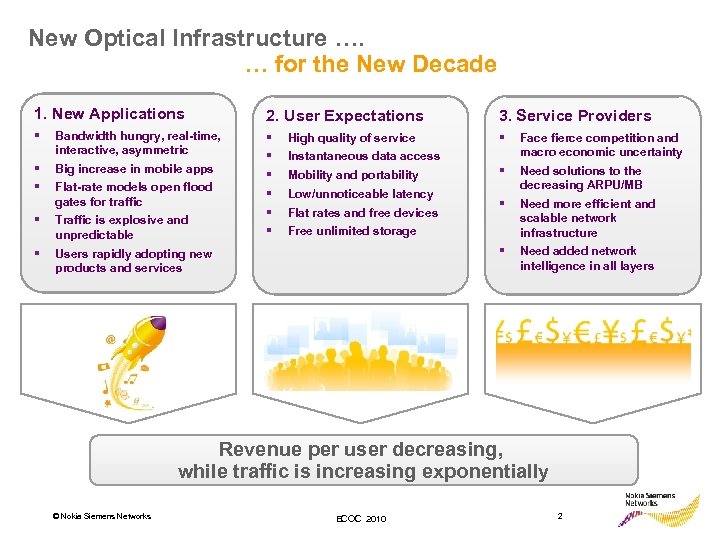 New Optical Infrastructure …. … for the New Decade 1. New Applications 2. User Expectations 3. Service Providers § Bandwidth hungry, real-time, interactive, asymmetric § Face fierce competition and macro economic uncertainty § § Big increase in mobile apps § § § § Need solutions to the decreasing ARPU/MB § Need more efficient and scalable network infrastructure § Need added network intelligence in all layers Flat-rate models open flood gates for traffic § Traffic is explosive and unpredictable § High quality of service Instantaneous data access Mobility and portability Low/unnoticeable latency Flat rates and free devices Users rapidly adopting new products and services Free unlimited storage Revenue per user decreasing, while traffic is increasing exponentially © Nokia Siemens Networks ECOC 2010 2
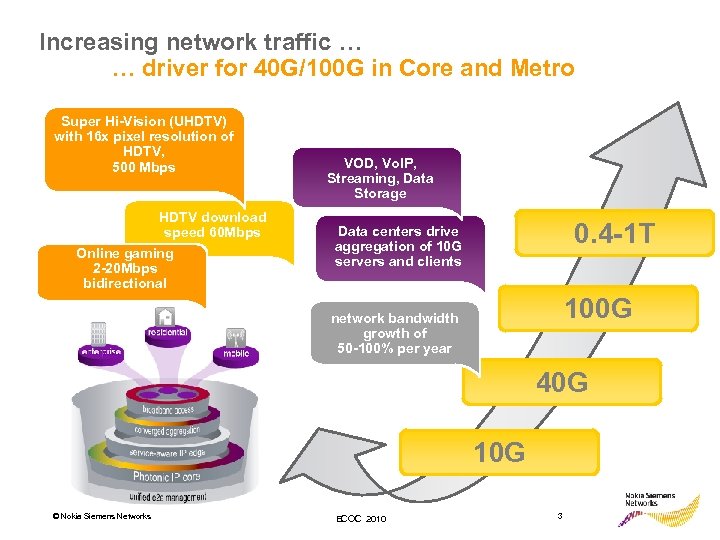 Increasing network traffic … … driver for 40 G/100 G in Core and Metro Super Hi-Vision (UHDTV) with 16 x pixel resolution of HDTV, 500 Mbps HDTV download speed 60 Mbps Online gaming 2 -20 Mbps bidirectional VOD, Vo. IP, Streaming, Data Storage 0. 4 -1 T Data centers drive aggregation of 10 G servers and clients 100 G network bandwidth growth of 50 -100% per year 40 G 10 G © Nokia Siemens Networks ECOC 2010 3
 Agile Networks 1. 0 … … challenges of the last decade q Optical Layer proved to be much bigger challenge than anticipated – most of the early focus was on the control plane q Lack of the economical wavelength switching technology – we built the roads and cars but forgot to build the car engine – inadequate wavelength blockers and PLC based ROADM’s were deployed with WSS catching up … q Lack of investment in core optical technology following the Internet bubble burst – number of promising startups with viable technology vanished q Workflow processes including service planning, ordering, procurement and installation, remained largely under automated leading to OPEX challenges and resulting in long service provisioning times q Restoration and protection services were never implemented and deployed in significant way – protection was realized at Layer 3 which is inadequate and arguably more expensive q Lack of sophisticated multilayer optimization tools leading to overdesigned and inefficient networks – network congestions fixed with brute force by adding more router capacity and point to point DWDM pipes © Nokia Siemens Networks ECOC 2010 4
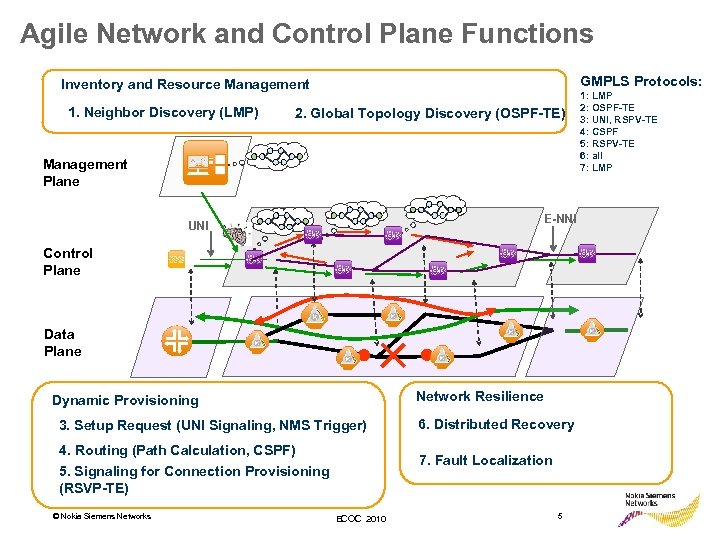 Agile Network and Control Plane Functions GMPLS Protocols: Inventory and Resource Management 1. Neighbor Discovery (LMP) 2. Global Topology Discovery (OSPF-TE) Management Plane E-NNI UNI Control Plane Data Plane Network Resilience Dynamic Provisioning 3. Setup Request (UNI Signaling, NMS Trigger) 4. Routing (Path Calculation, CSPF) 5. Signaling for Connection Provisioning (RSVP-TE) © Nokia Siemens Networks 6. Distributed Recovery 7. Fault Localization ECOC 2010 5 1: LMP 2: OSPF-TE 3: UNI, RSPV-TE 4: CSPF 5: RSPV-TE 6: all 7: LMP
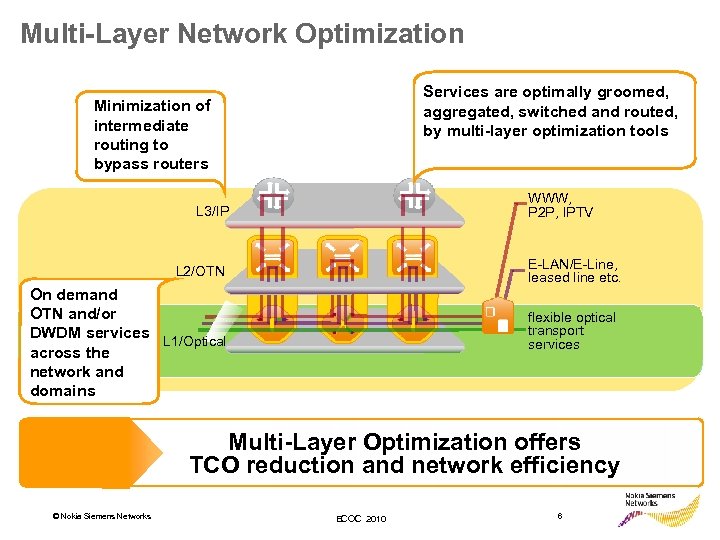 Multi-Layer Network Optimization Services are optimally groomed, aggregated, switched and routed, by multi-layer optimization tools Minimization of intermediate routing to bypass routers WWW, P 2 P, IPTV L 3/IP E-LAN/E-Line, leased line etc. L 2/OTN On demand OTN and/or DWDM services L 1/Optical across the network and domains flexible optical transport services Multi-Layer Optimization offers TCO reduction and network efficiency © Nokia Siemens Networks ECOC 2010 6
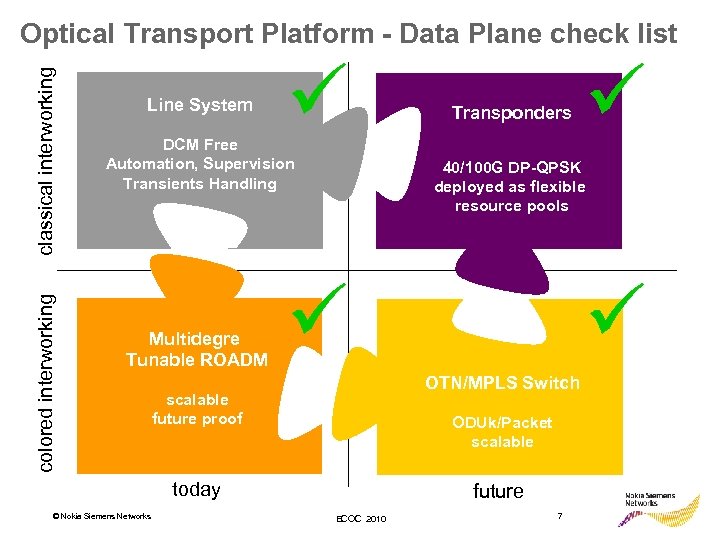 colored interworking classical interworking Optical Transport Platform - Data Plane check list Line System DCM Free Automation, Supervision Transients Handling Multidegre Tunable ROADM 40/100 G DP-QPSK deployed as flexible resource pools OTN/MPLS Switch scalable future proof ODUk/Packet scalable today © Nokia Siemens Networks Transponders future ECOC 2010 7
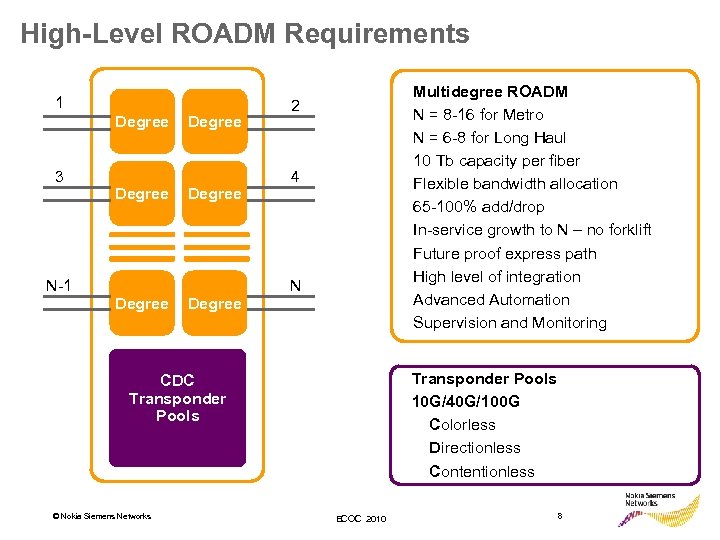 High-Level ROADM Requirements 1 Degree 3 N-1 Degree Degree Multidegree ROADM N = 8 -16 for Metro N = 6 -8 for Long Haul 10 Tb capacity per fiber Flexible bandwidth allocation 65 -100% add/drop In-service growth to N – no forklift Future proof express path High level of integration Advanced Automation Supervision and Monitoring 2 4 N Transponder Pools 10 G/40 G/100 G Colorless Directionless Contentionless CDC Transponder Pools © Nokia Siemens Networks ECOC 2010 8
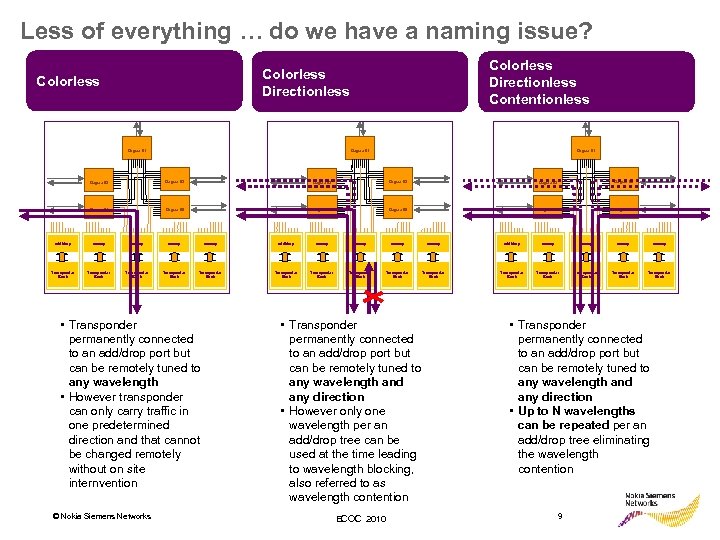 Less of everything … do we have a naming issue? Colorless Directionless Contentionless Colorless Directionless Colorless Degree #1 Degree #2 Degree #3 Degree #4 Degree #5 add/drop add/drop add/drop add/drop Transponder Bank Transponder Bank Transponder Bank Transponder Bank • Transponder permanently connected to an add/drop port but can be remotely tuned to any wavelength • However transponder can only carry traffic in one predetermined direction and that cannot be changed remotely without on site internvention © Nokia Siemens Networks • Transponder permanently connected to an add/drop port but can be remotely tuned to any wavelength and any direction • However only one wavelength per an add/drop tree can be used at the time leading to wavelength blocking, also referred to as wavelength contention ECOC 2010 • Transponder permanently connected to an add/drop port but can be remotely tuned to any wavelength and any direction • Up to N wavelengths can be repeated per an add/drop tree eliminating the wavelength contention 9
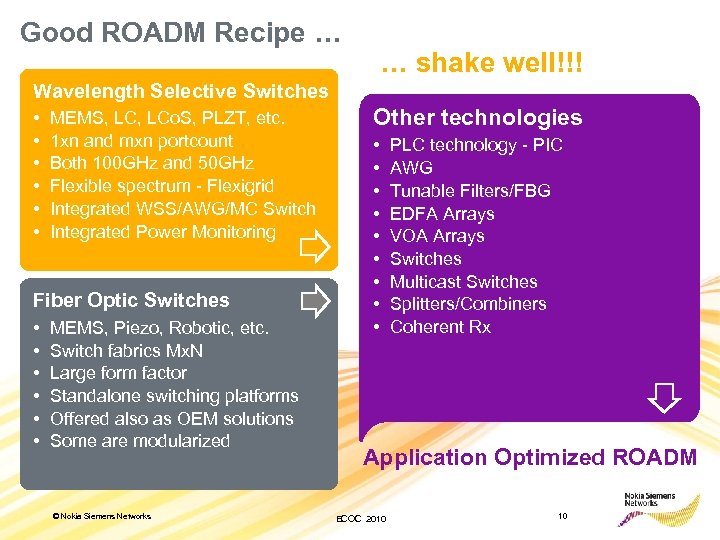 Good ROADM Recipe … … shake well!!! Wavelength Selective Switches • • • MEMS, LCo. S, PLZT, etc. 1 xn and mxn portcount Both 100 GHz and 50 GHz Flexible spectrum - Flexigrid Integrated WSS/AWG/MC Switch Integrated Power Monitoring Fiber Optic Switches • • • MEMS, Piezo, Robotic, etc. Switch fabrics Mx. N Large form factor Standalone switching platforms Offered also as OEM solutions Some are modularized © Nokia Siemens Networks Other technologies • • • PLC technology - PIC AWG Tunable Filters/FBG EDFA Arrays VOA Arrays Switches Multicast Switches Splitters/Combiners Coherent Rx Application Optimized ROADM ECOC 2010 10
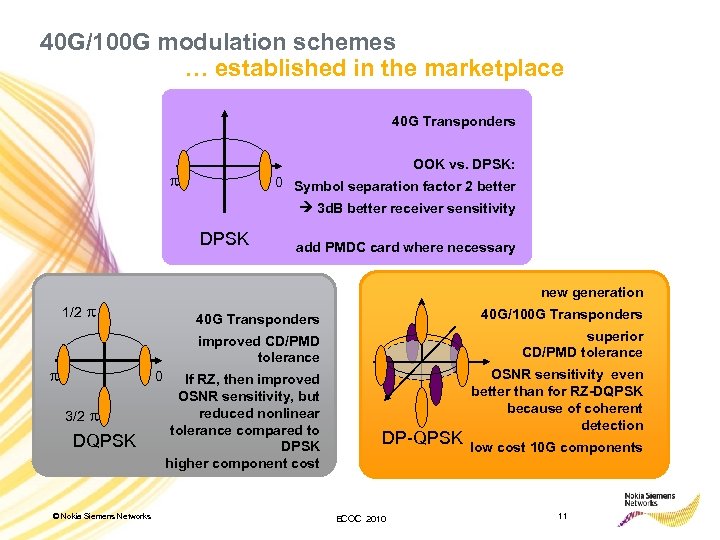 40 G/100 G modulation schemes … established in the marketplace 40 G Transponders OOK vs. DPSK: p 0 Symbol separation factor 2 better 3 d. B better receiver sensitivity DPSK 1/2 add PMDC card where necessary new generation p 0 p DQPSK 3/2 © Nokia Siemens Networks 40 G/100 G Transponders improved CD/PMD tolerance p 40 G Transponders superior CD/PMD tolerance If RZ, then improved OSNR sensitivity, but reduced nonlinear tolerance compared to DPSK higher component cost OSNR sensitivity even better than for RZ-DQPSK because of coherent detection DP-QPSK ECOC 2010 low cost 10 G components 11
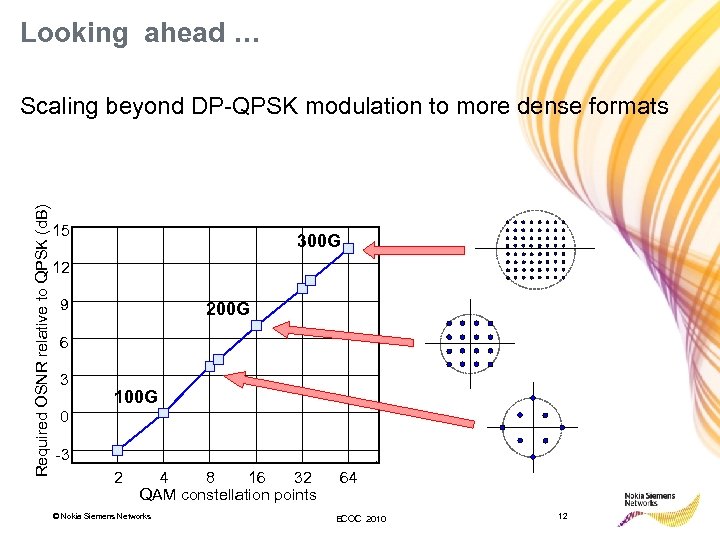 Looking ahead … Required OSNR relative to QPSK (d. B) Scaling beyond DP-QPSK modulation to more dense formats 15 300 G 12 9 200 G 6 3 100 G 0 -3 2 4 8 16 32 QAM constellation points © Nokia Siemens Networks 64 ECOC 2010 12
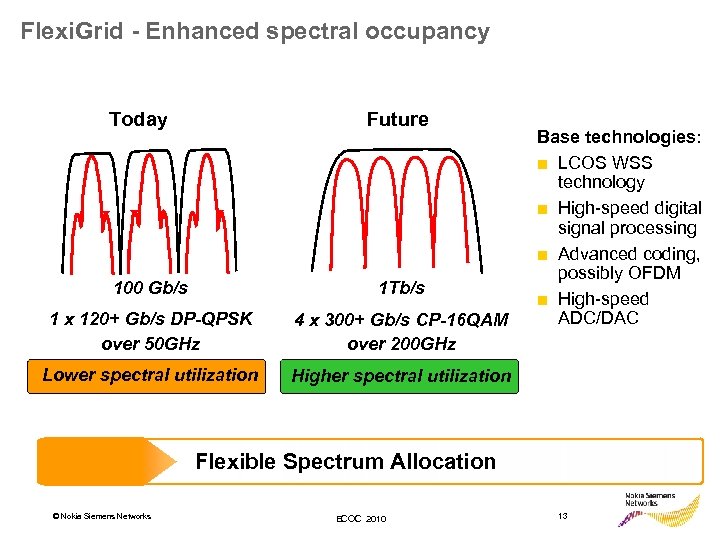 Flexi. Grid - Enhanced spectral occupancy Today Future 100 Gb/s 1 Tb/s 1 x 120+ Gb/s DP-QPSK over 50 GHz 4 x 300+ Gb/s CP-16 QAM over 200 GHz Lower spectral utilization Base technologies: ■ LCOS WSS technology ■ High-speed digital signal processing ■ Advanced coding, possibly OFDM ■ High-speed ADC/DAC Higher spectral utilization Flexible Spectrum Allocation © Nokia Siemens Networks ECOC 2010 13
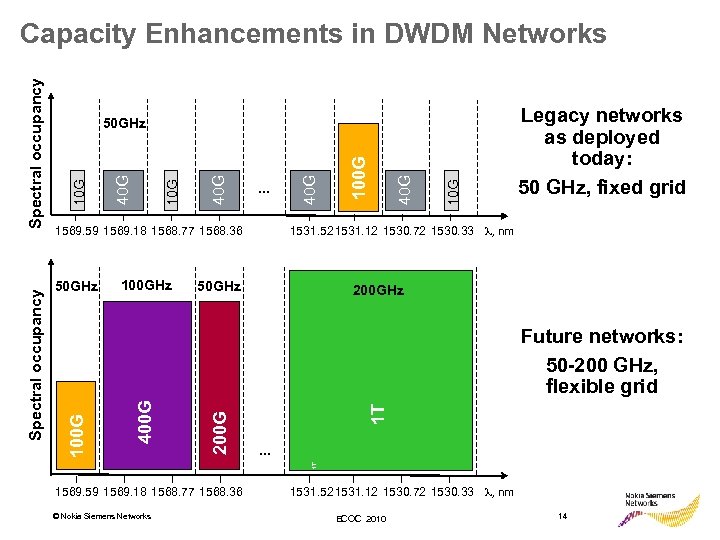 100 GHz 10 G 40 G Legacy networks as deployed today: 50 GHz, fixed grid 1531. 52 1531. 12 1530. 72 1530. 33 , nm 1569. 59 1569. 18 1568. 77 1568. 36 50 GHz 100 G … 40 G 10 G 50 GHz 200 GHz 1 T … 1 T 200 G 400 G Future networks: 50 -200 GHz, flexible grid 100 G Spectral occupancy Capacity Enhancements in DWDM Networks 1569. 59 1569. 18 1568. 77 1568. 36 © Nokia Siemens Networks 1531. 52 1531. 12 1530. 72 1530. 33 , nm ECOC 2010 14
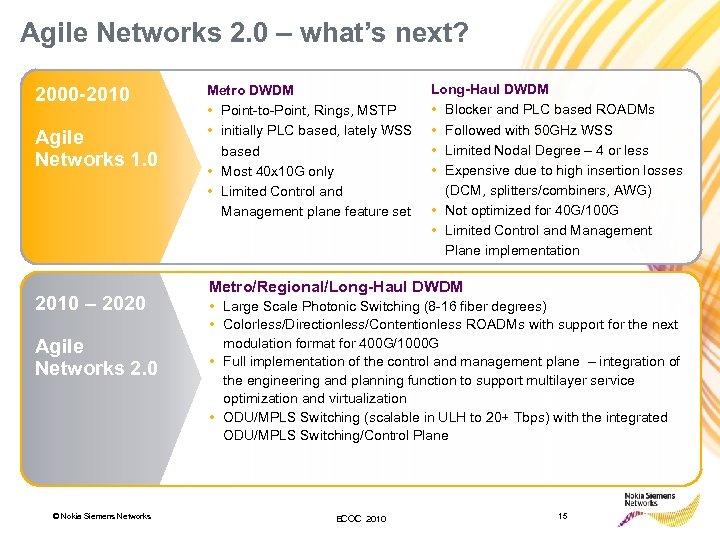 Agile Networks 2. 0 – what’s next? 2000 -2010 Agile Networks 1. 0 2010 – 2020 Agile Networks 2. 0 © Nokia Siemens Networks Metro DWDM • Point-to-Point, Rings, MSTP • initially PLC based, lately WSS based • Most 40 x 10 G only • Limited Control and Management plane feature set Long-Haul DWDM • Blocker and PLC based ROADMs • Followed with 50 GHz WSS • Limited Nodal Degree – 4 or less • Expensive due to high insertion losses (DCM, splitters/combiners, AWG) • Not optimized for 40 G/100 G • Limited Control and Management Plane implementation Metro/Regional/Long-Haul DWDM • Large Scale Photonic Switching (8 -16 fiber degrees) • Colorless/Directionless/Contentionless ROADMs with support for the next modulation format for 400 G/1000 G • Full implementation of the control and management plane – integration of the engineering and planning function to support multilayer service optimization and virtualization • ODU/MPLS Switching (scalable in ULH to 20+ Tbps) with the integrated ODU/MPLS Switching/Control Plane ECOC 2010 15
 Thank you © Nokia Siemens Networks ECOC 2010 16