


 Скачать презентацию Aggregated Traffic Flow Weight Controlled Hierarchical MAC Protocol
33f8c4a5b0930aa63db88d97be389d78.ppt
- Количество слайдов: 9
 Aggregated Traffic Flow Weight Controlled Hierarchical MAC Protocol for Wireless Sensor Networks Asia FI School Presented By Md. Abdur Razzaque Kyung Hee University Global Campus, South Korea 1
 Contents o o o Introduction Proposed Traffic Model Proposed ATW-HMAC Protocol Analytical Analysis Conclusion 2
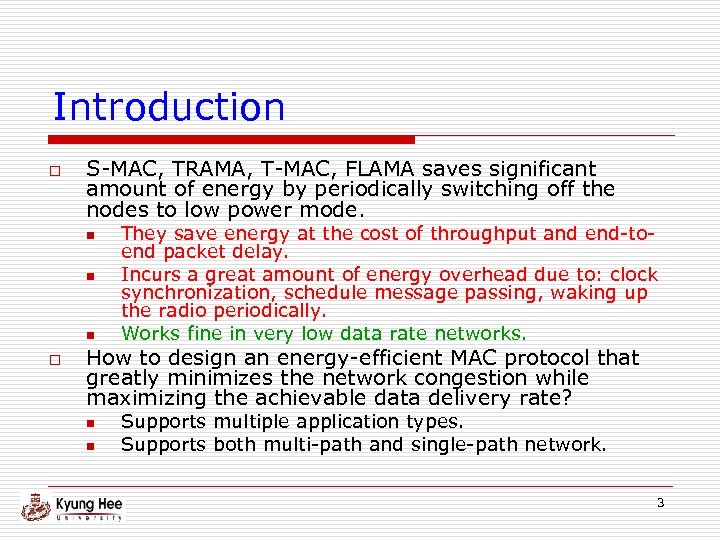 Introduction o S-MAC, TRAMA, T-MAC, FLAMA saves significant amount of energy by periodically switching off the nodes to low power mode. n n n o They save energy at the cost of throughput and end-toend packet delay. Incurs a great amount of energy overhead due to: clock synchronization, schedule message passing, waking up the radio periodically. Works fine in very low data rate networks. How to design an energy-efficient MAC protocol that greatly minimizes the network congestion while maximizing the achievable data delivery rate? n n Supports multiple application types. Supports both multi-path and single-path network. 3
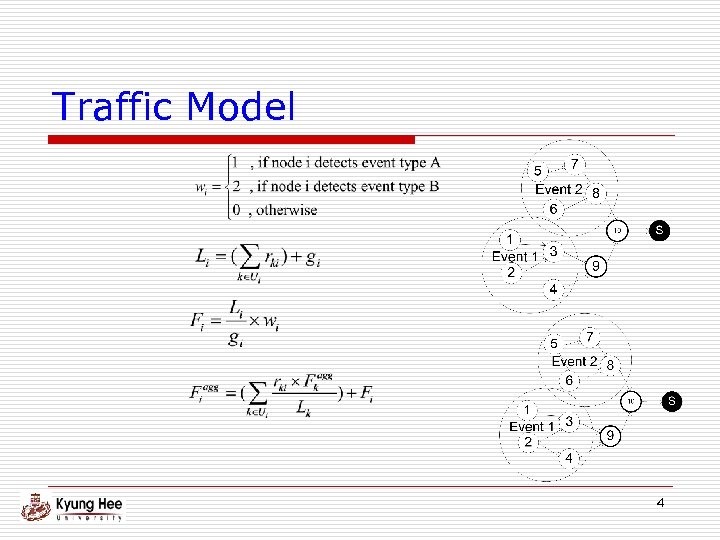 Traffic Model 4
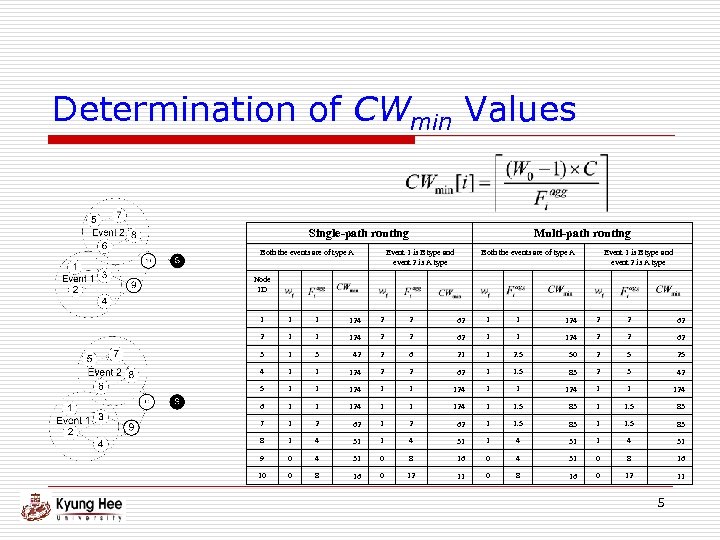 Determination of CWmin Values Single-path routing Both the events are of type A Multi-path routing Event 1 is B type and event 2 is A type Both the events are of type A Event 1 is B type and event 2 is A type Node ID 1 124 2 2 62 1 1 124 2 2 62 3 1 3 42 2 6 21 1 2. 5 50 2 5 25 4 1 1 124 2 2 62 1 1. 5 83 2 3 42 5 1 1 124 6 1 1 124 1 1. 5 83 7 1 2 62 1 1. 5 83 8 1 4 31 9 0 4 31 0 8 16 10 0 8 16 0 12 11 5
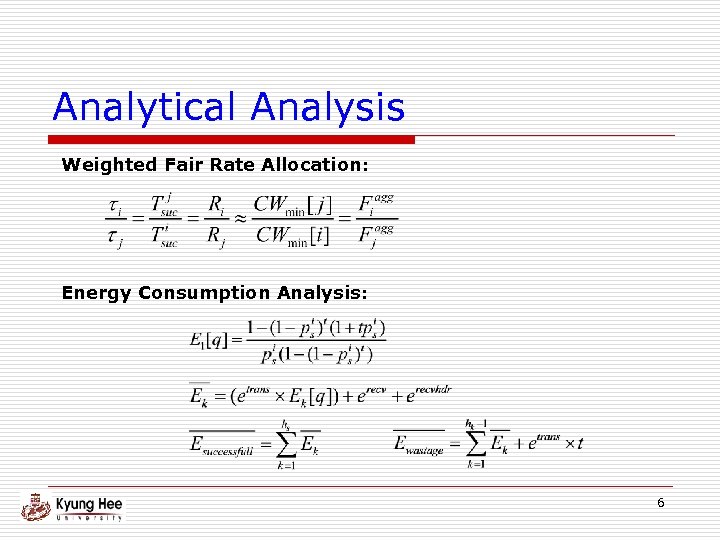 Analytical Analysis Weighted Fair Rate Allocation: Energy Consumption Analysis: 6
 Conclusion o Next problem to address: n How to further increase the overall throughput whenever data packets from a single source node are routed over multiple paths by employing a dynamic traffic engineering algorithm. 7
 References 1. A. Mahapatra, K. Anand, D. P. Agrawal, “Qo. S and energy aware routing for real-time traffic in wireless sensor networks”, Computer Communications, vol. 29, no. 4, pp. 437 -445, 2006. 2. Felemban, E. ; Lee, C. -G. ; Ekici, E. ; Boder, R. ; Vural, S. , “MMSPEED: Multipath Multi-Speed Protocol for Qo. S of Reliability and Timeliness in Wireless Sensor Networks”, IEEE Transactions on Mobile Computing, vol. 5, no. 6, 2006. 3. X. Huang, Y. Fang, “Multi-constrained Qo. S multipath routing in wireless sensor networks”, ACM Wireless Networks, 2007. 4. S. Lee, B. Bhattacharjee, S. Banerjee, “Efficient Geographic Routing in Multihop Wireless Networks”, the Sixth ACM International Symposium on Mobile Ad Hoc Networking and Computing ( Mobihoc), 2005, Urbana-Champaign, Illinois, USA. 5. K. Zeng, K. Ren, W. Lou, P. J. Moran, “Energy-aware Geographic Routing in Lossy Wireless Sensor Networks with Environmental Energy Supply”, Proc. of the 3 rd Intl. Conf. on Qo. S in heterogeneous wired/wireless networks QShine 2006, 6. Y. B. Kou and N. Vaidya, “Location-aided routing(LAR) in mobile ad hoc networks”, Proc. of the Fifth Annual ACM/IEEE International Conference on Mobile Computing and Networking (Mobi. Com 98), Dallas (1998) 7. S. Basagni, I. Chlamtac, and V. Syrotiuk, “A distance routing effect algorithm for mobility (DREAM)”, Proc. of the Fifth Annual ACM/IEEE International Conference on Mobile Computing and Networking (Mobi. Com 98), Dallas (1998) 8. T. He, C. Huang, B. Blum, J. Stankovic, and T. Abdelzaher, “Range-Free Localization Schemes for Large Scale Sensor Networks”, Proc. of Mobi. Com, 2003. 8
 THANK YOU Q&A 9