


 Скачать презентацию Agenda q TA Wenhua Wang 10 00
92e2d9e753330c0a800f8adda84bfde5.ppt
- Количество слайдов: 28
 Agenda q TA: Wenhua Wang, 10: 00 – 11: 30 am Mon & Wed, NH 239, wenhua. wang@mavs. uta. edu q Quick Review q Finish Logic Review q Program Proof Formal Methods in Software Engineering 1
 Quick Review q What are the syntactic objects we can use in first -order logic? Formal Methods in Software Engineering 2
 Deductive Verification q Introduction q Hoare’s Logic q An Example Proof q Summary Formal Methods in Software Engineering 3
 Deductive Verification. . . is to formally verify the correctness of a program using a proof system. Given a program P and an initial condition I, this approach proves that the expected final condition is the logical consequence of executing P from I. Formal Methods in Software Engineering 4
 Program Correctness q Partial correctness: If the initial condition holds, and if the program terminates, then the input-output claim holds. q Termination: If the initial condition holds, then the program terminates q Total correctness: If the initial condition holds, then the program terminates, and the input-output claim holds. Formal Methods in Software Engineering 5
 Benefits q Establishes or enhances the correctness of a program § § Finding errors in the code and correct them A better understanding of the verified algorithm q Identifies invariants that can be used to check code consistency during the different development stages. q A proof system can be used as a formalism to formally define the semantics of a language. Formal Methods in Software Engineering 6
 Limitations q Can’t be completely automated § often requires a great deal of domain expertise q Highly time-consuming § only performed on key algorithms q Errors may crop into the proof § who will verify the verifier? q Has limited scalability § difficult to verify large programs Formal Methods in Software Engineering 7
 Deductive Verification q Introduction q Hoare Logic q An Example Proof q Summary Formal Methods in Software Engineering 8
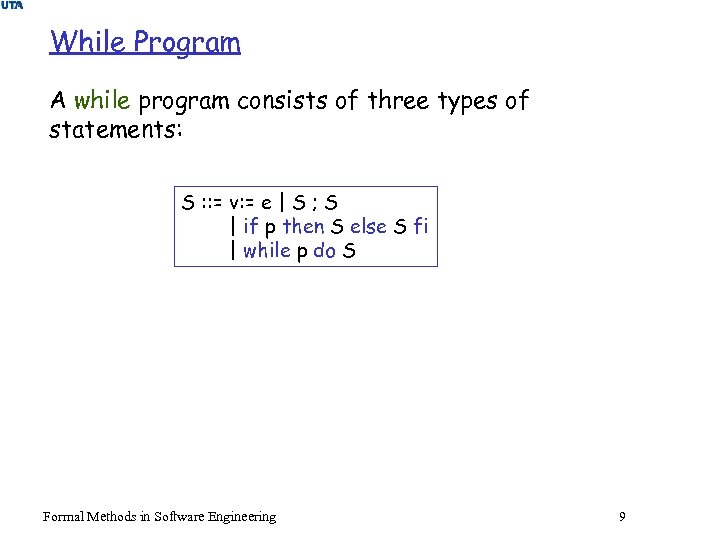 While Program A while program consists of three types of statements: S : : = v: = e | S ; S | if p then S else S fi | while p do S Formal Methods in Software Engineering 9
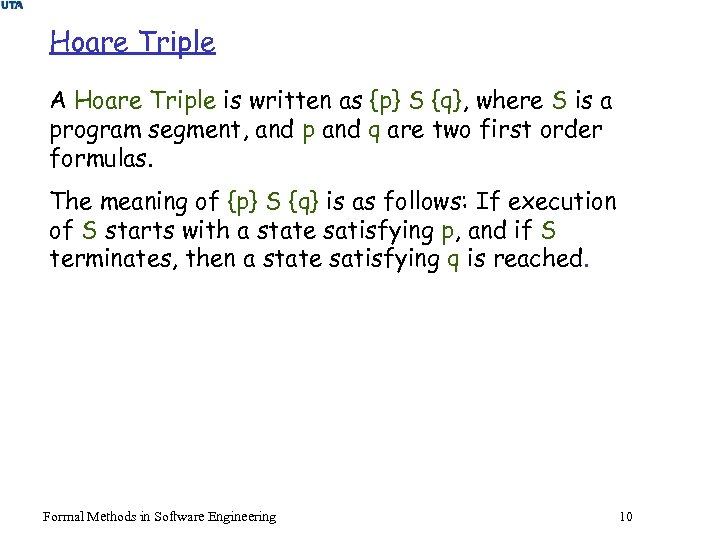 Hoare Triple A Hoare Triple is written as {p} S {q}, where S is a program segment, and p and q are two first order formulas. The meaning of {p} S {q} is as follows: If execution of S starts with a state satisfying p, and if S terminates, then a state satisfying q is reached. Formal Methods in Software Engineering 10
![Assignment Axiom {p[e/v]} v: = e {p} For example: {y+5=10} y: =y+5 {y=10} {y+y<z}](https://present5.com/presentation/92e2d9e753330c0a800f8adda84bfde5/image-11.jpg "Assignment Axiom {p[e/v]} v: = e {p} For example: {y+5=10} y: =y+5 {y=10} {y+y<z}") Assignment Axiom {p[e/v]} v: = e {p} For example: {y+5=10} y: =y+5 {y=10} {y+y
Assignment Axiom {p[e/v]} v: = e {p} For example: {y+5=10} y: =y+5 {y=10} {y+y
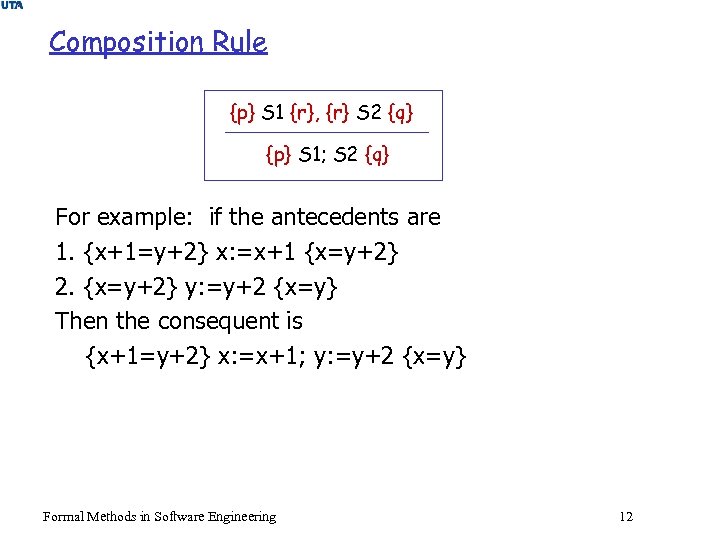 Composition Rule {p} S 1 {r}, {r} S 2 {q} {p} S 1; S 2 {q} For example: if the antecedents are 1. {x+1=y+2} x: =x+1 {x=y+2} 2. {x=y+2} y: =y+2 {x=y} Then the consequent is {x+1=y+2} x: =x+1; y: =y+2 {x=y} Formal Methods in Software Engineering 12
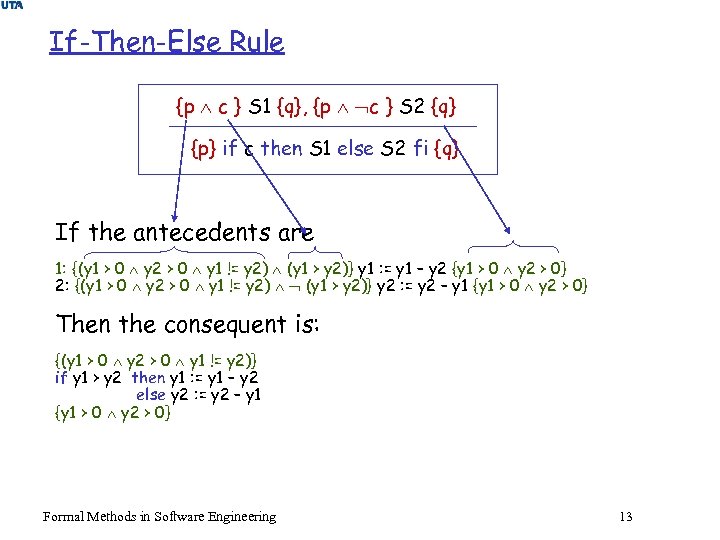 If-Then-Else Rule {p c } S 1 {q}, {p c } S 2 {q} {p} if c then S 1 else S 2 fi {q} If the antecedents are 1: {(y 1 > 0 y 2 > 0 y 1 != y 2) (y 1 > y 2)} y 1 : = y 1 – y 2 {y 1 > 0 y 2 > 0} 2: {(y 1 > 0 y 2 > 0 y 1 != y 2) (y 1 > y 2)} y 2 : = y 2 – y 1 {y 1 > 0 y 2 > 0} Then the consequent is: {(y 1 > 0 y 2 > 0 y 1 != y 2)} if y 1 > y 2 then y 1 : = y 1 – y 2 else y 2 : = y 2 – y 1 {y 1 > 0 y 2 > 0} Formal Methods in Software Engineering 13
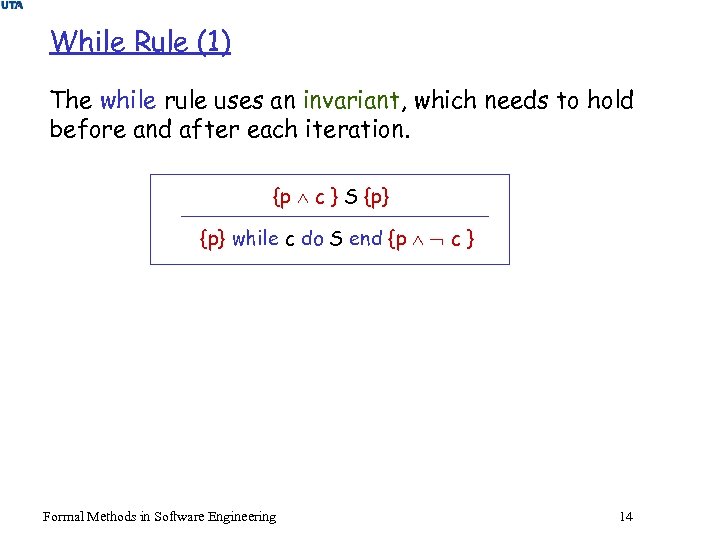 While Rule (1) The while rule uses an invariant, which needs to hold before and after each iteration. {p c } S {p} while c do S end {p c } Formal Methods in Software Engineering 14
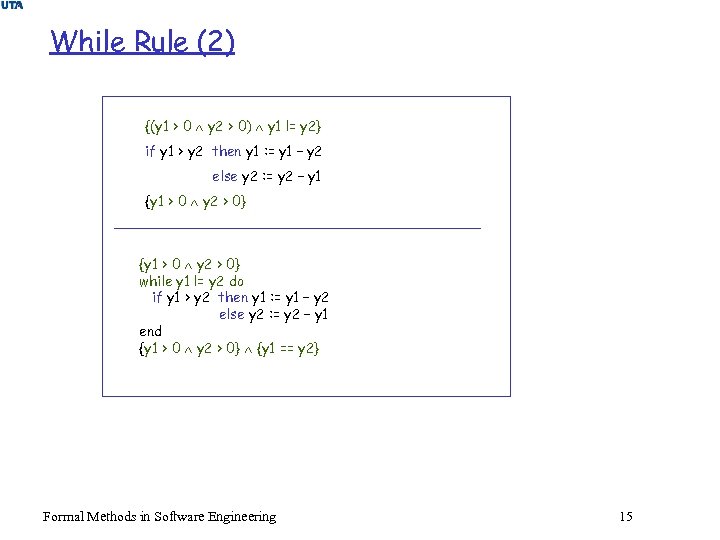 While Rule (2) {(y 1 > 0 y 2 > 0) y 1 != y 2} if y 1 > y 2 then y 1 : = y 1 – y 2 else y 2 : = y 2 – y 1 {y 1 > 0 y 2 > 0} while y 1 != y 2 do if y 1 > y 2 then y 1 : = y 1 – y 2 else y 2 : = y 2 – y 1 end {y 1 > 0 y 2 > 0} {y 1 == y 2} Formal Methods in Software Engineering 15
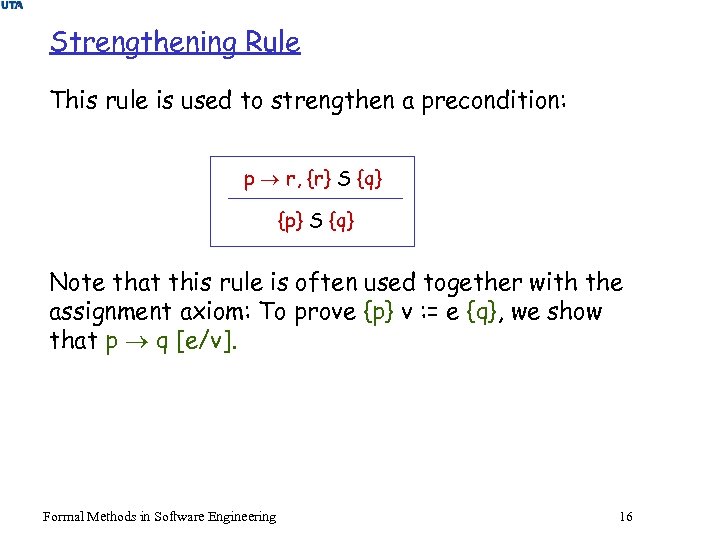 Strengthening Rule This rule is used to strengthen a precondition: p r, {r} S {q} {p} S {q} Note that this rule is often used together with the assignment axiom: To prove {p} v : = e {q}, we show that p q [e/v]. Formal Methods in Software Engineering 16
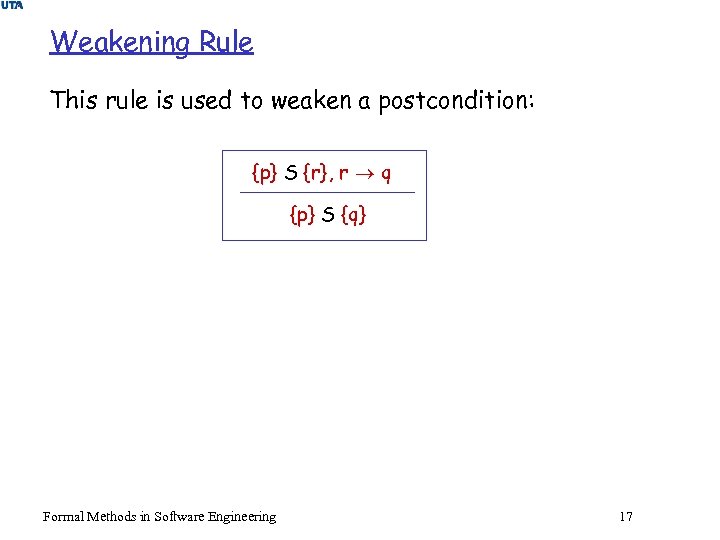 Weakening Rule This rule is used to weaken a postcondition: {p} S {r}, r q {p} S {q} Formal Methods in Software Engineering 17
 Deductive Verification q Introduction q Hoare Logic q An Example Proof q Summary Formal Methods in Software Engineering 18
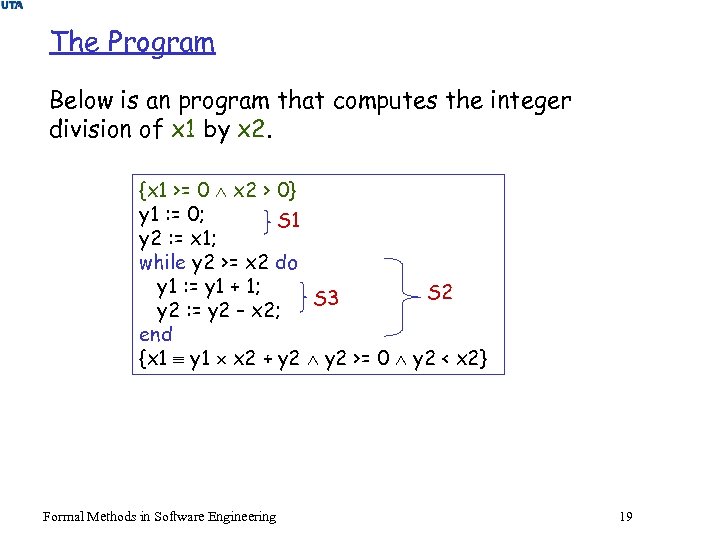 The Program Below is an program that computes the integer division of x 1 by x 2. {x 1 >= 0 x 2 > 0} y 1 : = 0; S 1 y 2 : = x 1; while y 2 >= x 2 do y 1 : = y 1 + 1; S 2 S 3 y 2 : = y 2 – x 2; end {x 1 y 1 x 2 + y 2 >= 0 y 2 < x 2} Formal Methods in Software Engineering 19
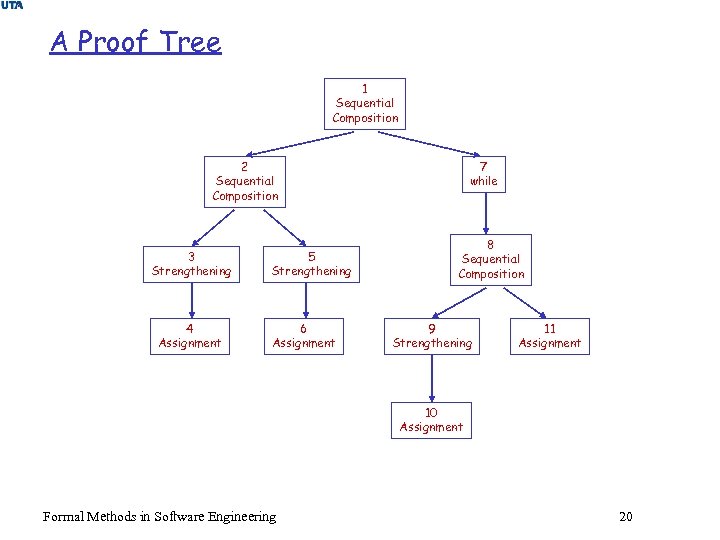 A Proof Tree 1 Sequential Composition 2 Sequential Composition 3 Strengthening 4 Assignment 5 Strengthening 6 Assignment 7 while 8 Sequential Composition 9 Strengthening 11 Assignment 10 Assignment Formal Methods in Software Engineering 20
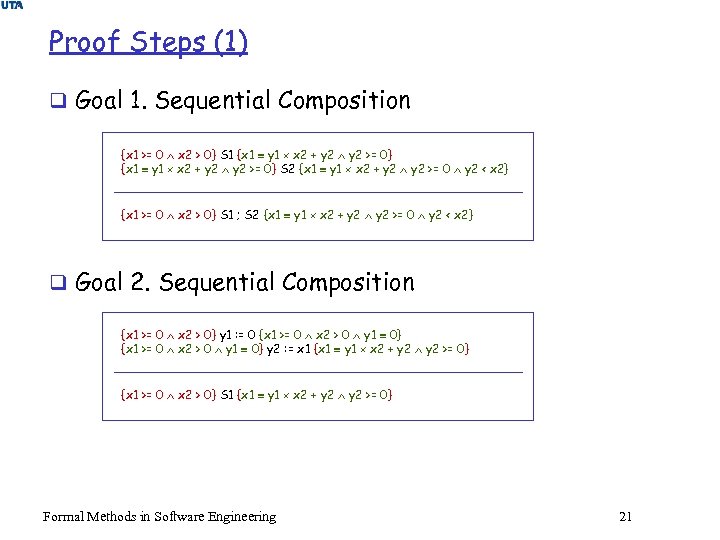 Proof Steps (1) q Goal 1. Sequential Composition {x 1 >= 0 x 2 > 0} S 1 {x 1 y 1 x 2 + y 2 >= 0} S 2 {x 1 y 1 x 2 + y 2 >= 0 y 2 < x 2} {x 1 >= 0 x 2 > 0} S 1 ; S 2 {x 1 y 1 x 2 + y 2 >= 0 y 2 < x 2} q Goal 2. Sequential Composition {x 1 >= 0 x 2 > 0} y 1 : = 0 {x 1 >= 0 x 2 > 0 y 1 0} y 2 : = x 1 {x 1 y 1 x 2 + y 2 >= 0} {x 1 >= 0 x 2 > 0} S 1 {x 1 y 1 x 2 + y 2 >= 0} Formal Methods in Software Engineering 21
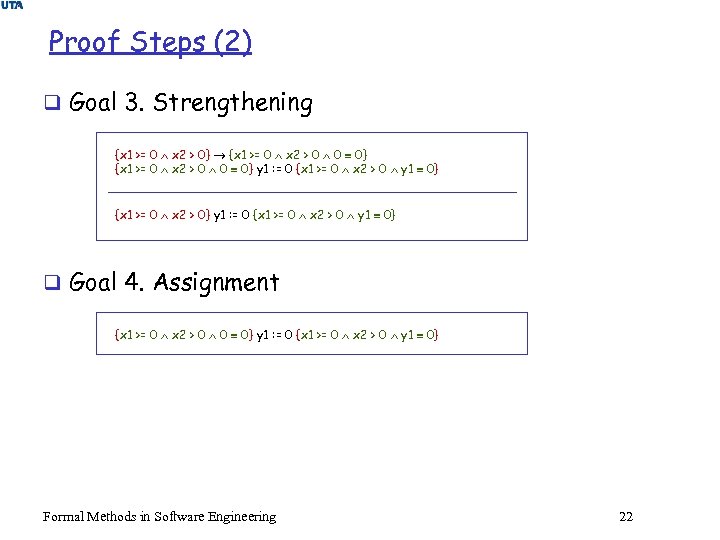 Proof Steps (2) q Goal 3. Strengthening {x 1 >= 0 x 2 > 0} {x 1 >= 0 x 2 > 0 0 0} y 1 : = 0 {x 1 >= 0 x 2 > 0 y 1 0} {x 1 >= 0 x 2 > 0} y 1 : = 0 {x 1 >= 0 x 2 > 0 y 1 0} q Goal 4. Assignment {x 1 >= 0 x 2 > 0 0 0} y 1 : = 0 {x 1 >= 0 x 2 > 0 y 1 0} Formal Methods in Software Engineering 22
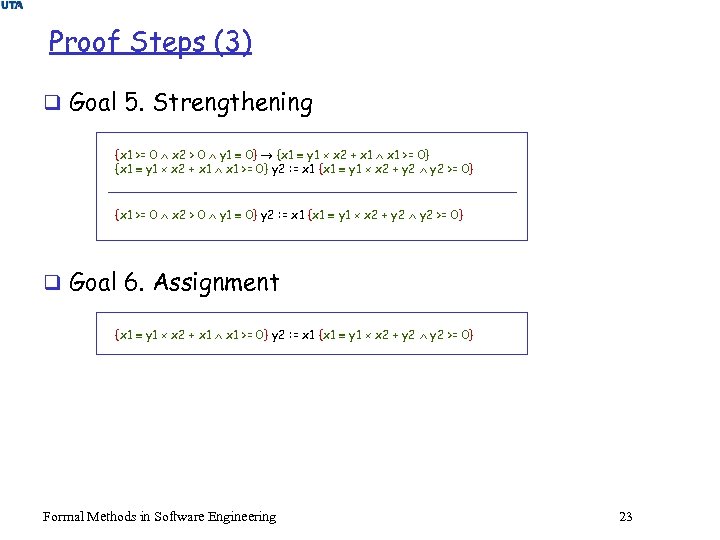 Proof Steps (3) q Goal 5. Strengthening {x 1 >= 0 x 2 > 0 y 1 0} {x 1 y 1 x 2 + x 1 >= 0} y 2 : = x 1 {x 1 y 1 x 2 + y 2 >= 0} {x 1 >= 0 x 2 > 0 y 1 0} y 2 : = x 1 {x 1 y 1 x 2 + y 2 >= 0} q Goal 6. Assignment {x 1 y 1 x 2 + x 1 >= 0} y 2 : = x 1 {x 1 y 1 x 2 + y 2 >= 0} Formal Methods in Software Engineering 23
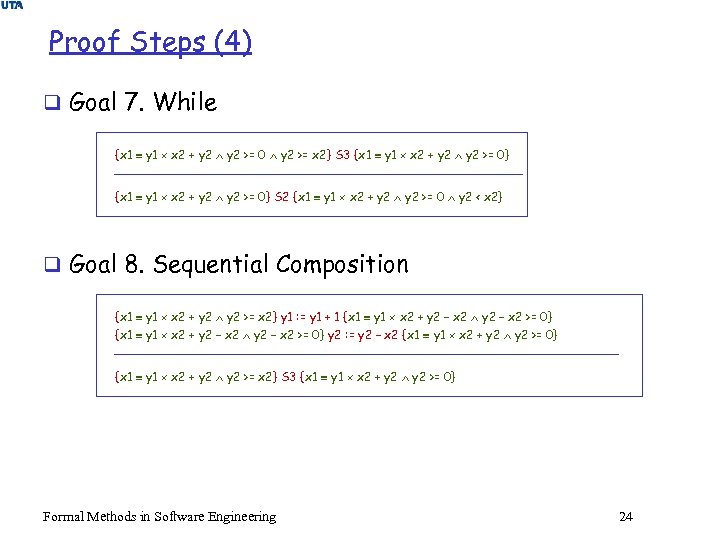 Proof Steps (4) q Goal 7. While {x 1 y 1 x 2 + y 2 >= 0 y 2 >= x 2} S 3 {x 1 y 1 x 2 + y 2 >= 0} S 2 {x 1 y 1 x 2 + y 2 >= 0 y 2 < x 2} q Goal 8. Sequential Composition {x 1 y 1 x 2 + y 2 >= x 2} y 1 : = y 1 + 1 {x 1 y 1 x 2 + y 2 – x 2 >= 0} y 2 : = y 2 – x 2 {x 1 y 1 x 2 + y 2 >= 0} {x 1 y 1 x 2 + y 2 >= x 2} S 3 {x 1 y 1 x 2 + y 2 >= 0} Formal Methods in Software Engineering 24
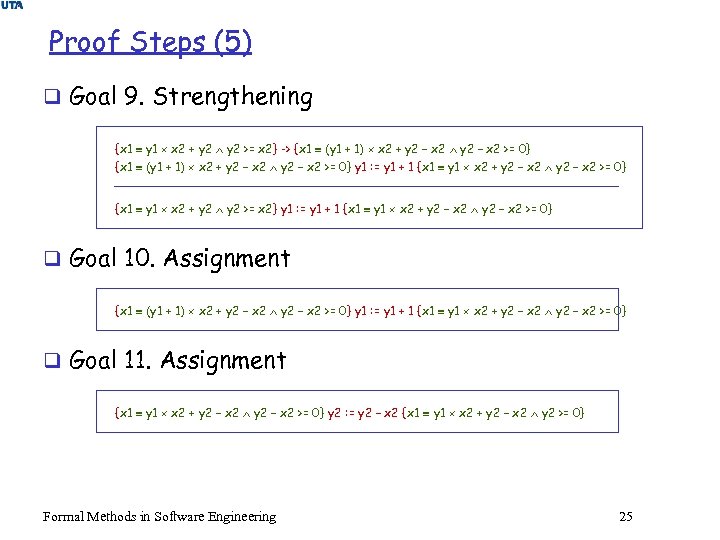 Proof Steps (5) q Goal 9. Strengthening {x 1 y 1 x 2 + y 2 >= x 2} -> {x 1 (y 1 + 1) x 2 + y 2 – x 2 >= 0} y 1 : = y 1 + 1 {x 1 y 1 x 2 + y 2 – x 2 >= 0} {x 1 y 1 x 2 + y 2 >= x 2} y 1 : = y 1 + 1 {x 1 y 1 x 2 + y 2 – x 2 >= 0} q Goal 10. Assignment {x 1 (y 1 + 1) x 2 + y 2 – x 2 >= 0} y 1 : = y 1 + 1 {x 1 y 1 x 2 + y 2 – x 2 >= 0} q Goal 11. Assignment {x 1 y 1 x 2 + y 2 – x 2 >= 0} y 2 : = y 2 – x 2 {x 1 y 1 x 2 + y 2 – x 2 y 2 >= 0} Formal Methods in Software Engineering 25
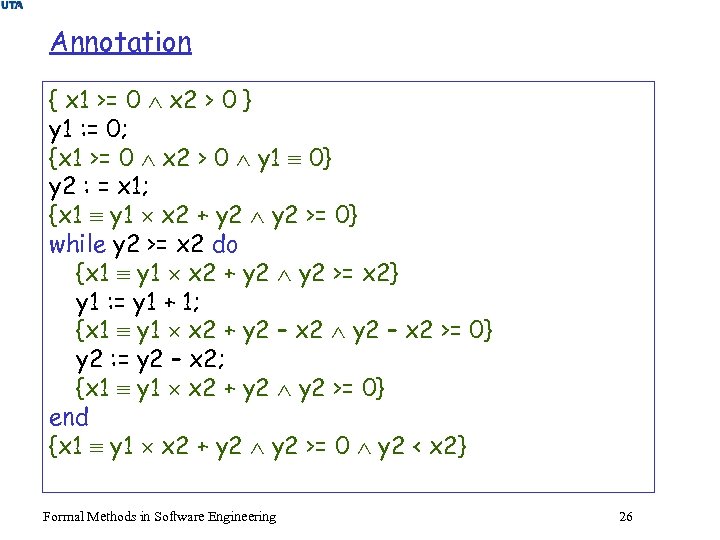 Annotation { x 1 >= 0 x 2 > 0 } y 1 : = 0; {x 1 >= 0 x 2 > 0 y 1 0} y 2 : = x 1; {x 1 y 1 x 2 + y 2 >= 0} while y 2 >= x 2 do {x 1 y 1 x 2 + y 2 >= x 2} y 1 : = y 1 + 1; {x 1 y 1 x 2 + y 2 – x 2 >= 0} y 2 : = y 2 – x 2; {x 1 y 1 x 2 + y 2 >= 0} end {x 1 y 1 x 2 + y 2 >= 0 y 2 < x 2} Formal Methods in Software Engineering 26
 Deductive Verification q Introduction q Hoare Logic q An Example Proof q Summary Formal Methods in Software Engineering 27
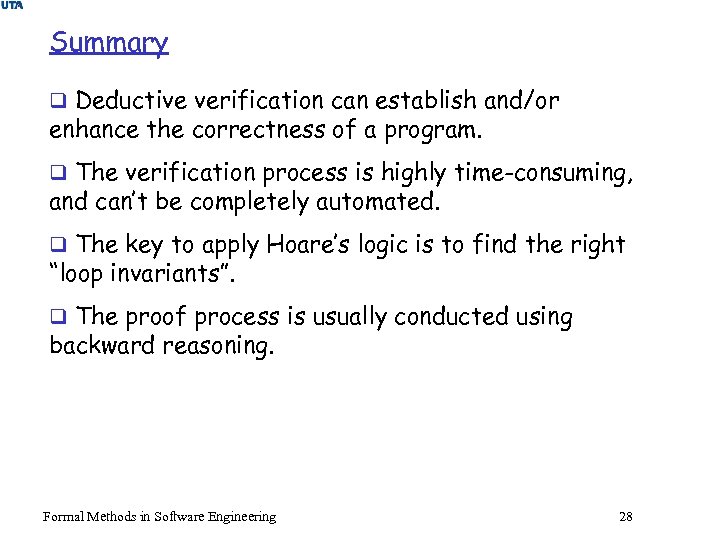 Summary q Deductive verification can establish and/or enhance the correctness of a program. q The verification process is highly time-consuming, and can’t be completely automated. q The key to apply Hoare’s logic is to find the right “loop invariants”. q The proof process is usually conducted using backward reasoning. Formal Methods in Software Engineering 28