 Скачать презентацию Agenda Power in the Italian Chamber of Deputies
c64e51406cb447daa190bfd2112a5fc6.ppt
- Количество слайдов: 26



Agenda Power in the Italian Chamber of Deputies 1988 -2000 Gary W. Cox, William B. Heller, and Mathew D. Mc. Cubbins
• In all national assemblies of which we are aware, there are certain offices to which extraordinary agenda powers attach. • We define an agenda cartel as a set of agents possessing two key properties. – First, they collectively hold a controlling share of the agendasetting offices relevant to a given assembly. – Second, the cartel establishes a procedure for agreeing on which proposals will be allowed access to the plenary session. Whether decentralized or centralized, formal or informal, this procedure amounts to investing k groups within the cartel, C 1, . . . , Ck, with vetoes over the placement of proposals upon the plenary agenda
Two subspecies of agenda cartel • First, in parliamentary systems, it is often said that each pivotal party in a multi-party majority coalition wields an agenda veto. We call this a parliamentary agenda cartel. • Second, Cox and Mc. Cubbins (2002, 2005) suggest that any majority of the majority party can veto the placement of items on the floor agenda in the U. S. House of Representatives.
Agenda Power • When a parliamentary agenda cartel exists, it is as if the legislative agenda were set as follows. – (1) Whoever wishes may introduce bills. – (2) In order for a bill to advance to the plenary session under the current government, however, it must be acceptable to each veto player, or gatekeeper, C 1, . . . , Ck. – (3) Bills that are not vetoed ex ante are decide in plenary session under open rules with germaneness restrictions. The outcome of which, in a one-dimensional policy game, is that the enacted bill will be located at the location of the median voter’s ideal point (Black, Downs). • In this model, the veto players should never lose (i. e. , have an unwanted policy change forced upon them).
The cartel thesis • The cartel thesis is that, if a majority government forms, then it will also constitute an agenda cartel.
Rolls and Roll Rates • Operationally, if a majority of a party votes against a bill that nonetheless passes, we say that the party has been rolled. – Prior to the final passage stage, there also sometimes clear agenda-setting votes—that is, votes to determine whether the legislature will or will not consider in plenary session a particular bill. We also speak of parties being rolled on these initial agenda -setting motions, when they vote against them but the motion nonetheless passes. Under conditions of complete and perfect information and with costless action, if a party wields a veto, it should never be rolled. • Roll rates are just the proportion of total votes on which a party was rolled. In what follows we examine only final passage votes or FPVs.
Floor Agenda (Median Voter) Model • What if there is no agenda cartel and no party wields a veto? • If we assume that all parties can be placed along a traditional left-right scale, so that successful bills necessarily propose to move policy toward the median legislator’s ideal point, then we have a very simple expectation: The median party is never rolled, while roll rates increase monotonically both to the left and to the right. – The intuition behind this result is straightforward. The median party cannot be rolled because it is not possible to form a majority that wants to move policy away from the median in a unidimensional model.
Cartel Agenda Model: Hypotheses H 1) Under complete and perfect information, and with costless gatekeeping, the roll rate of governmental parties will be zero. H 2) The roll rate of opposition parties should be higher than the roll rate of governmental parties, all else constant. H 3) The roll rates of opposition parties should increase the farther is their median ideal point from the floor median. That is, the greater is |m-F|, the greater an opposition party’s roll rate will be, all else constant. Government party roll rates, by contrast, should not be affected by distance from the assembly median.
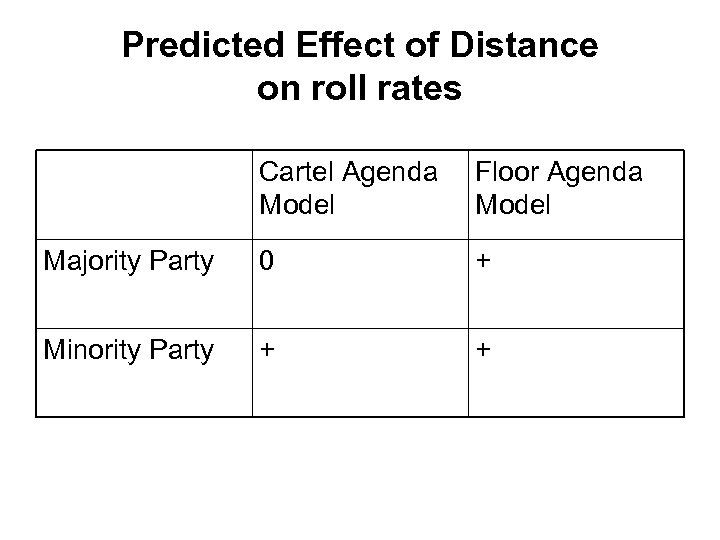
Predicted Effect of Distance on roll rates Cartel Agenda Model Floor Agenda Model Majority Party 0 + Minority Party + +
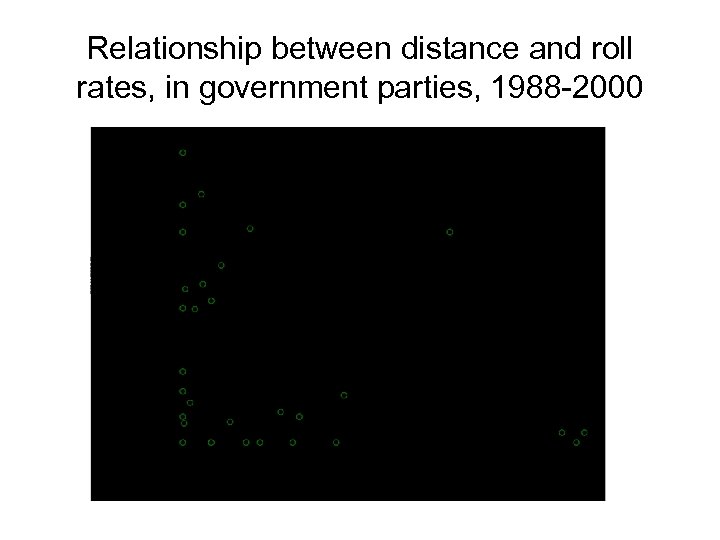
Relationship between distance and roll rates, in government parties, 1988 -2000
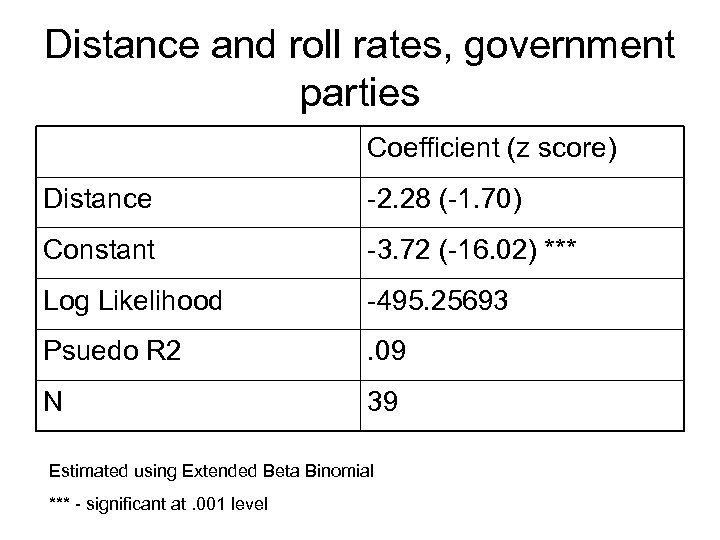
Distance and roll rates, government parties Coefficient (z score) Distance -2. 28 (-1. 70) Constant -3. 72 (-16. 02) *** Log Likelihood -495. 25693 Psuedo R 2 . 09 N 39 Estimated using Extended Beta Binomial *** - significant at. 001 level
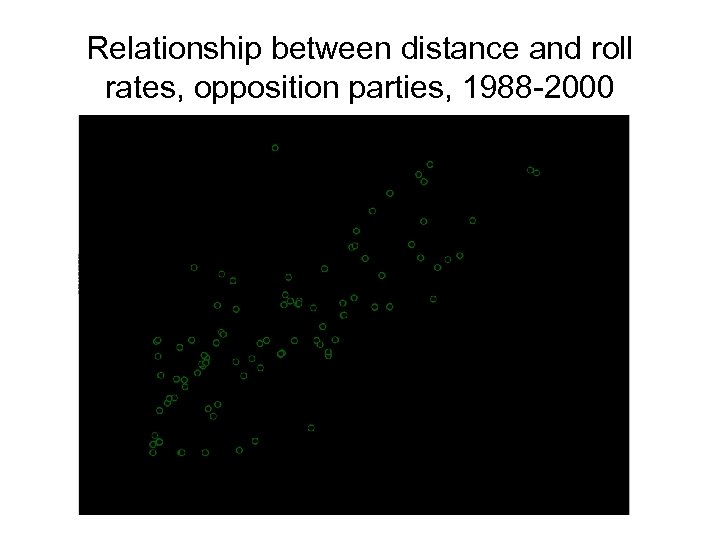
Relationship between distance and roll rates, opposition parties, 1988 -2000
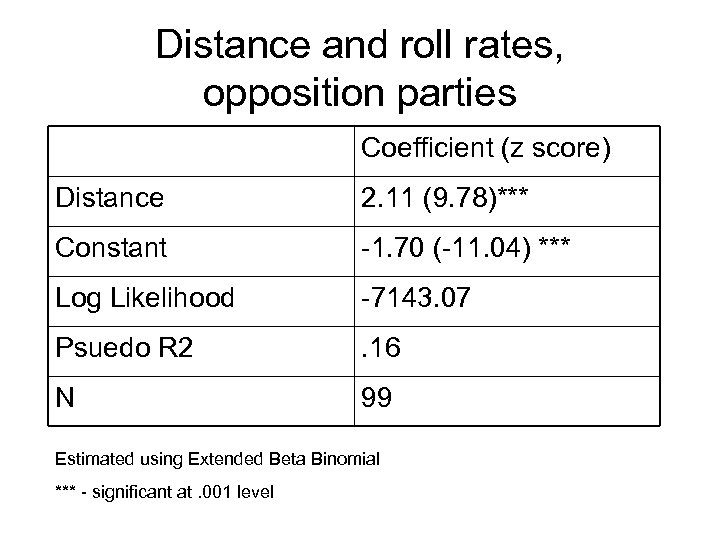
Distance and roll rates, opposition parties Coefficient (z score) Distance 2. 11 (9. 78)*** Constant -1. 70 (-11. 04) *** Log Likelihood -7143. 07 Psuedo R 2 . 16 N 99 Estimated using Extended Beta Binomial *** - significant at. 001 level
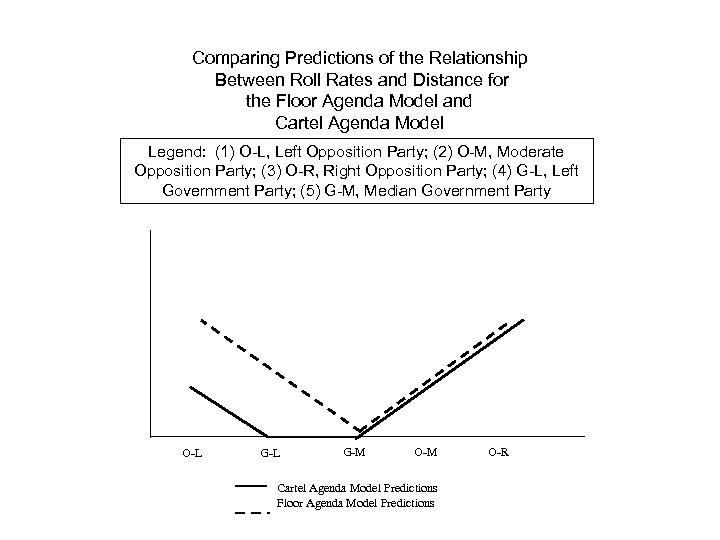
Comparing Predictions of the Relationship Between Roll Rates and Distance for the Floor Agenda Model and Cartel Agenda Model Legend: (1) O-L, Left Opposition Party; (2) O-M, Moderate Opposition Party; (3) O-R, Right Opposition Party; (4) G-L, Left Government Party; (5) G-M, Median Government Party O-L G-M O-M Cartel Agenda Model Predictions Floor Agenda Model Predictions O-R
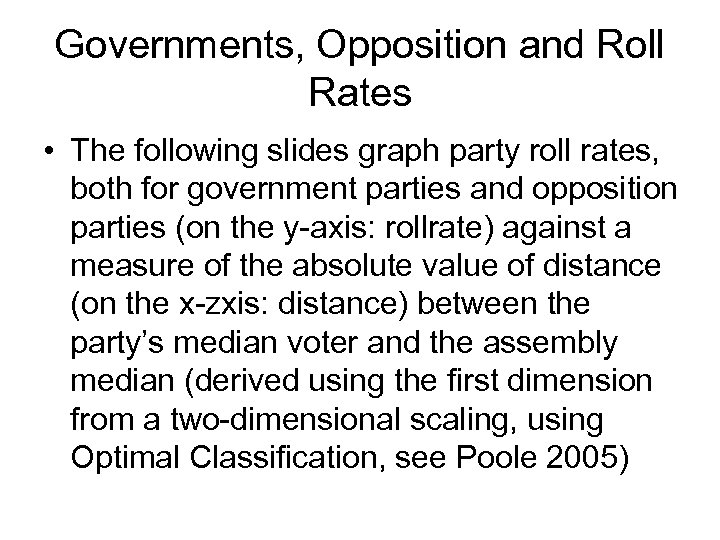
Governments, Opposition and Roll Rates • The following slides graph party roll rates, both for government parties and opposition parties (on the y-axis: rollrate) against a measure of the absolute value of distance (on the x-zxis: distance) between the party’s median voter and the assembly median (derived using the first dimension from a two-dimensional scaling, using Optimal Classification, see Poole 2005)
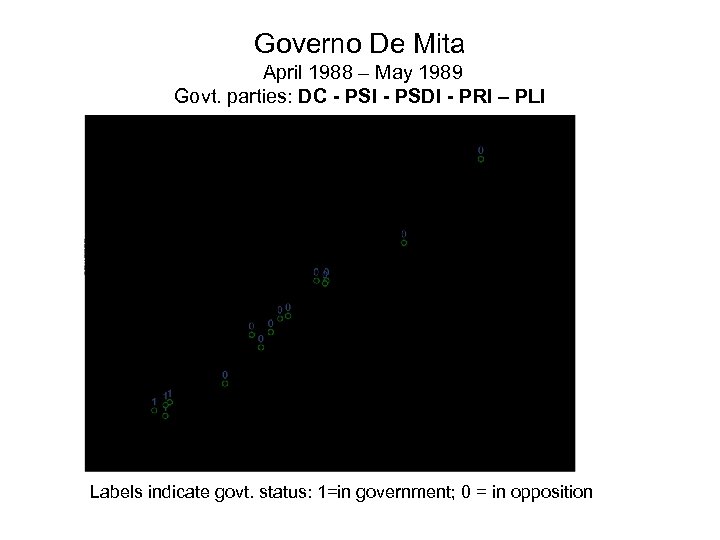
Governo De Mita April 1988 – May 1989 Govt. parties: DC PSI PSDI PRI – PLI Labels indicate govt. status: 1=in government; 0 = in opposition
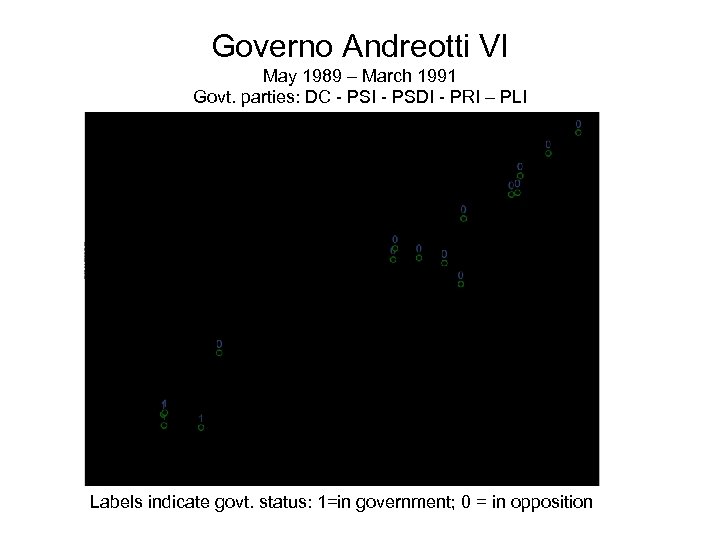
Governo Andreotti VI May 1989 – March 1991 Govt. parties: DC - PSI - PSDI - PRI – PLI Labels indicate govt. status: 1=in government; 0 = in opposition
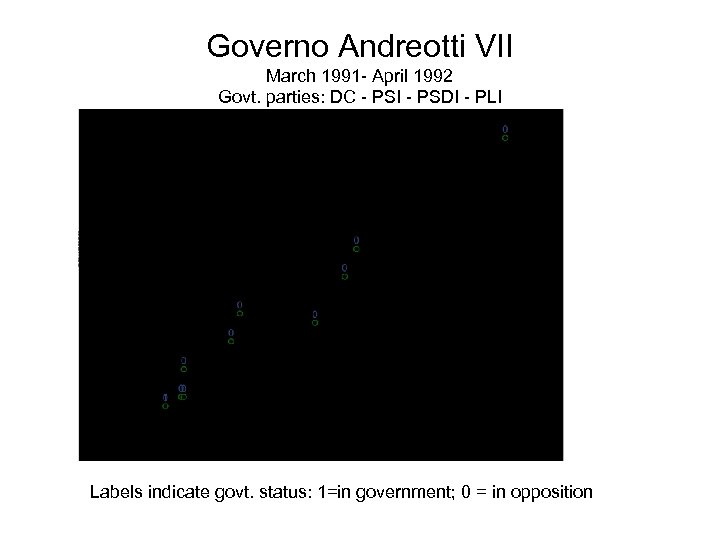
Governo Andreotti VII March 1991 - April 1992 Govt. parties: DC - PSI - PSDI - PLI Labels indicate govt. status: 1=in government; 0 = in opposition
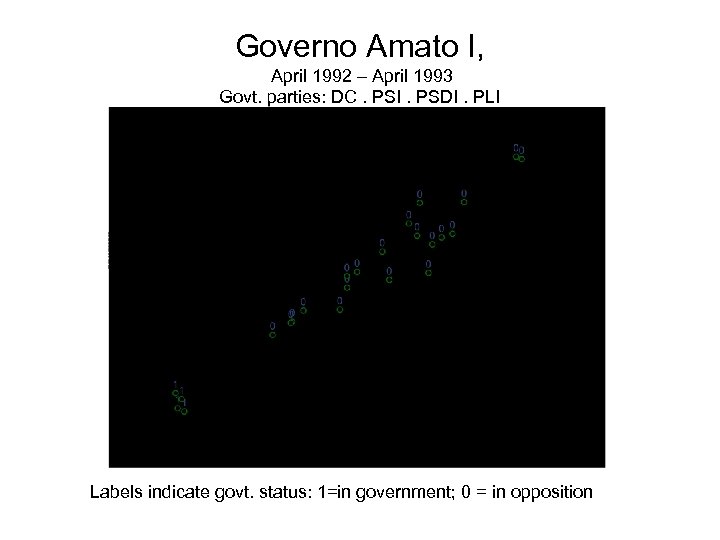
Governo Amato I, April 1992 – April 1993 Govt. parties: DC. PSI. PSDI. PLI Labels indicate govt. status: 1=in government; 0 = in opposition
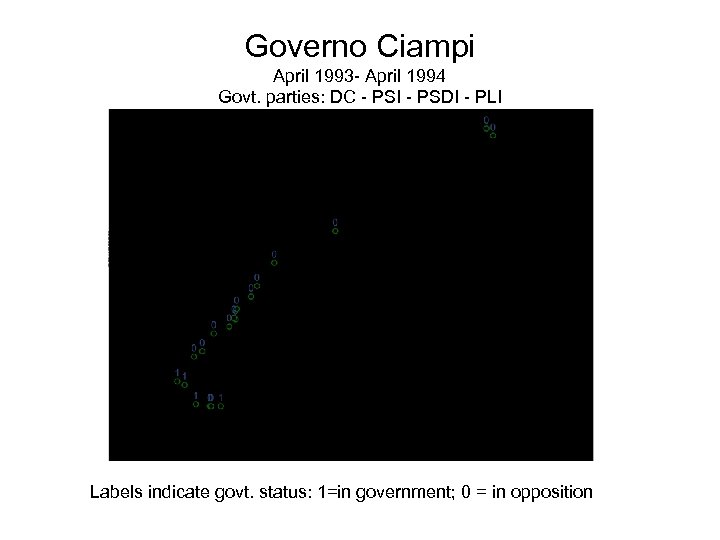
Governo Ciampi April 1993 - April 1994 Govt. parties: DC - PSI - PSDI - PLI Labels indicate govt. status: 1=in government; 0 = in opposition
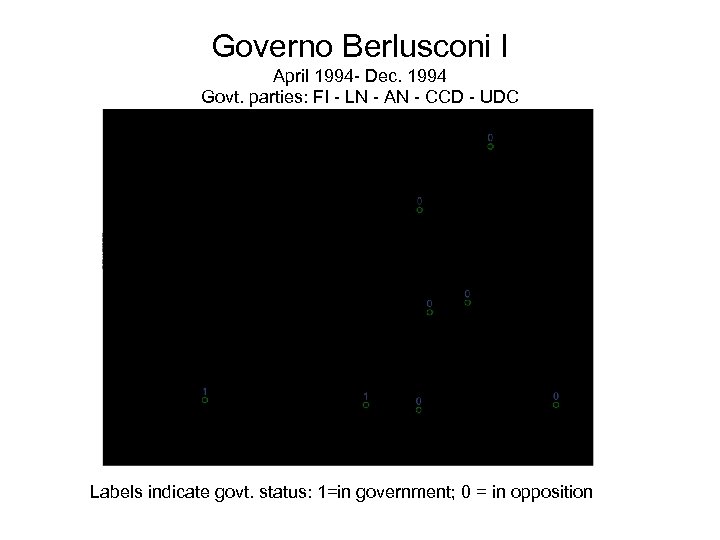
Governo Berlusconi I April 1994 - Dec. 1994 Govt. parties: FI - LN - AN - CCD - UDC Labels indicate govt. status: 1=in government; 0 = in opposition
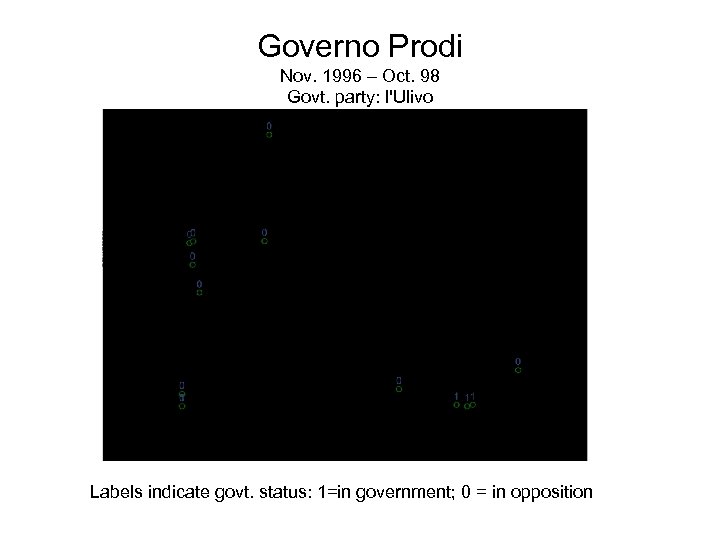
Governo Prodi Nov. 1996 – Oct. 98 Govt. party: l'Ulivo Labels indicate govt. status: 1=in government; 0 = in opposition
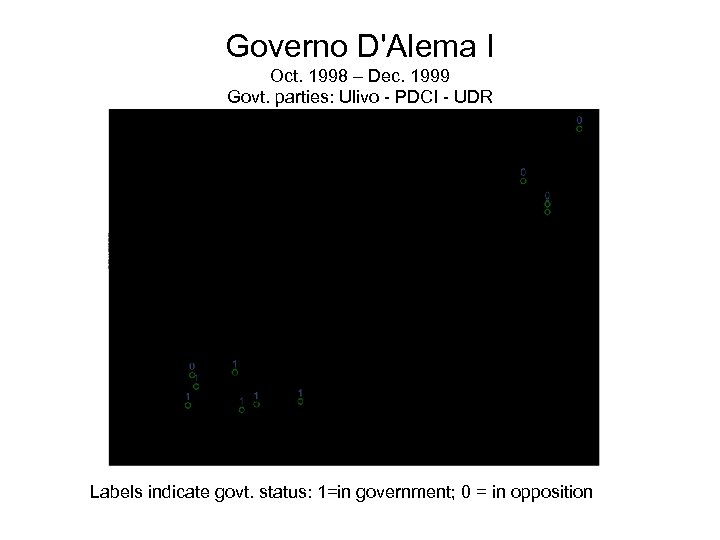
Governo D'Alema I Oct. 1998 – Dec. 1999 Govt. parties: Ulivo - PDCI - UDR Labels indicate govt. status: 1=in government; 0 = in opposition
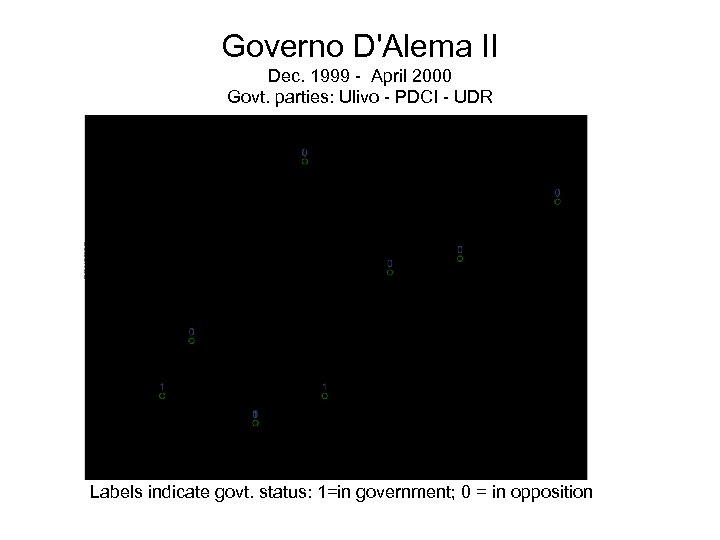
Governo D'Alema II Dec. 1999 - April 2000 Govt. parties: Ulivo - PDCI - UDR Labels indicate govt. status: 1=in government; 0 = in opposition
1993 Reforms • There is no significant change in roll rates, for either the government or opposition parties, after the 1993 reforms.
Italy: A Case of Ex Post Veto Power? • All majorities and governments rely on a mix of ex ante and ex post agenda control, together with party discipline, to control legislative outcomes. • If party discipline is weak, then there is a greater reliance on gatekeeping and ex post vetoes, as in the US House and Senate and, it appears, in Italy.
Скачать презентацию Agenda Power in the Italian Chamber of Deputies
c64e51406cb447daa190bfd2112a5fc6.ppt