


 Скачать презентацию Agenda n Welcome n Ground Rules n Warm
a46a5f8cb95ac39280bfe144235dc340.ppt
- Количество слайдов: 39
 Agenda n Welcome n Ground Rules n Warm Up Activity n Syllabus n NRAEF Manage. First n What is Cost Control? n Next week OH 1 -1
 Ground Rules n Be on time – start on time n All cell phones, pagers and IPods should be turned off during class n No Internet use during class, unless part of classroom activity n Free to take a break if needed n Appreciate other points of view n Respect others’ desire to learn n End on time OH 1 -2
 Warm Up Activity n Break into groups of 2 -3 students n Interview each other; as you will introduce each other to the class n Information you may wish to share: n What is your degree path? n Hospitality Experience n Family, hobbies OH 1 -3
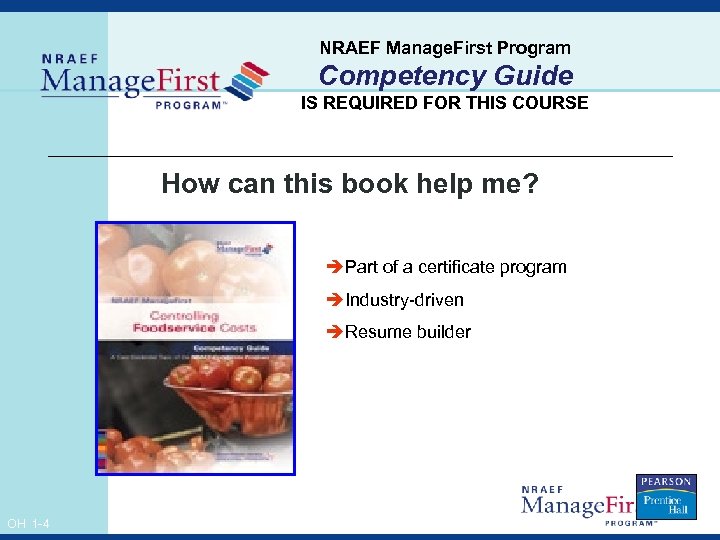 NRAEF Manage. First Program Competency Guide IS REQUIRED FOR THIS COURSE How can this book help me? èPart of a certificate program èIndustry-driven èResume builder OH 1 -4
 NRAEF Manage. First Program Competency Guide IS REQUIRED FOR THIS COURSE Who is the NRAEF? èEducational arm of the National Restaurant Association èBridge between academia and industry èWork with over 60, 000 restaurant, hospitality and foodservice members companies OH 1 -5
 NRAEF Manage. First Program Competency Guide IS REQUIRED FOR THIS COURSE Competency Guide Content èManagement-focused èApplication-based, not just theory èProfessional Profiles give you a “sneak peek” into the field è“Real world” activities help build job skills OH 1 -6
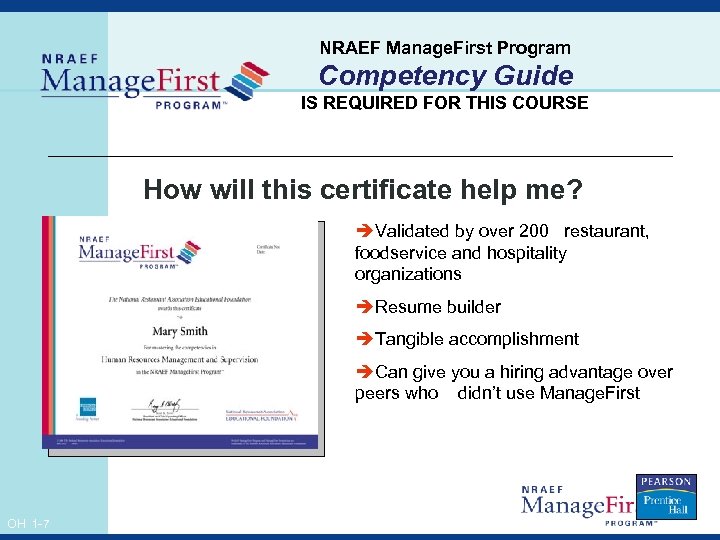 NRAEF Manage. First Program Competency Guide IS REQUIRED FOR THIS COURSE How will this certificate help me? èValidated by over 200 restaurant, foodservice and hospitality organizations èResume builder èTangible accomplishment èCan give you a hiring advantage over peers who didn’t use Manage. First OH 1 -7
 Academic Scholarship for NRAEF Manage. First Program® Students èUndergraduate students are eligible to apply for this scholarship who have earned at least one Manage. First certificate (not including Serv. Safe® Food Safety and Serv. Safe Alcohol®) and are studying culinary arts and/or foodservice management. èAward amount: $2, 000 èApplication and Instructions available at: èhttp: //www. nraef. org/scholarships/managefirst/ OH 1 -8
 MCC & ICA NRAEF Manage. First Core Credential Topics èCHRM 2475 Leadership: Hospitality & Restaurant Management èCHRM 2460 Cost Management: Controlling Foodservice Costs èCHRM 2470 Supervision: Human Resources Management & Supervision èCHRM 1020 Sanitation: Serv. Safe Food Safety NRAEF Manage. First Foundation Topics èCHRM 2480 Purchasing: Inventory and Purchasing èCHRM 1140 Food Production: Food Production èCHRM 2350 Nutrition: Nutition OH 1 -9
 WIN èSTUDENTS WIN èMCC/ICA WINS èNRAEF WINS èTHE INDUSTRY WINS OH 1 -10
 Let’s Take a Break Be back in 15 minutes OH 1 -11
 1 OH 1 -12 What Is Cost Control? n Controlling Foodservice Costs
 Chapter Learning Objectives n Describe the relationship between standards and controlling costs. n Identify the types of costs incurred by a restaurant or foodservice organization. n Classify foodservice costs as controllable or noncontrollable. n Describe and give examples of controllable and noncontrollable costs. OH 1 -13
 Chapter Learning Objectives continued n Classify foodservice costs as variable, semivariable, or fixed. n Describe and give examples of variable, semivariable, and fixed costs. n Explain the basic foodservice cost control process. OH 1 -14
 Characteristics of Controls n Contribute to profit making n Start with the menu n Affect all areas of the operation n Are formalized through a restaurant’s policies and procedures OH 1 -15
 Cost Standards n Are used to compare actual results to planned results n Are established by management n Standards may be designed to n Ensure a profit n Stay within the budget n Achieve planned quality levels OH 1 -16
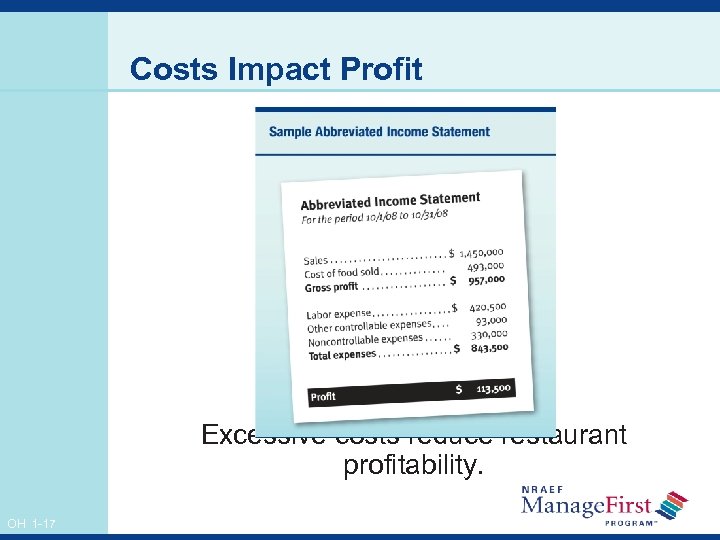 Costs Impact Profit Excessive costs reduce restaurant profitability. OH 1 -17
 Types of Costs n Controllable Costs n Food n Labor n Cleaning supplies OH 1 -18 n Noncontrollable Costs n Insurance n Mortgage payments n Cost of licenses
 Types of Costs continued n Fixed Costs n Do not vary with sales volume n Do not change from one accounting period to the next n Variable Costs n Increases and decreases are directly related to sales volume n Semivariable Costs n Increase or decrease with changes in sales volume, but not in direct proportion n Contain both fixed and variable components OH 1 -19
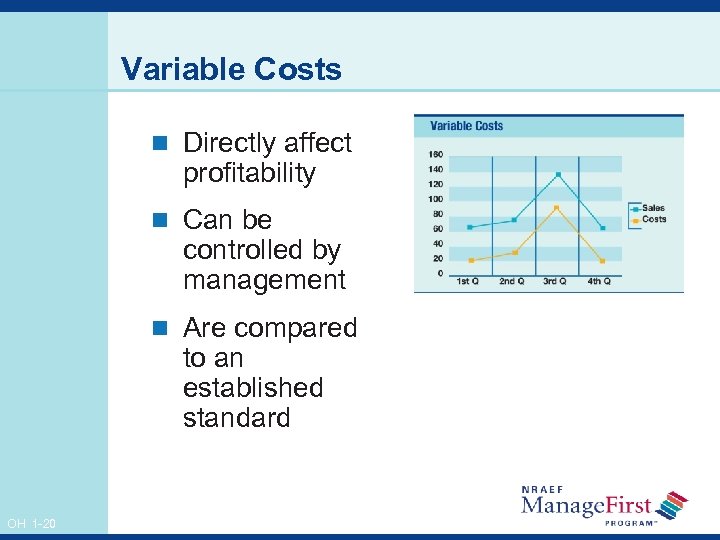 Variable Costs n Directly affect profitability n Can be controlled by management n Are compared to an established standard OH 1 -20
 Prime Costs n Include those expenses classified as n Food n Labor n Are directly controlled by management n Make up the majority of a restaurant’s total costs n Are directly related to profitability OH 1 -21
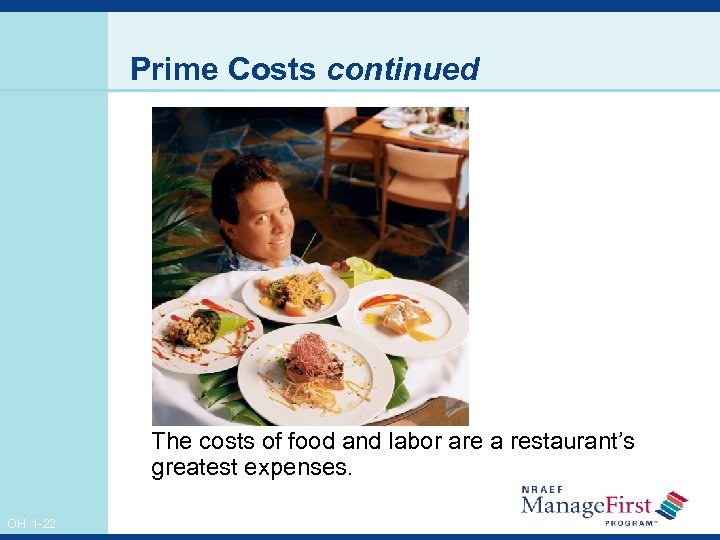 Prime Costs continued The costs of food and labor are a restaurant’s greatest expenses. OH 1 -22
 The Cost Control Process Step 1 – Collect sales and cost data. Step 2 – Monitor and analyze sales and costs. Step 3 – Take corrective action as appropriate. OH 1 -23
 The Cost Control Process Step 1 – Collect sales and cost data. n Yearly and monthly data are used for budgets and income statements. n Weekly and monthly data are used for purchasing and scheduling. n Meal period data are used for production planning. OH 1 -24
 The Cost Control Process continued Step 2 – Monitor and analyze sales and costs. n Evaluate n The line item’s name n Budgeted cost n Actual cost n Cost difference n Percentage difference OH 1 -25
 The Cost Control Process continued Step 2 – Monitor and analyze sales and costs. n Compare actual sales and costs to n Budget (line item review) n Operational standards n Historical information n Identify variances OH 1 -26
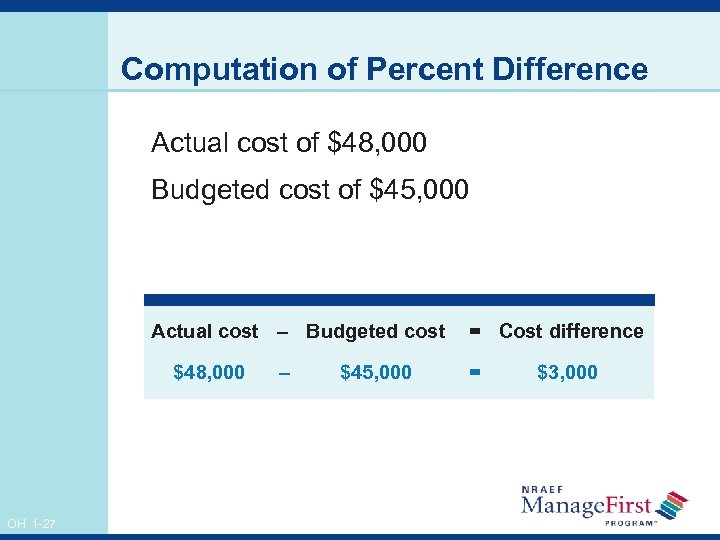 Computation of Percent Difference Actual cost of $48, 000 Budgeted cost of $45, 000 Actual cost – Budgeted cost $48, 000 OH 1 -27 – $45, 000 = Cost difference = $3, 000
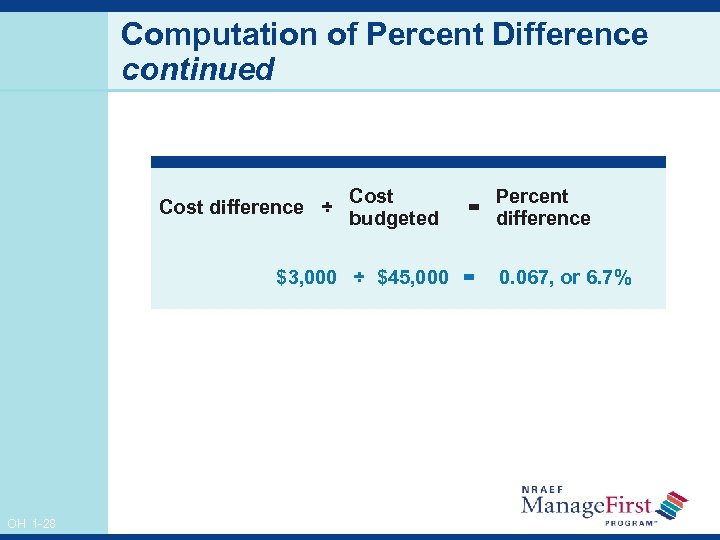 Computation of Percent Difference continued Cost difference ÷ Cost budgeted = $3, 000 ÷ $45, 000 = OH 1 -28 Percent difference 0. 067, or 6. 7%
 Cost Variations n Can be preventable n May be unpreventable n Take corrective action on preventable cost variations OH 1 -29
 The Cost Control Process continued Step 3 – Take corrective action as appropriate. n Variations from anticipated results may be n Large and significant n Small, but still significant n Small and insignificant OH 1 -30
 Corrective Actions for Cost Control To reduce food cost n Reduce portion size. n Replace the item with a lower cost alternative. n Feature menu items with higher profit margins (lower costs). n Raise menu prices. OH 1 -31
 Corrective Actions for Cost Control continued To reduce food waste n Monitor portion control. n Monitor food storage and rotation. n Monitor food purchasing (buy appropriate amounts). n Minimize production errors. OH 1 -32
 Corrective Actions for Cost Control continued To reduce labor cost n Reduce the number of employees on the schedule. n Ask employees to end their shift early if they are not needed. n Cross-train staff. OH 1 -33
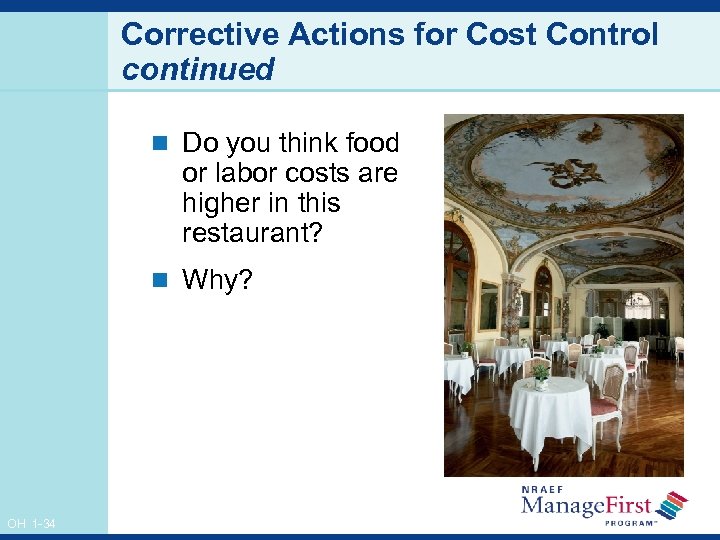 Corrective Actions for Cost Control continued n Do you think food or labor costs are higher in this restaurant? n Why? OH 1 -34
 How Would You Answer the Following Questions? Who is responsible for the size of a restaurant’s fixed expense? 2. Which of the following vary with sales volume? 1. A. B. C. D. Fixed expense Semivariable expense Variable expense Both B and C Who is responsible for monitoring controllable costs? 4. What two components make up “prime cost? ” 3. OH 1 -35
 Key Term Review n Control n Gross profit n Controllable cost n Income n Corrective action n Cost of food sold n Fixed cost statement n Labor expense n Line item review n Loss OH 1 -36
 Key Term Review continued n Noncontrollable n Semivariable n Prime cost n Standard n Profit n Total expense n Sales n Variable cost OH 1 -37 cost
 Chapter Learning Objectives— What Did You Learn? n Describe the relationship between standards and controlling costs. n Identify the types of costs incurred by a restaurant or foodservice organization. n Classify foodservice costs as controllable or noncontrollable. n Describe and give examples of controllable and noncontrollable costs. OH 1 -38
 Chapter Learning Objectives— What Did You Learn? continued n Classify foodservice costs as variable, semivariable, or fixed. n Describe and give examples of variable, semivariable, and fixed costs. n Explain the basic foodservice cost control process. OH 1 -39