


 Скачать презентацию AGENDA INTRODUCTION CELLS AND COMPONENTS PV PERFORMANCE PV
e1b1d9b74ce204ff84797aa5bfeff427.ppt
- Количество слайдов: 10
 AGENDA INTRODUCTION CELLS AND COMPONENTS PV PERFORMANCE PV APPLICATIONS CODES AND STANDARDS EMERGENCY RESPONSE
 “Is it fact, or have I dreamt it—that, by means of electricity, the world of matter has become a great nerve, vibrating thousands of miles in a breathless point in time. ” Nathaniel Hawthorne, The House of the Seven Gables, 1851 Objective To cite historical milestones in the development of PV’s To recall the factors that effect PV performance
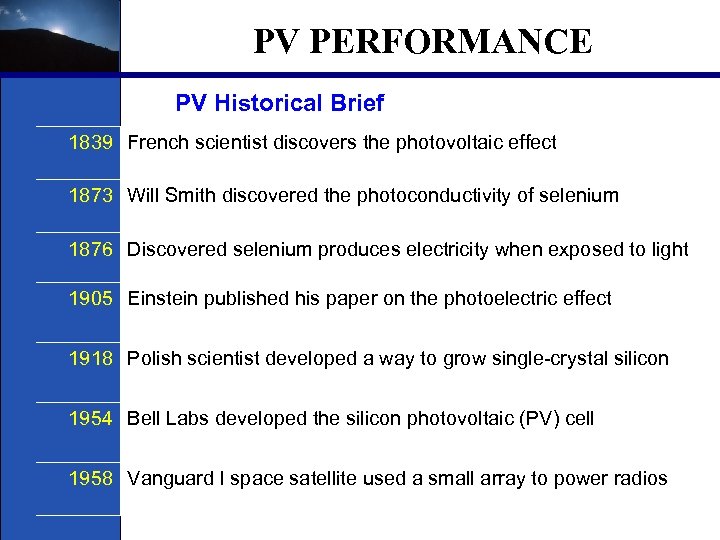 PV PERFORMANCE PV Historical Brief 1839 French scientist discovers the photovoltaic effect 1873 Will Smith discovered the photoconductivity of selenium 1876 Discovered selenium produces electricity when exposed to light 1905 Einstein published his paper on the photoelectric effect 1918 Polish scientist developed a way to grow single-crystal silicon 1954 Bell Labs developed the silicon photovoltaic (PV) cell 1958 Vanguard I space satellite used a small array to power radios
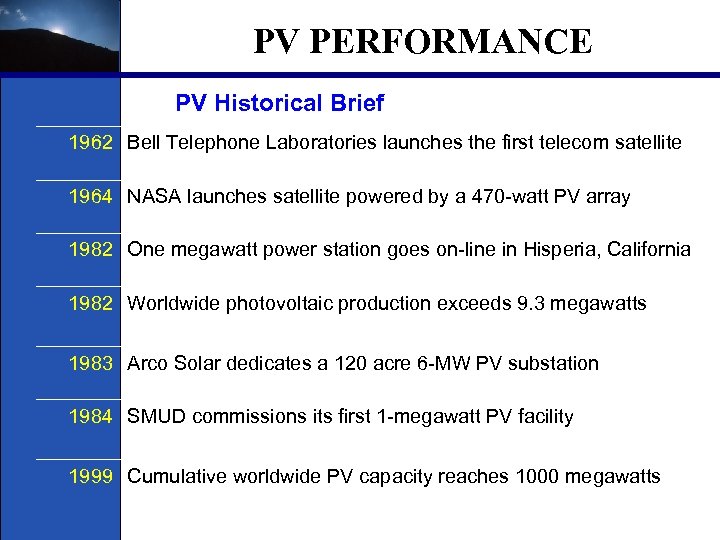 PV PERFORMANCE PV Historical Brief 1962 Bell Telephone Laboratories launches the first telecom satellite 1964 NASA launches satellite powered by a 470 -watt PV array 1982 One megawatt power station goes on-line in Hisperia, California 1982 Worldwide photovoltaic production exceeds 9. 3 megawatts 1983 Arco Solar dedicates a 120 acre 6 -MW PV substation 1984 SMUD commissions its first 1 -megawatt PV facility 1999 Cumulative worldwide PV capacity reaches 1000 megawatts
 PV PERFORMANCE PV Performance Limitations on technology: PV only converts as much as 20% of the suns energy Environmental factors: overcast days caused by clouds and smog can lower system efficiency Shade: chimneys, trees and nearby buildings shade panels and reduce the output for the entire array Temperature: PV systems operate best at 90 degrees or lower
 PV PERFORMANCE PV Performance Site Specific: availability of sunshine throughout the year, including average daily insolation, site latitude, magnetic declination (true south), tilt angle and site specific information such as local weather and climate Design: Installers underestimate the rated PV module output by 15 to 25% from the manufacturers tested output, some energy is lost as heat in the DCAC conversion
 PV PERFORMANCE PV Concepts Voltage is the measure of electrical potential between two points Amperage is the rate at which the electrons flow through the circuit. Wattage is the rate an appliance uses electrical energy, or rather the amount of work done when one amp at one volt flows through one ohm of resistance
 PV PERFORMANCE PV Concepts Ohm’s Law is a mathematical equation to calculate the value of these terms The Ohm’s formula is: Volts x Amps = Watts You can flip this equation around to find other values Watts ÷ Amps = Volts or Watts ÷Volts = Amps
 PV PERFORMANCE PV Concepts Ohm’s formula is used to calculate energy demand for PV design Watt-hour measures energy being used One thousand watts consumed over the period of one hour is one kilowatt hour, (or k. Wh) Installers will analyze the energy usage and customer expectations Energy conservation plays a significant role in PV performance and customer satisfaction
 SUMMARY The physics of electricity never change, regardless of how the electricity is generated. There a number of factors that affect overall PV system performance including the technology itself. Recognizing these factors is another key to personnel safety when working around PV systems.