Скачать презентацию Agenda Handling lifted actions action schemas
f310a59d2665489452a1f6166a22cad7.ppt
- Количество слайдов: 27
 Agenda
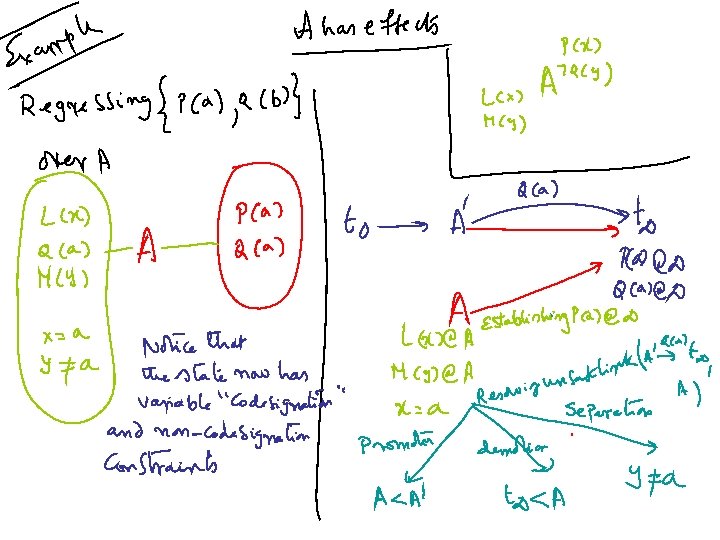
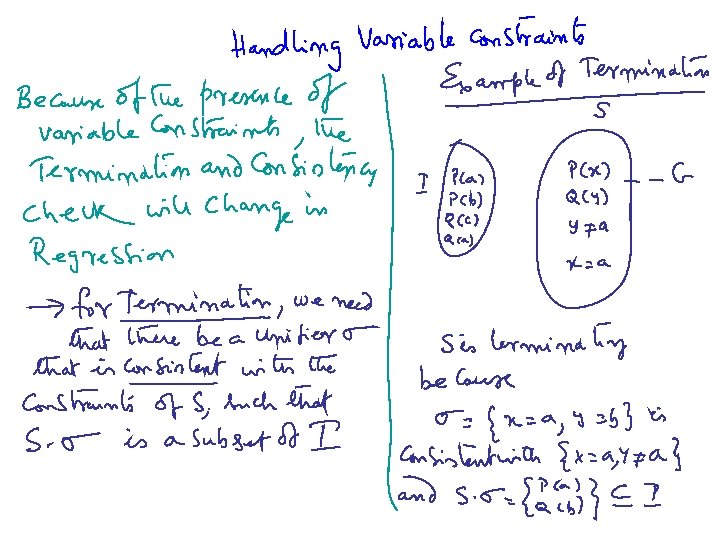
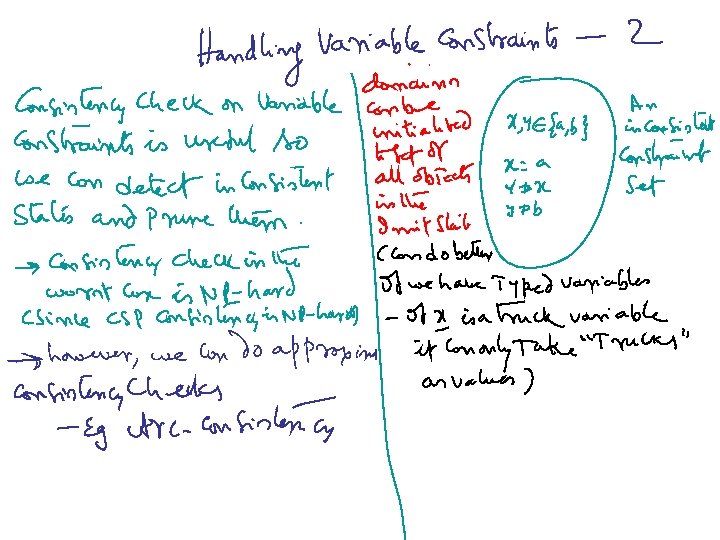
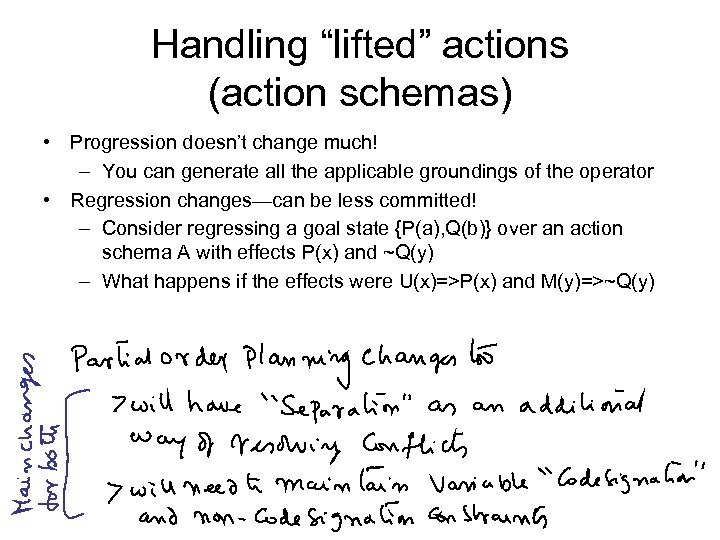 Handling “lifted” actions (action schemas) • Progression doesn’t change much! – You can generate all the applicable groundings of the operator • Regression changes—can be less committed! – Consider regressing a goal state {P(a), Q(b)} over an action schema A with effects P(x) and ~Q(y) – What happens if the effects were U(x)=>P(x) and M(y)=>~Q(y)
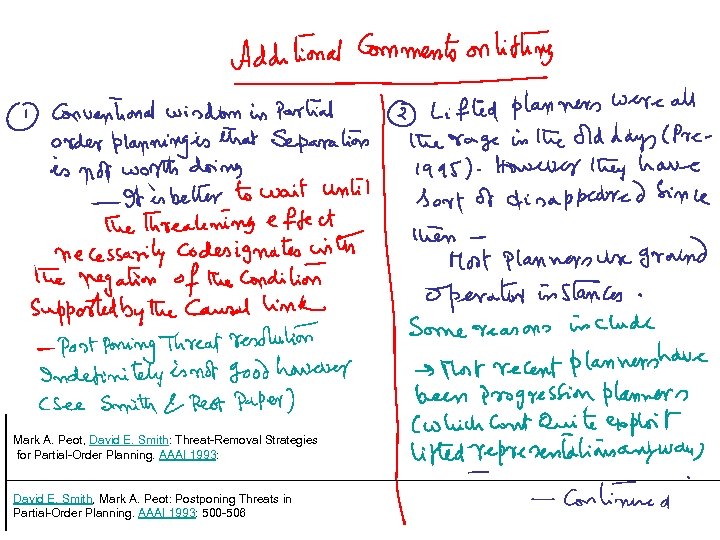 Mark A. Peot, David E. Smith: Threat-Removal Strategies for Partial-Order Planning. AAAI 1993: David E. Smith, Mark A. Peot: Postponing Threats in Partial-Order Planning. AAAI 1993: 500 -506
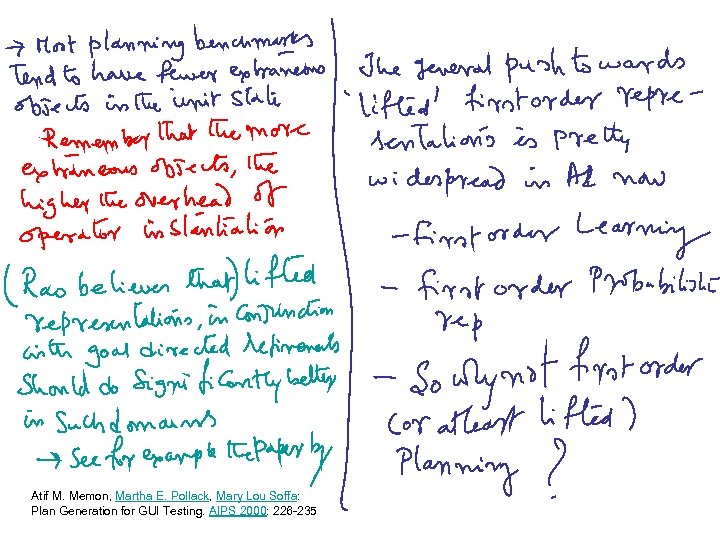 Atif M. Memon, Martha E. Pollack, Mary Lou Soffa: Plan Generation for GUI Testing. AIPS 2000: 226 -235
![Relevance, Rechabililty & Heuristics • Reachability: Given a problem [I, G], a (partial) state](https://present5.com/presentation/f310a59d2665489452a1f6166a22cad7/image-8.jpg "Relevance, Rechabililty & Heuristics • Reachability: Given a problem [I, G], a (partial) state") Relevance, Rechabililty & Heuristics • Reachability: Given a problem [I, G], a (partial) state S is called reachable if there is a sequence [a 1, a 2, …, ak] of actions which when executed from state I will lead to a state where S holds Relevance: Given a problem [I, G], a state S is called relevant if there is a sequence [a 1, a 2, …, ak] of actions which when executed from S will lead to a state satisfying (Relevance is Reachability from goal state) Progression takes “applicability” of • Regression takes “relevance” of actions into account – Specifically, it guarantees that every state in its search queue is reachable • • . . but has no idea whether the states are relevant (constitute progress towards top-level goals) SO, heuristics for progression need to help it estimate the “relevance” of the states in the search queue – Specifically, it makes sure that every state in its search queue is relevant • . . But has not idea whether the states (more accurately, state sets) in its search queue are reachable • SO, heuristics for regression need to help it estimate the “reachability” of the states in the search queue Since relevance is nothing but reachability from goal state, reachability analysis can form the basis for good heuristics
Relevance, Rechabililty & Heuristics • Reachability: Given a problem [I, G], a (partial) state S is called reachable if there is a sequence [a 1, a 2, …, ak] of actions which when executed from state I will lead to a state where S holds Relevance: Given a problem [I, G], a state S is called relevant if there is a sequence [a 1, a 2, …, ak] of actions which when executed from S will lead to a state satisfying (Relevance is Reachability from goal state) Progression takes “applicability” of • Regression takes “relevance” of actions into account – Specifically, it guarantees that every state in its search queue is reachable • • . . but has no idea whether the states are relevant (constitute progress towards top-level goals) SO, heuristics for progression need to help it estimate the “relevance” of the states in the search queue – Specifically, it makes sure that every state in its search queue is relevant • . . But has not idea whether the states (more accurately, state sets) in its search queue are reachable • SO, heuristics for regression need to help it estimate the “reachability” of the states in the search queue Since relevance is nothing but reachability from goal state, reachability analysis can form the basis for good heuristics
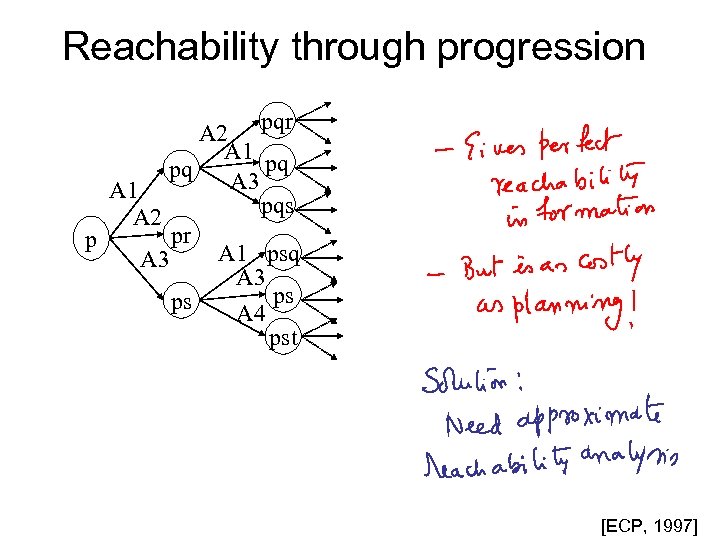 Reachability through progression pqr A 2 A 1 pq pq A 3 A 1 pqs A 2 pr p A 1 psq A 3 ps ps A 4 pst [ECP, 1997]
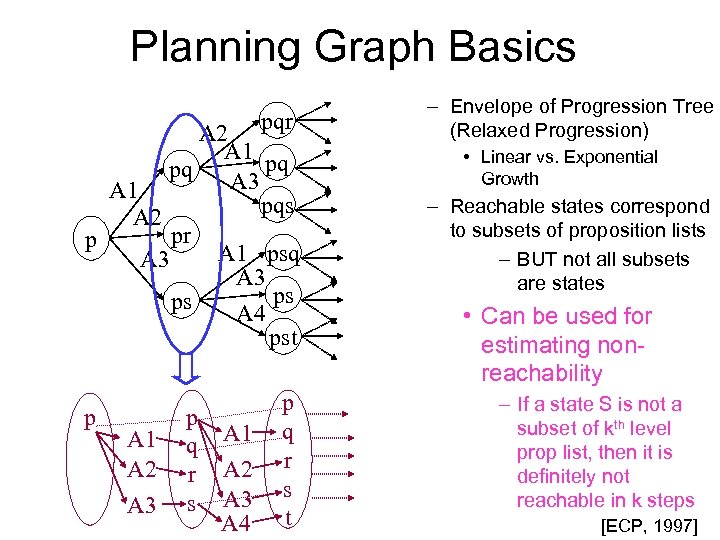 Planning Graph Basics pqr A 2 A 1 pq pq A 3 A 1 pqs A 2 pr p A 1 psq A 3 ps ps A 4 pst p A 1 A 2 A 3 p q r s A 1 A 2 A 3 A 4 p q r s t – Envelope of Progression Tree (Relaxed Progression) • Linear vs. Exponential Growth – Reachable states correspond to subsets of proposition lists – BUT not all subsets are states • Can be used for estimating nonreachability – If a state S is not a subset of kth level prop list, then it is definitely not reachable in k steps [ECP, 1997]
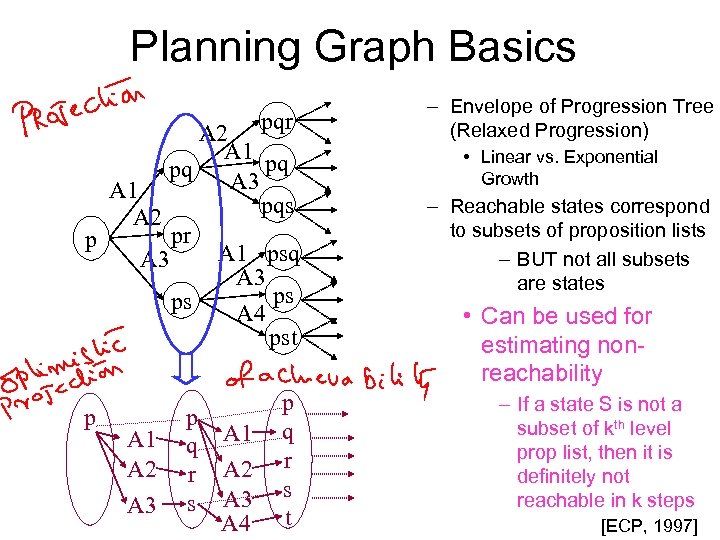 Planning Graph Basics pqr A 2 A 1 pq pq A 3 A 1 pqs A 2 pr p A 1 psq A 3 ps ps A 4 pst p A 1 A 2 A 3 p q r s A 1 A 2 A 3 A 4 p q r s t – Envelope of Progression Tree (Relaxed Progression) • Linear vs. Exponential Growth – Reachable states correspond to subsets of proposition lists – BUT not all subsets are states • Can be used for estimating nonreachability – If a state S is not a subset of kth level prop list, then it is definitely not reachable in k steps [ECP, 1997]
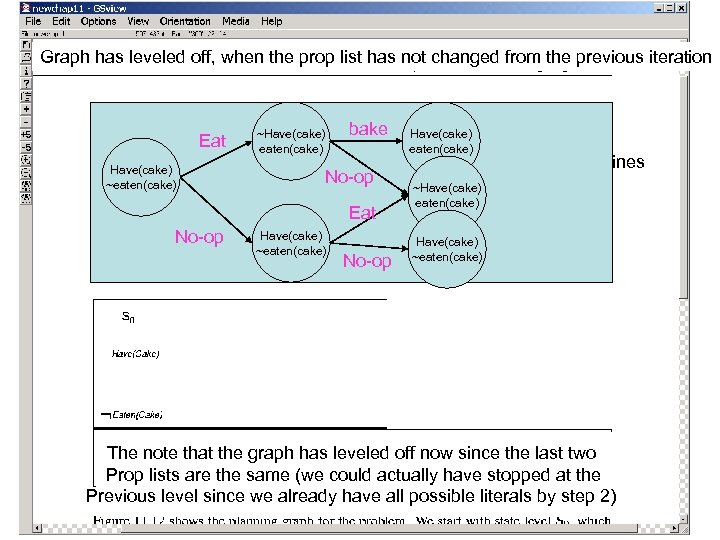 Graph has leveled off, when the prop list has not changed from the previous iteration Eat Have(cake) ~eaten(cake) bake ~Have(cake) eaten(cake) No-op Eat No-op Have(cake) ~eaten(cake) No-op Have(cake) eaten(cake) Don’t look at curved lines for ~Have(cake)now… eaten(cake) Have(cake) ~eaten(cake) The note that the graph has leveled off now since the last two Prop lists are the same (we could actually have stopped at the Previous level since we already have all possible literals by step 2)
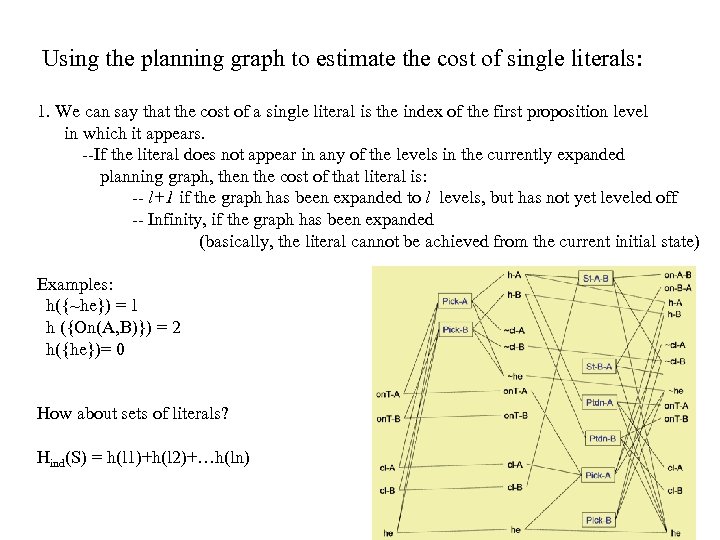 Using the planning graph to estimate the cost of single literals: 1. We can say that the cost of a single literal is the index of the first proposition level in which it appears. --If the literal does not appear in any of the levels in the currently expanded planning graph, then the cost of that literal is: -- l+1 if the graph has been expanded to l levels, but has not yet leveled off -- Infinity, if the graph has been expanded (basically, the literal cannot be achieved from the current initial state) Examples: h({~he}) = 1 h ({On(A, B)}) = 2 h({he})= 0 How about sets of literals? Hind(S) = h(l 1)+h(l 2)+…h(ln)
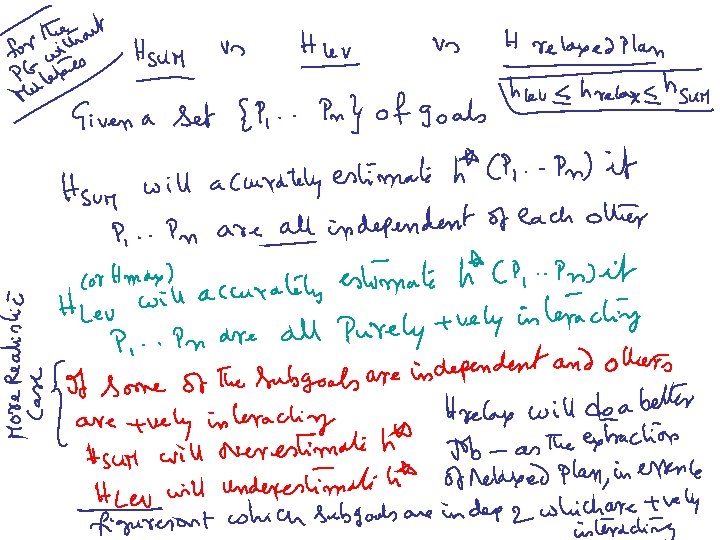
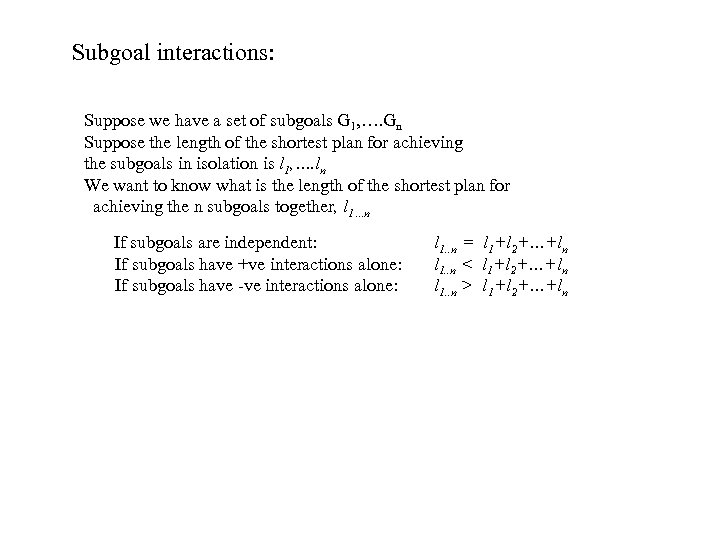 Subgoal interactions: Suppose we have a set of subgoals G 1, …. Gn Suppose the length of the shortest plan for achieving the subgoals in isolation is l 1, …. ln We want to know what is the length of the shortest plan for achieving the n subgoals together, l 1…n If subgoals are independent: If subgoals have +ve interactions alone: If subgoals have -ve interactions alone: l 1. . n = l 1+l 2+…+ln l 1. . n < l 1+l 2+…+ln l 1. . n > l 1+l 2+…+ln
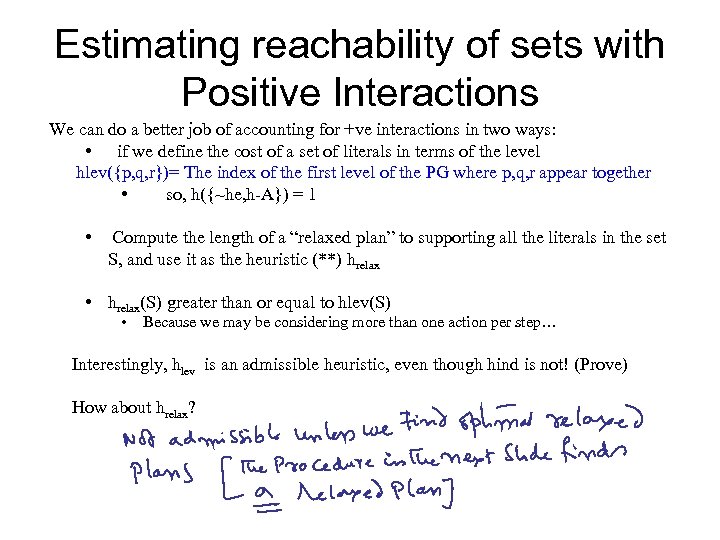 Estimating reachability of sets with Positive Interactions We can do a better job of accounting for +ve interactions in two ways: • if we define the cost of a set of literals in terms of the level hlev({p, q, r})= The index of the first level of the PG where p, q, r appear together • so, h({~he, h-A}) = 1 • Compute the length of a “relaxed plan” to supporting all the literals in the set S, and use it as the heuristic (**) hrelax • hrelax(S) greater than or equal to hlev(S) • Because we may be considering more than one action per step… Interestingly, hlev is an admissible heuristic, even though hind is not! (Prove) How about hrelax?
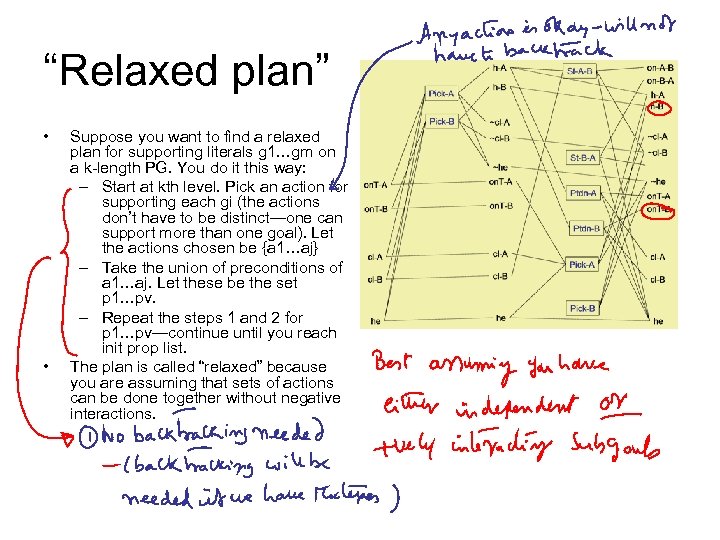 “Relaxed plan” • • Suppose you want to find a relaxed plan for supporting literals g 1…gm on a k-length PG. You do it this way: – Start at kth level. Pick an action for supporting each gi (the actions don’t have to be distinct—one can support more than one goal). Let the actions chosen be {a 1…aj} – Take the union of preconditions of a 1…aj. Let these be the set p 1…pv. – Repeat the steps 1 and 2 for p 1…pv—continue until you reach init prop list. The plan is called “relaxed” because you are assuming that sets of actions can be done together without negative interactions.
 More on Relaxed Plans • The optimal relaxed plan is the shortest relaxed plan – Finding optimal relaxed plan is NP-complete • Greedy strategies can find close-to-shortest relaxed plan • Length of relaxed plan for supporting S is often longer than the level of S because the former counts actions separately, while the later only considers levels (with potentially more than one action being present at each level) – Of course, if we say that no more than one action can be done per level, then relaxed plan length will not be any higher than level. • But doing this basically involves putting n-ary mutex relations between actions – Normal binary mutex relations won’t be enough. Consider three actions A, B, C which give p, q, r respectively. Start from the init state that is “empty”. Set-level on parallel graph will say that level of p, q, r is 1. The set-level on serial graph will say that setlevel of p, q, r is 2—still not enough.
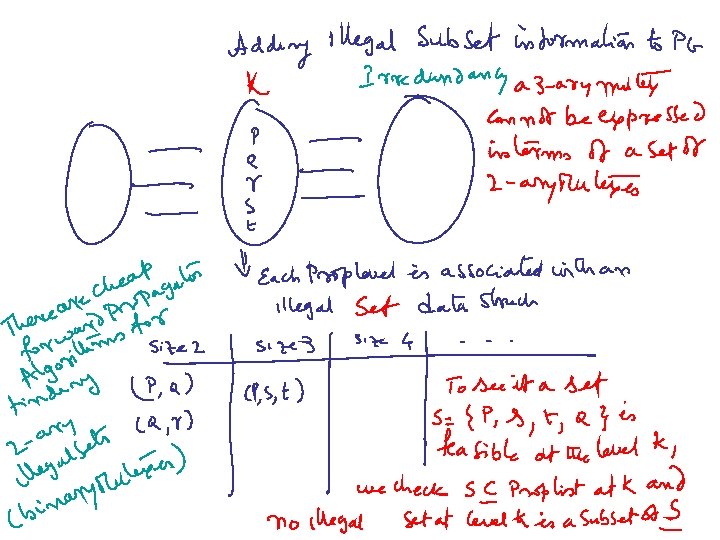
 Negative Interactions • • To better account for -ve interactions, we need to start looking into feasibility of subsets of literals actually being true together in a proposition level. Specifically, in each proposition level, we want to mark not just which individual literals are feasible, – but also which pairs, which triples, which quadruples, and which ntuples are feasible. (It is quite possible that two literals are independently feasible in level k, but not feasible together in that level) The idea then is to say that the cost of a set of S literals is the index of the first level of the planning graph, where no subset of S is marked infeasible The full scale mark-up is very costly, and makes the cost of planning graph construction equal the cost of enumerating the full progres sion search tree. – Since we only want estimates, it is okay if talk of feasibility of upto k-tuples • For the special case of feasibility of k=2 (2 -sized subsets), there are some very efficient marking and propagation procedures. – This is the idea of marking and propagating mutual exclusion relations.
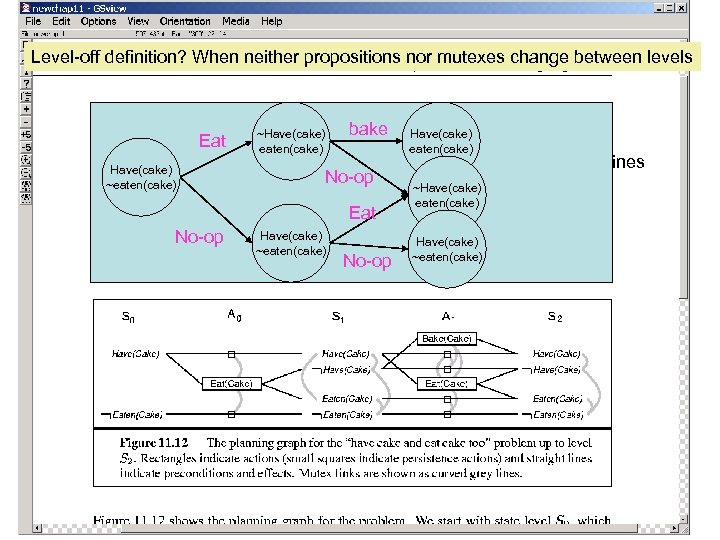 Level-off definition? When neither propositions nor mutexes change between levels Eat Have(cake) ~eaten(cake) bake ~Have(cake) eaten(cake) No-op Eat No-op Have(cake) ~eaten(cake) No-op Have(cake) eaten(cake) Don’t look at curved lines for ~Have(cake)now… eaten(cake) Have(cake) ~eaten(cake)
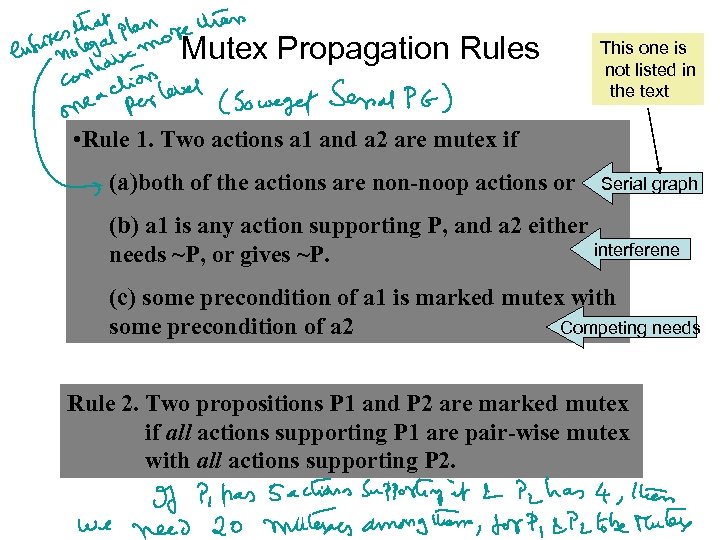 Mutex Propagation Rules This one is not listed in the text • Rule 1. Two actions a 1 and a 2 are mutex if (a)both of the actions are non-noop actions or Serial graph (b) a 1 is any action supporting P, and a 2 either interferene needs ~P, or gives ~P. (c) some precondition of a 1 is marked mutex with Competing needs some precondition of a 2 Rule 2. Two propositions P 1 and P 2 are marked mutex if all actions supporting P 1 are pair-wise mutex with all actions supporting P 2.
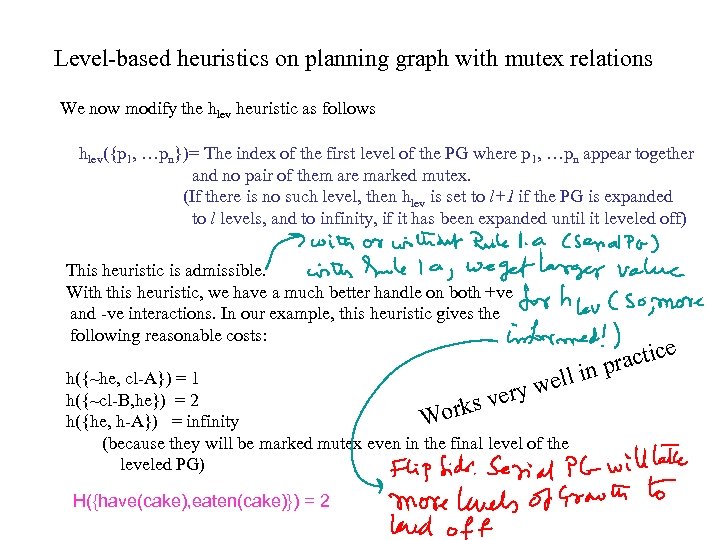 Level-based heuristics on planning graph with mutex relations We now modify the hlev heuristic as follows hlev({p 1, …pn})= The index of the first level of the PG where p 1, …pn appear together and no pair of them are marked mutex. (If there is no such level, then hlev is set to l+1 if the PG is expanded to l levels, and to infinity, if it has been expanded until it leveled off) This heuristic is admissible. With this heuristic, we have a much better handle on both +ve and -ve interactions. In our example, this heuristic gives the following reasonable costs: h({~he, cl-A}) = 1 ll y we r h({~cl-B, he}) = 2 ks ve Wor h({he, h-A}) = infinity (because they will be marked mutex even in the final level of the leveled PG) H({have(cake), eaten(cake)}) = 2 in ctice pra
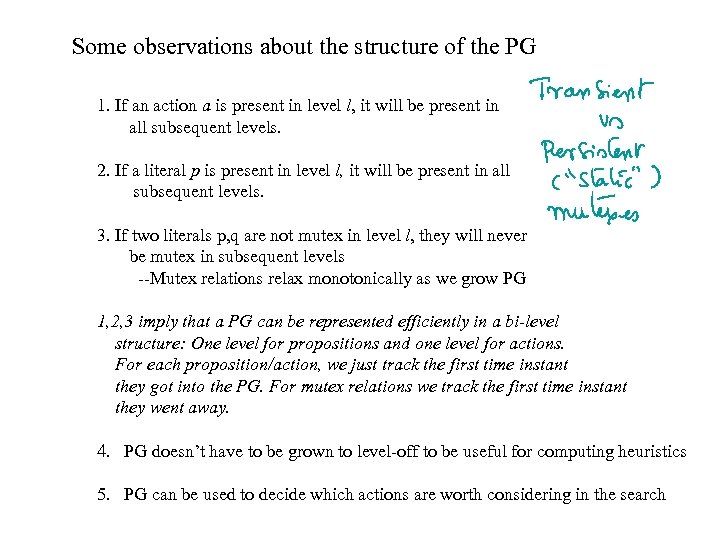 Some observations about the structure of the PG 1. If an action a is present in level l, it will be present in all subsequent levels. 2. If a literal p is present in level l, it will be present in all subsequent levels. 3. If two literals p, q are not mutex in level l, they will never be mutex in subsequent levels --Mutex relations relax monotonically as we grow PG 1, 2, 3 imply that a PG can be represented efficiently in a bi-level structure: One level for propositions and one level for actions. For each proposition/action, we just track the first time instant they got into the PG. For mutex relations we track the first time instant they went away. 4. PG doesn’t have to be grown to level-off to be useful for computing heuristics 5. PG can be used to decide which actions are worth considering in the search
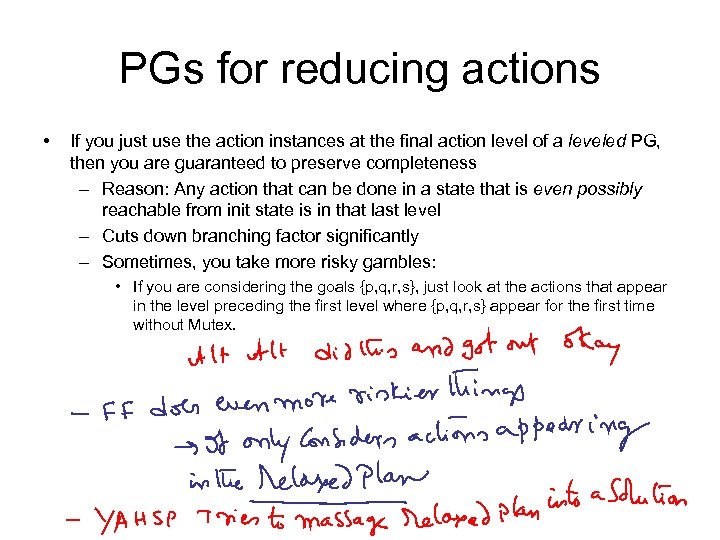 PGs for reducing actions • If you just use the action instances at the final action level of a leveled PG, then you are guaranteed to preserve completeness – Reason: Any action that can be done in a state that is even possibly reachable from init state is in that last level – Cuts down branching factor significantly – Sometimes, you take more risky gambles: • If you are considering the goals {p, q, r, s}, just look at the actions that appear in the level preceding the first level where {p, q, r, s} appear for the first time without Mutex.