


 Скачать презентацию Agency for Healthcare Research and Quality State Healthcare
3445ef05d6b5391802340ed5afdeaeb6.ppt
- Количество слайдов: 27
 Agency for Healthcare Research and Quality State Healthcare Quality Improvement Workshop: Tools You Can Use to Make a Difference January 17 -18, 2008
 DATA to Maine PEOPLE Information Actually Dennis Shubert M. D. , Ph. D. Agency for Healthcare Research and Quality State Healthcare Quality Improvement Workshop: Tools You Can Use to Make a Difference January 17 -18, 2008 2
 Goals of Presentation • Brief background and principles of Maine Quality Forum • Understand Maine’s data advantages • Demonstrate and explain Maine Hospital Quality Snapshots web site 3
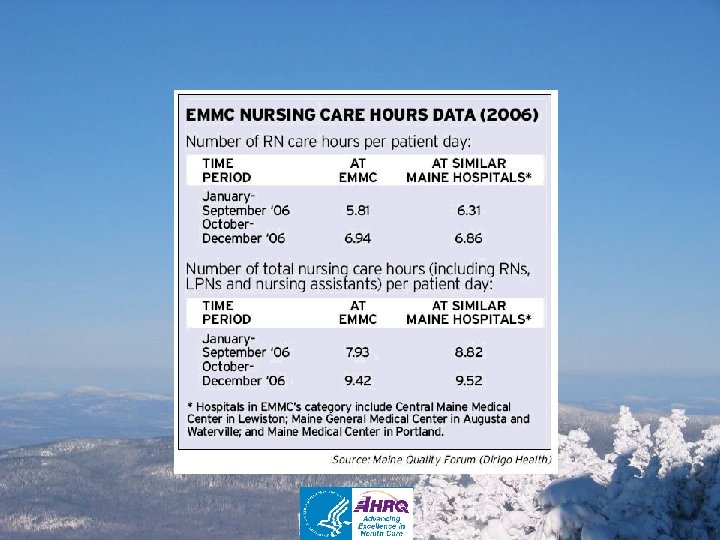
 Data show less nursing care at EMMC Hours logged at Bangor hospital below level of similar centers By Meg Haskell OF THE NEWS STAFF Source: Bangor Daily News Thursday, 10/11/2007 Edition: all, Section: a, Page 1
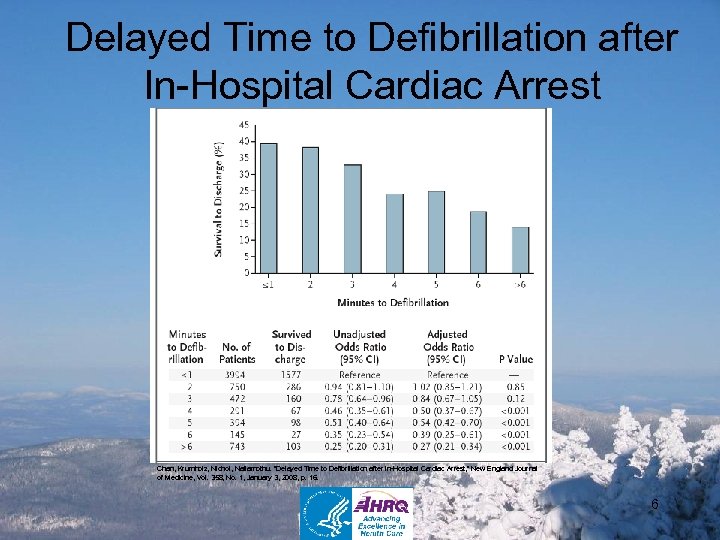 Delayed Time to Defibrillation after In-Hospital Cardiac Arrest Chan, Krumholz, Nichol, Nallamothu. “Delayed Time to Defibrillation after In-Hospital Cardiac Arrest, ” New England Journal of Medicine, Vol. 358, No. 1, January 3, 2008, p. 16. 6
 The Maine Quality Forum • Created as part of the Dirigo Health Agency – Access, Cost and Quality Triad • Tasked with assessing the quality of healthcare in Maine and reporting information to the people of Maine • Tasked with promoting and public reporting of comparative use of best practices in Maine • Pursue mission of providing actionable information about health care quality in easily accessible format 7
 Addressing the Mandates • Used IOM definition (STEEEP) as guiding framework – right thing, the right way, at the right time for each patient • Employ known levers of change 8
 Levers of Change • Change requires accountability and transparency – Both healthcare system and MQF • The People of Maine as a constituency • Data describing best practices and outcomes are essential 9
 Supporting Levers of Change • Both “administrative” data and provider submitted data • Common understanding of metrics is essential • Information understandable by the public is a key driving force • Communication target not necessarily the change target 10
 Maine Advantages • Tradition of self-examination: Maine Medical Assessment Foundation (MMAF) and small area variation analysis (SAVA) • Long standing discharge data base • Leader in “all payer”, paid claims database • Accomplished partners in Maine Health Data Organization (state) and Maine Health Information Center (private) • MQF drives data submission through rule making (science confused with self interest) 11
 Creating the Maine Snapshots 12
 Data Process • Started with Small Area Variation Analysis (SAVA) • Participated in the Tri-partite group of Pathways to Excellence to gain buy in of metrics • Developed initial website with a key data component 13
 Initial Website • Used small area variation analysis on procedures and inpatient activity of interest • Presented data via bar charts developed in Excel – Graphs presented hospitals significantly different from the expected • • Provided data tables for drill down Good start but difficult to understand Very difficult to update new data runs MQF site for example www. mainequalityforum. gov 14
 Revision Process • MQF and Advisory Council concurred: – Simpler representation • Don’t’ Make Me Think – Broader audience – More than one view of the data – Drill down from simplest to most complex (visual to raw data) • Needed to include new data (Chapter 270)* 15
 Next Steps • Intrigued by dial graphics representation used by AHRQ Quality Snapshots • Reached out to AHRQ (Dwight) who brokered relationship with Thomson and Academy Health • Connected with Thomson (aka Medstat) • Provided us with code 16
 Medstat • MQF Determined a need for support – Methods – Web design – Training • Contracted with Medstat • Contracted with RADCorp • Began process of applying methodology to Maine’s data • Training MHDO Epidemiologist 17
 Methodological Challenges Encountered • Small “N” – Limited by number of hospitals • Small “n” – Limited by number of measures – Limited by number of cases within measure • Regression Model • Nursing Data • Phase II SAVA-Geographic Information Systems (GIS) design 18
 Stakeholder Contributions • Maine Hospital Association – PTE process • Northern New England Quality Improvement Organization • Nursing Data • Public Process – Advisory Council – Multi-stakeholder involvement – Multiple views • Other political considerations 19
 Common Consistent Stakeholder Differences • Patient – If I previously had no information; am I not better off if I have information that provides a better that 50/50 chance of improving the outcome of my choice? • Provider – Don’t show a difference unless there is a 99/100 chance that there is a substantive difference 20
 Resolutions • Change to speedometer • Change methodology – Regression model – Data inclusion/exclusion • Nursing Data Representation • Descriptive Language • New MQF data site: 207. 103. 203. 51 21
 Phase II • GIS maps for variation analyses • New Chapter 270 data 22
 Maine Quality Forum Website http: //207. 103. 203. 51 Also, www. mainequalityforum. gov 23
 25
25
 dennis. shubert@gmail. com 26
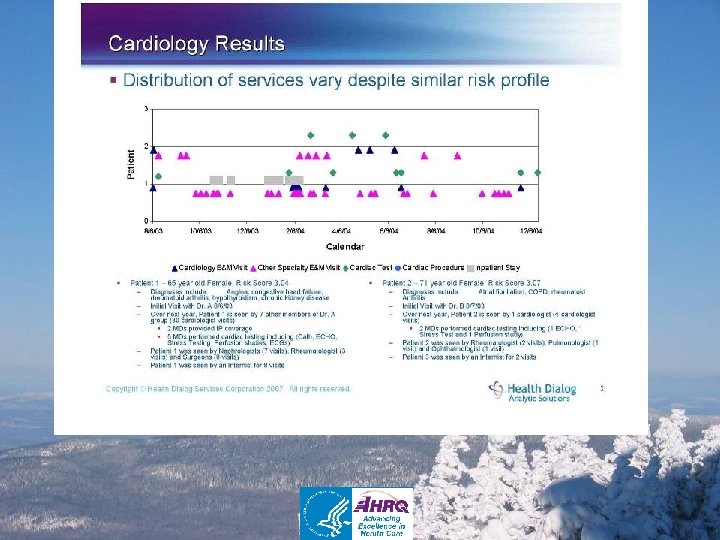
 Citations • Delayed Time to Defibrillation After In. Hospital Cardiac Arrest – NEJM Volume 358: 9 -17 Number 1 January 3, 2008 • Cardiology Analysis – Maine Quality Forum with Health Dialog Analytic Solutions 2006 (unpublished) 27