Скачать презентацию Ageing Decline How Much How Soon How
9e4a183be1eb476f1a82b165a7b4f5a3.ppt
- Количество слайдов: 50

 Ageing & Decline How Much? How Soon? How Inevitable? What Does the Research Say? AHIA Conference November 2005
 The Ageing Demographic Successful Ageing Contemporary Perspectives
 The Ageing of the Population
 By the end of the 20 th century, the global population aged over 60 years was approximately 600 million. In only 25 years, this number will double and by 2025 there will be 1200 million people in this age group.
 The number of Australians over 65 years of age has increased by 67% in the last 20 years.
 Between 2002 and 2022, the number of 15 to 19 year olds in Western Australia will increase by 10, 000. In the same period of time, the increase in the number of individuals aged between 50 and 59 years of age will be 110, 000. (Australian Bureau of Statistics)
 In terms of workforce growth – the working age population currently grows by around 170, 000 per year. By the decade of the 2020’s, that increase will drop to an average of less than 13, 000 per year. (Access Economics)
 Australia first set the retirement age in 1909, at 65 years of age. The average life expectancy for the Australian male was 58. If public policy had kept pace with medical advances and the increase in life expectancy, by the year 2000 our retirement age would have been around 80 years.
 v The increase in lifespan was one of the triumphs of the 20 th century. v This increase in lifespan in this 100 years was greater than what was attained in the previous 5000 years of human history.
 v Until the 1970’s most research into ageing looked at negative impacts such as disease and cognitive decline. v There is now research emerging on the positive impacts on ageing.
 The emerging research is overwhelming in its evidence that a positive approach and investment in ageing well can improve the quality and the quantity of later years. The WHO states that the challenge in this century is to decrease the period of morbidity at the end of the lifespan.
 “No one is terrified about growing old in itself, but the terror is in becoming clinically dependant. ” Prof. Suresh Rattan, DSc, Ph. D. Research Professor, University of Aarhus, Denmark
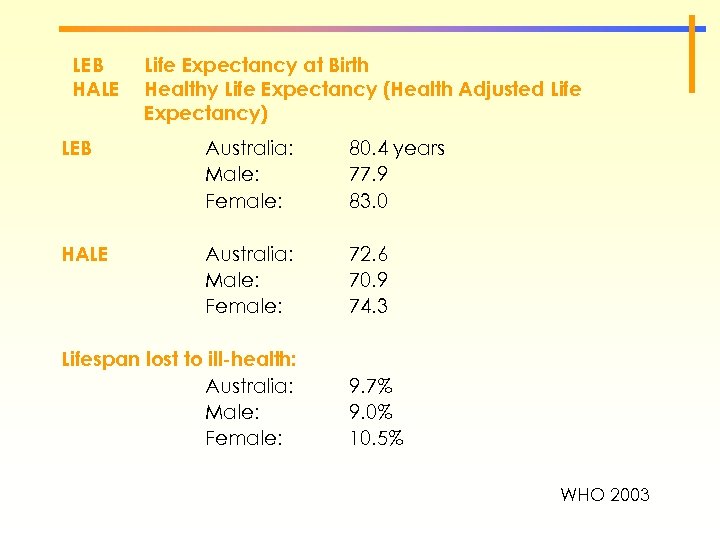 LEB HALE Life Expectancy at Birth Healthy Life Expectancy (Health Adjusted Life Expectancy) LEB Australia: Male: Female: 80. 4 years 77. 9 83. 0 HALE Australia: Male: Female: 72. 6 70. 9 74. 3 Lifespan lost to ill-health: Australia: Male: Female: 9. 7% 9. 0% 10. 5% WHO 2003
 What Is Successful Ageing?
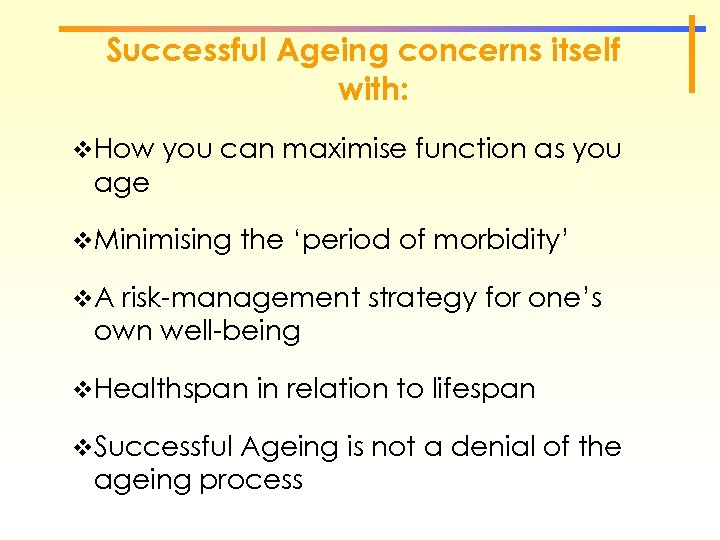 Successful Ageing concerns itself with: v. How you can maximise function as you age v. Minimising the ‘period of morbidity’ v. A risk-management strategy for one’s own well-being v. Healthspan in relation to lifespan v. Successful Ageing is not a denial of the ageing process
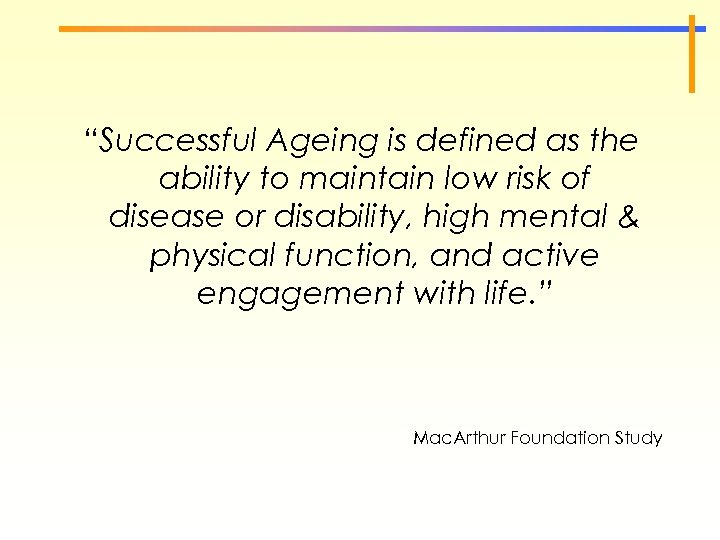 “Successful Ageing is defined as the ability to maintain low risk of disease or disability, high mental & physical function, and active engagement with life. ” Mac. Arthur Foundation Study
 Maintaining Low Risk of Disease & Disability
 Emerging research data concludes: v. As we grow older, the influence of environmental factors on our health become more important, and the influence of genetic factors becomes less important v. Our course in older age is not predetermined as we have understood it v. The frailty of old age is essentially avoidable and largely reversible Harvard Medical School Report 2001
 The human body essentially lives in a hostile environment, both externally and internally. Modern medicine has developed as a repair response to ‘breakdown’ or damage, rather than as a preventative action.
 Many of the chronic diseases of mature age are preceded by signs (albeit silent signs) For example: v increase in blood pressure v increase in BMI or abdominal fat v blood sugar increase v decrease in function of lung, kidneys v decrease in bone density & muscle mass.
 These signs of ageing are often accepted as ‘usual’ in the mature individual, however, research has now established these ‘usual’ conditions are caused in large part by our pathology – how we live – and not only by our biology – our genes.
 Maintaining Physical & Cognitive Function
 The 1% Rule Medical scientists have previously agreed that after age 25, we lose 1% per year in aerobic capacity, strength, speed and other physical attributes.
 It is now increasingly clear that it doesn’t have to be that way. The 1% rule applies only to those who lead a sedentary life.
 Physical activity is at the crux of successful ageing, regardless of other factors. Couch potatoes are now being grouped with cigarette smokers as taking their lives in their own hands. Mac. Arthur Foundation Study
 New research establishes that a moderate PA level has a powerful capacity to improve the overall health outlook.
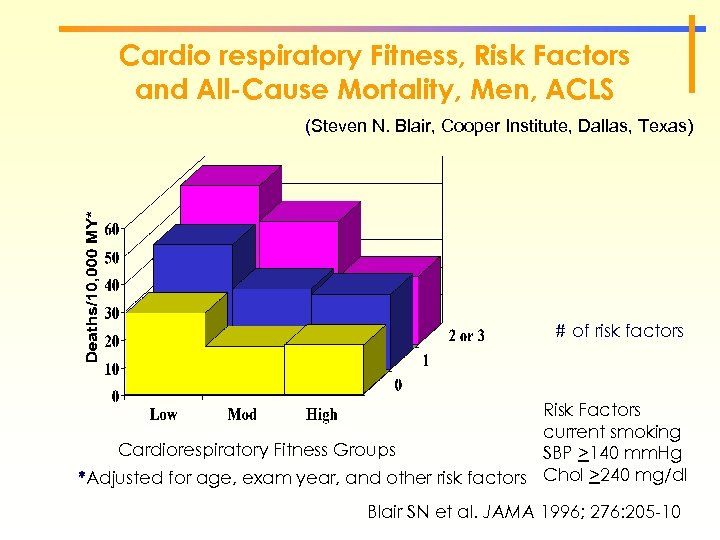 Cardio respiratory Fitness, Risk Factors and All-Cause Mortality, Men, ACLS (Steven N. Blair, Cooper Institute, Dallas, Texas) # of risk factors Risk Factors current smoking Cardiorespiratory Fitness Groups SBP >140 mm. Hg *Adjusted for age, exam year, and other risk factors Chol >240 mg/dl Blair SN et al. JAMA 1996; 276: 205 -10
 The dominant effect of fitness over other risk factors, and its apparent effect as an antidote for other risk factors, makes physical fitness perhaps the single most important thing an older person can do to remain healthy. (Mac. Arthur Foundation Study)
 Maintaining Cognitive Function
 The Facts Cognitive ability is not one function. Research indicates 2 areas of change in cognitive performance as we age: v. Speed of processing information v. Certain types of memory.
 Explicit memory is affected with ageing ie memory which involves the intention to remember & the subsequent ability to recall information on demand. Research shows other kinds of memory show little change in capacity with age.
 More than 50% of decline of cognitive function in older age is determined by genetic factors (more than other functions). However, this still leaves considerable influence for lifestyle factors.
 Research has established the following as direct contributors to maintaining cognitive function: v Learning v Physical Activity v Self-Efficacy v Complex Environments v Mild Stress v Nutrition
 Maintaining Meaningful Engagement
 Freud asserted that ‘love & work are the essentials of human life. ’
 v. Many successful agers cite friendship as the key factor that keeps them going v. Others cite ‘involvement’ v. Berlin Study on Ageing
 Social & Emotional Richness Harvard, Yale & Rush Institute for Healthy Ageing found that social and productive activities are as effective as fitness activities in lowering the risk of death. This research suggests activity may confer survival benefits through psychosocial pathways. (Glass et al)
 “As a rule, for people whose relationships to others are fewer and weaker, the risk of death is two to four times as great, irrespective of age and other factors such as race, socioeconomic status, physical health, smoking use of alcohol, physical activity, obesity, and the use of health services. ” (Successful Aging, John Rowe & Robert Kahn, 2000)
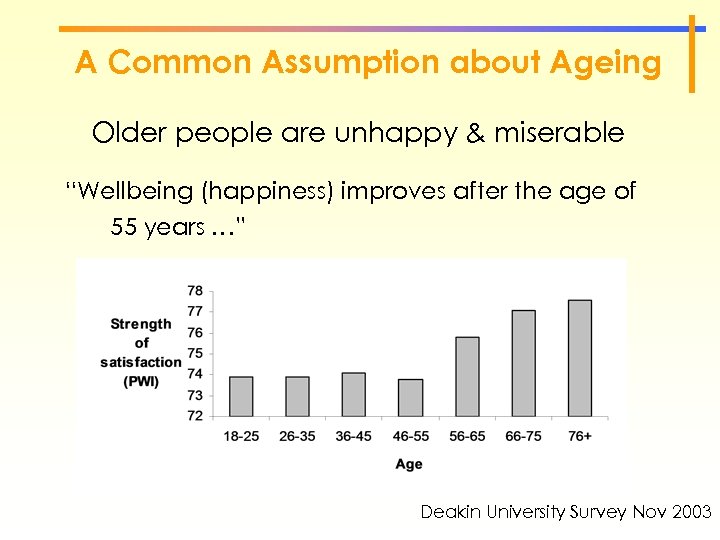 A Common Assumption about Ageing Older people are unhappy & miserable “Wellbeing (happiness) improves after the age of 55 years …” Deakin University Survey Nov 2003
 Economic Health Profile The over 55’s market in Australia accounts for: v 21% of the population v 25% of the disposable income v 39% of household wealth, and v will be responsible for 43% of total growth in spending in the next decade. (Access Economics)
 “The mature segment of our society continues to shift from being the poorest to the richest in the marketplace. ” Dr Ken Dychtwald Age Wave Communications USA
 “Any company that has a low or falling market share amongst people over 50 is likely to stagnate because it won’t participate in the spending boom associated with the ageing of the population. ” (Grey. Gold Research)
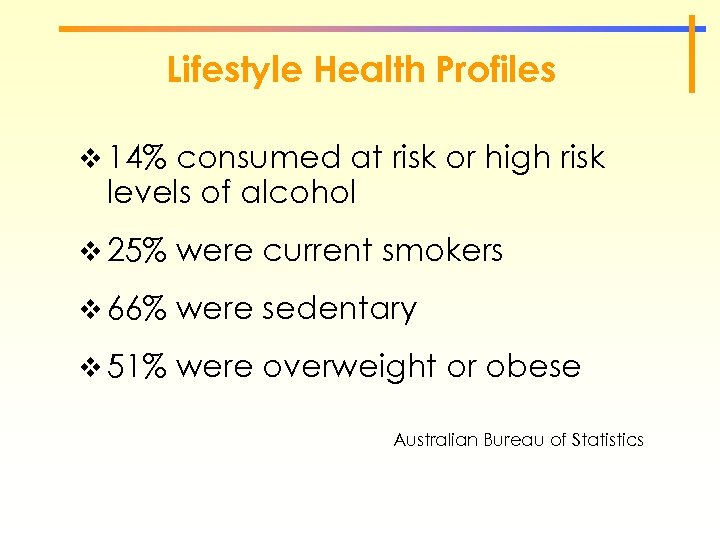 Lifestyle Health Profiles v 14% consumed at risk or high risk levels of alcohol v 25% were current smokers v 66% were sedentary v 51% were overweight or obese Australian Bureau of Statistics
 “Rebalancing (the health system) to preventative medicine would represent value for money in a health system facing rising costs and an ageing population. ” Federal Treasurer, March 2004
 “Ageing does not prescribe decline as we have previously understood it. In fact, recent research has shown that only 30% of physical ageing can be traced to our genes – the rest is down to our lifestyle choices. ”
 “Changes that a doctor or scientist once might have labelled an inevitable part of growing older are now considered pathology not biology. ” Harvard Medical School Report, 2001
 Individuals Achieving Well Beyond their ‘Use-By’ Date v. Michelangelo painted the Sistine Chapel between 71 & 89 v. Frank Lloyd Wright completed the Guggenheim Museum at 90 v. Joseph Rotblat won the Nobel Prize in 1995 at 87 v. George Burns won an Oscar at the age of 80 v. Golda Meir became Prime Minister of Israel at 71
 Individuals Achieving Well Beyond their ‘Use-By’ Date v. Konrad Adenaur became Chancellor at 87 of West Germany at 73 and retired v. At 77, Alan Greenspan was appointed to another 5 year term as Chairman of the US Federal Reserve v. At 72, Rupert Murdoch stated he planned to stay as the head of News Corp until he is 100.