 Скачать презентацию After Twenty Years O Henry Background Information
c8e78ec831a4c4509d0771ae00841102.ppt
- Количество слайдов: 105




After Twenty Years —O. Henry
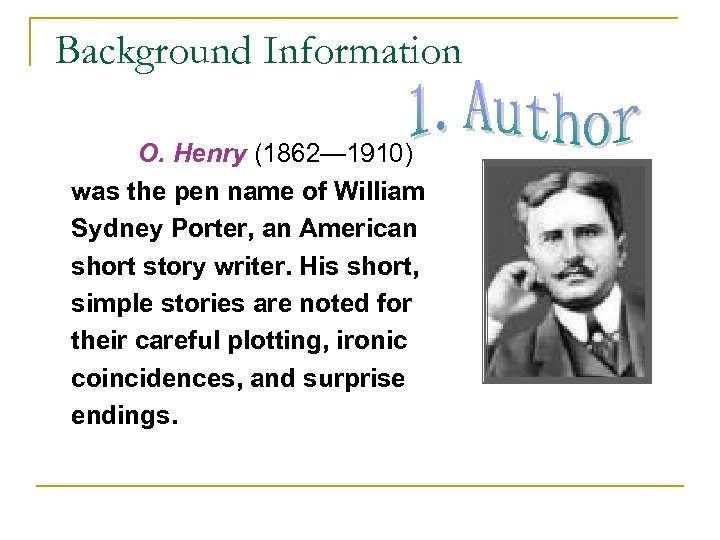
Background Information O. Henry (1862— 1910) was the pen name of William Sydney Porter, an American short story writer. His short, simple stories are noted for their careful plotting, ironic coincidences, and surprise endings.
![O. Henry was born in Greensboro [`ɡrinz, bərə] , North Carolina [, kærə`lainə]. He](https://present5.com/presentation/c8e78ec831a4c4509d0771ae00841102/image-3.jpg "O. Henry was born in Greensboro [`ɡrinz, bərə] , North Carolina [, kærə`lainə]. He")
O. Henry was born in Greensboro [`ɡrinz, bərə] , North Carolina [, kærə`lainə]. He went to Texas in 1882 and worked at various jobs—as teller in an Austin bank (1891— 1894) and as a newspaperman for the Houston [ju: ] Post.
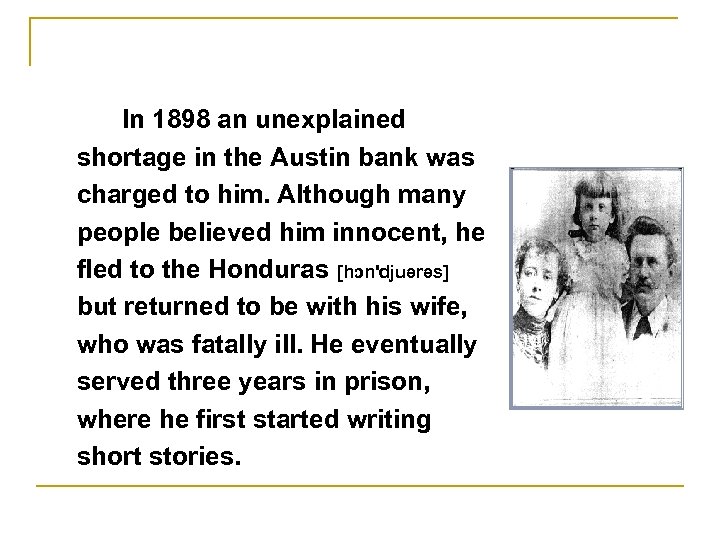
In 1898 an unexplained shortage in the Austin bank was charged to him. Although many people believed him innocent, he fled to the Honduras [hɔn'djuərəs] but returned to be with his wife, who was fatally ill. He eventually served three years in prison, where he first started writing short stories.
n Upon his release he settled in New York. Although his stories have been criticized as shallow and contrived, O. Henry did catch the color and movement of the city and evidenced a genuine sympathy for ordinary people.
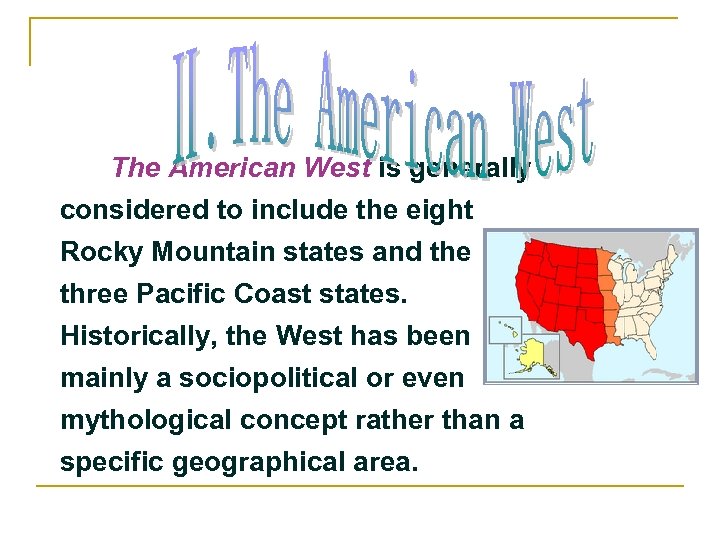
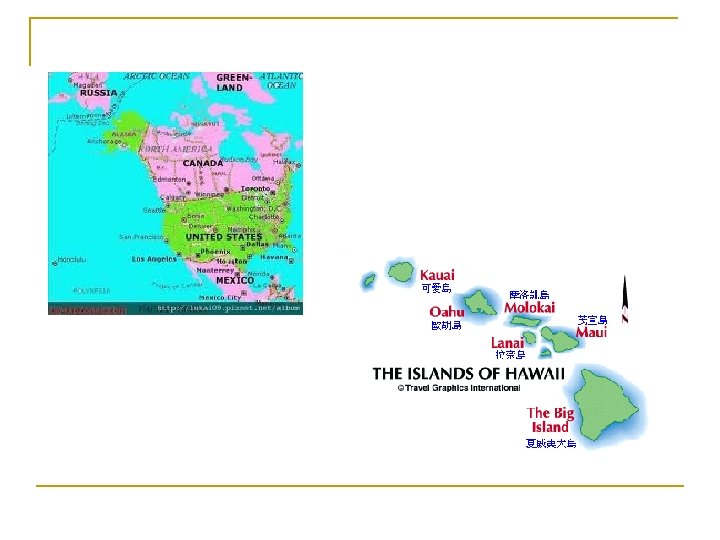
The American West is generally considered to include the eight Rocky Mountain states and the three Pacific Coast states. Historically, the West has been mainly a sociopolitical or even mythological concept rather than a specific geographical area.
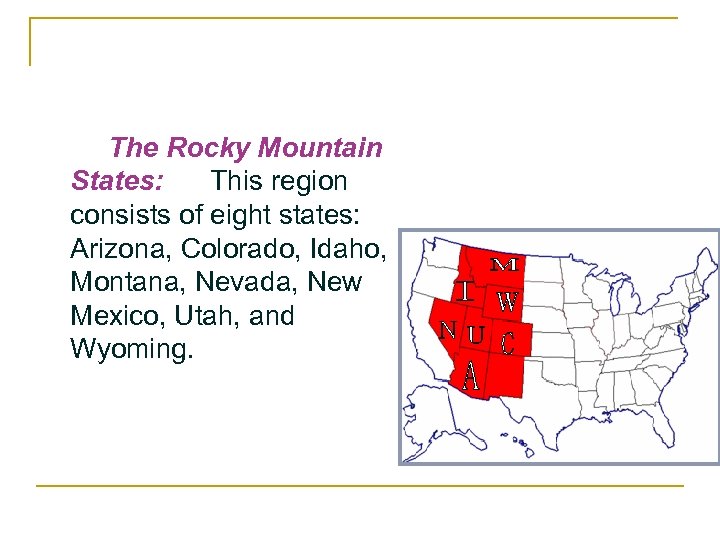
The Rocky Mountain States: This region consists of eight states: Arizona, Colorado, Idaho, Montana, Nevada, New Mexico, Utah, and Wyoming.
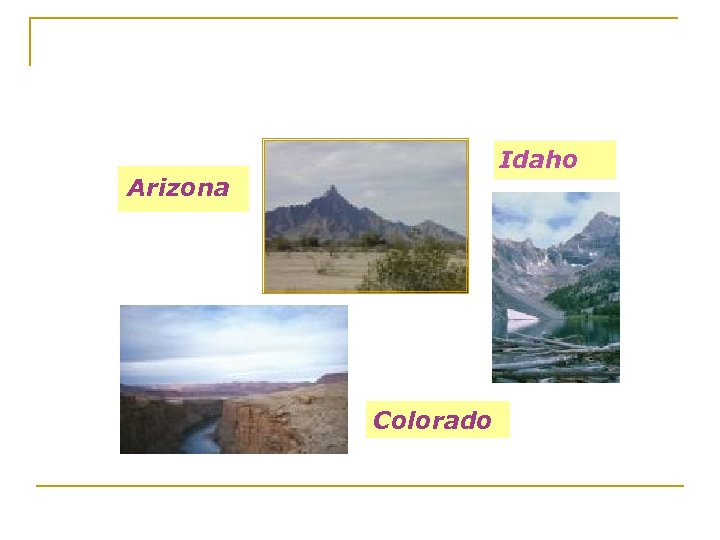
Idaho Arizona Colorado
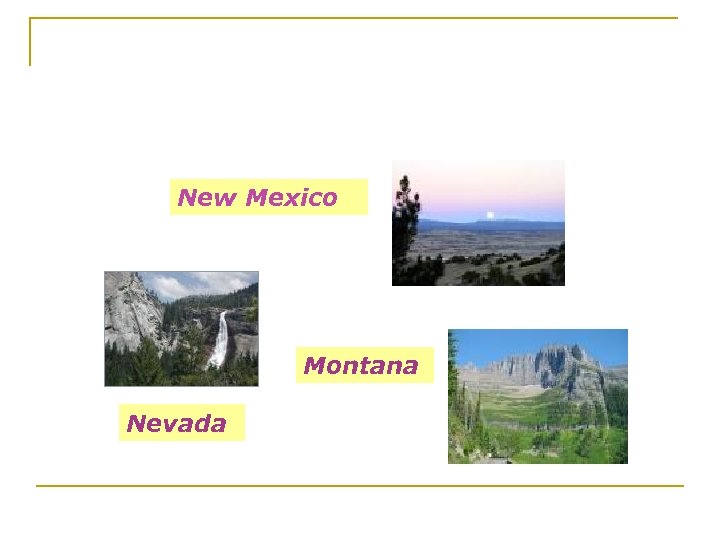
New Mexico Montana Nevada
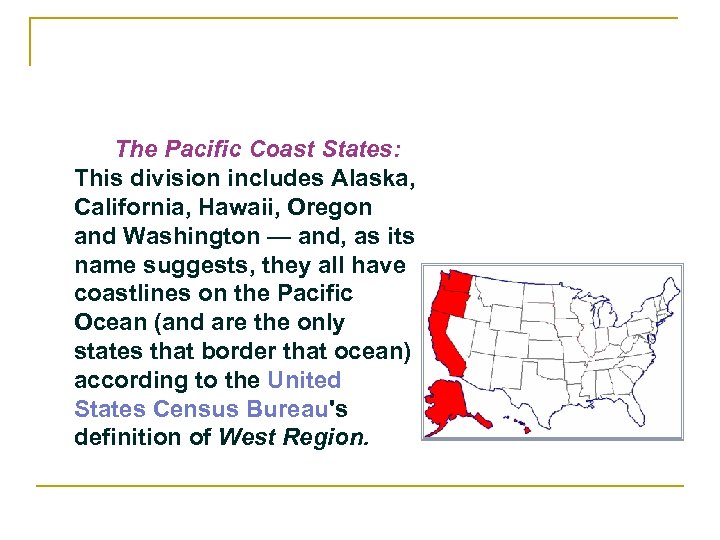
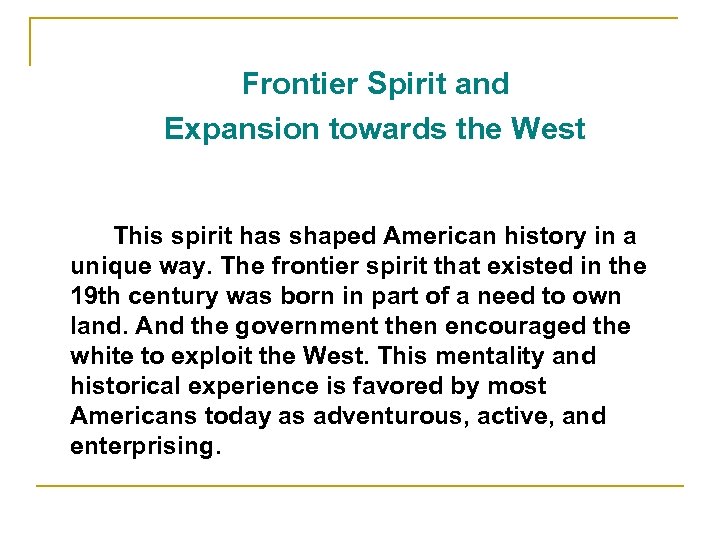
The Pacific Coast States: This division includes Alaska, California, Hawaii, Oregon and Washington — and, as its name suggests, they all have coastlines on the Pacific Ocean (and are the only states that border that ocean) according to the United States Census Bureau's definition of West Region.
Frontier Spirit and Expansion towards the West This spirit has shaped American history in a unique way. The frontier spirit that existed in the 19 th century was born in part of a need to own land. And the government then encouraged the white to exploit the West. This mentality and historical experience is favored by most Americans today as adventurous, active, and enterprising.
Text Appreciation n n Setting Plot Structure Theme
Setting of the story Place: ---on a business avenue of New York ---in the doorway of a hardware store Time: ten o’clock at night
Plot of the story Bob and Jimmy had obviously been close friends twenty years ago when they were young. Before their separation, they made an appointment to meet again at exactly the same place and the same hour twenty years later.
Structure A policeman on the beat a few minutes before 10 pm (para. 1 -2 ) n ---the policeman walked up the street impressively (p 1) n ---he looked the guardian of peace on the beat(p 2) n Ⅰ.
Ⅱ. The policeman’s encounter with Bob from the West and had a conversation(para. 3 -17) n n n ---he walked up to a man standing in the doorway of a store (p 3) ---the man explained to him he had come to keep an appointment (4 -6) ---the man told the policeman about the appointment made 20 years before with his best friend Jimmy Wells (7 -9) ---it seemed to the policeman the man from the West was rich (p 10 -13) ---the policeman left a few minutes after 10 o’clock (14 -17)
Ⅲ. The arrest of the man from West by a plain clothes man (para. 18 -31) n n ---about 20 minutes later a man came and claimed he was Jimmy (p 18 -21) ---the two friends told each other about their life since they parted (p 22 -27) ---Bob, the man from the West discovered the other man was not Jimmy (p 28 -30) ---the other man was a plainclothes man who came to arrest Bob, the criminal Chicago police wanted (p 31)
Ⅳ. A note from Bob’s best friend and then he found that the policeman was his expected friend Jimmy(para. 3233) n ---the plainclothes man handed Bob a note form Jimmy n ---in the note, Jimmy explained why he didn’t arrest Bob himself n
para 2 n 1) What did the police officer do while walking the beat? What for? What does all this show about this police officer?
n Trying doors as he went--n to find whether they were locked n (his strong sense of responsibility)
n Swinging his clubs with many clever movements--n to warn off would-be troublemakers n (his confidence and competence as a cop)
n Turning now and then to cast his watchful eye down the peaceful street--n to notice possible danger or illegal activity n (his vigilance as a policeman)
2) What made him look a guardian of the peace? n n His strong built form---physically, he was strong enough to deal with lawbreakers (his strength) Slight air of superiority---spiritually, he was able to overpower criminals (his pride and sense of dignity as a law-enforcing officer) Cast one’s eye on/over/down sth---to look at , or read sth quickly Eye---a particular way of seeing, judging or understanding
Para 3: Why did the policeman slow down? n Because he saw a man standing in the doorway and he became suspicious , or because he was excited that it might be the friend he had expected to see.
In the doorway of a darkened hardware store a man leaned, with an unlighted cigar in his mouth. n The writer was careful about the details in the description. n It had to be a darkened store and Bob’s cigar had to be unlighted, otherwise the policeman would find that it was the man wanted by the police in Chicago.
It’s an appointment made 20 years ago. The man was eager to explain sth to the police officer, which reflected the mentality of a man wanted by the police. n It is strange that they did not recognize each other. It could be the darkness and long separation. It could also be that Jimmy was cautious. n
The light showed a pale, square-jawed face…(p 6) n The match light showed a face which must have fitted the description of the wanted man, especially the square jaw and the white scar.
His tiepin was a large diamond, oddly set. n ---the diamond placed in a strange or unusual way showing the owner’s lack of taste n The mention of the diamond tiepin and that of the scar suggested what Bob had gone through in the West.
Twenty years ago tonight. (p 7) n Ten years ago this morning n This time yesterday n At exactly this hour next Sunday
We figured that in 20 years…. . (para 7) n We thought by that time we would have found out our fate and known how much we have achieved materially—whether our fortune huge or small
You see, the West is a pretty big place…. (para 9) n. I kept moving around in the West, never staying in the same place for long. (that’s why it was hard for us to keep track of each other).
A man gets stuck in New York. It takes the West to make a man really keen. (para 13) is unable to go very far or to be very n A man n successful in New York where life is boring. He has to go to the West to become an eager and exciting person. Bob means that New York was “civilized”, it had too many laws, and that getting rich quickly was less likely. In the West, however, one could by-pass the rules, and through being tougher and smarter one could become rich very fast though dishonestly.
---with collar turned up to his ears…. (para 19) n Why had the man turned up the collar to his ears ? n He did it to cover part of his face.
Chicago … wants to have a chat with you. It is a euphemism (a word or phrase used to avoid saying an unpleasant or offensive word). A euphemism is a word or phrase used to mask a rude or offensive concept. This figure of speech provides a technique to avoid taboos by being polite.
Somehow I couldn’t do it…(para 31) n n Somehow I couldn’t arrest you myself, so I had a plain clothes man do it. Jimmy had mixed feelings. He knew what his duty was. But the memories of their friendship, the expressions of Bob’s undying respect and admiration for him and the fact that Bob had come all the way from a thousand miles away just to keep the appointment made 20 years ago must have deeply touched him. Therefore, he could not bring himself to arrtest Bob.
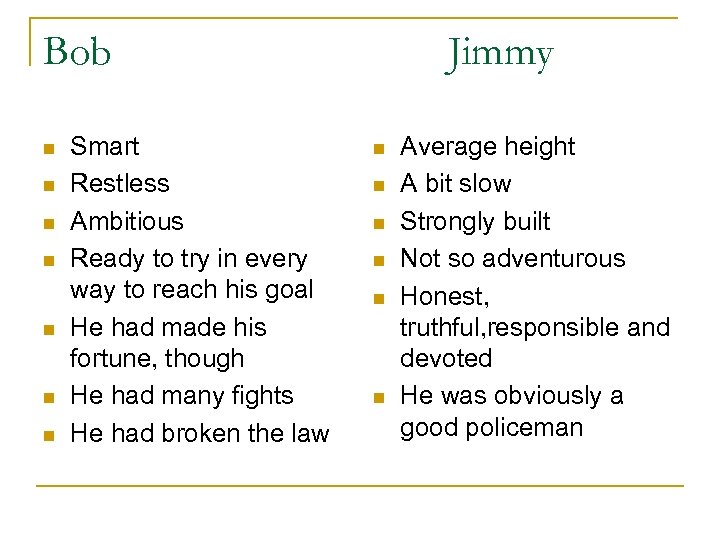
Bob n n n n Smart Restless Ambitious Ready to try in every way to reach his goal He had made his fortune, though He had many fights He had broken the law Jimmy n n n Average height A bit slow Strongly built Not so adventurous Honest, truthful, responsible and devoted He was obviously a good policeman
n n How do you think Jimmy felt when he saw Bob? How do you think Jimmy felt when he wrote the letter? What do you think Bob’s reaction was when he read the letter? Do you think Jimmy did the right thing as a friend? If you were him, what would you do?
n Do you think the friendship between Jimmy and Bob would survive after Bob’s arrest? Give reasons to support your point of view.
Theme of the story VS.
Language Study Word Study Phrases and Expressions Word Building
para. 1 The policeman on the beat moved up the avenue impressively. beat: the area of the town or city that a police officer regularly walks around; his route, which he patrols n n on the beat: checking the area he is assigned to
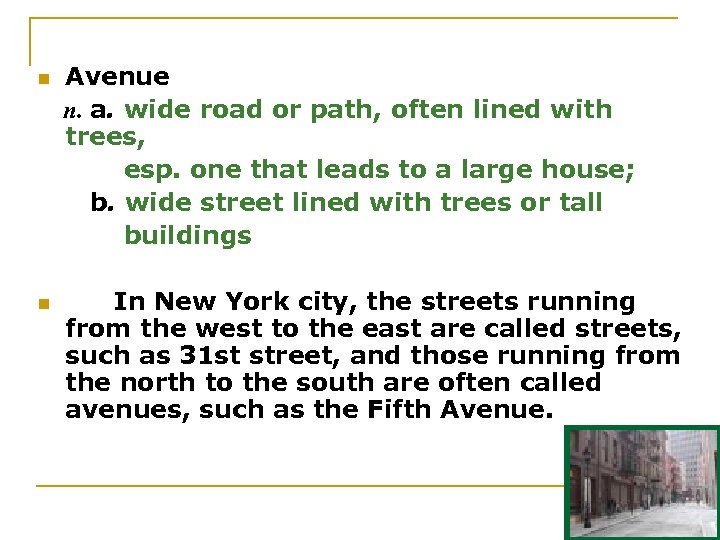
n n Avenue n. a. wide road or path, often lined with trees, esp. one that leads to a large house; b. wide street lined with trees or tall buildings In New York city, the streets running from the west to the east are called streets, such as 31 st street, and those running from the north to the south are often called avenues, such as the Fifth Avenue.
Barely She spoke so softly. I could barely hear her. I can barely make both ends meet. How can I buy a car?
n n n n Gust n. 1. sudden violent rush of air, or of rain, smoke, etc. ; 2. an outburst of emotion Examples: 1. The gust of wind blew the door shut. 1. fitful gusts of wind 阵阵的狂风 2. a gust of anger 勃然大怒
Empty The TV series emptied the streets at 8 pm every Saturday. n He emptied his pockets to show that he really had no money on him. n The river finally empties into the Atlantic. (flow into) n
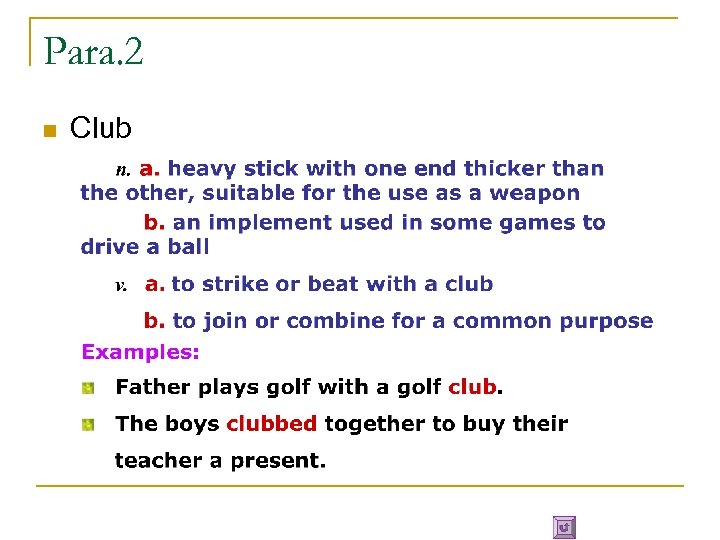
Para. 2 n Club
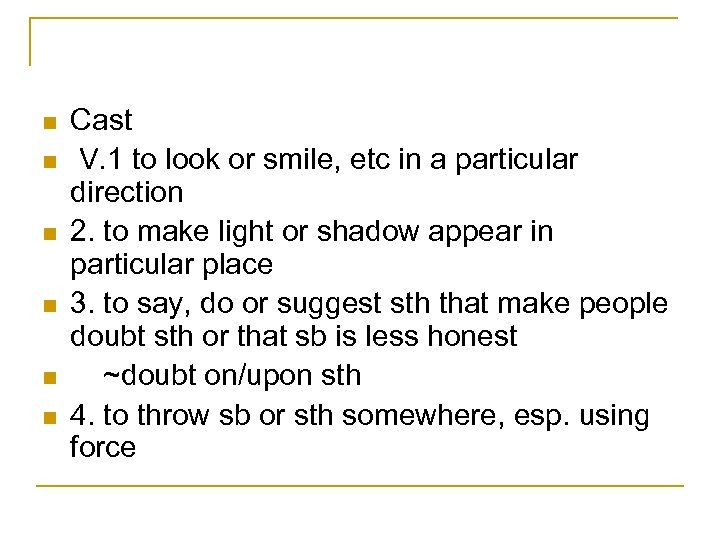
n n n Cast V. 1 to look or smile, etc in a particular direction 2. to make light or shadow appear in particular place 3. to say, do or suggest sth that make people doubt sth or that sb is less honest ~doubt on/upon sth 4. to throw sb or sth somewhere, esp. using force
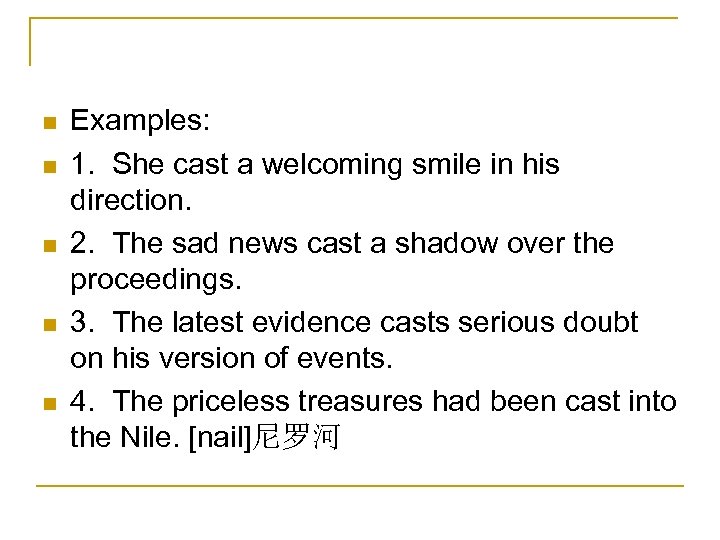
n n n Examples: 1. She cast a welcoming smile in his direction. 2. The sad news cast a shadow over the proceedings. 3. The latest evidence casts serious doubt on his version of events. 4. The priceless treasures had been cast into the Nile. [nail]尼罗河
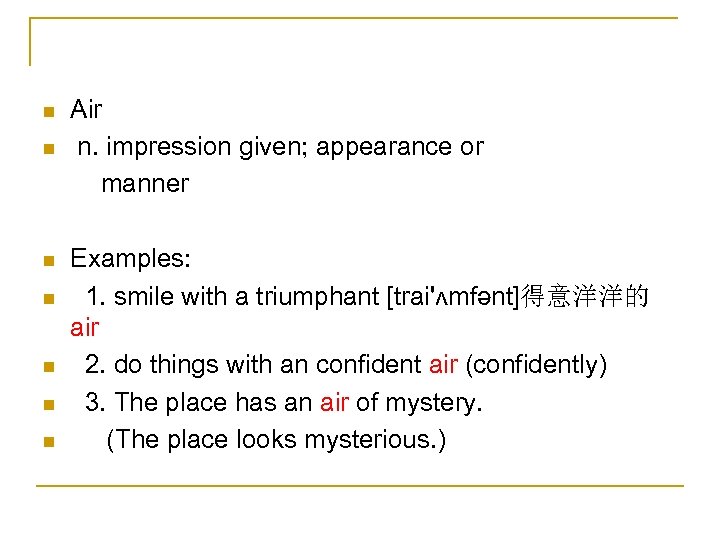
n n n n Air n. impression given; appearance or manner Examples: 1. smile with a triumphant [trai'ʌmfənt]得意洋洋的 air 2. do things with an confident air (confidently) 3. The place has an air of mystery. (The place looks mysterious. )
n all-night: open all night n lunch counter: a counter in a store or restaurant where food or served or sold to be taken out
Para. 3 n n n n Down Prep. along; towards the direction in which you are facing Adv. To or in the south of a country Examples: 1. He lives just down the street. 2. Go down the road till you reach the traffic lights. 3. fly down to Florida
n Lean
n n n n up (to sb. /sth. ) so as to be close to (a specified person or thing) Examples: 1. He came up to me and asked the time. 2. She went straight up to the door and knocked loudly. 3. A car drove up and he got in.
n Walk up: to walk towards sb n Speak up: to speak louder so that people can hear you
Para. 4 -6 n n Make certain a. make certain (that…): to inquire in order to be sure about sth. b. make certain of sth. /of doing sth. : to do sth. in order to be sure of (doing) sth. else Examples: 1. I think there’s a train at 8: 20 but you ought to make certain. 2. You’d better leave now if you want to make certain of getting there on time.
n Straight Adj. a. accurate and without additions; not modified or elaborate b. (of a person, his behavior, etc. ) honest; truthful n Examples: 1. tell a straight story 实 事求是地讲 一件事 2. give a straight answer to a straight question 直率 地回答直率的问题 3. I do not think you are being straight with me. 我 认为 你对 我不够坦诚.
n Tear down to pull or knock down a building or wall n Examples: 1. They’re tearing down these old houses to build a new office block.
n n Strike v. 1 to produce a flame when rubbed against a rough surface 2 to hit sb/sth hard or with force 3 to happen suddenly and have a harmful effect on sb/sth 4 to come into sb’s mind suddenly 5 to give sb a particular impression ~sb (as sth)
n n n Examples: 1. to strike a match on the wall 2. The ship struck a rock. 3. Two days later tragedy struck. 4. An awful thought has just struck me. 5. His reaction struck me as odd.
![n n Keen Adj. 1. [only before noun] quick to understand 2. [usually before](https://present5.com/presentation/c8e78ec831a4c4509d0771ae00841102/image-61.jpg "n n Keen Adj. 1. [only before noun] quick to understand 2. [usually before")
n n Keen Adj. 1. [only before noun] quick to understand 2. [usually before noun] enthusiastic about an activity or idea, etc. ~to do sth/ ~that/ ~on doing sth Examples: 1. a keen mind/ intellect 2. John was very keen to help.
His tiepin was a large diamond, oddly set. oddly ad. in a strange or peculiar manner n Examples: 1. behave oddly 2. be oddly dressed 3. She looked at him very oddly. 4. Oddly enough, we were just talking about the same thing.
n lack n. (lack of sth) the state of not having sth or not having enough of sth 1. a lack of food/money/skills 2. There was no lack of volunteers. v. to have none or not enough of sth 1. Some houses still lack basic amenities such as bathrooms. 2. He lacks confidence.
n Majority n. (~of sb or sth) the largest a group of people or things; Examples: 1. The majority of people interviewed prefer TV to radio. 2. The majority was/ were in favour of banning smoking.
n n Long since (para. 2) if something has long since happened, it happened a long time ago Example: I’ve long since forgiven her for what she did.
Para. 7 -9 n Bring up n n to raise, rear, or educate sb. Examples: She brought up five children. Her parents died when she was a baby and she was brought up by her aunt. He was brought up to respect authority.
n Figure v. to decide or think that sth will happen or is true to be part of a process, situation, etc. especially an important part to calculate an amount or the cost of sth Examples: 1. I figured that if I took the night train, I would be in Scotland by morning.
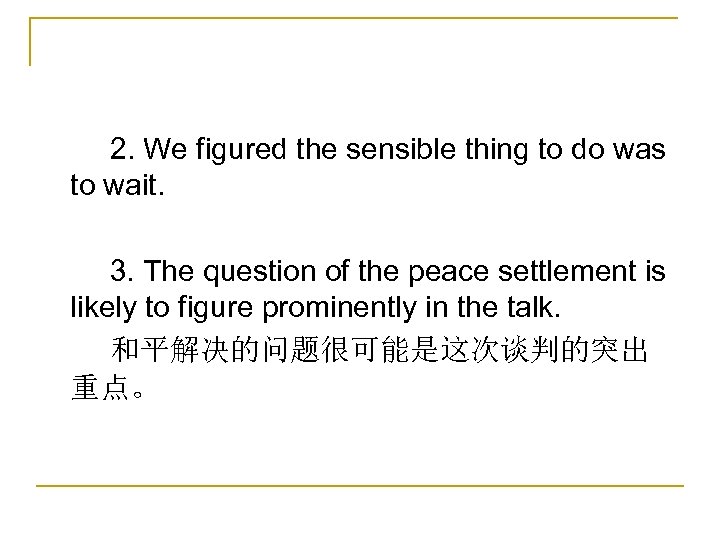
2. We figured the sensible thing to do was to wait. 3. The question of the peace settlement is likely to figure prominently in the talk. 和平解决的问题很可能是这次谈判的突出 重点。
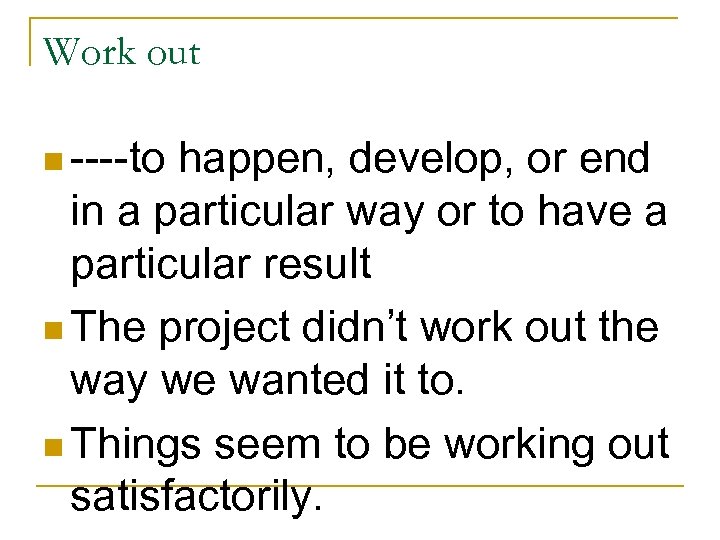
Work out n ----to happen, develop, or end in a particular way or to have a particular result n The project didn’t work out the way we wanted it to. n Things seem to be working out satisfactorily.
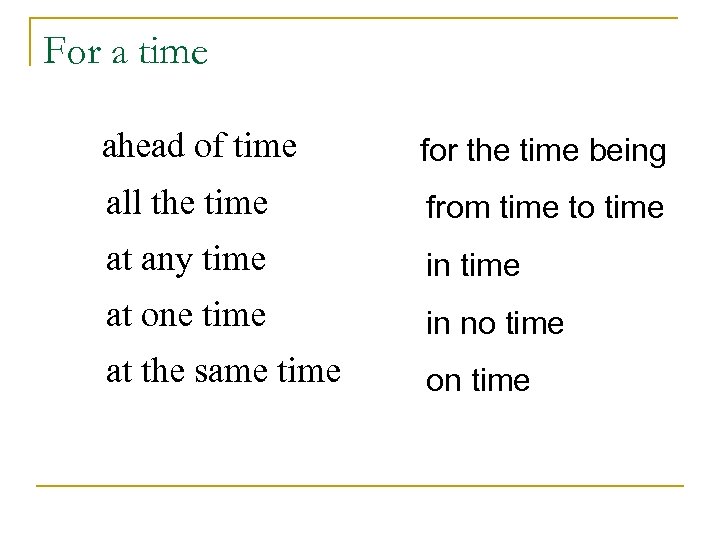
For a time ahead of time for the time being all the time from time to time at any time in time at one time in no time at the same time on time
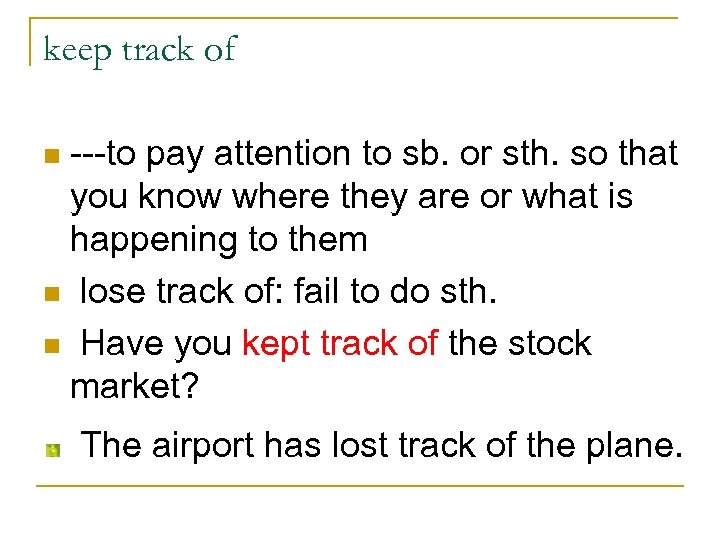
keep track of ---to pay attention to sb. or sth. so that you know where they are or what is happening to them n lose track of: fail to do sth. n Have you kept track of the stock market? n The airport has lost track of the plane.
Be worth it n ---used to say that you gain sth from an action n The laptop is a bit expensive, but it was worth it.
Turn up n ---to arrive at the place, especially in a way that is unexpected n We waited for months before a good job opportunity turned up. The police were ordered to arrest him as soon as he turned up.
Para. 10 -13 n The waiting man pulled out a handsome watch, the lids of it set with small diamonds. n 独立结构( Absolute Construction)实际上就是带有自 己主语的非限定分句和无动词分句。非限定分句和无 动词分句通常以主句的一定成分作为自己的逻辑主语, 但有时也带有自己的主语。其实,所谓“独立结构”并 非真正独立,它还是一种从属分句。 n 独立结构按其结构形式,分为不定式独立结构、ing分 词独立结构、ed分词独立结构和无动词独立结构,通 常在句中起状语分句的作用。
n n n The plan was that the two parties should first reach an agreement on the basic principles, the details to be worked out later. 计划是这样的,先让双方在基本问题上达成一 致,至于细节问题则日后另议。 Weather permitting, we will go for a picnic tomorrow.
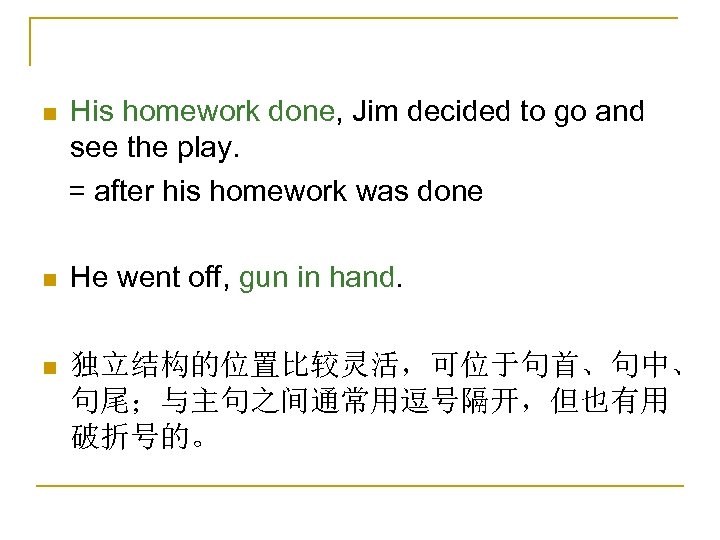
n His homework done, Jim decided to go and see the play. = after his homework was done n He went off, gun in hand. n 独立结构的位置比较灵活,可位于句首、句中、 句尾;与主句之间通常用逗号隔开,但也有用 破折号的。
n n n Announce Denounce Renounce
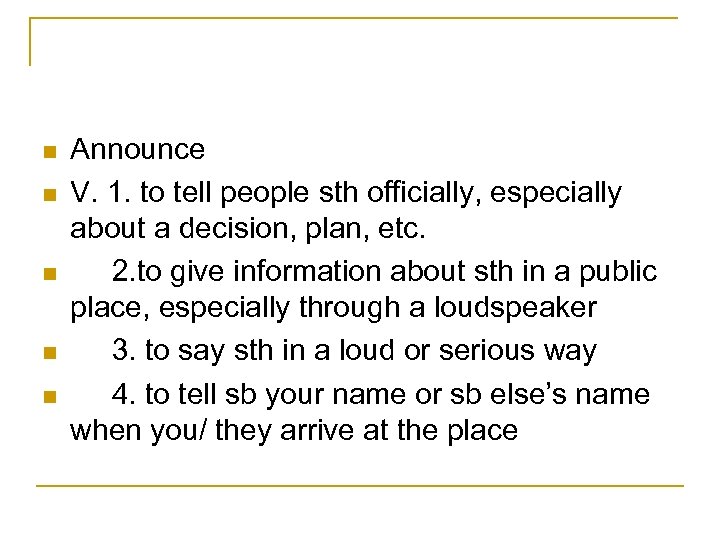
n n n Announce V. 1. to tell people sth officially, especially about a decision, plan, etc. 2. to give information about sth in a public place, especially through a loudspeaker 3. to say sth in a loud or serious way 4. to tell sb your name or sb else’s name when you/ they arrive at the place
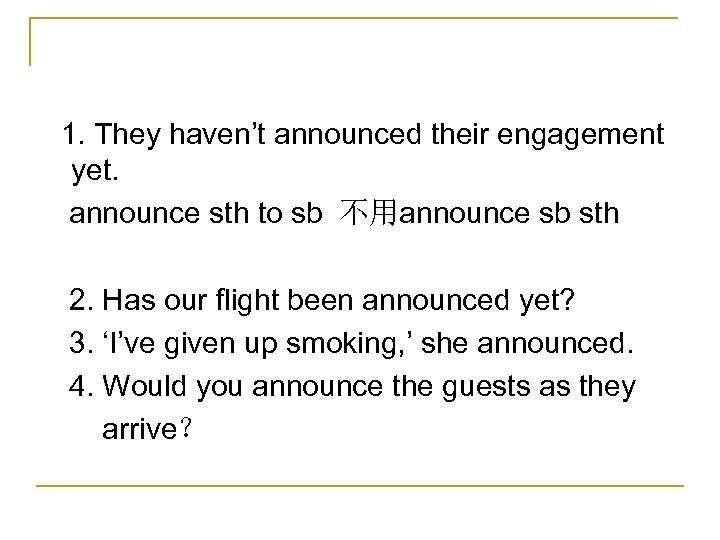
1. They haven’t announced their engagement yet. announce sth to sb 不用announce sb sth 2. Has our flight been announced yet? 3. ‘I’ve given up smoking, ’ she announced. 4. Would you announce the guests as they arrive?
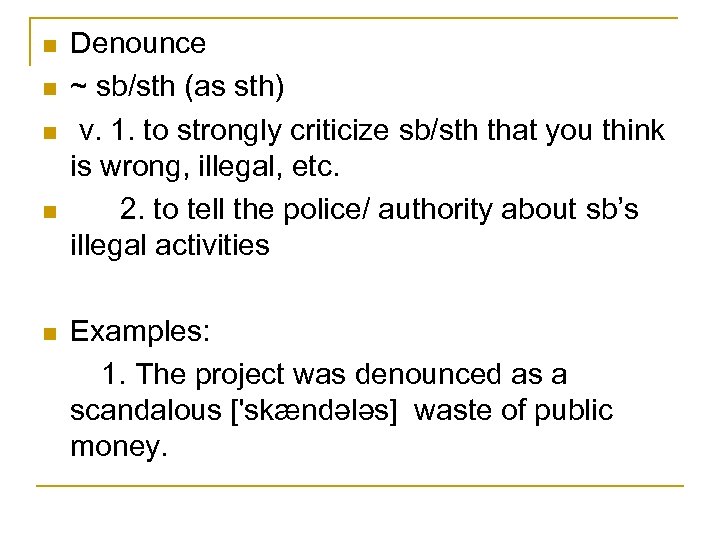
n n n Denounce ~ sb/sth (as sth) v. 1. to strongly criticize sb/sth that you think is wrong, illegal, etc. 2. to tell the police/ authority about sb’s illegal activities Examples: 1. The project was denounced as a scandalous ['skændələs] waste of public money.
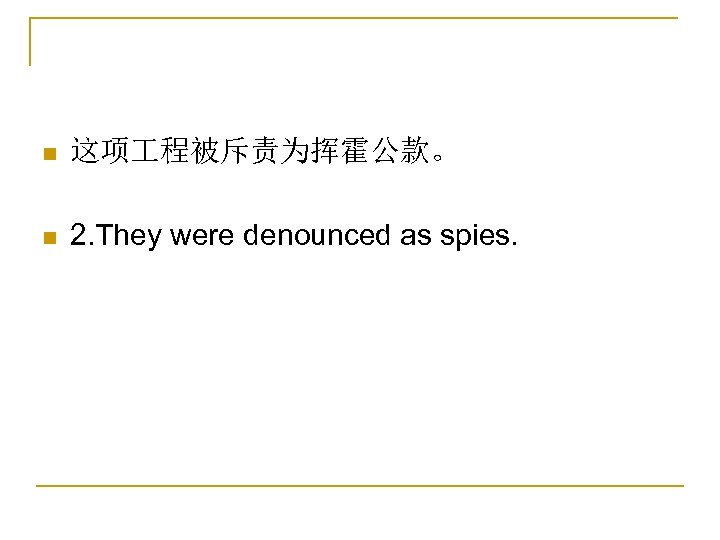
n 这项 程被斥责为挥霍公款。 n 2. They were denounced as spies.
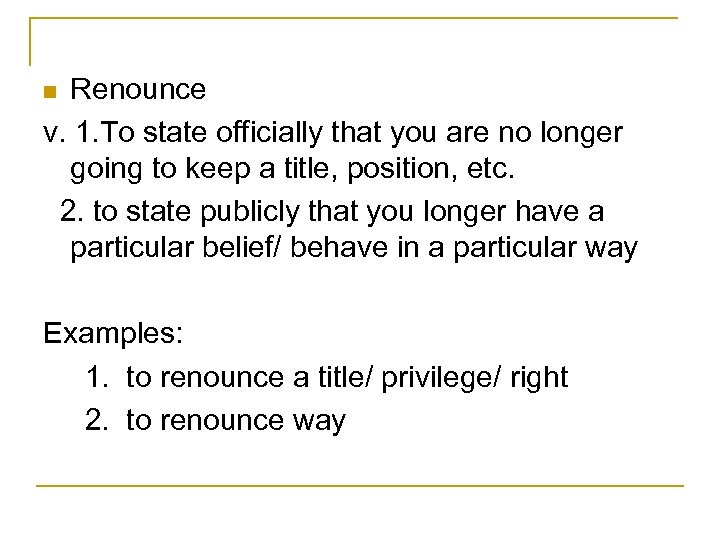
Renounce v. 1. To state officially that you are no longer going to keep a title, position, etc. 2. to state publicly that you longer have a particular belief/ behave in a particular way n Examples: 1. to renounce a title/ privilege/ right 2. to renounce way
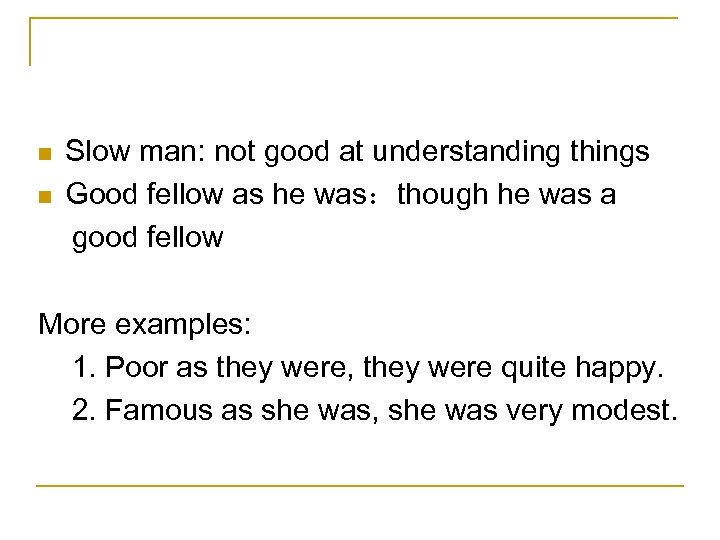
n n Slow man: not good at understanding things Good fellow as he was:though he was a good fellow More examples: 1. Poor as they were, they were quite happy. 2. Famous as she was, she was very modest.
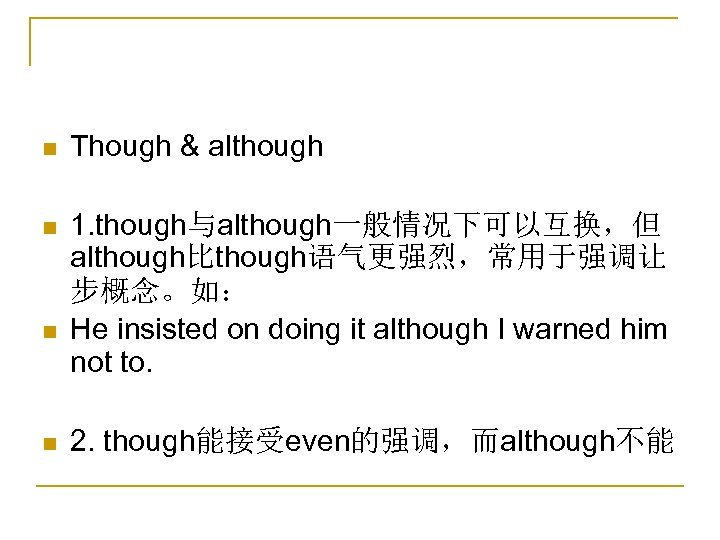
n Though & although n 1. though与although一般情况下可以互换,但 although比though语气更强烈,常用于强调让 步概念。如: He insisted on doing it although I warned him not to. n n 2. though能接受even的强调,而although不能
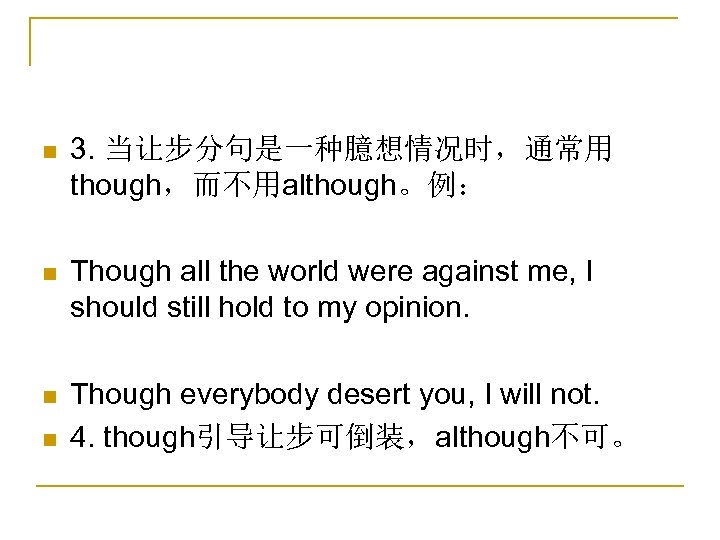
n 3. 当让步分句是一种臆想情况时,通常用 though,而不用although。例: n Though all the world were against me, I should still hold to my opinion. n Though everybody desert you, I will not. 4. though引导让步可倒装,although不可。 n
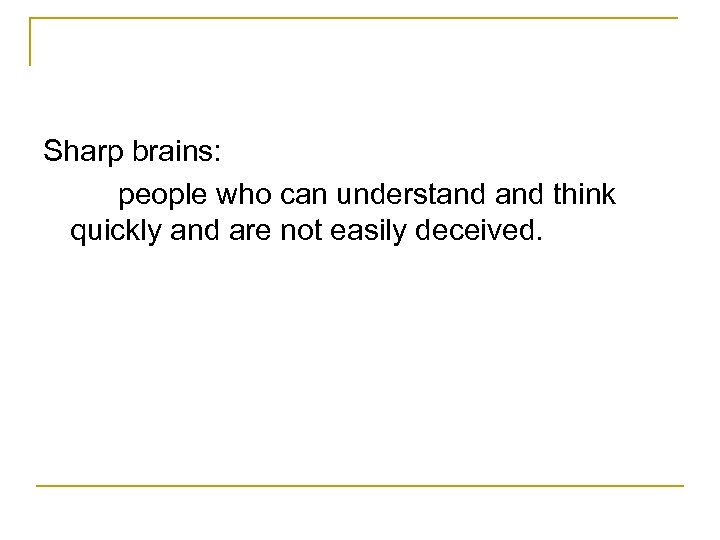
Sharp brains: people who can understand think quickly and are not easily deceived.
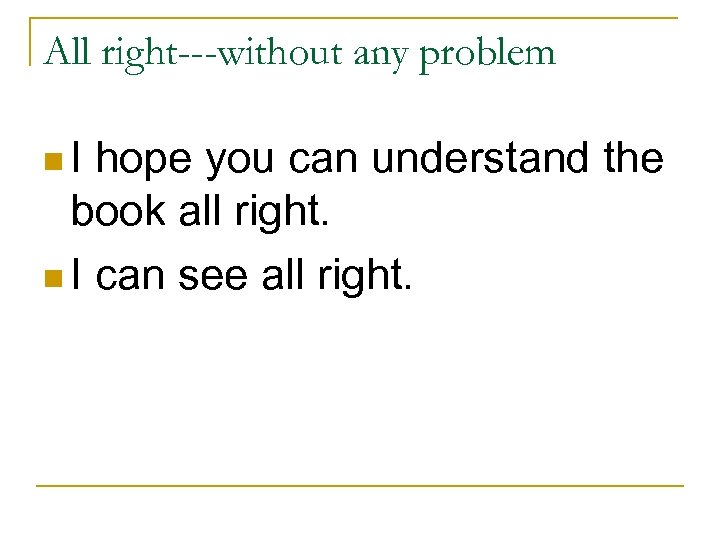
All right---without any problem n. I hope you can understand the book all right. n I can see all right.
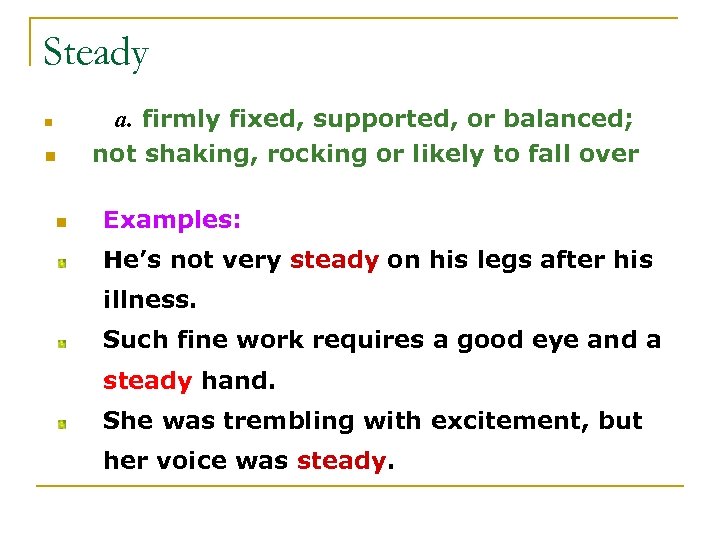
Steady n n n a. firmly fixed, supported, or balanced; not shaking, rocking or likely to fall over Examples: He’s not very steady on his legs after his illness. Such fine work requires a good eye and a steady hand. She was trembling with excitement, but her voice was steady.
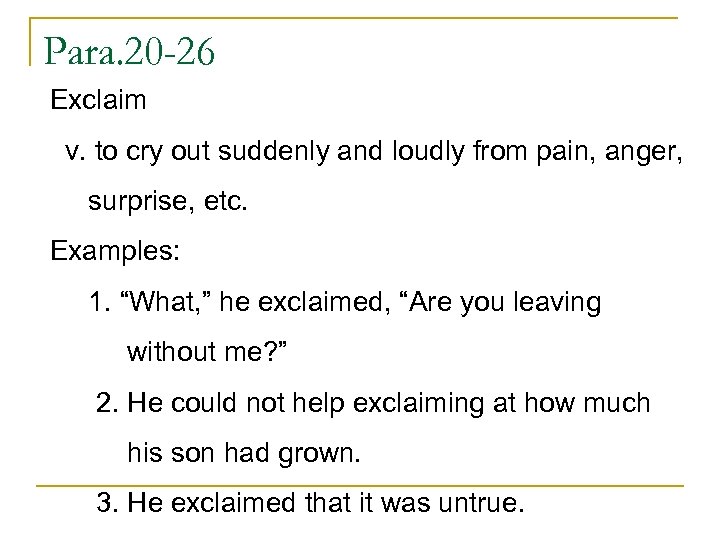
Para. 20 -26 Exclaim v. to cry out suddenly and loudly from pain, anger, surprise, etc. Examples: 1. “What, ” he exclaimed, “Are you leaving without me? ” 2. He could not help exclaiming at how much his son had grown. 3. He exclaimed that it was untrue.
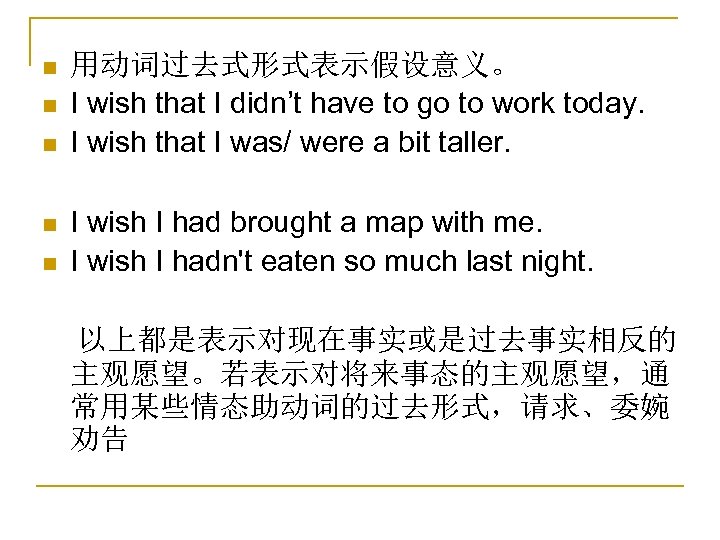
n n n 用动词过去式形式表示假设意义。 I wish that I didn’t have to go to work today. I wish that I was/ were a bit taller. I wish I had brought a map with me. I wish I hadn't eaten so much last night. 以上都是表示对现在事实或是过去事实相反的 主观愿望。若表示对将来事态的主观愿望,通 常用某些情态助动词的过去形式,请求、委婉 劝告
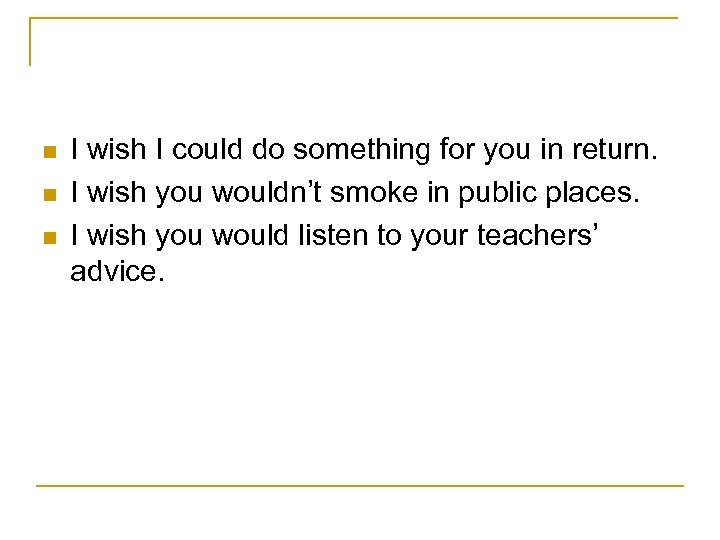
n n n I wish I could do something for you in return. I wish you wouldn’t smoke in public places. I wish you would listen to your teachers’ advice.
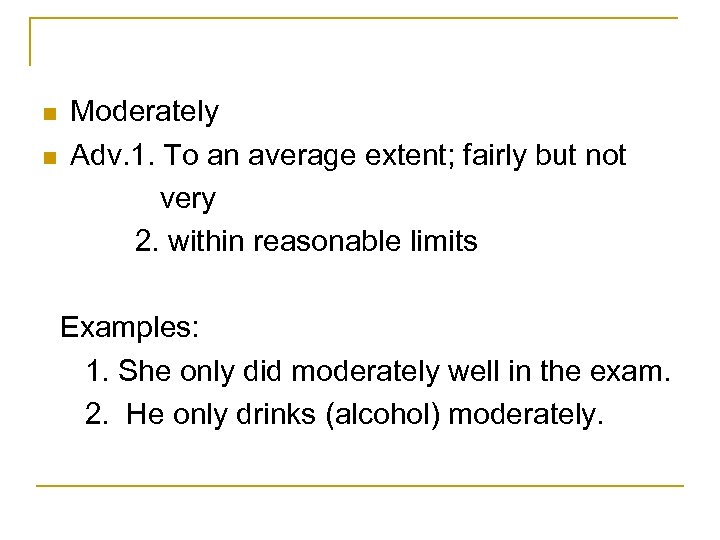
n n Moderately Adv. 1. To an average extent; fairly but not very 2. within reasonable limits Examples: 1. She only did moderately well in the exam. 2. He only drinks (alcohol) moderately.
n Know of sb/sth: (phrasal verb) to have heard of sb/ sth and be able to give a small amount of information about them n Have a good long talk about old times: have a hearty talk about those happy days we spent in the past.
Arm in arm Shoulder to shoulder Face to face Hand in hand
They fought shoulder to shoulder against their common enemy. Let us sit down and discuss the matter face to face. We must lower our taxes step by step.
n n n Outline v. to give a description of the main facts or points involved in sth n. a statement, summary of a written work or speech; a preliminary draft or plan Examples: 1. We outlined our proposals to the committee. 2. This is a brief outline of the events.
Para. 28 n n Chemist’s A “chemist’s” (Br. E) is a place where medicines are sold. Here “ ’s” is suffix which refers to the shop or home of the person. “Chemist’s” therefore means “the chemist’s shop”. More examples: baker’s, barber’s, and so on.
n n Brilliant adj. a. very intelligent; highly skilled or talented b. very bright; sparkling c. causing admiration; outstanding; exceptional Examples: brilliant sunshine a brilliant diamond a brilliant scientist She has a brilliant mind. a brilliant achievement The play was a brilliant success.
n …, brilliant with electric lights. = very bright because of its electric lights. “with” means “because of or caused by sb or sth ”. Examples: 1. His face is red with anger. 2. Her fingers were numb with cold. 3. They jumped with joy. 4. They were trembling with fear.
n n Simultaneous Adj. happening or done at the same time as sth else Examples: n 1. There were several simultaneous attacks by the rebels. n 2. simultaneous translation/ interpreting
n Gaze upon/ at/ into v. to look steadily at sb/sth for a long time, either because you are interested or surprised, or because you are thinking of sth else n n. a long steady look at sb/sth Examples: 1. She gazed at him in amazement. n 2. He sat for hours just gazing into space. 3. He met her gaze.
n n Stare : gaze fixedly, indicating curiosity, boldness, or stupidity He stared at me, trying to remember who I was. Gape: stare at sb/sth with your mouth open because you are shocked They gaped at me when I told them about the gold I had found. Glare: to look at sb in an angry way I looked at her and she glared furiously back.
Release n 1. He was released from the prison. 2. The news was released in yesterday’s New York Times. 3. She needed to do something to release her tension. 4. We could release you from your duties for two days. Meanwhile, you take a good rest.
Under arrest n ---being in the state or the process of sth n under control n under heavy influence n under attack n under repair
Writing Devices Ironic Ending We don’t know what happened twenty years ago that made them so special to each other. However, it was clear that Jim was a good honest man and always true to his friends and Bob admired and trusted him. Slipping along this way, we would expect a very touching story. However, the ending is very dramatic and surprising.
Скачать презентацию After Twenty Years O Henry Background Information
c8e78ec831a4c4509d0771ae00841102.ppt