


 Скачать презентацию After the Cold War The Post-Cold War
b4266492937e3ddd57ccb6d74e890ba2.ppt
- Количество слайдов: 47
 After the Cold War
 The Post-Cold War World: 3 periods
 n First Period, 1991 -2000: Triumph of the West u Triumph of global capitalism u Russia’s transition crisis u The Unipolar Moment: US hegemony at its peak u The Western expansion to the post-communist East u Formation of the global neoliberal regime
 n Second Period, 2001 -2008: US Hegemony Tested u The Islamist challenge and the Bush response u Development of a multipolar system u Russia’s resurgence u Relative decline of US hegemony
 n Third Period, 2008 u The global economic crisis u Creeping bankruptcy and political stalemate in the US u The crisis of European integration u The rise of China as a global power u Reset in Russia’s relations with the West
 Comparing 1917 and 1991: n The Romanov Empire collapsed as a result of a revolution, the elites were overthrown and replaced by new elites as a result of the civil war n The Communist elites moved to divide the empire to recast themselves as leaders of independent nation-states – u or of units of the Russian Federation n A key reason why the Soviet empire made a relatively quiet exit was because key Soviet elites saw a future for themselves after communism n Transition to capitalism would enable most of them to maintain and even enhance their power and privilege
 n n n Having dissolved the empire, the new elites have been engaged in competition and cooperation between themselves to: u secure their control, u reform their political-economic systems, u find new places in the regional and global orders THIS STRUGGLE OVER THE IMPERIAL SPOILS IS THE ESSENCE OF THE NEW INTERNATIONAL RELATIONS IN EURASIA Some of them stick together (RF, CIS, GUUAM) Others go their own separate ways, look for new partnerships Meanwhile, many other states are exploring opportunities to expand their influence in Eurasia
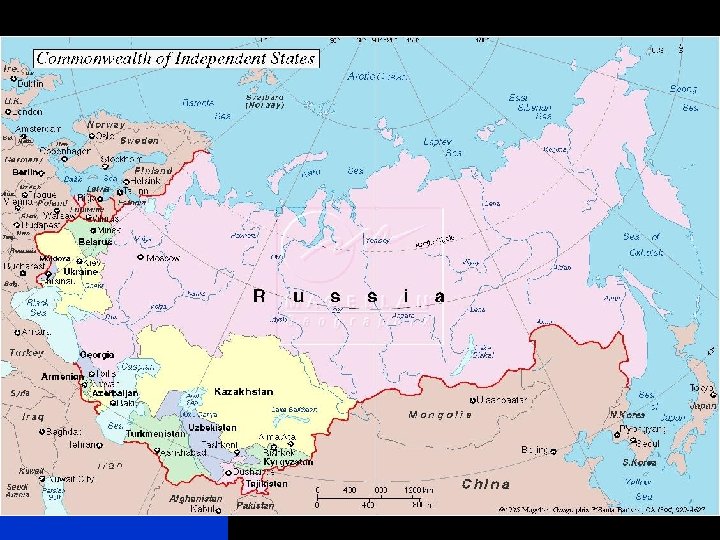
 Contraction of Russian power
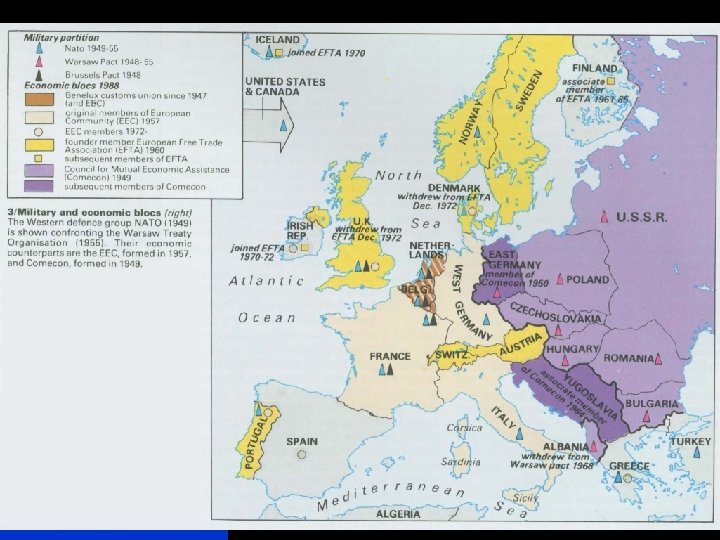
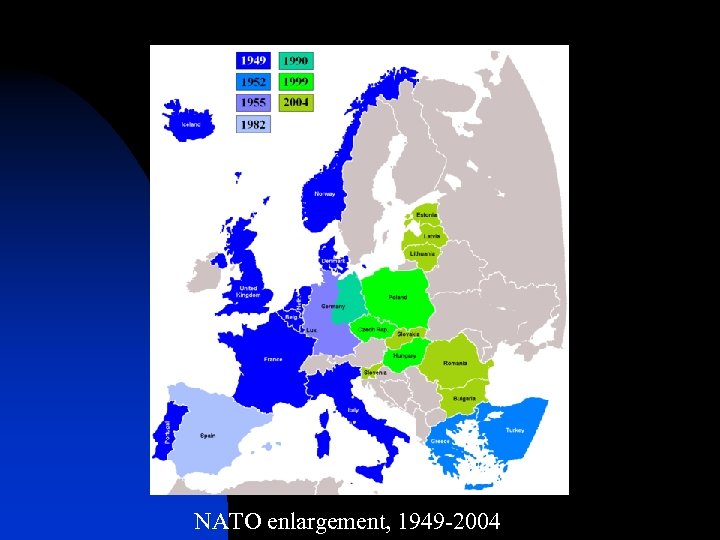 NATO enlargement, 1949 -2004
 Main changes in Russia’s international role following the end of the Cold War: 1. Reduction of the main parametres of Russia’s power u u Territorial losses Economic depression The military crisis Ideological neutralization « after being a key part of the Global Left for most of the 20 th century, Russia joined the Global (neoliberal) Right 2. Russian society was opened to the impact of global forces with minimal regulation by the state 3. Political affiliation with the West 4. Reluctant acceptance of US hegemony
 n Post-Soviet Russia was no longer a problem for the West in the Cold War sense: u Russia’s abandonment of its Soviet mode became a key enabling factor for the formation of the global neoliberal regime u RUSSIA AS A “NORMAL COUNTRY”: capitalist, cautious, status quo, pragmatic, with limited ambitions, seeking friends everywhere, wary of making enemies
 RUSSIA AS A PROBLEM AFTER THE COLD WAR n The transition crisis: dangerous side-effects of reforms: u The nuclear risks u Possibility of a totalitarian backlash u Potential for civil war u Tensions with new neighbours, attempts to maintain a sphere of influence in the post-Soviet space n Russia as a US client: no longer counterbalancing the US (not a problem for the US, but a problem for many other states) – or: n Russia as a member of coalitions to counterbalance US hegemony (a problem for the US)
 US objectives vis-à-vis Russia n Encourage Russia’s transition to capitalism n Prevent Russia from acting as a counterbalance to US n Control Russia’ behaviour to keep it congruent with US interests n Expand US influence into the post-Soviet space Perspectives outside the US: n Many countries would like Russia to play the role of a nonhostile, but relatively independent, actor in international politics n Most Russians have the same perspective
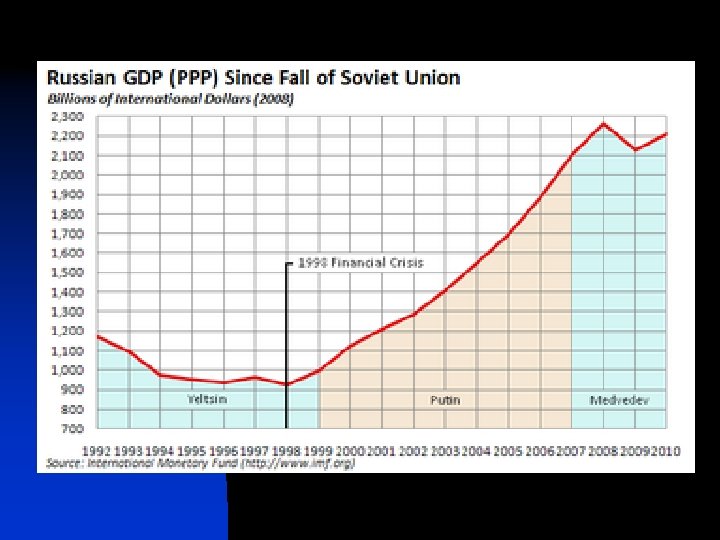
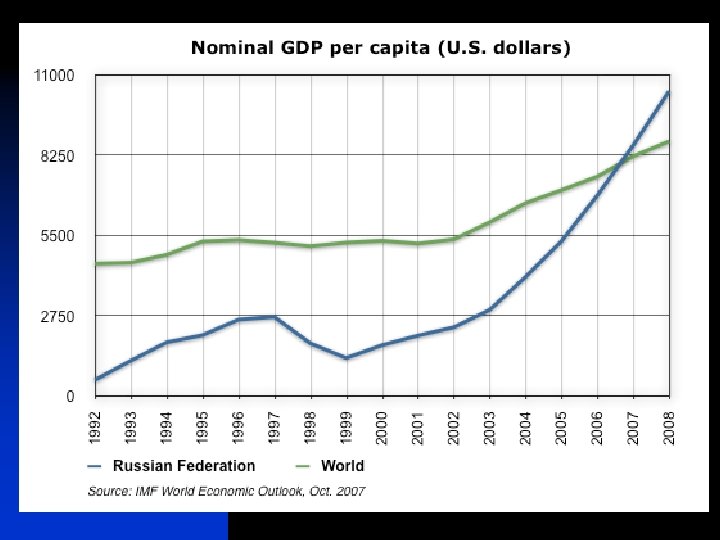
 n n The economy GDP, PPP - $2. 2 trln. (No. 8 in the world) u n GDP per capita - $16, 000 u n Canada – $1. 33 trln. Canada - $39, 400 Real growth rate – 5. 6% in 2008, -7. 9% in 2009, 4% in 2010 u Canada – 0. 5% in 2008, -2. 5% in 2009, 3. 1% in 2010
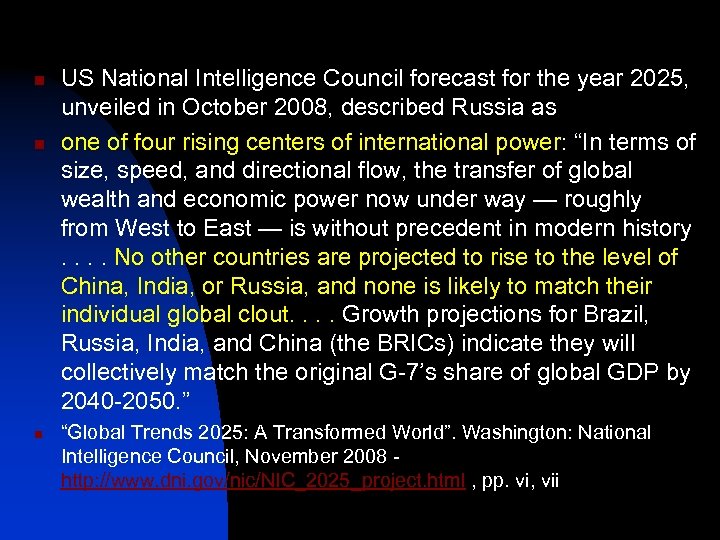 n n n US National Intelligence Council forecast for the year 2025, unveiled in October 2008, described Russia as one of four rising centers of international power: “In terms of size, speed, and directional flow, the transfer of global wealth and economic power now under way — roughly from West to East — is without precedent in modern history . . No other countries are projected to rise to the level of China, India, or Russia, and none is likely to match their individual global clout. . Growth projections for Brazil, Russia, India, and China (the BRICs) indicate they will collectively match the original G-7’s share of global GDP by 2040 -2050. ” “Global Trends 2025: A Transformed World”. Washington: National Intelligence Council, November 2008 - http: //www. dni. gov/nic/NIC_2025_project. html , pp. vi, vii
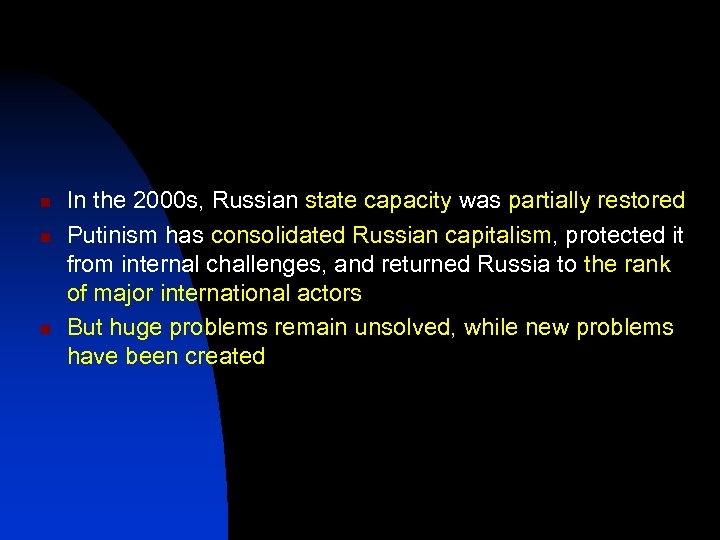 n n n In the 2000 s, Russian state capacity was partially restored Putinism has consolidated Russian capitalism, protected it from internal challenges, and returned Russia to the rank of major international actors But huge problems remain unsolved, while new problems have been created
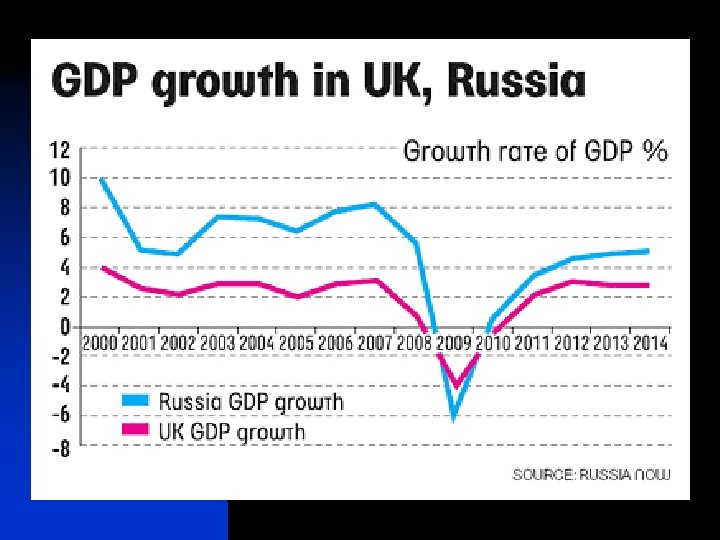
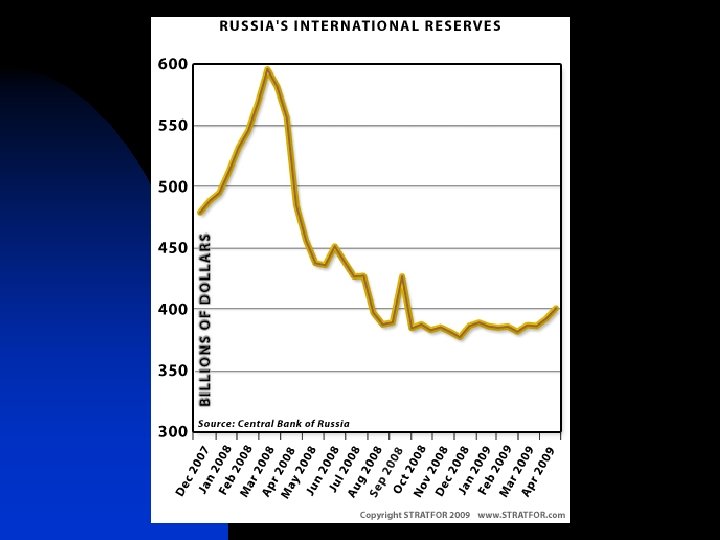
 n n The Russian economy needs major modernization to be competitive The new Russian state is in many ways dysfunctional and needs major reforms to meet Russia’s challenges The Russian society is deeply split by social inequality Continued resurgence requires new policies and reforms
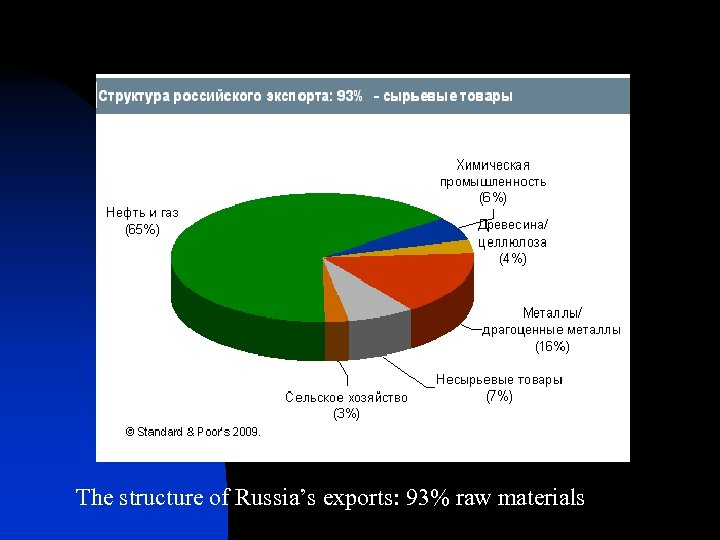 The structure of Russia’s exports: 93% raw materials
 Russian elite interests The oligarchy – the upper crust of the new capitalist class, product of the post-communist transformation u Most important sources of wealth: oil, gas and arms u Dependent on the West, primarily the US u Dependent on the Russian state, wants to rationalize it u Needs traditional foreign policy assets of the USSR u Assertive in the political sphere u Seeks economic opportunities worldwide u Intertwined with state bureaucracy
 n The bureaucrats u The “enforcers” (siloviki) – military and security elites « Determined to get upper hand over the oligarchs, get their property « Institutionally and traditionally suspicious of the West « Interested in a restoration of a stronger and more authoritarian Russian state, but on a capitalist basis u Federal civilian bureaucracy « Interested in whatever protects and increases their power u Regional bureaucracies, regional foreign policy interests
 n n The national bourgeoisie u Well below the ranks of the oligarchy u Gets little from the West u Feels dominated by the oligarchs u Is nationalist and protectionist The politicians u 1990 s: liberals, communists, nationalists, “United Russia” – becoming the ruling party under Putin u The Westernizer-Eurasianist divide – and synthesis
 n Russian threat perceptions u u u Security – internal and external Control of resources Russia’s defence capability Technological lag behind the West Negative demography
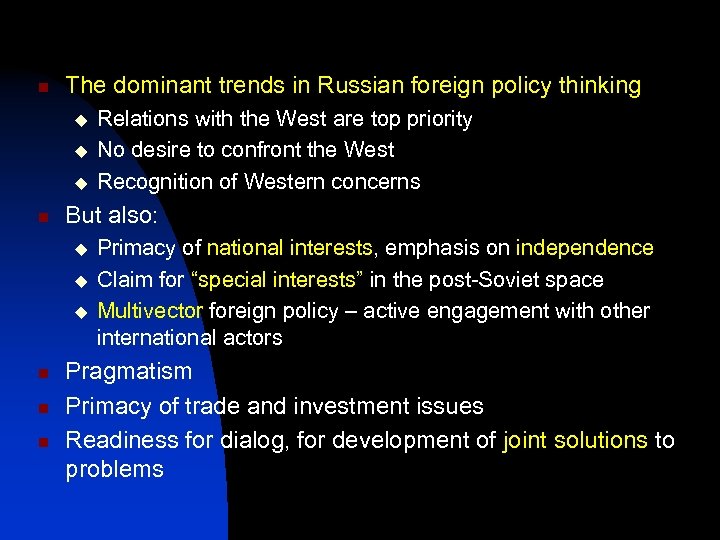 n The dominant trends in Russian foreign policy thinking u u u n But also: u u u n n n Relations with the West are top priority No desire to confront the West Recognition of Western concerns Primacy of national interests, emphasis on independence Claim for “special interests” in the post-Soviet space Multivector foreign policy – active engagement with other international actors Pragmatism Primacy of trade and investment issues Readiness for dialog, for development of joint solutions to problems
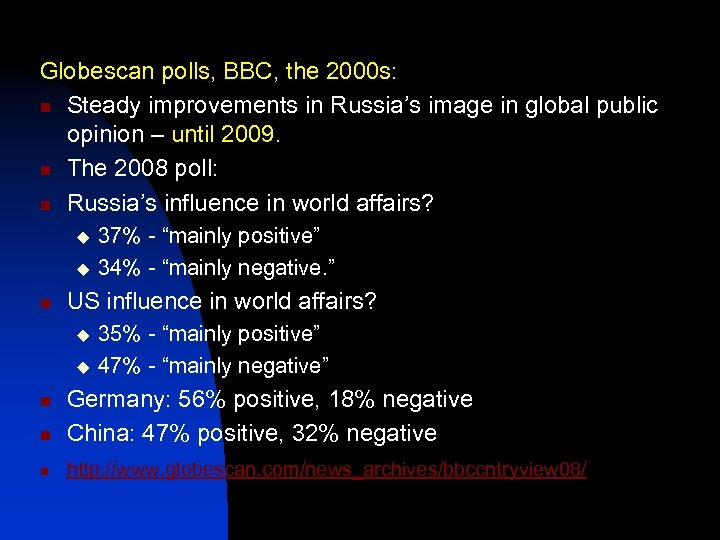 Globescan polls, BBC, the 2000 s: n Steady improvements in Russia’s image in global public opinion – until 2009. n The 2008 poll: n Russia’s influence in world affairs? u u n 37% - “mainly positive” 34% - “mainly negative. ” US influence in world affairs? u u 35% - “mainly positive” 47% - “mainly negative” n Germany: 56% positive, 18% negative China: 47% positive, 32% negative n http: //www. globescan. com/news_archives/bbccntryview 08/ n
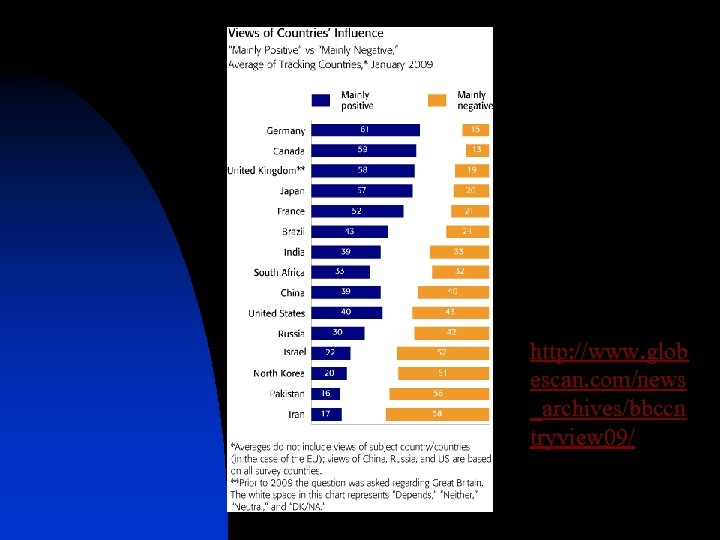 http: //www. glob escan. com/news _archives/bbccn tryview 09/
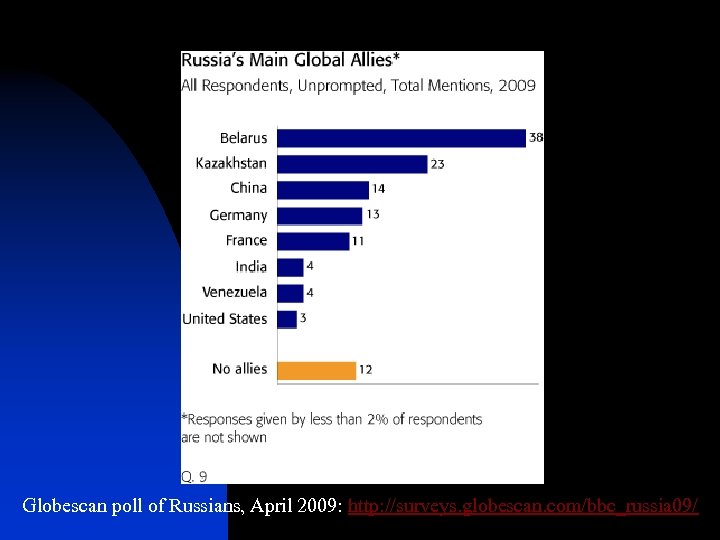 Globescan poll of Russians, April 2009: http: //surveys. globescan. com/bbc_russia 09/
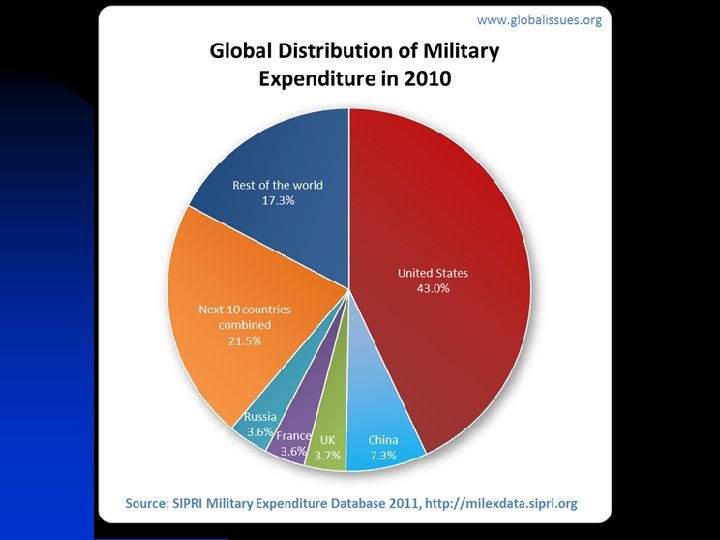
 Russia’s military budget n Mid-1980 s – defence spending accounted for 15 -17% of Soviet GDP n Massive cuts following dissolution of USSR in 1991 n Steady rise since 2000 – by 15 -25% a year n In 2006, a new state armaments program, which will span 2007 -2015, was adopted n Price tag: 4. 9 trillion rubles (US$186 billion). n 63% is to be allocated for the procurement of modern weapons and equipment n 27% towards defense research and development. n 2010 – defence spending accounted for 2. 84% of Russia’s GDP u u Plan for 2013 – 3. 39% Norm approved in 2000 – 3. 5%
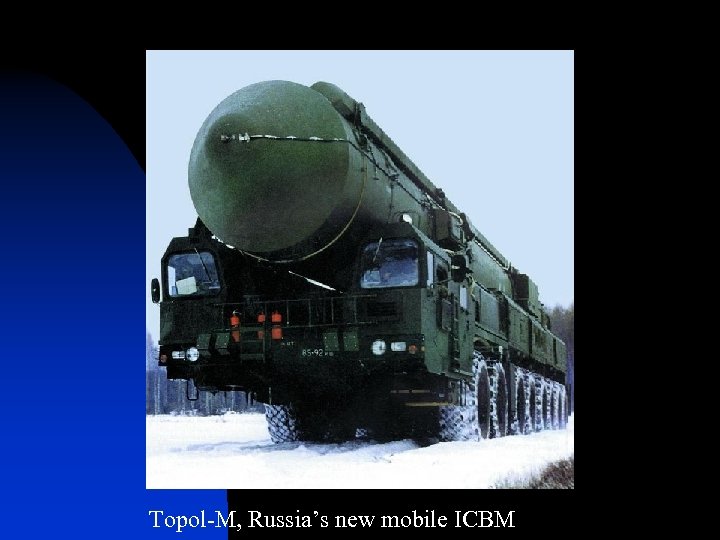 Topol-M, Russia’s new mobile ICBM
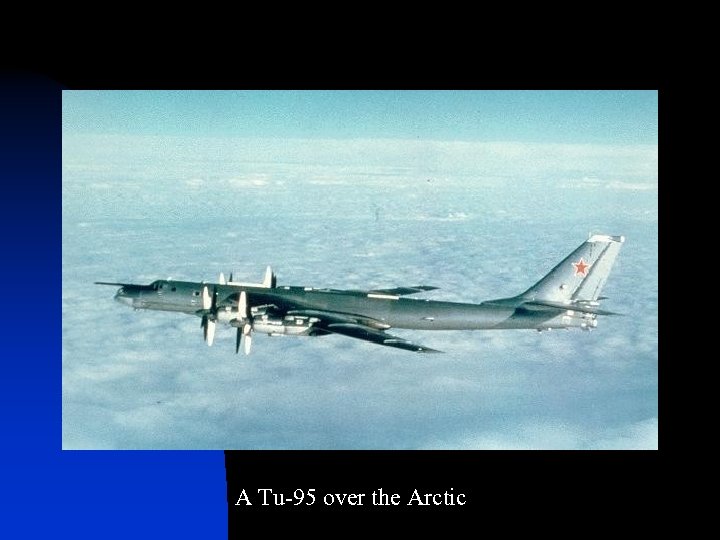 A Tu-95 over the Arctic
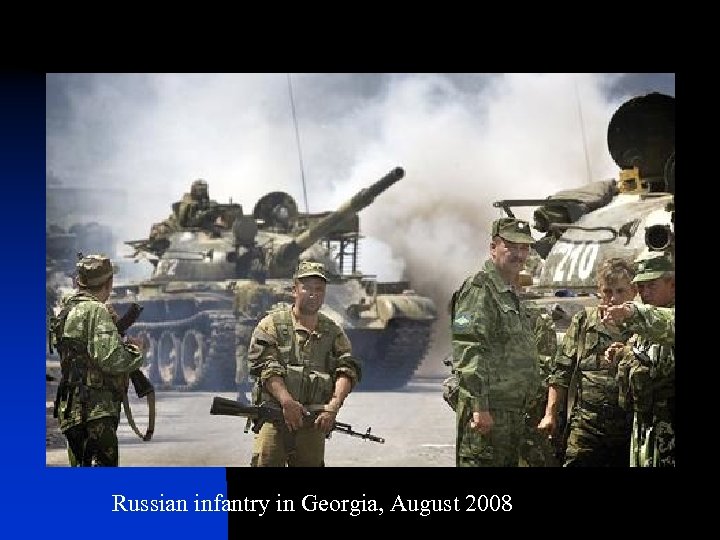 Russian infantry in Georgia, August 2008
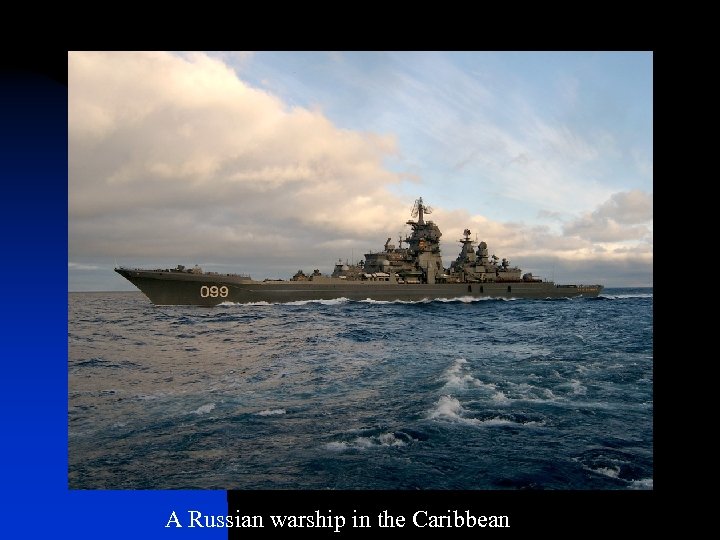 A Russian warship in the Caribbean
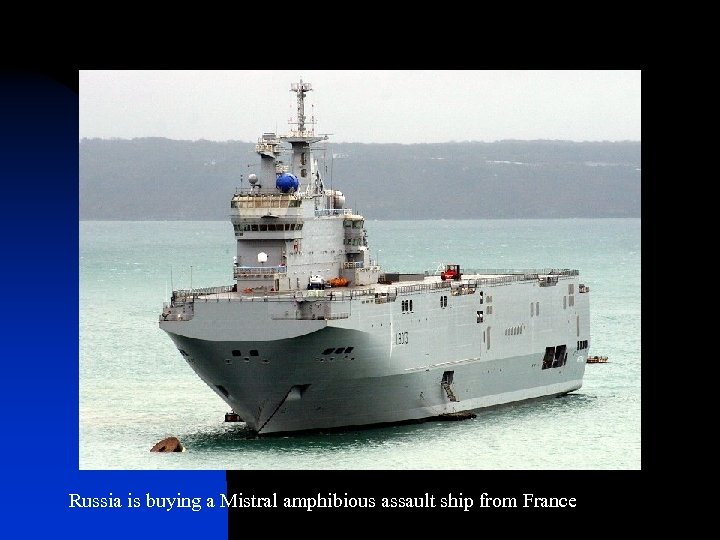 Russia is buying a Mistral amphibious assault ship from France
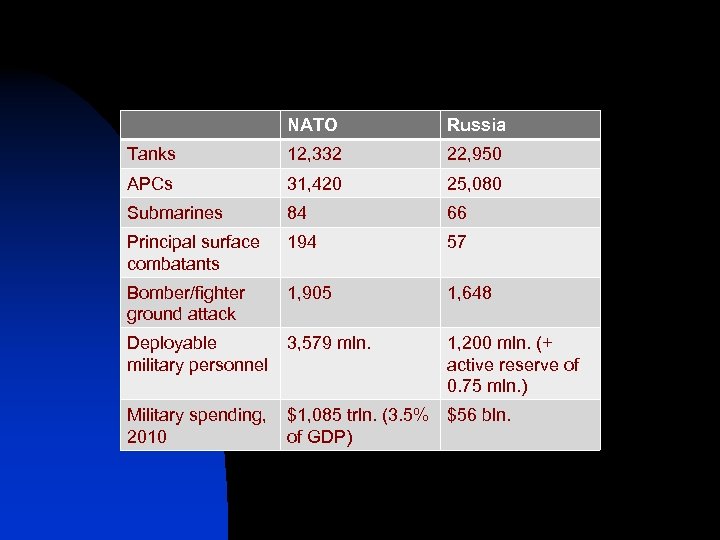 NATO Russia Tanks 12, 332 22, 950 APCs 31, 420 25, 080 Submarines 84 66 Principal surface combatants 194 57 Bomber/fighter ground attack 1, 905 1, 648 Deployable military personnel 3, 579 mln. 1, 200 mln. (+ active reserve of 0. 75 mln. ) Military spending, $1, 085 trln. (3. 5% $56 bln. 2010 of GDP)
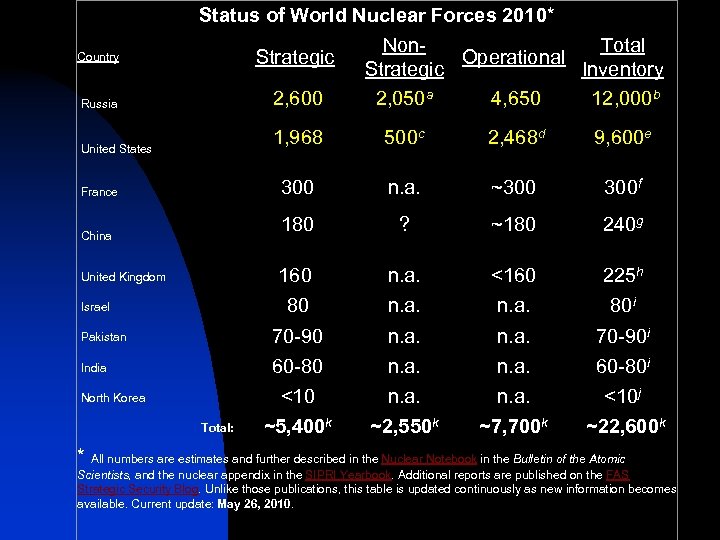 Status of World Nuclear Forces 2010* Country Strategic Russia 2, 600 Non. Total Operational Strategic Inventory 2, 050 a 4, 650 12, 000 b 1, 968 500 c 2, 468 d 9, 600 e 300 n. a. ~300 300 f 180 ? ~180 240 g United Kingdom 160 n. a. <160 225 h Israel 80 n. a. 80 i Pakistan 70 -90 n. a. 70 -90 i India 60 -80 n. a. 60 -80 i <10 n. a. <10 j ~5, 400 k ~2, 550 k ~7, 700 k ~22, 600 k United States France China North Korea Total: * All numbers are estimates and further described in the Nuclear Notebook in the Bulletin of the Atomic Scientists, and the nuclear appendix in the SIPRI Yearbook. Additional reports are published on the FAS Strategic Security Blog. Unlike those publications, this table is updated continuously as new information becomes available. Current update: May 26, 2010.
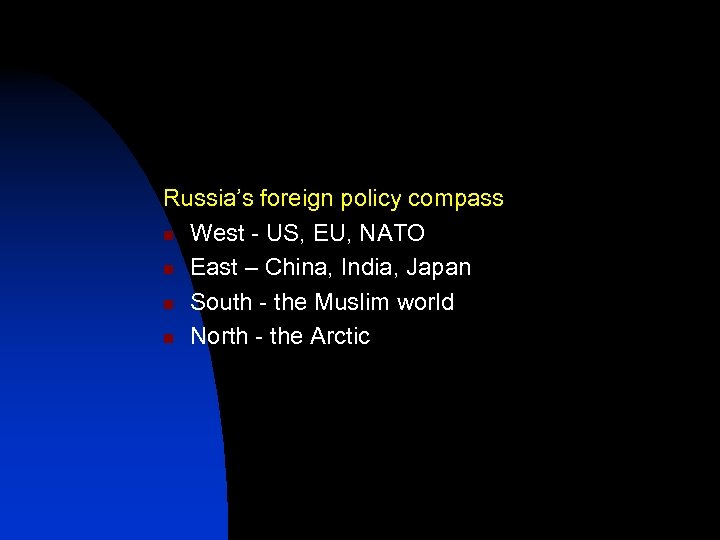 Russia’s foreign policy compass n West - US, EU, NATO n East – China, India, Japan n South - the Muslim world n North - the Arctic
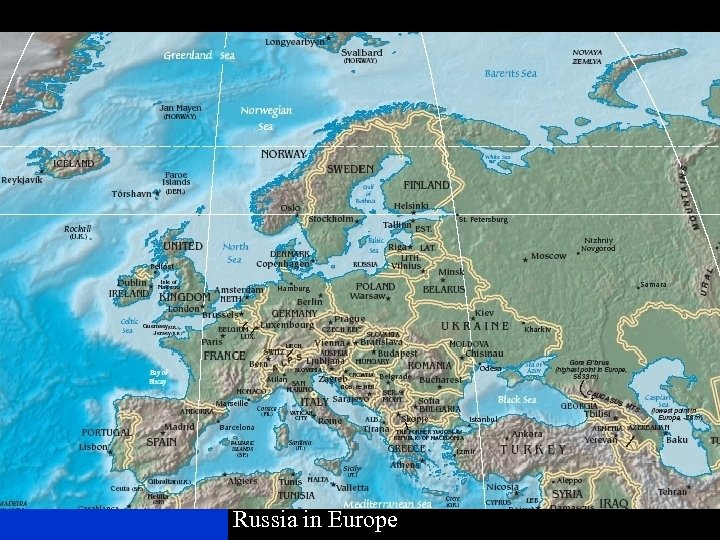 Russia in Europe
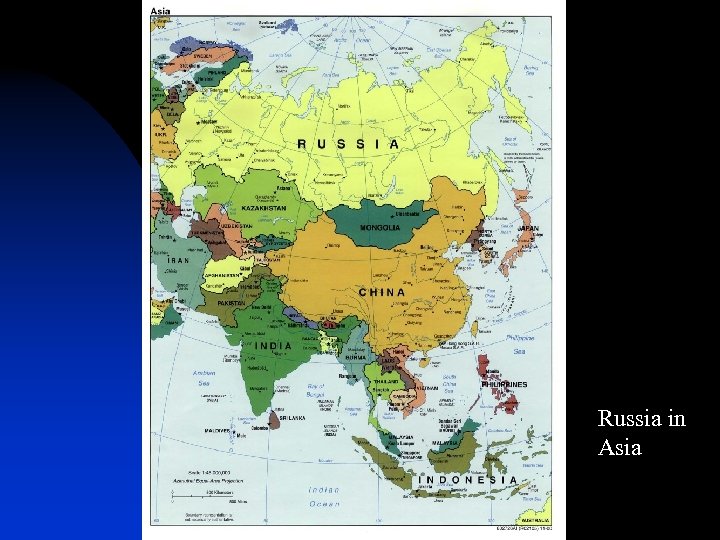 Russia in Asia
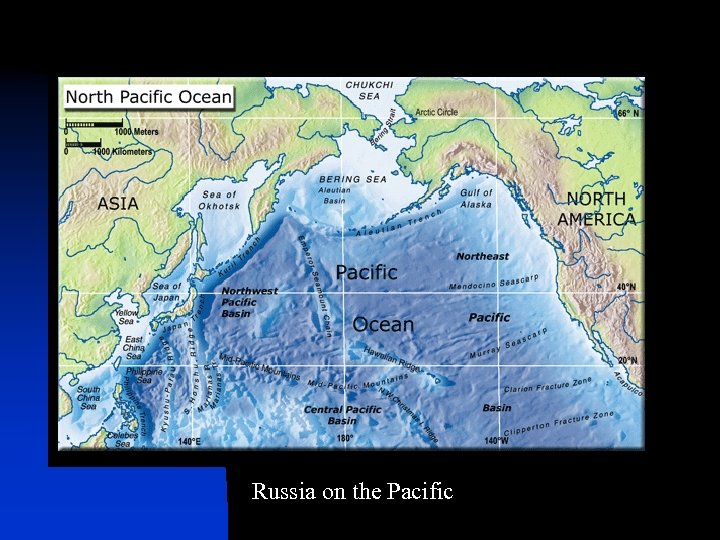 Russia on the Pacific
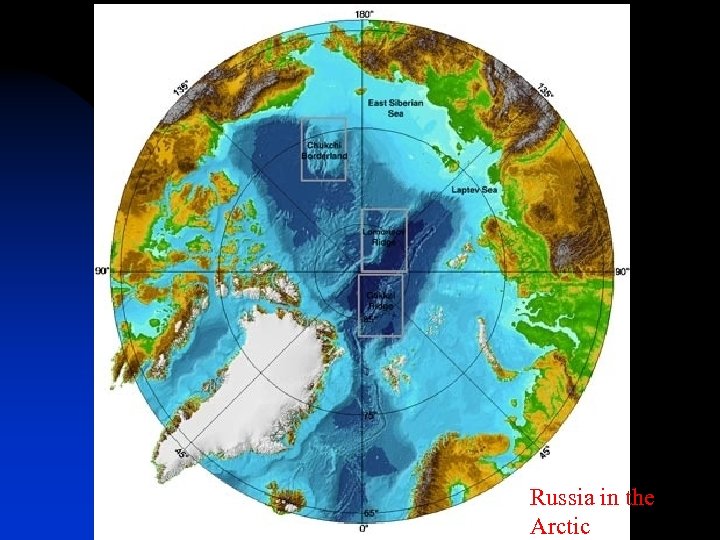 Russia in the Arctic