 Скачать презентацию Africa Statistics Day Better data better lives harnessing
4e617b15de9020fe095e680420abb4f8.ppt
- Количество слайдов: 21



Africa Statistics Day “Better data, better lives: harnessing modern technologies to enhance National Statistical Systems” By Dominique HABIMANA, Director-Statistical Methods Kigali, Nov 2015 1
Agenda 1. Establishment of NISR Objective: Providing highlights on NISR 10 years of policy support: 2005 -2015 2. NISR leadership 3. Key achievements 4. Future perspectives 2
1. Establishment of NISR Before 2005 There were 3 major different offices: q Department of Statistics in MINECOFIN q Office Nationale de la Population (ONAPO) q Services Nationale des Recensements Organic law NISR was created by the Organic Law N° 09/2005 of 14/07/2005 to replace the Department of Statistics in MINECOFIN NISR put together all the 3 offices and started with 36 permenant staff only. 3

2. NISR leadership Chairpersons- NISR Bo. D Mr. Canisius KARURANGA Sept 2005 - Aug 2012 Dr. Monique NSANZABAGANWA Sept 2012 up to now 4

2. NISR leadership Directors General of NISR Dr. Ir. Louis MUNYAKAZI Nov 2005 - Feb 2009 Dr. Diane KARUSISI DG ai: Oct 2010 – Oct 2011 Mr. Yusuf MURANGWA DG ai: March 2009 -Sept 2010 Mr. Yusuf MURANGWA 5 Nov 2011 up to now
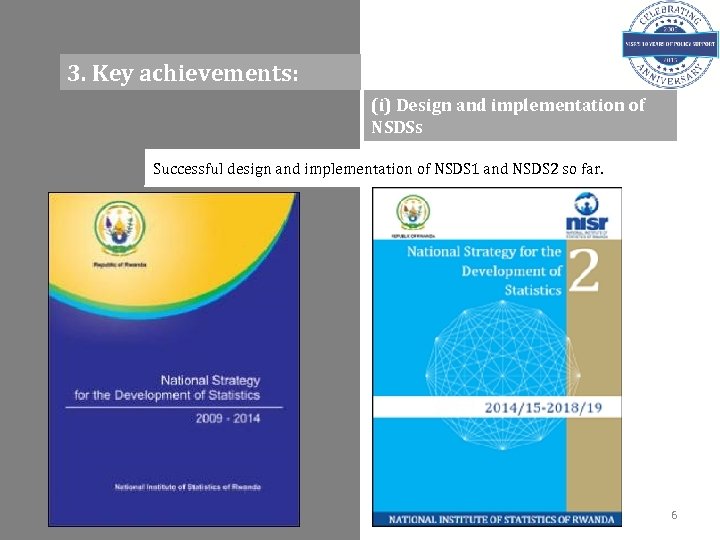
3. Key achievements: (i) Design and implementation of NSDSs Successful design and implementation of NSDS 1 and NSDS 2 so far. 6
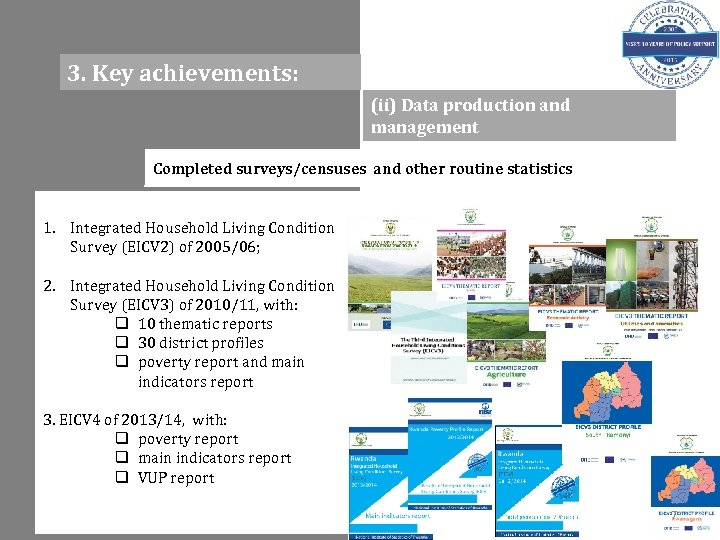
3. Key achievements: (ii) Data production and management Completed surveys/censuses and other routine statistics 1. Integrated Household Living Condition Survey (EICV 2) of 2005/06; 2. Integrated Household Living Condition Survey (EICV 3) of 2010/11, with: q 10 thematic reports q 30 district profiles q poverty report and main indicators report 3. EICV 4 of 2013/14, with: q poverty report q main indicators report q VUP report 7
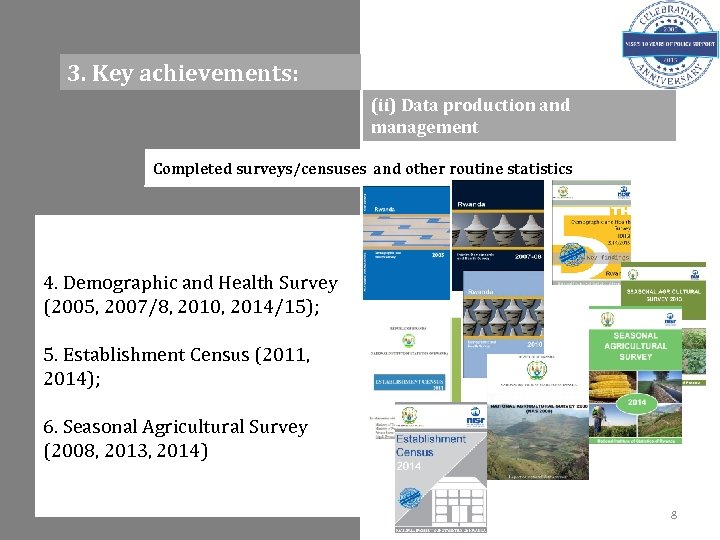
3. Key achievements: (ii) Data production and management Completed surveys/censuses and other routine statistics 4. Demographic and Health Survey (2005, 2007/8, 2010, 2014/15); 5. Establishment Census (2011, 2014); 6. Seasonal Agricultural Survey (2008, 2013, 2014) 8
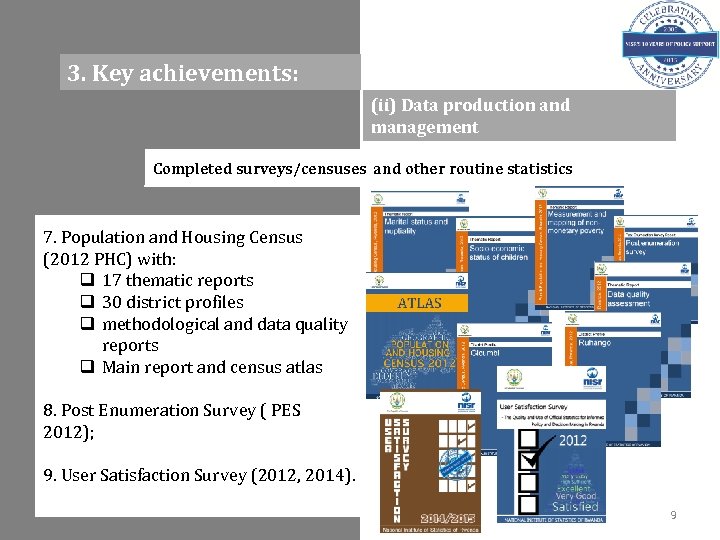
3. Key achievements: (ii) Data production and management Completed surveys/censuses and other routine statistics 7. Population and Housing Census (2012 PHC) with: q 17 thematic reports q 30 district profiles q methodological and data quality reports q Main report and census atlas 8. Post Enumeration Survey ( PES 2012); 9. User Satisfaction Survey (2012, 2014). 9
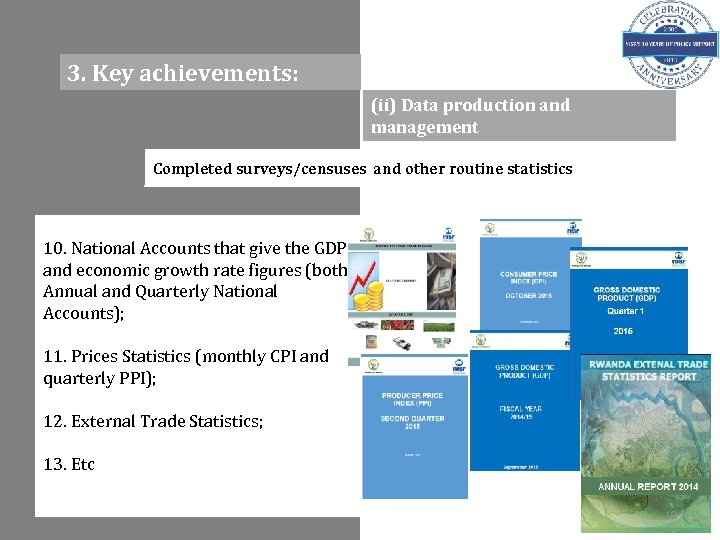
3. Key achievements: (ii) Data production and management Completed surveys/censuses and other routine statistics 10. National Accounts that give the GDP and economic growth rate figures (both Annual and Quarterly National Accounts); 11. Prices Statistics (monthly CPI and quarterly PPI); 12. External Trade Statistics; 13. Etc 10
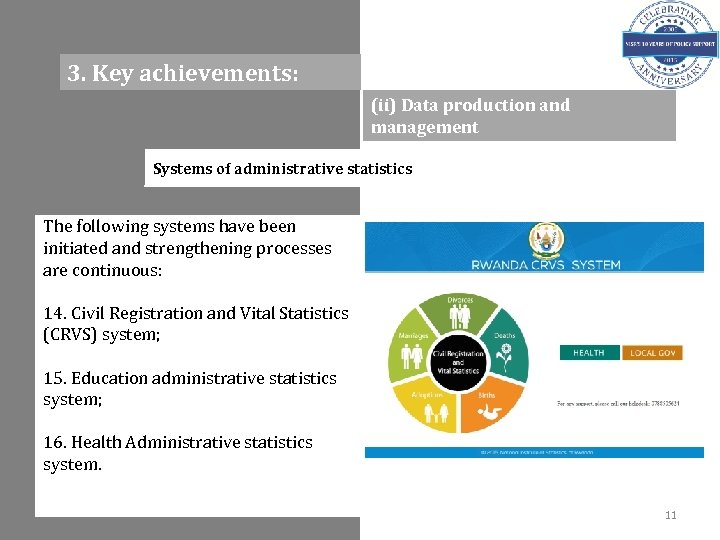
3. Key achievements: (ii) Data production and management Systems of administrative statistics The following systems have been initiated and strengthening processes are continuous: 14. Civil Registration and Vital Statistics (CRVS) system; 15. Education administrative statistics system; 16. Health Administrative statistics system. 11
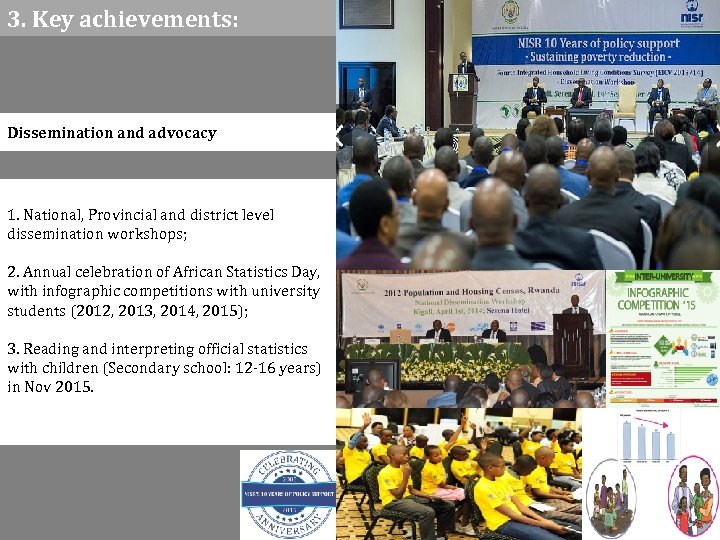
3. Key achievements: Dissemination and advocacy 1. National, Provincial and district level dissemination workshops; 2. Annual celebration of African Statistics Day, with infographic competitions with university students (2012, 2013, 2014, 2015); 3. Reading and interpreting official statistics with children (Secondary school: 12 -16 years) in Nov 2015. 12
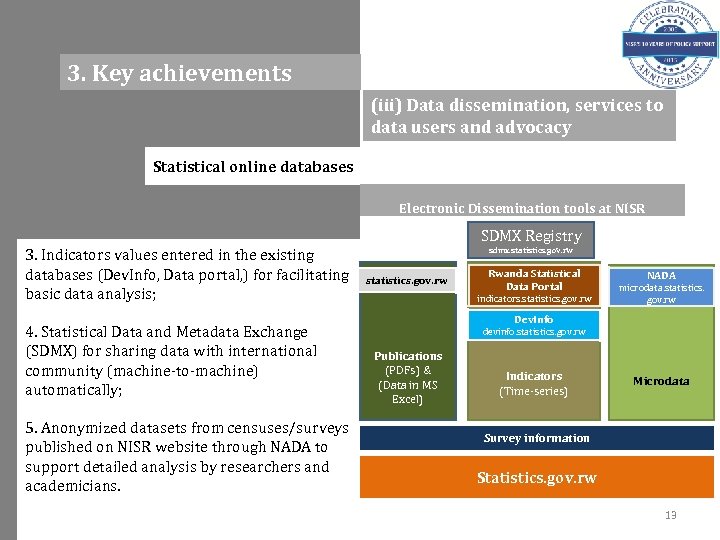
3. Key achievements (iii) Data dissemination, services to data users and advocacy Statistical online databases Electronic Dissemination tools at NISR SDMX Registry 3. Indicators values entered in the existing databases (Dev. Info, Data portal, ) for facilitating basic data analysis; 4. Statistical Data and Metadata Exchange (SDMX) for sharing data with international community (machine-to-machine) automatically; 5. Anonymized datasets from censuses/surveys published on NISR website through NADA to support detailed analysis by researchers and academicians. sdmx. statistics. gov. rw Rwanda Statistical Data Portal indicators. statistics. gov. rw NADA microdata. statistics. gov. rw Dev. Info devinfo. statistics. gov. rw Publications (PDFs) & (Data in MS Excel) Indicators (Time-series) Microdata Survey information Statistics. gov. rw 13
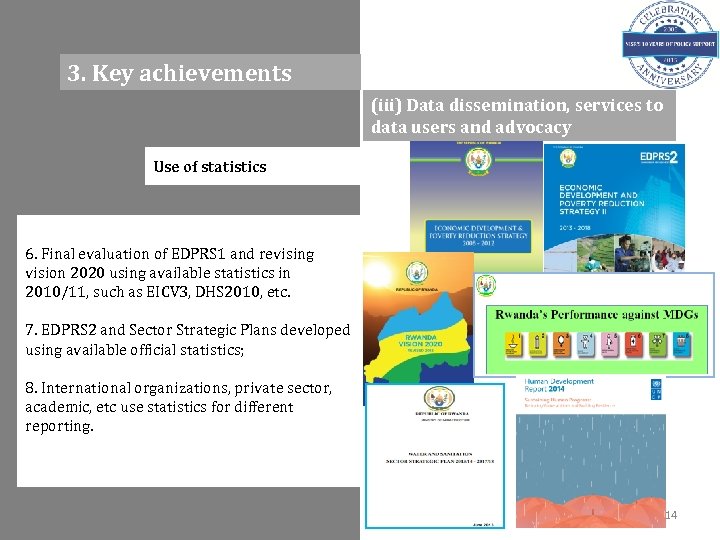
3. Key achievements (iii) Data dissemination, services to data users and advocacy Use of statistics 6. Final evaluation of EDPRS 1 and revising vision 2020 using available statistics in 2010/11, such as EICV 3, DHS 2010, etc. 7. EDPRS 2 and Sector Strategic Plans developed using available official statistics; 8. International organizations, private sector, academic, etc use statistics for different reporting. 14
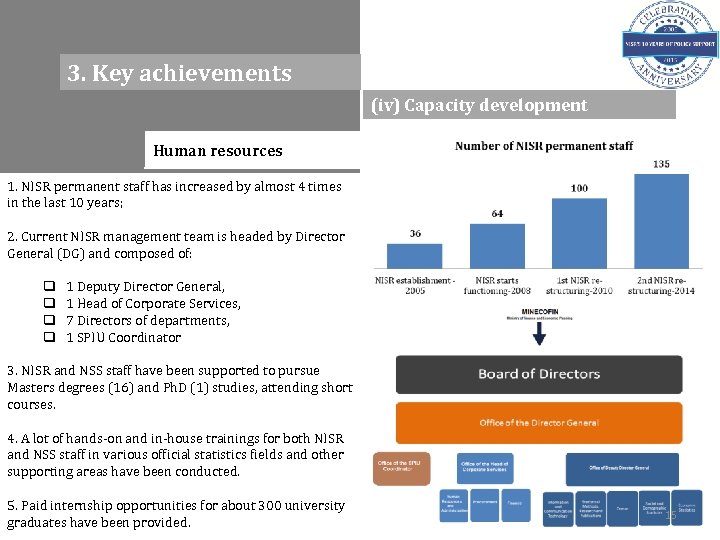
3. Key achievements (iv) Capacity development Human resources 1. NISR permanent staff has increased by almost 4 times in the last 10 years; 2. Current NISR management team is headed by Director General (DG) and composed of: q q 1 Deputy Director General, 1 Head of Corporate Services, 7 Directors of departments, 1 SPIU Coordinator 3. NISR and NSS staff have been supported to pursue Masters degrees (16) and Ph. D (1) studies, attending short courses. 4. A lot of hands-on and in-house trainings for both NISR and NSS staff in various official statistics fields and other supporting areas have been conducted. 5. Paid internship opportunities for about 300 university graduates have been provided. 15
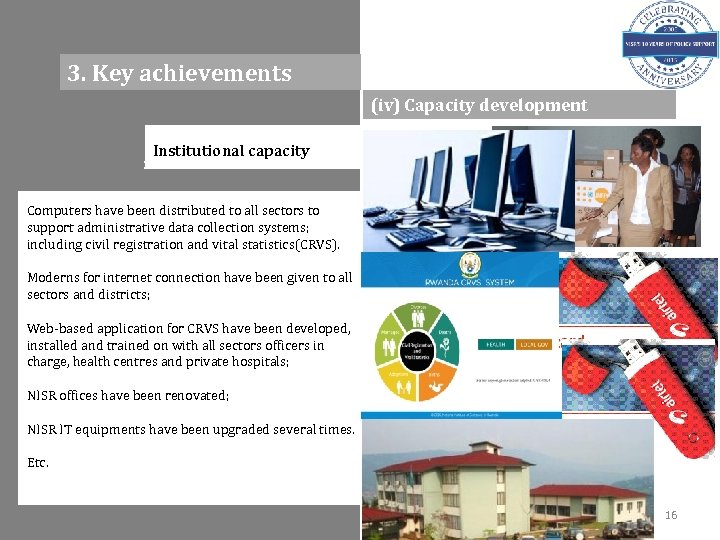
3. Key achievements (iv) Capacity development Statistical capacity Institutional capacity Computers have been distributed to all sectors to support administrative data collection systems; including civil registration and vital statistics(CRVS). Moderns for internet connection have been given to all sectors and districts; Web-based application for CRVS have been developed, installed and trained on with all sectors officers in charge, health centres and private hospitals; NISR offices have been renovated; NISR IT equipments have been upgraded several times. Etc. 16
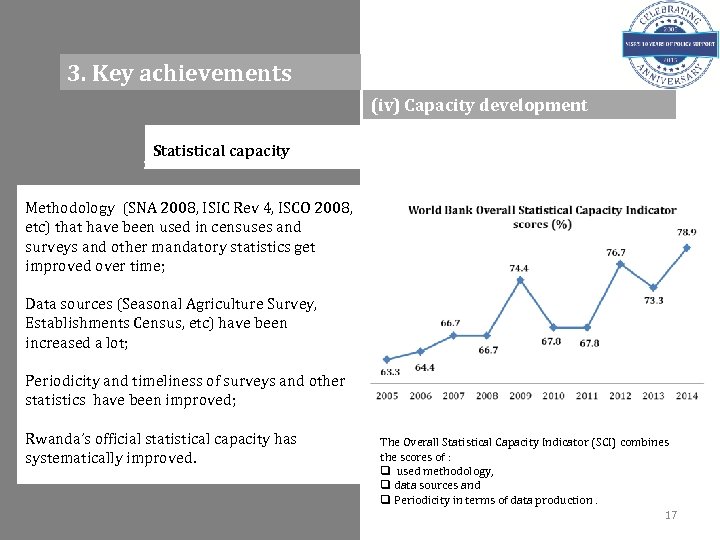
3. Key achievements (iv) Capacity development Statistical capacity Methodology (SNA 2008, ISIC Rev 4, ISCO 2008, etc) that have been used in censuses and surveys and other mandatory statistics get improved over time; Data sources (Seasonal Agriculture Survey, Establishments Census, etc) have been increased a lot; Periodicity and timeliness of surveys and other statistics have been improved; Rwanda’s official statistical capacity has systematically improved. The Overall Statistical Capacity Indicator (SCI) combines the scores of : q used methodology, q data sources and q Periodicity in terms of data production. 17
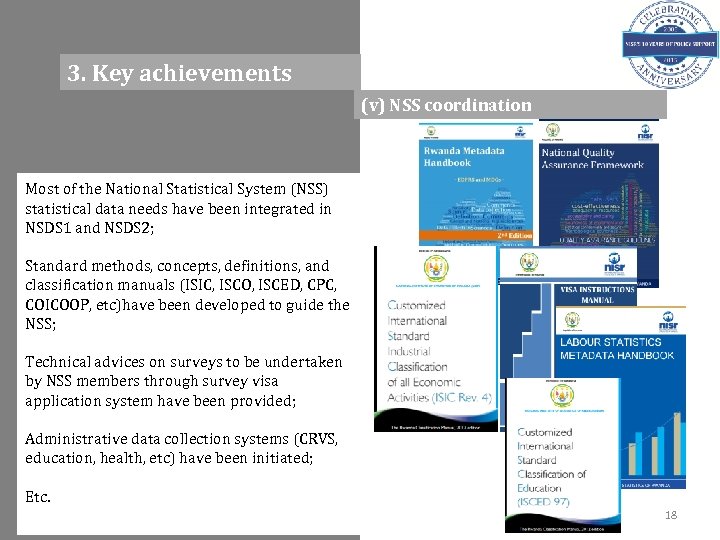
3. Key achievements (v) NSS coordination Most of the National Statistical System (NSS) statistical data needs have been integrated in NSDS 1 and NSDS 2; Standard methods, concepts, definitions, and classification manuals (ISIC, ISCO, ISCED, CPC, COICOOP, etc)have been developed to guide the NSS; Technical advices on surveys to be undertaken by NSS members through survey visa application system have been provided; Administrative data collection systems (CRVS, education, health, etc) have been initiated; Etc. 18
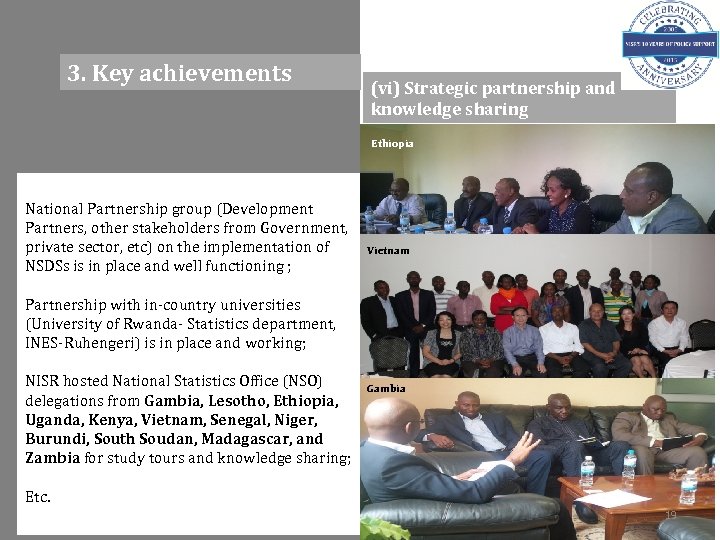
3. Key achievements (vi) Strategic partnership and knowledge sharing Ethiopia National Partnership group (Development Partners, other stakeholders from Government, private sector, etc) on the implementation of NSDSs is in place and well functioning ; Vietnam Partnership with in-country universities (University of Rwanda- Statistics department, INES-Ruhengeri) is in place and working; NISR hosted National Statistics Office (NSO) delegations from Gambia, Lesotho, Ethiopia, Uganda, Kenya, Vietnam, Senegal, Niger, Burundi, South Soudan, Madagascar, and Zambia for study tours and knowledge sharing; Gambia Etc. 19
4. Future perspectives q Implementation of NSDS 2; q Support the reporting of Sustainable Development Goals (SDGs) and second Economic Development and Poverty Reduction Strategy (EDPRS 2). 20

Our partners Thank you! We thank you. 21
Скачать презентацию Africa Statistics Day Better data better lives harnessing
4e617b15de9020fe095e680420abb4f8.ppt