 Скачать презентацию AFRICA — Session 5 NOTE about Namibia One
8dea207fbab74d4177c15246f6c790be.ppt
- Количество слайдов: 47



AFRICA - Session 5 NOTE about Namibia: One of our class participants has offered her expertise & assistance to anyone contemplating travel to Namibia. Ingrid Langdon 863 -6143
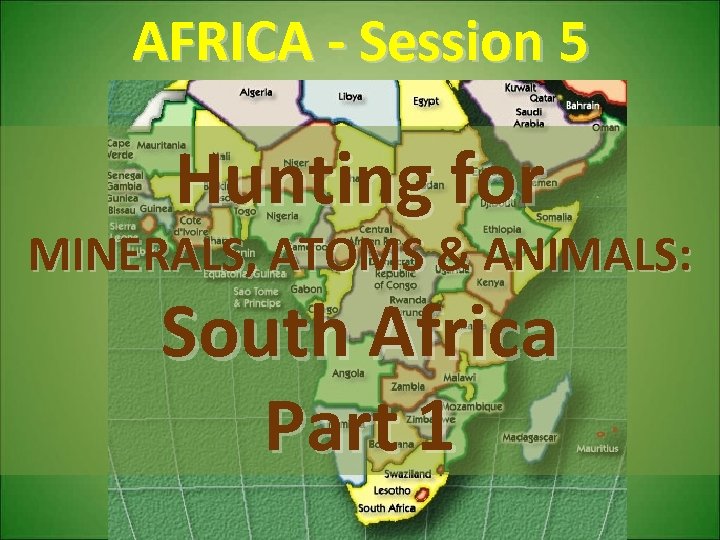
AFRICA - Session 5 Hunting for MINERALS, ATOMS & ANIMALS: South Africa Part 1
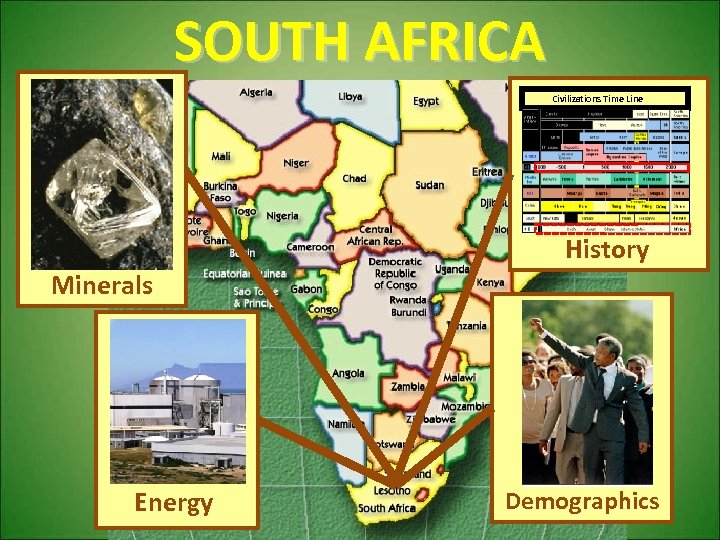
SOUTH AFRICA Civilizations Time Line History Minerals Energy Demographics
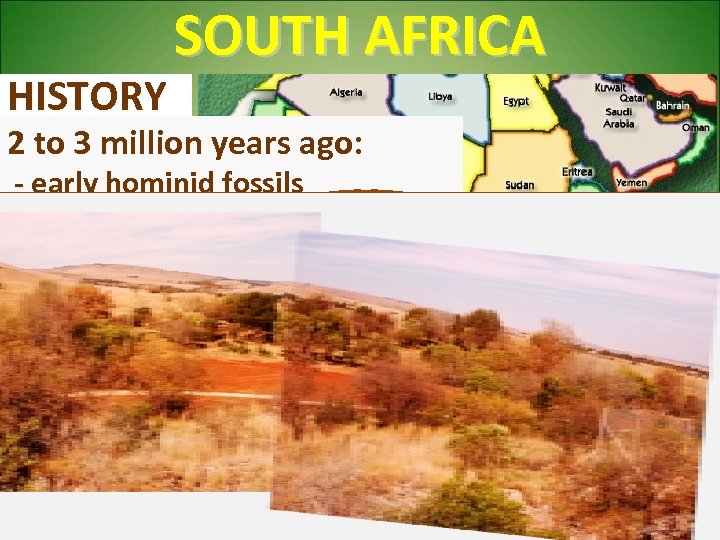
HISTORY SOUTH AFRICA 2 to 3 million years ago: - early hominid fossils - archeological site - Sterkfontein CRADLE OF HUMANKIND 182 sq miles in 2 provinces > 800 hominid fossil remains limestone caves
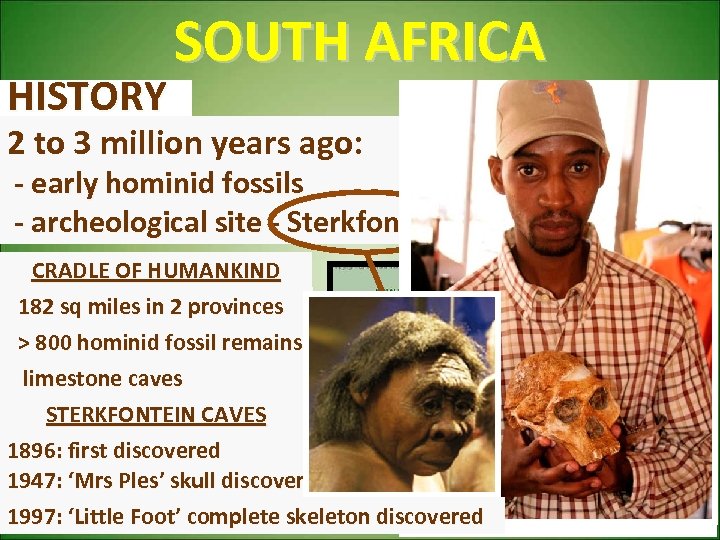
HISTORY SOUTH AFRICA 2 to 3 million years ago: - early hominid fossils - archeological site - Sterkfontein CRADLE OF HUMANKIND 182 sq miles in 2 provinces > 800 hominid fossil remains limestone caves STERKFONTEIN CAVES 1896: first discovered 1947: ‘Mrs Ples’ skull discovered 1997: ‘Little Foot’ complete skeleton discovered
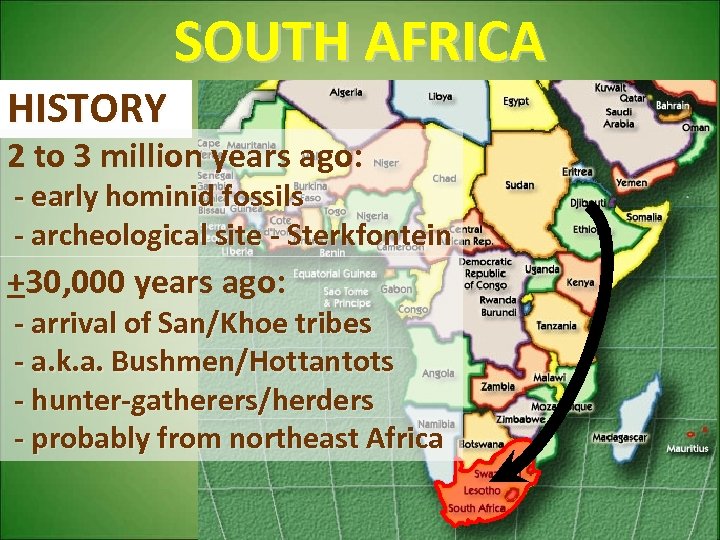
SOUTH AFRICA HISTORY 2 to 3 million years ago: - early hominid fossils - archeological site - Sterkfontein +30, 000 years ago: - arrival of San/Khoe tribes - a. k. a. Bushmen/Hottantots - hunter-gatherers/herders - probably from northeast Africa
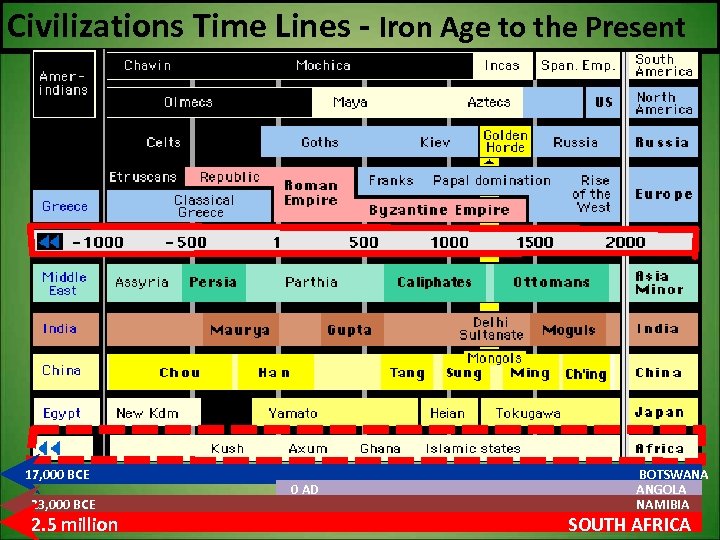
Civilizations Time Lines - Iron Age to the Present 17, 000 BCE 23, 000 BCE 2. 5 million 0 AD BOTSWANA ANGOLA NAMIBIA SOUTH AFRICA
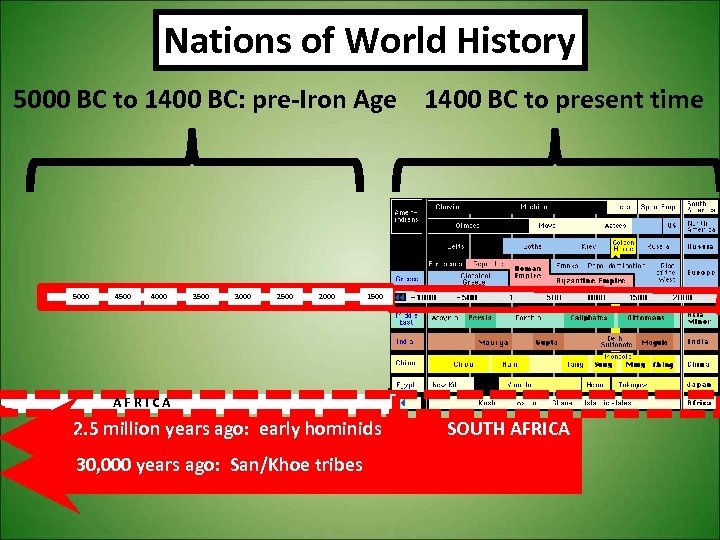
Nations of World History 5000 BC to 1400 BC: pre-Iron Age 1400 BC to present time 5000 4500 4000 3500 3000 2500 2000 1500 AFRICA 2. 5 million years ago: early hominids 30, 000 years ago: San/Khoe tribes SOUTH AFRICA
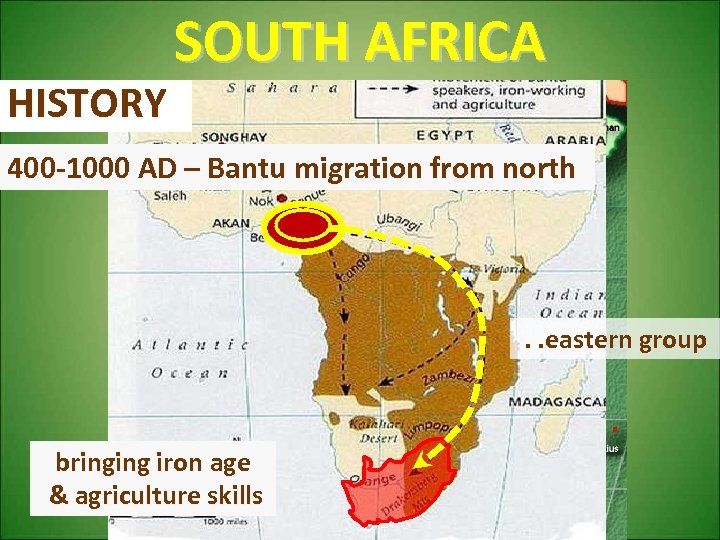
HISTORY SOUTH AFRICA 400 -1000 AD – Bantu migration from north . . eastern group bringing iron age & agriculture skills
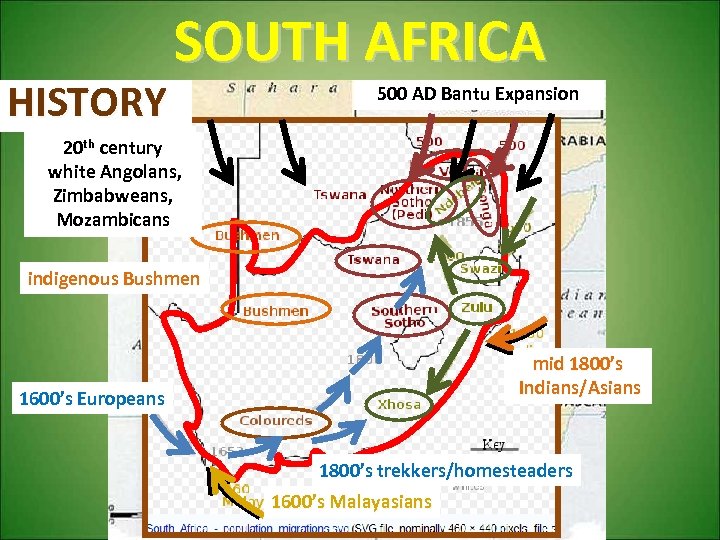
HISTORY SOUTH AFRICA 500 AD Bantu Expansion 20 th century white Angolans, Zimbabweans, Mozambicans indigenous Bushmen mid 1800’s Indians/Asians 1600’s Europeans 1800’s trekkers/homesteaders 1600’s Malayasians
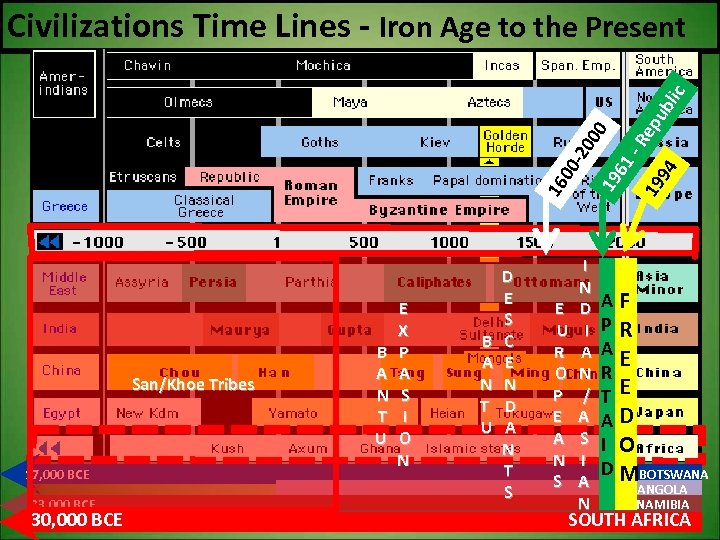
San/Khoe Tribes 17, 000 BCE 23, 000 BCE 30, 000 BCE B A N T U E X P A S I O N B A N T U D E S C E N D A N T S E U R O P E A N S ep I N D I A N / A S I A N 19 94 -R 61 19 16 00 -20 00 ub lic Civilizations Time Lines - Iron Age to the Present AF PR A E R T E AD I O D MBOTSWANA ANGOLA NAMIBIA SOUTH AFRICA
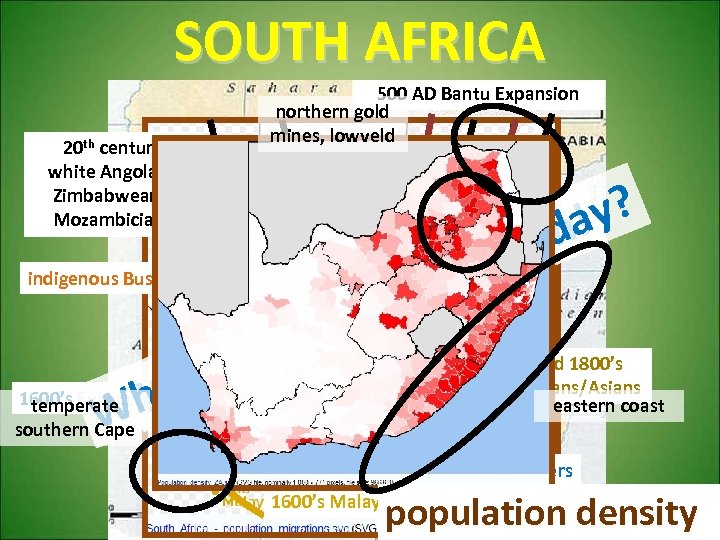
SOUTH AFRICA 20 th century white Angolans, Zimbabweans, Mozambicians 500 AD Bantu Expansion northern gold mines, lowveld y? da n! o tio le indigenous Bushmen pa o. N pew bo ie hn Rt ea r mid 1800’s ae h Indians/Asians rt se ’ 1600’s Europeanse temperate h eastern coast It W southern Cape 1800’s trekkers/homesteaders population density 1600’s Malayasians
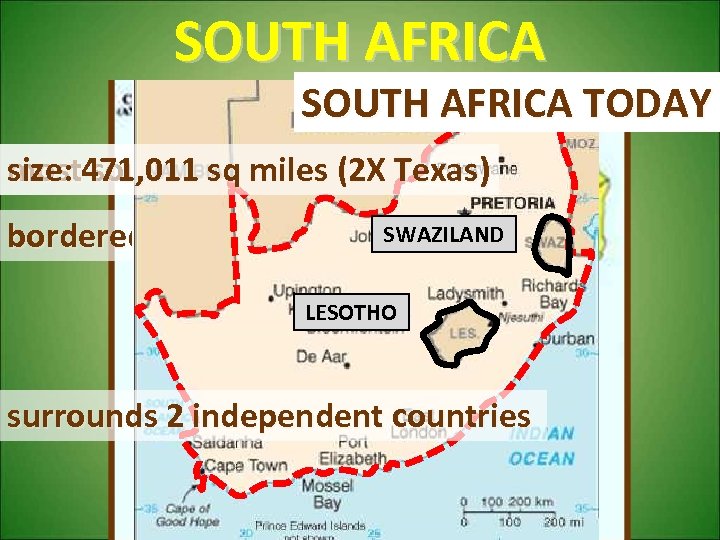
SOUTH AFRICA TODAY size: southern African country most 471, 011 sq miles (2 X Texas) bordered by. . A T L A N T I C O C E A N SWAZILAND UE Q BI AM ZIMBABWE Z LESOTHO O M NAMIBIA BOTSWANA surrounds 2 independent countries I N D I A N O C E A N
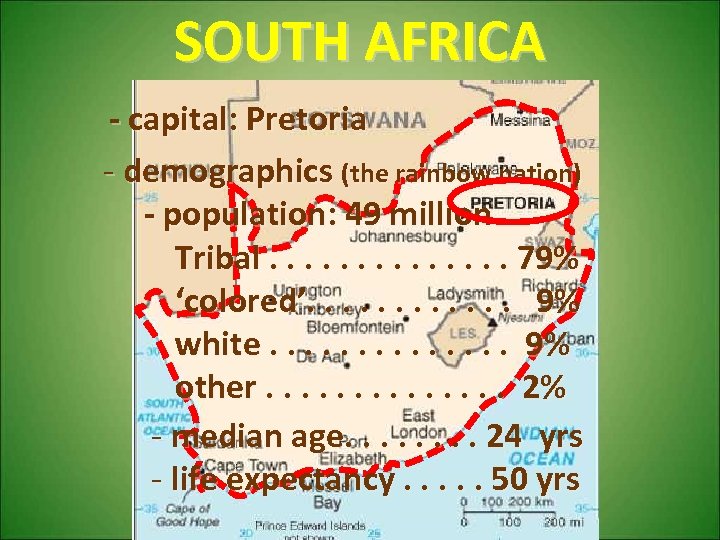
SOUTH AFRICA - capital: Pretoria - demographics (the rainbow nation) - population: 49 million Tribal. . . 79% ‘colored’. . . 9% white. . . 9% other. . . 2% - median age. . . . 24 yrs - life expectancy. . . 50 yrs
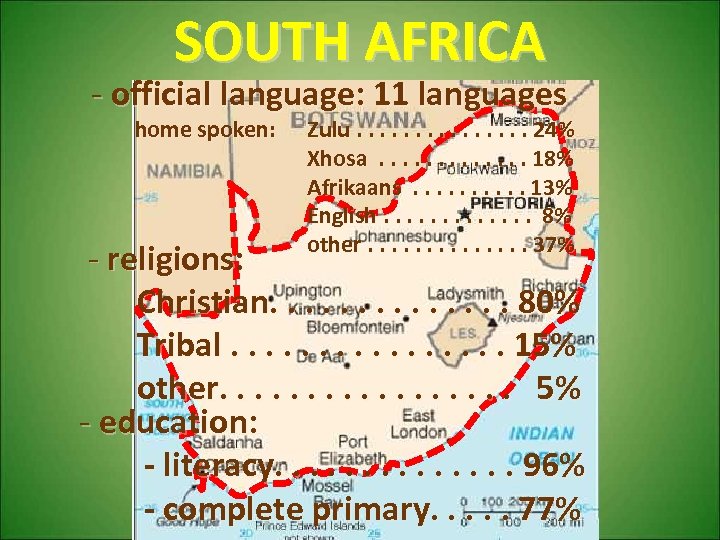
SOUTH AFRICA - official language: 11 languages home spoken: Zulu. . . . 24% Xhosa. . . 18% Afrikaans. . 13% English. . . 8% other. . . 37% - religions: Christian. . . 80% Tribal. . . . 15% other. . . . 5% - education: - literacy. . . 96% - complete primary. . . 77%
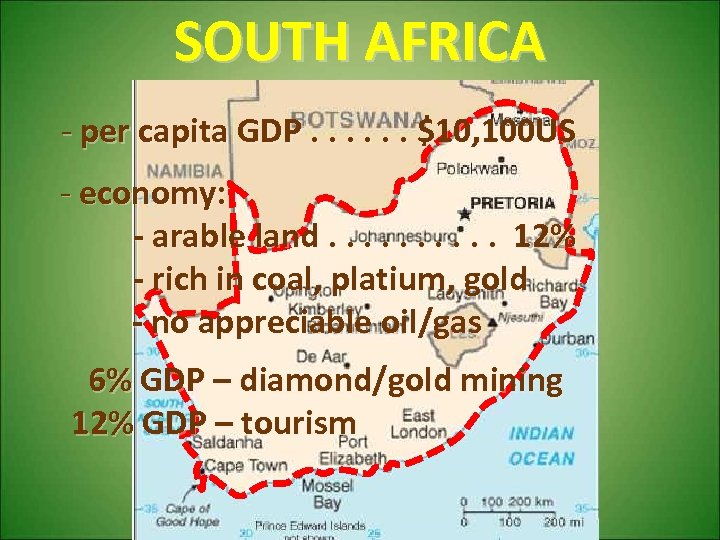
SOUTH AFRICA - per capita GDP. . . $10, 100 US - economy: - arable land. . 12% - rich in coal, platium, gold - no appreciable oil/gas 6% GDP – diamond/gold mining 12% GDP – tourism
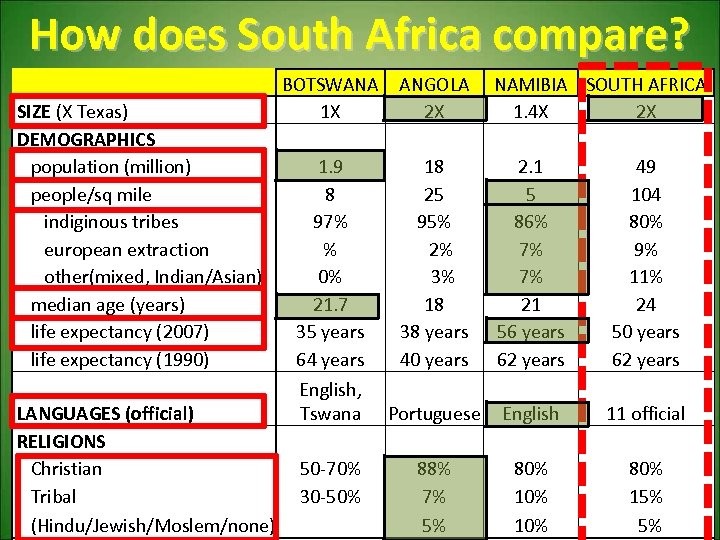
How does South Africa compare? BOTSWANA SIZE (X Texas) 1 X DEMOGRAPHICS population (million) 1. 9 people/sq mile 8 indiginous tribes 97% european extraction % other(mixed, Indian/Asian) 0% median age (years) 21. 7 life expectancy (2007) 35 years life expectancy (1990) 64 years LANGUAGES (official) RELIGIONS Christian Tribal (Hindu/Jewish/Moslem/none) English, Tswana 50 -70% 30 -50% ANGOLA 2 X 18 25 95% 2% 3% 18 38 years 40 years Portuguese 88% 7% 5% NAMIBIA SOUTH AFRICA 1. 4 X 2 X 2. 1 49 5 104 86% 80% 7% 9% 7% 11% 21 24 56 years 50 years 62 years English 80% 10% 11 official 80% 15% 5%
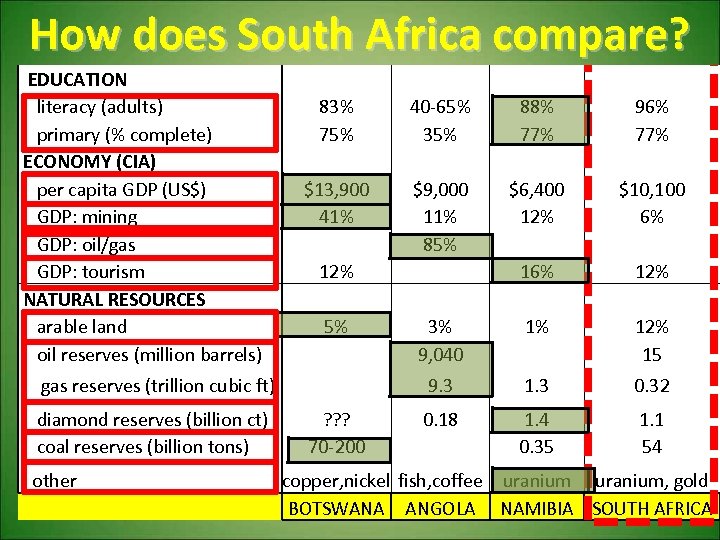
Christian Tribal (Hindu/Jewish/Moslem/none) EDUCATION literacy (adults) primary (% complete) ECONOMY (CIA) per capita GDP (US$) GDP: mining GDP: oil/gas GDP: tourism NATURAL RESOURCES arable land oil reserves (million barrels) 50 -70% 30 -50% 83% 75% $13, 900 41% 12% 5% 88% 7% 5% 40 -65% 35% $9, 000 11% 85% 3% 9, 040 80% 10% 88% 77% $6, 400 12% 16% 1% 70% 30% 96% 77% $10, 100 6% 12% 15 gas reserves (trillion cubic ft) 9. 3 1. 3 0. 32 diamond reserves (billion ct) coal reserves (billion tons) ? ? ? 70 -200 0. 18 1. 4 0. 35 1. 1 54 How does South Africa compare? other copper, nickel fish, coffee uranium, gold BOTSWANA ANGOLA NAMIBIA SOUTH AFRICA
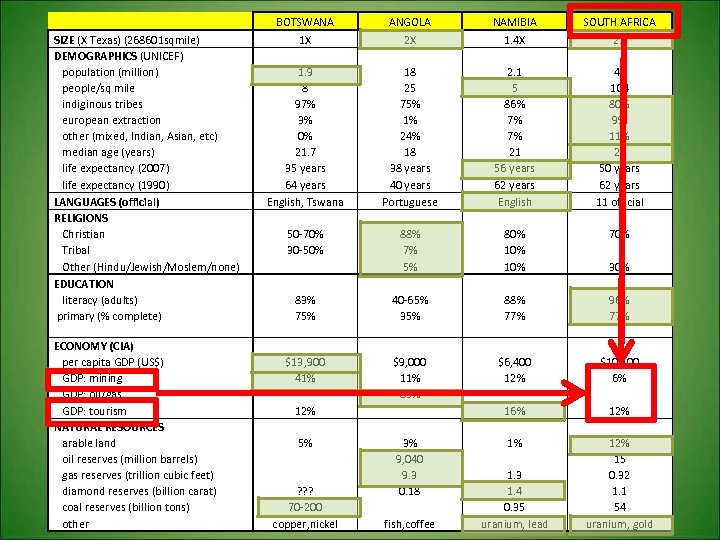
SIZE (X Texas) (268601 sqmile) DEMOGRAPHICS (UNICEF) population (million) people/sq mile indiginous tribes european extraction other (mixed, Indian, Asian, etc) median age (years) life expectancy (2007) life expectancy (1990) LANGUAGES (official) RELIGIONS Christian Tribal Other (Hindu/Jewish/Moslem/none) EDUCATION literacy (adults) primary (% complete) ECONOMY (CIA) per capita GDP (US$) GDP: mining GDP: oil/gas GDP: tourism NATURAL RESOURCES arable land oil reserves (million barrels) gas reserves (trillion cubic feet) diamond reserves (billion carat) coal reserves (billion tons) other BOTSWANA 1 X 1. 9 8 97% 3% 0% 21. 7 35 years 64 years English, Tswana 50 -70% 30 -50% 83% 75% ANGOLA 2 X 18 25 75% 1% 24% 18 38 years 40 years Portuguese 88% 7% 5% 40 -65% 35% NAMIBIA 1. 4 X 2. 1 5 86% 7% 7% 21 56 years 62 years English 80% 10% 88% 77% SOUTH AFRICA 2 X 49 104 80% 9% 11% 24 50 years 62 years 11 official 70% 30% 96% 77% $13, 900 41% 12% 5% ? ? ? 70 -200 copper, nickel $9, 000 11% 85% 3% 9, 040 9. 3 0. 18 fish, coffee $6, 400 12% 16% 1. 3 1. 4 0. 35 uranium, lead $10, 100 6% 12% 15 0. 32 1. 1 54 uranium, gold
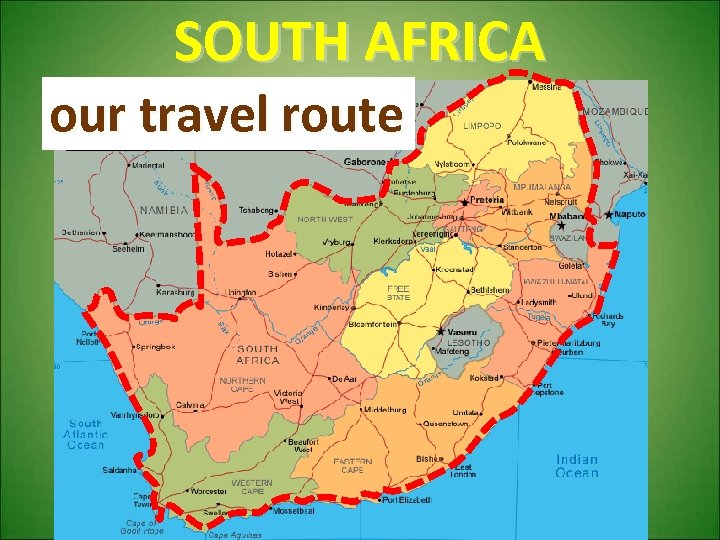
SOUTH AFRICA our travel route
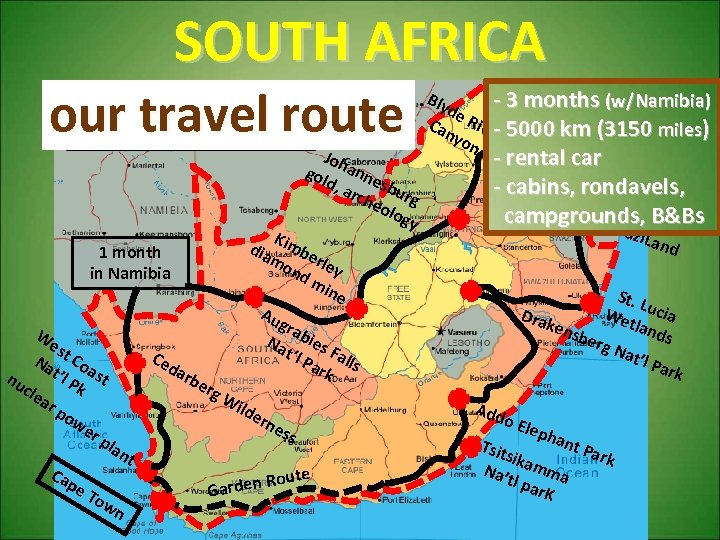
SOUTH AFRICA our travel route Joh gol anne d, a s rch burg eol ogy K dia imbe mo rle nd y mi ne Au gra Na bies F t’l Par alls k 1 month in Namibia W es Na t Co t’l ast nu Pk cle ar po we rp lan t Ca pe To wn Ce da rbe rg Wi lde rne ss oute R Garden Kru Bly ger - 3 months (w/Namibia) de N Can Rive- 5000 km at’l Par miles) (3150 k yon r - rental car - cabins, rondavels, campgrounds, B&Bs Sw azi. L and St. L We ucia Dra tlan ken ds sbe rg N at’l Park Add o El eph ant Tsit Park sika Na’ mma tl pa r. K
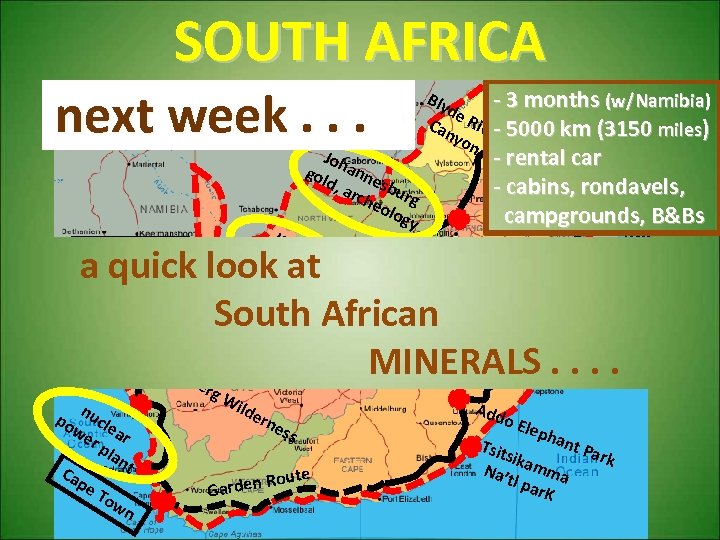
SOUTH AFRICA our travel route next week this week. . . . Joh gol anne d, a s rch burg eol ogy K dia imbe mo rle nd y mi ne Au gra Na bies F t’l Par alls k Kru Bly ger - 3 months (w/Namibia) de N Can Rive- 5000 km at’l Par miles) (3150 k yon r - rental car - cabins, rondavels, campgrounds, B&Bs Sw azi. L and a quick look at St. L We ucia Dra South African tlan ken ds sbe W rg N es at’l Ce Na t Co dar MINERALS. . Park t’l ast be Pk r 1 month in Namibia n po ucle we ar rp lan t Ca pe To wn g. W ilde rne ss oute R Garden Add o El eph ant Tsit Park sika Na’ mma tl pa r. K
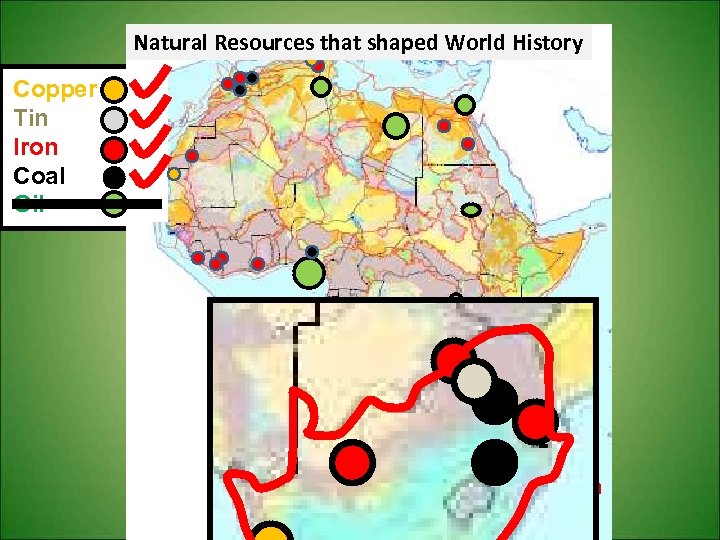
Natural Resources that shaped World History Copper Tin Iron Coal Oil South Africa
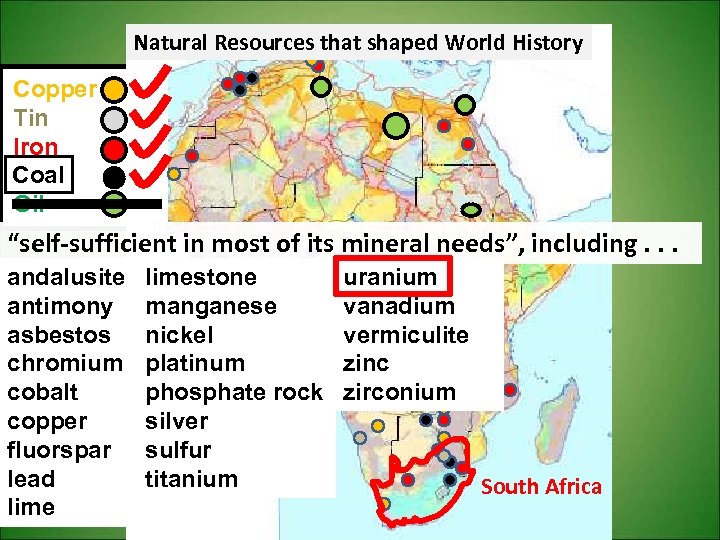
Natural Resources that shaped World History Copper Tin Iron Coal Oil “self-sufficient in most of its mineral needs”, including. . . andalusite antimony asbestos chromium cobalt copper fluorspar lead lime limestone manganese nickel platinum phosphate rock silver sulfur titanium uranium vanadium vermiculite zinc zirconium South Africa
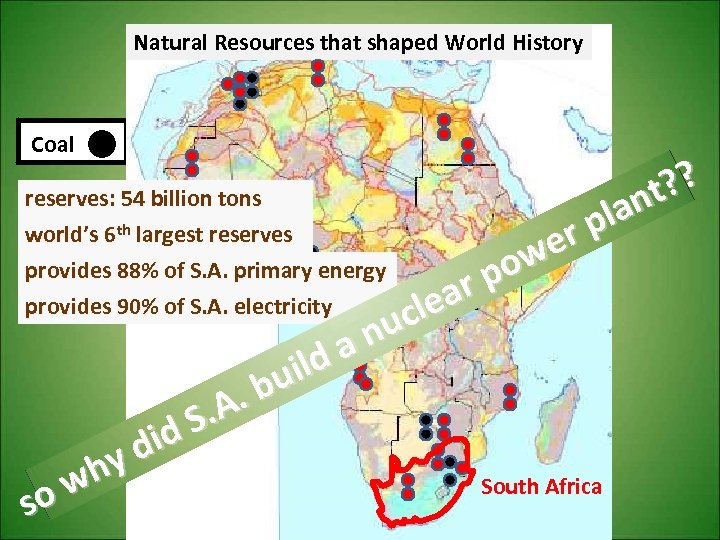
Natural Resources that shaped World History Coal reserves: 54 billion tons world’s 6 th largest reserves provides 88% of S. A. primary energy provides 90% of S. A. electricity so id yd h w ar cle nu a d uil. b S. A t? ? lan rp e ow p South Africa
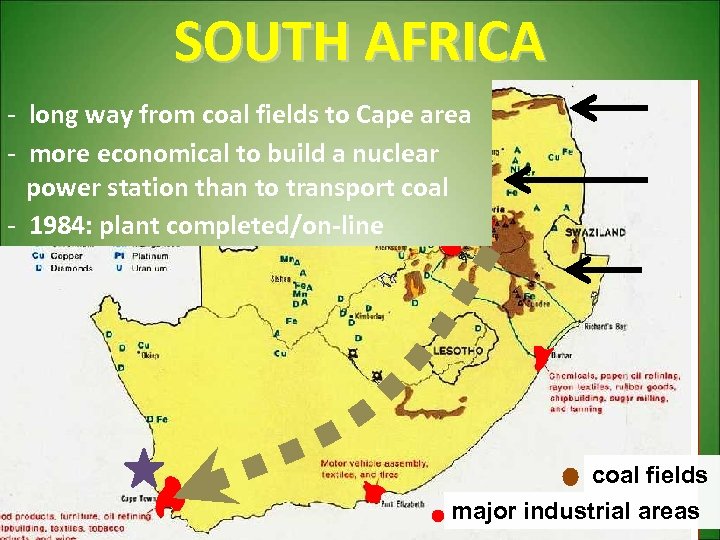
SOUTH AFRICA - long way from coal fields to Cape area - more economical to build a nuclear power station than to transport coal - 1984: plant completed/on-line coal fields major industrial areas
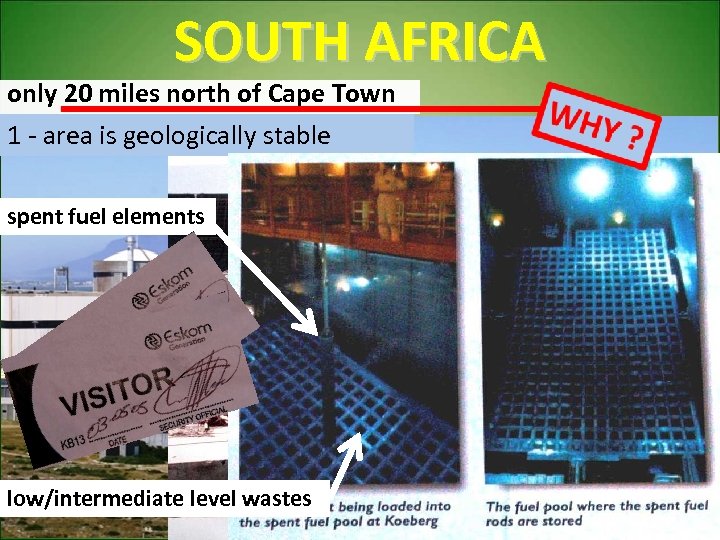
SOUTH AFRICA only 20 miles north of Cape Town 1 - area is geologically stable spent fuel elements the only nuclear power plant in Africa low/intermediate level wastes
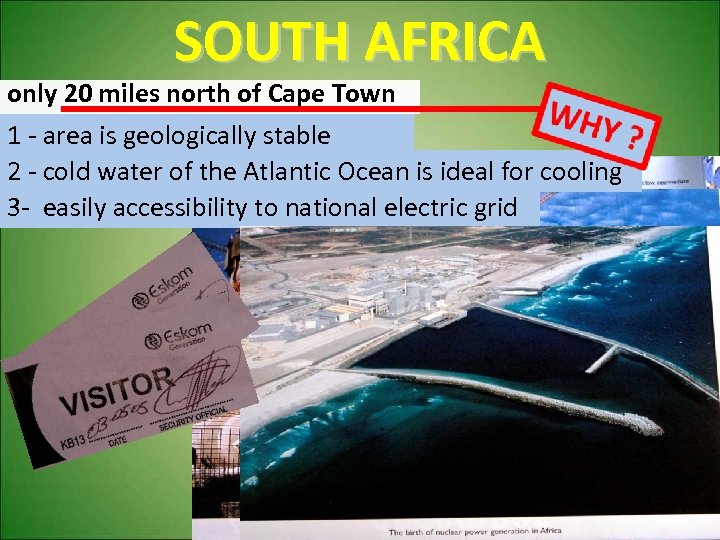
SOUTH AFRICA only 20 miles north of Cape Town 1 - area is geologically stable 2 - cold water of the Atlantic Ocean is ideal for cooling 3 - easily accessibility to national electric grid
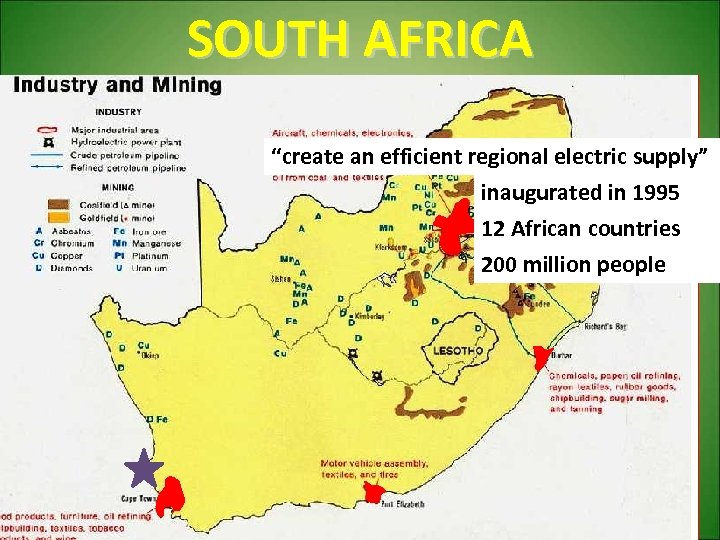
SOUTH AFRICA “create an efficient regional electric supply” inaugurated in 1995 12 African countries 200 million people
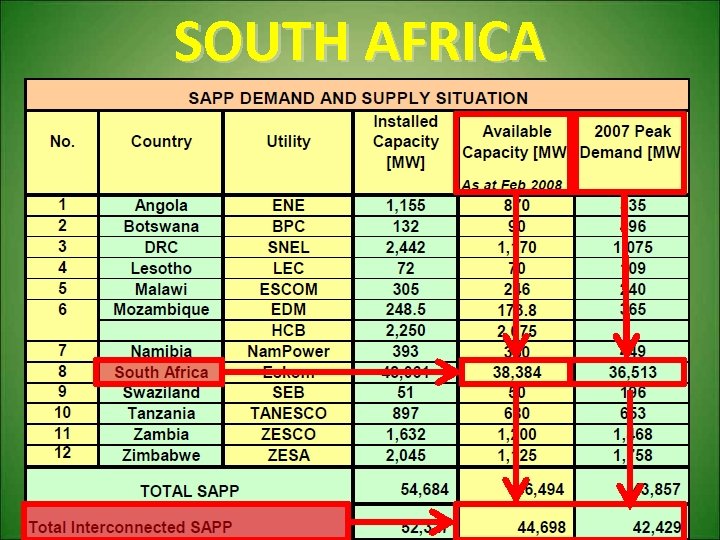
SOUTH AFRICA
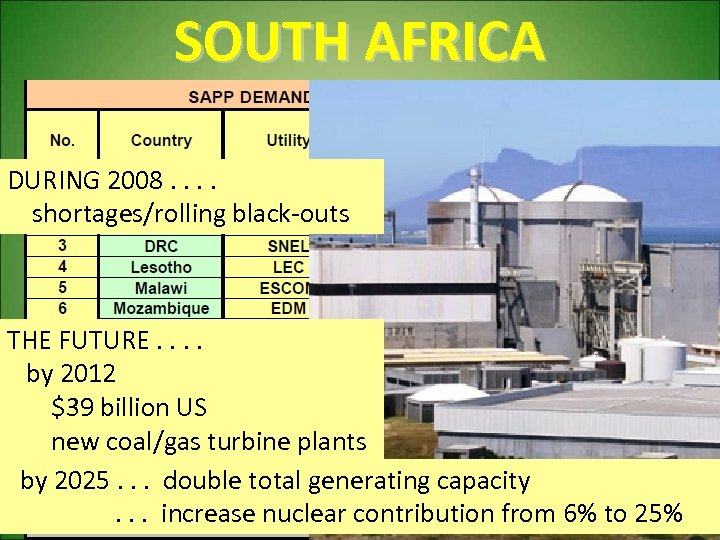
SOUTH AFRICA DURING 2008. . shortages/rolling black-outs THE FUTURE. . by 2012 $39 billion US new coal/gas turbine plants by 2025. . . double total generating capacity . . . increase nuclear contribution from 6% to 25%
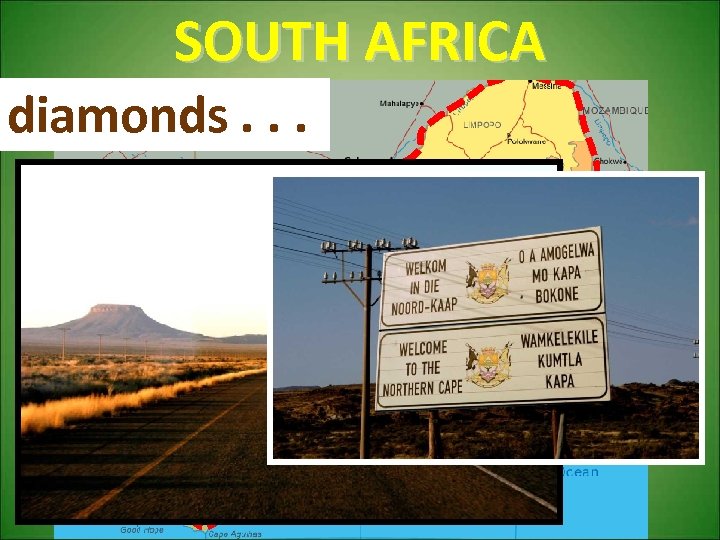
SOUTH AFRICA diamonds. . . dia Kimb mo erly nd mi ne nu cle ar pla pow er nt
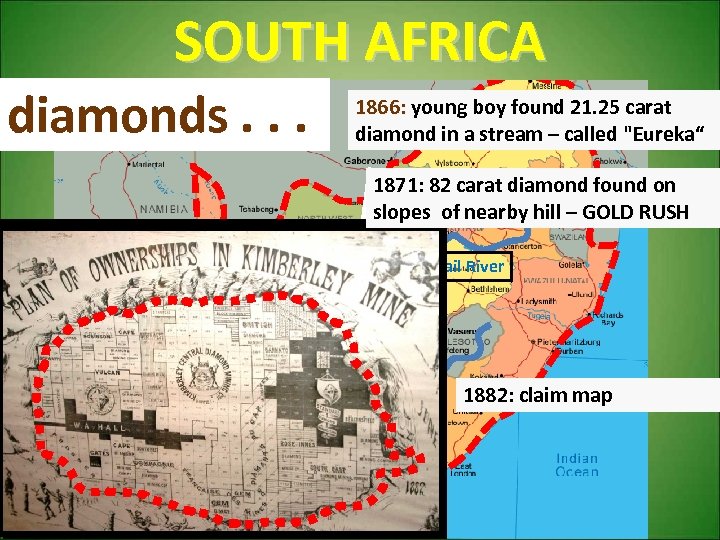
SOUTH AFRICA diamonds. . . K dia imbe mo rle nd y mi ne 1866: young boy found 21. 25 carat diamond in a stream – called "Eureka“ 1871: 82 carat diamond found on slopes of nearby hill – GOLD RUSH Vail River Orange River 1882: claim map
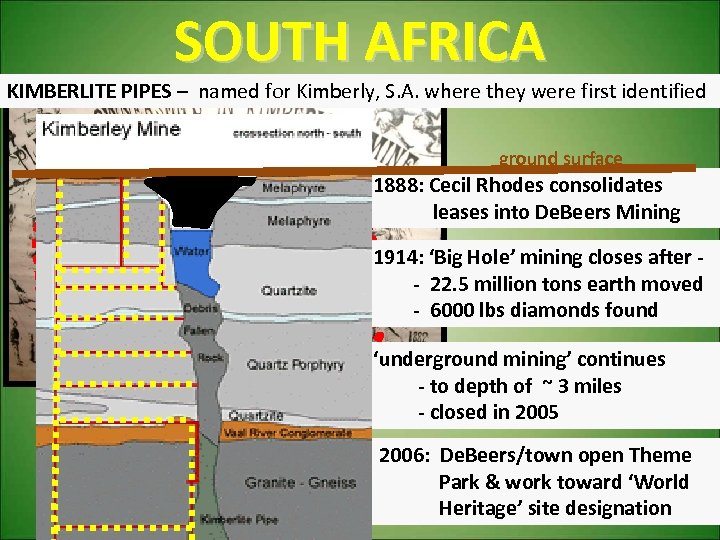
SOUTH AFRICA KIMBERLITE PIPES – named for Kimberly, S. A. where they were first identified ground surface 1888: Cecil Rhodes consolidates leases into De. Beers Mining 1914: ‘Big Hole’ mining closes after - 22. 5 million tons earth moved - 6000 lbs diamonds found ‘underground mining’ continues - to depth of ~ 3 map 1882: claim miles - closed in 2005 2006: De. Beers/town open Theme Park & work toward ‘World Heritage’ site designation
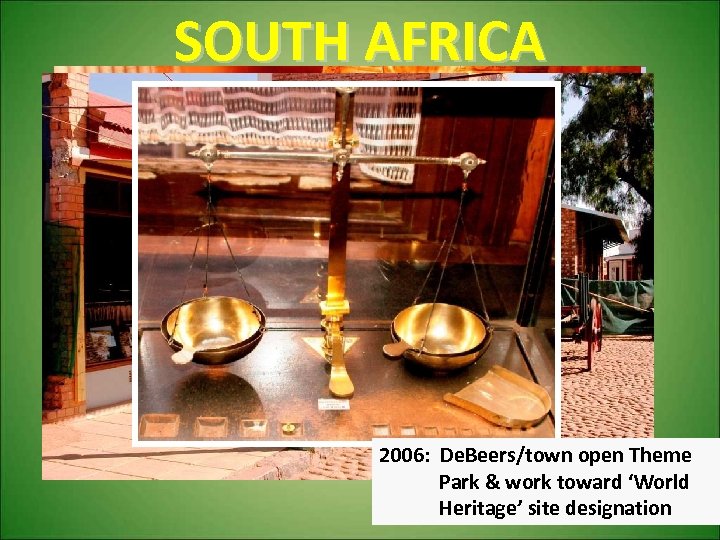
SOUTH AFRICA 2006: De. Beers/town open Theme Park & work toward ‘World Heritage’ site designation
SOUTH AFRICA Buy gas, get groceries Ask for help Off she goes to about lost dog See sign a safe place!
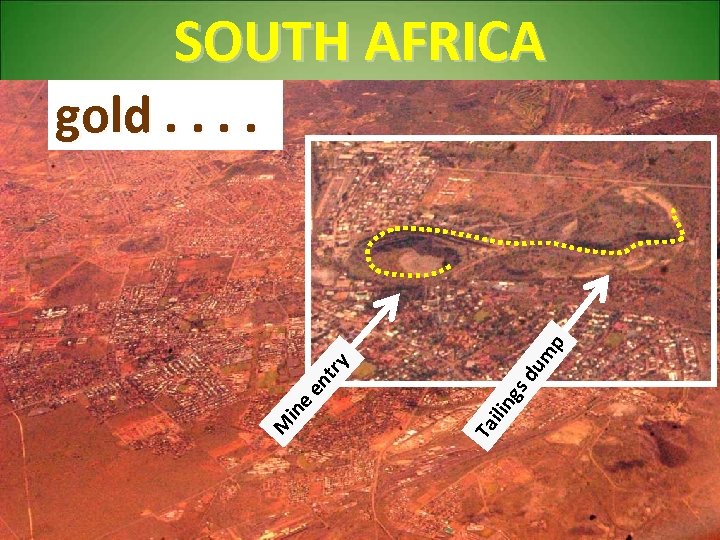
SOUTH AFRICA gold. . Joh gol anne d, a s rch burg eol ogy m du gs Ta ilin M in ee nt ry p K dia imber mo l nd ey min e
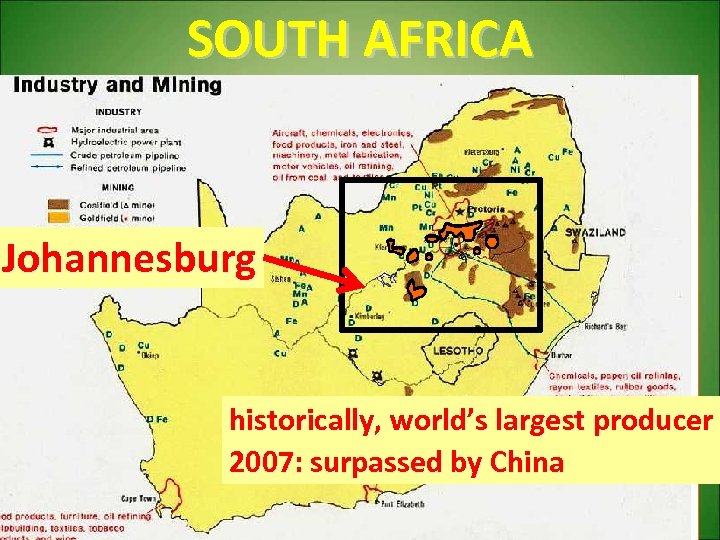
SOUTH AFRICA gold. . Johannesburg Joh gol anne d, a s rch burg eol ogy historically, world’s largest producer 2007: surpassed by China
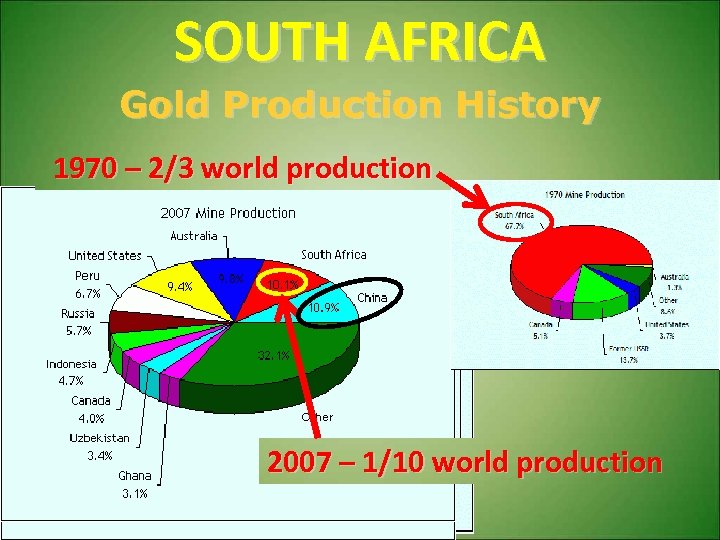
SOUTH AFRICA Gold Production History 1970 – 2/3 world production 2007 – 1/10 world production
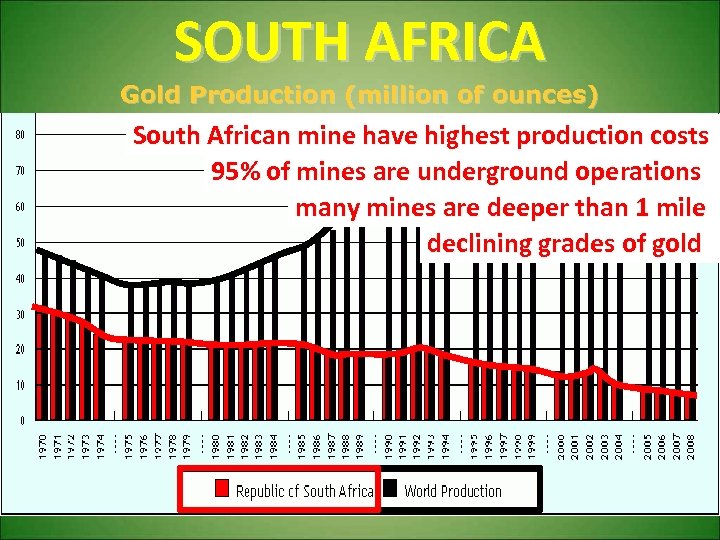
SOUTH AFRICA Gold Production (million of ounces) South African mine have highest production costs 95% of mines are underground operations many mines are deeper than 1 mile declining grades of gold
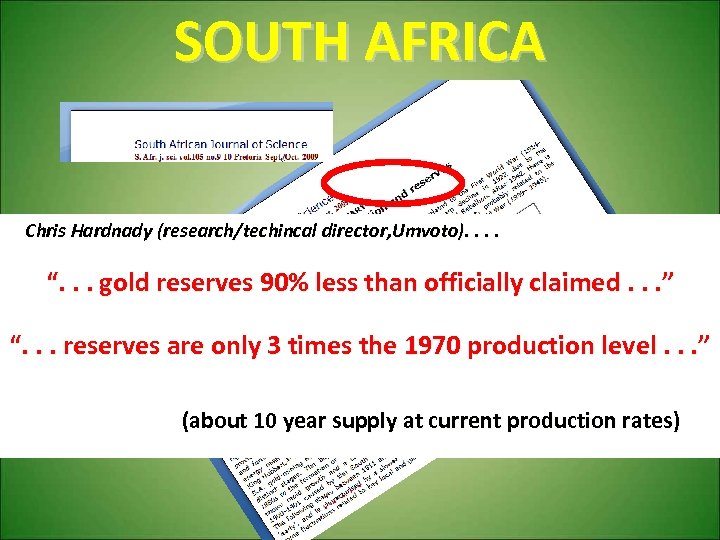
SOUTH AFRICA Chris Hardnady (research/techincal director, Umvoto). . “. . . gold reserves 90% less than officially claimed. . . ” “. . . reserves are only 3 times the 1970 production level. . . ” (about 10 year supply at current production rates)
SOUTH AFRICA Challenges to South African gold. . . - royalties - increasing electrical charges - burden of BEE (black economic empowerm’t) - recent safety shutdowns - security costs - currency exchange fluctuations Opportunity. . . . - stronger future uranium market - possible re-opening closed gold mines where uranium Is present
SOUTH AFRICA So, how does geology impact our travels? Geologic processes create MINERALS. . . COAL & URANIUM to fuel our factories & provide our electrical power. . . . DIAMONDS & GOLD for industrial use & to adorn our bodies REMEMBER. . GEOLOGY ROCKS!
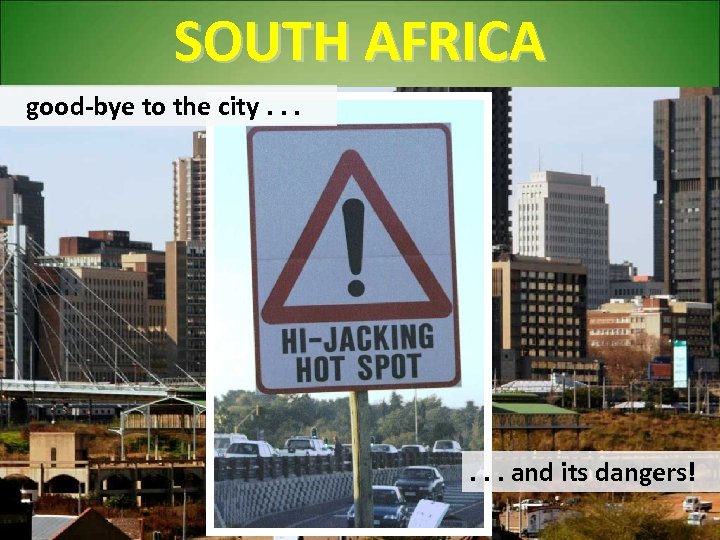
SOUTH AFRICA good-bye to the city. . . and its dangers!
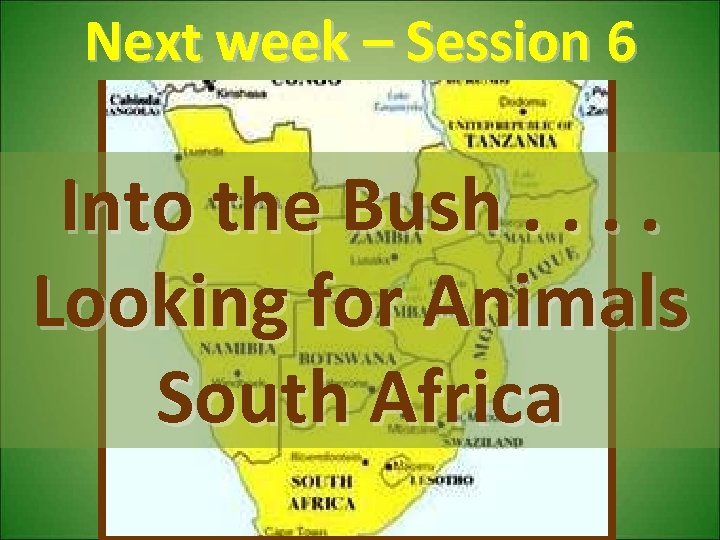
Next week – Session 6 Into the Bush. . Looking for Animals South Africa

Next week – Session 6 PLEASE! Return all borrowed books next week!
REFERENCES http: //geology. com/world/south-africa-satellite-image. shtml http: //pubs. usgs. gov/gip/dynamic/East_Africa. html http: //www. nationsencyclopedia. com/Africa/South-Africa-MINING. html http: //en. wikipedia. org/wiki/File: South_Africa_-_population_migrations. svg#file http: //www. sa-venues. com/maps/gauteng_cradle_of_humankind. htm http: //www. khulsey. com/jewelry/kh_jewelry_diamond_mining. html http: //www. melkbos. com/directory/Koeberg_nuclear_power_station/ http: //www. sa-venues. com/attractionsga/cradle-of-humankind. htm http: //www. maropeng. co. za/index. php/maropeng/ http: //www. eia. doe. gov/cabs/South_Africa/Coal. html http: //images. nationmaster. com/images/motw/africa/south_africa_ind_1979. jpg http: //www. world-nuclear. org/info/inf 88. html http: //www. eskom. co. za/live/content. php? Item_ID=548 http: //www. showcaves. com/english/za/mines/Kimberley. html http: //www. mineweb. co. za/mineweb/ http: //www. munoz-group. net/pics/map_africa. jpg http: //www. scielo. org. za/scielo. php? pid=S 003823532009000500004&script=sci
Скачать презентацию AFRICA — Session 5 NOTE about Namibia One
8dea207fbab74d4177c15246f6c790be.ppt