


 Скачать презентацию AFRICA DAY 5 th World Water Forum Financing
b9439ea86a37ce3555a4874dbc78c1fb.ppt
- Количество слайдов: 17
 AFRICA DAY 5 th World Water Forum Financing a Sustainable Expansion of Africa’s Water Infrastructure Presentation by A. R. Rakotobe, Director Water and Sanitation & African Water Facility Department, Af. DB Istanbul, 18 th March 2009
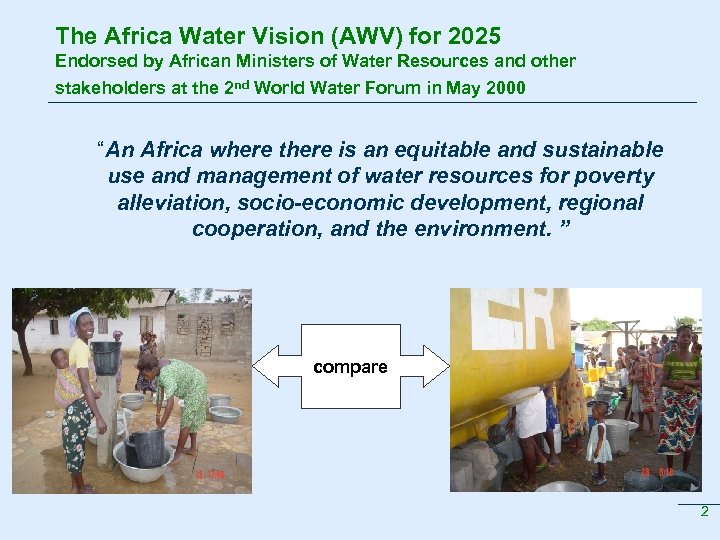 The Africa Water Vision (AWV) for 2025 Endorsed by African Ministers of Water Resources and other stakeholders at the 2 nd World Water Forum in May 2000 “An Africa where there is an equitable and sustainable use and management of water resources for poverty alleviation, socio-economic development, regional cooperation, and the environment. ” compare 2
 An update of the AWV financing requirements has been carried out. This is preliminary, indicative but realistic The Update was made possible by recent processes focused on water, including: • African Infrastructure Country Diagnostic (AIC) • WHO’s publication on ‘Regional and Global Costs of Attaining the Water Supply and Sanitation Target (2008) • WSP’s ongoing country-level diagnostics in water and sanitation • ADB’s Clean Energy Investment Framework • December 2008 Sirte meeting on Water for Agriculture and Energy in Africa, and • OECD’s contribution on ‘Financing and pricing water’ at the December 2008 Global Forum on Sustainable Development 3
 Estimates of overall cost are now better linked to specific economic and social development outcomes • Update allows estimation of the cost of water resources infrastructure to achieve economic growth, food and energy securities and hazard management • Although some uncertainties remain, (especially in energy and water storage, with multipurpose opportunities), unit costs of new infrastructure are gaining greater realism AWV 2025 Targets • provision of safe and adequate water supply and sanitation for 95% of the population; • doubling the irrigated area to 24 million ha; and • developing 25 % of the hydropower needs 4
 The AWV established a financial requirement for water infrastructure of US$20 bn p. a. in 2000. A recent update puts the requirement at $50 bn 5
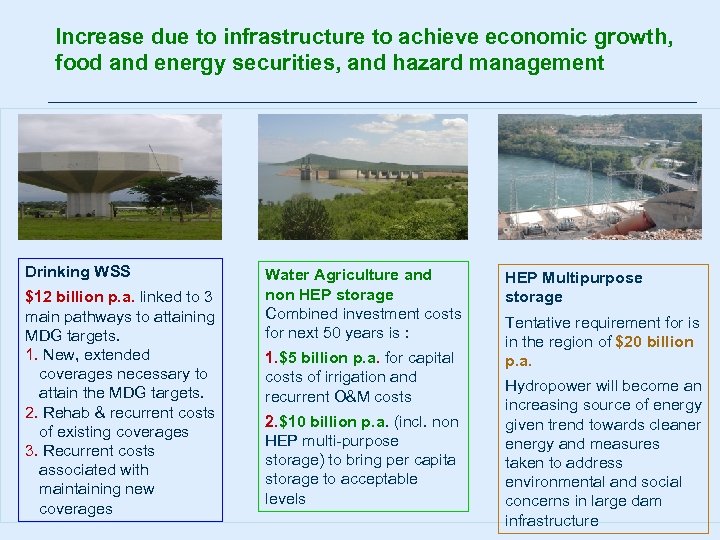 Increase due to infrastructure to achieve economic growth, food and energy securities, and hazard management Drinking WSS $12 billion p. a. linked to 3 main pathways to attaining MDG targets. 1. New, extended coverages necessary to attain the MDG targets. 2. Rehab & recurrent costs of existing coverages 3. Recurrent costs associated with maintaining new coverages Water Agriculture and non HEP storage Combined investment costs for next 50 years is : 1. $5 billion p. a. for capital costs of irrigation and recurrent O&M costs 2. $10 billion p. a. (incl. non HEP multi-purpose storage) to bring per capita storage to acceptable levels HEP Multipurpose storage Tentative requirement for is in the region of $20 billion p. a. Hydropower will become an increasing source of energy given trend towards cleaner energy and measures taken to address environmental and social concerns in large dam 6 infrastructure
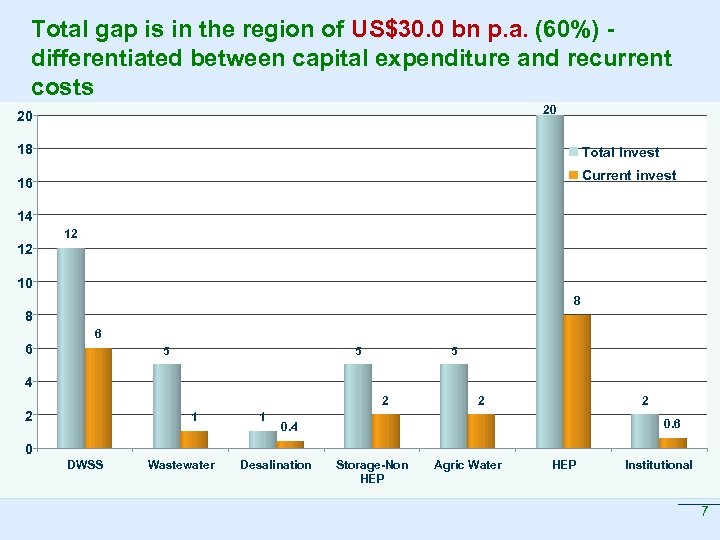 Total gap is in the region of US$30. 0 bn p. a. (60%) differentiated between capital expenditure and recurrent costs 20 20 18 Total Invest Current invest 16 14 12 12 10 8 8 6 6 5 5 5 4 2 2 1 1 2 2 0. 6 0. 4 0 DWSS Wastewater Desalination Storage-Non HEP Agric Water HEP Institutional 7
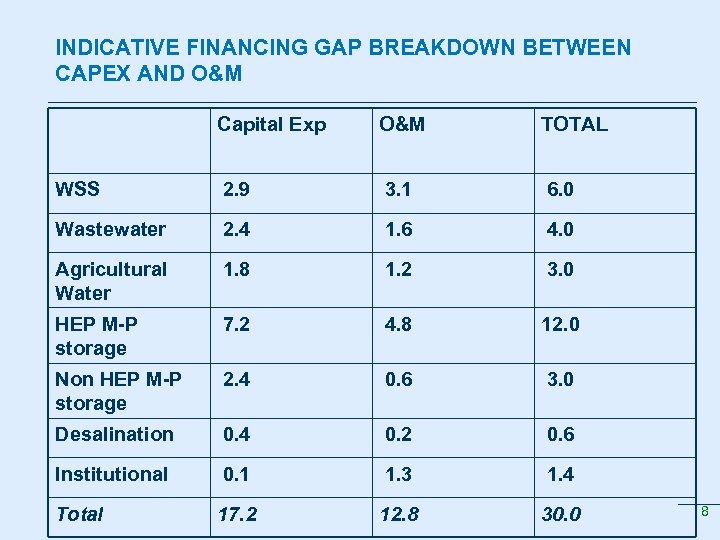 INDICATIVE FINANCING GAP BREAKDOWN BETWEEN CAPEX AND O&M Capital Exp O&M TOTAL WSS 2. 9 3. 1 6. 0 Wastewater 2. 4 1. 6 4. 0 Agricultural Water 1. 8 1. 2 3. 0 HEP M-P storage 7. 2 4. 8 12. 0 Non HEP M-P storage 2. 4 0. 6 3. 0 Desalination 0. 4 0. 2 0. 6 Institutional 0. 1 1. 3 1. 4 Total 17. 2 12. 8 30. 0 8
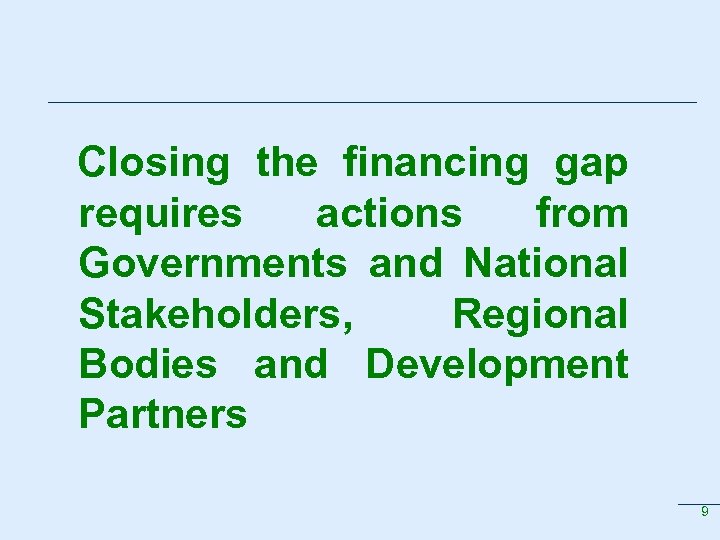 Closing the financing gap requires actions from Governments and National Stakeholders, Regional Bodies and Development Partners 9
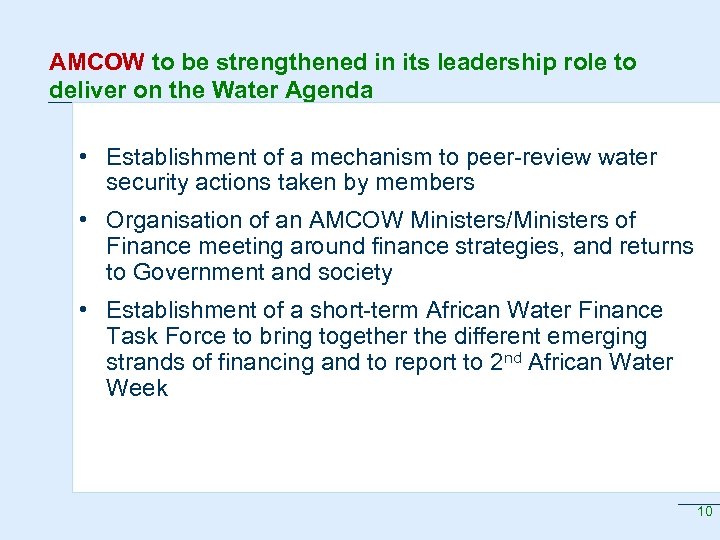 AMCOW to be strengthened in its leadership role to deliver on the Water Agenda • Establishment of a mechanism to peer-review water security actions taken by members • Organisation of an AMCOW Ministers/Ministers of Finance meeting around finance strategies, and returns to Government and society • Establishment of a short-term African Water Finance Task Force to bring together the different emerging strands of financing and to report to 2 nd African Water Week 10
 Closing gap requires Government and National Stakeholders actions Finance strategies to meet capex and O&M requirements (3 Ts – tariffs, taxes, transfers) 1. Utility reforms that reduce operational inefficiencies and cost recovery to meet at least O&M 2. Delivery on the e. Thekweni commitment on financing sanitation (0. 5% of GDP) 3. Meeting agriculture investments under the Maputo public expenditure pledge (10% of GDP) 4. Strengthened partnership with Development Partners and greater engagement with Africa’s emerging partners 11
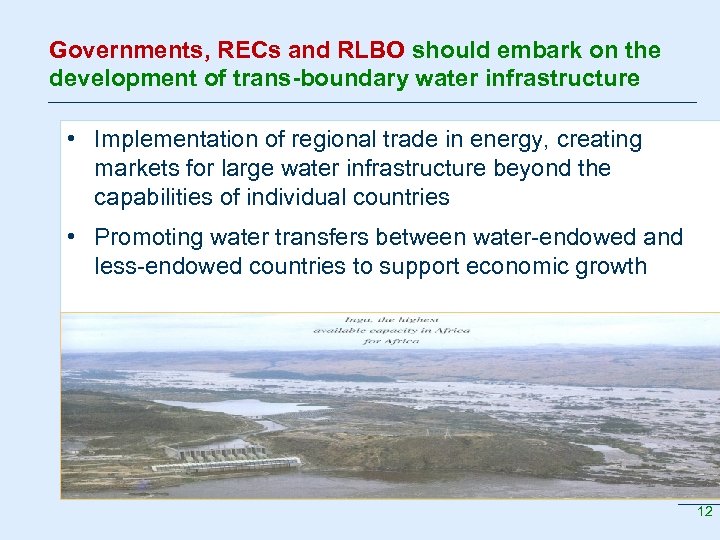 Governments, RECs and RLBO should embark on the development of trans-boundary water infrastructure • Implementation of regional trade in energy, creating markets for large water infrastructure beyond the capabilities of individual countries • Promoting water transfers between water-endowed and less-endowed countries to support economic growth 12
 Development Partners’ contributions should maximise use of existing national and regional facilities • Strengthen and scale up support for RWSSI and AWF rather than create new initiatives • Meet pledges and commitments, with greater clarity on disbursement instruments and replenishment of existing funds and facilities • An urgent implementation response to disbursement of 2008 ‘Food Price Crisis’ pledges 13
 Af. DB and the AWF will support specific actions on delivery of the commitments made. . including 1. Commissioning a Strategic and Operational study on the role of water in Africa’s economic development, returns to Government and society and Action Plan to develop the water infrastructure assets (2009/10); 2. Supporting a meeting of AMCOW Ministers and Ministers of Finance by end of 2009 3. Organisation of the 2 nd RWSSI International Conference to review achievement and mobilise resources for 2 nd and 3 rd phase implementation; 14
 Af. DB Actions. . (2) 4. Support countries to prepare Sector Investment Plans including finance strategies by developing and sharing framework and tools 5. Roll out implementation of Pan African M&E Framework that will track investment flows, among others 6. Implementation of the Bank’s plan to increase water storage by 1% p. a. up to 2013 15
 The concluding messages reinforce the central role of Governments in pulling financing actions together • In-country implementation is central to deliver on the commitments • Govt. leading actions to bring others into the investment/cost saving/cost recovery mix. . . not about new finance only – also opportunities on cost saving and efficiencies • Progressing investment plans needs to be together with finance (and marketing) strategies • Partners need to align to the Regional development agenda and make good of their commitments. 16
 Thank you for your attention! 17